Maritime security is a vital requirement for all nations’ prosperity. But the vastness of the maritime domain and the plentiful resources and platforms that reside within it always pose a challenge to maritime forces. Small and medium-sized navies have developed networks of cooperation to share the burden, and have employed innovative methods of securing their maritime locales. Whether they find themselves facing non-state threats, new oceanic infrastructure, or caught within competition between greater powers, innovation is at a premium for regional powers.
CIMSEC will be extending the topic week into a second week to showcase the high volume of quality submissions received. Below is the lineup of articles featuring during the topic week, and which will be updated as additional publications are finalized.
Dmitry Filipoff is CIMSEC’s Director of Online Content. Contact him at Content@cimsec.org.
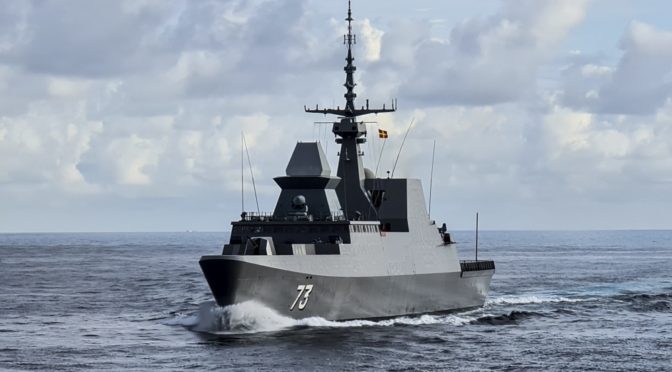
Featured Image: SOUTH CHINA SEA (June 17, 2020) – The Republic of Singapore Navy Formidable-class frigate RSS Supreme (73) flies the “Romeo” flag, internationally recognized as a signal for preparing to replenish at sea, while approaching the U.S. Navy Lewis and Clark-class dry cargo and ammunition ship USNS Carl Brashear (T-AKE 7) as the ships prepare to conduct a replenishment-at-sea. (U.S. Navy photo by Ordinary Seaman DJ Hinahon)
From July 20 to August 3, 2020, CIMSEC featured a wide array of publications on the future of ocean governance, submitted in response to our call for articlesissued in partnership with the Stable Seas program of One Earth Future. This turned out to be one of the most viewed CIMSEC topic weeks, and which featured insights from a wide range of authors.
Ocean governance is in a state of flux. Legal regimes are being revised, and maritime powers are employing hybrid tactics that seek to exploit the seams of legal frameworks and norms that constitute ocean governance. Non-state actors such as pirates, smugglers, and others are constantly innovating to further nefarious activity. The rules and standards that underpin good order on the high seas must keep pace with those who are keen to exploit them.
Illegal, unreported, and unregulated fishing is emerging as a significant issue. These natural resources require careful tending if they are to be sustainable, but aggressive fishing fleets, especially China’s, are depleting a resource that has long provided for millions. If revised regimes and norms cannot restore the world’s fisheries, they may become a major driver of competition and conflict in regions already suffering from tension. As the Cod Wars between allied Iceland and the United Kingdom revealed, fisheries can be, in the eyes of some, worthy of threatening broader conflict.
Ocean governance is explicitly tied toward the ability to effectively monitor and respond to crimes. But the vast expanse of the world’s oceans allows many criminals and nefarious actors to operate openly and in plain sight, unless someone has the means to both watch and react. Ocean governance is inseparable from maritime domain awareness, and developing greater awareness is often the first step toward establishing responses and distributing resources. Those who are tasked with enforcing good order on the seas will almost always suffer a dearth of monitoring and response capability, but ingenuity in the application of both will reap rewards.
Ocean governance is more than just combatting pirates or smugglers, illegal fishers or non-state actors. Ocean governance encompasses efforts that seek to prevent North Korean container ships and their partners in violating sanctions, or in understanding which hybrid warfare methods are more a legal matter than a military one. Ocean governance is center-stage in matters of great power competition, whether it be China’s nine-dash line in the South China Sea, or Russia’s maritime activities around the Crimean peninsula.
What is clear is that ocean governance deserves greater attention from policymakers, and the foresight to recognize that if many issues are not settled through enhanced ocean governance today, then later they may become far more expansive problems in the future.
Below are the articles that featured during the extended topic week, with excerpts. We thank these authors for their excellent contributions.
Fraudulent and false flagging is a complex issue requiring action from multilateral organizations like the IMO, national authorities, and the private sector. Each of these actors has a different set of incentives. Much is at stake for the private sector…The temptation to pass responsibility for combatting unauthorized flag use to others is immense. But it is only through steps taken collectively by all relevant stakeholders that this problem can be addressed.
Between NGOs, elements of U.S. government agencies, and Congressional legislation, there are positive moves toward addressing IUU fishing. Given the rapid depletion rates of fish stock, China’s growing global presence, and the impact of IUU fishing on economies, more action must be taken. Part of that action requires a reassessment of real innovative and adaptive measures that NGOs have used in partnership with host nations to counter what may be the greatest challenge in the twenty-first century.
The UN Convention on the Law of the Sea (UNCLOS), more than any other implement of international law, has underpinned the orderly delimitation and governance of the world’s oceans. Despite its status as an unparalleled accomplishment of diplomacy and international law, the treaty is not exhaustive or without ambiguities. One outstanding issue in delimitation arbitration is the relationship between the exclusive economic zone and continental shelf – specifically whether one state’s EEZ rights can overlap with another state’s continental shelf rights. What deserves greater attention is how recent court maritime boundary delimitations derided by some observers as legislation from the bench in fact follow the black letter of the law more closely than state practice or previous court decisions.
Fortunately for the U.S. and the larger international development community, a basic framework or mechanism to address maritime instability already exists, called Maritime Stability Operations (MSO). Additionally, one U.S. government agency in particular is especially qualified and well-suited for this mission, the U.S. Coast Guard.
Seabed governance is going to be one of the thornier issues for a humankind more dependent on the oceans and coasts in the future, and the foundation needs to be laid now for an approach that does not imperil the seabed’s ecosystem for a very dubious profit. National governments may be too indecisive to come to consensus, and international organizations like the ISA are ill-equipped to enforce anything even if they do have a change of heart or code. The process of better seabed governance begins with increased scrutiny, and will largely depend upon an alliance of marine environmentalist non-governmental organizations and the scientific research community.
Threats to maritime security cannot be understood in isolation, as they are deeply interrelated. Going forward, maritime security governance will therefore need a more integrated understanding of the hazards posed by maritime crimes as well as the potential of coordinated efforts to combat these crimes. Specifically, it is necessary to strengthen maritime domain awareness by emphasizing potential synergies between combatting maritime crimes with the blue economy and the safety of the marine environment.
IUU fishing is an ongoing humanitarian, economic, and environmental disaster. Working to stop it will be relatively affordable and advantageous for the U.S. if it leverages regional partnerships and interagency assets. More work should be done to explore the possibilities it offers as a matter of urgency.
Not once, but three times in the 20th Century, cod was almost the causus belli between Iceland and the United Kingdom in a string of events referred to collectively as the “Cod Wars.”1 The Cod Wars, taken together, make clear that issues of maritime governance and access to maritime resources can spark inter-state conflict even among allied nations. Fishing rights can be core issues that maritime states will vigorously defend.
This June has been unsettling for the Arctic. Russia experienced three events the Arctic Council has been dreading for years: an oil spill, an outbreak of wildfires, and the hottest Arctic temperature record being set with a 100-degree Fahrenheit day in Siberia. However, Russia is not alone in addressing these events. The Arctic Council, the Arctic’s premier multilateral organization, has sought to prepare the region and the globe for the eventuality of a warmer Arctic.
To keep pace with and ultimately get ahead of the criminals, CARICOM member states will need to explore a range of tools for addressing the full spectrum of illicit maritime activities. This includes using new technology such as maritime domain awareness platforms, enhancing operational cooperation through CARICOM IMPACS and the RSS, and both adopting and implementing legal instruments such as the Treaty of San José. While the pandemic has curtailed and thwarted many good things around the world, it somewhat ironically has helped catalyze this process in the Caribbean.
Much can be achieved through the collective efforts of these coastal communities when they come together as progressive stakeholders for the governance of the Gulf of Guinea. Effective ocean governance within the Gulf of Guinea will require their collective identification of common goals and the implementation of collectively agreed upon effective strategies for managing the region. These must all be built on enduring institutional structures.
Sprawling archipelagos and limited government resources make comprehensive maritime domain awareness (MDA) challenging in the Sulu and Celebes Seas. To improve their information gathering capabilities, Malaysia, Indonesia, and the Philippines have invested in advanced geospatial data acquisition technologies like unmanned aerial vehicles (UAV) and satellites.
Seafarers engage in various security practices while transiting the Straits of Hormuz, Bab Al-Mandeb, the Gulf of Aden, and the broader Indian Ocean. How have these practices developed to identify and communicate emerging maritime threats based on how seafarer feedback has been incorporated within strategies that counter piracy?
Since Frank Hoffman coined the term “hybrid warfare” in 2007, numerous articles and books have been written on this theme from the perspective of military studies and international relations. Yet the existing legal literature has not so far focused on the challenges that hybrid warfare poses for the order of the oceans. One of the main current research gaps lies in the lack of clear understanding on how the law of the sea operates in hybrid warfare.
Dmitry Filipoff is CIMSEC’s Director of Online Content. Contact him at Content@cimsec.org.
Featured Image: An overhead view of a container ship (Getty)
This week, CIMSEC is excited to feature Project Trident’s second topic, ocean governance, presented in partnership with Stable Seas, a program of One Earth Future. Continuing the trend from Project Trident’s first topic, we will be extending the topic into a second week in order to accommodate the high number of quality submissions.
As an element of maritime security, ocean governance has traditionally been seen as the purview of law enforcement agencies and coast guards; however, the authors featured this week challenge this basic assumption, noting that challenges to long-established international norms from non-state actors and nation states (and the hybrid of both) threaten to upend global geopolitics. From false flags to illegal fishing to “grey areas,” the authors examine potential flashpoints in ocean governance that could dictate the future of international maritime security.
Authors note that while piracy and smuggling remain key issues around the world, ocean governance is becoming a major driver of regional economies as international actors vie for resources below the seabed of contested waters. Nowhere is this competition more on display than in the rapidly evolving Arctic; however, competition for energy and other economic resources will soon be in full swing in Southeast Asia and elsewhere.
Below is the lineup of articles featuring during the topic week, which will be updated as more publications are finalized.
Dmitry Filipoff is CIMSEC’s Director of Online Content. Contact him at Content@cimsec.org.
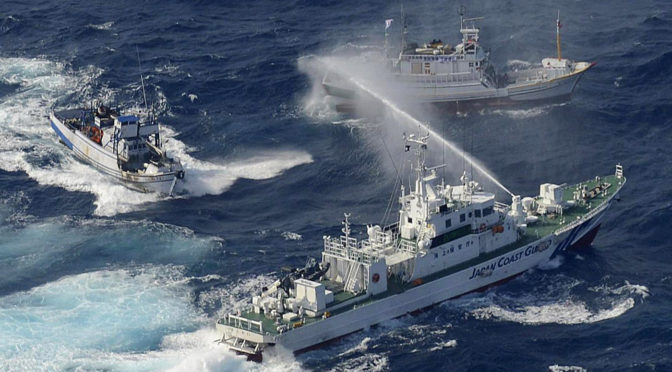
Featured Image: Coast guard vessels from Japan and Taiwan dueled with water cannons after dozens of Taiwanese boats escorted by patrol ships sailed into waters around the islands. (Yomiuri Shimbun/AFP/Getty Images)
CIMSEC had the opportunity to discuss commanding the USS Zumwalt (DDG-1000) stealth destroyer with commanding officer Captain Andrew Carlson.
In this wide-ranging discussion Capt. Carlson describes the goals of this unique warship, what it is like to experiment and field advanced new capability, and what the legacy of the ship may be for preparing for great power competition.
What would you say are the unique challenges of leading this ship and crew compared to most other ships?
Certainly, managing the maturation process in automation, integrating advanced technologies with legacy programs of record, and the minimal manning model all come to mind. However, none of those challenges are especially unique to Zumwalt.
The truly unique set of challenges for Zumwalt has really been orchestrating the path toward reaching an initial operational capability (IOC). Not only because of in-stride adjustments and acquisition decisions for certain systems but mainly navigating the dual-delivery approach prescribed in the Acquisition Decision Memorandum signed December 22, 2007 by the Under Secretary of Defense for Acquisition, Technology and Logistics.
DDG 1000-class ships undergo a two-phased activation approach, separating hull, mechanical, and electrical delivery (encompassing propulsion and support systems for safe navigation) from combat systems activation. DDG 1000 was originally delivered from the shipbuilder, Bath Iron Works, in May 2016. Since our arrival in San Diego in late 2016, the crew has coordinated with Naval Sea Systems Command (NAVSEA) for completing systems installation, activation, and testing, while subordinate to operational direction from the U.S. Third Fleet, and operating under the manning, training, and equipping functions of Commander, Naval Surface Forces, U.S. Pacific Fleet. This blending of delivery timelines and program milestones with fleet certification requirements and operational schedules presented a complex command and control relationship with shifting phases of supported and supporting efforts between the numbered fleet commander, the type commander, and NAVSEA.
Despite the challenges inherent in this approach, the benefits realized include an ability to achieve progress in each of the support roles to the different chains of command. Provided the ship systems met readiness levels, and the crew maintained training certifications under surface force guidance, Zumwalt was able to conduct operations at sea necessary for initial operational test and evaluation milestones as well as meet crew training and proficiency requirements while satisfying Third Fleet operational tasking. The best example of this was a Spring patrol in early 2019 after Zumwalt completed critical tier-1 certification requirements and eventually sailed over 9000 nautical miles, conducting first-in-class trials in Alaska, supporting engagement and security cooperation events with our Canadian partners in Esquimalt, British Columbia, and completed a transit to Pearl Harbor, all while conducting combat systems activation events and crew training sustainment.
Split delivery, though a necessary decision at the time, has been a challenging framework to operate in, though in retrospect, I am encouraged that the coordination between the fleet and NAVSEA has resulted in a meticulously managed progress toward achieving IOC, while providing opportunity for the crew to gain competence and confidence in operating Zumwalt and meeting operational tasking for the Pacific Fleet.
The Navy established a Surface Development Squadron that includes the Zumwalt. What is it like to lead a ship whose focus is experimentation, rather than, say, preparing for a traditional deployment?
I would adjust the framing of the question a bit to address the opportunity to experiment more explicitly, in addition to preparing for a deployment. The main focus of the ship is completion of developmental and integrated at-sea testing and achievement of initial operational capability. Along the way, because of first-in-class privilege, the crew also has the opportunity and even the obligation to experiment with the ship. The newer technologies in computing architecture, hull form, electric drive, and increased automation present incredible opportunity to experiment not only with technology and newer systems but in basic ship operations and tactical development applied to the class, and perhaps the fleet of the future.
The Surface Development Squadron establishment (created in May 2019 and now up and running today) and alignment of the Zumwalt hulls under one immediate superior in command furthers the opportunity DDG 1000 already enjoyed as a lead ship by positioning each ship under a commander charged with, among normal command duties, the rapid experimentation and developmental operations for technology and procedures. At the root of our training, maintenance, and operations, we are always looking for proficiency and the application of basic-through-advanced surface warfare disciplines in order to be ready for deployment.
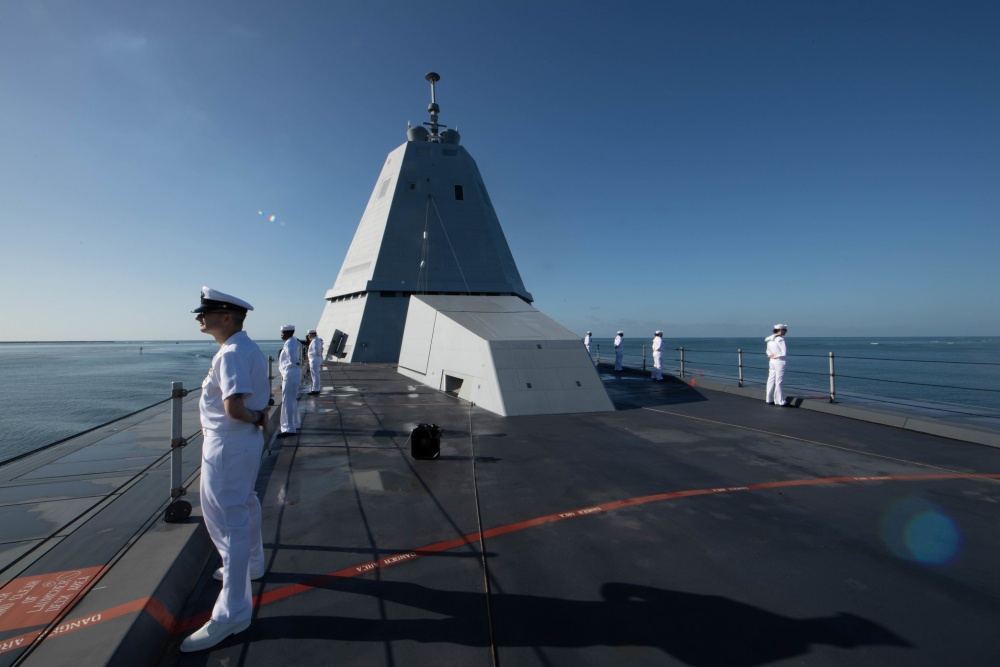
Pearl Harbor, Hawaii (Apr. 2, 2019) Sailors aboard guided-missile destroyer USS Zumwalt (DDG 1000) man the rails as the ship pulls into Pearl Harbor. (U.S. Navy photo by Mass Communications Specialist 2nd Class Jonathan Jiang)
The privilege of leading a first-in-class ship that gets to experiment was already a great job. Under a boss who supports, enables, and encourages experimentation, I have even more license and support to push the envelope in all facets of surface warfare. And this is all framed under a mindset of “preparing for a deployment” as it also includes developing the concepts of employment, adjusting and refining the training and certification models for this ship class, and proving out the best methods for integration with fleet and joint operations.
For a ship that will probably not experience a traditional deployment or reach its full capability soon, what keeps the crew interested and motivated?
Zumwalt Sailors have a long view. They have a problem-solving tenacity undeterred by ambiguity. And they understand that deploying is not synonymous with operating. We are able to operate, and need to operate, for testing, development, and validation so that subsequent ships and fleet units are ready when we do deploy. That is motivation enough to stay on top of readiness, training certifications, and maintaining proficiency in the very perishable skills of doing routine things in the maritime environment that, though dangerous, need not be unsafe.
The crew stays interested as well through first-in-class moments. We have the opportunity as the lead ship to live in the grey area and determine the way ahead for the ship class. Among our grading criteria is this path we pave for follow-on work. For example, the Zumwalt-class destroyer Michael Monsoor (DDG-1001) should meet or exceed many of our production, activation, testing, and qualification metrics. We absolutely measure our effectiveness more so by their successes rather than our own. Additionally, what we learn and experience has value to the current operating fleet as well as the ongoing research and development for future ship classes.
Finally, we focus on our team, our culture. Onboard Zumwalt we value civility, humility, teamwork, honesty, and integrity. We necessarily do this because those are characteristics of high-performing professional organizations, but we also make them a priority because they solidify our own crew as a team ready to lean in to the challenges involved in bringing a new ship class to life, and ushering in a new capability to the fleet. We are interested and motivated in each other, and that surpasses the challenge of succumbing to hard or wicked problems, and also counters dealing with the tedious nature of some of the more mundane things we do.
How would you describe the progress and process of the combat systems integration?
Challenging and rewarding, often simultaneously. In addition to ushering in advanced technology inherent in the Zumwalt design, we are poised at the intersection of legacy programs of record and new systems functionality that requires extensive testing beyond simple installation and testing on other hulls that have already passed through the crucible of being a part of a new ship class. Our situation has led to fascinating discussions and discoveries between design teams, engineers, industry leads, and fleet Sailors as we install, test, repair, modify, and operate various equipment and systems of systems onboard.
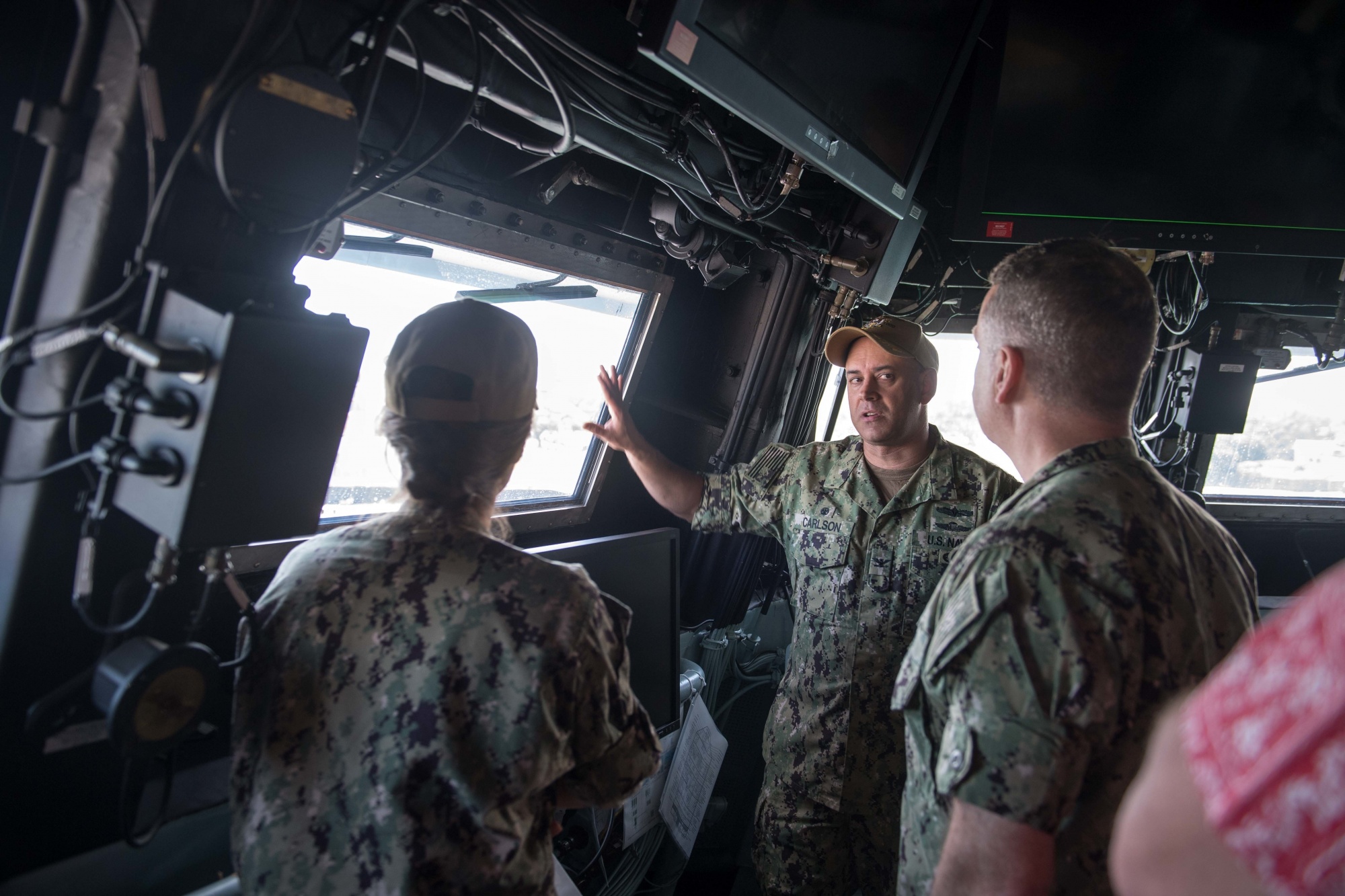
Pearl Harbor, Hawaii (April 2, 2019) Capt. Andrew Carlson, center, commanding officer of the guided-missile destroyer USS Zumwalt (DDG 1000), speaks to Rear Adm. Kristen Fabry, left, director of logistics, fleet supply and ordnance, for the U.S. Pacific Fleet, and Rear Adm. Jim Waters, director of Maritime Headquarters at the U.S. Pacific Fleet, during a tour of the ship. (U.S. Navy photo by Mass Communication Specialist 2nd Class Jonathan Jiang/Released)
It is necessarily detailed and deliberate, and certainly tests one’s patience when testing identifies a flaw or corrective action, but each time the collective team of government civilians, industry leads, and Sailors punches through to a successful test or validation of system integration there is a tremendous sense of accomplishment and increased motivation to move forward. In some cases, our in-situ feedback can be turned around into rapid changes that affect not just the Zumwalt ship class but other fielding efforts across the fleet. We are also well-positioned to inform discussions on future ship classes with operator perspectives to aid acquisition deliberations.
What can this ship teach the Navy about preparing for great power conflict?
Logistics and self-sufficiency are not only critical enablers for prompt and sustained combat operations at sea, but need to be factored into requirements definitions, and design and acquisition decisions. We have spent many hours reviewing and modifying our ability to conduct repairs and improve self-sufficiency within the lifelines of the ship. Adequate repair parts storage, critically evaluated parts allowances, and onboard repair capabilities should always be part of ship design. This includes not only traditional hull, mechanical and electrical repair capability, but with the continuing shift of key components in systems and the networking of engineering control on par with sensor and weapon control, the reliance on network health and security, fiber optic repair, electronic redundancies, and computer architectures will require increased reliability and failsafes to ensure our ships and their systems can remain available in a sustained fight.
Including margin in space, weight, power, and cooling in our ship systems aids longevity of design and permits agility in our procurement to adjust to a dynamic strategic and operational landscape. Patience and prudent decision-making along the way are key components of a steady strain to deliver capability to the fleet that has not existed and will be game-changing in great power conflict. Investment in time, fiscal resources, intellectual capital, and deliberate maturation of critical technologies are key to the long view in procurement.
Significant advancements in maritime warfare capabilities like automation, stealth, and high power systems are expensive and require clear articulation of cost and risk balances. Once we have determined that these advancements are necessary to tip the scales in favor of our national interests, we have to be disciplined and principled to effectively follow through. But this is not a call to blind loyalty or to obstinate determination in the face of invalidated assumptions, or changing fiscal, strategic, or operational realities.
When we need improved and advanced capabilities, including ones the Zumwalt class brings, we will find that those capabilities are not something we can quickly surge if they do not already exist in the fleet. We will be glad that we committed in advance to gaining the advantages Zumwalt brings, especially in technologies and tactics that usher in new capability across the fleet. There’s a great quote from the movie Spy Game from Robert Redford’s character, Nathan Muir. His assistant, Gladys, (brilliantly played by Marianne Jean-Baptiste) muses whether or not he is being paranoid as she watches him prepare for foreseen challenges he expects to face. Muir’s response as a seasoned intelligence operative resonates with me: “When did Noah build the ark, Gladys? Before the rain…before the rain.”
Closer to my wheelhouse, I believe the more I sail and operate with an advanced warship like Zumwalt, the more I am convinced that technical competence and system expertise, procedural compliance built on a foundational knowledge of basic principles, and tenacity in solving hard problems remain timeless requirements of service at sea.
What do you think the legacy of the Zumwalt class will be?
Power, stealth, and people. More explicitly, power generation, redundancy, and smart power distribution regimes will become the norm across the future force. We will continue to see increased demand for high voltage systems, integrated power, and balanced distribution of power across a variety of inductive loads that include sensors and weapons, and even propulsion systems of the future.
Regarding stealth, the nature of our ship and her inherent stealth design has thrust forward into our tactical development an emphasis on signature control and emissions discipline that is not only supremely effective in the employment of this ship class, but is immediately exportable to other ship classes. A crew that can appreciate the use of the electromagnetic and acoustic spectra in the routine doesn’t need to be on a stealth destroyer to realize the advantages therein. Put another way, one doesn’t have to be invisible if you don’t let people see you to begin with.
I would hope for a stealth destroyer legacy that engenders a renaissance of basic warfighting disciplines in emissions control, operational deception, anti-submarine tactics, and an application of offensive capability distributed across the battlespace to not only decrease our detect-to-engage sequence timelines, but also complicates and reduces the decision space of an enemy.
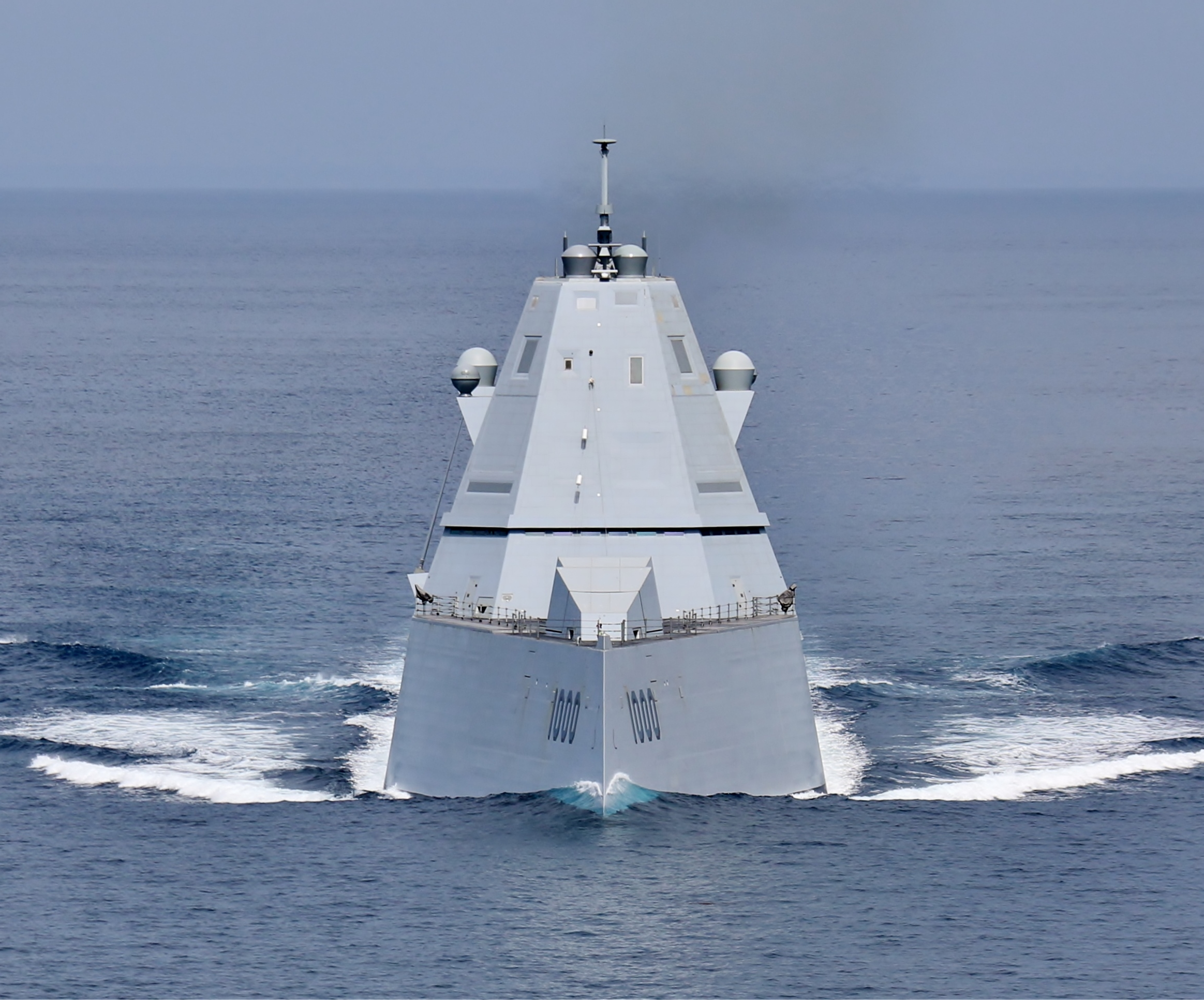
Eastern Pacific Ocean (Apr. 28, 2019) The guided-missile destroyer USS Zumwalt (DDG 1000) conducts class-specific testing while underway off the coast of California. (Internal U.S. Navy photo)
Finally, the privilege of leading a concentrated grouping of talented, mature, and resilient Sailors reinforces continued appreciation for the maxim that Sailors mean more than systems onboard a warship. John Paul Jones had it right when rating the capability of a ship.
Any final thoughts to share?
Facing similar challenges to those faced by today’s Navy, our ship’s namesake entered office as the 19th Chief of Naval Operations. With defense spending declining and a steadily aging fleet, Admiral Elmo “Bud” Zumwalt saw it as his job to ensure the Navy remained capable of meeting the current and future threats. Zumwalt’s embrace of innovation resulted in a number of new programs, such as the Oliver Hazard Perry-class frigate, the Ohio-class ballistic missile submarine, and the F-14 Tomcat, all of which had lasting impacts on the Navy’s warfighting readiness. We are similarly poised with advanced capability requirements, but constrained resources, and we need to fearlessly apply a pioneering mindset while critically evaluating the effectiveness and integration of new capabilities.
More important than fleet capability development, Admiral Zumwalt knew the primary force-multiplier of the Navy continued to be Sailors and, as a social reformer, began quality of life improvements for the fleet and the institutionalization of equality for minorities and women in the Navy. There is still much work left in both the modernization of our naval capabilities and making actionable progress in the area of equality. We are privileged onboard Zumwalt to uphold a legacy of ushering in new naval capability, but more so, to reinforce ideals the admiral voiced in Z-gram 66, that “there is no place in our Navy for insensitivity. We are determined that we shall do better…ours must be a Navy family that recognizes no artificial barriers of race, color, or religion. There is no black Navy, no white navy, —just one Navy—the United States Navy.”
Captain Carlson is a 1995 graduate of the U.S. Naval Academy. He previously commanded the legacy destroyer USS Higgins (DDG 76), the U.S. Aegis Ashore Missile Defense System in Romania, and a trio of coastal minehunters. He holds Navy subspecialties in space systems engineering and national security. The views here are his own and do not necessarily reflect those of the U.S. Navy or the U.S. Department of Defense. You can follow him on Twitter @ruminantswo.
Dmitry Filipoff is CIMSEC’s Director of Online Content. Contact him at Content@cimsec.org.
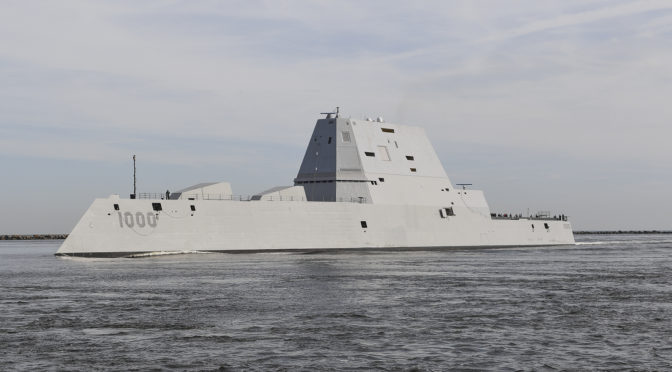
Featured Image: Jacksonville, Fla. (Oct. 25, 2016) The guided-missile destroyer USS Zumwalt (DDG 1000) transits Naval Station Mayport Harbor on its way into port. (U.S. Navy photo by Petty Officer 2nd Class Timothy Schumaker/Released)