All posts by Dmitry Filipoff

Force Structure Perspectives: Capt. Jeff Kline (ret.) on Bringing the Fleet Into the Robotics Age

Force Structure Perspectives Series

By Dmitry Filipoff

As a part of CIMSEC’s Force Structure Perspectives Series, CIMSEC discussed the Battle Force 2045 fleet design with Capt. Jeff Kline (ret.) who serves as Professor of Practice of Military Operations Research in the Naval Postgraduate School’s Operations Research department, and serves as Director of the Naval Warfare Studies Institute. In this conversation, Capt. Kline discusses advantages realized by fielding a fleet with greater platform variety, how to mitigate risk to emerging fleet networks, and the impacts of the Robotics Age on naval force structure.

The Secretary of Defense recently announced a new fleet plan for a future U.S. Navy of 500 ships, a major increase over today’s fleet of around 300 ships. Among many changes, the fleet emphasizes substantial additions in areas such as sealift, unmanned warships, submarines, and smaller surface combatants. What do you make of the size of this fleet and its mix of platforms?

I applaud these changes! This vision begins to embrace the offensive advantages of the new Robotics Age of warfare, while retaining more traditional forces to provide defense for sea lines of communications. It is a fleet designed with greater sea denial capabilities yet still retaining the ability to maintain sea control. It is a fleet with more resilience in both operations and logistics, and a fleet better able to operate across the spectrum of competition to conflict. It is very much in line with my CIMSEC commentary of several years ago, the “Impacts of Robots Age on Naval Force Structure Planning.”

This is not necessarily a “high-low” mix fleet design, but rather a lethal, focused-mission sea denial force intended for forward operations while also being a sea control force of multi-mission platforms to protect our ability to use the oceans for sustainment and logistics. It is a fleet design better suited for conflict, and therefore, may better deter conflict.

This new force structure may be used to execute Navy and Marine Corps warfighting concepts, including Distributed Maritime Operations (DMO), and Expeditionary Advanced Base Operations (EABO). These concepts and the new fleet design embody leadership’s thinking on the nature of future warfighing tactics and operations. Are these warfighting concepts mature or flexible enough to provide a long-term foundation for building this redesigned fleet? Are trends in tactics and technology adequately captured?

I believe this new fleet design moves toward an architecture more capable of effectively executing both DMO and EABO, while providing the connections for their synchronous employment. Foundationally, if DMO’s objective is to present an adversary with multiple points of risk, it is easier to do that with 500 platforms than 300. Likewise, if EABO is to place distributed offensive capability forward, then greater logistical capacity will be required to support it. Integrating these concepts will also be enabled by envisioning coordinated operations between the Navy’s forward offensive sea denial platforms—the submarines, unmanned systems, and smaller surface combatants—and the Marine’s shore-based ISR and anti-ship missile capabilities.

Having a better mix of single and multi-mission ships may also catalyze an increase in integrated operations with allies—a necessary condition for both DMO and EABO. Barriers to capability sharing in our advanced defensive systems are not necessarily the same with smaller combatants and unmanned platforms dedicated to regional ISR and offensive operations. And, for basic maritime security missions, smaller combatants are well-suited to work alongside allied partners. Adding a larger proportion of these vessel types to the fleet will provide additional options for engaging regional partners.  

As the new fleet design is incrementally introduced, and the advantages and limitations of new technologies are better understood, tactics can be modified along with concepts to effectively employ them. The greatest risk, of course, is to the networks and communications that tie this fleet together. In a way, this transforms the Navy’s “capital ship” from the aircraft carrier to the fleet network, a natural outcome of distributed operations enabled by the Robotics Age.

Two approaches to mitigate risk to the fleet network must be developed independently: adding robustness to our communication capabilities and maturing tactical mission command to a level that our force is network enabled and not network dependent. Essentially, developing concepts and tactics to allow our force to operate without fleet C2 if necessary. This may be a combination of older concepts by creating geographic operating areas and/or “kill boxes” where local tactical commanders have full control over a detect-to-engage sequence, and new communication techniques like burst mesh networking with robotic nodes. This will not work, however, unless local commanders have local control of ISR, engagement, and battle damage assessment assets in their assigned area. These ideas are covered in more detail in my 2016 CIMSEC article “A Tactical Doctrine for Distributed Lethality” and SECDEF’s fleet design moves toward providing the quantities of unmanned systems to make this happen.

The Navy has long been concerned about whether it can sustainably increase the size of the fleet within traditional levels of shipbuilding funding. How can we view the affordability and sustainability of this fleet? 

Sustainability is the greatest risk to this new fleet plan. Increasing the manpower, maintenance, and logistics requirements to support a more numerous fleet will require a tradeoff of some operational capacity toward sustainability. But even here there are ways to mitigate a traditional sustainment requirement. Exploring concepts involving less expensive, attritable unmanned sensor platforms, shorter platform lives where replacement vice retrofit is the goal, and low maintenance systems are more possible with a greater number of single-mission platforms than expensive multi-mission ones.

A possible manning tradeoff consideration is using lightly crewed or optionally-crewed systems to replace just one aircraft carrier and air wing at the battle’s edge. This may free personnel to fill control, maintenance, and sustainment roles. This is a conceptual leap deserving further analyses, but it reflects possibilities facilitated by leveraging intelligent automated systems and introducing entire platforms which use them. And, this fleet design conservatively retains a large portion of our aircraft carrier fleet to hedge against technological risk.

This process was notable for including the direct involvement and direction of the Office of the Secretary of Defense, which initially rejected the Navy and Marine Corps force structure assessment delivered in January. What is unique about how this process played out and what can we learn for making future assessments?

Historically, large capital-intensive navies are by nature difficult to change. Non Navy-specific, large-segmented bureaucracies, particularly those following established processes like the PPBE and acquisition systems, inspire marginal change at best. There is some goodness to this, as great change in a fleet can incur significant geopolitical and strategic risk, but in our current world-power situation, change is needed in our force structures to meet emerging technological threats. I believe this is well-recognized throughout Navy leadership.

The Secretary of Defense used his offices to overcome some of these barriers. What will be critical now is the next step: execution. I believe Congress, OSD, and Navy leadership will have to be directly involved to ensure this fleet design is realized. We don’t lack for fleet assessments recommending change, we lack for the actual change.

What does it mean for U.S. naval strategy and great power competitiveness to build this fleet, and to build it soon? Does it address a gap between national strategy and the navy needed to execute it?

I believe it sends a strong signal to our potential adversaries that we are building a fleet less vulnerable and more resilient in a possible future conflict across multiple domains. It means we are willing to take some technological risk to stay competitive in the Robotics Age of warfare, and be capable of holding their strategic interests at risk. This may have a strong deterrent effect on aggressive adventurism by providing additional response options with varying levels and types of force.

Previous force structure assessments conducted in 2016 were later considered by some to be overly optimistic with respect to certain factors, such as available resourcing. How can we be confident in this new assessment, and that it will spur the change it recommends? What comes next to build this fleet?

I don’t believe the assessment itself will motivate the necessary choices to realize this fleet design vision. SECDEF, SECNAV, and the CNO must create the organizational changes to institutionalize the transformation. That may require some radical shifting of resources, responsibilities, and authorities, and of course, Congressional support. The next step is really a campaign to address a full strategy—ends, ways and means. The new fleet design provides an endstate and it provides some force structure offsets to identify means. Now, what is required is a transformation execution plan which clearly articulates ways by identifying authorities and resources.

I am optimistic this change is achievable. The recently released House Armed Services Committee Future of Defense Task Force Report 2020 recognizes the advantages emerging technologies like artificial intelligence, quantum computing, and biotechnology can provide us, as well as the threat they pose in an adversary’s arsenal. It calls for changes to the DoD programming and acquisition processes as well as partnerships with industry to meet the vision of a transformed force. It is very much in the spirit of SECDEF’s naval force design. For Navy leadership pursuing this vision, I believe they will find an ally in Congress.

Also, great changes in fleet capabilities are normally associated with a strong visionary and leader who had the longevity to realize the introduction. A flag officer should be appointed with the authority and tenure in office to transform the fleet to embrace new information, manufacturing, cyber, and computational technologies. Naval gunnery was advanced by Dahlgren, the nuclear navy realized by Rickover, submerged ballistic missiles brought on by Burke, Navy computation reared by Hopper, and Aegis was shepherded by Meyer.

Recently, the Chief of Naval Operations launched Project Overmatch, where “Beyond recapitalizing our undersea nuclear deterrent, there is no higher developmental priority in the U.S. Navy,” and whose goal “is to enable a Navy that swarms the sea, delivering synchronized lethal and non-lethal effects from near-and-far, every axis, and every domain.” Can Admirals Small and Kilby, who are charged with leading this project, be those who bring the U.S. Navy into the Robotics Age?

A retired naval officer with 26 years of service, Jeff Kline is a Professor of Practice of Military Operations Research in the Naval Postgraduate School’s Operations Research department and serves as Director of the Naval Warfare Studies Institute. In addition to teaching courses in Joint Campaign Analysis, risk assessment and systems analysis, he supports applied analytical research in maritime operations and security, tactical analysis, and future force composition studies. He has served on the CNO’s Advisory Board for Fleet Architecture and several Naval Study Board Committees. His awards include the J. Steinhardt Award for Lifetime Achievement in Military Operations Research, Superior Civilian Service Medal, and the Institute for Operations Research and Management Science (INFORMS) Award for Teaching of OR Practice. He is a member of the University of Missouri’s Industrial Management Systems Engineering Hall of Fame, the Military Operations Research Society, and the Institute for Operations Research and Management Science.

Dmitry Filipoff is CIMSEC’s Director of Online Content. Contact him at Content@CIMSEC.org.

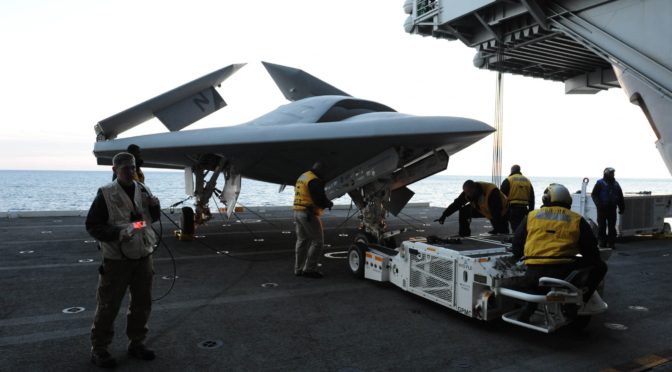
Featured Image: The X-47B Unmanned Combat Air System Demonstrator (UCAS-D) is secured in the hangar bay aboard the aircraft carrier USS Theodore Roosevelt (CVN 71). (U.S. Navy photo by Mass Communication Specialist Seaman John M. Drew/Released)
Force Structure Perspectives: Capt. Trip Barber (ret). on Building a New Fleet

Force Structure Perspectives Series

By Dmitry Filipoff

As a part of CIMSEC’s Force Structure Perspectives Series, CIMSEC discussed the Battle Force 2045 fleet design with Capt. Trip Barber (ret.), who was the Navy’s chief analyst of future force structure and capability requirements on the OPNAV staff as a civilian from 2002 to 2014. In this conversation, Capt. Barber discusses the Navy’s longstanding resistance to new ship types, whether Battle Force 2045 can be afforded, and how to begin building this new fleet.

The Secretary of Defense recently announced a new fleet plan for a future U.S. Navy of 500 ships, a major increase over today’s fleet of around 300 ships. Among many changes, the fleet emphasizes substantial additions in areas such as sealift, unmanned warships, submarines, and smaller surface combatants. What do you make of the size of this fleet and its mix of platforms?

The public dialogue about Navy force structure assessments focuses too much on total ship count. A force structure assessment is actually a set of a dozen or so separate requirement numbers, each for a specific class or general type of ship, that happen to add up to a total. Having a surplus of one ship type does not generally compensate in capability terms for having fewer than needed of a different type, even if the total fleet number matches the overall goal.

The Navy is at about 300 ships today and there are 20 or more budget cycles that will pass before the aspirational number of 500 or so can be reached. Political leadership, the world situation, and technology will change a lot over those 20 cycles, and new numbers will emerge. The total is irrelevant. Whether large seagoing unmanned vessels are counted or not counted in this number is a political issue.

What really matters about the latest force structure assessment is that the proportional mix among types of ships has significantly changed, and multiple new types of ships, including unmanned, appear in the new fleet mix. All previous assessments had been constrained to only address the types of ships that were in the established shipbuilding program of record, and the overall proportional mix within their totals did not change much, except for submarines. This type of more fundamental change has not happened at this scale in any force structure assessment since the 1980s, and it is a big deal.

The types of changes in the most recent force structure assessment are pretty much aligned with what I wrote in my January 2019 Proceedings article on fleet design, so of course I think they are a good idea! The proportional increases in logistics ships, unmanned, and undersea warships and the rebalancing of the surface combatant force toward a greater fraction of smaller but still multi-mission warships are all the right general direction to go. So is the shift to smaller amphibious warships and the consideration of incorporating larger numbers of smaller carriers in the aircraft carrier force.

The devil is in the details for all of these – what characteristics and capabilities (and cost) do we give these new types of ships as they march through our acquisition process, and go from the concepts in the assessment to the requirements that go to the shipbuilders for execution? It is the natural tendency of this process to pile capability requirements (and cost) onto anything that passes through, which could exacerbate the force affordability issues that already are a concern.

This new force structure may be used to execute Navy and Marine Corps warfighting concepts, including Distributed Maritime Operations (DMO), and Expeditionary Advanced Base Operations (EABO). These concepts and the new fleet design embody leadership’s thinking on the nature of future warfighing tactics and operations. Are these warfighting concepts mature or flexible enough to provide a long-term foundation for building this redesigned fleet? Are trends in tactics and technology adequately captured?

The way the naval services have been planning to fight, with concentrated Navy battle force formations and Marines storming ashore for forcible entry, has been made irrelevant by threatening military technology developments and proliferation, at least against great power adversaries. We are in a world of hider-finder competition and precision missile strikes, so distributing forces and firepower and making the units of the force somewhat smaller and more numerous is a better approach. That is what the new fleet and Marine Corps design is based on.

Whether this works and how well it works will depend on things still to be decided and developed, such as how to network a distributed force that includes unmanned systems to the degree and with the resilience needed, and how to get the force in place on the timeline needed in wartime and then support this force logistically. These are hard, unsolved questions. CNO Gilday’s recent memos initiating the “Project Overmatch” and “A Novel Force” efforts are the steps needed to begin coming to grips with these hard questions in order to develop (and fund) real solutions. This level of focused work should have begun earlier, but at least it is now beginning.

Could this design be resilient against a competitor’s adaptations once they see a new fleet being built? Could this fleet spur changes in the threat environment that diminish its competitiveness by the time it would be fielded around 2045?

I hope we do not declare this force structure assessment and fleet design to be the perpetual endstate. It will need to adapt and adjust over time in our ongoing and dynamic move-countermove strategic competition with an adversary that is much richer and smarter than the Soviet Union ever was. And this in an environment where, due to our digital networking of everything and where cybersecurity is always playing catch-up, our moves are seen and understood far faster by the other side.

We have long been building a Navy of platforms (ships and aircraft) that are large and expensive, and necessarily have very long service lives to amortize that capital expense. So our rate of change at the major platform level is dragging a huge “sea anchor” that slows it down. We can either reduce the size and cost of this capital equipment and give it shorter service lives so we turn it over more rapidly (such as the 1950s “Century Series” approach for jet fighters the Air Force wants to emulate), or we can make our larger capital equipment more rapidly adaptable so that its sensors, weapons, and systems can turn over rapidly, and then actually fund that rapid turnover of non-capital equipment payloads. We have not been doing either of these sufficiently over the past two decades and the right answer to pace adversary responses is probably some balance between them – a set of smaller, short-life platforms (probably largely unmanned) and a complimentary set of larger manned warship “nodes” designed with the space and margin for rapid system modernization.

The decisive battlespace in future warfare will be in the information domain and it will powerfully affect the outcome in the maritime domain, so our response to threat adaptations has to start there, not with ships. We are not focusing on this dimension of warfare as seriously as our adversaries are and it is hurting the competitiveness of our fleet.

The Navy has long been concerned about whether it can sustainably increase the size of the fleet within traditional levels of shipbuilding funding. How can we view the affordability and sustainability of this fleet? 

The fleet size of 500-plus ships of the new mix and types, like the fleet design of 355 program-of-record ships that preceded it, is unaffordable to either procure or to crew and sustain within any reasonable estimate of what funding the nation will provide to its Navy over the next 20 years. The nation needs a capable Army, Air Force, Marine Corps, Space Force, and intelligence community in addition to a Navy in order to meet the full range of challenges from our defense strategy. A seismic-scale rebalancing within the existing defense topline, always the hope of those who see the need for a bigger Navy, is unlikely. So is a much greater overall defense topline.

The discussion of fleet affordability to date has been focused on acquisition cost, but a fleet this large will have enormous sustainment costs as well. “Unmanned” systems are not completely unmanned – the people who operate them and keep them seaworthy are just not embarked and their numbers are still significant.

The fleet we actually get the funding to build and operate will be smaller than 500-plus ships, but needs to be larger than today’s 300, and it should have some numbers of the new types of ships that the new fleet design calls for. The proportional mix of types within a smaller, more cost-constrained overall fleet size may not be exactly the same as this assessment. That is a subject for follow-on work once the real level of long-term funding that will get bipartisan support becomes clearer.

This process was notable for including the direct involvement and direction of the Office of the Secretary of Defense, which initially rejected the Navy and Marine Corps force structure assessment delivered in January. What is unique about how this process played out and what can we learn for making future assessments? 

The Navy lost control of this process by hanging on for too long to the existing program of record ship types as the basis for its long-term force structure assessment and by failing to fully accept the fact that the changing strategic and technological environment meant that the time had come for a wholesale change in the shape of the fleet and its ship types.

This level of change is institutionally very hard to accept and will never earn an internal consensus. It threatens community beliefs and disrupts the shipbuilding industrial base. However, multiple outside evaluations of the Navy’s fleet design over the preceding four years had said that the time had come for this level of change, and OSD finally stepped in to make it happen when the Navy did not move aggressively enough.

As a result of this top-down intervention the assessment now reflects multiple new classes of ships with significant uncertainty in their design and cost, and an overall size that is hard to reconcile with a long-term shipbuilding plan (especially considering the massive Columbia-class SSBN replacement) that is based on likely levels of funding. Ideally, in a Navy-driven change of this magnitude, the processes for doing this detailed translation of the new ship types into well-engineered shipbuilding programs would have been in place when the force structure assessment process ended. But as a result of the top-down OSD actions they are a bit out of synch.

What does it mean for U.S. naval strategy and great power competitiveness to build this fleet, and to build it soon? Does it address a gap between national strategy and the navy needed to execute it? 

This new fleet will not be built soon no matter how much we wish for it. Requirements and designs for the new ship types the force structure assessment envisions are in many cases not mature. A skeptical Congress remains to be convinced that the Navy has thought these new ship types through in sufficient detail to justify near-term production funding. OSD does not go to these discussions, and so the Navy has to prove it knows what it is doing to Congress and that the timeline is realistic. Our track record has not earned their trust.

Our industrial base capacity to produce significantly more warships faster or to design multiple new complex ship types simultaneously does not exist, except for smaller craft such as unmanned vessels. The money to fund a much greater level of shipbuilding on a sustained basis is probably not in place or sustainable. And the fleet we have and what is currently under construction is made up of ships that will mostly last 30-50 years and will be the majority of any U.S. fleet for the next 20.

The Navy’s principal near- to mid-term response to great power challenges will have to come more from rapid enhancements to the systems, networks, and weapons of the current “legacy” fleet, and perhaps the first generation of fleet unmanned systems. There are many options for near-term means to achieve the expansive and ambitious ends that are stated in the national strategy, and a vastly larger Navy is just one of them. 

Previous force structure assessments conducted in 2016 were later considered by some to be overly optimistic with respect to certain factors, such as available resourcing. How can we be confident in this new assessment, and that it will spur the change it recommends? What comes next to build this fleet?

Do not focus on the total number of ships in this assessment, that number is unaffordable and will not be reached (with the right mix of ships making it up) for decades, if ever. Many things will change before then. What mainly matters is that the Navy has said it needs several new types of ships soon, and fewer of several ship types that are currently in production. We should focus today on getting the requirements and designs right for these new types and start building the first ones as soon as we do. We should develop the industrial base plan that rebalances the types of ships we make so we can slow down the old and start the new without major disruption.

These are here-and-now issues. Someday, 20 or more years from now, we may build the last of these new ships and we will know then what that final number is. We do not need to know that today. What matters now is getting started on making these significant changes happen. They are the right thing to do and it is time to do them.

Trip Barber is a retired surface warfare officer and Navy Senior Executive Service civilian. He was the Navy’s chief analyst of future force structure and capability requirements on the OPNAV staff as a civilian from 2002 to 2014 and did 25 years of Pentagon time in his 41-year Navy career. He is an engineering graduate of the Massachusetts Institute of Technology and the Naval Postgraduate School. He is currently the Chief Analyst at Systems Planning and Analysis, Inc.

Dmitry Filipoff is CIMSEC’s Director of Online Content. Contact him at Content@cimsec.org.

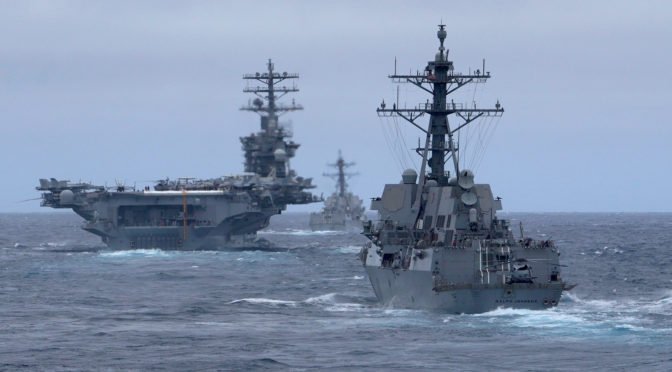
Featured Image: PACIFIC OCEAN (May 14, 2020) The Arleigh Burke-class guided-missile destroyers USS Ralph Johnson (DDG 114) and USS Sterret (DDG 104) transit the Pacific with aircraft carrier USS Nimitz (CVN 68) during a composite unit training exercise (COMPTUEX). (U.S. Navy photo by Mass Communication Specialist 3rd Class Andrew Langholf/RELEASED)

Force Structure Perspectives Series Kicks Off on CIMSEC

By Dmitry Filipoff

CIMSEC is launching a special Force Structure Perspectives Series to provide insight into the new Battle Force 2045 fleet design that was recently announced by Secretary of Defense Esper. This new fleet design aims to revamp much of the U.S. Navy to make it more operationally flexible, capture advancements in technology and tactics, and ultimately make the fleet better able to deter and prevail in great power conflict.

CIMSEC invited select contributors to share their views on this new fleet design. In these wide-ranging interviews and pieces, contributors shared their thoughts on the benefits and pitfalls of this new fleet, lessons on the intervention of the Office of the Secretary of Defense into fleet design, and what it will take to make this new fleet real.

The featured contributors are listed below, and may be updated with additional contributors as the series unfolds.

Capt. Trip Barber (ret). on Building a New Fleet
Capt. Jeff Kline (ret.) on Bringing the Fleet Into the Robotics Age
Capt. Sam Tangredi (ret.) on Shopping for Studies

CDR Phil Pournelle (ret.) on Chasing Legacy Platforms
Col. T.X. Hammes (ret.) on Experimenting for Adaptation

Capt. Robert Rubel (ret.) on OSD Seizing Fleet Design
“A Decisive Flotilla: Assessing the Hudson Fleet Design,” by Capt. Robert Rubel (ret.)
Congresswoman Elaine Luria on Getting Congress Involved
Dr. John T. Kuehn On Designing for the Long War
“The Navy Should Stop Talking About the Future and Start Building It,” by Frank Goertner

Dmitry Filipoff is CIMSEC’s Director of Online Content. Contact him at Content@cimcsec.org.

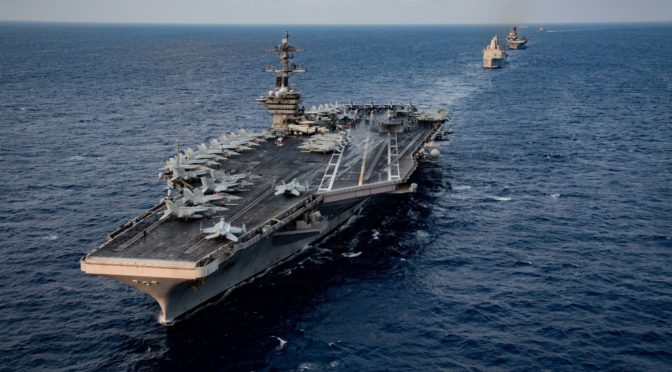
Featured Image: SOUTH CHINA SEA (March 15, 2020) The aircraft carrier USS Theodore Roosevelt (CVN 71) leads ships from the Theodore Roosevelt Carrier Strike Group and the America Expeditionary Strike Group during a transit of the South China Sea during a photo exercise, March 15, 2020. (U.S. Navy photo by Mass Communication Specialist 3rd Class Brandon Richardson/Released)

Regional Strategies Topic Week Concludes on CIMSEC

By Dmitry Filipoff

CIMSEC received a tremendous response to our Project Trident’s call for articles on regional maritime powers and strategies, launched in partnership with the Yokosuka Council on Asia Pacific Studies, the Institute for Security Policy at Kiel University, and the Dominican Command and Naval Staff School. Authors from many regions of the world responded with analysis and insight on regional powers and their maritime security challenges. Among their many takeaways, several themes emerged from their contributions.

Some smaller and medium-sized nations are looking to expand their standing and roles, including going beyond being a provider of their own security to providers of regional security. Others are looking to take their own experience in dealing with local threats and export their know-how via cooperative exercises and exchanges. Some nations and navies are feeling compelled to take on a larger role in regional affairs, or are taking uncharacteristically assertive actions that are making waves, such as Turkey’s insistence on its own version of maritime rights in the Eastern Mediterranean.

The actions and ambitions of great powers are reverberating across the strategies of smaller and medium-sized nations. As great powers grow in military might and decisively alter the traditional military balance within a region, smaller powers feel compelled to adapt both militarily and diplomatically to bolster deterrence. Smaller and medium-sized nations, especially in Asia, have equipped their navies with lethal and advanced modern weaponry. They are increasingly exercising with one another and establishing deeper ties with respect to military cooperation. Great powers should take note, since as they disrupt the usual military calculations of a region they can precipitate determined countermeasures from smaller nations.

What is clear is that smaller and medium-sized navies can have major influence. Whether it be through preeminence within a nearby body of water or proximity to a heavily-trafficked chokepoint that would be highly contested in a major conflict, the roles and capabilities of regional powers should not be underestimated. Regional navies are on the frontlines of managing traditional and non-traditional threats, and are constantly mindful of the ever-evolving maritime security environment within their locales. 

Below are the articles that featured during the extended topic week, with excerpts. We thank these authors for their excellent contributions.

“China’s Aircraft Carriers and Southeast Asia: Testing Coercive Naval Diplomacy?” by Shang-su Wu

“Since the People’s Liberation Army Navy (PLAN) commissioned its second aircraft carrier, the possibility of utilizing these capital ships for coercive diplomacy is becoming more real. In China’s surrounding areas, Southeast Asia would be most suitable for “carrier diplomacy” regarding the proximity, the relatively weak defenses of the regional countries, and the major territorial disputes in the South China Sea. However, Southeast Asian countries, with their military modernizations and geopolitical circumstances, would not be merely hopeless either.”

“Illegal Fishing in the South Pacific: What Can the Chilean Navy Do?” by Francisco Martinez

“The Chilean Navy is more than just a national warfighting force aimed at conventional deterrence. Earthquakes, volcanic eruptions, fires, and tsunamis are all examples of natural disasters that Chile faces in which the Navy is one of the first to provide support. Along with disaster relief and safeguarding life at sea, countering Illegal, Unreported, and Unregulated (IUU) fishing is one of the most economically important duties of the Chilean Navy.”

“Boats, Budget, and Boots: The Colombian Navy’s Challenges in International Cooperation” by Rafael Uribe Neira

“In recent years the Colombian Navy has undergone a well-planned but less-than-well executed modernization to exert sea control and counter regional threats in both the Caribbean Sea and the Pacific Ocean. After significant changes in doctrine and procurement, the institution still struggles to contribute to regional security despite being a key U.S. partner in the region.”

“The Sino-Japanese Maritime Disputes in the East China Sea” by Yoichiro Sato

“While much focus is paid to the Chinese claim of sovereignty over the Senkakus (China calls them Diaoyu), the dispute over the islands is partially nested within a larger dispute over the broader Exclusive Economic Zone(EEZ)/Continental Shelf boundary dispute between the two countries. As such, the implications of the islands’ sovereignty over the broader maritime boundary dispute and the respective strategies of China and Japan warrant closer examination.”

“The Israeli Navy in a Changing Security Environment” by Ehud (Udi) Eiran

“Looking forward, the Israeli Navy is facing a number of challenges. First, if the tensions with Iran, which manifest themselves in occasional air strikes in Syria, will expand, the navy may be called to further develop capabilities to reach Iranian shores. Israel is 1,500 km away from Iran, and the sea is an attractive route to access the Islamic Republic. Israel’s recent normalization of its relationship with the UAE and Bahrain might also make future Israeli naval deployments in the Arabian Gulf easier. There is also talk of a possible Iranian naval station in Syria, which may bring the maritime conflict closer to home.”

“A South Pacific Island-Led Approach to Regional Maritime Security” by Michael van Ginkel

“Given the strong influence of the maritime space on the national economies and local communities within the South Pacific, the deleterious effects of non-traditional threats to human security in the maritime domain are of significant concern to the island nations. By further enhancing MDA, maritime law enforcement capacity, and security assistance capabilities, local South Pacific island governments and multilateral organizations can protect their maritime-based economies.”

“Sweden and the Blue Society: New Challenges for a Small Navy” by Lars Wedin

“A small navy like the Swedish Navy does not seek to be able to project power on a global scale – not even on a regional one. It cannot protect SLOCs in contested areas far away. But it can, and must, promote and defend its interests at sea in its own area of interest.”

“Turkey’s ‘Mavi Vatan’ Strategy and Rising Insecurity in the Eastern Mediterranean” by Capt. Andrew Norris, J.D., USCG (ret.) and Alexander Norris

“For the past several years, Turkey has leveraged its regional economic, political, and military superiority to aggressively assert a claim over contested, potentially oil-rich regions of the Eastern Mediterranean. This hegemonic strategy, domestically referred to as “Mavi Vatan,” or “blue homeland,” has most recently manifested itself in Turkey’s deployment of the seismic vessel Oruç Reis with a naval escort to disputed waters south and west of Cyprus. Despite widespread and growing international criticism of this doctrine and its associated activities, Turkey has so far remained steadfast in its resolve.”

“Between the Giants: The Future of the Taiwanese Navy in an Era of Great Power Competition” by Jonathan Selling

“In this new world of enhanced competition between the United States and China, no nation has more reason to be concerned than the island nation of Taiwan. Claimed by China, and largely protected by the United States, Taiwan cannot avoid being drawn into the competition. Because of its unsettled political status, Taiwan could easily become a flashpoint between the two powers.”

“Vietnam’s Struggles in the South China Sea: Challenges and Opportunities” by Viet Hung Nguyen Cao

“With only weak, symbolic reactions to China’s aggression, Vietnam is without a proactive or effective strategy to fight back. There are policies that Vietnam should adopt, but at the heart of these policies is the need for more international cooperation in resolving the issues linked to China’s strategy.”

“Southeast Asia: A New Strategic Nexus for Japan’s Maritime Strategy” by John Bradford

“With all branches of Japan state power now investing in Southeast Asian maritime security, this region is cementing as a new nexus in Japan’s maritime strategy. The scope, strategic intent, and likely future development of Japan’s maritime security activities in Southeast Asia merits closer examination.”

“Unraveling China with Soft Balancing: Malaysia, ASEAN, and the South China Sea” by Afdal Izal

“As dynamic as the international community and regional bloc is today, can ASEAN continue to make its relations work in spite of the great power rivalry near its shores? Will each member nation play by the ‘ASEAN way’ and with ‘ASEAN centrality’ when it comes to navigating the might of the U.S. and China? Malaysia offers an interesting case study, and especially in the context of ASEAN’s historical background and recent developments.”

“Italy Resurgent: Defending National Interests in the Mediterranean” by Capt. (N) Renato Scarfi (ret.)

“As much as Italy is concerned, the vital need of imports from the sea is evident, in particular because of the choice to base the national economy on strong industrialization. Although it is geographically defined as a peninsula, Italy can be likened to an island when it comes to its strong dependence on the availability of maritime lines of communication. The seas and the oceans therefore play a central role for the Italian economy because the scarcity of raw materials forces Italy to trade with foreign countries for supply.”

“The Pathway Toward Containment: Fleet Actions for the United States and ASEAN Plus 5” by Captain Gregory W. Snyder, USMC

“The ongoing territorial disputes playing out in the South and East China Seas offer useful case studies for determining what nations in the western Pacific can do differently to counter malign Chinese actions. Additionally, the United States has a variety of options to employ all of its sea services to help support its allies and partners in the region.”

“India’s Strategy for the Indian Ocean in Light of COVID-19 and Confrontation with China” by David Scott

“Paradoxically, though COVID-19 has weakened India’s economic ability to fund its naval infrastructure and assets program for the Indian Ocean, it has enabled India to strengthen its links with Indian Ocean micro-states through the humanitarian assistance delivered by the navy. Meanwhile, land confrontation with China at Galwan has encouraged India to deepen its military links with other maritime powers operating in the Indian Ocean. In an unstated but evident balancing fashion, this is enabling India to improve its maritime position in the Indian Ocean vis-à-vis China.”

“Between Scylla and Charybdis: ASEAN and the U.S.-China Contest for the South China Sea” by Mark Valencia

“ASEAN and its members are in an increasingly dangerous dilemma. They are under mounting pressure to choose between the U.S. and China in their competition for political and military preeminence in the region. In response, ASEAN member states are maneuvering to maintain their ‘neutrality’ and pursue ASEAN ‘centrality’ in international affairs affecting the region. Their perspectives and roles in this great power competition merit closer examination, as well as how they are adapting to it, and what—if anything—ASEAN can do.”

Dmitry Filipoff is CIMSEC’s Director of Online Content. Contact him at Content@cimsec.org.

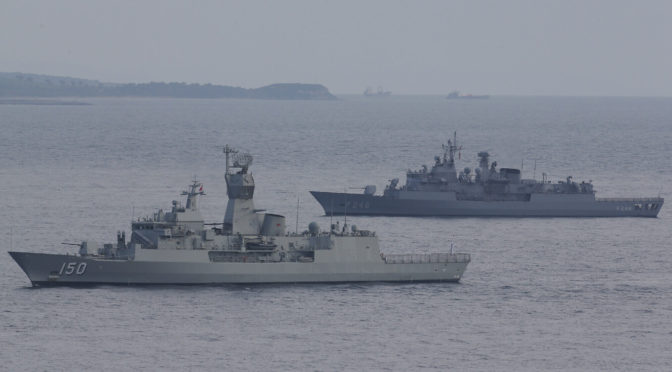
Featured Image: Turkish Navy ships in 2015 (AP Photo/Lefteris Pitarakis)