All posts by Guest Author

Disturbing the Pond: A Missing Tanker in the Gulf of Guinea

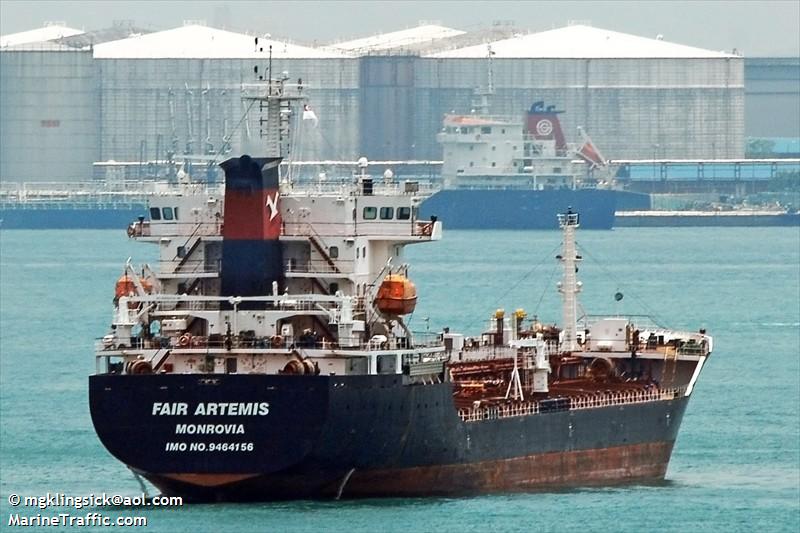
MT Fair Artemis. Image (c) MarineTraffic.com/Mgklingsick@aol.com

MT Fair Artemis. Image (c) MarineTraffic.com/Mgklingsick@aol.com

By James M. Bridger, Delex Systems Inc.

A Greek-owned oil tanker that lost contact with its owner after the evening of June 4 is still missing and presumed hijacked in the pirate-prone Gulf of Guinea. The MT Fair Artemis was last reported operating some 40 nautical miles SSE off Accra, Ghana and is laden with a cargo of gasoil. The International Maritime Bureau (IMB) is treating the vessel’s disappearance as a possible hijacking, while local naval forces have mobilized in a search.  

A senior port official in Tema, Ghana claims that the vessel’s master sent a distress call on June 6, saying that the ship had been hijacked and was being looted as it was forced to sail east through the waters of neighboring Togo. Naval forces from Ghana, Togo, and Nigeria have all engaged in a search for the Fair Artemis, with Ghanaian military officials noting, “We are looking within the whole sub-region.” 

The Fair Artemis’s cargo and sudden disappearance fit the profile of the well-organized tanker hijackings that have plagued the Gulf of Guinea in recent years. If the vessel is under pirate control, its attackers have likely disabled the ship’s communication equipment and painted over its identifying markers. The pirates’ objective would be to sail the Fair Artemisto a safe location, most commonly off the western coast of Nigeria, and transfer the vessel’s valuable cargo to secondary vessels for onward sale on the regional black market.  

Disturbing the Pond

A tanker hijacking off Ghana would be particularly notable because the country’s waters have been a relative sea of calm compared with those of its neighbors. The anchorages of Lagos, Nigeria, Cotonou, Benin, Lome, Togo, and Abidjan, Cote d’Ivoire have all witnessed multiple tanker hijackings since 2010, while Ghana has seen only a handful of minor robberies at sea. Striking off Accra thus conforms to the pattern of the hijack gangs who have sought to shift their attacks to anchorages where they are not expected and where defenses are lowered.  Previous outlier hijackings have occurred as far west as Abidjan, Cote d’Ivoire and as southward as Luanda, Angola. 
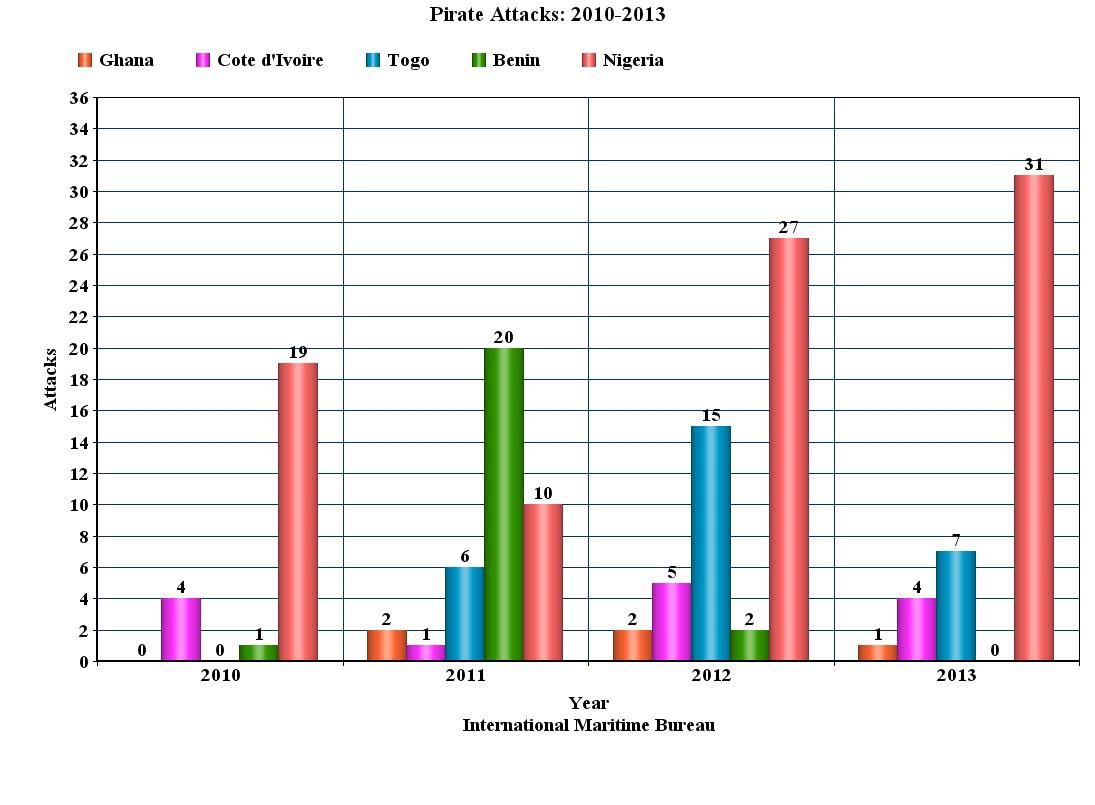
Ghana Chart

The specter of Nigeria-based piracy expanding to its waters has weighed heavily on Ghanaian officials as the country continues to develop its offshore oil productioncapabilities.  Accra has acquired new patrol boats and surveillance aircraft in recent years and is in the process of launching a naval special forces unit. Ghana has also sought to improve its maritime situational awareness by implementing a Vessel Traffic Management and Information System to remotely monitor vessels and coordinate efforts among government and commercial stakeholders. A pirate hijacking off a Ghanaian port will damage the country’s reputation for maritime security and “reflect on the attitudes of the international shipping community towards our port,” notes Paul Asare Ansah, head of public relations at the Ghana Ports and Harbors Authority.

A Tough Neighborhood

Despite the progress the country has made towards securing its maritime domain, Ghana remains beholden to a neighborhood characterized by “sea blindness and mutual distrust.” Pirates, for example, have hijacked several tankers along the maritime border of Ghana and Togo and then fled across the sovereign boundary to avoid hot pursuit from national naval forces. The Fair Artemis’ prolonged disappearance and likely multi-national hijack route mirrors the January 2014 case of the MT Kerala, which pirates hijacked off the coast of Luanda, Angola and then sailed some 1,200 miles north to sell its stolen cargo in Nigerian waters.  

Pirate Attacks in the Gulf of Guinea: 2014 (OCEANUS)
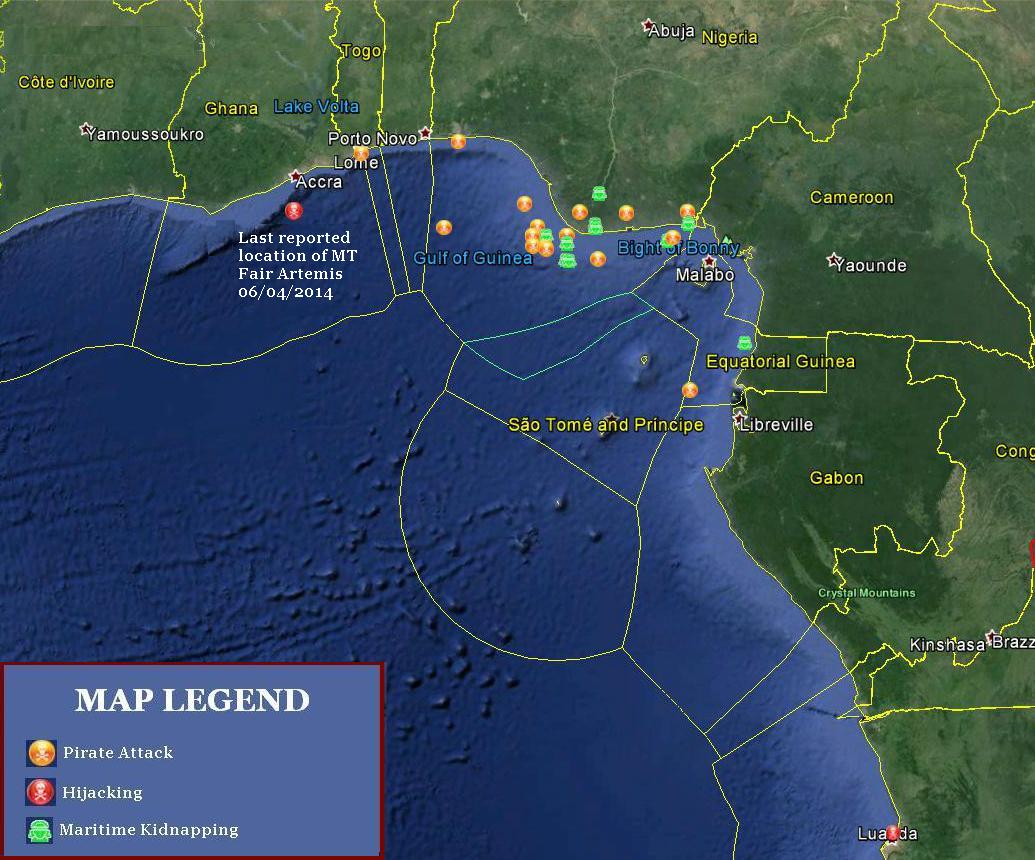
Gulf of Guinea Piracy 2014 (Data and analysis from Oceanus and Delex)

Over 60 percent of pirate attacks go officially unreported in the Gulf of Guinea, as vessel masters weigh the costs of delays and inspections against the unlikely chance of a regional naval response. 

The Maritime Trade Information & Security Centre (MTISC) in Accra was established with international support in 2013 as a means to improve regional information sharing and response coordination. However, interagency information sharing and exchange of maritime domain awareness information was reportedly lacking during a recent international naval capacity building exercise, Operation Obangame Express.  

Regional maritime security cooperation is incrementally improving, and tanker hijackings have in fact declined from a 2011 high. The presumed pirating of the Fair Artemis, however, demonstrates that the hijack gangs remain regionally active and will continue to stalk assumedly safe anchorages.

James M. Bridger is a Maritime Security Consultant with Delex Systems Inc. and the Director of Publications for CIMSEC. His current areas of focus and expertise address piracy, terrorism, and other irregular threats to global maritime transportation. He can be reached at jbridger@delex.com
Sea Control 38: War Gaming with the CRIC Podcast (1 of 2)

seacontrol2From the entertainment of the risk board to the grand scale of international exercises… war games of varying types and scale inform and misinform us in learning about war and conflict. For the first in a two-part series on wargaming, CIMSEC jumped onboard with Jeff Anderson and the CNO Rapid Innovation Cell Podcast to discuss the CRIC’s Fleet Battle School game as well as a more general group discussion of the benefits, tripfalls, potential and limitations of wargaming. Chris Kona discusses the Fleet Battle School game and some larger wargaming programs. Jeff nerds out on Starcraft, and I talk a bit about the first world war.
Download: Sea Control 38:
War Games (1 of 2)

Speaking of wargames… remember, CIMSEC is running our “Sacking of Rome” series starting 16 June! Instead of talking about securing the commons, maintaining global security… using historic examples, modern-day developments, or predictions of the future, red-team the global system and develop constructive answers to your campaign. If you were an adversary, how would you seek to subvert or tear down the global system and how could we stop you? Paul Pryce is our editor for the week: (paul.l.pryce -at- gmail.com).

Remember, subscribe on iTunes or Stitcher Stream Radio. Leave a comment and rate five stars!

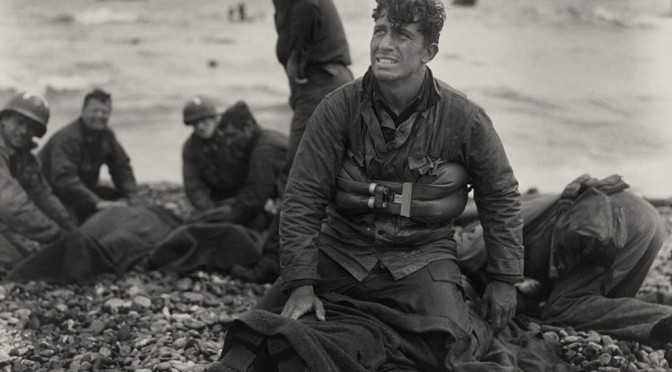
(ARCHIVE) URGENT Re: D-Day

This is from our archives, the 2012 reflection on D-Day.

Today’s military is an urgent place. Exclamation marks, capitalization, asterisks, and all sorts of extra accoutrements of PowerPoint panic or Outlook outrage are used to signal that yes, the supplementary quarterly alcohol awareness training is critical to ship’s readiness. As we have turned inward in a time of relative maritime peace, trading many of our helmets for hardhats, terms such as I(Insurv)-minus 400 have replaced the likes of D-Day and H-Hour. However, many approach these administrative and maintenance challenges with greater trepidation and anxiety than any young GI waiting in the landing craft with his rifle.

Today let us remember that exactly 70 years ago roughly 500,000 teenagers stormed through the bloody foam of a pounding surf into the mouth of German guns and likely death. The urgency was real, as men traded their lives for liberty in the most gruesome of ways. On this day, men were blown apart in their own landing craft before the shore. Soldiers drowned under the weight of their own packs in water shallower than a public pool. Waves of dedicated men lost everything they had before even setting foot on the continent they had resolved to save. With a mixture of fear and resolution, an entire generation of boys became old men in a matter of hours.


It is well that Memorial Day, Midway, and D-Day come within such close proximity to one another; In our fast-paced world where agitation and consternation can be transmitted at the speed of an email or a cellphone call, it’s a concentrated reminder of the young man huddled behind an anti-tank caltrop. Surrounded by the dead and halfway there, he has no radio, no phone, and no way to communicate his fears; he concentrates on his shipmates, solutions, and survival. He -knows- for what cause he wears his uniform. There is no room for complaint, as enough whining is being done by the bullets, bombs, and mortar rounds falling all around. However, he does take a moment to throw up a prayer, SUBJ: Re:URGENT.

PTP Response: Levels of Interaction, the Historical Approach and the Public Mind

This post was provided by Dr. John T. Kuehn in response to the series on CIMSEC and The Bridge, Personal Theories of Power. Dr. Kuehn is a member of the U.S. Army Command and General Staff College faculty and the author of Agents of Innovation: The General Board and the Design of the Fleet that Defeated the Japanese Navy and A Military History of Japan: From the Age of the Samurai to the 21st Century.

It is just here that the Institute might render important service to the profession by enlightening the public mind of the Navy on this subject, through the medium of essays and frequent discussions. — Admiral Stephen B. Luce, 1888, annual address as President of the U.S. Naval Institute

My personal theory of power, at least for the moment, has two parts. The first part comes from an idea broached by Mark Mandeles known as “levels of analysis.” The second part has to do with my own approach to exercising such power in ethical and, hopefully, altruistic ways in my own life through education, specifically educating minds to include the historical perspective. In other words, the theory followed by its application and execution in my own case.

Levels of Power — An Analysis

First, levels of analysis describe human interactions in terms of relationships. Generally, these levels fall into three groups: the individual, organizational, and institutional. Institutions are near the very top of social hierarchies and, in the words of Douglass North are, “society’s rules of the game.”[i] Translating this to a personal level, each human interaction occurs within these sorts of contexts and, therefore, for each of us, each interaction—as an individual, as a member of an organization or small cohesive team, and as a member of a larger institution—is pregnant with both possibility and limitation, occasionally leading to brilliant success or utter catastrophe. We influence others, wield our power as it were, in these situations and in different ways. Most interactions are at the personal level, but within teams and organizations, we behave a bit differently based, again, on the possibilities and limitations of our personal influence in that particular context. For example, parents exercise individual level power all the time with their children. At the organizational level we often think of our team, unit, or organization associated with employment. As one’s responsibility increases, so does the level of interaction and the ability to exercise personal power at the organizational level. However, for the audience that is probably reading this, we have folks who occasionally (or more often) exercise their power within institutional settings, as leaders of powerful institutions—for example Admiral Jonathan Greenert exercising his influence and authority as the US Navy service chief or David Petraeus when he was director of the CIA.

Education of the Historical Perspective

Back in the turbulent 20th Century an American historian named Thomas Bailey wrote A Diplomatic History of the American People. Bailey argued that the American people, through the power of public opinion, have always (one might say traditionally) exerted a profound influence on the foreign policy of the United States.[ii] This raises the issue of how does one influence the public opinion of the American people? N.A.M. Rodger dealt extensively with how the public mind is influenced by historical narratives and myths. He found that, contrary to perhaps conventional wisdom, Americans do use history to inform their public thinking, but that most of this history is flawed, wrong, or obscures what might have value coming to grips with the human past.[iii] I contend that the historical approach to influencing the public mind is not something that needs doing, rather it is something that needs doing correctly.

For Clausewitz and Mahan theory literally was study.

Minds as different and culturally divergent at Carl von Clausewitz, A.T. Mahan, and Mao Zedong all shared one trait in common when it came to military theory—theory should include study and when it came to war that study should be military history. For Clausewitz and Mahan theory literally was study.[iv] It is all well and good for the military professional to create his or her own theory by doing this (precisely what this series of articles is doing, after all), but how does this translate in power and influence? One means is through education, and not just military professionals or governmental elites, but the public. They get a vote.

For me it involves teaching, engaging if you will, with history as a means to educate the public mind—with individuals, groups, and in larger settings, at all levels. And so I teach primarily military and political history—at Fort Leavenworth, for Norwich University, at University of Kansas, for the Naval War College fleet seminar program, and frankly at any opportunity I get.

A theory is useless unless one employs it in a practical and daily manner.


[i] Friedman, Mandeles, and Hone, American and British Aircraft Carrier Development, 5-6. These authors cite Nobel Laureate Douglass C. North, Institutions, Institutional Change, and Economic Performance (New York, 1993.) More recently, Mandeles acknowledges the role of Jean de Bloch’s pioneering analyses in The Future of War: Organizations as Weapons (Washington, DC, 2005) as contributing to his inspiration for the “levels of analysis” approach.

[ii] Thomas Bailey, A Diplomatic History of the American People, Tenth Edition (Englewood Cliffs, NJ: Prentice-Hall, 1980).

[iii] N.A.M. Rodger, “The Perils of History,” Hattendorf Prize Lecture, Naval War College Review (October 2011): 8-15

[iv] Carl von Clausewitz said this literally in Book 2 on military theory of On War, trans. Peter Paret and Michael Howard (Princeton, NJ: Princeton University Press), 141-142; Jon T. Sumida emphasizes this aspect of both Mahan’s and Clausewitz’s theoretical approaches in Inventing Grand Strategy and Teaching Command: The Classic Works of Alfred Thayer Mahan Reconsidered (Washington, D.C.: Woodrow Wilson Center Press/Johns Hopkins Univ. Press, 1997) and Decoding Clausewitz (Lawrence, KS: University of Kansas Press, 2008), especially chapter 1. For Mao see John Shy and Thomas Collier, “Revolutionary War” in Makers of Modern Strategy (Princeton, NJ: Princeton University Press, 1986): 815-862.