All posts by Guest Author

How the Fleet Forgot to Fight, Pt. 4: Technical Standards

Read Part 1 on Combat Training. Part 2 on Firepower. Part 3 on Tactics and Doctrine.

By Dmitry Filipoff

Introduction

The nature of a system’s technical performance is an important foundation for developing tactics and gauging readiness. Naval warfare is especially technically intensive given that a modern warship is an advanced machine made up of many complex systems.

Combat systems are rapidly evolving in the Information Age and are frequently upgraded through new software updates. This adds to the challenging of maintaining current skills and can require a force to regularly retrain its people. However, warfighting culture characterized by scripted training can mask a decline in technical competence. Such a decline can be seen in how standards fell for some of the most important tools that help the Navy guard against tactical surprise.

Environmental Factors

When American warships came under missile fire in the Red Sea two years ago they could have been far better prepared. Key environmental data that would affect the parameters of any anti-air engagement was left unaccounted for, thereby contributing an important degree of tactical surprise. Many years earlier the Navy had finalized key tools and procedures that would promise a significant evolution in environmental awareness and would have greatly mitigated this sort of tactical surprise. Somehow these tools never made it into the fleet in time.

John Hopkins University Applied Physics Laboratory (JHU APL) has been at the forefront of the Navy’s technology development for decades, including leading work on networking and surface-to-air missile capabilities. In 1982 the Navy’s Aegis Program Office began supporting JHU APL work on radar propagation models. This effort intended to more precisely understand the performance of the Aegis combat system and better account for environmental variables.1 JHU APL expounded on the important tactical implications of knowing those environmental variables:

“Environmental impacts on missile detection can be complex. The environment may limit radar detection ranges and cause degradations in track continuity through the effects of land, sea, and precipitation clutter. Communications systems may experience outages or periods of increased interference. Weapon systems may encounter midcourse guidance errors and variations in illuminator power-on-target and bistatic clutter into the missile, which affect the missile engagement envelope. In addition, the environment affects radar configuration, ship stationing, situational awareness, and missile doctrine selection.”2

Variables such as the temperature of the ocean and air, humidity, sea state, and wind speed have a strong effect on how radar energy propagates throughout the atmosphere. The chart below shows the range at which a target transitioned into track by an AN/SPY-1 radar across 20 Navy live fire exercises in differing environmental conditions. It shows how environmental factors can affect detection range by as much of a factor as three to four.3 It points out how firm track ranges could be reconstructed from post-exercise analysis that factored in environmental data gathered by key measuring tools such as rocketsondes and helicopters equipped with environmental sensors.
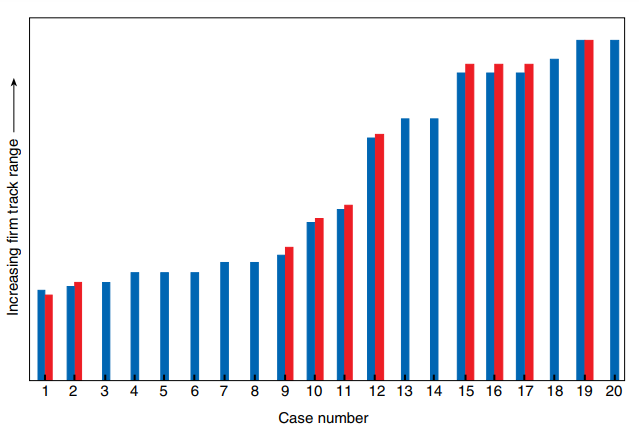
Original caption from JHU APL source: Twenty cases showing variation in actual AN/SPY-1 performance for littoral environments are shown in blue (actual firm track range). Cases where timely helicopter and/or rocketsonde measurements supported postexercise AN/SPY-1 performance analysis are shown in red (simulated firm track range).

Radar energy can behave very differently when acted on by environmental factors. Radar pulses can be absorbed by the atmosphere, sapping the amount of energy that can be reflected back toward the receiver. Ducting can create radar holes and skip zones where targets cannot be detected. Refraction can even make targets appear to change direction. Atmospheric effects can also worsen radar clutter on the ocean surface hundreds of miles away from the radar.4  

These factors combine to affect the key performance metric of probability of detection and can even create false contacts. Because radar energy acted on by environmental phenomena will often have more unpredictable and complex behavior compared to simpler line-of-sight detection these effects can challenge radar clutter rejection algorithms that are built into combat systems.

One of the most significant tactical implications of the environment is that certain conditions can allow a ship to break through the fog of war and see through the radar horizon limitation. Refracted radar energy can travel far along the surface and allow a ship to detect a sea-skimming target for many tens of miles below and beyond the radar horizon. Environmental awareness is therefore critical to improving threat perception and adding to a ship’s depth of fire in a most crucial zone of tactical action.
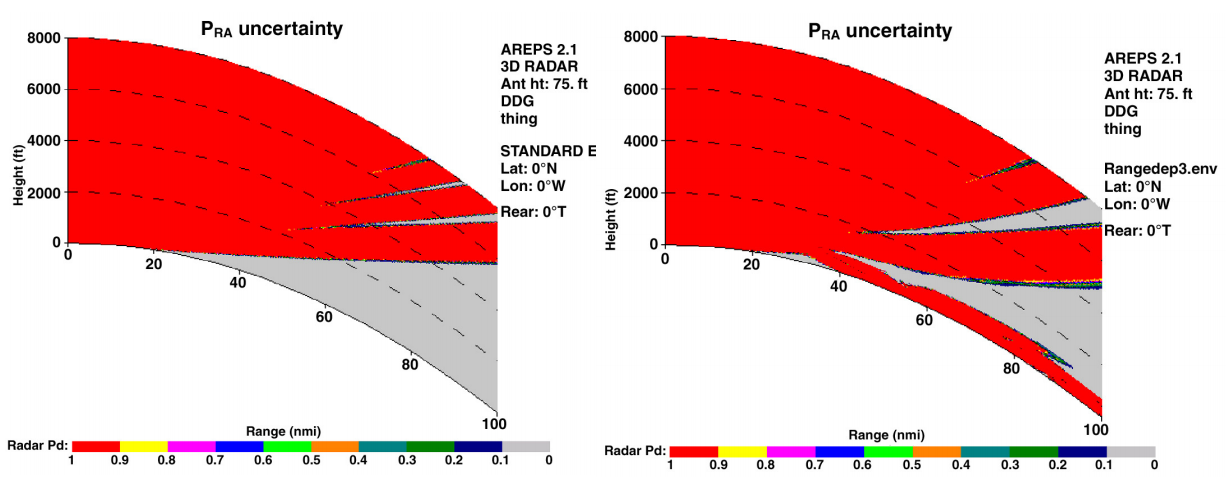
Radar propagation models where the figure on the right shows how surface ducting conditions allow radar energy to bend over the horizon. (Source: Donna W. Blake et. al, “Uncertainty Results for the Probability of Raid Annihilation Measure,” 2006.)

These effects combine to make mastering environmental awareness a major tactical priority. A tactical memorandum (TACMEMO) issued by the Surface Warfare Development Group in 1995 reinforced this point:

“To adequately define expected detection ranges for a given threat, an accurate assessment of the environment and its impact on sensor systems and employment is required. Depending on the environmental conditions being experienced, system performance could be enhanced or degraded. The primary environmental factors which impact detection ranges are temperature, atmospheric pressure, relative humidity, and local weather. The operating environment (e.g. near land/overland, littoral, or open ocean) also (affects) ranges.”5 

These environmental effects are known, but the operational challenge is in accurately measuring them in real time and then making the necessary tactical adjustments.6 Potential solutions take the form of environmental sensors as well as modeling software that is wedded to combat systems. However, while shipboard sensors and measurements can collect environmental data, certain tools are required to gather additional data beyond what can only be gathered from the deck of a ship in order to produce higher-fidelity models.

High-quality environmental assessments were proven to require crucial range-dependent data that must be collected by periodically launched tools such as helicopters equipped with environmental sensors. JHU APL’s prototype SEAWASP system would model environmental conditions and would monitor the need to launch an expendable tool called a rocketsonde that was considered “the most effective of the expendable sensor packages for providing real-time environmental information” and where the rocketsonde was described as “essential for supporting radar performance assessments under many conditions.”7 JHU APL scientists also described the environmental helicopter as “the platform of choice” and suggested “the future may see environmental sensors on operational helicopters.”
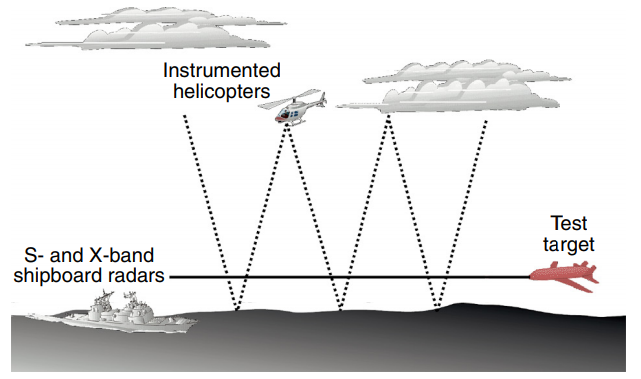
Original caption from JHU APL source: Helicopter sawtooth pattern. Temperature, pressure, humidity, altitude, latitude, longitude, and meteorological measurements are collected on helicopter descents.

By 2001 these systems were tested by operational units in several deployments and received enthusiastic reviews for inclusion in future Aegis baselines. The Navy Program Executive Office for Theater Surface Combatants (PEO TSC) asked JHU APL to plan to backfit their prototype SEAWASP environmental assessment capability onto existing ships and for incorporation into future system baselines.8 Guidance for using the SPY radar to help determine the presence of atmospheric effects was included in the form of appendices to the Aegis TACMEMO.9 Helicopter-based environmental assessment was mandated for Aegis Combat Systems Ship Qualification Trials (CSSQTs).

Yet somehow these efforts fell flat. Despite adequate testing and strong recommendations that the Navy widely field measuring tools like rocketsondes and helicopter-based sensors it appears these simple yet critical systems are almost nowhere to be found in the Navy’s operational forces today.

The Surface and Mine Warfighting Development Center (SMWDC) described the main lessons learned from the 2016 Red Sea attacks:

“The first and perhaps most significant lesson emerged from observing the impact of the Red Sea littoral environment on combat-system performance during an actual engagement. Until the events in October, the best understanding of environmental impact on system performance had come from computer simulations and live-fire exercises in the less-challenging conditions in the Virginia Capes or Southern California operational areas…We have updated our AWS, SSDS, and SPY radar doctrines to account for environmental impacts to system performance previously unobserved during a live Standard missile engagement.”10 

Previously unobserved environmental conditions may have turned into tactical surprise in part because the Navy’s best understanding of these variables may have come from only a couple areas close to home that feature test ranges. Fixed test ranges can constrain environmental awareness through consistent conditions. Atmospheric refractivity also happen to be far more intensive in littoral regions. However, it seems the Navy lacked key environmental awareness in one of the world’s most important maritime chokepoints that lies within the Middle East littoral that was prioritized for a generation.11 

If the Navy wasn’t environmentally aware in the Red Sea because things were mostly tested near Virginia or California then what does the Navy not know about the environment in the Baltic Sea, the Mediterranean, the South China Sea, or everywhere else in the world the Navy deploys? Does the Navy have specifically-tailored doctrine statements and combat system configurations for all of these environmental conditions?
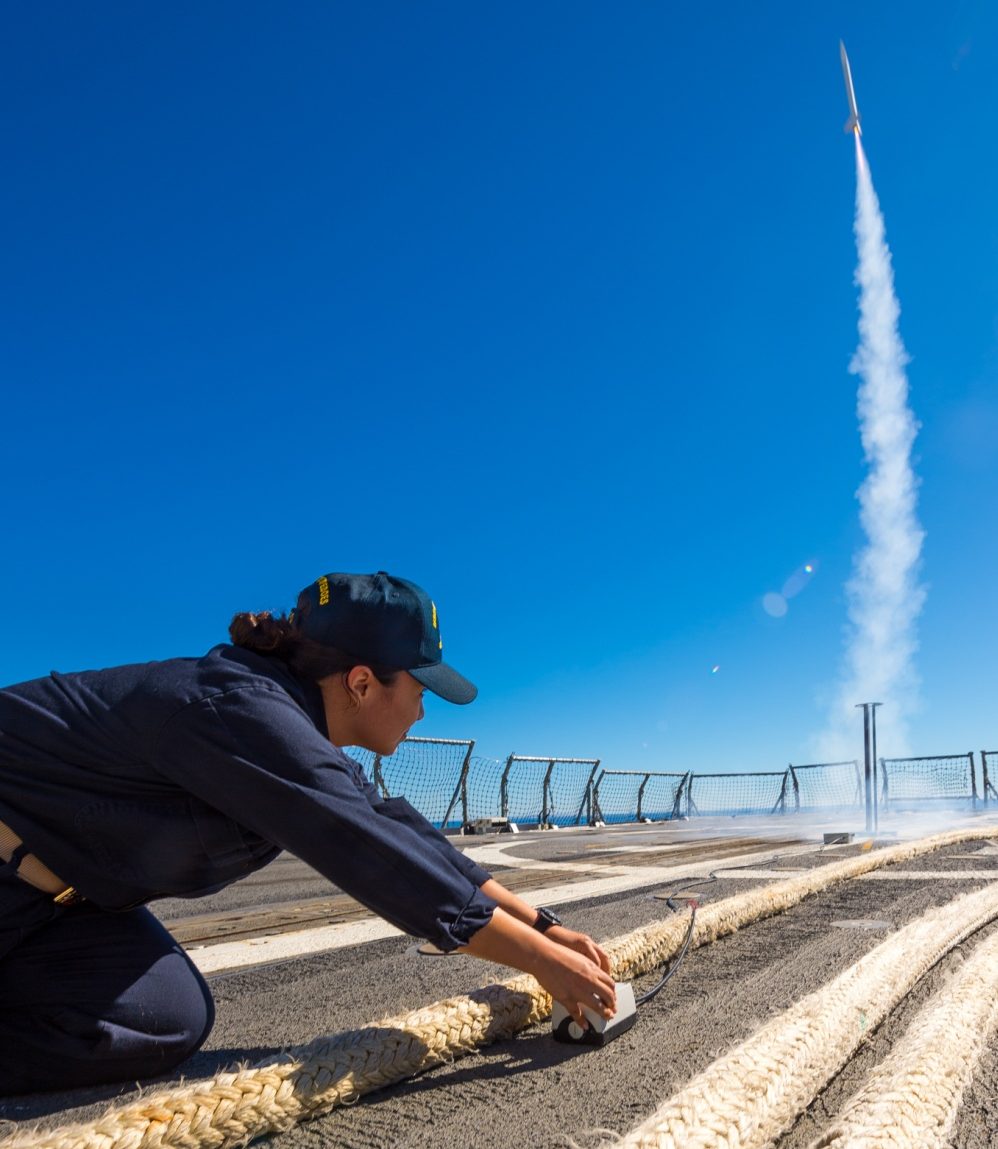
PACIFIC OCEAN (Oct. 23, 2017) Lt. Rose Witt, the guided-missile cruiser USS Mobile Bay (CG 53) Supply Officer, assists in launching a rocketsonde from the flight deck of the ship. Mobile Bay is currently underway testing an AEGIS Baseline 9 upgrade to its Baseline 8 combat system in preparation for its upcoming deployment. (U.S Navy Photo by Mass Communication Specialist 1st Class Chad M. Butler/Released)

Once the environment is revealed to be crucial tactical context the force must develop an expeditionary environmental learning program as a most urgent necessity. The Navy already operates such programs to understand the environment on a global scale, such as how environmental factors have long been known to affect undersea operations and anti-submarine warfare. This understanding is operationalized through a global exercise program the surface fleet has maintained for decades, the Ship Antisubmarine Warfare Readiness and Effectiveness Measuring (SHAREM) program. Exercises under SHAREM are conducted across many geographic areas to account for different environmental factors thereby producing tailored tactics and revealing shortfalls.12 If not for environmentally-focused programs like SHAREM the tactical effectiveness of the surface fleet’s anti-submarine warfare capability would be far from ideal. 

But does the Navy have a similar program that specifically seeks to account for the tactical effects of atmospheric refractivity? These environmental effects not only impact radar energy, but radiofrequency energy more generally. According to JHU APL the performance of major capabilities such as close-in-weapons systems and critical networks like the Cooperative Engagement Capability (CEC) were also “shown during field tests to strongly depend on atmospheric refractivity.”13 

The tactical implications are clear and profound, especially for networked warfighting. Environmental awareness is foundational to electromagnetic awareness. 
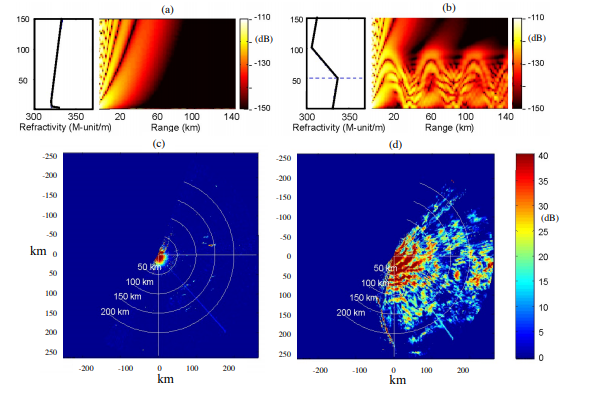
Original caption from source: Propagation diagram of a (a) weak evaporation duct, (b) surface-based duct (high intensity: bright). Radar PPI screen showing clutter map (dB) during the 1998 SPANDAR experiment resulting from a (c) weak evaporation duct, (d) surface-based duct. (Click to expand.)

SMWDC is setting an example by charging hard and implementing fast-paced corrective action after the Red Sea attacks:

“…Surface Warfare Advanced Tactical Training and live-fire exercises have been updated to keep pace…SMWDC teams have visited every deployed and soon-to-deploy ship to ensure each has the latest TTP, training, and combat-system configuration recommendations. Ashore, the Radar Systems Controller Enhanced Course has been restored as a critical tool to ensure our SPY radar operators are prepared for what they will face in theater. In addition, SMWDC has built a case study from these events that is being included in the curricula of tactical training schoolhouses across the fleet.”

Now the question remains as to how updated understanding of the environment will translate into other parts of the Navy’s force development. SMWDC said the attacks should result in updated performance models and pointed to the problem of the Navy having only a handful of baseline datasets drawn from the Virginia Capes and Southern California areas. The widespread lack of environmental assessment tools that were described as “essential” such as rocketsondes and helicopters with special sensors may also indicate very incomplete datasets. 

Whether it be training, test and evaluation, or wargaming, these insights born from the Red Sea attacks may require many other parts of the Navy to update baseline data and contemplate extensive retroactive action. Such action could take the form of replaying wargames with newly updated environmental parameters and conducting expeditionary test and evaluation in less familiar waters. 

Ultimately such an important evolution in environmental awareness should have been enough to prompt rapid and wide-ranging adaptation similar to what SWMDC is doing and what was hinted at years ago. At first, the Navy did appear to be in the process of introducing expected change. The importance of atmospheric refractivity on tactical possibility was being acknowledged in the form of new programs of record, tactical memoranda, and requirements, many dating back over twenty years ago. Upgraded environmental assessments were made mandatory in at least one key part of the Navy’s business in the form of Aegis CSSQTs. Key measuring tools such as rocketsondes and helicopters with environmental sensors were tested, proven, approved of, and required relatively little effort to equip.

Somehow the system comprehensively failed, and frontline warfighters came under fire while lacking the important degree of tactical awareness those key tools contribute. Now to best anticipate tactical surprise the Navy must look to update environmental understanding on a global scale.

View post on imgur.com

 Sea surface currents and temperatures in the eastern Pacific Ocean (NASA)

SPY Radar 

The SPY radar is the most powerful radar on the Navy’s large surface combatants, and it is perhaps the most important set of eyes for the Aegis combat system. But this critical radar suffered a decline in standards. After describing several issues with SPY radar maintenance the 2010 Balisle report noted:

“The SPY radar has historically been the best supported system in the surface Navy. If the SPY radar is one of the most important systems in the Navy and central to our BMD mission for the foreseeable future, then it is assumed that less important systems could well be in worse material condition.”14

In his article, “Is Your SPY Radar Enhanced, Nominal, or Degraded?” Captain Jim Kilby recalled the Balisle report’s warning and described his own experience in witnessing a decline in radar maintenance. After reminiscing about past standards Kilby said that somewhere along the way the surface fleet had “lost some of this spirit”and that Sailors “do not have the cultural model to fall on when they report to the ship.” This loss of spirit and culture could be possibly interpreted as the degradation of standards. Kilby felt he ultimately had to “provide that leadership” himself.15 

Kilby may have felt he personally had to set a higher standard because he realized the Navy, institutionally, did not properly maintain it. The Balisle report suggested that Sailors are “perhaps losing their sense of ownership of their equipment and are more apt to want others to fix it.” Kilby relates a story where a contractor working as a combat systems instructor for his crew said he and his technicians used to have a tracking book so they “all knew where we were, combat-system performance-wise.” Captain Kilby then wondered to himself, “Why shouldn’t I know that too?” 

If something can be measured then it can usually be optimized. Kilby pointed out “You can’t manage what you can’t measure,” so they “decided to measure and track key parameters to better manage the system.” He went on to discuss how he personally instituted a new process on the warship to track the performance of the SPY radar that would go “beyond a superficial indicator level.” Kilby realized he had to know the quantitative results of maintenance actions in order to know how radar performance was trending, such as with respect to key metrics like effective transmit power. He went on to personally invent and decide on a “quantitative SPY radar material goal” to provide to the crew. 

But is it really the responsibility of one ship’s captain to decide what the radar material goal should be for the SPY radar, let alone invent such a standard on his own? A crew that does not have a meaningful system to track the transmit power of their radar is like an armor crewman not knowing he should boresight the main gun of a tank, or an infantryman not knowing how to sight his scope. This was Kilby’s fifth Aegis tour and he certainly wasn’t inexperienced. His career track put him inside the Navy’s surface warfare directorate, the Ballistic Missile Defense office, and he partook in the Aegis Fire Controlman Deep Dive that resulted in new training. He also happened to invent this new radar tracking system around the first ballistic missile defense patrol of a freshly upgraded cruiser, a special unit that could find itself on the frontlines of defending against nuclear attack.

Perhaps change has taken place since Kilby published about his reforms. But it suggests that for a time the Navy did not have a meaningful set of standards in place for unit leaders to effectively know the performance of one of the most critical sensors in the fleet. What was Kilby’s personal invention clearly should have already been a Navy-wide process and standard. In the end his new methods were not unique innovations, but rather rediscovered responsibilities:

“SPY radar self-sufficiency can and should be supported by outside entities, but ultimately it is a function of my behavior, interest, and leadership. It is my responsibility. Specific results of transmitter power and phase must be understood, considered, and acted upon by operators and by me. The devil is in not knowing the details. As the commanding officer, I have to be personally involved. I cannot delegate this effort.”

Target Missiles

The Navy’s lack of appreciation for the anti-ship missile threat is not confined to its own limited arsenal of such weapons, but also extends to the inventory of target missiles that seek to replicate those threats for force development. The Navy allowed a significant shortfall to emerge in its inventory of target missiles where tools that realistically represent the supersonic anti-ship missile threat are now very few and far between.

A 2005 report by the Defense Science Board described the shortfall at the time as “dire” and that the supersonic target missile inventory was “substantially deficient.” It pointed out the discrepancy between the tools on hand and the common flight profiles of weapons in the hands of great power rivals:

“The area of greatest concern to the Task Force was our gap in supersonic anti-ship cruise missiles for testing. The Russians have deployed at least three such cruise missiles that involve either sea-skimming flight profiles or a high-altitude profile involving a power dive to the target. At this time, we have no test vehicles for either flight profile.”16

Once the anti-air Talos missile was retired in the late 70s the remaining inventory was converted into Vandal target missiles. The Vandal would be the Navy’s main tool for representing the supersonic sea-skimming missile threat for decades. For other threats the AQM-37C long served as the Navy’s target for high-flying supersonic flight. However, it is incapable of maintaining supersonic speeds while executing a powered dive or sea-skimming trajectory – the two common flight profiles of supersonic missile threats the Defense Science Board noted.
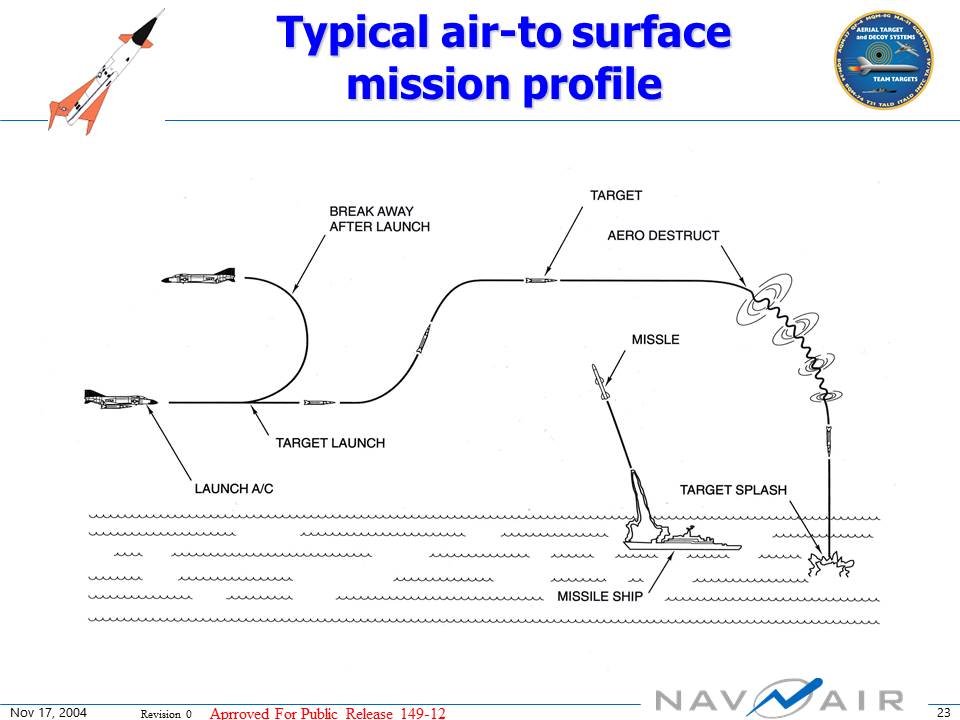
Flight profile of AQM-37C target missile. (Source: Presentation by Steve Berkel, AQM-37 Projection Coordinator, NAVAIR, 2004.)

The supersonic AQM-37C and Vandal target missiles were launched dozens of times per year for decades.17 But the firing rates fell to much lower levels after they left service in the early 2000s. After a viable replacement came online in 2005 in the form of the Coyote target missile the Navy would go on to launch less than 50 targets capable of supersonic sea-skimming flight across the next ten years.18 Admiral Phil Davidson also claimed that Navy units based on the East Coast went almost 13 years without shooting down any supersonic target missiles until 2016.19 
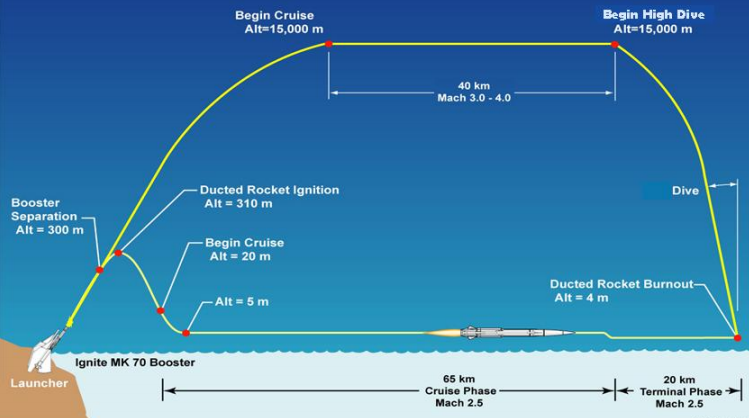
High-diver and sea-skimmer flight profiles of supersonic Coyote target missile (Source: Presentation by CAPT Pat Buckley, Aerial Target and Decoy Systems Program Office PMA-208, 2006.)

The Navy launches several hundred target missiles per year but almost all are slow, subsonic payloads that hardly represent the supersonic anti-ship missiles that are commonly found in the navies of great power competitors.20 It also appears that supersonic target missiles are almost always fired from land. This diminishes the realism of the events with respect to exploring varying environmental conditions, especially those that would be found in open-ocean warfare.21

In spite of this, the subsonic target missile that according to the Navy is its “workhorse” will be replaced by another subsonic payload.22 As more lethal supersonic and eventually hypersonic weapons proliferate the Navy’s target missile inventory will continue to be almost entirely made of subsonic payloads that fail to accurately represent these advanced threats. The disparity between the Navy’s target inventory and the true nature of the anti-ship missile threat is poised to widen further.
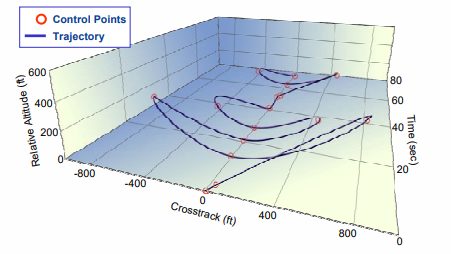
Optional flight profile of a subsonic BQM-74 target missile simulating terminal phase maneuvering. (Source: Presentation by John VanBrabant
Manager, Aerial Targets Business Development Integrated Systems Western Region, Northrop Grumman Corporation, NDIA Targets 2006.)

Supersonic target missiles certainly are very expensive tools and it is impractical to expect most units to have a chance to practice with them. However, these tools are invaluable for ensuring realism for key force development activities.

Consider all the lessons SMWDC is learning and translating into the surface fleet, especially through their restarted Live Fire With a Purpose (LFWAP) events that aim to “test and validate TACMEMOs and latest tactical recommendations.”23 For the sake of tactical development and high-end readiness what good may come from firing salvos of supersonic target missiles in the general direction of some of the Navy’s finest tacticians?

Doctrine Statements

For a force that is primarily made of highly sophisticated machines technical standards are a key part of warfighting readiness. In the case of naval warfare the abovementioned technical standards have especially important tactical consequences.

Naval warfare in the missile age is notable for having transcended the boundary of human limitations. The speed and intensity of engaging a salvo of anti-ship missiles that could be seconds away from impact is a tactical challenge that is mostly beyond the ability of a human to carefully manage with real-time inputs. Therefore the combat systems of warships, perhaps best exemplified by the Aegis combat system and the Ship Self-Defense System (SSDS), must be automated to an extraordinary degree to stand a chance of defeating missiles under trying circumstances.  

The role of the operator then is to program pre-set conditions and instructions into the combat system. These are known as doctrine statements, up to and including fully automated responses for highly lethal situations. These doctrine statements can be built around the characteristics and flight profiles of potential threats, and can dictate how the combat system will automatically combine the various capabilities of the ship to defeat those threats.24 These automated doctrine statements can be the Navy’s last line of defense against tactical surprise because even if Sailors are caught off guard by a sea-skimming salvo breaking over the horizon the automated combat system can carry the day.
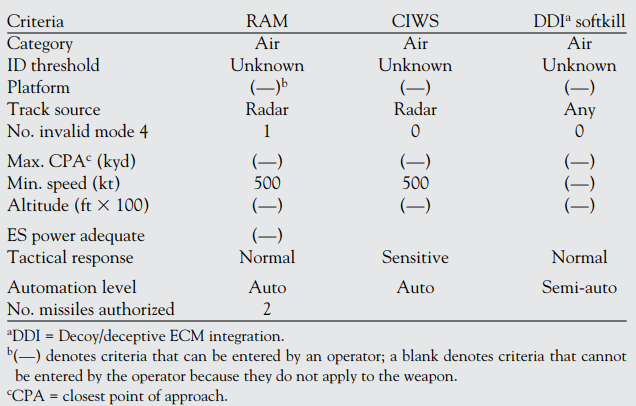
Example of a Ship Self-Defense System (SSDS) engagement doctrine statement. (Source: Richard J. Prengaman et. al, “Integrated Ship Defense,” JHU APL Technical Digest)

Effectively countering the anti-ship missile threat is very much a matter of crafting doctrine statements well in advance of a combat situation. Sailors should not be put in a position where they are forced to rapidly reconfigure doctrine statements in the middle of the fight in order to survive. More ideally, Sailors will be familiar with a variety of well-tailored doctrine statements they can choose from to meet a range of situations.

It is essential to know the state of a radar’s energy output and to understand the environmental factors that dictate how that radar energy propagates. Both are fundamental baseline context for ascertaining the ability to detect targets, knowing how to configure combat systems, and managing emissions control.25 Certain environmental conditions can also raise the probability of false alarms, and there may be situations with little opportunity to intervene in an automated response to make timely corrections.

How well does the Navy understand the nature of guiding a semi-active homing weapon such as the Standard Missile through environmental conditions below the radar horizon? How well has the Navy configured doctrine statements to guard against skip zones and other environmental effects that complicate how a ship can see and engage targets through its radar? 
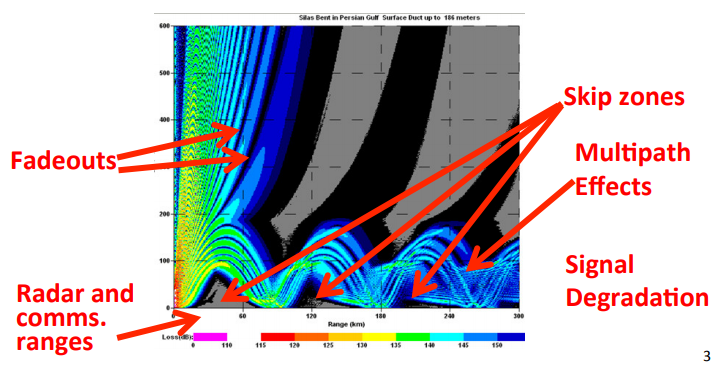
Radar propagation effects of environmental surface duct in the Persian Gulf. (Source: “Trident Warrior: Demonstrating the Use of Unmanned Aerial Vehicles for Characterizing the Marine Electromagnetic Propagation Environment.” Presentation by Dr. Peter Guest, Department of Meteorology, Naval Postgraduate School. Click to expand)

Consider the Red Sea combat events and how new doctrine statements and combat system configurations were key outputs from the learning experience, and how these updates were based on a specific environmental context. The Navy should look to this experience and see how it can learn similar lessons minus the risks of real combat. As an engine of tactical development can the Navy conduct expeditionary Live Fire With a Purpose events similar in design to the SHAREM program? Could the Navy produce refined doctrine statements by firing advanced target missiles in varying environmental conditions that resemble forward areas? Such a program could do well to sharpen the tool of Aegis.

Poor environmental awareness, low-fidelity target missiles, and lack of key radar performance metrics forms a recipe for less than ideal doctrine statements. Failing to maintain high technical standards across these areas suggests very suboptimal programming may be built into the automated combat functions of warships across the world.


Part Five will focus on Material Condition and Availability.


Dmitry Filipoff is CIMSEC’s Director of Online Content. Contact him at Nextwar@cimsec.org.

References

1. J. Ross Rottier, John R. Rowland, Gerald C. Konstanzer, Julius Goldhirsh,
and G. Daniel Dockery, “APL Environmental Assessment for Navy Anti-Air Warfare,” JHU APL Technical Digest, Volume 22, Number 4, 2001. https://pdfs.semanticscholar.org/8400/6b65f5cac14e71239fc5aa7e400444007036.pdf 

2. J. Ross Rottier, John R. Rowland, Gerald C. Konstanzer, Julius Goldhirsh,
and G. Daniel Dockery, “APL Environmental Assessment for Navy Anti-Air Warfare,” JHU APL Technical Digest, Volume 22, Number 4, 2001. https://pdfs.semanticscholar.org/8400/6b65f5cac14e71239fc5aa7e400444007036.pdf 

3. James J. Sylvester, Gerald C. Konstanzer, J. Ross Rottier, G. Daniel Dockery,
and John R. Rowland, “Aegis Anti-Air Warfare Tactical Decision Aids,” JHU APL Technical Digest, Volume 22, Number 4, 2001. http://www.jhuapl.edu/techdigest/TD/td2204/Sylvester.pdf

4. Naval Surface Warfare Dalhgren Division, “Sensors: Challenges and Solutions for the 21st Century,” Leading Edge, Volume 7, Issue No. 2. https://www.navsea.navy.mil/Portals/103/Documents/NSWC_Dahlgren/LeadingEdge/Sensors/Sensors03.pdf 

5. John David Whalen, “Comparison of evaporation duct height measurement methods and their impact on radar propagation estimates,” Naval Postgraduate School, 1998. https://calhoun.nps.edu/bitstream/handle/10945/8118/comparisonofevap00whal.pdf?sequence=1 

6. Committee on Environmental Information for Naval Use, Ocean Studies Board of the National Research Council of the National Academies, Environmental Information for Naval Warfare,” 2003. https://www.nap.edu/read/10626/chapter/11#148

7. J. Ross Rottier, John R. Rowland, Gerald C. Konstanzer, Julius Goldhirsh,
and G. Daniel Dockery, “APL Environmental Assessment for Navy Anti-Air Warfare,” JHU APL Technical Digest, Volume 22, Number 4, 2001. https://pdfs.semanticscholar.org/8400/6b65f5cac14e71239fc5aa7e400444007036.pdf 

8. James J. Sylvester, Gerald C. Konstanzer, J. Ross Rottier, G. Daniel Dockery,
and John R. Rowland, “Aegis Anti-Air Warfare Tactical Decision Aids,” JHU APL Technical Digest, Volume 22, Number 4, 2001. http://www.jhuapl.edu/techdigest/TD/td2204/Sylvester.pdf

9. James J. Sylvester, Gerald C. Konstanzer, J. Ross Rottier, G. Daniel Dockery,
and John R. Rowland, “Aegis Anti-Air Warfare Tactical Decision Aids,” JHU APL Technical Digest, Volume 22, Number 4, 2001. http://www.jhuapl.edu/techdigest/TD/td2204/Sylvester.pdf

10. Rear Admiral John Wade and Lieutenant Timothy Baker, USN, “Red Sea Combat Generates High Velocity Learning,” U.S. Naval Institute Proceedings, September 2017. https://www.usni.org/magazines/proceedings/2017-09/red-sea-combat-generates-high-velocity-learning 

11. J. Ross Rottier, John R. Rowland, Gerald C. Konstanzer, Julius Goldhirsh,
and G. Daniel Dockery, “APL Environmental Assessment for Navy Anti-Air Warfare,” JHU APL Technical Digest, Volume 22, Number 4, 2001. https://pdfs.semanticscholar.org/8400/6b65f5cac14e71239fc5aa7e400444007036.pdf 

12. OPNAV INSTRUCTION 3360.30D, “SHIP ANTISUBMARINE WARFARE READINESS AND EFFECTIVENESS MEASURING PROGRAM,” Chief of Naval Operations, January 23, 2018. https://doni.documentservices.dla.mil/Directives/03000%20Naval%20Operations%20and%20Readiness/03-300%20Warfare%20Techniques/3360.30D.pdf

Excerpts:

4. Objective. The objective of the SHAREM Program is to assess surface ship ASW readiness and effectiveness and recommend solutions for ASW warfighting gaps. This objective is met via the collection and analysis of sensor and environmental data in tactically relevant geographic operating areas.

a. SHAREM exercises will evaluate surface force ASW systems and tactics, techniques, and procedures in tactically-relevant environments. Evaluation of current and emerging threats and environments of national interest, as recommended by the fleet and force commanders and as directed by the Office of the Chief of Naval Operations, Surface Warfare Division (OPNAV N96), will lead to development of tactically-focused exercise events and collection of tactically significant environmental data.

b. Environmental data will be collected in coordination with systems commands, naval laboratories, and Commander, Naval Meteorology and Oceanography Command.

c. SHAREM-sponsored exercises, Submarine Command Course (SCC) mini-wars, and limited objective experiments provide the opportunity to collect and analyze data to assess the full scope of surface ship ASW operations through the detect-to-engage sequence. Exercises should be conducted on underwater tracking ranges or in environments that reflect areas of
operational interest.

See also: Naval Surface and Minewarfighting Development Center SNA National Symposium Edition Newsletter, January 2018. https://www.public.navy.mil/surfor/nsmwdc/Documents/SMWDC_January_2018_Newsletter.pdf

Excerpt:

“SHAREM has operated for 48 years and has transitioned from SWDG to SURFDEVRON, SURFDEVRON to STDG, and finally STDG to SMWDC, where it now resides. SHAREM is highly effective at informing future ship builds, releasing tactical memos (TACMEMOs) for future integration into tactics, techniques and procedures, and maintaining a database of all data collected.”

13. James J. Sylvester, Gerald C. Konstanzer, J. Ross Rottier, G. Daniel Dockery,
and John R. Rowland, “Aegis Anti-Air Warfare Tactical Decision Aids,” JHU APL Technical Digest, Volume 22, Number 4, 2001. http://www.jhuapl.edu/techdigest/TD/td2204/Sylvester.pdf

14. Vice Admiral Phillip Balisle, USN (ret.), “Fleet Review Panel of Surface Force Readiness,” February 26, 2010.  http://www.sailorbob.com/files/foia/FRP%20of%20Surface%20Force%20Readiness%20(Balisle%20Report).pdf

15. Captain Jim Kilby, USN, “Is Your SPY Radar Enhanced, Nominal, or Degraded?” U.S. Naval Institute Proceedings, January 2012. https://www.usni.org/magazines/proceedings/2012-01/your-spy-radar-enhanced-nominal-or-degraded 

16. “Report of the Defense Science Board Task Force on Aerial Targets,” Defense Science Board, October 2005. http://www.dtic.mil/dtic/tr/fulltext/u2/a441466.pdf

17. Presentation by Steve Berkel, AQM-37 Projection Coordinator, NAVAIR, 2004. https://www.google.com/search?q=STEVE+BERKEL+ppt+navair&oq=STEVE+BERKEL+ppt+navair+&aqs=chrome..69i57.4393j0j9&sourceid=chrome&ie=UTF-8

18.  “Orbital ATK Successfully Launches Two Coyote Targets for the U.S. Navy,” Businesswire.com, June 17, 2005. https://www.businesswire.com/news/home/20150617005337/en/Orbital-ATK-Successfully-Launches-Coyote-Targets-U.S.

See also: 49th Annual Targets, UAVs, & Range Operations Symposium & Exhibition, 2011. http://www.dtic.mil/dtic/tr/fulltext/u2/1005858.pdf#page=142

19. Megan Eckstein, “Warfighting Development Centers, Better Virtual Tools Give Fleet Training a Boost,” U.S. Naval Institute News, February 23, 2017. https://news.usni.org/2017/02/23/fleet-training-getting-a-boost-through-better-lvc-tools-warfighting-development-centers

20. Presentation by John VanBrabant Manager, Aerial Targets Business Development Integrated Systems Western Region, Northrop Grumman Corporation, NDIA Targets 2006. https://ndiastorage.blob.core.usgovcloudapi.net/ndia/2006/targets/VanBrabant.pdf

21. Captain Pat Buckley Program Manager PMA-208, Aerial Target & Decoy Systems, October 10, 2008. https://ndiastorage.blob.core.usgovcloudapi.net/ndia/2008/targets/Friday/Buckley.pdf

22. Subsonic Aerial Target System (SSAT), Naval Air Systems Command. http://www.navair.navy.mil/index.cfm?fuseaction=home.displayPlatform&key=2F240C2D-621A-42B2-9186-20B3F2469236

For “workhorse” see: Captain Pat Buckley Program Manager PMA-208, Aerial Target & Decoy Systems, October 10, 2008. https://ndiastorage.blob.core.usgovcloudapi.net/ndia/2008/targets/Friday/Buckley.pdf

23. Presentation by Naval Surface and Mine Warfighting Development Center (SMWDC) at West 2018 conference. https://www.westconference.org/West18/Custom/Handout/Speaker0_Session6209_1.pdf

SMWDC Quarterly, Volume 1, Issue, December 2016. https://www.public.navy.mil/surfor/nsmwdc/Documents/SMWDC_Newsletter_16DEC2016-DAPS.PDF

24. “The Navy’s New Aegis,” Semaphore, Sea Power Centre Australia, Issue 07, 2009. http://www.navy.gov.au/sites/default/files/documents/Semaphore_2009_7.pdf 

25. James J. Sylvester, Gerald C. Konstanzer, J. Ross Rottier, G. Daniel Dockery,
and John R. Rowland, “Aegis Anti-Air Warfare Tactical Decision Aids,” JHU APL Technical Digest, Volume 22, Number 4, 2001. http://www.jhuapl.edu/techdigest/TD/td2204/Sylvester.pdf

Excerpt: “The Aegis community had concluded that accurate combat system performance assessments were valuable to the Aegis warfighter in terms of ship stationing, adapting radar configuration appropriately to the environment, and maintaining awareness of self defense capabilities and limitations.”  

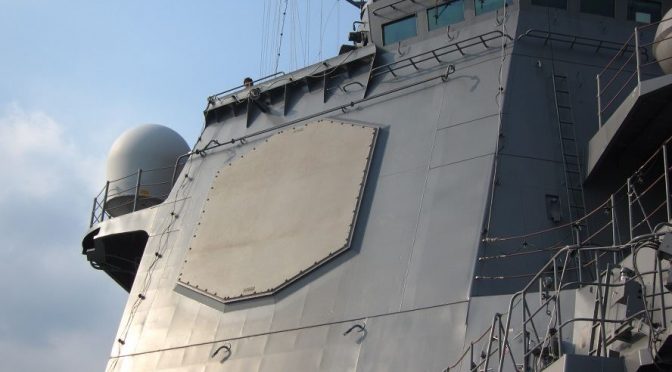
Featured Image: SPY radar array on Aegis-equipped DDG-175 escort ship “Miyoko” of the Japanese Maritime Self Defense Forces via Marie’s Garden Blog.

The New York Naval Militia in Operation Sandy

By CDR Art McCormick (ret.)

Super Storm Sandy

On 26 October, 2012, as Super Storm Sandy, the largest tropical storm in area ever recorded in the Atlantic Ocean roared up the eastern seaboard of the eastern seaboard of the United States Governor Andrew Cuomo declared a state of emergency in New York.1 Preparations included the 24-hour activation of the state’s emergency operation center (EOC) with major participating components, including the Division of Military and Naval Affairs (DMNA), ready to respond. A Warning Order was issued by Major General Patrick Murphy, the Adjutant General (TAG), to all components of the DMNA which comprises the NY Army National Guard, the NY Air National Guard, the NY State Guard, and the NY Naval Militia (NYNM). A Warning Order for the Naval Militia had been issued by the NYNM Deputy Commander for Operations on 25 October 2012. Three days later Gov. Cuomo ordered the mobilization of NY Military Forces (NYMF). The mobilization included members of the Naval Militia.2

On the same day, the U.S. Secretary of Defense, with the consent of the Governor, authorized the appointment of a Dual Status Commander (DSC) for NY, thereby allowing a pre-certified National Guard officer to command both state and federal forces within the state.3 This command was executed at 1128 on 3 November, 2012. This was the first large-scale unplanned contingency utilizing a DSC since the concept was established in 2009.4

Establishing the NY Naval Militia

Article 1 Section 8 of the United States Constitution authorizes states to establish militias which can be called forth by Congress “to execute the laws of the union, suppress insurrections and repel invasions.” The states are reserved the right to appoint officers of their militias and authorize training “according to the discipline prescribed by Congress.” Title 10 of the U.S. Code (USC) Sec.311, established by Congress, defines the organized militia as the National Guard and the Naval Militia.5 NY State Military Law Article 1, Sec. 6 “authorizes the Governor in event of invasion, disaster, insurrection, riot, breach of peace, or imminent danger thereof, to order all or part of the organized militia into active service.”6

Article 1 Sec. 8 of the U.S. Constitution also directs the Congress to “provide and maintain a navy.” In the late nineteenth century states began reestablishing Naval Militias, originally created and then disbanded in the early 19th century, to support the mandated federal Navy. In times of national emergencies states provided their naval militias for federal service. New York Governor David Hill signed a bill creating the NY Naval Militia on June 14, 1889.7 The 1st Battalion stood up two years later.8 The Naval Militia Act (NMA) of February 1914 put the State Naval Militias under the supervision of the Secretary of the Navy.9 This preceded the launching of the Naval Reserves by two years.10 With the establishment of the Navy Reserves, and later the Marine Reserves, federal support of naval militias ended and most states abolished their organizations.11

New York is unique in continuously maintaining its federally recognized Naval Militia. Title 10 USC does not include the Naval Militia as a reserve component but does authorize the Secretary of the Navy to set standards that the Naval Militia must meet, including the requirement that 95 percent of unit members be U.S. Navy (USN) or U.S. Marine Corps (USMC) reservists, to qualify for federal material support.12 NY State Military Law also requires 95 percent of Naval Militia members to be federal reservists13 and that the organization parallels that of the Navy and Marine Corps Reserves.14 Additionally, Memoranda of Understanding (MOU) between the NYNM and the USN (1996),15 the USMC (1996)16 and the U.S. Coast Guard (1997) have been signed, reaffirming continued cooperation while also permitting Coast Guard Reservists to join the NYNM.  Federal responsibilities supersede NYNM activation. A January, 2007 Defense Department report, Critical Homeland Infrastructure Protection, discusses the benefits “of the Federal Government providing immediate access to Navy and Marine reservists during State and Local emergencies, at no cost to the DoD.”17

History of NY Naval Militia Disaster Response

The NYNM can trace its disaster response history back to when it was mobilized to “protect steam ship passengers during the 1892 cholera quarantine at Fire Island.”18 120 years later the NYNM would again be at Fire Island performing Defense Support to Civilian Authorities (DSCA) missions. A more recent operation includes the TWA 800 recovery in 1996. The U.S. Coast Guard (USCG) was the lead agency in the massive recovery operation with significant USN support. Over 30 NYNM members, mostly stevedores from the USN 6th Cargo Handling Battalion, along with Marines, were activated for three to four weeks to load, unload, and drive trucks. 

When the North Country Ice Storm of 1998 struck in January 15 NYNM members were on State Active Duty (SAD) for five weeks assisting primarily with logistics and supplying staff officers. Naval Militia Construction Battalion (SeaBees) members served under the NY National Guard 152nd Engineer Support Company and used National Guard heavy equipment.

The most significant NYNM state activation occurred immediately after the World Trade Center terrorist attack on September 11, 2001. Naval Militia personnel were on site within hours and remained in Lower Manhattan for ten months. A total of 560 personnel were called to SAD. A decade later, nearly 200 NYNM members were mobilized when Hurricane Irene struck in August 2011. Non-disaster activations included assisting with maritime security for the 2004 Republican National Convention when NYNM SAD members served alongside National Guard Title 32 and Title 10 troops.

Joint Task Force Sandy       

As the NY community was still reeling from the ravaging effects of “Sandy,” a Nor’easter (named “Athena” by The Weather Channel) struck the NY metropolitan area on 8 November, delivering 7-13 inches of snow, a four-foot tide surge, high winds, and additional power outages. Although a relatively minor snow storm as far as Nor’easters are concerned, the timing could not have been more demoralizing with snow accumulations breaking records for this early date. At the peak of operations there were over 4000 military personnel under state control with the majority being on SAD, some under Title 32, which allows the governor to retain command and control (C2) while the federal government assumes the financial burden, and nearly 700 Federal Title 10 forces (federal active duty personnel under C2 of the Secretary of Defense/President of the U.S.). Brigadier General Mike Swezey, a pre-designated DSC, was the only individual in both Operation Sandy chains of command: one leading up to the president, who retained C2 of Title 10 forces, and down to the active duty troops serving within NY. The other lead up to the Governor of NY, who retained C2 of Title 32 and SAD troops, and down to the state forces responding.

Orders were accepted by over 200 NY Naval Militia members during the Operation Sandy response with 25 to 85 personnel on SAD at a time. Duration of activations ranged from 1 day to over 30 days from 29 October to 30 November, with the majority serving from five to nine days. Most of the NYNM members were integrated into the state’s military task forces whose missions included security, sheltering displace citizens, food and clothing distribution, and the evacuation of hospitals and nursing homes. Additionally, the NY Naval Militia Military Emergency Boat Service (MEBS) performed safety reconnaissance operations in Jamaica Bay to help identify maritime hazards along with security patrols around Fire Island at the request of local law enforcement agencies until emergency utilities could be restored and access roads made passable. Naval Militia members were also integrated into the DMNA Joint Task Forces Headquarters (JTFHQ) and the Operation Sandy Joint Operations Centers (JOC) respectively.

The NYNM warning order of 25 October 2012 directed the activation of the Personnel Action Team (PAT) to begin identifying and contacting members in preparation of expected activation. Liaison Officers were also advised to be ready to respond to anticipated mobilization execution order (EXORD). General NYNM activation directives require members recalled to DSCA SAD to be self-sufficient for up to 72 hours if necessary. The EXORD was given on 28 October and the JTF Sandy Liason Officer (LNO) team reported the next day. A NYNM LNO would be present at the JTF Sandy JOC from 29 October until 19 November when liaison duties would be handled locally by the senior militiamen in the area of responsibility (AOR). NYNM LNOs would also be manning the JFHQs JOC in Latham, NY. Within a few days the JTF Sandy JOC would include representatives from the NY Army National Guard (NYARNG), the NY Air National Guard (NYANG), the exclusively state NY Guard (NYG) and the NYNM. In addition, representatives from the U.S. Northern Command (USNORTHCOM), Army North, the National Guard Bureau, and the USS Wasp Amphibious Battle Group (ABG) would be occupying seats within the JOC. On 3 November, the USS Wasp (LHD-1), accompanied by the USS San Antonio (LPD-17) and the USS Carter Hall (LSD-50), arrived off the coast of New York and New Jersey with embarked Marines and Sailors from the 26th MEU along with detachments from Marine Heavy Helicopter Squadron (HMH) 366 and Marine Light Attack Helicopter Squadron (HMLA) 467. They operated in support of Hurricane Sandy disaster relief efforts. Title 10 personnel from the U.S. Army, Air Force, Navy, and Marines were among the responders:

  •  Air Force teams completed unwatering operations at Rockaway Wastewater Treatment facility, and East School in Long Beach, N.Y., and provided teams to support fire departments conducting unwatering operations in Breezy Point, N.Y.
  • Army divers repaired the pier system at Caven Point, N.J. Additionally, divers continue to assist the New York City Fire Department unwater the PATH tunnel at the World Trade Center and unwater the Long Beach High School and Recreation Center, N.Y.
  • Marines continued assessments with Army engineers in Far Rockaway, N.Y., and pumped 90,000 gallons of water from apartment buildings there. About 750,000 gallons were pumped from affected homes and parks in Breezy Point, N.Y.
  • Navy dive detachments continue to support the World Trade Center site and Marine Corps pump teams are assisting pumping operations at Breezy Point.

Helicopters from the 26th Marine Expeditionary Unit were transporting and relocating generators in the area at the direction of the Federal Emergency Management Agency. Navy Seabees and Marine personnel restored the beach at Coast Guard Station Sandy Hook; and supporting debris clearance operations at locations in Bayonne, N.J. and the Battery, N.Y.19

Also, National Guardsmen from Florida, Delaware, Georgia, Kansas, Massachusetts, Maine, Ohio, Pennsylvania and West Virginia arrived in NY through Emergency Management Agreement Compacts. With such a diverse force responding to the disaster, the Governor, with input from the Adjutant General (TAG), and the Secretary of Defense  consented to the activation of a DSC to command Title 10, Title 32, and SAD forces within the state. The DSC was executed on 3 November and the NYNM was a part of this historic event.

Naval Militia members, after reporting to the Joint Reception Staging Onward Movement and Integration (JRSOI) site and being scanned into the system, were then put to work where needed according to their skillsets. Seven members arrived with air transportation provided by the 109AW and then proceeded with the Air Guard command down range to Floyd Bennet Field in Brooklyn which quickly became the main logistical point for supplies and equipment being used and distributed by the various responding agencies. The majority of the mobilized force was sent to the Lexington Avenue Armory where they were integrated into Task Force 69.

According to one Meritorious Commendation citation awarded during the period:

“The NY Naval Militia element of Task Force 69 was responsible for saving numerous lives at Belleview Hospital during Super-storm SANDY. On 30 October 2012, the NY Naval Militia contingent, part of the Task Force, completed a mission at Belleview Hospital to keep critical hospital functions operational. In conjunction with Officers of the New York Police Department, this element kept the hospital’s generators operating overnight. Utilizing a bucket-brigade and 5-gallon buckets they hauled 100 gallons of fuel per hour from a 1400 gallon fuel truck to generators on the 13th floor of the hospital. Additionally, Task Force 69 assisted hospital staff by keeping food and water supplied throughout the hospital. When it was determined that Bellevue Hospital should be evacuated, 4-5 man teams carried patients down multiple flights of stairs to awaiting ambulances.”20

Two young Marine NYNM members that were qualified Humvee drivers spent a month chauffeuring the TAG and DSC throughout the AOR. MEBS-qualified truck and trailer drivers along with boat teams were kept busy early in the operation ensuring the safety of the vessels and equipment from storm damage. Boats needed to be taken out of the water and brought to higher ground where feasible and if not, taken underway to safer anchorages. If not for the conscientious meritorious efforts of the MEBS teams significant damage would have resulted. This would have hampered the security patrols that were to follow.

On 5 November, a request from Suffolk County for maritime security patrols with local law enforcement officers off Fire Island was routed through the JFHQ. It was determined that the NYNM could accomplish this mission and two vessels, trucks, and trailers, along with 15 qualified boat personnel, were soon on their way. They would perform what was quickly labeled “Vampire Patrols” from 1600 until dawn for 14 days commencing on 8 November. Although the first patrol had to be cancelled due to dangerous seas, security patrols from Kismet to Davis Park were completed. This area was without electrical power and the roads were impassable due to the super storm making the homes vulnerable to looters and any remaining civilians without emergency assistance. These patrols greatly reduced the risks. Flexibility was key as fuel and anchorage had to be secured for the vessels along with berthing and messing facilities for the crews. Assistance from the local authorities, including the nearby U.S. Coast Guard station was critical to the mission’s success.

Immediately after the 11 September, 2001 attacks, JTF Empire Shield (JTFES) was stood up and has remained active since. Simultaneously, the NYNM MEBS command was established with resources committed to JTFES mission. At the time of Superstorm Sandy’s arrival, 2 MEBS vessels were assigned to Empire Shield. One vessel, with armed National Guard personnel onboard, assisted with security at the Indian Point nuclear power station just up the Hudson River from NYC. The other boat was utilized for safety and security checks of vessels entering NY Harbor with a U.S. Coast Guard inspection team embarked. This was done through a unique agreement between NY and the Coast Guard. When Sandy struck, both MEBS boats were taken off the Empire Shield mission and given over to JTF Sandy to be used by the DSC as needed. This allowed the boats to be available if conditions permitted while allowing them to be relocated to safer anchorage. Within a few days, when it was determined that sufficient MEBS resources could be mobilized for Operation Sandy, both boats were returned to Empire Shield to continue their normal missions.

The final mission assignment for members of the NYNM involved going door-to-door in the ravaged coastal areas of Rockaway, Brooklyn, and Staten Island to ascertain the well-being of citizens whose lives were devastated by this catastrophic event. This was accomplished through the Thanksgiving Holiday.

The Current Force    

As the federal maritime forces in NY have decreased, so has the NYNM membership. The recent Strength Report dated March 1, 2012, counts total enrollment at 2206, (compared to approximately 4500 on 9/11), with 209 officers, 22 warrants, and 1975 enlisted.21 The majority of members are selected reservists (SELRES) from the USN (1300), followed by USMC SELRES (655), and USCG SELRES (106). Retired reservists under 60 years of age on the Federal Component List (94) and 5-percenters on the State Active List (51) make up the rest of the force. NY State educational assistance entices recruitment.22 Prior to the September 11, 2001 attacks, all training was provided by the federal government through the reserve system.

A new Joint Operations Center (JOC) with direct communications with the U.S. Northern Command (USNORTHCOM) was dedicated at DMNA Headquarters in 2008.23 The NYNM, along with the other components of the DMNA JTFHQ, mans a position at the JOC, continuing to stand the watch for not only New York, but all of America.

Arthur McCormick CDR (ret) NY Naval Militia is a US Navy veteran having served on active duty as a Radioman from 1966 to 1970 and then as a reserve Hospital Corpsman from 1987 to 1990. Shortly after 9/11/01 he was recalled to state active duty into the federally recognized NY Naval Militia in support of the World Trade Center disaster response. He served in lower Manhattan. He subsequently accepted a state commission in 2003. CDR McCormick served as Senior Joint Task Force 3 Liaison Officer on the staff of the Dual Status Commander for Hurricane Irene (DSC authorized but not activated) and Superstorm Sandy (DSC activated). CDR McCormick graduated from the US Naval War College with Joint Professional Military Education Phase 1 certification in 2008. CDR McCormick retired from the NY Naval Militia in 2016. On the civilian side Dr. McCormick is a retired veterinarian having graduated from the NY State College of Veterinary Medicine, Cornell University in 1979. He may be reached at artmccormick@hotmail.com.

References

[1] Governor Cuomo Declares State of Emergency in New York in Preparation for Potential impact of Hurricane Sandy. http://www.governor.ny.gov/press/10262012-sandystateofemergencecy  Oct 26, 2012.

[2] Governor Cuomo Directs New York Army and Air National Guard to Mobilize for Hurricane Sandy. http://www.governor.ny.gov/press/10282012nationalguardmobilized  Oct 12, 2012

[3] Panetta Appoints ‘Dual’ Commanders for Hurricane Relief. American Forces Press Service. http://www.defense.gov/news/newsarticle.aspx?id=118366 Oct 28, 2012

[4] Hurricane Sandy Puts New National Guard Command Mechanism to Work. National Defense Industrial Association. http://www.nationaldefensemagazine.org/archive/2012/December/Pages/HurricaneSandyPutsNewNationalGuardCommandMechanismtoWork.aspx December 2012

[5] Title 10 Sec. 311 USC. http://www.law.cornell.edu/uscode/10/311.html

[6] NYS Military Law Art 1 Sec 6. http://codes.lp.findlaw.com/nycode/MIL/1/6

[7] NY Times. June 15, 1889. http://query.nytimes.com/mem/archive-free/pdf?_r=2&res=9404E3DE133AE033A25756C1A9609C94689FD7CF

[8] New York Naval Militia Turns 120 on June 23 2011. http://dmna.ny.gov/news/news.php?id=1308832192

[9] NYNM. http://www.dmna.state.ny.us/nynm/naval.php?id=about  

[10] TNR. MAR 2010. History of the Navy Reserves, p. 18. http://www.navyreserve.navy.mil/Publications/2010/TNRmar10.pdf

[11] National Archives. Records of the Bureau of Naval Personnel. 24.6.2 Records of the Division of Naval Militia Affairs. http://www.archives.gov/research/guide-fed-records/groups/024.html#24.6.2

[12] Title 10 Sec. 7854.  http://www.law.cornell.edu/uscode/html/uscode10/usc_sec_10_00007854—-000-.html

[13] NYS Mil Law. http://codes.lp.findlaw.com/nycode/MIL/2/43

[14] Ibid.

[15] Dept of Defense (DoD). http://www.defenselink.mil/news/newsarticle.aspx?id=40825

[16] MARINE CORPS ORDER 5725R.7C ASSOCIATION OF MEMBERS OF THE SELECTED MARINE CORPS RESERVE (SMCR) WITH A STATE NAVAL MILITIA 7JUN96. http://www.marines.mil/news/publications/Documents/MCO%205725R.7C.pdf

[17] Defense Science Board Task Force, p19. http://www.acq.osd.mil/dsb/reports/2007-01-Critical_Homeland_Infrastructure_Protection.pdf

[18] NYNM. http://www.dmna.state.ny.us/nynm/naval.php?id=about

[19] US DoD News. Pentagon Provides Sandy Response Update. Nov 9, 2012. http://www.defense.gov/News/NewsArticle.aspx?ID=118496

[20] Meritorious Commendation Award citation. EO1 Thomas Gray. For meritorious service during the period 29 October 2012 – 8 November 2012.

[21] NYNM HQ. Latham, NY 12MAR2012.

[22] NYNM Education.  http://www.dmna.state.ny.us/nynm/naval.php?id=education

[23] NYNG Media Advisory. http://www.dmna.state.ny.us/pressroom/presindx.php?id=1203072420

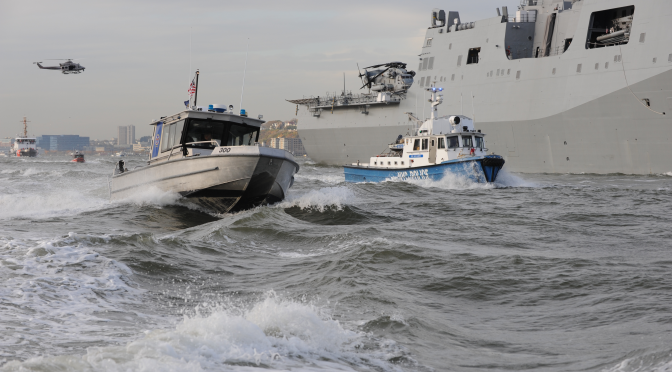
Featured Image: Crews from the Coast Guard Cutter Sturgeon Bay, Coast Guard Marine Safety and Security Team Boston, Coast Guard Station New York, the New Jersey State Police and the New York City Police Department escort the Pre-Commissioning Unit (PCU) New York as the ship sails into New York Harbor. The nearest patrol boat is  NYNM PB 300 escorting the USS New York (LPD-21) into NY harbor for it’s commissioning ceremony in November 2009.

Uncompromising Honor

Weber, David. Uncompromising Honor. Baen, 2018. 784 pp. $28.00/hardcover.

By Mark Vandroff

There is a special challenge in reviewing the fourteenth book in an iconic, best-selling series. The point of a book review is to advise potential readers if they should invest their time and money toward reading the work in question. For true fans of author David Weber, who have thirstily imbibed the first thirteen installments of the Honor Harrington saga, nothing offered in this essay could possibly deter them from immediately engaging with this long-awaited tome.

For those who are not yet smitten by the charms of the science fiction milieu known as the Honorverse, book fourteen, while highly entertaining in its own right, is best experienced as a follow-on to the earlier books in the story. The task of this review is then two-fold; to entice those who have yet to experience David Weber’s art to begin a literary journey that will eventually culminate in the reading of this outstanding book, while at the same time whetting the appetite of the experienced Honorphile before he or she feasts upon Uncompromising Honor.

A Classic and Engrossing Universe

David Weber’s Honorverse consists of fourteen books in the main Honor Harrington series, the four books of the Saganami Island series, the three books of the Crown of Slaves series, and various other short story anthologies, prequels, and novellas. The first book of the Honor Harrington series, On Basilisk Station, introduces the reader to Commander Honor Harrington who serves in the Royal Manticoran Navy during tumultuous times.

The books of the Honor Harrington series explore roughly 22 years of the military, political, and social history of Manticore, its allies, and its adversaries, while following the career of a remarkable woman as she rises through the ranks from command of a light cruiser to service at the highest levels of military and political leadership. The two main companion series explore concurrent events in other parts of the galaxy and provide context and backstory for characters that will eventually impact the main series. While the side series are worthy reading in their own right, they are best experienced as background material to the main storyline.

Several factors combine to make Weber’s books both enjoyable as fiction and profound as works of art. Weber works hard to provide a self-sustaining and consistent universe. As an example, any science fiction has to overcome the problem of the impossibility, as our current understanding of physics dictates, of travelling in excess of the speed of light. David Weber handles this in a well thought-out explanation of “new science” that imposes both capabilities and important limitations on the occupants of his universe. All the fictional technology in the Honorverse is self-consistent and does not allow for easy fixes to wish away problems for either the protagonist or antagonist. Manticore’s technology is superior but not magical, and inventive opponents often craft effective counters.

The wide range of political and social systems extant on the worlds with which Manticore must interact allows Weber to explore many different facets of the human condition. 1900 years after human beings first left Earth in an attempt to colonize habitable planets around the galaxy, a wide variety of social and political structures have arisen on the worlds that humanity now occupies. The Star Kingdom of Manticore is a constitutional monarchy that calls three habitable planets in a binary star system home and maintains a range of alliances with foreign star systems. We discover a planet where the Christian religion ennobles and sustains its population, and another where religious fanaticism has created a planet-wide, Christian version of ISIS. Some democracies produce wise government, responsive to the needs of its citizens and others produce entrenched bureaucracies which exploit their people. Others take the form of imperialist welfare states, forced to conquer for the sake of propping up a broken system while using authoritarian means to stifle dissent. These political entities find themselves entangled in vicious wars and subversion as great power competition makes its way into the space age on a galactic scale.

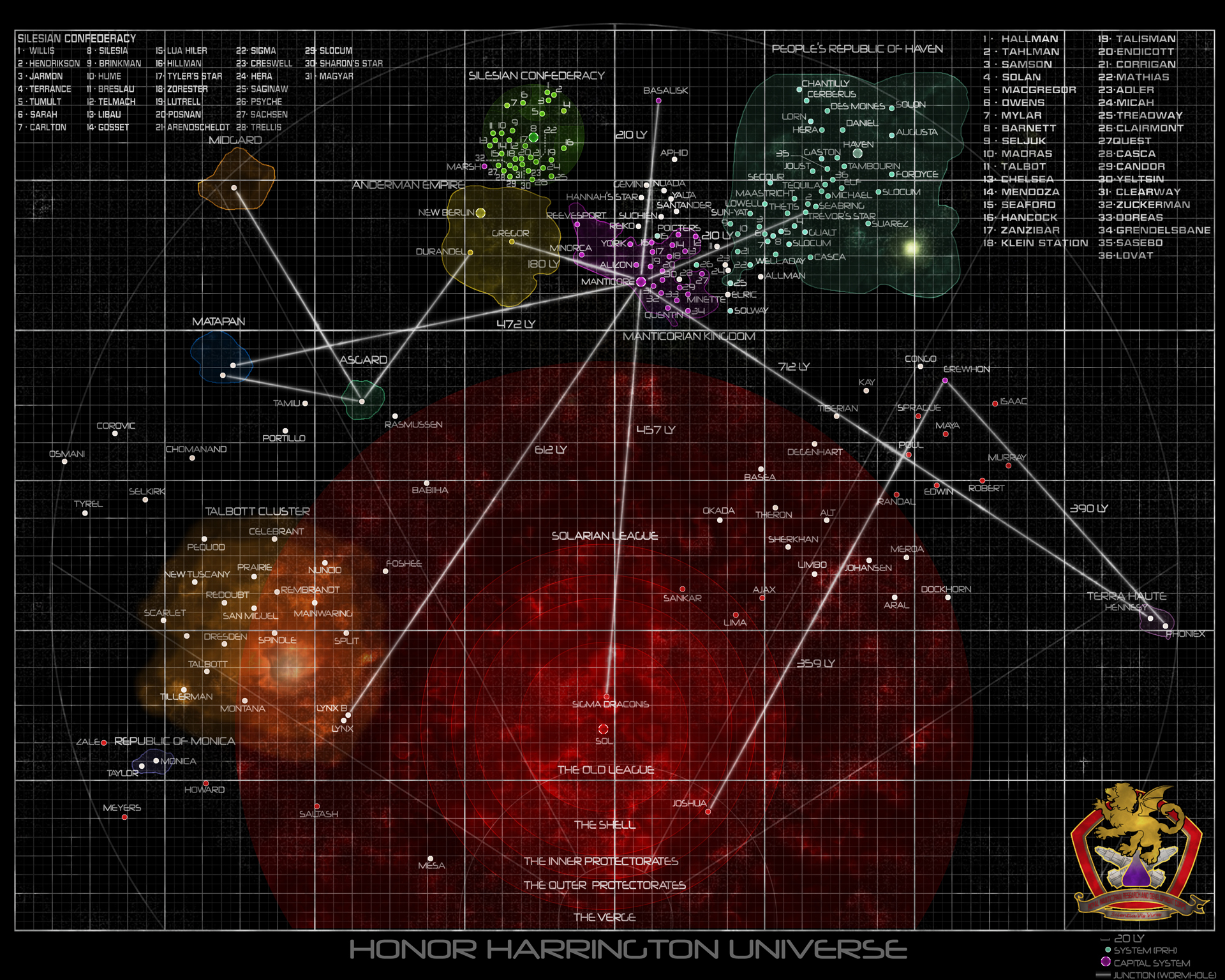
A map of the Honor Harrington universe (via Honoverse.wikia.com, Click to Expand)

Battles are described in vivid, suspenseful detail. Usually portrayed through the eyes of multiple participants, Weber’s strong writing places the reader on the bridge and in the reactor plant of powerful warships as the crews fight to accomplish their missions and fulfill their duty. A well-crafted formula of naval capability and tactics elegantly combines the sudden destruction of missile warfare with close-range fires reminiscent of the age of sail. Ships often employ signature control, electronic warfare, and drones to gain the upper hand through crafty means. Through this well-formulated vision of space combat Weber thrusts his characters into a wide range of operational encounters and tactical dilemmas that test their ability to command and adapt.

Weber takes the time to create rich backgrounds for multiple characters. The good guys are never entirely perfect and the bad guys are rarely all bad. Weber is also willing to have key characters die along the way and when an important battle is done, readers often feel as if they have lost friends in action. Weber’s characters often have to remain resilient in the face of tremendous loss, lead battered and demoralized crews, and cope with the unsatisfactory taste of bittersweet victory.

War, Deceit, and Honor

Uncompromising Honor picks up at the end of the Second Battle of Manticore and tells the story of what Honorverse fans will likely come to refer to as the Solarian War. The book covers the nine months between July and March in the 1922nd and 1923rd year after humanity began stellar colonization. The Solarian League Navy, unable to defeat Manticore and the rest of its alliance in a battle between the heaviest ships of the wall, embarks upon a campaign of economic warfare against Marticore’s trading partners. Manticore’s response is to cripple the Solarian economy by taking possession of all known galactic wormhole junctions used by merchant ships to reduce their transit times. By seizing control of the geographic chokepoints of galactic commerce Manticore aims to starve the Solarian League of its ability to maintain the industrial production that supports it economy.

These opposing strategies set up the first great battle of Uncompromising Honor, the Battle of Ajay Hyper Bridge. The Solarians, armed with a large fleet of 50 battlecruisers and additional lighter units, need to pass their task force through the Ajay wormhole in order to conduct their assigned system raids. Manticore must hold the wormhole so its supply ships can sustain their deployed forces. The Solarians have numbers on their side and Manticore has superior technology. 78 pages of white-knuckled suspense tell the tale of this key battle in the Solarian War.

The second major battle scene in Uncompromising Honor is the Battle of Hypatia. Hypatia is a star nation that is in the midst of voting to leave the Solarian League. A small task group of Manticoran cruisers and destroyers is in Hypatian space awaiting the results of the plebiscite. Should Hypatia vote to become independent of the Solarian League, the Manticoran ships are ready to deliver the Star Kingdom’s new ambassador to this potential key ally. However, the Solarian League Navy shows up with several dozen battlecruisers with orders to prevent Hypatian secession, even to the point of committing war crimes to achieve their mission.

The choices presented to the Manticoran commander harken back to the solemn “Last View” ceremony at Manticore’s naval academy. Graduating midshipmen are presented with the history of the academy’s namesake, Commodore Edward Saganami, and his final battle against Silesian pirates. In both the Last View and the Battle of Hypatia, Weber masterfully explores the difficult moral obligations of a commander to both his mission and his people. The question of when should a commander risk devastating losses to the forces under his command in order to accomplish a critical mission is on display as both sides grapple to do their duty as they understand it.

Between and after the battles, Weber continues to develop the political and economic storyline of the galaxy. The shadowy Mesan Alignment continues to execute its plan and influence star nations in ways seen and unseen. Characters on Earth, Manticore, Haven, and in the Talbott and Maya Sectors all struggle. Some struggle for power and wealth, some struggle for understanding, and a few noble souls struggle to do the right thing. There are triumphs and tragedies along the way spread out over much of the inhabited galaxy. In the end these struggles and machinations lead to climatic conflicts in the Beowulf system, and finally in the home system of Earth itself.

Despite, or perhaps because of all the military and political action in Uncompromising Honor, it is the human touches that make this book so gripping. We are treated to the planet Grayson’s favorite girl next door (assuming you live next door to a Steadholder’s palace), Lieutenant Abigail Hearns of the Grayson Space Navy, as she goes on her first date with a handsome young man with a questionable background from the Seraphim system in one of Manticore’s more upscale dining establishments. This is also the first of the mainline Honor Harrington books where multiple treecats play important roles and the reader is treated with extensive treecat dialog and monologue. Treecats are the native sentient species of one of the Manticore system’s habitable planets. The close relationship of Honor to her small, furry, cute, and at times lethal, treecat friend Nimitz plays an important role in the plotline of the series. In this book, multiple human characters have important treecat relationships. By the end of Uncompromising Honor, we understand that treecats are not only sentient, but that they bring a unique perspective on understanding humanity in a way that only a non-human species that can experience human feeling could provide.

A Tale Continues…

While Uncompromising Honor does allow for a satisfying conclusion, there is clearly more left to tell and many questions remain tantalizingly unanswered. While David Weber’s fans will greatly enjoy Uncompromising Honor they will be left with the same gripping emotional state at the end of this book as with the others, eagerly awaiting the next installment of this magnificent series.

Captain Mark Vandroff is a 1989 graduate of the United States Naval Academy. His 28 years of commissioned service include duty as both a Surface Warfare and Engineering Duty Officer. He was formerly the Major Program Manager for the DDG 51 program and is currently the Commanding Officer of Naval Surface Warfare Center, Carderock. The views expressed in this article are the author’s personal views and do not reflect the official position of the Department of Defense or Department of the Navy.

Featured Image: Adaptation of the cover of the Honor Harrington’s novel Honor Among Enemies by Genkkis via DeviantArt

Crimes of Command in the U.S. Navy – A Conversation with Michael Junge

By Christopher Nelson

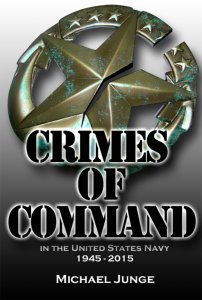
Recently, Captain Michael Junge published an interesting book on why and under what circumstances the U.S. Navy relieves commanding officers. His book, Crimes of Command, begins in 1945 and proceeds through numerous historical case studies up to the modern era. I think many people – not only those in the surface warfare community – but commanders, leaders, and sailors in other communities will find our exchange interesting.

The book is worth your time – and it is a perennial topic that deserves attention.

Nelson: Would you briefly describe what the book is about and why you wanted to write it?

Junge: In short, it’s about why the Navy removes commanding officers from command – the incidents that lead to removal, the individuals removed, and what the Navy does about the incident and the individual. But instead of a look at just one or two contemporary cases, I went back to 1945 and looked across seven decades to see what was the same and what changed.

Nelson: In the book, when referring to the process of relieving commanding officers, you talk about words like “accountability,” “culpability,” and “responsibility.” These words, you say, matter when talking about why commanding officers are relieved. Why do they matter and how do they differ?

Junge: The common usage blends all three into one – accountability. We see this with the press reports on last summer’s collisions – the Navy’s actions are referred to as accountability actions.” Most people, I think, read that line as “punitive actions” mostly because that’s what they are. But accountability isn’t about punishment – it’s about being accountable, which is to give an accounting of what happened, to explain one’s actions and thoughts and decisions. The investigations themselves are an accountability action. The investigations are supposed to determine who was responsible for the problem, what happened, who was at fault, and then determine if within that responsibility and fault there is also culpability.

Culpability is about blame – accountability is not, even if we use it as such. In investigations, when you mix culpability, blame, and accountability together end up being about finding fault and levying punishment instead of finding out what happened. That keeps us from learning from the incident and preventing future occurrences. We’ve completely lost that last part over the past few decades if we even had it to begin with. Every collision I looked at, for example, had four or five things that were the same – over seven decades.

Nelson: Later in the book, you say that as virtues, honor, courage, and commitment are not enough. How should we reexamine those virtues? Isn’t this always the challenge – the challenge of the pithy motto vs. the substantive truth, that’s what I was getting at. And it’s not that there is some truth to the motto or slogan, but rarely are they sufficient alone – yes?

Junge: Honor, courage, and commitment make for a great slogan, but will only be inculcated in the force when our leaders routinely say them and live by them. I wrote a piece for USNI Proceedings in 2013 that commented on how naval leaders rarely used those words. That hasn’t changed. If they are used it’s in prepared text and often used as a cudgel. Leaders need to exemplify virtues – we learn from their example – and if they don’t use the words we don’t really know if they believe in them. But they are a great start, and they are ours – both Navy and Marine Corps.

What I meant in the book is that honor, courage, and commitment aren’t enough for an exploration of virtues in general. For the Navy, they are an acceptable starting point. For individual officers, or for the Naval profession, we need to think deeper and far more introspectively. My latest project is looking at the naval profession and a professional ethic. My personal belief is that we don’t need, or want, an ethical code. Or if we have one it needs to be like the Pirate Code – more as guidelines than rules. There’s science behind this which is beyond our scope here, but rules make for bad virtues and worse ethics. Rules tend to remove thought and press for compliance. At one level that’s great, but compliance tends to weed out initiative and combat leaders need initiative.

Nelson: So, after studying the historical data and specific events from 1945 to 2015, what did you conclude? Why are there more commanding officers relieved today than there were fifty years ago?

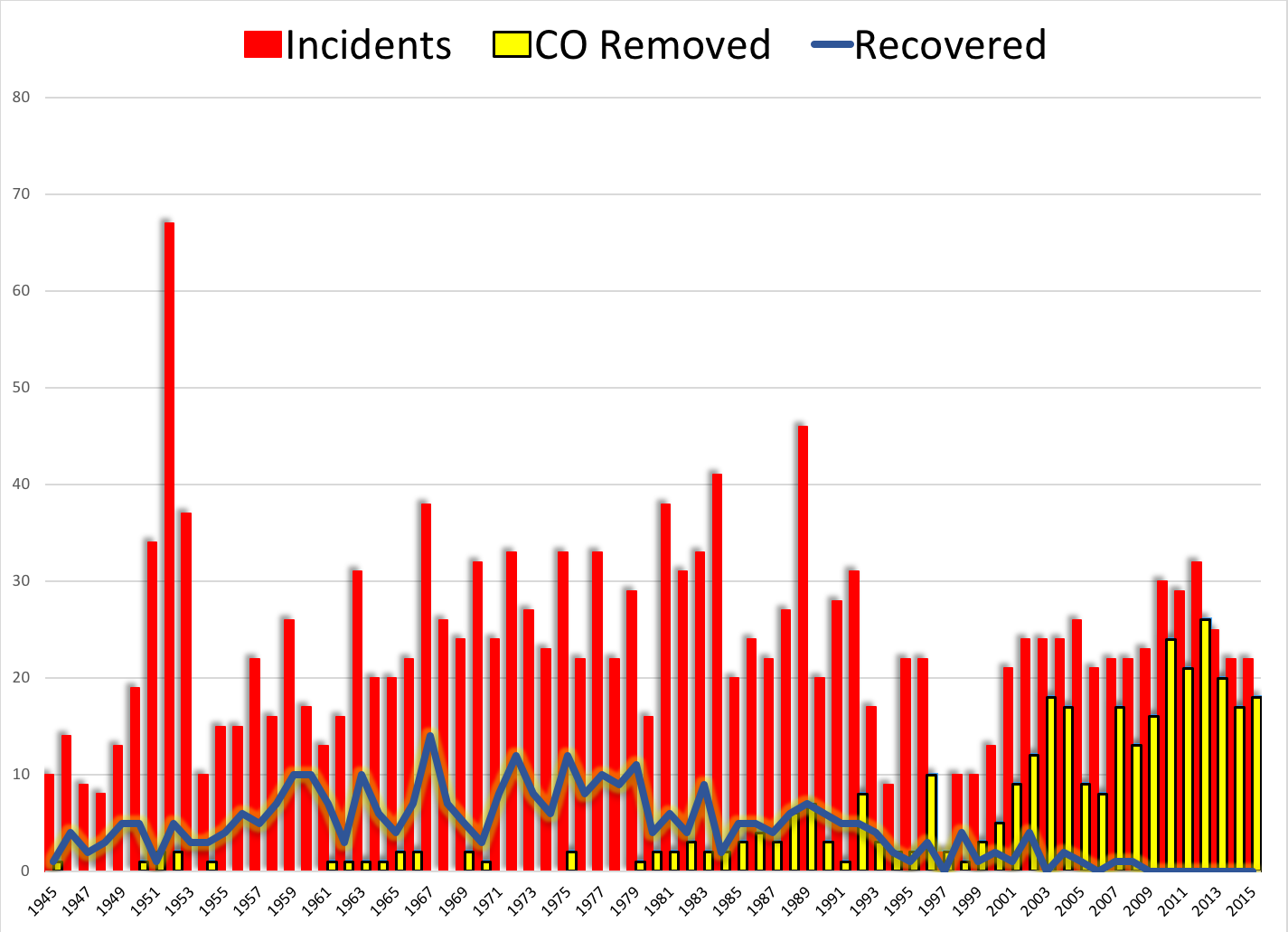
Junge: Even after all the research and the writing, this is a tough one for me to encapsulate. In my dissertation defense, I made a joke at the end that the reason we remove more officers now is complicated. And it is. Every removal is a little different from the others. That makes linking details difficult. But, when you lift back a little and take a really long view, I could find some trends. Not only do we remove more commanders today, we do it for more reasons, and we have almost completely ended any sort of recovery for officers removed from command.

Chart courtesy of the author.

Without giving too much away, because I do want people to read the actual book, today’s removals come down to a couple of things – press, damage (material or emotional) to the Navy, and the commander’s chain of command. If the chain of command relationship is poor, the press gets a story, and there is some level of damage to the Navy (metal bent, people hurt, or image tarnished) then the commander is likely to go. But it’s not a direct line. Sometimes the information comes out later – we saw this with USS Shiloh last year and in one of the cases I covered, the helicopter crash in USS William P Lawrence. Neither commander was removed from command, but both careers were halted after the investigations were done and the administrative side of the Navy took over. If those incidents happened in the 1950s or 1960s, both commanding officers would have unquestionably moved forward with their careers. Whether that would be good or bad depends entirely on what those officers might have done with the knowledge gained from the investigations that challenged their leadership and individual character but we won’t know anymore. Maybe we should.

Nelson: When you started this book and after looking at the data, did anything surprise you? Did you go in with particular opinions or develop a theory that the data disproved or clarified?

Junge: When I started this I was pretty sure there were differences. One of the reasons I pulled all the data together was because in 2004 the Navy Inspector General issued a report that said, in essence, that a one percent removal rate was normal. If one percent was normal in 2004, when we had fewer than 300 ships, then we should have heard something about removing COs when we had 1000, or 3000, ships. But, we didn’t. So that there was a change wasn’t surprising.

I started off thinking that Tailhook was a major inflection point. I intended a whole chapter on the incident and investigation. In the end, the data didn’t support it – the inflection had already happened and Tailhook, especially its aftermath, was indicative of the change. I’m not minimizing the impact Tailhook had on Navy culture – we are still dealing with echoes twenty-five years later – but for the trend of removing commanders, it wasn’t a watershed. Likewise, I thought the late 1960s to early 1970s might be an inflection point – we had a rough couple years with major collisions, attacks, fires, Vietnam – but the data showed it wasn’t the turning point I expected.

It wasn’t until I plotted the information out that I saw the inflection of the early 1980s. When I saw the changes in the graph I had to go back to the research to sort out why. It was both frustrating and encouraging. It showed me I wasn’t trying to force data to fit a pre-selected answer, but it also meant leaving a lot of research behind.

Nelson: You go into some detail in your book about court-martials. Historically, why does the navy rarely take commanding officers to court martial?

Junge: The simple reason is that the Navy has a difficult time proving criminal acts by commanding officers. It’s not a new problem. When officers are taught to think for themselves and have sets and reps thinking critically, then when on a jury they are likely to take the evidence and make their own minds up. And that conclusion may run counter to what Navy leadership wants. Getting courts-martial into that real true arbiter of guilt and innocence was a major win for the post-World War II military. But, since leaders can’t control courts-martial anymore we now see this major abuse of administrative investigations, which runs counter to our own regulations on how we are supposed to handle investigations of major incidents and accidents.

Nelson: In fact, you threw in an anecdote in your book about Nimitz issuing letters of reprimand to the jury members on Eliot Loughlin’s court-martial. This was fascinating. What happened in that case?

Junge: In April 1945, Lieutenant Commander Charles Elliot Loughlin sank a ship without visually identifying it. The ship turned out to be a protected aid transport with 2,000 civilians aboard. Nimitz removed Loughlin from command and ordered his court-martial. The court found Loughlin guilty but only sentenced him to Secretarial Letter of Admonition. Nimitz was reportedly furious and issued letters of reprimand to the members of the court. In just answering this question I realize I never dug deep into what happened to those members – I might need to do that.   

Anyway, that was a rare case of Nimitz being angry. And in retrospect, I wonder if he was angry, or if he was protecting the court from the CNO Admiral King. There’s a story I’ve been percolating on in how Nimitz and King had differing ideas of responsibility and culpability. King was a hardliner – King could be seen as the archetype for modern culpability and punishment. There were some exceptions but he was pretty binary – screw up, get relieved. Nimitz was the opposite. Halsey put Nimitz into multiple tough spots where Halsey probably should have been removed from command – but Nimitz knew Halsey and erred on the side of that knowledge rather than get caught up in an arbitrary standard. That’s why I think those letters were out of character. But I have to temper that with the very real knowledge that Loughlin committed a war crime, was pretty blasé about it, blamed others, very likely put American prisoners of war in more danger than they already were, and might have endangered the war termination effort. Those conclusions run counter to the modern mythology around Loughlin, but are in keeping with the actual historical record.

Nelson: And if I recall, there was an XO that chose court martial rather than NJP ten or so years ago after a sailor on the ship was killed during a small boat operation. The XO was exonerated and cleared from any wrongdoing by the jury. Fleet Forces ended up putting a statement out how he disagreed with the verdict.

Junge: USS San Antonio – LCDR Sean Kearns. Sean remains one of my heroes for forcing the system to do what it says it will do. I firmly believe that Admiral Harvey stepped well outside his professional role and made his persecution of Sean a personal matter when he issued some messages and letters after the acquittal. I know among many SWOs that Harvey’s actions after the verdict really altered their opinions of him. Sean’s case is also major reason I am in favor of the Navy ending the “vessel exception” which precludes anyone assigned to a sea-going command from refusing non-judicial punishment and demanding a court-martial. Too many Navy leaders abuse this option. I know of a story where an officer was flown from his homeport to Newport, RI for non-judicial punishment, and another where an officer was flown from Guam to Norfolk for NJP. There are more cases where officers were removed from command, but kept assigned to sea duty so that they could not refuse NJP. That this even happens completely belies the intent behind the vessel exception.  

Nelson: You also talk in some detail about Admiral Rickover and the culture he fostered and how that culture affected command. Overall, how did he affect command culture?

Junge: This was my biggest surprise. If you’d talked to me before I started and asked about Rickover I’d have easily said he had nothing to do with the changes. Wow –that was wrong. I’m not sure how I could ever think that someone who served almost 30 years as a flag officer, hand selected each and every nuclear-trained officer, and personally inspected each and every nuclear ship for decades didn’t influence Navy culture. Rickover ends up with the better part of a chapter in a story I didn’t think he was even part of. But, the culture we have today is, I think, not the one he intended. Maybe.

Rickover was, and remains, an individual who brings up conflicted memories and has a conflicted legacy. Like many controversial figures, the stories about him often eclipse the reality behind them. I’ll paraphrase a student who spoke of my colleague, Milan Vego, and his writings – you have to read about Rickover because if you just reject him completely, that’s wrong – and if you just accept him at face value, that’s wrong – you have to read and think and read some more, then come to your own conclusion. I can tell you that in the professional ethic piece I am working on, I expect Rickover’s legacy to play an important part.

Nelson: If I recall, I believe you self-published this book. How was that process? Would you recommend it for other writers? What did you learn when going through this process for publication?

Junge: The process, for me, was pretty simple. Getting to the process was very difficult. We know the adage of judging a book by its cover – well there’s also a stigma of judging a book by its publisher.

Actually getting a book published through an established publisher, the conventional process, takes well over a year and is full of norms and conventions that, from the outside, seem unusual. In the same way that we wonder “how did that movie get made?” when you go through the process of publishing, you start to wonder “how did that book get published?” I have a long time friend who is a two-time New York Times bestselling author who gave me some great advice on the conventional route. Just getting the basics can take up to an hour of discussion.

I tried the conventional route but after sending dozens of emails to book agents and getting only a few responses back, all negative, I checked with a shoremate who self-published his own fiction and decided to take that route partly out of impatience, frustration, and curiosity. I’m just good enough at all the skills you need to self-publish that it worked out to be pretty easy, with one exception – publicity. I’m not good at self-promotion so even asking friends to read the book and write reviews was a challenge.

Anyway, whether I recommend the self-publication process – it depends entirely on your own goals and desires. I wanted my book read – that was my core focus. To do that I could have just posted a PDF and moved on. But, I also wanted to make a few dollars in the process – and people who pay for a book are a little more likely to read it. This book grew out of my doctoral dissertation and I have a friend who is doing the same thing – but his goals were different. His core goals are different – he’s a full-on academic and needs the credibility of an academic publishing house for his curriculum vitae. We both defended around the same time – his book comes out sometime next year. I’m happy to spend more time talking about what I learned in the process, but the best advice I can give is for authors to figure out their objectives first. That is probably the most important thing. Everything else can fall into place after that.

Nelson: I ask this question in many of my interviews, particularly of naval officers – if you had ten minutes with the CNO, and if he hadn’t read your book, what would you tell him about Crimes of Command? What would you recommend he do to change the culture if change was necessary?

Junge: I really thought about punting on this one and running the note our Staff Judge Advocate has been running about Article 88 and Article 89 of the UCMJ (contemptuous words and disrespect toward senior commissioned officers). If I had ten minutes with CNO I doubt I would get 60 seconds of speaking time. My conclusions run completely counter to Navy lore about accountability and 10 minutes isn’t enough time to change anyone’s mind. But, as I thought about it I think I would say this: “CNO, we have really got to follow our own instructions. If an instruction says ‘do this’ then we need to do it, or change the instruction. We can’t have flag officers making personal decisions about this rule or that based on short-term ideas and feelings. If the situation doesn’t fit the rule, either follow the rule with pure intent or change the rule. But we can’t just ignore it. That’s an example that leads us, as a profession, down bad roads.” I would hope that question would then lead to a conversation of leadership by example that would include everything from Boards of Inquiry to travel claims to General Military Training.

Nelson: Sir, thanks for taking the time.

Michael Junge is an active duty Navy Captain with degrees from the United States Naval Academy, United States Naval War College, the George Washington University, and Salve Regina University.  He served afloat in USS MOOSBRUGGER (DD 980), USS UNDERWOOD (FFG 36), USS WASP (LHD 1), USS THE SULLIVANS (DDG 68) and was the 14th Commanding Officer of USS WHIDBEY ISLAND (LSD 41). Ashore he served with Navy Recruiting; Assault Craft Unit FOUR; Deputy Commandant for Programs and Resources, Headquarters, Marine Corps; Deputy Chief of Naval Operations for Communication Networks (N6); and with the Office of the Secretary of Defense. He has written extensively with articles appearing in the United States Naval Institute Proceedings magazine, US Naval War College’s Luce.nt, and online at Information Dissemination, War on the Rocks, Defense One, and CIMSEC. The comments and opinions here are his own.

Christopher Nelson is an intelligence officer in the United States Navy.  He is a regular contributor to CIMSEC and is a graduate of the U.S. Naval War College and the Maritime Advanced Warfighting School in Newport, Rhode Island. The questions and views here are his own.

Featured Image:  (FORT BELVOIR, Va. (May 04, 2017) Hundreds of service members at Fort Belvoir Community Hospital gathered before daybreak and celebrated their unique service cultures and bonds as one of the only two joint military medical facilities in the U.S. during a spring formation and uniform transition ceremony May 4, 2017. (Department of Defense photos by Reese Brown)