Tag Archives: US Navy

Navy Combat Information Integration

Trying tying.
      Trying  tying:  the info streams.

The U.S. Navy at a high level has recognized the potential value of the concept of integrating combat information from own-force tactical sensors and sensors external to the force to achieve information superiority and dominance of an adversary. However, there is little evidence of concrete action to implement this vision.

On 26 November, 2012, the Navy Strategy for Achieving Information Dominance 2013-17 was published identifying the “Integration of Combat Information” as one of its four major goals. Joint Pub 1-02 defines Combat Information as “Un-evaluated data, gathered by or provided directly to the tactical commander which, due to its highly perishable nature or the criticality of the situation, cannot be processed into tactical intelligence in time to satisfy the user’s tactical intelligence requirements.” Navy Strategy identifies the specific objective of the “integration of all source information across kill chains with outputs from all sensors in all domains accessible in time to facilitate freedom of action, targeting, and the employment of weapons, both kinetic and non-kinetic.”

In its January 2012 Report on Arleigh Burke Destroyers, (GAO-12-113), GAO reported that Navy planned to leverage offboard sensors such as Performance Tracking Support System (PTSS) to enhance performance of the DDG 51 Block III Air and Missile Defense Radar (AMDR). Navy envisioned ground and space-based sensor systems providing target cueing for AMDR. This cueing would have meant the shooter ship could be told by the off-board sensors where to look for a target, allowing for earlier detection and increasing the size of the area that could be defended by the shooter. While it is yet unclear why PTSS was cancelled last month, the concept still serves to highlight the potential benefits from integrating off-board sensor data with the ship’s own tactical sensor data and combat system.

Given OPSEC considerations, communications constraints, and especially tactical timelines this integration has to occur at the tactical level, e.g. onboard ship, and will therefore require the staff of Office of the U.S. Chief of Naval Operations (OPNAV) and Navy acquisition to bridge some long-standing institutional seams. Within OPNAV, various codes will have to agree on the concept and their roles with respect to requirements and resources. Navy acquisition will have to decide which Program Executive Office (PEO) is responsible for the acquisition of combat information integration solutions for ship classes. The long-standing situation in which PEO Integrated Warfare Systems (IWS) acquires combat systems and PEO C4I acquires C4I systems for ship classes sustains the institutional friction that has precluded implementation of integrating combat information since at least late 1978, when OUTLAW SHARK demonstrated the concept.

Articulating visions, goals, and objectives is valuable but relatively painless. The heavy lifting is in the institutional change that is necessary to solve problems and exploit opportunities. To quote Machiavelli: “There is nothing more difficult to take in hand, more perilous to conduct, or more uncertain in its success than to take the lead in the introduction of a new order of things.”

Dick Mosier is a recently retired defense contractor systems engineer; Naval Flight Officer; OPNAV N2 civilian analyst; SES 4 responsible for oversight of tactical intelligence systems and leadership of major defense analyses on UAVs, Signals Intelligence, and C4ISR.  His interest is in improving the effectiveness of U.S. Navy tactical operations, with a particular focus on organizational seams, a particularly lucrative venue for the identification of long-standing issues and dramatic improvement. The article represents the author’s views and is not necessarily the position of the Department of Defense or the United States Navy. 

Wrapping Up Alternatives to DDG Flight III

Last month we challenged contributors to take their best shot (or really any shot, so long as it was interesting) at articulating alternatives to the U.S. Navy’s Arleigh Burke-class DDG Flight III. We originally intended the series to run a week, but never ones to reject late-but-coherent thoughts, we kept it going as long as the submissions kept coming in. The results were quite interesting, challenging force structure/projection assumptions, as well as following the assumptions in the chain of reasoning leading to the Flight III as currently conceived:

  • The U.S. needs to conduct ballistic missile defense (BMD)
  • U.S. BMD needs a sea-based component
  • The sea-based component needs to fit on a surface ship

Most of the hard looks questioned whether the (yet-to-be awarded) Air and Missile Defense Radar is the best way forward for the BMD mission and if so, whether the Flight III DDG is the best platform on which to base it.

Here are some parting shots that focus not on the BMD side of the house, but on ways to generate more of what a Flight III would accomplish with the rest of its mission set toolbox:

LT Patrick Kiefer, USN:

“One thing that we need more of on the destroyers is more helicopters… why we stop at 2 is a little baffling and then only a carrier has more…why not look to put 4 or 6 with simultaneous takeoff and landing? And when you look at everything the MH-60 brings, it is really a force multiplier that brings significant capabilities to the anti-submarine warfare (ASW) and surface warfare (SUW) missions, especially counter-swarm, and provides some limited support to anti-air warfare (AAW) and STRIKE.”

Sebastian Bruns, Germany:

The selection of the Flight III DDG or an alternative needs to be explained to the American people. Thoroughly. It is a grave irresponsibility to not lead a public discourse about the value of sea power in general, and the value and uses of certain platforms over others in particular.

More than a joke in need of a punchline: How many MH-60Rs can you fit on a DDG?
More than a joke in need of a punchline: How many MH-60Rs can you fit on a DDG?

It follows from this that there must be a coherent policy – means selected to accomplish aims with due respect to timing and costs (“strategy”). This would serve as national security contract underpinning the use of the Navy (and Marine Corps and Coast Guard) for the better of the nation. What do you want from a (probably Aegis-equipped?) ship? FIghting pirates off Somalia or intercepting ICBMs in the Mediterranean? Counter-narco ops in Mexico or deterrence of regional rouge states? This approach is easier said than done, but one needs bold characters and ideas to really make a strategy deserving of its name (as opposed to yet another doctrine, white paper, document, etc. that’s more platitudes than substance). Vague “AirSea Battle” concepts don’t buy public support, and they rarely serve as a 10- or 20-year outlook. 30-year shipbuilding plans, on the other hand, don’t mean much to many people (in fact, as a Hill staffer, I attended a hearing where the value of a three-decade plan was questioned and IMHO misleading arguments were made for a 10- or 20-year shipbuilding plan).

U.S. shipbuilding must get its act together, along with a trimmed procurement bureaucracy at the Pentagon and a coherent Congress that sets its priorities straight. This last item might, above all, be the most “wishful” of all my thinking, as politics will always be politics. But consider for a moment the extensive list of design failures, cost-overruns, ideas scuttled at the drawing board, and procurement problems vs. the “successes” of the past 25 years. There’s quite a negative imbalance, from the perspective of an outside observer. Competitiveness must be improved. Perhaps the U.S. needs to finally look abroad for designs that could be adapted for the U.S. Navy. A joint design, perhaps, with a trusted allied partner nation from Asia or Europe?

I am under the impression that the current pace of events (and, quite frankly, developments not really in favour of a strong defense budget) might well quickly overtake the discussions that naval specialists lead among themselves, rendering these conversations irrelevant. The end state? Pooling and sharing, leading from behind by default and necessity, without the negative political connotations.

LT H.Vic Allen, USN:

The ability to base 2 helos is non-negotiable. Helos expand a great deal – from situational awareness (SA) to the weapons systems envelope to flexibility; you name it. The capabilities of the MH-60R brings a ridiculous amount of SA to the CO/warfare commander.

Rethink the bridge watch team, a la LCS. For the vast majority of the time, there’s no reason why fly-by-wire and autopilots can’t do the work of a bridge team that is probably 200% too big.

Keep VLS. Even a 32-cell install is very useful.

Hybrid power plants that support kinetic and directed energy weapons. GTGs won’t cut it anymore.

Incorporate a wide array of UAVs. Undersea unmanned vehicles (UUVs) and unmanned surface vehicles (USVs) don’t provide enough bang for the buck – a DDG is very visible, so stealthy insertion of UUVs isn’t going to help, and USVs just don’t have the range/speed necessary to make them competitive with UAVs. I foresee close-in (<10nm), local (10-100nm) and long-range (>100 nm) UAVs as assisting DDGs with their missions.

Note: The views expressed above are solely those of the authors and do not necessarily represent those of their governments, militaries, or the Center for International Maritime Security.

X-47B Sea Trials – A BFD

X-47
                                                                           Taking flight


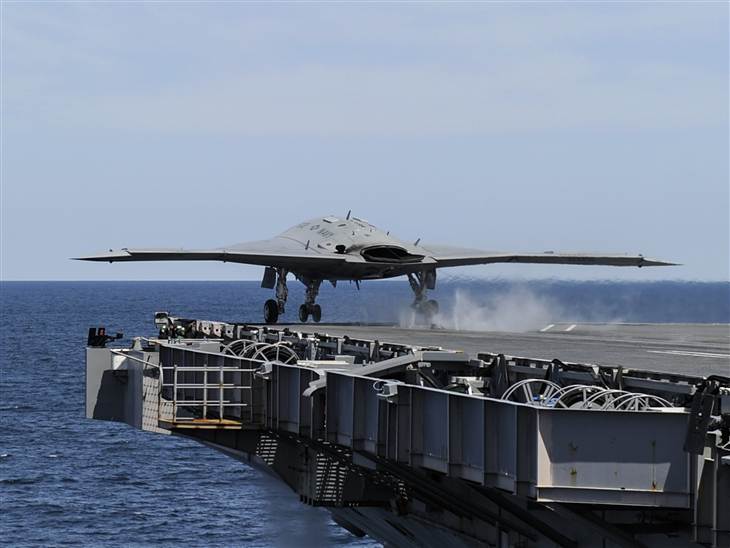
My twitter feed was abuzz today with statements lauding this morning’s launch of the U.S. Navy’s X-47B unmanned carrier air system from USS George H. W. Bush (CVN 77):

“…another great first for naval aviation…History has just been made…Momento histórico…History has just been made…the Next Era of Naval Aviation…Launch Catapults Naval Aviation into the Future…New era in warfare…MOMENTOUS…Watershed…a pivotal milestone in naval aviation…game-changing technology,” etc.

There is a bit of truth in all of these.  Though perhaps the event is best summarized in the words of Vice President Biden.


This article was re-posted by permission from, and appeared in its original form at NavalDrones.com.

USS Enterprise – A British Memoriam

           We are Legend; Ready on Arrival; The First, the Finest; Eight Reactors, None FasterBig EWhen a crisis confronts the nation, the first question often asked by policymakers is: ‘What naval forces are available and how fast can they be on station?’
                 – Admiral C.A.H. Trost, USN Chief of Naval Operations Proceedings, May 1990


In December 2012, in execution of the recommendations set down in the National Defense Authorization Act (NDAA) for the fiscal year 2010, the world’s first nuclear powered aircraft carrier, USS Enterprise (CVN-65), was ‘inactivated’ at Naval Station Norfolk, Virginia. Such ceremonies are always poignant events, a mixture of sadness and celebratory reflection on a ships life and achievements. It is estimated that some 100,000 American men and women had served on her during a distinguished 51-year career and many of them turned out to say farewell to this extraordinary warship.

She is not only extraordinary in her length of service in the U.S. Navy but also in her size and capabilities. She is 1,123 feet long (331 feet shorter than the height of the Empire State Building). Her displacement is 95,000 long tons, 4.5 times larger than the recently decommissioned Royal Navy Invincible-class carriers and still 25 – 30,000 long tons larger than, the new Queen Elizabeth-class carriers, the first of which will enter service in 2018, 60 years after the hull of Enterprise was laid down in a Virginian ship yard. Her 8 nuclear reactors allowed her to ‘steam’ at up to 35 knots, and meant she never had to refuel. She had a ships company of over 3,000 and could carry up to 95 aircraft. I often remember fondly a story my father told me in which he recalls acting as plane guard to a Nimitz class carrier in the Persian Gulf in 1991. In command of the Royal Navy frigate HMS Scylla (F71), he was struck by her effortless acceleration, while he practically had to burn the wardroom furniture to keep up. Even if not Enterprise, I imagine many a naval officer around the world has similar, lasting impressions of an American nuclear powered carrier.
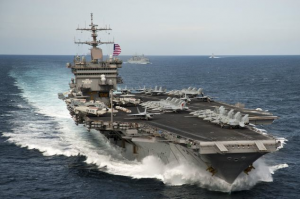
Big E 2By any yardstick Enterprise is an impressive military asset, and all the more so when you consider she was laid down just 13 years after the end of the Second World War. Since then she has been involved in almost every major conflict since, beginning with the Cuban Missile Crisis in 1962, including;

• Six deployments in support of Operations in Vietnam, during which she survived a devastating fire.
• Operation Frequent Wind (1975); the evacuation of U.S. citizens and at-risk Vietnamese citizens during the North’s invasion of the South.
• Operation El Dorado Canyon (1886); the bombing of Libya.
• Operation Earnest Will (1988); escorting Kuwaiti oil tankers during the Tanker Wars.
• Operation Preying Mantis (1988) in response to the Iranian mining of an American warship during Earnest Will.
• Operation Classic Resolve (1989); demonstrating American support to Philippine President Corazon Aquino during an attempted rebel coup.
• Operation Joint Endeavour (1996) & Operation Southern Watch (1996); enforcing no fly zones over Bosnia and Iraq respectively.
• Operation Desert Fox (1998); launching airstrikes against targets in Saddam Hussein’s Iraq following his continued flagrant disregard for UN sanctions.

In more recent years, Enterprise was first to provide direct air support for Operation Enduring Freedom, the 2001 invasion of land-locked Afghanistan, delivering 700 seaborne airstrikes in just 3 weeks. She would later provide continued air support for Operation Iraqi Freedom in 2003. She has even supported operations off the Horn of Africa against Somali pirates, quite a contrast to her baptism of fire off Cuba. I only list the most salient operations in which she played a significant part, but this list – by no means exhaustive – is sufficient to demonstrate the flexibility and utility of such a vessel. The above record also does not account for the ever-valuable ‘showing the flag’ missions, a task for which she would have had a powerful talent. One must never underestimate the diplomatic leverage a warship with such destructive potential can afford, either sitting offshore or docked in harbour; wherever she is in the world she is a potent expression of America’s engagement with that region. There is something sublime and deeply affecting in the design, scale and military capability of a carrier such as Enterprise.

But she is more than a military asset; she is also an American icon. She has hosted rock concerts, she had starring roles in the films Top Gun and Hunt for the Red October, and of course, her futuristic namesake explores the final frontier. She and her sister ships not only define how America prosecutes defence, but also help to shape an understanding of American culture and international identity. When commissioned in 1961 Enterprise was the embodiment of the post-war American spirit, powerful, flexible, responsive and technologically innovative, characteristics that all contributed to an over-arching commitment to global security1. She was a clear demonstration of America’s post-1945 ambitions and more significantly for a Brit like myself, a clear indication that the Royal Navy had been conclusively usurped as the world’s preponderant naval force (however I am yet to concede the title of the finest!). Seapowers around the globe still aspire towards what Enterprise defines. You only need to look to the shipyards of China, India, Russia and indeed, the United Kingdom, to get an appreciation for the far-reaching legacy of this ship, laid down half a century ago.
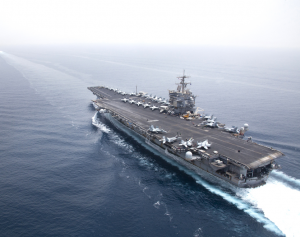
Big E 3Her inactivation has not hugely impacted America’s seaborne air-power capabilities. The U.S. Navy still operates 10 carrier battle groups across the globe (each purported to cost the equivalent of the entire Italian defence budget), capable of responding swiftly to any emergency, be it military or humanitarian. These groups continue to define America’s global defence posture. The Nimitz-class carriers, and the new generation currently under construction, present a clear indication that Washington still has an intention to remain a global presence to shape its and the world’s future from the sea and not from protracted and costly wars ashore.

At the de-commissioning event in December, Captain William C. Hamilton, Jr., the twenty-third and final commanding officer of Enterprise reflected on the ships history, “Enterprise is a special ship and crew, and it was special long before I got here”.

“Before I took command of this ship, I learned the definition of ‘enterprise’, which is ‘an especially daring and courageous undertaking driven by a bold and adventurous spirit.’ Fifty-one years ago, this ship was every bit of that definition.”

“Here we are 51 years later, celebrating the astonishing successes and accomplishments of this engineering marvel that has roamed the seas for more than half the history of Naval Aviation. Daring, courageous, bold, and adventurous indeed.”2

It is hardly surprising, and a reflection of the impression Enterprise has made on the American psyche, that a recent announcement declared that the latest Gerald R. Ford-class carrier will be named Enterprise, the 9th American warship to bear what has become a legendary title. When one considers the contribution of Big E to American security, diplomacy and military operations over the last half century, who can argue, as some are tempted to do here in London, if not in words but in their actions, that seapower is becoming less and less relevant to present and future global security?

 Simon Williams received a BA Hons in Contemporary History from the University of Leicester in 2008. In early 2011 he was awarded an MA in War Studies from King’s College London. His postgraduate dissertation was entitled The Second Boer War 1899-­1902: A Triumph of British Sea Power. He organised the Navy is the Nation Conference, which was held in April 2012 in Portsmouth, UK. The aim of this event was to explore the impact of the Royal Navy on British culture and national identity.

1. I must add at this point however that the USN relies heavily on RN mine-countermeasure vessels to ensure safe passage of his big-ticket assets in hostile waters.

2. ‘Enterprise, Navy’s First Nuclear-Powered Aircraft Carrier, Inactivated’