

By Helge Adrians
Russia is working to integrate inland waterways more deeply into its deterrence and defense posture. In Western contexts, this area of maritime geography is usually termed the ‘brown water zone.’ A harbinger of that development was the October 2015 strike against positions of Islamist groups in Syria, carried out by small warships in the Caspian Sea using land-attack cruise missiles (LACMs). Russia not only demonstrated a new level of operational reach (of over1 1,500 kilometers), but also revealed a singular capability that remains unmatched to this day – executing deep precision strikes (DPS) from inland waters.2
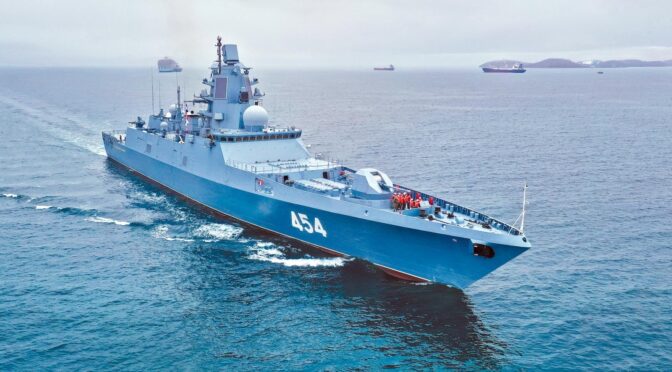
Indications that the Russian Navy could carry out such an operation from lakes and possibly even rivers had emerged a few years prior. As part of the State Armaments Program for 2007-2015, Russia started outfitting many of its naval vessels with a new, long-awaited universal vertical launch system (VLS). Like the US MK 41 VLS — which has been in use since 1986— the Russian 3S14 VLS is designed to accommodate different types of missiles (rather than using specialized tubes for each missile type, as was previously the case on Soviet and Russian warships)3. The outfitting included river-capable Buyan-class corvettes, of which a modified batch with an eight-cell VLS was built from 2010—the Buyan-M class, sometimes also called Sviyazhsk-class.4 Two years later, the 3M14 LACM—a variant of the Kalibr family of missiles—was introduced on surface warships. One of the first units was the Gepard-class frigate Dagestan, which is part of the Caspian Flotilla. The formation also received the first three Buyan-M class corvettes, commissioned in 2013.
The reinforcement of the Caspian Flotilla was no coincidence. It was closely linked to the naval build-up of the three former Soviet republics Azerbaijan, Kazakhstan, and Turkmenistan from the mid-2000s. The motivations behind this trend were twofold – a growing interest amongst the littoral states in exploiting the Caspian Sea’s economic potential, and the ambiguity surrounding its legal status at that time, particularly concerning maritime borders and access rights. Despite its scale resembling a marginal sea, the Caspian Sea is in practical terms an inland lake.5

Although Western observers were aware of these two developments — ‘Kalibrization’ of the Russian Fleet and strengthening the combat power of forces of an inland water body — it seems they failed to derive the correct insights. For example, the Intermediate-Range Nuclear Forces (INF) Treaty, concluded with the United States in 1987, prohibited land-based medium-range missiles, but not sea-based ones. This explains why Russia’s strike in October 2015 caused such significant surprise. As is often the case with such events, many of the subsequent analyses focused on the political implications and the technologies used, while paying less attention to the underlying conceptual framework.
New strategic importance of Russia’s inland waters
Russia’s inland waterways hold strategic significance. This is due to three reasons: first, the country has a large number of rivers spread across its entire territory; second, many of them are long and wide, well-suited for transporting cargo; and third, most of the rivers lie entirely within Russian borders, making them less accessible to Western intelligence. That may have been one of the reasons why the Soviet Union connected the waters west of the Urals in the mid-20th century. At the center is the Volga River, which flows into the Caspian Sea. Through the construction of canals, the Volga was also linked to the Baltic Sea and the White Sea in the North, and to the Black Sea in the South.6 This network is most commonly referred to as the Unified Deep Water System of European Russia (UDWS).

From the earliest days of the Cold War, there were discussions within NATO about the military utilization of the UDWS. However, this was more about the possibility of moving single warships, especially submarines, between the northern and the southern flank covertly and thus protected from NATO attacks. To this day, Russia maintains naval shipbuilding at several shipyards along the Volga River. Until the 1990s, even Kilo-class submarines were constructed at a facility there.
Fitting river-capable corvettes with 3M14 LACMs and using them from the Caspian Sea has fundamentally altered strategic assessments of the UDWS, from a useful logistical corridor to an inland naval bastion. However, the capability to carry out DPS from such an unexpected location seems less the outcome of deliberate planning. It was more a consequence of budgetary limitations as a result of the collapse of the Soviet Union in 1991 and the Russian financial crisis in 1998.7 Faced with the need to maintain its nuclear-powered ballistic missile submarines (SSBNs), Russia was forced to make cuts in surface fleet development. Enhancing the operational reach of so-called third-rank combatants like corvettes, traditionally used for operations in the littoral ‘green water,’ or as they say in the Russian Navy – ‘near sea’ zone – emerged as a pragmatic and creative compromise, particularly against the backdrop of the INF Treaty, which was in effect until 2019.8,9 Amongst these are the aforementioned Buyan-M class and its more advanced successor, the Karakurt-class, of which several examples have been commissioned since 2018.
Searching for safe spaces
Following Russia’s full-scale invasion of Ukraine in February 2022, naval platforms became part of the ground campaign through the use of 3M14 LACMs. Initially, such strikes were launched from the Black Sea. By end of December 2022, the Caspian Sea—far away from the frontlines—had also become a launch area for these operations. As Ukraine gradually managed to keep the Black Sea Fleet at distance through a combination of shore-based anti-ship missiles, sea mines, and later—with growing intensity since summer 2023 at the latest—uncrewed surface vessels (USVs), the strategic relevance of the Caspian Sea grew. It not only served as a safe space for continued DPS but also as a hub for repairing and replacing damaged ships.
The expanded use of uncrewed systems in the war against Ukraine plus Western intentions to acquire such platforms have made secure maritime areas increasingly vital for the Russian Navy. However, those are scarce. During the Cold War, Soviet fleets relied on an ‘area denial’-strategy (AD),10 also known as the ‘Bastion’-concept with regard to the defense of the bases of the Northern and the Pacific Fleet where Russia continues to concentrate its SSBNs. The extended defense of this protected space can be described as an ‘anti-access’-approach (A2). Long before the term ‘A2/AD’ was coined by Western analysts in 2003 and became a buzz word from 2014, Moscow had already developed the necessary capabilities as a lesson learnt from World War II (mainly a large long-range aviation and submarine force).11,12 These platforms threatened opposing surface warships, which could be detected and targeted before reaching Soviet positions. Even fleets in marginal seas were enabled to perform A2/AD. A renaissance came with the introduction of various land-based long-range missile systems from around 2012.13 For a long time, Western nations appeared to have little means to counter these A2/AD capabilities. Unmanned systems may offer a solution, as the Ukrainian armed forces have repeatedly demonstrated in the air and in the maritime domain. Due to their small size and design, uncrewed systems have low signatures. Consequently, they are frequently able to penetrate Russian defense layers unrecognized. As a result, the retreat of warships into protected areas under full Russian control—including the UDWS—appears to be the only viable option to safeguard against new asymmetric threats such as USVs and uncrewed underwater vehicles (UUVs).
In light of this, the Russian Navy has adapted for better protection, starting with the creation of a new naval district for the Sea of Azov in July 2023. Situated north of the Black Sea, it is a shallow shelf sea accessible primarily via the Kerch Strait, which Russia has controlled since annexing Crimea in March 2014. In the early stages of the invasion of Ukraine in 2022, Russian forces succeeded in closing the gap between Donbas and Crimea. Since then, Russia has gained full control over the Sea of Azov. One of the main reasons for this approach may have been that there is access to the UDWS via the Don River, which flows into the north-west. In the Sea of Azov, Russian warships are less exposed to Ukrainian attacks than in the Black Sea. This made the maritime enclave appear suitable, amongst other things, as a launch area for corvettes with LACMs.
Efforts to identify secure maritime spaces were also observed in other regions: in the east of the Baltic Sea, the Russian Navy appears to be planning to open up Lake Ladoga—situated north of St. Petersburg—as a fallback area for small warships. Covering nearly 18,000 square kilometers, it is the largest inland body of water in Europe. Since Finland’s defeat in the Second World War, it has been completely surrounded by Russian territory14 and became part of the UDWS. During the Cold War, the lake’s remoteness made it a strategically valuable site for naval testing, playing a role comparable to that of the Caspian Sea. Now, according to Russian media, it is set to become a component of Moscow’s deterrence and defense posture vis-à-vis NATO. For this, two Karakurt-class corvettes of the Baltic Fleet were deployed to Lake Ladoga for several days in September 2023, followed by two Buyan-M class vessels for a similar duration in September 2024.15 While in the first year the focus lay on navigation training and surveying former naval mooring sites repurposed by Russian state-owned defense companies, the second year was reportedly marked by notional launches of 3M14 LACMs as part of the major naval exercise Okean 2024.16
In Russian media, there have been discussions about bolstering forces for brown water operations. This was sparked by a March 2024 announcement from the then Russian Minister of Defense, stating plans to reconstitute a Dnieper Flotilla by the end of the year—intended to take over riverine combat duties from the ground forces. Such formations have existed intermittently since the 18th century, most recently until 1951. The Soviet Union also operated similar groupings on other major rivers. Russia has taken over some of them. The last major command was the Amur Flotilla at the Russian-Chinese border in the Far East: it was transferred to the Border Service in 1995 and formally disbanded in 1998. Apart from that, a sizable shipyard still exists on the Amur River, which also builds Karakurt-class corvettes. However, it is not yet known to what degree these will be deployed from there and whether Russia intends to build up further riverine units.

Decisive, complementary impact without salvos
The extent to which the Russian Navy attributes a strategic role to inland waters is currently connected to the deployment of Buyan-M and Karakurt-class corvettes. Nevertheless, the presence of these vessels beyond the usual duration of a transit is better understood as a sign that changes might be underway, rather than definitive evidence that a change has already taken place. This is because, although the corvettes can strike far-off targets using 3M14 LACMs, they are limited to carrying just eight per ship. However, in conjunction with long-range and decoy UAVs that could saturate air defenses, these assets enable surgical strikes or DPS, respectively, against select targets, particularly critical infrastructure. This reflects the ‘Strategic Operation for the Destruction of Critically Important Targets’-approach outlined in Russian military theory around 2010. The concept is to discourage an adversary from escalating or continuing a conflict by selectively destroying high-value targets, aiming to impact political or societal morale without causing mass casualties. This behavior has been repeatedly demonstrated in Russia’s war against Ukraine.
Such effects could also be achieved through ground- or air-based systems. In this context, warships should be seen as a supplement — particularly when other assets are absent or limited. One example is the Russian part of Karelia, an area east of Lake Ladoga, where Moscow only recently began expanding its ground force presence in 2024, following Finland’s accession to NATO in 2023, leaving the area initially lacking adequate deterrence capabilities.17 Even though Lake Ladoga is seasonally unusable due to ice cover, it can nonetheless be utilized temporarily for defensive or deterrent purposes.
The potential use of LACMs also serves to demonstrate the Russian Navy’s relevance in land operations—an aspect that should not be underestimated. Here, the focus is less on quantity but more on quality; internally, this reinforces the Navy’s standing within the Russian armed forces and political leadership, while externally, it contributes to strategic ambiguity by signaling that all branches of the military are capable of delivering long-range effects.
Closing NATO’s blindspot
Striking land targets from lakes offers several advantages. In addition to the protection against asymmetric threats, it also provides cover from reconnaissance and targeting by enemy missile systems. This is due to the stealthy design of the Buyan-M and Karakurt-class corvettes. When moving or hiding near shorelines, spotting, tracking, and targeting them becomes difficult. Moreover, engaging warships requires different types of munitions than those used against land-based systems like rocket launchers—specifically, warheads capable of penetrating hulls or superstructures to cause significant damage or achieve a kill. Most Western anti-ship missiles have limited range, typically only a few hundred kilometers, and travel at subsonic speeds over longer distances, making them easier to detect and intercept. Additionally, some anti-ship missiles designed for blue-water targets may struggle with targets amongst the cluttered shorelines of lakes and rivers.
While NATO may not prioritize countering Russian warships on lakes in a broader conflict scenario, the risk remains significant. Ukraine’s response offers a blueprint of what can be done. On the one hand, obstructing passage through chokepoints such as straits or locks can effectively trap warships or prevent them from entering. Since the start of the war, Ukraine has sought to block the Kerch Strait; for example, in July 2024, it targeted the nearby ferry terminal at Kavkaz from the air. According to the Ukrainian Navy, Moscow has withdrawn all warships from the Sea of Azov as a result.
On the other hand, the destruction of port infrastructure can disrupt the resupply of naval forces, particularly the reloading of missiles, which can only be done pier-side. Ukraine successfully struck Russian warships in the captured port of Berdiansk on the Sea of Azov in March 2022 as well as in the naval base at Kaspiysk on the Caspian Sea in November 2024. In the latter, both Gepard-class frigates and a Buyan-M class corvette would have been affected.
Ukrainian drones strike the naval base of the Russian Caspian Flotilla in November 2024. (Footage via Twitter/OSINT Technical)
There are also lessons to be learned from Russia’s tactics: in August 2025, it launched an attack on a Ukrainian reconnaissance vessel deep in a tributary of the Danube River. The vessel was reportedly underway in Ukrainian waters, just meters away from the opposite Romanian bank. Remarkably, Russia succeeded in covertly deploying a USV about 40 kilometers into the Danube to conduct the kamikaze strike, while coordinating a UAV to monitor the mission from the air (which could also have fired on the ship).
In principle, it seems possible that the Russian Navy may seek to enhance the strategic role of inland waters. The deployment of Kilo II-class submarines or the loading of 3M14 LACMs in the containerized Club-K version18 onto civilian riverboats are both conceivable, though unlikely due to the logistical complexity involved (because of, for example, river depths19 and currents20 as well as satellite connections). Instead, Russia is more likely to focus on better protecting its Buyan-M and growing Karakurt-class corvettes. Increasing their numbers and distributing them when at sea or over several supporting sites make detection significantly more difficult. This would allow Russia to maintain a strategic reserve for DPS.
Conclusion
NATO should not underestimate Russia’s strategic brown water capabilities. The same applies to Japan and South Korea in the event that Moscow, contrary to current indications, intends to use the Amur as a launch area to defend the Sea of Japan and the Sea of Okhotsk. Therefore, it is essential to prepare doctrinally, enhance surveillance techniques, and develop effective countermeasures. This will require more unconventional thinking—for example, the dropping of sea mines, USVs and UUVs from the air or the arming of partisans with portable anti-ship missiles such as the Swedish RBS-17. New doctrine and capabilities can effectively account for this important yet underappreciated dimension of Russian naval influence.
Commander Helge Adrians, German Navy, M.A., is a Visiting Fellow at the German Institute for International and Security Affairs.
References
1. 3M14 should be able to fly up to 2,500 kilometers, according to [U.S.] State Department, Bureau of Arms Control, Verification and Compliance (2020): 2020 Adherence to and Compliance with Arms Control, Nonproliferation, and Disarmament Agreements and Commitments (Compliance Report), online in: https://2017-2021.state.gov/wp-content/uploads/2020/06/2020-Adherence-to-and-Compliance-with-Arms-Control-Nonproliferation-and-Disarmament-Agreements-and-Commitments-Compliance-Report-1.pdf (PDF file), June 2020 (accessed: 26.12.2024), p. 14 and 16.
2. The distance from the Caspian Sea to the targets in Syria was given by the official Russian side as ‘nearly 1,500 kilometers’, cf. TASS (2015): Caspian Flotilla ships fire 26 cruise missiles on IS targets in Syria — Defense Minister [sic!], online in: https://tass.com/defense/826919, 07.10.2015 (accessed: 18.12.2024).
3. Cf. Bogdanov/Kramnik (2018), p. 6.
4. Cf. Office of Naval Intelligence (2015): The Russian Navy. Historic Transition, Washington: N.p., p. 20.
5. For decades, the Soviet Union and Iran—the Caspian’s only littoral states until 1991—neglected to define its legal status. Only in 2018 did the five current coastal states reach an initial agreement (i.e., the Convention on the Legal Status of the Caspian Sea, also known as ‘Teheran Convention’), concluding that the Caspian Sea should be treated as neither a sea nor a lake in legal terms.
6. Cf. Jaghdani, Tinoush Jamali/Ketabchy, Mehdi (2023): The Strategic Significance of the Russian Volga River System, in: Russian Analytical Digest, Vol. 304, pp. 22-27, here: p. 22.
7. Cf. Mommsen, Klaus A. R. (2020): The Russian Navy. “Russia’s pride, strength, and asset”, in: Routledge Handbook of Naval Strategy and Security, edited by Krause, Joachim/Bruns, Sebastian (2018), Abingdon/New York: Routledge, pp. 305-314,
here: p. 307.
8. Cf. Kofman, Michael (2023): Evolution of Russian naval strategy, in: The sea in Russian strategy, edited by Monaghan, Andrew/ Connolly, Richard (2023), Manchester: Manchester University Press, pp. 94-123, here: p. 109.
9. For example, the delays in delivering the first two Admiral Grigorovich-class frigates in 2015 prompted a shift in focus toward building Karakurt-class corvettes instead, cf. РИА Новости (2015): Минобороны заявило, что ОПК “немножко сорвал” срок сдачи двух фрегатов, online in: https://ria.ru/20151224/1348076684.html, 24.12.2015 (accessed: 19.08.2025).
10. Cf. Ushirogata, Keitaro (2025 in English; 2019 in Japanese): Global Maritime Military Strategy. 1980-2023, Singapore: Springer, p. 128 ff.
11. This was related to the fact that the US developed a new strategy to deprive Chinese A2/AD-capabilities. Russia and Iran were also credited with such capabilities, making the issue more relevant for European NATO members, especially as there were fears after the occupation and annexation of Crimea that Russia could do the same with the Baltic states and make defence more difficult by activating A2/AD-systems, cf. Simón, Luis (2016): A European Perspective on Anti-Access/Area Denial and the Third Offset Strategy, online in: https://warontherocks.com/2016/05/a-european-perspective-on-anti-accessarea-denial-and-the-third-offset-strategy/, 03.05.2016 (accessed: 27.08.2025).
12. Cf. Gorschkow, Sergej (1976): Seemacht Sowjetunion, edited by Opitz, Eckardt (1978), Hamburg: Hoffmann & Campe, p. 266.
13. In 2012, the S400 air defence system, which entered service in 2007, was stationed in Kaliningrad—the first of the three missile systems primarily linked to A2/AD, cf. Dalsjö, Robert/Berglund, Christofer/Jonsson, Michael (2019): Bursting the Bubble. Russian A2/AD in the Baltic Sea Region. Capabilities, Countermeasures, and Implications (FOI-R–4651–SE), p. 27. The other two systems are Iskander (both the -M and -K version) against land targets, and Bastion-P against sea targets, cf. ibid., p. 10.
14. In late 1939, the Soviet Union demanded territory from Finland, citing the security of Leningrad (now Saint Petersburg) as a primary justification. After Finland refused, the Soviet Union invaded in November. The war ended in March 1940 with the Moscow Peace Treaty and the formerly shared Lake Ladoga became entirely surrounded by Soviet territory. Though contested during the 1941–1944 war, this control held. This outcome was formally recognized in 1947 with the Paris Peace Treaty that formally established Lake Ladoga as a Soviet inland lake under international law.
15. It was the Sovetsk (hull number: 252) and the Odintsovo (252), see the report ‘Baltic Fleet on Ladoga’ in: https://vpk.name/en/ 784930_baltic-fleet-on-ladoga.html 16.10.2023 (accessed: 24.11.2024). This is the English translation of the original Russian article by Timur Gainutdinov, published on Krasnaya Zvezda. The original text was published online but is not accessible from within Germany, cf. http://redstar.ru/na-sedoj-ladoge/. However, the Norwegian military blogger Thore Are Iversen uploaded the article and another English translation to X; see corresponding images at https://x.com/The_Lookout_N/status/ 1714640171176493411, 18.10.2023 (accessed: 27.12.2024).
16. One them could be the former naval base Lakhdenpokhya in the north west of the lake, cf. Ryabov, Kirill (2023): “Karakurt” on Lake Ladoga, online in: https://en.topwar.ru/228351-karakurty-na-ladozhskom-ozere.html, 19.10.2023 (accessed: 24.11.2024). Otherwise, the corvettes were moored at the floating bridge in Priozersk, as satellite images showed, see the Tweet by Thore Are Iversen in: https://x.com/The_Lookout_N/status/1833800057469952169, 11.09.2024 (accessed: 28.12.2024).
17. It was only in April 2024 that Russia announced its intention to station three missile artillery battalions equipped with the Iskander-M system in Karelia, see report ‘В Карелии сформирована отдельная ракетная бригада с ОТК «Искандер-М»0‘, in: https://iz.ru/1684603/2024-04-19/v-karelii-sformirovana-otdelnaia-raketnaia-brigada-s-otk-iskander-m, 19.04.2024 (accessed: 12.01.2025).
18. However, ‘[t]he current status of the Club-K system is unclear, and there is no public evidence that russia [sic!] has commenced serial production of this system’, cf. Syngaivska, Sofiia (2024): New Icebreaker Showcases russia’s [sic!] Advanced Naval Technology, Allegedly Suitable for the Kalibr Missiles, online in: https://en.defence-ua.com/weapon_and_tech/new_icebreaker_ showcases_russias_advanced_naval_technology_allegedly_suitable_for_the_kalibr_missiles-10743.html, 05.06.2024 (accessed: 26.08.2025).
19. Kilo-class submarines were usually deployed on barges across rivers, see the following undated photo in https://imgur.com/a/ lYRJeAO, 12.12.2023 (accessed: 04.01.2025). The link was shared in a discussion on Reddit, see https://www.reddit.com/r/ submarines/comments/18g02tl/how_submarines_built_in_nizhny_novgorod_were/, n.d. (presumably 2024; accessed: 04.01.2025). In 2021, a decommissioned November-class nuclear submarine was even transported via the White Sea-Baltic Sea Canal, see https://paluba.media/news/11667, 21.09.2021 (accessed: 16.01.2025).
20. Even smaller warships are therefore accompanied by tugs, as can be seen in a video showing the Karakurt-class corvette Taifun (805) on its way to Lake Ladoga in 2019, see https://www.youtube.com/watch?v=jZ7uYoh-hXg&t=1s, 20.05.2019 (accessed: 03.01.2025).
Featured Image: Buyan-M-class corvette of the Russian fleet, December 2022. Russia. (Photo via Ministry of Defense of the Russian Federation)
 are successful. The annexation of Crimea in 2014 was primarily to ensure Russian control of the naval base at Sevastopol, which had been heretofore leased to Russia by the Ukrainian government. To this end, the document