Tag Archives: Russia

The Baltic: Grey-Zone Threats on NATO’s Northern Flank

European Maritime Security Topic Week

By Martin N. Murphy, PhD and Gary Schaub, Jr. PhD

Hybrid Warfare

The governments and peoples of the Baltic States recognize that, following Russia’s takeover of Crimea and intervention in eastern Ukraine, they are once again in the Kremlin’s sights facing the prospect of Russian destabilization and even outright invasion.

NATO’s leadership termed Russian strategy “hybrid warfare,” defining it as warfare in which “a wide range of overt and covert military, paramilitary, and civilian measures are employed in a highly integrated design.”1  Questions were raised immediately about the suitability of the designation, as the label NATO adopted fails to adequately capture the reality of what Russia inflicted on Ukraine—and may inflict on states in the Baltic Sea Region (BSR) in the near future.

Russian successes in Crimea reinvigorated two longstanding instruments of its power: its armed forces and its capacity for intensive information warfare.2 “Grey-zone” perhaps captures the orchestrated multidimensional nature of Russian actions calibrated to gain specified strategic objectives without crossing the threshold of overt conflict and exploit Western concepts of war and peace as two distinct conditions.3 Any conflict between NATO and Russia will likely occur at the Article 4 rather than the Article 5 level, complicating any Western response.4

Hybrid War in the BSR: Political and Information Warfare Dimensions          

It is possible to count all the fighters, bombers, troops and ships in the Baltic and arrive at a correlation of forces. But the BSR is a peripheral region, and only three things matter when it comes to its security:

  • The commitment of core NATO powers – especially the U.S. – to the region’s defense;
  • Russia’s determination to restore its sphere of influence in the region; and
  • Russia’s desire to probe for Western weakness.

Russia is interested less in territory than in effect. NATO’s focus on military measures to defend the Baltic States may overlook the challenge posed by all arms of Russian power to identify and exploit political, social, economic, and military vulnerabilities in its target states and the Western alliance.

These dimensions have been underplayed in NATO thinking, a tendency reinforced by the military nature of its Charter and institutional culture. Questions remain as to whether NATO’s own legal framework and traditional instruments are sufficient to deal with these non-military challenges, and certainly whether they can respond to a fast-changing situation. The means Russia is prepared to use in order to deceive and confuse NATO are based on the same tools it used during the Cold War, but it has adapted them to the mores of the social media age, which lacks the experience to judge the import of Russian messaging or actions.

Applying the Hybrid Model to Warfare at Sea

Russia’s high-end forces would not constitute the first movers in a hybrid conflict. They should be regarded as deterrents to local resistance and intervention by NATO and other Nordic states. It would rather pursue more ambiguous methods.

Broadly speaking, two scenarios for a Russian campaign in the BSR appear possible:

1. A low-key, possibly opportunistic, campaign that exploits real or manufactured discontent among Russian compatriots to destabilize one or more of the Baltic States, creating a “frozen conflict” that undermines NATO’s credibility; or

2. A more structured, high-tempo campaign to achieve the same objectives against NATO power in the BSR and also render Nordic defense cooperation redundant.

It is reasonable to assume that the Baltic Sea Fleet and other organs of Russian maritime power will play supporting rather than leading roles in any such conflict.

Aside from Moscow’s ability to manipulate the loyalty of Russian expatriate communities in the Baltic states, many of the points where it can apply pressure lie on or under the Baltic Sea itself. These include:

Geographically Isolated Islands and Disputed Borders

The Bornholm, Gotland and the Aland group are respectably Danish, Swedish, and Finnish islands that have considerable strategic significance in the BSR. Many are ideal as bases, supply points, staging areas, and jumping off points for SOF operations and ambushes, while bays, fjords, and peninsulas provide hiding places and launch points for fast raiders.
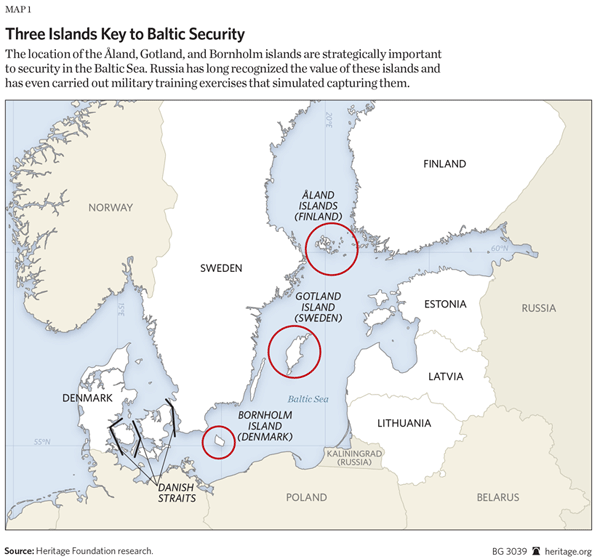
Map indicating large islands within the Baltic Sea. (Heritage Foundation)

Undersea Cables

Modern economies depend upon a remarkably vulnerable information and communications infrastructure. Roughly 95 percent of intercontinental communications traffic—e-mails, phone calls, money transfers, and so on—pass through fiber-optic cables that “lack even basic defenses, both on the seabed and at a small number of poorly guarded landing points.”5

When it comes to the Baltic Sea particularly, Poland, Lithuania, and Latvia have only a few nodes that need be severed, while Estonia, the Nordic countries, and Germany have much more redundancy in their connections. Still, the economic disruption caused by severing these undersea cables would be considerable in time and cost and be difficult to mitigate, even for those countries with multiple nodes. They would therefore be a prime target in a hybrid warfare campaign.            

Energy Supplies

It has long been recognized that Estonia, Latvia, Lithuania, and Poland depend upon Russian energy. This exposes them to the possibility of economic coercion. These states have reduced their dependence on Russian supplies, but diversification has been difficult given the cost of replacing existing infrastructure and vulnerabilities remain.

Port and Supply Chain

Ports and ships could be subject to sabotage and strikes using SOF as part of a hybrid offensive. Yet the most serious threat could come from cyberattacks, a concern that already animates much of the landward resilience debate. Modern ports could not operate absent sophisticated computer systems, while modern ships are increasingly automated to cut crew costs. Any prolonged interference with the region’s maritime trade could severely impact industrial production flows and economic security.

Why Would Russia Disrupt the BSR?

Russia is a revisionist power. Internationally, it wants to revise the existing regional order at the least possible political and military cost to itself, diminish U.S. power, and further a multipolar world. Domestically, Putin’s government requires an enemy to divert attention from internal troubles. The Baltic States lie at the point where American power is most extended and Russian power can be concentrated most easily. As Russia is under no illusion it can fight the U.S. directly, or a coalition of America’s core allies, its challenges will stay below the level of direct confrontation.

The Soviet Union invested around fifty percent of its shipbuilding capacity in the St. Petersburg area. A second vital facility is located in the Kaliningrad Oblast. The Baltic Sea has also become a vital conduit for Russian trade. Prolonged interruptions in flows of energy and goods would inflict considerable damage on Russia’s poorly diversified economy. During 2015, 52 percent of Russian container traffic passed through St. Petersburg. Europe remains a major customer for Russian crude oil shipped by tanker from ports near St. Petersburg. On the seabed is the Nord Stream gas pipeline. A second pipeline–Nord Stream 2–has been proposed that would double the capacity. This connection reinforces the dependency and mutual interest that already exists between the EU and Russia and risks compromising Western European responses to possible Russian aggression in CEE.

The Baltic Sea Region has plentiful points of vulnerability where Russia can test Western resolve. While these are not confined to the Baltic States, the most obvious point of leverage is the Russian minorities who reside in each one with concentrations in port cities and other maritime areas.Nor are the Baltics removed from Russia’s deeply ingrained sense of insecurity arising out of its loss of strategic depth. Advancing the Russian right flank to the Baltic Sea would right a perceived wrong, prevent the encirclement of Kaliningrad, the main base of the Russian Baltic Sea Fleet, and provide a platform from where Russia could threaten the entire Baltic Sea littoral.

Sweden and Finland are clearly concerned about this possibility. Sweden has returned its army garrison to the strategically important island of Gotland, while towns and cities across Sweden have been told to make preparations against a possible military attack.Conscription has also been reintroduced.However, any move by either to join NATO could “provoke Russia to launch a pre-emptive provocation in order to demonstrate the alliance’s weakness” and deter either country from proceeding with its application.9

Russian Military Capability

Despite the importance of the Baltic Sea routes, the Russian Baltic Sea Fleet is the weakest of Russia’s four fleets (Baltic, Black Sea, Pacific, and Northern). It continues to have the lowest priority for new units.

That does not mean modernization has not taken place. Since 2007, the fleet has been upgraded with two new classes of corvette equipped with land-attack missiles, a capability that is new to the Baltic Sea fleet.10 However, the fleet’s submarines have not been modernized and remain inferior to German and Swedish boats. Lacking AIP propulsion, which Russian industry is having problems mastering, they are also likely to be noisier. The fleet’s anti-submarine warfare (ASW) and mine counter-measures (MCM) capabilities are also limited.
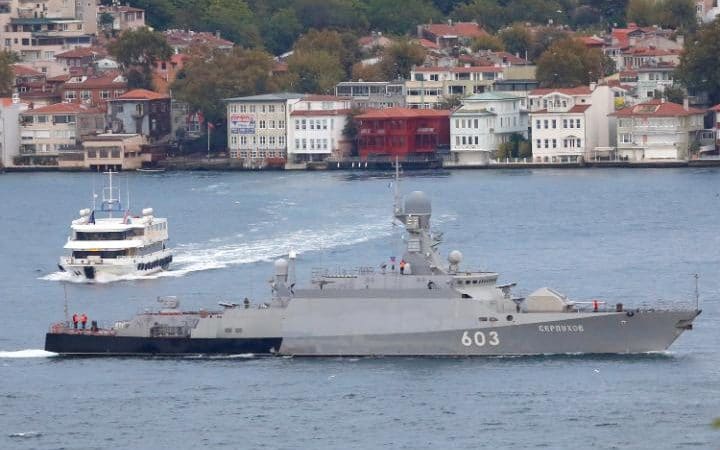
Three Buyan-class Corvettes, seen above, are expected to augment the Baltic Fleet by 2020. (Murad Sezer/Reuters)

That said, the Baltic Sea is relatively small with an average width of only 193km (120 mi). The sea and surrounding littoral can–and almost certainly would–be dominated by air power and air-deployable ground forces in any high intensity conflict. In particular, Russia is able to effectively dominate large areas of the Baltic Sea and air space using missile forces based in the Kaliningrad and Leningrad oblasts.11 The Iskander-M mobile ballistic missile is capable of hitting targets in much of Sweden and from southern Poland to central Finland, whether fixed or mobile.

NATO movement would be affected in all environments: air transports bringing reinforcements into theater would be at risk from manned interceptors and a layered, air-and-missile defensive system equipped with the S-300 and the highly-capable S-400 systems. Movements by sea would be threatened by the Bastion-P coastal defense system based on the supersonic 300km-range P-800 Yakhont anti-ship missile, which Russia has announced will shortly be deployed to the Kaliningrad Oblast.12

NATO ground forces, meanwhile, would need to travel further than Russian units to reach the capitals of the Baltic states and throughout the transit could be subjected to long-range air and ground-based bombardment.

Naval “Hybrid Warfare”

Hybrid warfare as deployed by Russia in Crimea and Eastern Ukraine has received considerable analytical coverage; hybrid warfare at sea less so.13 The geography of the Crimea and Ukrainian theaters, and the circumstances of the incursions, meant the naval role was limited in both. However, Russia appears to have taken note of the success China has achieved with hybrid warfare tactics in the South China Sea, including its harassing behavior as multiple incidents have taken place on and over the Baltic and Black Seas.14 At the same time, Russia has resumed Soviet-style probing missions against NATO countries, while the Baltic states, Sweden, and Finland have all had their territorial waters and airspace compromised.15

The Chinese have made extensive use of their maritime paramilitary forces to assert maritime claims and to deny neighboring states access to waters for fishing and resource extraction purposes. The opportunities for the disruptive use of coast guard and border forces appear to be less in the BSR yet Russian behavior–for instance withholding ratification of the Narva Bay and Gulf of Finland Treaty–demonstrates that they are maintaining the potential for disruption inherent in the handful of disputes that remain.16

Mitigation Measures

Given the essentially political nature of hybrid war, mitigation measures should focus on political, economic, and information outcomes. Still, Russia needs to be convinced that all BSR states are committed to challenging Russian aggression at sea. The maritime component of NATO’s 2014 Readiness Action Plan includes intensified naval patrols in the Baltic built around the Standing NATO Maritime and Mine Countermeasures Groups, increased sorties by maritime patrol aircraft, and an expansion of the annual BALTOPS naval and amphibious exercise.17 However, BALTOPS in large measure still reflects the Alliance’s focus on high-end military operations. Changes have been made that broaden its focus and these need to be maintained and expanded in order to continuing raising maritime readiness and interoperability standards at all stages along the deterrence-to-conflict continuum. In addition, both Baltic and NATO navies need to exercise lower-end maritime security, VBSS, fishery protection, and SAR missions, while regional navies need to demonstrate they can act seamlessly with regional coast guards and border forces, port authorities and other maritime agencies, police forces and intelligence services. Furthermore, cooperation in intelligence sharing and analysis through a BSR Hybrid Threats Fusion Cell coupled with a strategic communications response capability to provide swift and consistent factual responses to false narratives would contribute to building societal resilience.

Societal resilience also requires less dependence on Russian energy supplies. A new facility for the import and regasification of liquefied natural gas (LNG) has been built at Klaipeda in Lithuania. Ensuring its security is vital. Further diversification could be achieved if additional terminals were to be built in Estonia and Latvia with reversible-flow pipelines linking all three. Ideally, a trans-Baltic pipeline should be built to link the Baltic States with the Swedish system.18 These pipelines would supplement the “NordBalt” power cable laid between Sweden and Lithuania. Notably, this link was interfered with by Russian warships on three occasions during the course of its construction. Finally, BSR states need to place a strong emphasis on port and supply chain security. This must include defenses against cyber-attacks. Protecting this largely maritime infrastructure would place a premium on effective Baltic Sea maritime domain awareness (MDA).

Conclusion

Russia considers itself to be a maritime power. It has always sought to control the seas that give it access to the world ocean. The Baltic Sea is vital in this regard. Despite this perception, Russian power, when compared to its Soviet predecessor, is sadly diminished. It is therefore understandable that it should continue to augment its remaining military power with the measures of influence, deception, and covert action that were so characteristic of the Soviet approach to inter-state relations.

Any repetition of the Crimean model is likely to be a whole-of-government effort of political subversion and destabilization in which the conventional military—as opposed to SOF and proxy militia—will play a largely passive role until the last minute, or unless the political campaign fails and can only be redeemed using conventional military force. Whole-of-government aggression demands a whole-of-government response.

In this sense, there is no such thing as maritime hybrid warfare, certainly in Russian political or military doctrine or practice. What states in the BSR may be confronting even now, however, is a long-term campaign of politically motivated societal disruption, aspects of which may occur in, through, or from the maritime domain. The seaborne aspects of the campaign will be maritime rather than exclusively naval in that what takes place could involve any of the ways people use the sea, the seabed, and the airspace over the sea. It will involve warships, submarines, and military aircraft but also include fisheries, shipping and ports, coast guards, and border forces along the way. Conventional naval forces are likely to play an analogous background role in any disruptive campaign at sea in the Baltic, as they did during the Crimea invasion and Ukraine intervention.

Martin N. Murphy, PhD is a Visiting Fellow at Corbett Centre for Maritime Studies at King’s College London. He has held similar positions with CSBA and the Atlantic Council in the U.S. He is the author of three books and numerous book chapters and articles on maritime security and unconventional warfare at sea. His next book, On Maritime Power, is due for publication in 2018.

Gary Schaub, Jr., PhD, is a Senior Researcher at the Centre for Military Studies, Department of Political Science, University of Copenhagen. Before that he held a number of academic positions in the U.S. including Assistant Professor of Strategy at the U.S. Air War College.

References

1. NATO. ‘Wales Summit Declaration’. Issued by the Heads of State and Government participating in the meeting of the North Atlantic Council in Wales, 5th September 2014.

2. Kier Giles, et al. ‘The Russian Challenge’, Chatham House Report, June 2015, p. 46. NATO Article 4 states that “The Parties will consult together whenever, in the opinion of any of them, the territorial integrity, political independence or security of any of the Parties is threatened.” NATO, ‘The North Atlantic Treaty’, last updated 21st March 2016.

3. For clear definitions of “hybrid” and “grey-zone” conflicts, and comparisons between the two, see Frank Hoffman. ‘The Evolution of Hybrid Warfare and Key Challenges’. Statement before the House Armed Services Committee, 22nd March 2017.

4. Stephen F. Larrabee, et al. Russia and the West after the Ukrainian Crisis: European Vulnerabilities to Russian Pressures. Santa Monica: RAND, 2017, pp. 10-11.

5. Robert Martinage. “Under the Sea: The Vulnerability of the Commons,” Foreign Affairs, Vol. 94, No. 1, January/February 2015, p. 117.

6. Martin N. Murphy, Frank G. Hoffman and Gary Schaub, Jr. ‘Hybrid Maritime Warfare and the Baltic Sea Region’. Copenhagen: Centre for Military Studies, University of Copenhagen, November 2016, pp. 11-14.

7. Richard Orange. ‘Swedish towns told to “make preparations regarding the threat of war and conflict” with Russia’. Daily Telegraph, 15th December 2016.

8. Daniel Dickson; and Bjorn Rundstrom. ‘Sweden returns draft amid security worries and soldier shortage’. Reuters, 2nd March 2017.

9. Edward Lucas. ‘The Coming Storm: Baltic Sea Security Report’. Washington, DC: Center for European Policy Analysis, June 2015, p. 4.

10. ‘Russia reinforces Baltic Fleet with ships armed with long-range cruise missiles in ‘worrying’ response to Nato build-up’. Daily Telegraph, 26th October 2016.

11. Kaas. ‘Russian Armed Forces in the Baltic Sea Region’.

12. ‘Russia deploys “Bastion” coastal missile complex to the Kaliningrad region’. UAWire, 22nd November 2016.

13. Charles K. Bartles and Roger N. McDermott. ‘Russia’s Military Operation in Crimea: Road-Testing Rapid Reaction Capabilities’. Problems of Post-Communism, Vol. 61, No. 6, November–December 2014, pp. 46–63; Admiral James Stavridis, USN (rtd.). ‘Maritime Hybrid Warfare is Coming’. U.S. Naval Institute Proceedings, Vol. 142, No. 12, December 2016, pp. 30-33.

14. For example, Julian E. Barnes and Gordon Lubold. ‘Russian Warplanes Buzz U.S. Navy Destroyer, Polish Helicopter’. Wall Street Journal, 13th April 2016.

15. Thomas Frear, Łukasz Kulesa and Ian Kearns. ‘Dangerous Brinkmanship: Close Military Encounters between Russia and the West in 2014’. European Leadership Network Policy Brief, November 2014.

16. ‘Russian envoy: Ratification of border treaty with Estonia obstructed by bad relations’. The Baltic Times, 9th July 2016.

17. NATO. ‘NATO’s Readiness Action Plan’. NATO Fact Sheet, May 2015; Megan Eckstein. ‘U.S. Led BALTOPS 2015 begins with heftier presence than last year’s exercise,” USNI News, 5th June 2015; Megan Eckstein.‘Foggo: BALTOPS 2016 includes more anti-sub, more challenging amphibious operations’. USNI News, 15th June 2016.

18. Milda Seputyte. ‘Lithuania grabs LNG in effort to curb Russian dominance’. Bloomberg, 27th October 2014; ‘Sweden gets new LNG terminal’. World Maritime News, 20th October 2014.

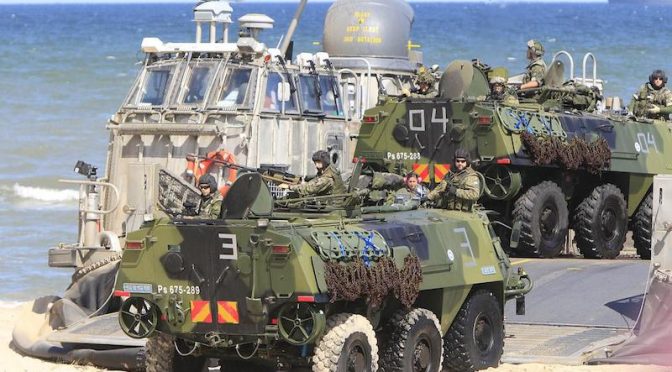
Featured Image: Soldiers sit atop of amphibious vehicles as NATO troops participate in the NATO sea exercises BALTOPS 2015 that are to reassure the Baltic Sea region allies in the face of a resurgent Russia, in Ustka, Poland, Wednesday, June 17, 2015. (AP Photo/Czarek Sokolowski)
Russia’s Evolving Arctic Capabilities

By Steve Micallef

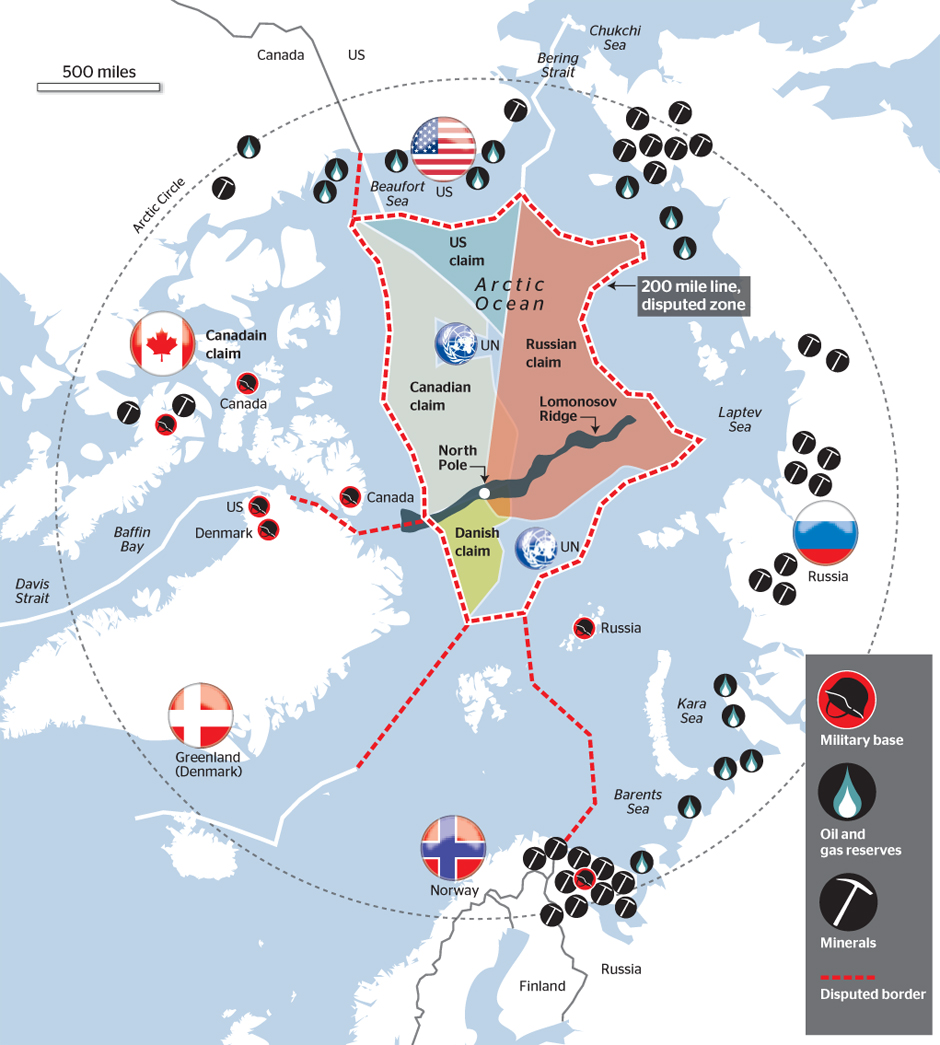
Far from the battlegrounds of East Ukraine and Syria another confrontation with Russia is brewing. As the Arctic ice retreats countries with claims in the Arctic are more willing to extract the resources found in this inhospitable location. The U.S. estimates the Arctic seabed is home to about 15 percent of the world’s remaining oil, up to 30 percent of its natural gas deposits, and about 20 percent of its liquefied natural gas. Like the U.S., Canada, Denmark and Norway, Russia has its own claim on a section of the Arctic which it is now looking to defend and expand. Today we are witnessing a resurgent Russia in the Arctic, deploying more troops and equipment to the Arctic in support of its claims.

The Cold History

There is a long history of territorial claims around the North Pole; Canada was the first to claim sovereignty over vast areas of the arctic in 1925. This was followed by the Soviet Union in 1926 which claimed an area stretching from Murmansk, east to the Chukchi Peninsula and north, towards the North Pole including both the Mendeleev and Lomonosov Ridges. This was followed by claims from the U.S., Norway, and Demark that where never internationally recognized until 1999 and the adoption of the United Nations Convention on the Law of the Sea (UNCLOS). UNCLOS, the melting ice caps, and the vast amounts of natural resources on the sea floor are the root causes of current Arctic confrontations.

Overlapping Arctic claims and resources. (TheTimes.co.UK)

Under the provisions of UNCLOS, states have ten years after treaty ratification to claim and extend territorial limits beyond the 200-mile Exclusive Economic Zone provided by the convention. Russia ratified UNCLOS in 1997 and had until 2007 to apply for a concession. Whilst Russia has always looked at the Arctic as an integral part of Russian identity (indeed until the collapse of the Soviet Union, Moscow maintained a large presence in the Arctic), it was Vladimir Putin who revived Russian ambitions in the Arctic. In December 2001, Russia applied for an extension of territory, claiming that the Lomonosov Ridge is an extension of the Siberian continental shelf and therefore entitles Russia to a bigger claim in the Arctic. However, this was inconclusive and the UN commission neither rejected nor accepted Russia’s proposal, citing a need for more research.

In the face of the melting icepack the Russian administration has declared the Arctic a region of strategic importance for Russia; due to both the potential Northern Sea Route as well as the energy and rare earth element reserves under the ice. Since 2002, Russia has sent expeditions in support of it claims over Lomonosov Ridge, including a 2007 expedition that planted a Russian flag on the seabed. Vladimir Putin has also taken the bold step of increasing Russian military presence in the inhospitable north.

Icebreaker Development

Icebreakers are the cornerstone of any capability in the Arctic. Icebreakers have multiple uses from resupplying far-flung communities and outposts to scientific exploration, search and rescue, and ensuring that sea lines remain ice-free for shipping. They are the backbone of any presence in the Arctic, both military and civilian. In this department Russian Arctic capabilities are significant, especially when compared to those of other Western claimants.

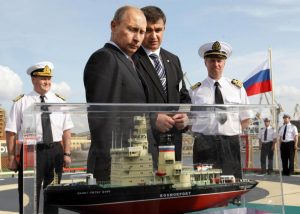
Russian President Putin views a model of Project 21900 icebreaker ST PETERSBURG (Getty Images)

Russia has as many as 40 icebreakers, both nuclear powered and conventional (see table below). Although some of these vessels are relatively old, with many of them built during the Soviet era, Russia also has various new designs under construction. In total, there are currently some 14 icebreakers of various types being built in Russia.

Class Displacement in Tons Build Qty Comments
Nuclear Powered Vessels
LK-60Ya

(Project 22220)

33,540 3 New class of nuclear powered vessels; will be the world’s largest icebreakers.
Arktika

(Project 10520)

23,000 6 Soviet era nuclear vessels- 4 remain in service.
Conventionally Powered Vessels
Project 21900 & 21900M 10,000 2 & 3 2x 21900s are in service along with 2x upgraded 21900Ms (1 additional under construction)
Ilya Muromets Project 21180 6,000 4 First one expected to be delivered in 2017.
LK-25
Project 22600
22,000 1 Largest diesel-powered icebreaker in the world; may be delivered in 2018 after several years’ delays.
Project 70202 3,8000 1 Oil spill response, fire extinguishing, and ecological monitoring vessel. Constructed by Finnish Aker Arctic Technology. A unique hull shape allows the vessel to operate efficiently sideways and backwards.
Aker Arc 130/A


8,699 2 Constructed for Gazprom Neft for use as support ships in Arctic oilfields. Constructed by Aker Arctic.
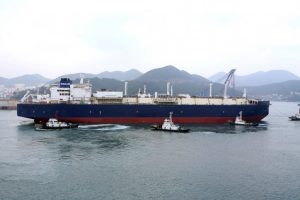
Arc7 ice-classed LNG carriers 80,200 14 First delivered in 2016, others are under construction in Geoje, South Korea for service in the Arctic. Able to break through 2.1m of ice.

Of particular interest are the LK-60Ya nuclear ice breakers and Arc-7 LNG carriers. Three LK-60Yas are under construction; the first (the Arktika) was launched in June 2016 and will be commissioned in 2018 with others commissioning in 2019 and 2020. These vessels are intended for use in the Northern Sea Route along Russia’s Arctic coast and are capable of breaking through ice over nine feet thick.

SCF Yamal/ Christophe de Margerie, the first Arc-7 Ice Classed LNG carrier. (IHS)

The development of LNG and oil carrying ice-capable tankers is an area of particular economic interest for Russia. In this area, Russia is collaborating with Daewoo Shipbuilding and Marine Engineering in South Korea and an international consortium for the construction of the first Arc 7 ice-classed LNG carriers. The aim is to reliably deliver the LNG produced from the Yamal LNG project in the Yamal Peninsula.

Military Development

Icebreakers are not the only things Russia is constructing to help it control the Arctic. All along its northern frontier Russia has begun rebuilding and reoccupying its military bases, some of which have not been used since the end of the Cold War. Russia is upgrading its docking facilities in Murmansk, one of the few ports which is ice free year round and home to Russia’s nuclear icebreaker fleet, to provide more space for the larger nuclear icebreaker and submarine fleets.

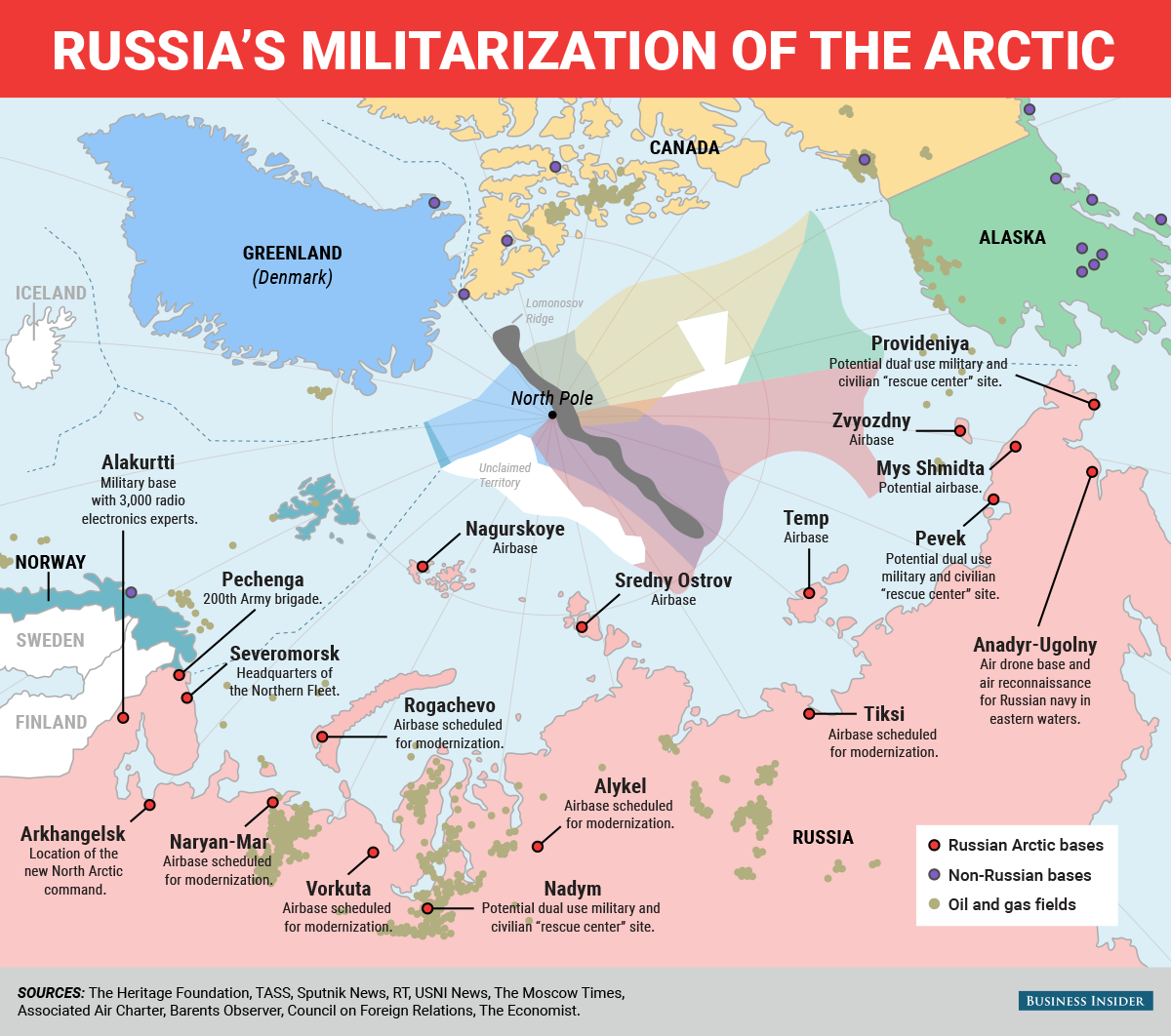
Aerial facilities are also being upgraded to improve coverage over the Arctic. Since 2015 Russia has equipped six new bases in the region, both on the mainland and on islands. These have included airbases on the islands of Franz Josef Land, Severnaya Zemlya, Wrangel Island, Kotelny Island and Novaya Zemlya. On the mainland, the facilities at Mys Shmidta, including the port and the airport, are also being upgraded.

Russian military installations proximate to the arctic.

Moreover, the Russian Navy has stepped up its presence in the Arctic with a permanent base on Kotelny Island and in 2016 when it started using new facilities on Alexandra Land. Beyond the ability to conduct search and rescue operations and support other Russian forces operating in the Arctic (mainly through the use of submarine forces), the Navy is also looking to stop infiltration by other powers into sovereign Russian territory.

Weapons-wise, Moscow has deployed two long range S-400 regiments to Novaya Zemlya and the port of Tiksi alongside short range surface-to-air Pantsir-S1 systems to protect them. Arctic bases have also been reinforced with P-800 Oniks supersonic anti-ship missiles, although the number of these systems present in the Arctic remains unclear.

Ground forces are being deployed to the region as well. The 99th Arctic Tactical Group has been permanently deployed to Kotelny Island to protect and aid in the construction of the airfield and piers there. Two other formations, the 200th Independent Motor Rifle Brigade and the 80th Independent Motor Rifle Brigade, have been converted into Arctic Brigades. Both formations appear stationed in the Murmansk Oblast and seem to be equipped with two-tiered tractors, snowmobiles and other vehicles, including the DT-30P Vityaz articulated track vehicle. Allegedly, these troops receive reconnaissance, airborne, and mountain training.

All these elements are under the command of Russia’s Arctic Joint Strategic Command, recently formed in December 2014. This command is responsible for the training and operational employment of Russian assets in the region; including all combat units, radar stations, airfields and support units. Northern Fleet units based at Kotelny Island also fall under the authority of this command.

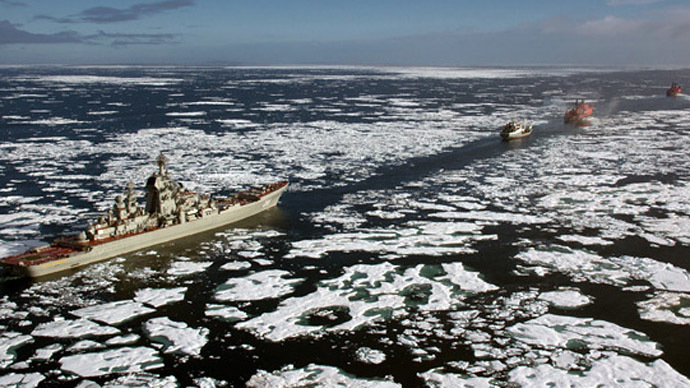
A Russian Northern Fleet warship transits Arctic waters with icebreaker escort in 2013. (RT)

Russian will continue to build new facilities in the future. A large year-round airbase is being built on the New Siberian Islands Archipelago, which will enable the deployment of Tu-95MS and Tu-160 bomber and the stealth PAK DA bomber in the future. A network of 10 Arctic Search and rescue stations, 16 deep-water ports, 12 new airfields and 10 air-defense radar stations is planned. The Russian Defense Ministry also recently announced it will build over 100 infrastructure facilities in the Arctic by the end of 2017. Together, these units and facilities will allow Russia to maintain a watchful eye over the Arctic, its oil reserves and, in the future, maritime shipping.

Conclusion

Russia has developed its Arctic capabilities to a level that was inconceivable a couple of years ago – one that has not been seen since the end of the Soviet Union. Nor is there is any sign that Russia will stop here – in November 2016 Putin called for accelerating development of the Arctic region. Whatever the outcome, these huge investments in the Arctic leave Russia in a much better position to exploit the benefits brought by the melting ice fields.

Steve Micallef graduated from the University of Malta with a B.A. (Honors) in International Relations in 2015. He also holds an MSc in Strategic Studies from the University of Aberdeen, Scotland. He currently works at Bugeja Geopolitical Consulting, Malta.

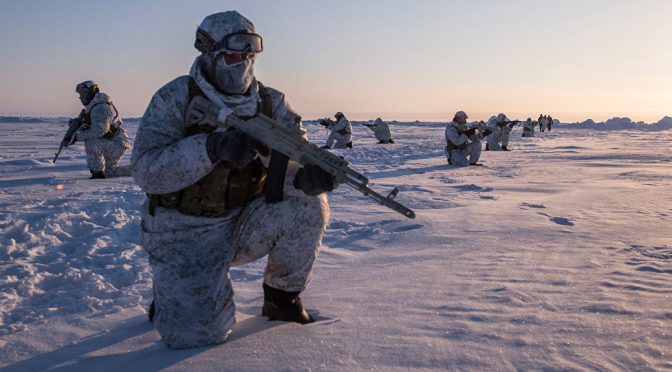
Featured Image: Russian arctic troops (Sputnik/ Valeriy Melnikov)

Sea Control 127 – Dr. Tom Fedyszyn on Russian Navy Ops, Acquisition, and Doctrine

By Ashley O’Keefe

If you’ve turned on the news recently, you probably noticed that Russia has been dominating it. From their intervention in Syria, to the increasing range and scope of their naval deployments, and the release last year of their new Maritime Strategy, Russia – and the Russian Navy – have turned our focus back to our Cold War foe. In this episode of Sea Control, we explore the Russian Navy’s modernization plans and recent newsworthy stories with U.S. Naval War College Professor (and retired Navy Captain) Tom Fedyszyn.

Read on below or listen to the audio below. This interview has been edited for clarity and length.

AO: Hello, and welcome to the Center for International Maritime Security’s Sea Control podcast. I’m Ashley O’Keefe, the CIMSEC Secretary, and I’m here today with Dr. Tom Fedyszyn, of the U.S. Naval War College. He’s been a member of the faculty here since 2000, and he serves as the senior advisor to the College’s Russian Maritime Studies Institute. He received a PhD from the Johns Hopkins University in Political Science while he was on active duty. His 31-year naval career included military assignments as the U.S. Naval Attaché to Russia, and two tours at NATO headquarters in Brussels. He commanded the USS Normandy and the USS William V. Pratt, and deployed to the Mediterranean, Baltic, and Norwegian Seas. He was a principal contributor to both the Lehman-era 1980s maritime strategy, and NATO’s strategic concept following the Cold War. He’s a nationally recognized expert and publishes regularly on maritime strategy, NATO strategy, and the Russian Navy, which is our topic today.

Let’s start off with a very basic question: why is it that we should still be interested in the Russian Navy? I thought that we were interested in China’s rise these days.

TF: Most people in the U.S. Navy seem to care more about China’s navy than the Russian navy. I can attest to that because I’ve been a Russian navy guy for a long time, and I was the rough equivalent of the Maytag repair man for about twenty years. My phone never rang! I’m sure my China counterpart’s phone was ringing regularly.

But the world has changed. Let’s quickly take it to a couple of years ago, when you’re looking around the world, and see Russia, which for about 20 years had been that big former enemy who looked like it was going to be the next big cooperator – a nation aligned with and becoming more and more like the West. And then we were shocked in 2014 when all of a sudden Russia annexes the Crimea, starts a hybrid war in eastern Ukraine, and gets everyone’s attention. And so that same country that was cooperating with everyone back in 1998, even 2005, is now listed in NATO documents, for example, as some combination of adversary and aggressor. So, all of those military forces that they had that looked like they were going to do nothing but exercises with us now are potentially aggressive forces that we, especially those in the intel world, need to look at a lot harder.

AO: So where does the Russian Navy operate today? Are they in the same places that they used to be? Are they really a meaningful threat?

TF: Those old enough in the audience remember the old Soviet Navy. For 15-20 years, they were effectively our equivalent, less carrier battle groups. In other words, they outnumbered us in terms of submarines, they were equivalent to us in major surface combatants, and every theater we operated in, they did too. Then they had a 20-year period where they went to sleep, were in a coma. So that’s why we didn’t hear about the Russian Navy for a long time. I’ll make the case that starting around 2008, the Russian Navy began to get money, they began to get smart, they began to get joint, and they began to operate again. So today, pretty much anywhere, you can find ships of the Russian Navy. In some parts of the world, you can see a militarily significant force, and others just in ones and twos. But noting that 15 years ago they were nowhere, there were none in the Atlantic, there were none in the Mediterranean…whereas today they’re almost everywhere. However, they’re not necessarily a military force to be reckoned with at the high level.

AO: Admiral Sir Philip Jones (the British First Sea Lord) said a few days ago that they were seeing the highest level of Russian submarine activity in 25 years. That’s a sentiment we’ve heard not just from the Brits, but also from the NATO commander last year. If that’s true, what is so significant about that fact?

TF: Going back to that turnaround, it was sometime around the year 2000. Speaking only from unclassified sources, from what’s been in the open press, I’ll summarize for you. Between 2001-2003, our best guess is that there were virtually no Russian submarines in the Atlantic. Realizing, of course, that was going to be where a good portion of WWIII was to have been fought, for them to have no submarines in the Atlantic is a very low standard against which to compare the First Sea Lord’s number. But what we’ve been seeing is almost every year since 2008, there’s been an increase in submarine activity of between 5-15 percent. So right now, we’re getting roughly 1,500 at-sea days for Russian submarines all around the world, but an increasingly higher percentage in the Atlantic. So, again, we did start from around zero, but we’re looking at meaningful numbers again. Certainly not the level that we saw during the Cold War, but the trend is very clearly upward.

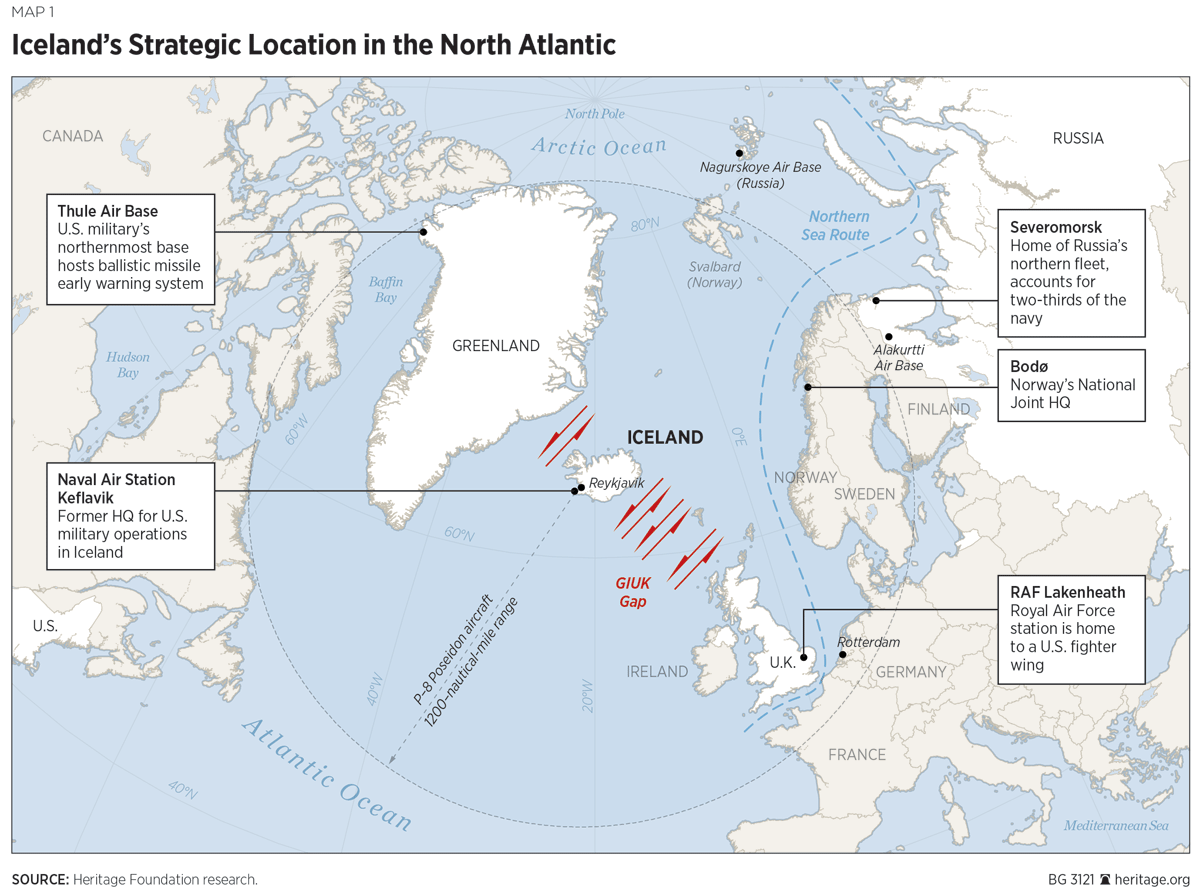
AO: Specifically when we hear about submarines, we often hear about the “GIUK gap.” For a generation that didn’t grow up during the Cold War, we don’t know what that means. Can you tell me its significance, and do we care about it today?

TF: We lived and died by the GIUK gap back during the Lehman days. This is the “Greenland-Iceland-UK gap.” Just look at a map of the North Atlantic and you can see that it’s the rough equivalent of a choke point for any Russian submarine to get out into the Atlantic – it’s got to run that gauntlet. We did set up a veritable gauntlet there. We had all kinds of sonar and SOSUS activities, we had our own submarines up there, and we had probably the biggest maritime patrol aircraft base in the world up in Iceland, with P-3s flying everywhere. The likelihood that some of our forces would find you, if you were a Russian submarine running that gauntlet, was very, very good. This is essentially what we’re up against now. We had about 20 years of nobody trying to run that gap, and now they’re running that gap again and we’re seeing – or hearing them – again.

A map depicting the GIUK Gap (Heritage Foundation)

AO: Another thing that we didn’t used to hear about was Russian aircraft carriers. We thought the Admiral Kuznetsov was going into an extended maintenance period, and instead, she shows up off the coast of Syria. How did she perform, and what did we learn from that deployment?

TF: First, let me make a little editorial about Russian aircraft carriers. Russians have been talking about building aircraft carriers for a long, long time. It has effectively been talk. What we’ve seen, loosely, is that the Russians’ ability to build very large ships is not very good. With the possible exception of submarines, their performance in building large things that float has been at the “D”/ “D-” level. And of course aircraft carriers are part of that category.

So, when you get what we might call a “sea control” admiral in charge of the Russian Navy, invariably, he will talk about building aircraft carriers. I don’t think there’s been a time when there wasn’t someone in the Russian Navy talking about building aircraft carriers. But what they deliver – well, for their operations right now, they delivered one ski-jump carrier with a very limited air wing.

Do understand that it’s a very high-prestige ship in their navy. It’s unique, and it does give a special capability to their navy that no other ship brings. So, Russian people are very proud of it. Much as in American politics, domestic politics matters to them, too. And the fact of the matter is that the Russian press, which used to be reasonably free when I lived there 20 years ago, is no longer free. It’s very much controlled by the government, and it’s a propaganda tool. What you have now is an opportunity for the government to put a spin on aircraft carrier deployments, which obviously make them look good, and that’s what we saw.

Two stories: when Kuznetsov deployed to the Syrian coast, if you had only read the Russian press, you’d be convinced it was the most successful deployment in the world. Note, of course, that the air wing was only about half of what it might have been, and only a quarter of what we would consider a real air wing.

So, if you read the British press, all you’d see is a ship belching black smoke (and on some days, it even looked like white smoke, for all you surface warfare officers, not good). You’d also have seen the four British destroyers that were tailing it and having it in their sights the whole way.

So, was it successful? To the Russian people, absolutely, A+. To the western world, not so much. The air wing that they took was miniscule. Second, they don’t have much opportunity to exercise their air wing. While I’m not an aviator, I know that this is very difficult. So, I wasn’t at all surprised when within their first week they lost two airplanes due to an inability to operate a flight deck and an air wing properly. So when you only take over 20-25 airplanes, and lose two in the first week, we shouldn’t be surprised that effectively the entire air wing went ashore. That probably wasn’t anywhere in the Russian press, but it certainly was in the western sources. So, did Russia end up with more airplanes in their Syrian operation? Yes. Did the Russian aircraft carrier carry them down there? Yes. Was it a successful aircraft carrier operation? I would say no.

AO: Given that lens, my next question may seem a little silly, but what about the Shtorm 23000E, the next generation aircraft carrier? Defense News was reporting about it earlier this month, citing possible Indian Navy interest. Does this seem likely to be built? Will they keep trying?

TF: The Russian economy is built on exporting minerals (mostly oil and gas). Below that, it’s arms exports. They export almost as much as we do! But they have such a small economy that their arms sales really matter. So, when you look at Russian military capability, sometimes that’s just a small part of why they deploy. A larger part of why they deploy is to show off what type of technology they have and to try to sell it. You mentioned the Indian Navy. When I was in Moscow, there were more Indian officers there than from any other nation. U.S. was second. Why? Because the Russians, by the default of politics, ended up selling India its navy. Still today, about 70 percent of the Indian Navy is Russian. I’ve spoken to lots of Indian Navy officers about this. The sense is that they don’t like the Russian ships, they don’t work too well, they’re suboptimal, but they can afford them. The U.S. has this double-whammy where we’re not that good at selling high technology, and when we sell it, it costs a lot of money. And the Indian budget makes them buy Russian – and they continue to buy Russian. So, should the Russians be able to continue to build the Shtorm, India would be the most likely nation that would buy it.

But remember, of course, Russia just sold and delivered to them the Vikramaditiya, a ski-jump carrier which was 4 years overdue, 300 percent over budget, and every Indian naval officer I’ve spoken to has said, “Well, it’s not a good ship, but we needed an aircraft carrier and we could afford it, so we got what we got.” If this Shtorm really does turn out to be good, the Indians may well want it, but the Indians are also in the process of building their own nuclear-powered aircraft carrier, which would be their first choice, and if they can build it (they’re not very good at building ships either, unfortunately), they’ll stick with their domestic product.

Now, will the Russians actually build it? I would be very pessimistic. When they talk about Shtorm, they talk about building between 3 and 6. That’s how definitive they are – they can be off by a factor of two. It seems that they’re leaning in the direction of nuclear power, but sometimes you can read press articles that suggest maybe not. So they’re so unsure of where this is going, and their track record of having a yard that can build a 65,000 ton ship…it’s unlikely. In fact, if they ever get around to it, they’ll probably have to build it in two sections and then weld it together. I’m no shipbuilder, but I know this can’t be easy.

AO: Let’s switch gears and talk about their new Maritime Doctrine, which was released in 2015. What’s changed since the last version?

TF: Their last one was in 2001, and I’m nerdy about this but I read these documents. It’s important because you need to know what changes there are from one document from the next. If you read American naval strategy, you’ll note that there are significant differences between the one that just came out on the street and the one in 2007 – those differences will affect how we operate and what ships we build. Same for the Russians. In 2001, they wrote what they called a Maritime Doctrine, and it was almost as if there wasn’t a Navy admiral present at the drafting. It was like the Secretary of Commerce, the Secretary of Tourism, and the Secretary of Energy sat down and, at the last minute, invited an admiral in to come in and write a couple of words. It clearly was a maritime doctrine, not a naval doctrine.

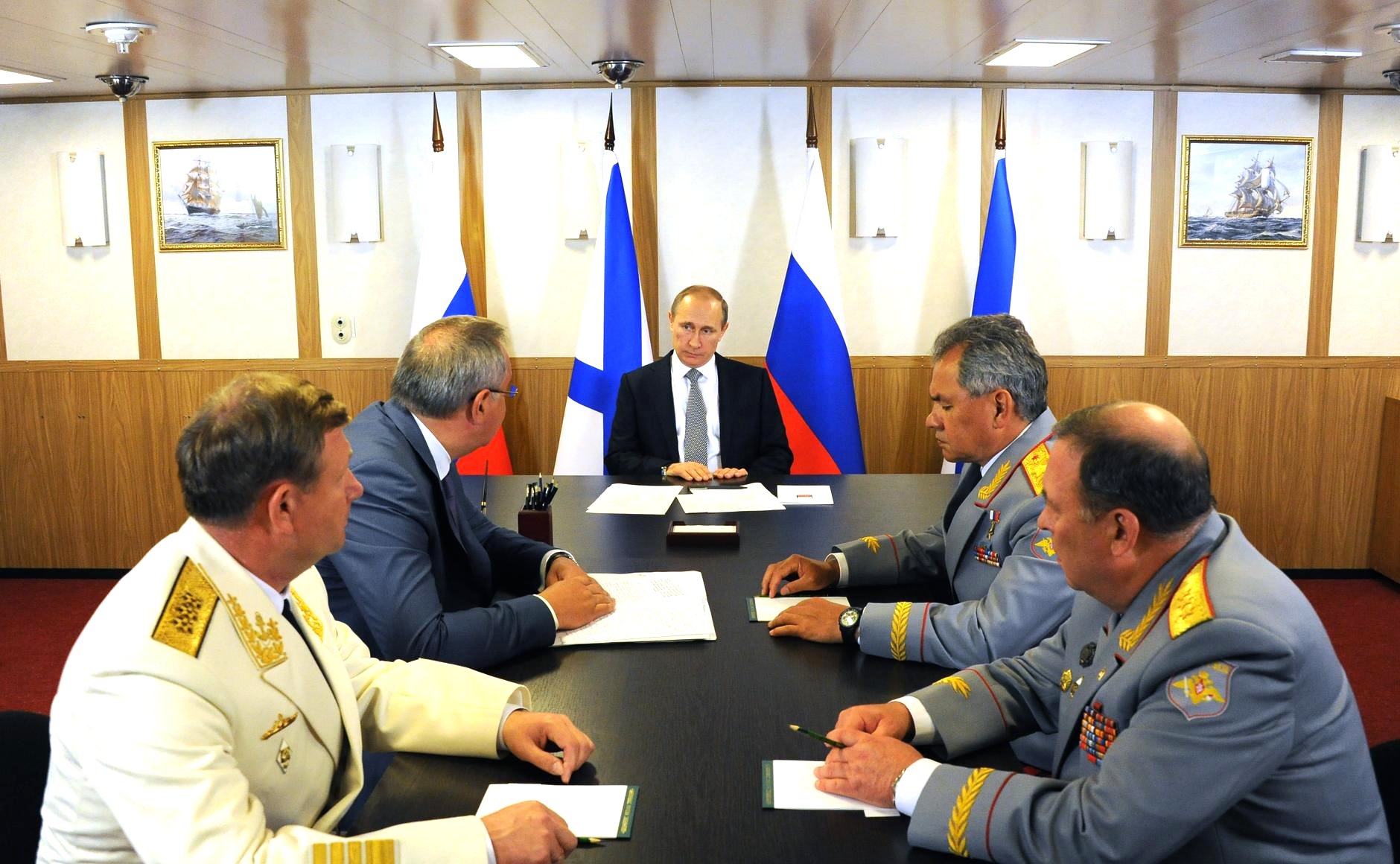
In 2015, the new maritime doctrine was signed by President Putin in a formal scene built for television, aboard a brand-new frigate, named for Admiral Gorshkov, as you’ll recall, the founder of the great Soviet Navy, in Kaliningrad harbor. The only other people there were the admiral who ran Kaliningrad harbor, the chief of the navy, the chief of Russian defense, and Russia’s national security advisor. The Secretaries of commerce, tourism, etc. weren’t invited because this new document is significantly different. The tone is just wildly different. You will read phrases like, “The Russian Navy’s mission is to ensure non-Russian naval ships are not allowed to operate freely in the Arctic.” Things like, “NATO is the principal threat to Russia therefore the Russian navy must deploy to the Atlantic because the NATO Navy must be engaged before it gets to Russian shores” and “The Russian Navy will have a permanent flotilla in the Mediterranean.”

Remember, for a lot of years, there were virtually no Russian ships. When I deployed William V. Pratt there in 1989, we watched the 5th Eskadra leave the Med. We were fully expecting that we would be doing the usual tricks with our Soviet counterparts, cat and mouse games with their submarines, etc. They all left! And so the admiral called in all the skippers and said, “We have nothing to do. Any ideas?” I said, “15 port visits?” And he had nothing better, so we were able to have a loveboat cruise. But obviously the world has changed. The Russians are back in the Med. They’ve got a flotilla there, between 7-10 big serious warships, and the reason that they’re there, according to their maritime doctrine, is because of the NATO threat. You read “NATO threat” all over this document. When you read it in the Pacific, it’s clear that they are all about establishing better relations with the Chinese and Indian navies. And so they call a spade a spade. They’re not afraid to talk about which fleets are growing.

And by the way, every fleet is growing according to this document. You wouldn’t think it, but the Black Sea fleet, which was supposed to go away, now because of Ukraine and Crimea is now getting bolstered more than almost any other fleet. They’re talking about expanding each of their fleets – qualitatively and quantitatively. Finally, there’s a huge chapter on shipbuilding this time. They have a huge shipbuilding organization, and it is tasked with building navy ships in response to the demands of the navy – the missions that the navy intends to do. So, in tone and in tenor and in content analysis, the words in the 2015 document are significantly different. The picture of Putin and chief of defense sitting there in the wardroom of the frigate Gorshkov, I think is worth 10,000 words by itself.

From let to right: Victor Chirkov, Dmitri Rogozin, Vladimir Putin, Sergei Shoigu and Anatolii Sidorov onboard the frigate Admiral Gorshkov (Kremlin.ru)

AO: Let’s pick apart this modernization plan. There’s a strategy, then there’s a modernization plan inside of that strategy. Let’s talk about the surface navy, first. How do they expect to evolve and modernize?

TF: They’ve got a plan, and I’ll give you another editorial, too. Whatever they say, decrease it by about 50 percent. They lie, cheat, and steal when they talk about how many ships they intend to operate this year. When I look back on what they say and what they actually do, they get about half. Once again, it’s one of these “how tall are the Russians?” questions. During the Cold War, the debate always used to be, “are they 8 feet tall? 10 feet tall?” We ended up saying maybe 5’6.” Today, we’re having that debate again. No one is saying that they’re 10 feet tall. We’ll get to that later. But, for about 20 years, they were about 0 feet tall. They built virtually nothing. The ships that they had – which was the second-biggest navy in the world back in 1989 – they pulled the plug on it. The ships were just tied at the pier, they began to rot. Though quantitatively it was still huge, qualitatively it was a mess. I can attest to that because I was at the embassy in Moscow in the mid-90s and probably a lot of the reports that I wrote on the Russian Navy at the time, when they were read in Washington, were laughed at. They were so horrifically bad. Now when you talk about modernization, they went from nothing to the point where they’re building a few ships now. The few ships that they did build were aimed at arms exports. So yes, they sold submarines to Indonesia, Vietnam, India, the Chinese Navy; they kept very little. Just ones and two of everything they built.

That started to change around 2008. They continued to build ships, but increasingly to build it for themselves. In the year 2000, it wasn’t uncommon when they started to build, say, a frigate, to take 14 years from the time they laid the keel to the time that they delivered it. Laughable, yes. But that was the way life was back then. Understand, of course, Russia. Russia is a small economy. They lost the Cold war because their economy couldn’t keep up with our economy. We outspent them to death. They’re very aware of that. But what we had was that if we forced them to build a lot of ships, they would run out of money fast. They knew that, therefore they didn’t build a lot of ships. Starting around 2005-2007, economists can help us here, but the economy started to go up. I don’t mean to say this with scorn, but to a great extent, Russia is a large Nigeria. They’re dependent on the price of oil. And if the price of oil goes up, their wallets are very thick. Price of oil goes down, they’re threadbare. Price of oil went up – it was over $100/barrel, and they had more money than they knew what to do with. They had a brand-new secretary of defense back in 2008, Serdyukov. Maybe we don’t know him in the west, but in Russia, they really appreciate what this guy did. He demanded that a lot of money be spent on all the services, and the navy got more than their fair share – 40 percent – of this building budget.

He did that, one, and two, he also kicked a lot of butt and took a lot of names with respect to the operational readiness of the fleet. He saw, full well, that the Russian Navy couldn’t operate with the Russian air force, or the Russian Army. Remember that, back in the 70s and 80s in the U.S.? That’s what they started to grow out of. Under Serdyukov, he understood that they had a conscription-based military, many sailors were almost illiterate, and they, of course, were not the type of sailors that you and I would like on our ships. He started a policy that said, “if it goes to sea, and certainly if it’s new construction…no conscripts.” Conscripts were left to be mess cooks at navy bases. And the real sailors, the contract sailors, went to ships. Remember before I told you ships didn’t go to sea too much in 2000-2002. But they started to go to sea more, without the conscript sailors, and so you got a qualitatively improved force. And at the same time, you were building ships that weren’t just for arms export. They were for your navy. I’m bragging here – get over this – but it used to take them 14 years to build a frigate and now they can build one in five or six. OK, that’s not very fast, but they’re getting better at it. They’ve consolidated their shipbuilding, and they’re building a couple of ships per year. They announce they’re putting out eight warships a year. I’ve yet to see a year where eight ships came out. But, three and four, yes. And of course, they’re not big ships, they’re smaller, they might even be enhanced patrol boats, but at least they are putting out ships. But there are meaningfully, a few classes of ships and submarines that they’re putting out that do appear to be successes.

AO: So speaking of submarines, perhaps you can give a brief overview of today’s submarines, especially how they stack up against U.S. submarines. Are they as good as they once were?

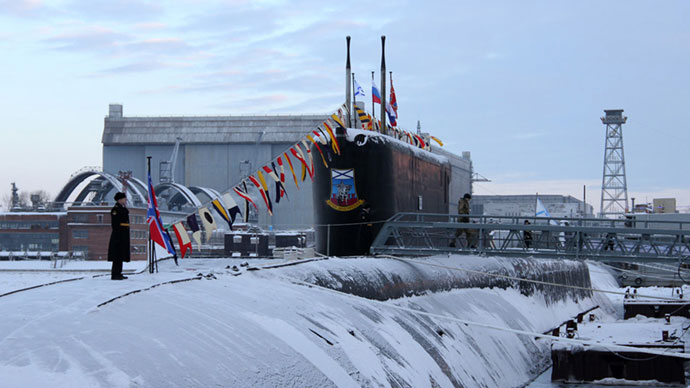
TF: The answer is yes, remembering of course that they were never as good as our submarines. But they got close, and they’re getting close again. Two general areas. First of all, boomers, SSBNs. We have the luxury of having a blue water sea control navy. They don’t. We can talk about that later. But first and foremost, their navy is there for strategic deterrence. So when they get a dollar, they spend it on strategic deterrence, first. Their most successful building program is what they call their Borei class – the 955 class SSBN. They’ve got three in the water already and five more coming, and most western analysts look at it as a successful building program. The bigger problem that they have is with the solid-fuel missile that they’re trying to mate to it, the Bulava. That’s had a very checkered past, in which at times virtually every shot was a failure. Now they’re getting about a 50 percent success rate. They’re happy with that. They’re mating the Bulava to the SSBN, and they claim they’re ready to operate. Their deployments have been short. They tend to be in the old Bastion areas that we got used to looking at during the Cold War. But the point is that their SSBNs are going to sea again with an SLBM. And even though they did have a few other Delta IIIs, Delta IVs, Typhoons, these were unreliable, it was rare for them to deploy. The Russians were proud to say that if necessary they could fire a ballistic salvo from pier side. That’s true. But I’m not sure that’s anything to brag about. So yes, they did have a submarine force with ballistic missiles. But now they’ll have a force, with more to follow, that I expect will be delivered on time. So now they’ll have a force of about eight SSBNs that can deploy and shoot missiles from sea.

Russian Navy Borei-class submarine (RIA Novosti)

Now, SSNs, they’ve got a very impressive new submarine. It’s large, has got a lot of new weapons systems, and is reputedly very quiet. At least in the unclass world, it looks to be close to, but not quite, an LA and Virginia class. It’s got a lot of things, but the problem is that it’s so sophisticated by Russian standards that they’re having a hard time following it with what they claim to be seven more of the Severomorsk class warships. I think it’ll happen, but it’ll happen very slowly, and it’ll be almost like custom-made cars. They’ll happen, but it won’t be like an assembly line. It’s a little too difficult for them to put them on an assembly line yet. But they will be very good, once they do come out, and they’re now talking about a follow-on class of SSN with hypersonic cruise missiles and more sophisticated gadgetry. But if I can summarize, their submarine building is way better than their big surface ship building program. That’s where they’ve concentrated, where they’ve put their talent, their money, where they’ve had most of their successes, and that was true back during the Cold War much as it is today.

AO: Continuing our scope through “things the Russians might build…” missiles. What does it mean that Russian corvettes were able to successfully launch missiles out of the Caspian Sea last year?

TF: Well first of all, cynics say, ‘boy won’t a lot of people want to buy that missile?’ We’re sure that the Russians are wanting to sell it, and they’ll probably sell it a lot cheaper than the U.S. will. But the Russians couldn’t get over how great this was because they were able to shoot this Kalibr-class missile from two different directions, from two different, small platforms. The Buyan patrol boat, which is a 1000 ton patrol boat, can carry 8 of these missiles, with a range of 1500 miles, which is a lot, and, depending on what you read, only three of them were misfires. 23 out of 26 hit something, presumably a target. You know, when we were shooting our first cruise missiles 25 years ago, we had a worse failure rate than that. And they not only shot from Buyans in the Caspian flotilla, but then they also shot from diesel submarines, the brand-new improved Kilo-class submarines, which are delivering to the Black Sea fleet. They shot a series of them from the Med. So they had cruise missiles coming from both directions, from unsophisticated small-ish ships. Very sophisticated weapon, and the world took note of that.

AO: Changing gears a bit, let’s go a bit bigger picture and talk about maritime power. Is it fair to call Russia a maritime nation? Most people would call it a land power. How does that figure into Russia’s national security posture?

TF: That’s right. It’s mostly a land power. But it’s a land power that knows how to use maritime power in selective and judicious ways. I’m going to inject a bit of personality into this too. I think Vladimir Putin prides himself on his navy. I think he identifies with his navy. The navy is sleek, it looks cool, it packs a quick punch. He is a judo master after all. He has used his navy in a number of ways – Syria is the classic example – not only does he have a force off of the Syrian coast, but he is protecting the logistics with his flotilla. 99 percent of all the Russian logistics that goes to Syria comes from the Black Sea, through their port in Tartus. It’s defended by his naval forces, they’ve delivered air power also, and there’s air defense that they’ve set up there. What he has is an opportunity to play a weak hand and to play it forcefully. To a great extent, he played his navy in the 2013 red line on Syria chemical weapons – that’s when he deployed his force. And he was quick to point out that he had a naval force in the Med, when we really did not. His naval force would watch and ensure that the Syrian chemical weapons were delivered to the right place for destruction. It’s a small hand, but he plays it and isn’t afraid to over play it.

He sends his ships, when we were discussing reestablishing relations with Cuba – he sent a cruiser into Havana harbor, and it was sitting there while our diplomats were discussing relations with the Cubans. So, he does a lot with a little. And he’s more than happy to identify with his navy. There’s really no navy celebration that he doesn’t put on his navy hat. With the exception of going barechested, he is most likely seen in Google wearing navy hats. He just seems to like his navy. And he’s been funding his navy very well for quite some time.

Russian President Vladimir Putin in naval attire (AP)

So, I’m not going to go so far as to say that it’s a maritime nation, because it’s not a sea control navy. He has admirals that have been telling him to build a sea control navy. But our 6th fleet commander did take a look at what he would be up against, and he was not afraid to admit that while it isn’t a sea control navy, it’s not just an A2AD navy, either. It can do more than bloody our nose if we decide to get into a fight with them in the Black Sea, in the Baltic, and certainly in the Arctic. It can do a number of things that can hurt us. They just don’t have the sailors, the seamanship, the tradition, the Admiral Gorshkov, to go after us again in the middle of the Atlantic or the middle of the Pacific. But near their shores, they’re extremely potent.

AO:  Is there anything else you think our listeners need to know, that you think we’ve missed, to wrap up our discussion?

TF: Sleep well at night. If it were a fair fight, our navy still can so wildly outperform their navy that they would never seek a fight like that. As you see Russian doctrine talking about things like hybrid warfare – they’re always interested in an unfair fight. So, they may very well want to take their hybrid warfare, their little green men equivalent, to sea, and they may be interested in provoking us in other ways that we have yet to predict, and we should be ready for that. This would not be existential. But it could certainly hurt us, and it could hurt our pride, and it could certainly surprise us. So I would say let’s be ready for that.

But on the positive side (assuming you look at Russia as an adversary or as an aggressor), their military, much as the Soviet leaders, is dependent on their economy. Their economy has performed very poorly over the past couple of years. Partly price of oil, partly western sanctions, but the bottom line is they’ve had a negative GDP for a couple of years. What’s happened under Mr. Putin is that his budgets have had to shrink in every area. If you were a provincial governor, your budget shrunk by 50 percent last year. If you were a pensioner, your pension was cut 50 percent last year. If you were the chief of navy, your budget wasn’t cut, and you were about the only guy whose budget wasn’t cut. If their economy continues its bad performance, I would argue that the chief of navy is going to get his budget cut next year. All of the grand plans for the new aircraft carriers, destroyers, will be put on hold, and it will be again, sometime in the future. Don’t expect to see it in the near term.

AO: Professor, this has been a super interesting Sea Control podcast, and I want to thank you for joining us. We really appreciate your time, insights, and hope to talk to you again soon.

TF: Ashley, thank you very much. Time did fly and I had a great time.

Ashley O’Keefe is the CIMSEC Secretary for 2016-2017. Her views and those of Professor Fedyszyn are theirs alone and do not represent the stance of any U.S. government department or agency.

Sea Control 126 – End of the Year Episode 2016

By Matthew Merighi

It’s the end of the year, so the CIMSEC team gets together to talk about the events of 2016 and does its best to look into the crystal ball to see what is on the horizon in 2017.

Happy New Year from the entire CIMSEC team!

Matthew Merighi is the Senior Producer for Sea Control and the Host of Sea Control: North America. He works as Assistant Director of Maritime Studies at the Fletcher School of Law and Diplomacy.