Tag Archives: NATO

NATO’s Pivot to Russia: Cold War 2.0 at Sea?

Putin’s annexation of the Crimea shifts NATO’s focus back to Europe. Therefrom, maritime security’s relevance for the Alliance will suffer. Nevertheless, Russia’s new assertiveness has massive impact on NATO’s maritime priorities. Other than expeditionary missions, European homewaters are now the theaters of concern.


All Opportunities Gone


After the Cold War, NATO was never threatening Russia, but rather sent dozens of cooperation offers to Moscow. Moreover, if Russia would sincerely have seeked NATO membership, Putin would fly to NATO’s September Summit. However, in NATO, Russia would never have been eye-on-eye with the US, but rather would have found itself on a level with Germany, France and the UK. Thus, Russia would never have found the global prestige and geopolitical influence it was looking for. That is the real reason why Russia never joined the Alliance. Since 1991, there were many opportunities for naval cooperation between NATO and Russia.

In Partnership for Peace (since 1994) and the NATO-Russia Council (since 2002), the Alliance reached out to Moscow, aiming to work closer together at sea. Positively, some of these opportunities turned into reality. NATO and Russia were working together in the Mediterranean (Med’) in Operation Active Endeavour to combat terrorism and in the Indian Ocean to combat piracy. Moreover, the planned, but cancelled joint naval mission to protect the destruction of Syria’s chemical weapons has shown the potential for increased cooperation. However, with the annexation of the Crimea, these opportunities ceased to exist.

Step up Black Sea Presence

Ukraine has no significant navy anymore. Instead, Ukraine’s warships were taken over by Russia, which makes Moscow’s navy, by numbers, larger than the US Navy. However, due to the warships’ poor quality, this increase in naval power does not present a game changer. Surely, a plus for Putin’s navy is that Sevastopol will remain a Russian naval base for decades.

Black Sea (Source: Wikipedia Commons)

After Sevastopol is lost, Ukraine’s only significant port left is Odessa. NATO’s response should be to support Ukraine in keeping at least a small navy. Moreover, NATO should give a guarantee that, in case of further Russian aggression, Ukrainian ships can find shelter in Romania, Bulgaria, Turkey or Greece. In addition, SNMGs and SNMCMGs should pay regular visits to Odessa; on the one hand for partnership with Ukraine and on the other hand as show of force to Russia. Trips to Georgia should go along.

Like it or not – The Bosporus has become a bargaining chip. NATO should make contingency plans how to close the Bosporus for Russian warships, should Russia invade Eastern Ukraine or Moldova. NATO must make clear to Russia that a price to pay for further annexation of territories would the loss of access through the Bosporus.France, Please Cancel the Mistral Deal
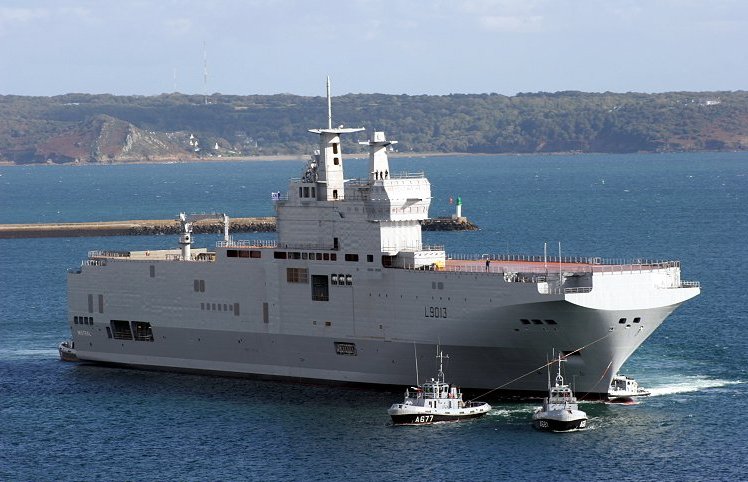
French Mistral LHD. (Source: Wikipedia Commons)

Russia could have done military campaigns like Georgia 2008 or Crimea 2014 much easier with one of the Mistrals. One of these LHD would also be useful for Russia’s navy in campaigns against Moldova, with regard to Gagauzia and Transnistria, or even against Estonia, because the Mistrals can serve as a platform for command and control, attack helicopters and landing troops.

That Russia announced to base its Mistrals in the Pacific does not mean that they will operate there. For its Syria show-of-force, Russia deployed warships from its Pacific Fleet to the Med’.

Regarding the military balance in Europe, France would do its allies a disservice, if it would deliver the Mistrals to Putin. Instead, these vessels should remain either in Europe or in a like-minded country. Options where to sell the ships could be South Korea, Japan, Singapore, Brazil, Turkey, South Africa or India; countries, which are looking for new LHD.


An even better idea comes from Jeff Lightfoot. He argues that “NATO should buy the Mistrals“. Like AWACS and AGS, the Mistrals could become a shared NATO asset. Although I fully support Lightfoot’s arguments for a NATO-nization of the Mistrals, I disagree with him about how to do that. After NRF and EU-Battlegroups failed, NATO’s Standing Maritime Groups are the only multinational units with combat capabilities, which ever really worked. Moreover, Europe was carrying most of the burdens in the SNMG, which face a serious of lack amphibious capabilities. Thus, the Mistral purchase should be mostly funded by the Europeans. Germany, Norway, the Netherlands, Denmark, Poland and Belgium could go for “NATO Mistral 1”, while the US, Canada, Spain, Italy, Portugal and Turkey could go for “NATO Mistral 2”. A NATO LHD in the Baltic or Black Sea would send clear message to Russia. Deployments to the Med’ or Indian Ocean would help to pursue Western maritime interests.
Sustain Superiority in the Baltic and the Med
Baltic Sea (Source: Wikipedia Commons)

With the entry of the Baltic Countries and Poland into NATO and EU, the Baltic Sea was a solely political issue, not worth military considerations. This has changed, too. However, this does not mean that we are on the brink of war. Nevertheless, NATO needs to make plans how to deter Russia from threatening the Baltic Countries from the sea. The Alliance must make sure that its naval superiority in Baltic remains clear. Deploying an SNMCMG to the Baltic and regular naval exercises, such as BALTOPS (non-NATO), are efforts worth doing. Moreover, Sweden and Finland should join NATO. Both countries would bring great contributions to NATO and their membership would even increase Russia’s isolation in the Baltic Sea.

Russia is no partner for cooperation in the Med’ anymore. Beside the consequences of Crimea, Russia’s show-of-force in the Eastern Med to cover Syria made clear that Putin is willing to use naval power in missions targeted against Western interests. In consequence, the Europeans have to prevent – politically – that Russia opens new naval bases in the Med’, for example in Cyprus or Egypt. EU member Cyprus must receive the clear message from Brussels that a Russian base on Cyrus is unacceptable. In addition, NATO should closely monitor all Russian naval activities in the Med’ and make plans about how to deal with them in case of further Russian aggression. Moreover, NATO states should close their ports for Russian ships to be replenished.
We Need Nuclear Deterrence
Ohio-Class SSBN, US Navy (Source: Wikipedia Commons)
Besides guaranteeing NATO’s future, Putin’s Crimea annexation also ends the American and British debates about the need for a sea-based nuclear deterrent. The argument for retiring the SSBN was that state-to-state conflict was unlikely and, therefore, nuclear deterrence was outdated. However, sea-based nuclear deterrence provides the minimum of global stability we need to prevent devastating state-to-state conflict. Where could the conflict with Russia go, if global zero was reality? What would prevent Putin from sending Russian tanks through Tallinn via Riga to Vilnius? Surely not statements from Berlin to keep the diplomatic hotlines open.

No matter about the massive unpopularity – Europe will need the nuclear umbrella provided by the US, UK and France. We are not yet back in the pre-1989 times. There is not yet a Cold War 2.0 at sea. However, if we forget the lessons learned of nuclear and conventional deterrence, we may find ourselves in exactly these situations much sooner than we think.

NATO-Building Starts at Home

NATO’s pivot to Russia will shift attention away from the maritime domain back to the continent. Armies and air forces will receive, once again, much more attention than navies. While Putin’s aggression increased the importance of NATO for its member states, maritime security’s relevance for member states and, therefore, for the Alliance will decrease. In consequence, theaters like the Persian Gulf and the Indian Ocean will become of much less concern for NATO.

In case the Crimea Crisis did not happen, NATO, to sustain its relevance, would probably have looked for new maritime tasks in the Med’, Gulf of Guinea and the Indian Ocean, maybe even in Southeast Asia. However, thanks to Putin, we will find NATO’s warships deployed back in the Baltic and the Black Sea. Given Operation Ocean Shield ends this year, we will not see NATO back in the Indian Ocean very soon; except maybe for a few friendly port visits. After Crimea and with Putin’s hands on Eastern Ukraine and Moldova, NATO’s debates about partners across the globe and global alliance are finally dead.

In response to Putin, NATO-building begins at home. We need NATO’s Public Diplomacy Division, fully focused on the Alliance’s core business, reaching out to the member states’ ordinary taxpayers. The changing European security environment requires an emphasis on the big messages: Defense, deterrence and security. Thus, zeitgeist-motivated campaigns should be stopped. In these times, NATO must tell the people what armies, air forces really are for and how our soldiers serve their countries and our Alliance.

Felix Seidler is a fellow at the Institute for Security Policy, University of Kiel, Germany, and runs the site Seidlers-Sicherheitspolitik.net (Seidler’s Security Policy).

Follow Felix on Twitter: @SeidersSiPo
Sea Control 27 – International Law, Crimea, and China

seacontrolemblemProfessor Anthony Clark Arend joins us to discuss International law. We discuss some basic definitions, and their influence on international actors, using the lens of Crimea and the Chinese ADIZ. I also learn later that my mic input has been the crummy laptop mic all month, explaining all my audio quality frustrations. Remember, subscribe on iTunes or Stitcher Stream Radio. Leave a comment and five stars!

DOWNLOAD: Sea Control 27- International Law, China, and Crimea

Sea Control 25 – Crimean Crisis

seacontrolemblemSea Control discusses the Crimean Crisis, with three CIMSEC writers: Dave Blair, Viribus Unitis, and Robert Rasmussen. We discuss Russia’s aims and tactics, the Maidan movement, Ukrainian governance and passive resistance, and what this crisis means for Russia and the EU/NATO.

DOWNLOAD: Sea Control 25 – Crimean Crisis

We are available on Itunes, Stitcher Stream Radio, etc… Remeber to subscribe, leave a comment and a 5-star rating.


NATO Should Block the Bosporus and Assure its Allies

Felix is a fellow at the Institute for Security Policy, University of Kiel, Germany and runs the site Seidlers Sicherheitspolitik“. This article was published there at first

The times for good-will diplomacy are over. In response, NATO should block the Bosporus for Russian warships. Putin wants to play great power politics? Okay, let’s do it. 

Choose a hard line!
The last time the Alliance has been as relevant as today was 9/11 or maybe even pre-1991. After the German-French-Polish brokered deal in Kiev has effectively failed, the EU is out of business. Moreover, Russia obviously does not take the EU seriously. Hence, Europe needs to be backed up by American power. In short, we need NATO.

Picture 1

Ukrainian soldiers, left and unidentified gunmen, right, guard the gate of an infantry base in Privolnoye, Ukraine, Sunday, March 2, 2014. Hundreds of unidentified gunmen arrived outside Ukraine’s infantry base in Privolnoye in its Crimea region. The convoy includes at least 13 troop vehicles each containing 30 soldiers and four armored vehicles with mounted machine guns. The vehicles — which have Russian license plates — have surrounded the base and are blocking Ukrainian soldiers from entering or leaving it. (Darko Vojinovic/AP)

Good-will diplomacy and communiques about cooperation had their chance. They failed. Putin is pursuing a hard line and so should the West. Through NATO as a political alliance, the West should take a hard stance against Russia. Putin has already been part of the problem in Iran and Syria and he never intended to become part of the solution. Therefore, it is time that the West stops giving a damn about Russian positions.

Moreover, the UN will not be useful for anything. How could it, if Russia effectively decides what to do!? Therefore, let’s get down to business and do realpolitik as the Russians do.

Block the Bosporus! 
Putin’s aim is to have Sevastopol as a naval base in the Black Sea, so that Russia is able to deploy warships to the Mediterranean. Hence, to get a bargaining chip, NATO should block the Bosporus to all Russian warships, no matter whether they are leaving or entering the Black Sea. The blockade should not apply to civilian vessels.

Supported by a NATO decision, Turkey should suspend execution of the Montreux Convention, which grants Russian warships access to the Bosporus. NATO’s policy should be: As long as Russia intervenes in Ukraine, the Bosporus will be closed for Russia’s navy. Effectively, without access to the Bosporus, Russia’s Black Sea Fleet will be useless and its warships in the Mediterranean will face serious operational difficulties.

Picture 2 

The Bosphorus marked by the red flash.

NATO should deploy one of its Standing NATO Maritime Groups to the Aegean Sea or to the Bosporus. Moreover, we need at least one US Navy vessel – maybe the USS Mount Whitney – around the theater to make clear that the blockade is absolutely serious. Thereafter, a simple deal could be: Russia leaves Ukraine and in return gets access to the Bosporus. Without that deal, Russia would keep a naval base in Sevastopol that is worth nothing.

Give Assurance to Eastern Europe
If the West does not do anything and Russia takes the Crimea, it is likely that eastern Ukraine is next. Our allies in Eastern Europe rightly worry about their security.

Personally, I have many doubts that Germany would be willing to defend the Baltic states in case of a Russian invasion. NATO/EU membership would not matter. Can you imagine Angela Merkel giving her approval to invoke NATO’s Article 5, then asking the Bundestag to approve the case of defense (“Verteidigungsfall”), re-institute the draft (which we would have to do then) and to send the Bundeswehr up to the Baltic to fight the Russians? I can hardly imagine.

Consequently, we have to renew security guarantees for our Eastern European partners now and we have to do it with more than just words. This could mean deploying additional fighters for NATO’s Baltic Air PolicingJames Stavridis has mentioned the NATO Response Force as an option, which could be, according to Stavridis, brought into “a higher state of alert”. Moreover, SHAPE should develop contingency plans to respond to any assertive Russian behavior concerning NATO territory.

Please do not get me wrong. I do not want to make the case for the use of force. However, I want to make the case that NATO, by use of its military power, has to draw red lines and make clear to Putin that – this time – the red lines will be enforced.

Picture 3 

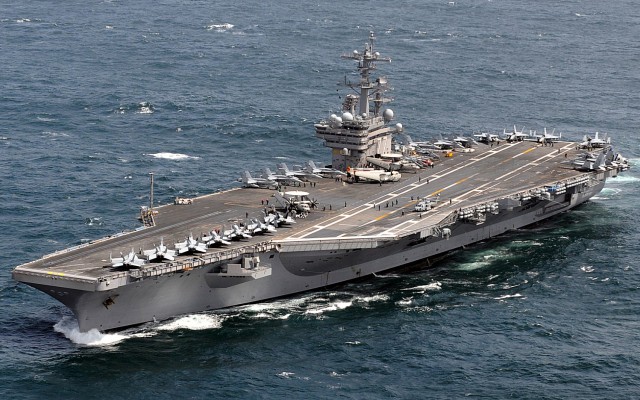
Currently in the Mediterranean: the USS George H.W. Bush (CVN-77)

Will Germany lose face?
For Germany, this crisis is a moment of truth. In January, the President of Germany Joachim Gauck as well as the Defense and the Foreign Ministers established high ambitions for a more proactive German foreign and security policy. The most challenging issue is now, if Germany can deliver, that the stated new ambitions (at least partially) meet with reality. Foreign minister Steinmeier’s negotiation efforts in Kiev were a sufficient try to meet the ambitions; however, more has not yet been delivered.

By the way, where is Angela Merkel? Expressing “deep concern” on the phone to Putin will not have any impact. Given the world gets nothing else from Berlin but words, Germany risks losing its face once again. Hence, Germany should be one of the leading nations in creating a response by NATO to Russia’s aggression; including my proposed Bosporus blockade.

Russia is not the worst threat to NATO
Since 1992, NATO has been engaged in out-of-area and combat missions. This era was about to end anyway through the lack of political will, resources, and money. However, through Ukraine, NATO’s focus and relevance have settled back in Europe. We do not need NATO in Asia or Sub-Sahara Africa.

Instead, we are our worst own enemy. In principle, things look quite well: All NATO allies together remain superior to the rest of the world – economically, technologically, militarily, soft power-wise. In practice, the West’s performance has been very poor. In Syria, Russia, China, Iran, and Assad have very successfully played cats and dogs with the West – resulting in the supposedly-impossible declared survival of Assad’s regime. Even worse, Americans and Europeans let it happen that they became victims of Putin’s divide and rule game, under use of the chess pawn Edward Snowden. However, NATO states could succeed together in Ukraine and elsewhere, but this depends on strategic foresight and – most important – on political will.

Despite all the criticism, the Alliance continued to exist and through Russia’s invasion of Ukraine, it will continue to do so. However, to make a difference, Western governments, in particular the US and Germany, need to wake up and start doing realpolitik.


 Felix F. Seidler is a fellow at the Institute for Security PolicyUniversity of Kiel, Germany and runs the site Seidlers Sicherheitspolitik. This article was published there at first