“Facts are meaningless. You can use facts to prove anything that’s even remotely true. Facts, schmacts.”
-Homer Simpson, from Lisa the Skeptic
Both Steven Wills in his USNI Blog opinion piece and Chuck Hill in his response trot out some interesting numbers in support of diametrically opposed positions on the survivability of LCS. According to Wills, the US Navy lost ships under 3400 tons at a much higher rate than larger vessels in WWII. Hill looks at the numbers and comes to the opposite conclusion. The debate reminds me of the recent statistical dustup over the Patriots’ propensity to fumble that has accompanied Deflategate. And the numbers are just about as meaningful.
Wills asserts that the US Navy lost 71 destroyers and 11 destroyer escorts in WWII. Hill makes that number to be 58 destroyers and 9 destroyer escorts. From what I can tell, they’re both wrong. Using the summary report for ship losses to enemy action from 17 October 1941-7 December 1944, the US Navy lost 134 destroyers and 16 destroyer escorts through December 1944. I could not easily find numbers from December 1944 through the war’s end, but the fact that these figures do not include losses from the Battle of Okinawa suggest that the actual number of destroyer losses for the whole war was closer to 150. Over the period of the report, the US Navy also lost 51 cruisers (CA and CL), 22 battleships, and 39 aircraft carriers (combining CV, CVL, and CVE losses).
After citing the number of losses, Hill uses the fate of vessels in commission at the start of the war to extrapolate survivability statistics for all vessels. Statistically, this is highly suspect. As Hill points out, the US fleet at the start of the war included just 233 major surface combatants. But between 1941 and 1945, the US built over 1,300 more major surface combatants, including 349 DD’s and 498 DE’s. Those ships in commission at the start of the war are a non-random sample, since they would tend to be older, slower, and less likely to incorporate new weapons, sensors, and other technologies that could affect survivability, unless backfitted during the war. The US had no DE’s in commission at the start of the war, further skewing the sample.
The numbers in the two reports point out some of the challenges with getting accurate data: since the US had no DE’s in commission at the start of the war, all 16 DE losses should come from those commissioned 1941-1945. But only 9 are annotated as “sunk” in the shipbuilding report. Similarly, 32 of the 349 DD’s commissioned during the war are listed as “sunk,” which when added to Hill’s figure of 29 destroyers in commission at the start of the war that were sunk comes nowhere close to the figure of 134 destroyers lost (nor even to Wills’ figure of 71, although it is over Hill’s figure of 58). But it doesn’t matter.
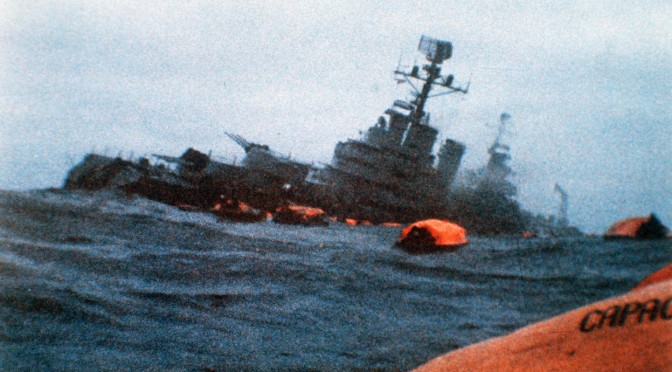
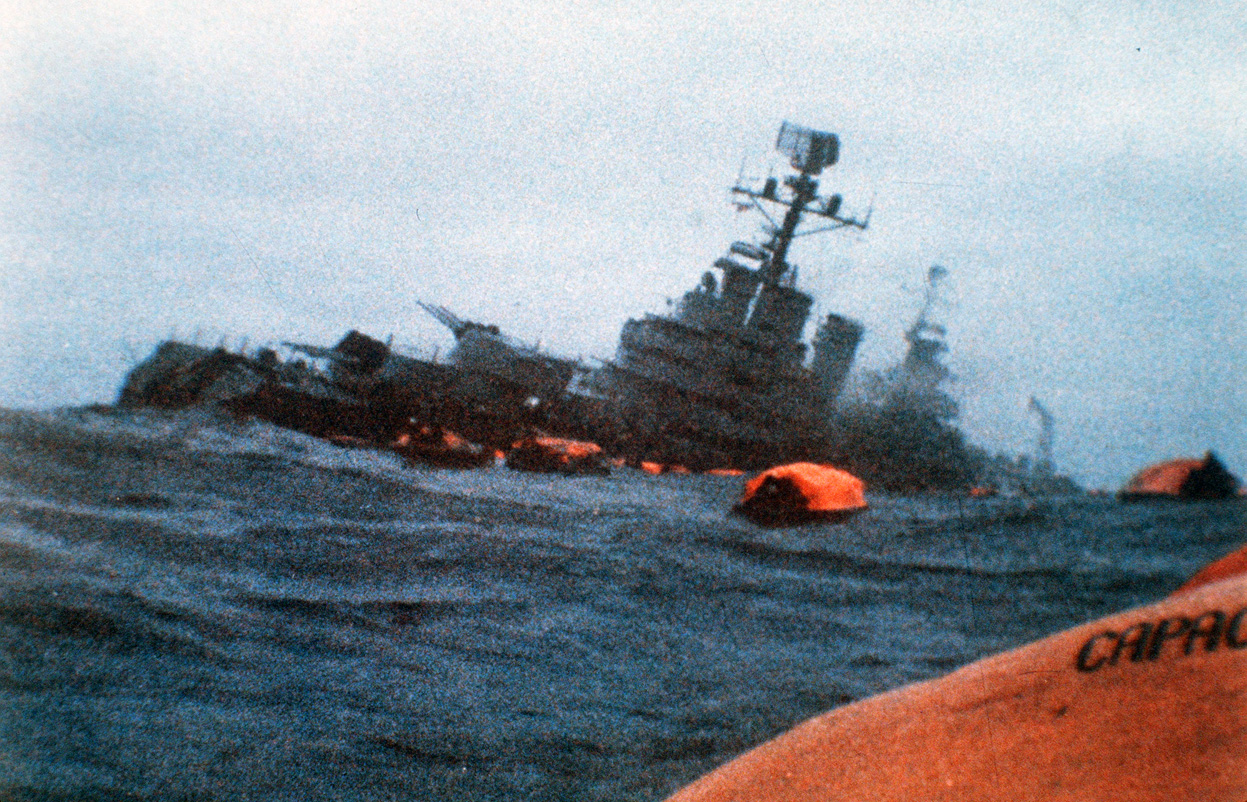
The most significant figure in the WWII ship loss data is zero. That’s the number of ships lost to anti-ship cruise missiles. While it’s tempting to try to draw equivalencies between threats in WWII and threats today, the simple fact is that war at sea looks different today than it did then. The Falklands campaign, in which the Royal Navy lost two ships (a 5,000 ton destroyer and a 15,000 ton logistic ship) to Exocet missiles, and another five vessels (one LCU, two Type 21 frigates of 3,290 tons, a destroyer of 5,000 tons, and an auxiliary of 6,000 tons) to aerial bombs, may provide a more relevant frame of reference. British ship losses in the Falkland campaign totaled two of 15 frigates and two of 12 destroyers or larger. While these numbers are helpful, it’s worth remembering the facts behind the data: the RN were limited in their mobility by the need to protect the landing force; the Argentinians were operating at the outer limits of their range, limiting the duration of engagements. And with such a small sample, it’s risky to draw too-strong conclusions.
The most significant contributor to ship survivability is not getting hit. Hill argues that LCS will not be a priority target due to its small size and relative unimportance. Such an argument depends on the presence of perceived higher-value targets to draw fire. But the whole nature of the A2/AD problem is that it creates too much risk to put high-value targets under the threat umbrella. If LCS is the only surface platform we’ve got in the fight, it will be the platform that the adversary targets. (Worse, if LCS is heavily dependent on the proximity of vulnerable combat logistics force ships to stay in the fight, an adversary may not need to target LCS at all, choosing instead to sink the oilers, rendering LCS immobile and irrelevant.)
The debate about LCS survivability is important, especially as we look to up-arm the ships and give them more offensive punch. And, given the program’s history of overly-optimistic estimates of cost and capability, I understand why analysts would prefer to “go to the data,” rather than relying on assurances of improved survivability and defensive capability. But unfortunately, we don’t have access to survivability data in an unclassified debate. In the absence of the models and simulations that have been run on LCS versus modern threats, looking for examples from the past of different ship types versus different threats only clouds the picture. In short, going back to World War II data to try to prove a point about the survivability of large ships versus small ships in modern combat is about as relevant as pointing out that USS Constitution, a ship of only 1,500 tons, was so survivable that she earned the name, “Old Ironsides.”
Doyle Hodges is a retired Surface Warfare Officer currently pursuing PhD studies at Princeton’s Woodrow Wilson School of Public and International Affairs.
In a 1997 speech to the National Press Club that will be familiar to many Navy and Marine Officers, General Charles Krulak, 31st Commandant of the Marine Corps, told the story of Roman consul Publius Varus. Consul Varus was a once successful general whose legions were decimated by Germanic tribes using what we might refer to as asymmetric tactics that left the Roman’s flummoxed. Varus’ last words were recounted as “Ne Cras, Ne Cras,” or “Not like yesterday.” The story presents a challenge to military leaders in our own generation to refrain from getting complacent in their own capabilities, and to continue to adapt their organizations to meet new and unexpected threats.
General Krulak’s went on to introduce the concept of an urban “three block war,” in which combat forces would simultaneously conduct humanitarian relief, peacekeeping, and high intensity combat operations in the space of three contiguous blocks of a complex urban environment. In many ways General Krulak’s words were more prophetic than he could know, as within six years U.S. forces were engaged against an irregular enemy in complex, densely populated urban terrain in Iraq.
American combat troops out of Iraq and on the cusp of departing Afghanistan. This makes it the perfect opportunity to examine old ideas about urban warfare with fresh eyes and look for both the continuities and the differences resulting from a globally connected world and the proliferation of advanced weapons and technologies down to the sub-state level.
Dr. David Kilcullen, an Australian soldier and counterinsurgency specialist who advised U.S. leadership on strategy in Iraq and Afghanistan, has taken a major step in this direction with his new book Out of the Mountains. Kilcullen’s new work analyses the major trends driving the future of conflict around the world. His findings will indeed have far reaching implications for the U.S. military, which has been focused for years on a rural insurgency based in the mountains and deserts of Afghanistan. Conflict will not be as it was yesterday. It will be fought in major coastal urban centers amidst tens of millions of people, and it will span all domains including land, sea, air, and cyber. These conflicts will be complex and will almost never have a purely or even primarily military solution, but their intensity will at the very least require military force to protect and enable other forms of power and influence as they are applied in support of U.S. strategic goals. The U.S. Navy and Marine Corps will need to be adaptable and flexible in order to remain mission-capable in such an environment.
This article will examine the major trends that Kilcullen identifies, and attempt to delve deploy into their military implications. Dr. Kilcullen identifies four “mega-trends” that are shaping the future of humanity, and with it the future of warfare as a human endeavor. These trends include:
Increasing Population – The U.N. estimates that the global population will continue to increase, especially in developing nations, before leveling off around 9 billion people sometime in the latter half of the century.
Urbanization – For the first time in human history, more than half of the population worldwide lives in cities.
Littoralization – Most cities, and certainly the largest ones, are in coastal zones that provide access to seaborne transportation and thus access to the global economy. Kilcullen usefully defines the littorals as the portion of land and air that can be targeted by weapons from the sea, and likewise that portion of sea and air that can be targeted from land.
Digital Connectedness – Internet and mobile phone access are beginning to saturate markets worldwide, and in some countries access to communications technology outstrips access to sanitation facilities.
The first three of these trends are not news. Kilcullen notes that sociologists have been writing about population and urbanization for decades, and urban conflict was a major focus of military thinking in the 1990s. However, the acceleration of these trends, combined with the burgeoning level of digital connectedness not widely foreseen in the 1990s, means that urban conflicts will take on a new level of violence and intensity that will be broadcast around the world instantaneously. This will provide our adversaries with powerful commercial tools to enable command and control (C2) of independent networked cells in a dynamic battlespace.
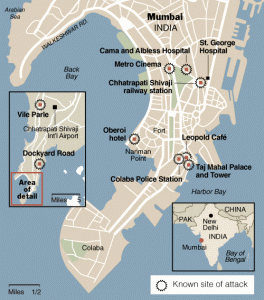
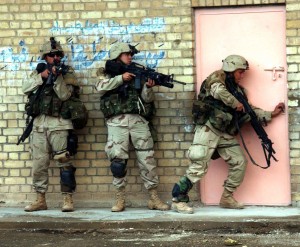
At the operational level, planners can expect warfare to range from the multiple-battalion level assault on Fallujah at the high-end to complex “urban seige” attacks such as Mumbai and Nairobi in the mid-range to the persistent urban violence of the drug wars in Rio de Janeiro’s favelas at the low-end. In each instance, the enemy will be a small, networked, and extremely well-armed group. It will reside in a sea of millions of civilians and be able to call upon commercial digital networks from cell phones to Twitter to collect intelligence, post propaganda, and act as ad hoc C2 nodes to coordinate operations. It will also be able to draw on a massive global transportation system to transport people, weapons, and finances around the world in short order.
In order to flesh out the capabilities of modern networked urban terrorist groups, Kilcullen analyzes in detail the 2008 Lashkar-e-Taiba (LeT) Mumbai assault. LeT’s ground-breaking tactics, which displayed a level of free-flowing swarming ability that is at the very least rare for a sub-state actor, are worth examining. The attack was carried out by multiple cells of just a few individuals each who had conducted a thorough reconnaissance of their targets for nearly a year. The attackers used maritime ratlines normally employed by smugglers to move from Karachi to the port of Mumbai, making landfall in a slum neighborhood with little police presence. Once the assault began, their actions were coordinated via cell- and satellite-phone by a LeT command team operating their own combat operations center in Pakistan (likely with some support from Pakistani ISI). The team used broadcasts from CNN and other media networks to inform their battle tracking and develop an open-sourced understanding of the Indian police response. This allowed the LeT cells to remain several steps ahead of Indian security forces for several days, killing civilians at several high-profile public locations around Mumbai before they were finally surrounded and neutralized.
Digital connectedness is also allowing insurgent groups to expand their presence into the global information space that was once the sole purview of states and large corporations. Regular readers of this blog will likely remember that al-Shabaab live-tweeted the recent Navy SEAL raid in Barawe, and after the special operators withdrew, were able to claim victory before Western news outlets even knew the operation had taken place. The militants then followed up by posting pictures of equipment that the SEALs had left behind during their extraction from the firefight. While seemingly trivial, this allowed al Shabaab to stake its claim to the information available on the attack, and perhaps shatter some of the aura of invincibility surrounding the SEALs since their assault on Osama bin Laden and rescue of Captain Richard Philips from Somali pirates.
It is beyond the scope of a single blog post to analyze all of the future trends that Kilcullen examines in detail. Indeed, the book itself is likely just the first of a great deal of research that still needs to be done on the future of urban conflict against evolved irregular or hybrid adversaries in mega-slums and other dense and highly complex urban environments. Much of that research will, of necessity, have to focus on non-military aspects of conflict prevention and mitigation, due to the unavoidable fact that future urban conflicts will be driven by sociological factors inherent to the urban systems where they are being fought. Under Kilcullen’s formulation, urban design and development will in many ways become as important to American policy as foreign aid, governance and economic development, and security sector reform.
The implications for military doctrine and organization will be significant as well. It will impact Naval doctrine, organization, and ship-building plans even as Navy leadership seeks to focus its efforts and budgetary priorities towards AirSea Battle. The same is true for the Marine Corps’ efforts to reposition itself as the nation’s amphibious crisis response force following a decade of warfare in landlocked environments. In following articles, we will examine these implications in depth, and attempt to achieve a better degree of resolution on the future of urban littoral combat and the steps that the Navy and Marine Corps will need to take to remain mission-capable in that environment.
Dan Dewit is a researcher with the Arleigh Burke Chair in Strategy at the Center for Strategic and International Studies in Washington. From 2009- September, 2013 he served as an officer in the U.S. Marine Corps.
In the din of East African security issues, the navy of Africa’s most populous nation has fallen out of the international eye. With continued pressure on diversified procurement, increasing capability, and new international cooperation, Nigeria’s Navy is slowly growing to fill a void dominated by piracy, petroleum smuggling, and other criminal elements that is re-engaging international attention in Western Africa. Whereas the state of Somalia has been quite unable to manage its offshore affairs, the Nigerian Navy has plotted a course out to sea under the pall of its severe security challenges. If the challenges of oversight, funding, and collusion don’t capsize their efforts, it may become a quite fine sailing.
Procurement-Let’s Go Shopping:
Since 2009, Nigeria has been pursuing an aggressive new procurement program. During the last Nigerian naval modernization period, the late 1970’s and early 1980’s, Nigeria purchased a vast number of vessels from Germany (LST’s) , France (Combattantes), the UK (Thornycraft), Italy (Lerici minesweepers), and others. Unlike the procurement processes familiar in larger navies, such those of NATO, Nigeria ran an “open-source” program, pulling already-proven foreign systems off the foreign shelf. This new buildup is similar, with some new attempt to build local ship-building capacity.
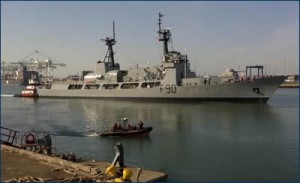
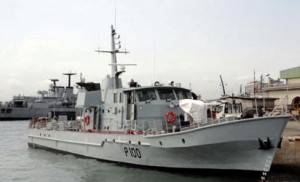
NNS Thunder, the former USCG Chase
The three big ticket “ship of the line” purchases are the 2 “Offshore Patrol Vessels” and the NNS Thunder. The NNS Thunder is the old school “off the shelf” style ship purchase, bringing a Hamilton-class High Endurance Cutter, the ex-USCG Chase, into Nigerian service in 2011. The “Offshore Patrol Vessels” were commissioned with China Industry Shipbuilding Corporation and approved for purchase by President Jonathan in April of 2012. The fleet’s major combatant until the NNS Thunder was the NNS Aradu, an over 30 year old vessel and Nigeria’s only aviation-capable ship. The new contenders will add a total of 5 new 76mm Oto Melara’s added to the fleet, a none too shabby improvement of overall firepower for littoral operations. The 45 (NNS Thunder)/ 20 (OPV’s) day endurance will give the Nigerian Navy an impressive new stay-time for continuous at-sea opeartions. Arguably most important is that all three vessels have maritime aviation capabilities that will greatly expand the reach and ISR component of Nigerian maritime operations. These three ships are right on target to fill critical gaps in Nigeria’s capabilities.
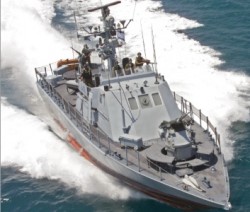
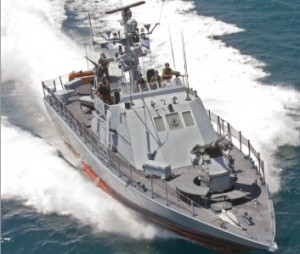
Nigerian Navy Shaldag mk III
Nigeria’s littoral squadrons are also scheduled for improvement. Nigeria is purchasing several brown-green water patrol craft to bolster her much-beleaguered inshore security where smuggling of all kinds is rife. Singaporean Manta’s and Sea Eagle’s, US Defender’s, Israeli Shaldag Mk III’s, and others will add potent brown and green water assets to Nigeria’s toolbox.
On small ship for a ship, one large ship for Nigerian Shipwright kind.
However, not all of Nigeria’s purchases are imports. Thi package also begins the cultivation of indigenous ship-building capability. One of the aforementioned OPV’s is scheduled for 70% of its construction to occur in Nigeria. To more fanfare, the NNS Andoni was commissioned in 2012. Designed by Nigerian engineers and produced locally with 60% locally sourced parts, it is considered a good step forward for building local expertise and capability in the realm of the shipwrights. More local capacity and expertise will further increase the ease with which ships bought locally, or abroad, can be maintained.
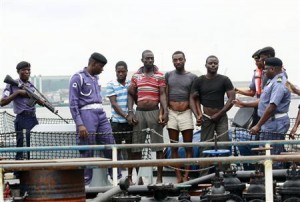
Popped collars, midriff, and tiny shorts? Worst pirates EVER!
Ships are all well and good, but what matters is what you do with them and how. Though the scale of offshore criminality is likely in total hovering around 10 billion, and the entire naval budget is roughly a half billion, the Nigerian Navy is moving more aggressively to course-correct their coastal regions. Several instances include a successful gun battle in August, ending the careers of six pirates, further arrests for oil theft in september, and a nice little capture of pirates in August for which photo opportunities were ensured for the press. The Nigerian Navy is further attempting to extend the “immediacy” of their reach by establishing Forward Operating Bases, like the ones at Bayelsa and Delta states. These and many other instances are the nickles-and-dimes as the Nigerian Navy chips away at the corners of their behemoth security challenge at sea. Every journey begins with a single step, and though the Nigerian Navy has reached a bit of a trot, they have a long way to go. But even in the Navy, no man is an island. With a limited budget and math-rough half of the budget going to the army, the Nigerian Navy needs support. The civil and military authorities are moving closer to that “joint” model with the Memorandum of Understanding between the Nigerian Air Force (NAF) and the Nigerian Maritime Administration and Safety Agency (NIMASA) on the use of NAF assets in Anti-Piracy operations. With an existing MoU between NIMASA, this creates further points of coordination between civil, naval, and air force assets in a coordinated battle against criminals at sea. It’s no J3/J5 shop, but it’s a start.
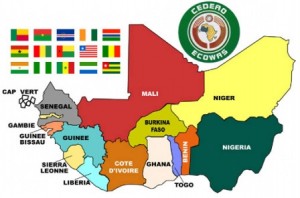
Nigeria is no stranger to international cooperation. Many forget that in August 26th, 1996, ECOMOG (under ECOWAS) actually conducted an amphibious assault into Liberia led by Nigerian military units. From peacekeeping in Liberia, to Sierra Leone, to Darfur, to Mali, etc… etc… Nigeria troops have been a staple of many peacekeeping efforts. Now, their typical face abroad, the boots on the ground, is pulling back to the homeland to fight Boko Haram. However, the navy is still extending its project to integrate into partnership programs through both engagement at home and extending the hand abroad. Nigeria is an active catalyst of the regional security regime. For one, ECOWAS is a factor at sea as well as land. At an ECOWAS conference ending 9 OCT, the naval chiefs of Nigeria, Niger, Benin, and Togo agreed to a common “modality” for the combating of terrorism and agreed to set up a “Maritime Multinational Coordination Center” in Benin to coordinate security efforts. It also doesn’t hurt to host the maiden run of a major procurement/policy forum in your continent, namely the “Offshore Patrol Vessels Conference” for hundreds of African and interested parties. Networking, though an intangible product, is an important way of building institutional strength and connections. Nigeria also engages with US and NATO training missions, like the most recent Operation African Wind: a training exercise for the Armed Forces of Nigeria and other regional militaries in conjunction with the Netherlands Maritime Forces under the auspices of the United States sponsored African Partnership Station. In Lagos and Calabar, units will learn about sea-borne operations, jungle combat, amphibious raids, etc… over 14 days of training and 4 days of exercises. Finally, Nigeria’s navy has made a very respectable show of striking out by conducting a “world tour” of sorts with the new NNS Thunder. The NNS Thunder made a tour around Africa before crossing the Indian Ocean for an historic visit to Australia this month for International Fleet Week. The Nigerian Navy seems determined not to remain shackled by their previous bad position, and is aggressively pursuing an expanded mission and self-image through more than just procurement. Despite the challenges ahead, they’ve demonstrated a reach few of their continental compatriots can lay claim to. It may not help against pirates, but it should be a fine addition to espirit de corps.
The Nigerian Navy is making good progress. With new ships, expanded operations, and continued engagement the bow is pointed in the right direction. However, without maintaining the engineroom and navigational equipment by battling corruption and putting enough fuel in the diesels by increasing their defense budget, the Nigerian Navy will find itself floundering in the storm.
Matthew Hipple is a surface warfare officer and graduate of Georgetown’s School of Foreign Service. He is Director of the NEXTWAR blog and hosts of the Sea Control podcast. His opinions may not reflect those of the United States Navy, Department of Defense, or US Government. Did he mention he was host of the Sea Control podcast? You should start listening to that.
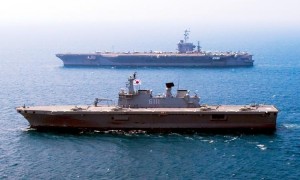
The ROKS Dokdo and USS George Washington on exercise together.
In my previous entry on the U.S.-ROK naval strategy after the OPCON, I argued for a combined fleet whereby the U.S. and ROK Navies, together with the Japanese Maritime Self-Defense Force (JMSDF), may share their unique resources and cultures to develop flexible responses against future threats by Kim Jŏng-ŭn. Since I have been getting mixed responses with regards to the viability of the aforementioned proposal, I felt compelled to flesh out this concept in a subsequent entry. Here, I will examine command unity and operational parity within the proposed combined fleet.
First, as Chuck Hill points out in his response to my prior entry, should the three navies coalesce to form a combined fleet, the issue of command unity may not be easily overcome because “[w]hile the South Korean and Japanese Navies might work together under a U.S. Commander, I don’t see the Japanese cooperating under a South Korean flag officer.” Indeed, given the mutual rancor over historical grievances, and the ongoing territorial row over Dokdo/Takeshima Island, both Japan and the ROK may be unwilling to entertain this this arrangement. However, this mutual rancor, if left unchecked, could potentially undermine coherent tactical and strategic responses against further acts of aggression by Kim Jŏng-ŭn. It is for this reason that Japan and the ROK should cooperate as allies if they truly desire peace in East Asia.
So how can the three countries successfully achieve command unity within the combined fleet? One solution would be for an American admiral to assume command of the fleet. However, while it is true that the ROKN and the JMSDF have participated in joint exercises under the aegis of the U.S. Pacific Fleet, this arrangement would stymie professional growth of both the ROKN and JMSDF admirals who lack professional expertise comparable to their American counterparts. In particular, given that ROKN admirals will assume wartime responsibility for their fleets after the 2015 OPCON transfer, such arrangement would be unhealthy for the ROKN because it would only lead to further dependence on the U.S. Navy.
Instead, a more viable solution, as Hill suggests, would be for the three navies to operate on a “regular rotation schedule…with the prospective commander serving as deputy for a time before assuming command.” This arrangement would somewhat alleviate the existing tension between the ROKN and JMSDF officers. Furthermore, the rotation schedule may serve as an opportunity for ROKN and JMSDF admirals to prove their mettle as seaworthy commanders.
One successful example that demonstrates the efficacy of the above proposal is the ROKN’s recent anti-piracy operational experience with the Combined Task Force (CTF) 151 in the Gulf of Aden from 2009 to the present. In 2011, ROKN SEALs successfully conducted a hostage rescue operation against Somali pirates. ROKN admirals also assumed command of the Task Force twice, in 2010 and 2012 respectively.[1] According to Terrence Roehrig, the ROKN’s recent anti-piracy operational experience has “provide[d] the ROK navy with valuable operational experience [in] preparation for North Korean actions, while also gaining from participating in and leading multilateral operations.”[2]
However, it should be noted that it is “unclear whether ROK counter-piracy operations [with CTF 151] had a significant deterrent effect and, if so, it [was] likely to be limited.”[3] While CTF 151 may provide a plausible model for command unity for the combined fleet concept, it does not fully address potential operational and logistical problems in the event of another armed conflict on the peninsula. Moreover, while frequent joint exercises and exchange programs have lessened operational and linguistic problems, so long as the ROKN continues to be overshadowed by the Army-centric culture and structure within the ROK Armed Forces, it cannot function effectively as a vital component of the U.S.-ROK-Japan alliance in deterring future aggression by Kim Jŏng-ŭn.
To achieve operational parity within the combined fleet, I recommend the following. First, the United States could help bolster the naval aviation capabilities of both navies. The JMSDF has been expanding its number of helicopter carriers, while the ROKN is expanding its fleet of Dokdo-class landing ships, supposedly capable of carrying an aviation squadron or unmanned aerial vehicles (UAVs), in addition to its naval air wing. However, the absence of carrier-based fighter-bomber capabilities may pose problems for the combined fleet concept because it deprives the fleet of flexible tools to respond expeditiously to emergent threats. Thus, the U.S. Navy and Marine Corps could equip the two navies with the existing F/A-18E/F Super Hornets or the new F-35s.
Second, both Japan and the ROK should bolster their amphibious and special operations forces (SOF) capabilities. As the successful hostage rescue operation in January, 2011, of the crew of the Korean chemical tanker Samho Jewelry by the ROKN SEAL team demonstrates, naval SOF capabilities may provide the combined fleet with a quick reaction force to deal with unforeseen contingencies. Furthermore, amphibious capabilities similar to the U.S. MAGTF (Marine Air-Ground Task Force) may provide both the ROK and Japan with the capabilities to proactively deter and not merely react to future DPRK provocations. That the Japanese Rangers[4] have recently trained for amphibious landing with U.S. Marines, while the ROK MND (Ministry of National Defense) has granted more autonomy to the ROK Marines, can be construed as steps in the right direction. As if to bear this out, there are reports that the ROK MND plans to establish a Marine aviation brigade by 2015 to enhance the ROKMC’s transport and strike capabilities.
In this blog entry, I examined command arrangement and operational parity to explore ways in which a combined U.S.-ROK-Japanese fleet may successfully deter potential DPRK threats. Certainly, my proposal does not purport to offer perfect solutions to the current crisis in the Korean peninsula. Nevertheless, it is a small step towards achieving a common goal—preserving peace and stability which all East Asian nations cherish.
Jeong Lee is a freelance international security blogger living in Pusan, South Korea and is also a Contributing Analyst for Wikistrat’s Asia-Pacific Desk. Lee’s writings have appeared on American Livewire, East Asia Forum, the Georgetown Journal of International Affairs, and the World Outline.
________________________________________
[1] Terrence Roehrig ‘s chapter in Scott Snyder and Terrence Roehrig et. al. Global Korea: South Korea’s Contributions to International Security. New York: Report for Council on Foreign Relations Press, October 2012, p. 35
[2] ibid., pp. 41
[3] ibid.
[4] Japan does not have its own Marine Corps.

 Both Steven Wills in his USNI Blog opinion piece and Chuck Hill in his response trot out some interesting numbers in support of diametrically opposed positions on the survivability of LCS. According to Wills, the US Navy lost ships under 3400 tons at a much higher rate than larger vessels in WWII. Hill looks at the numbers and comes to the opposite conclusion. The debate reminds me of the recent statistical dustup over the Patriots’ propensity to fumble that has accompanied Deflategate. And the numbers are just about as meaningful.
 The most significant figure in the WWII ship loss data is zero. That’s the number of ships lost to anti-ship cruise missiles. While it’s tempting to try to draw equivalencies between threats in WWII and threats today, the simple fact is that war at sea looks different today than it did then. The Falklands campaign, in which the Royal Navy lost two ships (a 5,000 ton destroyer and a 15,000 ton logistic ship) to Exocet missiles, and another five vessels (one LCU, two Type 21 frigates of 3,290 tons, a destroyer of 5,000 tons, and an auxiliary of 6,000 tons) to aerial bombs, may provide a more relevant frame of reference. British ship losses in the Falkland campaign totaled two of 15 frigates and two of 12 destroyers or larger. While these numbers are helpful, it’s worth remembering the facts behind the data: the RN were limited in their mobility by the need to protect the landing force; the Argentinians were operating at the outer limits of their range, limiting the duration of engagements. And with such a small sample, it’s risky to draw too-strong conclusions.
 At the operational level, planners can expect warfare to range from the multiple-battalion level assault on