By MIDN 1/C Jeffrey W. Jaeger, USNR
Since 1899, the U.S. Navy has used a generalist career track for its surface warfare officers. This coincides with the Arthur administration’s imperative that the Navy rehabilitate itself from traditionalist mores that restricted steam engines, available in common maritime usage from the early 1800s as auxiliary systems for primary sail power. Congress responded to President Arthur and authorized the Navy’s first all-steel, all-steam warships in 1883.1 The Spanish- American War finally convinced most of the Navy’s recalcitrant officers that machinery-powered warships were the future. The Great White Fleet followed, and tall ships were relegated to history.
Although sailing had long been viewed throughout the world as a specialized profession, those within the profession qualified “able-bodied” seaman as generalists. This meant that just about every sailor aboard ship had the capability of working with sails and rigging, and the officers were possessed of knowledge not just of navigation but of how the propulsion system had to be operated and maintained. Even so, a major criticism of this transition from the officer corps was that the more crew-efficient, technically-specialized nature of machine-driven plants would degrade the teamwork required amongst the seamen, petty officers, and junior officers to work en masse with the labyrinthine sail rigs.2 This was in addition to the perceived unreliability of machine plants, which was justified in part due to the specialized skills required to maintain, operate, and repair such plants. The navigator was relieved from the burden of having to constantly optimize the set of his sails in dynamic conditions over distance and fixing position by celestial sights at frequent intervals as the dead reckoning course became more reliable. With regular propulsion not dependent on environmental factors and operated from a remote position away from the quarterdeck, much of the watch officer’s duties could be refocused toward other deck-related tasks.
The Navy believed that redundancy and the operational needs of gunnery and damage control meant that military crews would remain more generalist, while merchant crews grew leaner and more profitable. Crews did indeed become more fragmented into the divisions and departments that exist today instead of gun crews and messes. They were broken up by technical function into smaller and more disparate teams across larger vessels. Watch officers became disengaged from the operation of the propulsion, since their navigational duties became increasingly disconnected from the means of propulsion itself and was more reactive, or corrective, than proactive in nature.
The deck and engine departments formed themselves, which panicked the Navy. Redundancy, they decided, required every officer aboard to return to the Age of Sail and know every other officer’s job aboard so that a loss of men would not result in combat ineffectiveness of the unit. Steeped in tradition, and mourning a time that would never return, the Navy clung to the adage that an officer could only be effective if he had a passable knowledge of every system aboard ship, rather than in-depth expertise of certain systems.
The Merchant Marine, on the other hand, leapt into steam power with gusto. Scottish engineers in Glasgow created the Charlotte Dundas, a canal tug, as the world’s first practical steam-powered vessel in 1802, less than a century after the original Newcomen steam engine was built on land but decades before the Navy adopted steam power.3 Robert Fulton built the first commercially viable steamship in America five years later, using a Watt engine of mid-eighteenth century design. By 1819, the auxiliary steamer SS Savannah had completed the first trans-Atlantic voyage under partial steam power. Although maritime steam languished for several decades, better understanding of the relationships between cubic capacities versus the square water resistance of ships along the waterplane led to the creation of larger, more economical vessels, while naval vessels unconcerned with cargo profits focused on armament, armor, survivability, and maneuverability. Professionalization of marine steam engineers relieved many of the concerns about steam boiler explosions, since they were operated by experts rather than captains pushing unfamiliar systems to the limit. In 1838, the SS Sirius won the first unofficial Blue Riband by crossing the Atlantic entirely by powered machinery in record time.4 She made the crossing with a crew of 36. A U.S. Navy first-rate tall ship of the line launched in the same year, the USS Pennsylvania, carried 1,100. An early Navy steamship of the 1830’s, the USS Fulton, mounted only four 32-pounders but carried a complement of 130. Setting aside gun crews, Sirius was far more efficient ton-for-ton by deadweight and displacement. Amongst commercial ships of the time, Sirius had half the crew of full-rigged tall ships. The Age of Steam was well upon the Merchant Marine.
Driven by the business necessities of minimizing crew costs, lowering transit times, and maximizing carriage capacity, the Merchant Marine’s adoption of steam power was an economic imperative. It did not have the luxury of clinging to tradition for tradition’s sake, and could not afford to overbuild ships for minimal risks that were underwritten by insurers anyway. This capitalist mandate for innovation spurred the Merchant Marine to adopt engineers as a separate and distinct department of maritime labor. More efficient engines in terms of machinery and fuel, along with additional developments such as multiple-expansion boilers, condensers, and economizers, came with increased demands for specialists that could keep these plants running with minimal laytime and personnel.
Authority is more horizontal in the Merchant Marine than in the Navy, and duties are less formally assigned. This necessitates broader swaths of knowledge despite the separation of departments. On the deck side, officers fill roles that are flexible, often interchangeable, and usually according to informal tradition. This flexibility amongst the captain’s mates allows the master (as the captain is legally known) to exercise broad authority for the entire crew and vessel, despite being licensed solely as a deck officer. Engineering officers have even more flexibility in their roles and are usually assigned a broad group of systems to supervise. Both sets of officers stand watches within their departments, although automation has resulted in “unmanned” engine rooms for many newer ships that permit the engine crew to operate as dayworkers. These officers are usually the only licensed personnel on duty at any time, so they must have a complete knowledge of every task and duty which might befall them during the watch. Unlicensed watch personnel are also typically limited to just one or two on either side. Most unlicensed sailors do daywork, fulfilling their working hours on a normal schedule with overtime for after-hours cargo, locking, or docking operations.
In the Navy, however, officers are considerably more siloed and yet pulled in more directions throughout the day than their Merchant Marine counterparts. A junior officer is assigned control of a division, which comprises a chief petty officer, one or more petty officers, and several enlisted sailors that are grouped together by their technical rating or the specific systems they operate on a daily basis. They will fill different roles in different situations, according to multitudes of station bills written up for every conceivable circumstance the ship could find itself in. The officer in charge of that division has no specialized or technical training for that division’s equipment. He is made to manage a small group of sailors, who are the experts that train new enlisted sailors rotating in from A-school already in possession of foundational training.
Contrast that with a Merchant Marine officer, who is not only licensed by proving that he has expertise in every facet of his department on a grueling series of exams, but has also sailed for no less than a full calendar year as a trainee in his department (half that for engineers, since their roles are more easily trained on land). His unlicensed personnel are either highly experienced, requiring little supervision, or new with minimal union schooling, thereby requiring considerable supervision and training with a capitalistic impetus to learn rapidly. This is a more efficient crew structure that maximizes usage of each individual and of automated equipment.
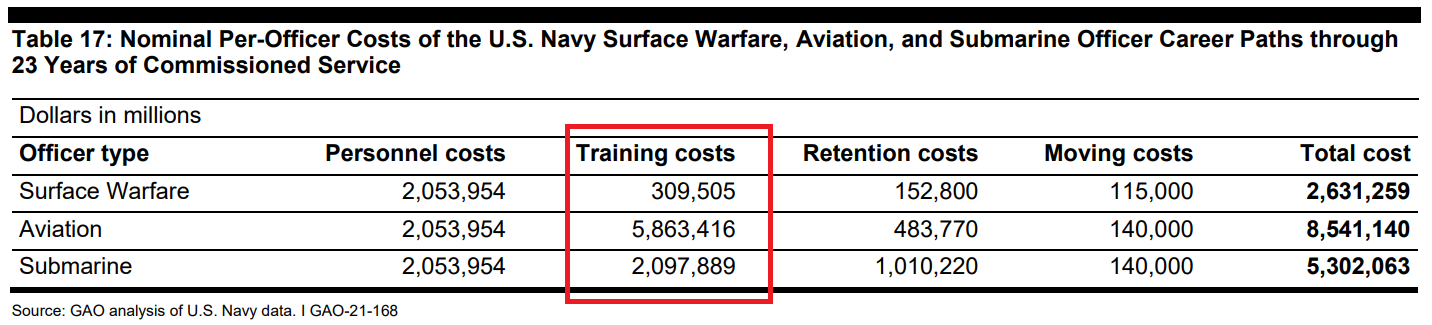
Throughout their careers, surface warfare officers acquire training and warfare-specific knowledge through on-the-job training and sporadic schooling ashore. Merchant Marine officers arrive to the fleet fully-trained and expected to stand a watch on day one, which they are qualified to do. The Navy previously shipped officers directly from their commissioning source (college, OCS, or USNA) to their ships. Practically zero of them had any shipboard experience whatsoever and had to get a crash course on the basics such as COLREGs or maneuvering. Some watchstanding training is now provided ahead of time, first through a distance-learning course derisively known as “SWOS in a box” and now through the Basic Division Officer Course in Newport.5 However, these officers must learn the basics while managing a division of sailors, with all the needs and wants of sailors wholly dependent on their leadership for their careers and well-being, standing watches on the bridge, and then at some point in the engine control room. As a result, surface warfare officers are constantly burned out, overtaxed, and less knowledgeable about the thing that makes them a SWO – their ship – than their Merchant Marine counterparts. Even the SWO pin qualification is less an exercise in actual proof of understanding, as the curricula for Merchant Mariners’ “sea years” are, and more just a matter of rote memorization.
The fact remains that a Navy SWO is less trained and less experienced than a more junior Merchant Marine officer at that thing that unites them professionally – being a mariner. The lack of seamanship has gotten so critical that the Navy, who commissions a small cadre of under 2,200 licensed Merchant Mariners as reserve Strategic Sealift officers (SSOs), has to send these mariners out to sea to teach SWOs basic shipboard concepts such as bridge resource management.
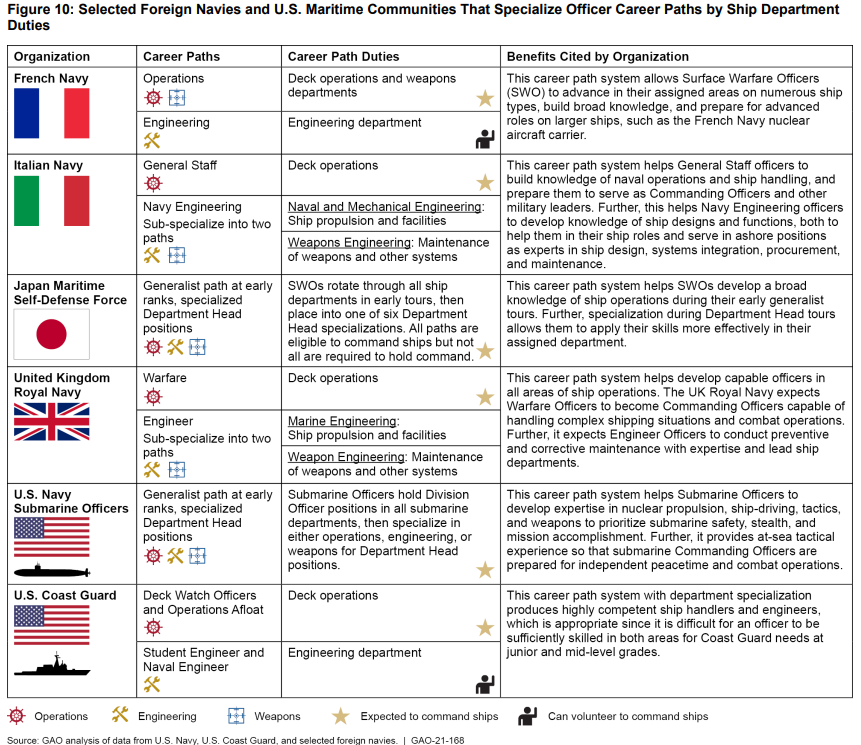
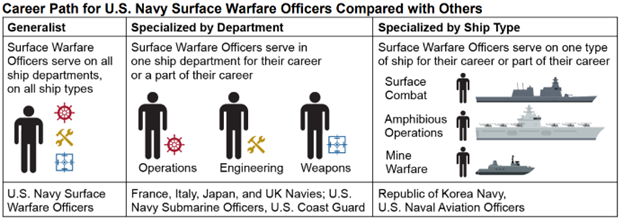
While there can be a need for officers to be well-rounded leaders and know their entire ship, the fact of the matter is that combat redundancy is no excuse for simultaneously pigeonholing officers into a division with no relevant training and then forcing them to understand every department’s equipment and operations through slapdash “training” performed almost entirely as a competition to their already-strained workday. If so many engineering officers are killed in combat that a deck officer must fill their role, then the ship is already combat ineffective. Generalist officers often cannot offer enough instruction, expertise, and advice to the more specialized enlisted sailors they are meant to supervise. Passing that buck to their chief petty officers robs the officer of their responsibility to become a mariner and a leader of mariners.
By contrast, Merchant Marine officers are either deck or engineering officers from their first day as cadets. They spend up to four years training in academies and at sea, or even longer if they “hawsepipe” (that is, learn from observation and classes taken during vacations on land while working as an unlicensed sailor), just to master the basics of their department. Front- loading training and then specializing them in one of just two major functions common to every ship afloat means they are effective on day one of work. Specialization permits more in-depth knowledge of tasks and equipment, which still takes many years of intense training to master. Forcing them to learn both halves of the ship would cause the training sufficient for them to be ready “day one” to take seven or more years, or else result in officers who are somewhat familiar with both halves but incapable of properly manning any role in either half. Specialization, to the extent that the Merchant Marine does so, strikes the right balance between the technical expertise of individual ratings that rightfully belongs to the enlisted Navy sailor while allowing them to be effective supervisors, managers, and – most importantly – mariners.
Navy generalists argue that SWOs operate vessels that are orders of magnitude more complex than merchant vessels and have weaponry and sensors to operate that merchantmen do not. They argue that a SWO must have a total understanding of the entire vessel so they can employ their division or department within the context of the whole. How, we ask, is that any different than what a merchantman does? While a modern merchant vessel no longer employs weapons systems, the ship’s “weapons” are the interlinked cargo-handling gear systems that give the vessel its purpose just as a destroyer’s missiles give it its mission. For the same reason that merchantmen took on steam power in its infancy, commercial trade dispensed with longshoremen as soon as better technology was available. While more efficient, this increased the technical and engineering demands on both departments of the ship crews. Yet no one would argue that merchant officers should have become less expert in their fields as a result.
There is also a major difference in that merchant mariners are constantly employing their vessel’s central capabilities and functions to full effect. The same cannot be said of SWOs who have not had to fight their ships in a great power war in decades. This lack of experience in performing their ultimate function may be masking a need for specialization because the generalist model has not been subjected to the stress of modern great power conflict. Recent sustained missile conflict in the Red Sea has offered the closest glimpse, and perhaps shown some cracks in the system. Yet the generalist model is arguably already struggling to meet peacetime demands beyond the bare minimum. With the advent of warfare tactics instructors, it is possible for a third department to emerge within the surface warfare community – operations – which focus on the weapons and sensors used to fight the ship.
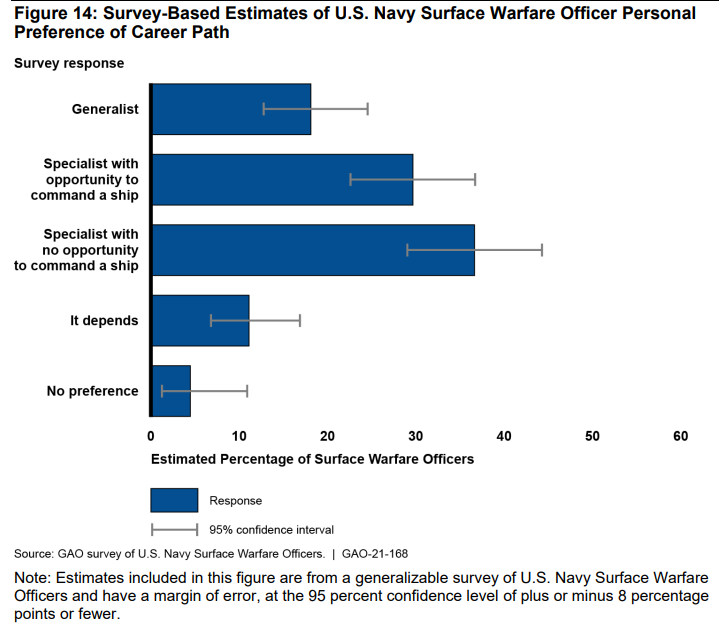
With retention being one of the most critical issues apart from maritime expertise facing the SWO community, specialization will only enhance a sense of professionalism that lends itself to more fulfilling careers served in full. Despite bonuses into the six figures, SWO department head retention rates are stubbornly stuck around 35 percent, well below other warfare communities.6 SWOs have complained of overwork and being pulled in too many directions. Specialization into a single department just as Merchant Mariners enjoy, combined with more frequent shore time in the model of the submarine service’s blue-gold crewing structure, will relieve these issues. The SWO will become more mission-focused in a field in which he is not only allowed but encouraged to develop deep professional expertise, and permitted to stay in the area of his expertise in the same way that naval aviators fly the same aircraft type for their entire career. Professional satisfaction and welfare will increase retention, building up into manpower levels that permit more flexible crewing structures.
On the topic of aviators and submariners, the generalist argument that broad knowledge is required to assume higher levels of responsibility rings hollow. While it is true that Merchant Marine captains are exclusively licensed as deck officers, chief engineers are accorded similar levels of respect within the community. The Navy relegates this position to mid-level management as a department head with no particular engineering expertise.
Thanks to bridge manning with watch officers and officers of the deck, it is entirely feasible that a captain can be drawn from any department. Even if the Navy chooses to emulate the Merchant Marine and draws captains from the most “seaman-ly” department, the deck, this is little different than distinguishing between the unrestricted and restricted lines. Officers motivated to stay in their fields from which they draw professional satisfaction instead of being forced into management positions they are less engaged in are more likely to stay in service and hone their craft.
MIDN 1/C Nicholas Punla Smith, USNR, previously served as a bosun’s mate aboard the USCGC Barque Eagle (WIX 327) and has argued that generalized training for new officer candidates is valuable precisely because it demands the teamwork and foundational seamanship that Navy generalists cling to with their traditional mindsets left over from the Age of Sail. Generalized operations, however, are counterproductive. We cannot ignore the fact that our vessels today are far more complex than even the largest ships of the line. While electronics and automation have reduced the requisite number of crew for equivalent tasks, many shipboard tasks today were unimaginable to tall ship sailors who were simply not technologically advanced and would not recognize the style of warfare we now practice. The Merchant Marine embraced change and adapted to new technologies with their commensurate labor roles as soon as it was feasible and demanded by economics. The Navy, thanks to their ability to stand outside the flow of constant market forces, clung to tradition for tradition’s sake even to the point of ordering all-sail ships half a century after the introduction of marine steam plants.7
The time was a century ago for the SWO officer corps to accept that the future had arrived, and it is past high time for them to do so now. The U.S. Navy surface warfare community must adapt accordingly, as their Merchant Marine brethren have to great effect, for their benefit as professional mariners.
MIDN 1/C Jeffrey W. Jaeger, USNR, is in his final year at the Great Lakes Maritime Academy and will be licensed as a third mate and first-class pilot in the U.S. Merchant Marine as well as commissioned as an ensign in the Navy’s Strategic Sealift Officer Force. He has sailed in unlicensed and cadet capacities aboard the M/V Edwin H Gott, USNS Washington Chambers (T-AKE 11), USS Mason (DDG 87), and M/V Herbert C Jackson. MIDN Jaeger has been previously published in the US Naval Institute’s Proceedings and is a former indirect fire infantryman and infantry officer of the U.S. Army.
References
1. US Navy. (2024, February 20). Sail to Steam Propulsion. Naval History and Heritage Command. https://www.history.navy.mil/browse-by-topic/communities/surface/steam.html
2. US Navy. (2024a, January 17). The Steel Navy. Naval History and Heritage Command. https://www.history.navy.mil/browse-by-topic/exploration-and-innovation/steel-navy.html
3. Fry, Henry (1896): The History of North Atlantic Steam Navigation: With Some Account of Early Ships and Shipowners, Sampson Low, Marston & Co., London.
4. Britannica Editors (2019, September 13). Sirius. Encyclopedia Britannica. https://www.britannica.com/topic/Sirius-steamship
5. Faram, M. (2017, August 27). Maybe today’s Navy is just not very good at driving ships. Navy Times. https://www.navytimes.com/news/your-navy/2017/08/27/navy-swos-a-culture-in-crisis/
6. Stancy, D. (2024, January 9). Here’s what the Navy is doing to boost SWO retention. Navy Times. https://www.navytimes.com/news/your-navy/2024/01/09/heres-what-the-navy-is-doing-to-boost-swo-retention/
7. National Park Service. (2011, June 5). USS Constellation (frigate). National Historic Landmarks Program. https://web.archive.org/web/20110605234813/http://tps.cr.nps.gov/nhl/detail.cfm?ResourceId=697&ResourceType= Structure
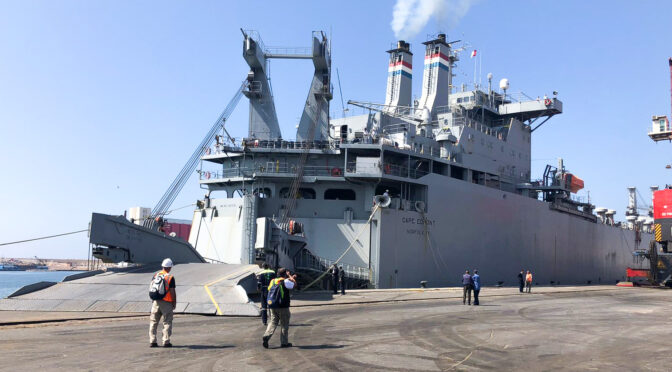
Featured Image: The Cape Edmont Ready Reserve Force vessel docks in Agadir, Morocco, Feb. 29, 2020. The cargo vessel, operated by Merchant Marines from the U.S. Department of Transportation, carried nearly 7,000 tons of military equipment for use in African Lion 20, the largest exercise in Africa. (Photo by Maj. Cain Claxton U.S. Army Southern European Task Force, Africa)