Tag Archives: China

A Sign of the Times: China’s Recent Actions and the Undermining of Global Rules, Pt. 3

By Tuan N. Pham

Last March, CIMSEC published an article titled “A Sign of the Times: China’s Recent Actions and the Undermining of Global Rules, Part 1” highlighting three troubling developments that oblige the United States to further encourage and challenge China to become a more responsible global stakeholder that contributes positively to the international system. The article noted Beijing is trying to convince others to accept the self-aggrandizing and self-serving term of “near-arctic state”; to fulfill its nationalistic promise to the Chinese people and reclaim the disputed and contested South China Sea (SCS) from ancient times; and to expand its “sharp power” activities across the globe.

A month later, CIMSEC published a follow-on article underscoring that these undertakings continue to mature and advance apace. The article featured China possibly considering legislation to seemingly protect the fragile environment in Antarctica, but really to safeguard its growing interests in the southernmost continent; taking more active measures to reassert and preserve respectively its perceived sovereignty and territorial integrity in the SCS; and restructuring its public diplomacy (and influence operations) apparatuses to better convey Beijing’s strategic message and to better shape public opinion abroad. At the end of the article, the author commented that although the United States made progress last year calling out wayward and untoward Chinese behavior by pushing back on Chinese unilateralism and assertiveness, strengthening regional alliances and partnerships, increasing regional presence, reasserting regional influence, and most importantly, incrementally reversing years of ill-advised accommodation; there is still more America can do.

The following article lays out previously recommended ways and means that Washington can impose strategic costs to Beijing and regain and maintain the strategic initiative. Providentially, the Trump Administration has implemented many of them, but the real challenge remains in sustaining the efforts and making the costs enduring. Otherwise, Beijing will just wait out the current administration in the hopes that the next one will advance more favorable foreign policies. Alternatively, they could also step up their “sharp power” activities to influence extant U.S. foreign policies and/or undermine the current U.S. administration’s political agenda and diminish its re-election prospect in 2020.         

What America Can Do in the Indo-Pacific

 The new National Security Strategy and National Defense Strategy call for embracing strategic great powers competition with rising China. They both make the case that when two powers, one dominant (United States) and one rising (China), with competing regional and global strategies extend into one’s another security and economic spheres, the geopolitical landscape is ripe for friction. However, this competition is not to be feared but to be expected and embraced. America must challenge China’s rise if it continues to not be peaceful and undermines the global rules that provide global peace and prosperity for all.  

China will likely remain the economic partner of choice for the Indo-Pacific, while the United States will likely remain the security partner of choice. As this China-U.S. competition grows and intensifies, balancing these complex and dynamic relationships will become increasingly challenging as regional countries feel greater pressures to choose sides. The U.S. should continue to pursue stronger regional security ties and strive to be a more dependable and enduring partner in terms of policy constancy, resolve, and commitment. Strengthening old alliances and partnerships, and forging new ones with Hanoi, New Delhi, and others will be beneficial.  

The “most effective counterbalance” to China’s campaign of tailored coercion against its weaker neighbors will still be U.S. persistent presence and attention (and focus) in the form of integrated and calibrated soft and hard deterrent powers – multilateral diplomacy, information dominance, military presence, and economic integration. 

The “most promising and enduring check” to China’s expansive regional and global ambitions will still be economic integration. The U.S. should move forward on more bilateral trade agreements; support the emerging Trans-Pacific Partnership-11 (TPP-11) initiative; and/or reconsider bringing back the TPP itself to bind the United States to the other regional economies, guarantee an international trading system with higher standards, and complement the other instruments of national power. Otherwise, Washington may inadvertently drive the Indo-Pacific nations toward other economic alternatives like the China-led Regional Comprehensive Economic Partnership, Asian Infrastructure Investment Bank, and Belt and Road Initiative

China is a signatory of the United Nations Convention on the Law of the Sea (UNCLOS) but often violates its provisions, whereas the United States has not ratified UNCLOS but has been its foremost champion on behalf of freedom of navigation, global commerce, and international rule of law. The U.S. should consider ratifying UNCLOS if challenges are going to have more gravitas and be taken more seriously by the international community, otherwise, the status quo simply strengthens Beijing’s ability to call into question Washington’s sincerity to international norms.

The U.S. must keep reframing and countering when appropriate the narratives that China pushes with accusations of American containment and hypocrisy while promoting a perception of  China’s global benevolence and benign rise. Washington’s message is more often than not reactive and defensive, not synchronized, or sometimes nothing at all. The U.S. can seize the messaging initiative like during the 2017 Shangri La Dialogue with the keynote speech by Australian Prime Minister Turnbullremarks by American Secretary of Defense Mattis during the first plenary session (United States and Asia-Pacific Security), and comments by former Japanese Minister of Defense Inada during the second plenary session (Upholding the Rules-based Regional Order). The U.S. can continue to acknowledge that both countries have competing visions, highlight the flawed thinking of Beijing’s approach, champion its own approach as the better choice, and call out wayward and untoward Chinese behavior when warranted. This can include China’s expansive polar ambitions, intrusive sharp power activities, and destabilizing SCS militarization, but the U.S. should also give credit or commend when appropriate, such as China’s economic sanctions against North Korea. The U.S. cannot euphemize in its messaging, and whenever possible, should synchronize communication throughout the whole-of-government and international partners while reiterating at every opportunity. There can be no U.S. policy seams or diplomatic space for China to exploit.

The U.S. must take each opportunity to counter China’s public diplomacy point-for-point, and keep repeating stated U.S. diplomatic positions to unambiguously convey U.S. national interests and values such as:

  • The United States supports the principle that disputes between countries, including disputes in the ECS and SCS, should be resolved peacefully, without coercion, intimidation, threats, or the use of force, and in a manner consistent with international law.
  • The United States supports the principle of freedom of navigation, meaning the rights, freedoms, and uses of the sea and airspace guaranteed to all nations in international law. United States opposes claims that impinge on the rights, freedoms, and lawful uses of the sea that belong to all nations. United States takes no position on competing claims to sovereignty over disputed land features in the East China Sea (ECS) and SCS.
  • Claims of territorial waters and economic exclusive zones (EEZ) should be consistent with customary international law of the sea and must therefore, among other things, derive from land features. Claims that are not derived from land features are fundamentally flawed.
  • Parties should avoid taking provocative or unilateral actions that disrupt the status quo or jeopardize peace and security. United States does not believe that large-scale land reclamation with the intent to militarize outposts on disputed land features is consistent with the region’s desire for peace and stability.
  • United States, like most other countries, believes that coastal states under UNCLOS have the right to regulate economic activities in their EEZ, but do not have the right to regulate foreign military activities in their EEZ.
  • Military surveillance flights in international airspace above another country’s EEZ are lawful under international law, and the United States plans to continue conducting these flights as it has in the past. Other countries are free to do the same.

What America Can Do in the SCS

Since the start of 2018, China appears embarked on a calculated campaign to determinedly reassert and preserve its perceived sovereignty and territorial integrity in the SCS through words and deeds. Beijing believes that sharp and emphatic “grey zone” operations and activities will once again compel Washington to back down in the SCS. Washington did little when Beijing illegally seized Scarborough Shoal in 2012; brazenly reclaimed over 3200 acres of land over the next five years despite a 2002 agreement with the ASEAN not to change any geographic features in the SCS; barefacedly broke the 2015 agreement between Xi Jinping and Barack Obama to not militarize these Chinese-occupied geographic features; and blatantly disregarded the landmark 2016 Arbitral Tribunal ruling.          

The U.S. can continue to reframe the SCS as a strategic problem (and not a regional issue) that directly involves the United States and obliges China to act accordingly. Explicitly conveying to Beijing that the SCS is a U.S. national interest and making the SCS a “bilateral” U.S.-China issue may induce Beijing to rethink and recalibrate its revisionist strategy. The U.S. can turn the tables and make Beijing decides which is more important to its national interests – the SCS or its strategic relationship with Washington (trade, military-military, etc.). Stay firm and consistent to stated SCS positions :

  • No additional island-building and no further militarization
  • No use of force or coercion by any of the claimants to resolve sovereignty disputes or change the status-quo of disputed SCS features
  • Substantive and legally binding Code of Conduct that would promote a rules-based framework for managing and regulating the behavior of relevant countries in the SCS and permissibility of military activities in the EEZ in accordance with UNCLOS.

Otherwise, deferring to Beijing on aforesaid issues will only reinforce the perception in Beijing that Washington can be influenced and maneuvered with little effort.

Beijing undermined the International Tribunal for the Law of the Sea by drawing red lines around the reclaimed and disputed geographic features. Washington and the international community must therefore buttress the Tribunal’s authority and legitimacy through words and deeds. There is value in continuing to challenge Beijing’s excessive and contested maritime claims in the SCS through a deliberate, calibrated, and enhanced campaign of presence operations – transits, exercises, and freedom of navigation operations (FONOP). Otherwise, failing to conduct these routine operations in the aftermath of the landmark 2016 ruling, particularly FONOPs, sends the wrong strategic signal and further emboldens Beijing to continue its brazen and destabilizing militarization of the SCS. Combined, multi-national exercises can underscore the universal maritime right of all nations to fly, sail, and operate wherever international law permits.

China pursues a very broad, long-term maritime strategy and will view any perceived U.S. force posture reduction as a reward (tacit acknowledgement and consent) for its unilateral rejection of the Tribunal ruling, a win for its strategy and preferred security framework, and another opportunity to reset the regional norms in its favor. Reduction may also increase Beijing’s confidence in its ability to shape and influence Washington’s decisions and encourage China to press the United States for additional concessions, in return for vague and passing promises of “restraint.”

Although Manila and Washington did not capitalize on the hard-fought legal victory over China’s excessive and contested maritime claims in the SCS, it is still not too late to do so. The U.S. can encourage and support Hanoi, Kuala Lumpur, and other Association of Southeast Asian Nations (ASEAN) countries to put additional pressures such as legal challenges, public diplomacy, and collective maritime activities on Beijing to curb its assertiveness and unilateralism, stop its land reclamation and militarization activities, and come in good faith to the multilateral (not bilateral) negotiating table for a peaceful and enduring resolution of the competing and contested maritime claims.

Now is Not the Time to Back Down in the SCS

All told, years of American acquiescence and accommodation may have “unintentionally and transitorily” eroded international rule of law and global norms while diminishing the regional trust and confidence in U.S. preeminence. Furthermore, this accommodation may have weakened some of the U.S. regional alliances and partnerships, undermined Washington’s traditional role as the guarantor of the global economy and provider of regional security. These accommodations have accelerated the pace of China’s deliberate march toward regional preeminence and ultimately global preeminence.

So, as to not further give ground to Beijing in the strategic waterway, Washington cannot back down now in the SCS. To do so would further embolden Beijing to expand and accelerate its deliberate campaign to control the disputed and contested strategic waterway through which trillions of dollars of global trade flows each year and reinforce Beijing’s growing belief in itself as an unstoppable rising power and Washington as an inevitable declining power that can be intimidated out of the SCS and perhaps eventually the greater Indo-Pacific in accordance with its grand strategic design for national rejuvenation (the Chinese Dream). For Beijing, controlling the SCS is a step toward regional preeminence and eventually global preeminence.      

Conclusion

Beijing’s strategic actions and activities are unwisely and dangerously undermining the current global order that it itself has benefited from. Hence, Washington has a moral and global  obligation of leadership to further encourage and challenge China to become a more responsible global stakeholder that contributes positively to the international system. Otherwise, Beijing will continue to view U.S. acquiescence and accommodation as tacit acknowledgement and consent to execute its strategic ambitions and strategies unhindered and unchallenged. The U.S. window of opportunity to regain and maintain the strategic high ground and initiative will not remain open forever.

Tuan Pham serves on the executive committee of the Yokosuka Council on Asia-Pacific Studies and is widely published in national security affairs and international relations. The views expressed therein are his own and do not reflect the official policy or position of the U.S. Government.

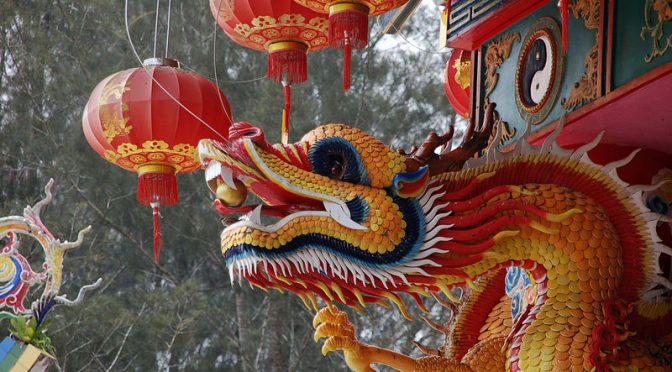
Featured Image: Chinese dragon statute (Wikimedia Commons)
Controlling the Masses: Protests and Media in the People’s Republic of China

This article is published in partnership with the U.S. Naval Academy’s Foreign Affairs Conference (NAFAC).

By Yena Seo

In the Western world, the freedoms of press, speech, assembly, and petition are considered vital to the functioning of a healthy democracy. Free media acts as the fourth estate by providing information to the masses, while citizens under a democratic government can expect to have their speech heard through assembly and petition. In the People’s Republic of China, the freedoms of press, speech, assembly, and petition intersect as the government uses the media – rather than brute force – to repress and silence democratic movements. Media control in China affords the government a one-two punch when countering pro-democracy protests: censorship silences social movements from the bottom, and those that succeed into physical demonstrations are oppressed and marginalized via the state media’s protest paradigm.

According to Freedom House, China is home to one of the world’s most restrictive media environments.1 The Central Propaganda Department (CPD) and State Administration of Press, Publication, Radio, Film and Television (SAPPRFT) ensure media content is consistent with the goals of the Chinese Communist Party (CCP).2 In regard to pro-democratic protests, the government’s media approach consists of two prongs: repression and silence. State media coverage of protests falls under the protest paradigm, a phenomenon in which news outlets spotlight the appearance and behaviors of protesters – rather than their mission – in an attempt to marginalize them.3 The protest paradigm is a powerful tool for the Chinese media, which often portray protesters as violent and lawless, yet do not provide much content on the social movements themselves. Online, the Chinese government uses censorship to silence citizens, both leading up to and during demonstrations. Nationwide technical filtering, or “the Great Firewall,” blocks international news outlets.4 Furthermore, it blocks major social media platforms such as Twitter and Facebook, and Chinese alternatives such as Sina Weibo and WeChat are heavily monitored.5 Censorship is used to eliminate potential pro-democracy movements before they blossom into full-scale physical demonstrations; if large social uprisings do occur, the government censors terms and images associated with them. These tactics create a sophisticated strategy that enables the CCP to not only silence protesters, but systematically oppress them.

Media coverage of pro-democracy protests in China can be traced back to 1989, when government troops fired on thousands of Chinese citizens in Beijing’s Tiananmen Square. During the protests, state television networks fell into the protest paradigm as they broadcasted endless condemnations of the “hooligans” and “counterrevolutionaries” responsible for the demonstrations.6 Radio stations carried out announcements of local arrests to further marginalize participants.7 Since the Internet was not widely utilized at this time, the government did not have to resort to pure censorship; instead, state media was able to suppress the spread of the movement by depicting it as violent and criminal. Tiananmen Square’s protest paradigm has also extended past its original coverage. On the 25th anniversary of the demonstrations, the Chinese government censored any and all mentions of the massacre. Even the most indirect references to June 4th – the date when the Chinese military opened fire on protesters – were blocked or deleted.8 The sole mention of the 25th anniversary in state media was in an unsigned op-ed piece in The Global Times, in which the author ridiculed those seeking to mark the anniversary as a day of remembrance: “The mendacious impression is made by anti-China forces in the West and Chinese exiles who have been marginalized there. They hope it will deal a heavy blow to the stability of Chinese society but they will end up failing.”9 Media outlets in Hong Kong, in contrast to mainland organizations, actively covered the anniversary. The South China Morning Post created a special multimedia project featuring video footage and photos from Tiananmen Square.10 Even on Hong Kong media websites, however, comments from Chinese users were removed.11

Indeed, media outlets from Hong Kong and mainland China have vastly different coverage of pro-democracy protests, due to the “one country, two systems” policy implemented after Hong Kong was reverted to Chinese rule in 1997.12 The former British territory maintained its social and economic systems, allowing media organizations in Hong Kong to be free from the same kind of state control as mainland news outlets; however, online censorship still occurs on a widespread scale. Hong Kong’s 2014 Umbrella Revolution illustrated the differences in pro-democracy protest coverage. Mainland media organizations aligned with the protest paradigm, reporting on the negative impacts that the protests had on “life in Hong Kong.”13 State media portrayed the demonstrations as disorganized, immature, and not to be taken seriously.14 The People’s Daily, a major state-controlled newspaper, called the Umbrella Revolution “illegal” and described the protesters as being selfish: “They incite people, paralyze traffic, impede businesses, cause conflict and seriously disturb the normal life of the people of Hong Kong, and even pose a threat to life and property.”15 Over the course of the demonstrations, images of the protests did not appear in any of China’s state-run media.16 In contrast, media from Hong Kong amplified the voices of citizens partaking in the Umbrella Revolution, who were protesting an election reform that would mandate Beijing’s approval of candidates for Hong Kong’s chief executive position.17 Hong Kong broadcasters such as NOW and Cable TV provided extensive coverage of the demonstrations, including footage of student leaders storming government headquarters and clashing with the police.18 Apple Daily, a pro-democracy newspaper in Hong Kong, ran its own live online feed that featured aerial imagery of crowds captured by a drone.19 Despite Hong Kong’s relative institutional independence from the CCP, censors still aggressively scoured Sina Weibo, the Chinese version of Twitter, to crack down on the protests; the rate of censorship was more than double that seen on the 25th anniversary of Tiananmen Square.20 Instagram was shut down in China during the Umbrella Revolution protests, and users reported posts being deleted from their social media platforms, even those in private chats.21

But censorship on pro-democracy protests is not limited to uprisings in China or its territories. When countries abroad faced their own pro-democracy movements, the Chinese government took swift action to prevent such revolutions from having a domino-like effect. Searches for the Chinese name for Egypt were blocked on Sina Weibo, resulting in an error message stating, “Due to relevant laws, regulations and policies, the search returns cannot be shown.”22 The Chinese government is wary of democratic uprising around the world influencing politics at home, and treat such social movements – whether in territories such as Hong Kong or on another continent – as “a matter of life or death…a fuse that can take down their world.”23

Free media has a profound impact on democratic movements, perhaps more than any other social institution. A free and independent press is a catalyst to free speech, assembly and petition. Understanding this, the Chinese government has taken a comprehensive approach toward the media in an effort to suppress pro-democracy uprisings. The state media’s protest paradigm approach and the government’s online censorship tactics make an effective system in oppressing the freedoms essential to democracy. As long as state media continues to vilify political changemakers and the government maintains strict online censorship and surveillance, China will continue to succeed in countering any kind of pro-democracy movement, whether in territories such as Hong Kong or on the mainland.

Yena Seo is a student at Ithaca College studying Journalism and Politics, with a concentration in International Studies. She plans to pursue a career in national security.

Works Cited

Calamur, Krishnadev, “One System, Two Media: How China, Hong Kong are Covering the Protests,” NPR, October 1, 2014, accessed March 31, 2018, https://www.npr.org/sections/thetwo-way/2014/10/01/352747590/one-system-two-media-how-china-hong-kong-are-covering-the-protests.

Chappell, Bill, “25 Years After Tiananmen Protests, Chinese Media Keep It Quiet,” NPR, June 4, 2014, accessed March 31, 2018, https://www.npr.org/sections/thetwo-way/2014/06/04/318756603/25-years-after-tiananmen-protests-chinese-media-keep-it-quiet.

Freedom House, “Freedom of the Press 2017: China,” accessed March 31, 2018, https://freedomhouse.org/report/freedom-press/2017/china.

Martinez-Gutierrez, Paula, “Media Coverage of Protests in China,” Brown Political Review, March 4, 2015, accessed March 31, 2018, http://www.brownpoliticalreview.org/2015/03/media-coverage-of-protests-in-china/.

Newsweek Staff, “Covering the Tiananmen Square Massacre, Then and Now,” Newsweek, June 4, 2015, accessed March 31, 2018, http://www.newsweek.com/covering-tiananmen-square-massacre-then-and-now-339542.

Parker, Emily, “Social Media and the Hong Kong Protests,” The New Yorker, October 1, 2014, accessed March 31, 2018, https://www.newyorker.com/tech/elements/social-media-hong-kong-protests.

Ramzy, Austin, “Egypt Wave Barely Causes a Ripple in China,” TIME, February 8, 2011, accessed March 31, 2018, http://content.time.com/time/world/article/0,8599,2046901,00.html.

Shahin, Saif, Pei Zheng, Heloisa Aruth Sturm, and Deepa Fadnis, “Protesting the Paradigm: A Comparative Study of News Coverage of Protests in Brazil, China, and India,” The International Journal of Press/Politics 21, no. 2 (2016), 143-164. Accessed March 31, 2018. doi: 10.1177/1940161216631114

References

[1] Freedom House, “Freedom of the Press 2017: China,” accessed March 31, 2018, https://freedomhouse.org/report/freedom-press/2017/china.

[2] Freedom House.

[3] Saif Shahin, Pei Zheng, Heloisa Aruth Sturm, and Deepa Fadnis, “Protesting the Paradigm: A Comparative Study of News Coverage of Protests in Brazil, China, and India,” The International Journal of Press/Politics 21, no. 2 (2016), 145, accessed March 31, 2018, doi: 10.1177/1940161216631114.

[4] Freedom House.

[5] Freedom House.

[6] Newsweek Staff, “Covering the Tiananmen Square Massacre, Then and Now,” Newsweek, June 4, 2015, accessed March 31, 2018, http://www.newsweek.com/covering-tiananmen-square-massacre-then-and-now-339542.

[7] Newsweek Staff.

[8] Bill Chappell, “25 Years After Tiananmen Protests, Chinese Media Keep It Quiet,” NPR, June 4, 2014, accessed March 31, 2018, https://www.npr.org/sections/thetwo-way/2014/06/04/318756603/25-years-after-tiananmen-protests-chinese-media-keep-it-quiet.

[9] Chappell.

[10] Chappell.

[11] Chappell.

[12] Krishnadev Calamur, “One System, Two Media: How China, Hong Kong are Covering the Protests,” NPR, October 1, 2014, accessed March 31, 2018, https://www.npr.org/sections/thetwo-way/2014/10/01/352747590/one-system-two-media-how-china-hong-kong-are-covering-the-protests.

[13] Calamur.

[14] Paula Martinez Gutierrez, “Media Coverage of Protests in China,” Brown Political Review, March 4, 2015, accessed March 31, 2018, http://www.brownpoliticalreview.org/2015/03/media-coverage-of-protests-in-china/.

[15] Calamur.

[16] Calamur.

[17] Emily Parker, “Social Media and the Hong Kong Protests,” The New Yorker, October 1, 2014, accessed March 31, 2018, https://www.newyorker.com/tech/elements/social-media-hong-kong-protests.

[18] Calamur.

[19] Calamur.

[20] Parker.

[21] Parker.

[22] Austin Ramzy, “Egypt Wave Barely Causes a Ripple in China,” TIME, February 8, 2011, accessed March 31, 2018, http://content.time.com/time/world/article/0,8599,2046901,00.html.

[23] Calamur.

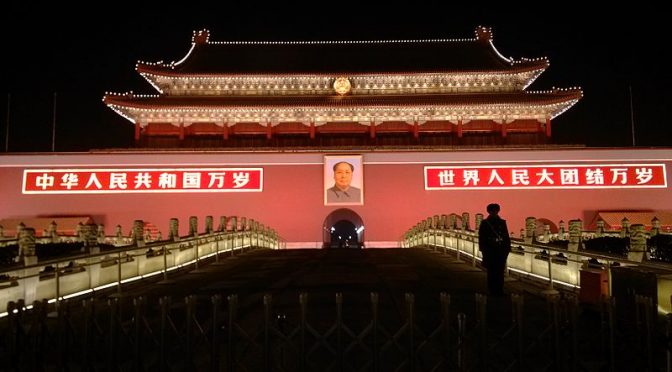
Featured Image: Tiananmen Square (Wikimedia Commons)

China’s Claim to the Spratly Islands is Just a Mistake

This article is an adaptation of an academic publication by Bill Hayton published in ‘Modern China’ as ‘The Modern Origins of China’s South China Sea Claims: Maps, Misunderstandings, and the Maritime Geobody.’ A version of this article was published in Vietnamese by BBC and may be read here.

By Bill Hayton

The South China Sea is a dangerous place because of the layering of several different struggles on top of one another. There are struggles over the future of the world order, struggles between regional powers, and struggles over maritime resources. But underlying them all is a knot of territorial disputes over a few hundred tiny rocks and reefs. Given how much attention the disputes currently attract, it is surprising how little attention has been paid to their origins. A few flawed accounts were written several decades ago but more evidence has come to light since then and it is time to revise the conventional wisdom. Governments like to pretend that their claims to the hundreds of rocks and reefs in the sea are historical and logical. However, after several years of studying them, it is clear that this is far from true.

The focus of most of the current trouble in the South China Sea is the Spratly Islands and a few underwater features that are closer to the coasts of Vietnam and Borneo. These are a very long way from the Chinese mainland and China has never made clear the precise origins of its claim to them. My own research – just published in the academic journal ‘Modern China’ – leads me to conclude that the Chinese claim only emerged because of some poor translation and bad map-making during the 1930s. My conclusion is that China’s claim to the Spratly Islands is actually a mistake.

The First Claim

The story of China’s claims in the South China Sea began in 1907 with the discovery of a Japanese merchant digging up petrified bird droppings on the island of Pratas (between Hong Kong and Taiwan). Nishizawa Yoshiji was one of many Japanese entrepreneurs mining guano for fertilizer all over the Pacific. However, there were rumors that Japan was also planning to build a naval base on Pratas and that concerned the United States and its newly-acquired colony in the Philippines. The American government informed officials in Beijing in late 1907 but it took well over a year before a Chinese ship was sent to investigate. In March 1909, Chinese officials confirmed Nishizawa’s presence. That triggered large protests in southern China and a boycott of Japanese products. The Japanese government agreed to negotiations, which eventually led to Japan recognizing Chinese sovereignty over Pratas.

However, at the same time, the southern Chinese authorities learned about the existence of the Paracel Islands, apparently for the first time, and became concerned that Japan might try to annex them. This led to an expedition in May and June 1909 during which China formally claimed sovereignty over the Paracels for the first time. The Chinese ships spent three days among the islands firing cannon and planting flags before returning home. However, it was immediately clear to the expedition leaders that the Paracels were not going to deliver any riches. Newspaper accounts mention a plan to turn them into a penal colony but within weeks the authorities had completely lost interest in the islands. They did not return until the 1920s.

The next major incident in the South China Sea created complete confusion – a muddle that infected the earlier academic accounts of the Chinese claim and still affects historical discussions to this day. In December 1931 France – the colonial power in Indochina – claimed sovereignty over the Paracel Islands and, nine months later, China protested. In July 1933, while the two governments were still arguing over the Paracels, France also announced the annexation of six of the Spratly Islands. This led to great confusion in China. It is clear from official documents and newspapers of the time that the Chinese authorities did not know the difference between the Spratlys and the Paracels. They thought that the islands that France had just annexed were the same that China had claimed in 1909. It took several weeks for the confusion to be cleared up. During the discussions the Chinese Navy even sent a telegram to the Chinese Foreign Ministry asserting that the Spratly Islands did not exist! The situation was only cleared up with the help of maps provided by American officials in Manila. In the end, the Chinese government decided that it could not prove a claim to the Spratlys and so did not protest against France’s actions.

However, this confusion led the Chinese government to instruct its ‘Land and Water Maps Review Committee’ to investigate the situation. Among the committee’s other tasks, it inspected and translated maps to show which islands were the Paracels and which were the Spratlys. It also gave Chinese names to them – but these were simply translations or transliterations. North Danger Reef became Beixian 北險礁 (a translation from English). Spratly Island became Si-ba-la-tuo 斯巴拉脫島 (a transliteration of the name of the English sea captain, Richard Spratly), and Luconia Shoals was transliterated as Lu-kang-ni-a 盧康尼亞滩. My own research suggests that the list of names the committee translated was probably taken from the China Sea Directory, published in 1906 by the United Kingdom Hydrographic Office.

However, in the process, the committee made some mistakes. It seems to have been particularly confused by the English nautical terms “bank” and “shoal.” Both mean an area of shallow sea—the former describes a raised area of seabed, the latter is a nautical expression derived from Old English meaning “shallow.” However, the committee chose to translate both as tan 灘, which has the ambiguous translation of “sandbank,” a feature that might be above or below water.

The committee gave one particular underwater feature, James Shoal, the Chinese name Zengmu tan 曾姆滩, and another, Vanguard Bank, the name Qianwei tan 前衛滩. Zengmu is the transliteration of “James,” Qianwei is a translation of “vanguard,” and tan is the translation of “bank” and “shoal.” This translation choice has had major consequences, as we shall see. Why it decided to make a particular point of selecting these two underwater features for its list is also something of a mystery.

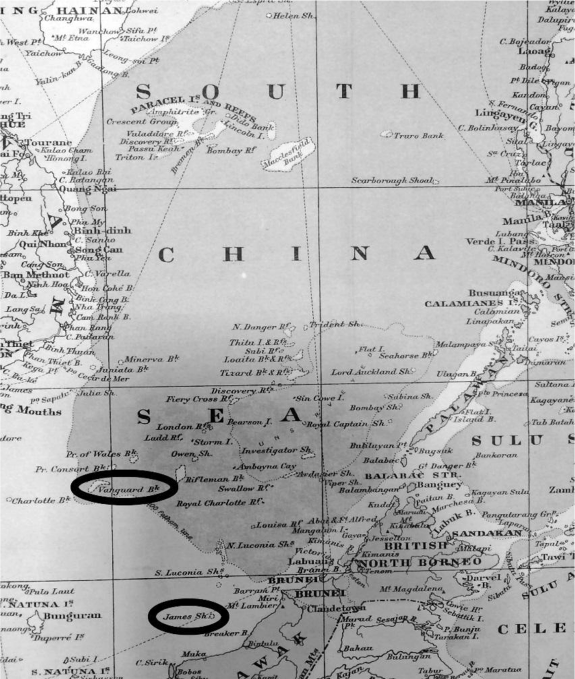
My hypothesis is that, since they did not undertake any of their own hydrographic surveys, committee members were completely guided by the maps that they were copying. One map that would have been part of any standard collection at the time was one produced by Edward Stanford Ltd. of London. The company’s 1918 map entitled Asiatic Archipelago gives particular prominence to both James Shoal and Vanguard Bank and to most of the other features listed by the committee (see Figure 1). I suspect that this map also guided the committee’s choices about which features to give Chinese names to.

Figure 1. Asiatic Archipelago, showing James Shoal and Vanguard Bank as underwater features (circles added by author). Map published by Edward Stanford Ltd., London, 1918 (British Library shelfmark Maps 88715.

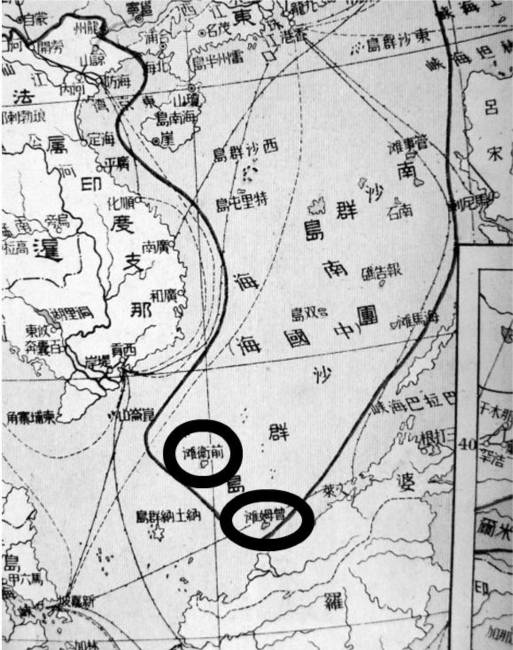
In 1936, Bai Meichu 白眉初, a founder of the China Geography Society, used the committee’s information to publish his New Atlas of China’s Construction 中華建設新圖. Taking his cue from the committee’s mistranslation, he made a massive mistake. He drew the underwater James Shoal and Vanguard Bank as islands. He then added a U-shaped line around the South China Sea as far south as James Shoal and as far southwest as Vanguard Bank (see Figure 2). Bai’s meaning was clear—the line marked his “scientific” understanding of China’s rightful territory. Because of his mistakes the James Shoal and Vanguard Bank would later became the limits of China’s claim in the South China Sea. This was the very first time that such a line had been drawn on a Chinese map. It was not a state document though; it was the work of a private individual.

Figure 2. Map from New Atlas of China’s Construction (1936) published by Bai Meichu. James Shoal is labeled as Zengmu tan 曾姆滩, and Vanguard Bank as Qianwei tan 前衛滩. Both are drawn as islands with solid outlines and colored infill and are encompassed by the Bai’s boundary line. (Highlighting circles added by author) Source: Beijing Normal University Newspaper no. 295 (May 10, 2012), http://bnu.cuepa.cn/show_more.php?doc_id=613549.

Bai added some other innovations, too. He also drew the underwater features of the Macclesfield Bank (in the center of the South China Sea) as islands. This may be the reason why, to this day, the Chinese state talks about four “archipelagos” in the sea, even though one of them demonstrably does not exist!

The Republic of China still did not claim the Spratlys, however. As late as 1943, the ROC Ministry of Information published its China Handbook 1937–43, a comprehensive guide to the country’s geography, history, politics, and economics. On its opening page it stated that “the territory of the Republic of China extends from [the Sajan Mountains in the north] . . . to Triton Island of the Paracel Group.”

This view of China’s maritime territory would change dramatically over the following three years. It seems likely that this change was facilitated, perhaps even orchestrated, by two of Bai Meichu’s students. In 1927, while he was chair of the Department of History and Geography at Beijing Normal University, Bai taught Fu Jiaojin 傅角今 and Zheng Ziyue 鄭資約. After the Second World War, they were hired by the Chinese Ministry of Interior to advise the government on its territorial boundaries. They drew the government maps in 1946 and 1947 that led to the official Chinese claim in the South China Sea. Fu and Zhang used Bai’s map and his ‘U-shaped line’ to guide them. Thus China would claim the underwater features of the James Shoal and Vanguard Bank as its territory. This makes no sense at all – except if you understand this strange piece of history. The Chinese claim is the result of a series of mistakes.

In October 1947 the ROC Ministry of the Interior renamed the islands within its new claim. Most of the 1935 translations and transliterations were replaced by new, grand-sounding and more “Chinese” titles. For example, the Chinese name for Spratly Island was changed from Si-ba-la-tuo to Nanwei 南威島 (Noble South) and Scarborough Shoal was changed from Si-ka-ba-luo 斯卡巴洛礁 (the transliteration) to Minzhu jiao 民主礁 (Democracy Reef). Vanguard Bank’s Chinese name was changed from Qianwei tan to Wan’an tan 萬安灘 (Ten Thousand Peace Bank). This process was repeated across the archipelagos. The ministry seems to have recognized its earlier problem with translating “shoal” at this time because it coined the word ansha 暗沙, literally “hidden sand,” as a neologism to use instead of tan 灘 in the names of several features, including James Shoal, which was renamed Zengmu ansha.

It was not until 1948, therefore, that the Chinese state formally extended its territorial claim in the South China Sea to the Spratly Islands, as far south as James Shoal. Clearly something had changed in the years between July 1933, when the Republic of China government was unaware that the Spratly Islands existed, and April 1947, when it could “reaffirm” that the southernmost point of its territory was James Shoal.

Conclusion

Although the Chinese government likes to say that it has an ancient and historical claim to the reefs and rocks in the South China Sea, a detailed examination of evidence shows that it actually emerged in the first half of the twentieth century. It also changed during a 40-year period 1907-1947. The whole process was filled with confusion and misunderstanding. A few mistakes by a small number of poorly-informed Chinese officials and academics back in the 1930s have created lingering confusion that still poisons the politics of Southeast Asia to this day.

Bill Hayton is an Associate Fellow with the Asia-Pacific Programme at Chatham House, the Royal Institute of International Affairs, London. He is the author of The South China Sea: The Struggle for Power in Asia and Vietnam:Rising Dragon.

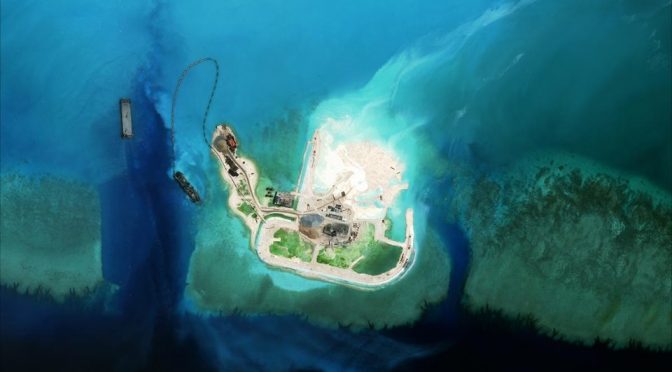
Featured Image: Satellite image taken in June 2015 of China’s land reclamation efforts on Mischief Reef in the Spratly Islands. (AMTI/CSIS)

The Growing Dragon: The Radical Reorganization of the PLA

By Pawel Behrendt

Two years ago, President Xi Jinping announced the reorganization of the Chinese People’s Liberation Army (PLA) and the implementation is gaining momentum. The changes, which go far beyond administrative restructuring and equipment modernization, will make the world’s most massive fighting force more modern and flexible. The reorganization gives Xi and his team an opportunity to purge political opponents within the military and address many of the problems that have plagued the military for decades.

During his speech to the National People Congress in 2012, Hu Jintao announced the modernization of the PLA, seeking a modern armed force, able to “win local wars under informationized/hi-tech conditions.” Under Xi Jinping, these modernizations began to materialize. The first noticeable change was the restoration of political officers in the PLA, a clear sign of turbulent relations between the new leadership and the generals. Next, Xi announced a wide-reaching anti-corruption campaign. Most notably, former deputy chairmen of the Central Military Commission, Generals Xu Caihou, and Guo Boxiong, were among those accused of corruption. Their fate was settled in 2016 – Xu died of cancer while under arrest and Guo was sentenced to life in prison.

With the backdrop of the anti-corruption campaign, a real military reform was afoot – in 2014, a reorganization of the command structure was announced. The number of military regions was reduced from 7 to 5, and a joint operation command was established to coordinate actions of ground, air, and naval forces in each area. There was also an increase in the role of the Air Force and Navy, both of which are more prominent in a state with global ambitions as opposed to an Army-dominated system that has long characterized China’s military. In celebration of the 70th anniversary of World War II, Xi Jinping announced the reduction of the PLA by 300,000 soldiers to 2 million standing troops. On the last day of 2015, amid overall personnel reduction, new military branches were established – the Rocket Force and the Strategic Support Force.

2016 brought about important, but less flashy, changes. Specifically, the creation of a DARPA-equivalent research lab was announced in March 2016. The agency was operational in July 2017. In April 2016, military education reform was announced and, as a result, departments related to land forces reduced the number of freshmen by 24 percent and the departments of logistics and support shrunk by 45 percent. Conversely, the number of students admitted to courses related to aviation, Navy, and missile technologies was increased by 14 percent. An increase of 16 percent was planned for departments related to space technologies, radars, and drones.

Further, closer cooperation between universities and training units was also announced. This was the result of increasingly louder complaints that soldiers cannot take full advantage of the increasingly modern equipment. Overcoming this gap is now considered one of the most critical tasks to the PLA. Xi Jinping stressed several times a great need for officers who have a broad knowledge of advanced technologies. Most concerning is the shortage of IT specialists. Like many other countries, Chinese IT companies offer much better compensation and work conditions, robbing the military of talent. Higher military income and attractive career paths are being implemented to prevent the talent bleed. Further, to attract talented college graduates, the draft was aligned with the college graduation season.

In September 2016, the activation of the Joint Logistics Support Force was announced. This step aims to improve the decentralized PLA logistics system. Within each of the military regions, a Regional Joint Logistics Support Center was established with headquarters in Wuxi, Guilin, Xining, Shenyang, and Zhengzhou. Of note, the Joint Logistics Support Force is not subordinate to the PLA HQ, but to the Central Military Commission.

Starting in 2017, even more radical changes were made. In mid-March, a five-fold increase in the size of the Marine Corps was announced. The force now numbers 20,000 soldiers organized in two brigades, but the goal is as many as 100,000 troops in six brigades. The greatly expanded Marine Corps is dedicated primarily to the protection of the maritime thread of the One Belt, One Road, and defense of the overseas interests of the Middle Kingdom. The Chinese Marines will be permanently stationed in Gwadar, Pakistan, and in Djibouti. The African garrison is rumored to have as many as 10,000 soldiers. It is important to mention that, according to media sources, the first Type 075 amphibious assault ship was laid down in March 2017. Specifics on the ship design and numbers are still unknown. The Chinese Admiralty wanted LHDs similar to the American WASP-class but opted for a smaller ship – based on the French Mistral-class – due to financial constraints. Recent information suggests that “something in between” has been chosen.

Amphibious assault ships are necessary if China wants “American style” power-projection capability. The Chinese are well aware of the unique requirements of the Marines, and outdated PLAN Marine Corps equipment is discussed openly. The force has spent years preparing for an invasion of Taiwan and operations in the nearby waters of South and East China Seas requires a thorough reorganization.

The marine brigades of the PLAN are not the only amphibious assault units of the PLA. There are also four amphibious mechanized infantry divisions (AMID) that are part of the PLA Ground Force. These units are essentially mechanized divisions equipped with more amphibious vehicles and river crossing equipment. In effect, the divisions are more suited to crossing rivers and lakes than in taking part in actual seaborne operations. Under the reorganization of the PLAN Marines Corps, the future of AMID is unclear.

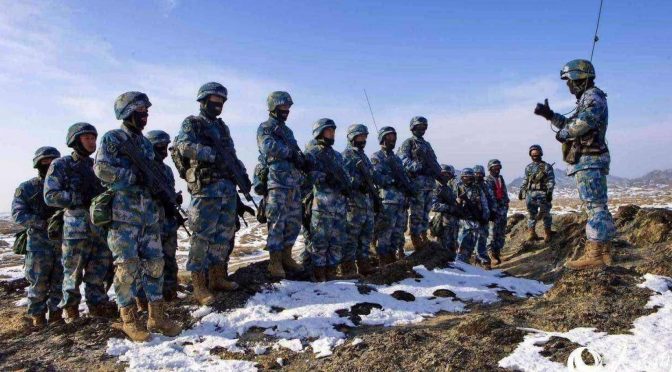
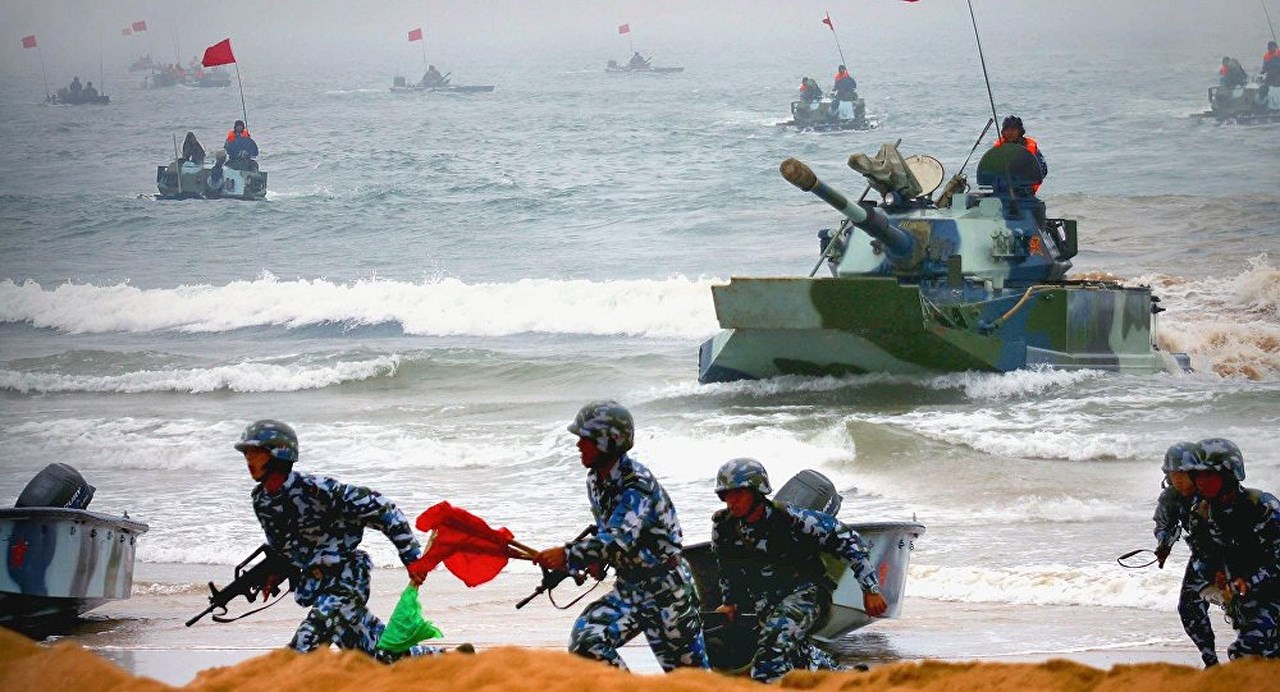
Chinese marines storm a beachead (AFP 2018 / Xinhua)

Around the same time that the PLAN Marine Corps reports emerged, PLA Ground Force restricting was also announced. From 1949 through the mid-1980s, the Ground Force was organized into 70 corps. Then, during one of the previous reorganizations, the number was halved and later reduced to 24. At the same time, the corps were renamed “group armies.” During subsequent reductions in the 1990s and 2009, their number fell to 21 and, eventually, to 18 corps. Now, the group armies are returning to corps and further decreased in number to 13. This change, however, has a deeper meaning. Specifically, the 16th and 47th Group Armies will be disbanded. Both are large units and were closely linked to the aforementioned Generals Xu and Guo. According to social media, not all soldiers from disestablished units will leave the military – some may be reassigned, even to the Air Force, Navy or Rocket Force. Some of the other units that will be disbanded are the 14th, 20th, 27th and 40th group armies.

In April 2017, further information was officially disclosed by the Ministry of Defense, when it revealed an even more drastic reorganization. The entire PLA will be divided into 84 corps that will comprise all military branches, as well as garrisons, reserves, military academies, and research units. This means an interruption of historical continuity, cultivated mainly in the Ground Force, in which new army corps will have numbered from 71 to 83. Most of them will be located in northern and western China, opposite the U.S. forces and Japan, but also Russia and North Korea.

Airborne units have also undergone serious organizational changes. Until 2017, there had been three airborne divisions (43rd, 44th, and 45th), organized into the 15th Airborne Corps, subordinate to the PLAAF. Each division consisted of two airborne regiments, a special forces group, an air transport regiment, and a helicopter group. After the recent reorganization, the PLA Airborne Corps was created, and separate divisions were disbanded. Airborne regiments were reclassified as brigades (127th, 128th, 130th, 131st, 133rd, and 134th), and special forces and transport groups were organized into separate brigades. Confusingly, signal, chemical and engineering troops have been assigned into a single brigade. This solution is perceived as the next step in the development of a robust Chinese airborne force and their transformation from light troops into heavily armed units modeled after Russian paratroops.

The large-scale reorganization of the armed forces has also brought about some unexpected personnel problems. Public protests by active duty servicemen and veterans have become common, and the primary cause of dissatisfaction is not only the reduction of posts. Unlike previous cuts, the severance pay program and employment efforts for former military personnel failed. In fact, pay and military pensions sometimes arrived late or in reduced sum. Veterans are particularly embittered, and they accuse the government of ignoring their needs and problems. In October 2017, more than 1,000 vets protested at the Ministry of Defense singing military songs and waving party flags. Police and security officers were confused and surrounded the protesters with buses and police vehicles. On October 11, another protest lasted late into the night, resulting in several arrests. According to human rights organizations, protests are not rare, with over 50 occurring in 2016 alone. As a result, a special Ministry of Veterans Affairs was established in March 2018. The new institution will help veterans to find jobs, lodging, and ensuring their status of “revered members of society.”

Conclusion

A reorganization of a structure as big and complex as the PLA is never an easy task and it is compounded by resistance from active and veteran military personnel. Unlike the USSR, there is no clear division between party, military, and security force. Further, the military has always had a strong influence on the state apparatus. During his second term, Hu Jintao warned about the negative consequences of this system. Despite silencing the most hostile officers whose status and influence were endangered by the reform, protests by lower ranks and veterans show that the Communist Party of China has to be very careful. From the military point of view, the reform aims to convert the force designed primarily to defend Chinese territory into one prepared for expeditionary operations.

Pawel Behrendt is a Political Science Ph.D. candidate at the University of Vienna. He is an expert at the Poland-Asia Research Center and is the deputy chief-editor of konflikty.pl. Find him on Twitter @pawel_behrendt.

Featured Image: Chinese marines (Xinhua)