
If the answer to the Navy’s future is robotics, then Admiral Greenert’s July 2012 U.S. Naval Institute Proceedings piece, “Payloads Over Platforms, Charting a New Course” opens up a whole new world of possibilities for using existing small ship platforms as “trucks” to deliver large numbers of modern weapons platforms to areas of interest.
As former Under Secretary of the Navy Bob Work emphasized during his recent appearance on MIDRATS, the Littoral Combat Ship is such a truck–a vehicle for delivering unmanned weapons system.
This post is meant to take that concept and cheapen it.
What is a corvette? Something smaller than frigate but larger than a patrol boat, I guess. The LCS in either of its variants is large at about 380 feet in length and displacing 2800 tons. A Gearing-class destroyer from post WWII measured in 390 feet and 3400 tons. The Perry-class frigates are over 440 feet and 4100 tons.
Seems we have a lot of size and space to play with.
It occurs to me that we need to take the thinking that developed the WWII escort aircraft carrier (CVE) and model it down to a ship that is a “drone” carrier (and by “drone” I mean unmanned vessels of any type- surface, subsurface and aerial) – like the LCS only in the smaller economy version.
After all, if the real weapons systems toted by the LCS are its drones, then virtually any vessel capable of lowering said drones into the water or into the air and hosting their command and control system can be a “drone carrier,” too. Such a ship becomes a “mother ship” for the drones.
Are drone carriers are really “war ships?” Remember, “payload over platform.”

Suppose we take a hull like an offshore oil platform supply “boats” outfitted with a “surface warfare module” (yes, like that designed for the LCS) and four davits designed to lower four USVs into the water.
If the USVs are outfitted with torpedoes or missiles like those discussed here, and if you deploy them in the face of a threat, you now have a ship with capable weapons systems out there.
Other vessels might include large tuna clippers and small freighters.

Photo: San Diego Tuna Clipper (they already have a stern launch system)
Even better, you have now added complications to the targeting systems of any opponent because instead of having one vessel to engage, it now has five. Make up a small squadron of such mother ships (say 4 per squadron) and your opponent now faces 20 vessels. These may consist of multiple threats- a squadron may have USVs in combinations of missiles, torpedoes or other weapons.
If the mother ships carry additional drones, the threat increases as each batch is placed in the water. Proper use of an aerial relay drone may allow the mother ships to be reasonably far from the action site, under the umbrella of a larger warship or some sort of converted floating offshore oil platform configured properly to “sea base” operations.
The drone mother ships will require a tender of some sort for fuel and other hotel services, but such a tender need not be elaborate nor expensive. Under the proper circumstances they might be shore supported.
One of the cost-saving features of this concept is that the drone mother ships might be acquired in a COTS fashion either by lease or purchase. Under an old U.S. Navy program (and one used by the Australians), there is precedent for using a “Craft of Opportunity Program (COOP)” to acquire vessels to experiment with. While the U.S. experience with COOP involved inshore mine hunting, the underlying concept is sound–lease or buy already built units that can meet the minimal standards of your “drone trucks”–and avoid the expense and delays of design and construction (albeit allowing for necessary modifications) . The other expression for acquiring such ships is “STUFT”-“Ships Taken Up From Trade,” which the Royal Navy used to put together a force during the Falkland War in 1982.
These vessels can be minimally manned and are, in the famous phrase “expendable.” Since they deliver their weapons remotely, speed is not really an issue. Instead, deck space and electrical capacity will be important. Manning could be mixed CIVMAR, active and reserve Navy.
For example, an older diesel powered platform supply vessel capable of 12 knots and about 290 feet in length could work if properly outfitted. I suspect it, even with the appropriate modifications will not cost any close to even a cheap non-truck warship. Heavy lift a half dozen of these to where they are needed and you have a force multiplier on the cheap. Lots of deck space for vans, generators and cranes and perhaps even some self-protection bolt-ons.

Are they “corvettes?” Payload-wise they could be . . .
Of course, unlike a “standard” corvette but like the LCS, these drone carriers are dependent on modules.
Eagle1 is the nom de plume for Mark Tempest, who maintains his own blog EagleSpeak and co-hosts the popular Naval Affairs podcast “Midrats.” Mark is a retired attorney and former US Naval Reserve Captain (Surface Warfare).
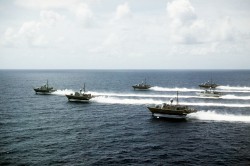
 Corvettes have their own “laundry list” of shortcomings that make them undesirable as a replacement for a large part of the current surface fleet. Past missile corvettes have been employed by less powerful navies as low-cost, short range coastal defense units. These craft enjoy interior lines of communication and supply, and are an ideal component to a coastal nation’s anti-access/area denial (A2AD) capability. U.S. corvette advocates however desire to use them in an offensive role on the high seas. Such an flotilla would be dependent on network information for both offensive and defensive operations. In the years since the First Gulf War in 1991, the U.S. has made it very clear to any of its potential opponents that it is very reliant on military networks to achieve its desired military objectives. No peer or near-peer opponent is likely to allow the U.S. unimpeded use of its military networks and will likely targets those systems in its own first attacks. Without network connectivity, corvette forces would be dependent on their own short-range sensors for targeting data and would need to move dangerously close to prospective targets in order to attack. The U.S. is still dependent on the 1970’s vintage Harpoon subsonic anti-ship cruise missile (ASCM) as the likely armament of a missile corvette. Longer range supersonic weapons would need to be developed and fielded in order to make the ship a “battle-worthy” opponent. Failure to do so would create another fiasco like the LCS where key mission components significantly lag behind the construction of the actual ship. Unlike higher-end U.S. combatants, corvettes do not have area defense weapons nor are their weapon systems self supporting. If attacked, rather than a networked defense, each corvette must individually engage incoming threats. Such actions, if uncoordinated and done in close proximity to other ships can have disastrous results. In the 1982 Falklands war, there were cases of ASCM’s decoyed away from one ship that suddenly engaged another without time for response. A corvette is also much more likely to be destroyed with all hands than a larger U.S. surface combatant if hit by even one medium-sized cruise missile. Each such corvette has a crew of between 35 and 40 highly trained personnel who would likely be lost. If the U.S. Navy really does value its well-trained personnel more highly than individual ships, it will not assign them to corvettes likely to be sunk. “They Were Expendable” makes for a good movie title, but U.S. naval personnel in the 21st century are not such a disposable commodity.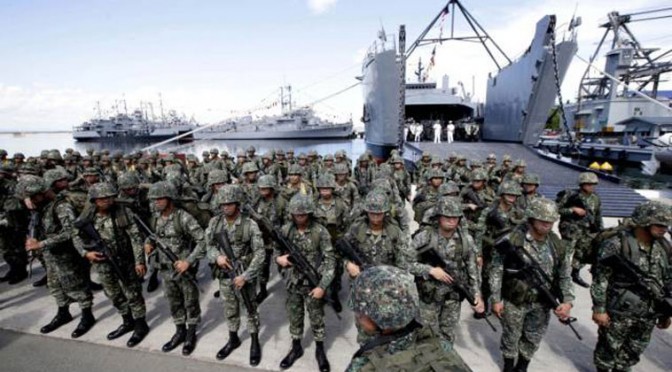
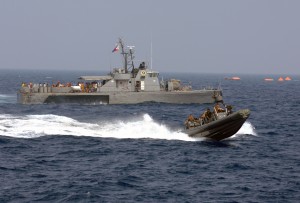 A closer look at the program’s bid specifications along with missions that are likely to be met by the platform, reflects the balancing act between cost and capability that all naval forces must perform when seeking mid-to-low assets. Is it really a frigate that they’re looking for? Or is it more of a corvette? Or even an Offshore Patrol Vessel (OPV)?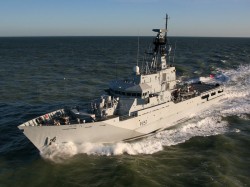
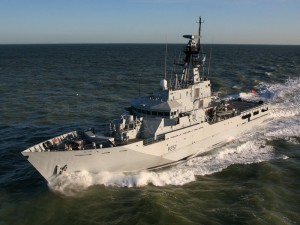 The Offshore Patrol Vessel (OPV) is a contemporary ship category not easily understood; it is mostly lost in the larger debate to distinguish similar vessel types such as frigates and corvettes. For our purposes, the OPV is a ship leaning towards enforcement or constabulary duties as opposed to being a dedicated combatant vessel, with a minimal weapons fit necessary to fulfill it’s function.