
Military planners have historically used wargames to influence future operations. The extensive wargaming conducted at the U.S. Naval War College during the interwar years is widely credited with preparing the Fleet to fight one of the greatest seaborne wars in history against Japan during World War II.
As Fleet Admiral Chester Nimitz put it: “War with Japan had been reenacted in the game rooms at the Naval War College by so many people and in so many different ways, that nothing that happened during the war was a surprise…absolutely nothing except the kamikaze tactics toward the end of the war; we had not visualized these.”
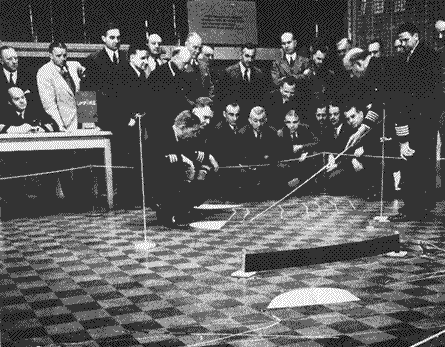
The iconic images of War College students maneuvering model fleets across the wargaming floor of Pringle Hall as the players experimented with scenario after scenario are staples for any student of naval history. Since then, technology and computers have greatly improved the process, and the War College is arguably still the world’s premier wargaming organization, providing key insights to fuel operational planning and acquisition. Unfortunately, as extensive and sophisticated as its program is, it can only perform about 50 events each year. Facility space, equipment availability, and personnel to actually play the games will always constrain the robustness of on-site wargaming programs…at least for now.
What if all resource constraints were removed from our wargaming activities? What if an infinite amount of space was available – only limited by the surface of the Earth? What if the potential participants were only limited by a population willing and able to participate? What if they were equipped with the resources necessary to execute a war game? These questions might seem absurd at first, but a new and powerful concept known as crowdsourcing could be the answer to solve these resource issues.
No longer a notional concept, crowdsourcing is becoming more widespread. The basic idea is to leverage the collective intelligence and creativity of the “crowd” – a large, virtually limitless population. Advances in collaborative technologies have helped commercial entities leverage this concept and vastly increase productivity. One of the more well-known is the Amazon Mechanical Turk which, at last count, had more than 500,000 participants in more than 190 countries all simultaneously completing simple tasks. Another is CrowdFollower, which claims to be able to access more than 2 million participants across the globe. Even complex strategic analysis from a crowdsourcing consultancy like Wikistrat is being done today.

How can this be applied to wargaming though? Given current processing power and infrastructure, it is not feasible for the crowd to submit traditional wargaming moves to a central hub (such as the War College) for adjudication. Instead, this broadening of the talent pool enables more ideas to effectively put the crowd to work. A starting point has been established by the U.S. Navy Warfare Development Command (NWDC), where they have conducted Massive Multiplayer Online War Game Leveraging the Internet (MMOWGLI) sessions that seek creative ideas to mission requirements across the active, reserve and civilian forces.
Crowdsourcing traditional wargames (such as those at NWC) in this way, would seek solutions to strategic, operational, and tactical problems while coupling realistic analysis with user-friendly interface necessary to enable an end-to-end scenario played by participants. The balance between the level of fidelity required to provide meaningful data, with the level of abstraction necessary to enable experimentation would be a key attribute. After processing of the information, these game results could reveal meaningful insights for tactical development.
As demonstrated in the interwar period, iteration after iteration of experimentation in wargaming can help predict possibilities in war and then provide at least a starting point to begin to prepare. Today, technology is advancing at rates never dreamed of prior to WWII, while geopolitical shifts are much more rapid and pronounced. The necessity for speed of iteration and experimentation has never been greater, and the crowd has the potential to help address this. Instead of roughly 50 war games each year, imagine hundreds – even thousands – played daily. The crowd can win and lose wargame scenarios over and over, rapidly resetting and fighting again. Combined with near-instant social media exchange of ideas, innovative solutions can emerge through pure trial and error from a group almost unimaginably large.
The world will always lean on experts. The crowd will most likely never replace the great wargaming work conducted at war colleges and throughout the military, but it has the potential to be a powerful source of rich data. The crowd is moving into formation, preparing to sail into war. Will we use the crowd or waste this virtually untapped resource? The time is coming to send the crowd to war.
LT Jason H. Chuma is a U.S. Navy submarine officer who has deployed to the U.S. 4th Fleet and U.S. 6th Fleet areas of responsibility. He is a graduate of the Citadel, holds a master’s degree from Old Dominion University, and has completed the Intermediate Command and Staff Course from the U.S. Naval War College. He can be followed on Twitter @Jason_Chuma.
The opinions and views expressed in this post are his alone and are presented in his personal capacity. They do not necessarily represent the views of U.S. Department of Defense or the U.S. Navy.
 LCS has been taking a beating, from the cut in production numbers to the recent HASC request to slow their rate of product. With the new Request For Information out on possible replacement hulls, there’s clearly some thinking to be done. Zack Howitt joins us to discuss his Proceedings article, “
 A business can hire-in at every level, shifting employment for new projects and products. The milieu can be fun and exciting! Too bad! The military HR machine is driven by a more concrete, inflexible requirement: to-fill seats of operators and planners necessary to man the defenses. The military cannot hire-in at every level, it needs to develop people from start to finish, designing in flexibility for future changes but without so much as to demotivate personnel floating in endless holding patterns. The needs of the force are precariously balanced with the space to hone the warfighter and the warfighter’s own envisioned personal path. In this naturally messy and un-artful system, retention becomes a critical issue.
 To coincide with this retention push,