Specialize or Not? Former RAN CO’s Reflections on Surface Warfare Officer Development

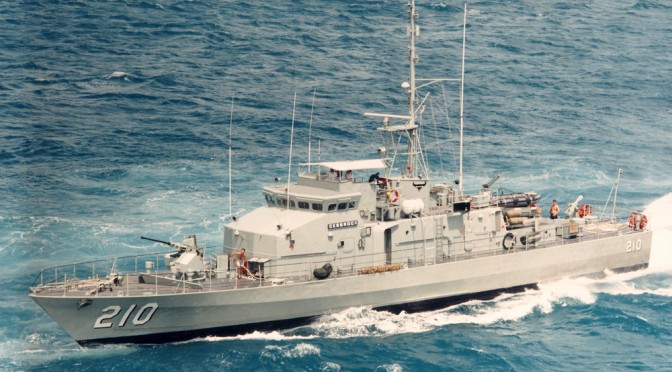
Rear Admiral (ret) James Vincent Purcell Goldrick AO, CSC, RANR, served three times as a the Commanding Officer of a ship at sea. He is a fellow at the Seapower Centre and a Naval Historian.
(editor’s note) He is also served with the Patrol Boat navy, which means he is one of the best.

The recent discussion about the different approaches to surface warfare officer training in the British and American navies has been of great interest to me, if only because the Royal Australian Navy, my own service, has largely combined British training methods and career paths with the use of American designed ships and equipment.

I have had first-hand experience with both British and American methods, as well as the Australian approach, having served at sea on two exchange postings with the Royal Navy, been both XO and CO of RAN ships, small and big (by Australian standards) and sea ridden USN units, including in command time in tactical control of MIO operations in the northern Arabian Gulf. If I could sum up my view with a one liner it is that the British system is better for individual ships, the American for a navy as a whole.

Here I need to make an important distinction – the USN’s operational requirements are not those of the British, still less are they the same as those of Canada or Australia, so its personnel solutions should not necessarily be identical. Another, associated aspect of the comparison is that the USN system works better in major units because these can have enough experts onboard – with their associated rank and seniority – to provide the necessary leadership to all the specialisations involved. This is very difficult to achieve in smaller ships. Actually, it’s practically impossible.

The unit of power in the surface forces of the smaller navies, particularly in recent years, has been the frigate or destroyer. Within the USN, although times are changing – as recent deployment patterns not only in the Caribbean but even the South China Sea suggest – it has remained that of the carrier battle or expeditionary strike group. This requires a very different approach. A USN destroyer or frigate has been judged largely by how it fits into the whole, while a Canadian or Australian and even a British ship has in the past to manage both task group operations and independent activity to a much greater degree. In other words, the smaller navies have had to wring much more out of their limited capabilities and doing so successfully requires a higher level of expertise at more junior ranks than has generally been the case for the USN.

The reality is that deep expertise is found in the O5s and O6s of the American Navy that the other naval services can only envy. But, contrary to some of the declarations in earlier contributions to this discussion, I’d take a British or Australian O3 or O4 in their specialisation over the average (but not the best) USN surface warfare officer with the equivalent qualified sea service any day. This may seem a hard judgement, but it is not one based on intellect, morals or individual quality, it is simply a matter of experience – a USN officer has to cover so many more bases that there is an inevitable element – somewhere in it all – of ‘once over lightly’. My belief is that the USN maintains the standards it does by sheer hard work and a great deal of sea time.

But there is more to it than that. It seems to me that the argument has been confused by the inclusion of platform and propulsion engineering into the wider question of the requirement of warfare officers for technological understanding and technical mastery in addition to what could be described as operator skills. Because of the ‘once over lightly’ problem, my judgement is that, in general terms, propulsion engineers provide a more effective service and ship commanders are more expert in their essential skills if there is no attempt for platform engineers to proceed down the path of combatant command. I believe very firmly, in so far as frigates and destroyers which may have to operate as autonomous units are concerned, that it is practically impossible to accumulate the expertise necessary to cover all the bases associated if the officer complement are to have an ‘unrestricted line’ background. All that time in the machinery spaces has to come at the expense of the combat system and tactical knowledge as well as the associated ship driving skills which are vital to the effective direction of a warship’s operations. One sees certain resonances of this argument in the American submarine community and it is notable, although they have had their challenges in their nuclear force, that the British have never chosen to risk their tactical expertise in meeting their nuclear power demands. Royal Navy submarine captains get some nuclear power training, but they do not serve as engineers. I think that the British are right. My own experience is that I was very hard pressed to ensure that I was sufficiently expert as a surface warfare officer with the minimum mastery of combat systems and tactics necessary to fight the ship. I was also always acutely aware that my captains – and the ships’ companies with whom I served – demanded nothing less.

I do not have an engineering degree and I have also always had to work hard to ensure that I have had what I think is sufficient mastery of all aspects of ship design and propulsion to be an effective sea officer and, later, sea commander. Yet this was always in support of my primary functions, not such a function itself and this is the real point. Could I have known more about engineering? Yes, but at what cost to my warfare expertise? Did I end up knowing enough? I once had an exchange with my – extremely efficient and truly expert- platform (or what we call ‘marine’) engineer officer ashore over a beer one night. ‘Sir,’ he said, ‘I know that both your undergraduate and postgraduate degrees are in history. How is it that you always know the question to ask me that I don’t want you to ask me?’ ‘Simon,’ I replied, ‘I’m the captain, it’s my job.’ I still treasure that as one of the greatest professional compliments I have ever been paid – but I think it is one that, at least in part, I had earned. I will say here that the training system through which I passed allocated more time to engineering theory and practical engineering training for surface warfare officers than does the ‘objective focused’ system of the present day. There is a minimum required and I am not convinced that it is being met in either the RAN or the Royal Navy.

The point, however, is that my job as a captain was not to be the engineering officer, nor attempt to do his or her job. Mine was to be as expert as possible in driving and fighting my ship to achieve its military purposes. I am deliberate in suggesting that the platform engineering specialisation is not the ideal preparation for combatant command – although I have no objection to such officers commanding auxiliaries and non-combatant units, provided that they have had sufficient time on the bridge. Let me emphasise that I am not suggesting that officers with a platform engineering background are necessarily ineffective as combatant captains. What I am saying is that the individuals concerned would be much better off – and much better war fighters if they were differently prepared. There just isn’t enough time to do otherwise.

Let me return to explain one point – my view that the USN system can be better for a navy. If one is to accept that platform engineers as a group must be ‘Engineering Duty Only’, this must not result in their exclusion from the highest levels of decision making and influence. The USN has achieved as much as it has in the last seventy and more years because it got its platform engineering right so many times. And where it did not, it soon knew what to do to fix the problem. This must continue.

However, I do believe that the USN has evolved a generally more effective approach to combat systems management than the RN or the RAN both at sea and ashore. This is another area in which there could be more theory and practical training for warfare officers within our organisations. While I assess that there is a vital space for the specialists that the British describe as ‘Weapon Engineers’, I do not think that the British (and Australian) system has allowed surface warfare officers to develop sufficient understanding of their technology and the operation of their weapon and sensor systems since the old warfare sub-specialisations such as gunnery and ASW were replaced by the Principal Warfare Officer concept in the 1970s. The PWO possessed a much improved ability to make a correct, no-notice response to an immediate threat, no matter whether it was from over, on or under the sea, but it was partly at the expense of the much deeper system knowledge of his predecessors and to the detriment of a much more equal relationship with the Weapon Engineers who were and are responsible for the preparation, maintenance and readiness of the weapons, sensors, computers and communications concerned. Our navies have a lot to do in this area.

I don’t have any simple solutions for all this, but I will finish with one point. Whatever career system is adopted, it will only work if a truly professional attitude is adopted by all concerned. This includes, above all, a welcoming and inclusive approach to the new joiners that makes it clear that high standards are essential, but provides every opportunity to them to achieve their professional goals. Command at sea remains one of the most worthwhile experiences it is possible to have, but central to its value is encouraging and developing the young. None of our navies have always been as consistently focused on this as we should have been, but it is vital. As a very distinguished admiral once said, “You spend your first command proving yourself to yourself. You should spend your second and subsequent commands proving other people to themselves.”

He was – and is – right, but it also applies to every step in the surface warfare officer ladder. We all need to remember that we are there, amongst other things, to train our relief


American Strategy in the 21st Century: Maritime Power and China – Part III

This is the third of a three-part series. See Jake’s first article here and second here.

Criticism
Justin Logan outlines an alternative critique of America’s “pivot” toward Asia and a maritime presence that counters China’s growing military power. According to Logan, the “liberal internationalist” or “optimists” (also known as “Panda Huggers”) represented by G. John Ikenberry, “elide the zero-sum nature of military questions, hang too much on faith that political liberalization will happen, and will resign China to American military dominance, and similarly place too much faith in the power of international institutions.” On the other hand, “realists” or “pessimists” (also known as “Dragon Slayers”), represented by John J. Mearsheimer, “have not shown how Washington could squash Chinese economic growth at an acceptable cost, and do not demonstrate directly how even a much more powerful China would threaten the security of the United States.” He suggests that “Beltway elites” have adopted “an inherently contradictory approach, congagement, that borrows problems from both schools of thought and creates a new problem: free riding.” [1]

“Congagement” creates several problems. America’s attempt to act as “the balancer of first resort” becomes more costly as China becomes more wealthy and capable of fielding an ever-more effective military. By “infantizing” allies in the region, they do not see the need to invest in their own defense, instead relying on American security guarantees. Japan, South Korea, Thailand, the Philippines, Australia and others should come together to deter Chinese aggression without America doing it for them. [2]

Are you a panda hugger or dragon slayer?

The United States should instead “pivot home.” It must “revisit formal and informal U.S. security commitments in Asia with a clear eye trained on what it would actually be willing to fight a war with China over, and just how likely those scenarios are.” Policymakers should “work to lessen and ultimately remove the forward-deployed U.S. military presence in the region, helping establish more powerful national militaries in like-minded states” and “encourage Asian nations to work together on security issues without the United States leading the way.” Otherwise “it likely will see its allies unable to play a larger role, and a larger share of America’s national income dedicated to containing China on their behalf.” [3]

I_didn't_raise_my_boy_to_be_a_soldier1

Logan’s critique builds upon the strong “libertarian” or “isolationist” strain in American foreign policy going back to the days of Thomas Jefferson, and perhaps best embodied today by Senator Rand Paul and his father, former Congressman Ron Paul. It has a popular appeal, one in which the United States avoids involving itself in the affairs of other nations and the “entangling alliances” of the former European powers. In this view, America can best serve its national security and foreign policy interests by having a military capable of defending its political territory and using that power only in self-defense. While America can serve as an “international example” of freedom and economic liberalization, it should avoid a muscular policy with broad strategic interests, one in which the United States is the predominant military power and international leader.

Despite its appeal, Logan’s critique leaves much to be desired. Neither the “liberal internationalist,” “realist” or “congagement” policy perspectives argue that American allies will rely solely on American security guarantees. Indeed, evidence suggests that while China’s defense spending has certainly increased substantially from 2000 to 2011 ($22.5 billion to $89.9 billion), so has that of America’s allies and other security partners. Japanese defense expenditures rose from $40 billion to $58.8 billion, South Korea’s rose from $17 billion to $29 billion, and Taiwan’s rose from $8 billion to $10 billion. Indian defense spending surged 47.6 percent over the decade, reaching $37 billion. [4] The evidence that Asian nations are “free riders” does not appear compelling as Logan would have us believe.

The historical experience since the end of the Vietnam War has shown that the American presence is Asia is a stabilizing force, counter to Logan’s claim. He does not appreciate the context of the 19th and 20th Centuries. For example, Japan’s growing role in regional security would not be possible without American leadership (and influence on) Japanese policy. Logan at one point highlights recent security agreements between the Philippines and Japan as an example where America was not needed. Yet he fails to understand that without the American security umbrella (and still tacit influence over Japanese defense policy), the Philippines would almost certainly not enter into any security agreement with their one-time occupier. The same holds true for South Korea, whose experience with Japan includes more than a century of occupation. Can one seriously believe that the Japanese and South Koreans could or would work together without America’s leadership (and forward presence) in the alliance structure?

Sailor on watch.
Sailor on watch.

Logan is right that policymakers must think seriously about under what scenarios the United States might find itself drawn into conflict with China, but he seems to downplay how likely those scenarios are. The fictional scenario considered in Part I is not out-of-the-question. Indeed, it may be more likely than any Taiwan-related scenario because the chances of miscalculation on the part of China are much higher. China may perceive territorial conflicts over small islands in the South and East China Seas much easier to accomplish than a forced reunification with Taiwan. Logan suggests that those types of conflicts would result in more economic harm to China, and it would not be in their economic self-interest. Setting aside the conceit that an American sitting comfortably in Washington D.C. is just as capable of determining Chinese self-interest as the Politburo in Beijing, he again ignores history. Economic interdependence rarely deters war. Thucydides’ observation over 2,500 years ago is still true today – nations go to war because of fear, honor and interest. Matters of security, national honor and fear will always trump trade agreements.

The siren song of isolationism is strong, and the burden of world leadership is great. However, we have already been through periods of American disengagement, especially after the First World War and we’ve seen how this plays out. While Logan is right to demand that policymakers outline the explicit threat to American national security China poses, he is wrong to suggest it is small.

Conclusion
Maritime power provides American policy makers with significant benefits, perhaps none more important than time. Forces can be replaced, space can be regained, but time cannot. Any conflict with China will require significant political considerations of the objectives to be attained while at the same time slowing escalation into a larger regional or global war. Maritime power does not pose a direct, immediate threat to the regime’s survival in Beijing, and may permit the political leadership on both sides to reach an acceptable end to the conflict should hostilities ensue. At the same time, should the conflict escalate, sea control will become a prerequisite for any hope of defeating China on land, as unpalatable as that option may be.

Maritime power is also a more politically viable alternative in an age of budget austerity. It will meet our strategic security needs while providing flexible options to policy makers on appropriate responses to security challenges. This is not to suggest that the development and modernization of long-range strike platforms, amphibious assault ships, logistic facilities or scouting systems will be cheap. They will not. Yet we need not consider maritime power solely from the perspective of large surface combatants, long-range bombers or nuclear attack submarines. Smaller, stealthier and faster surface combatants armed with ASCMs or unmanned vehicles (surface, subsurface and air) as well as improved cyberspace capabilities can provide a significant “bang for the buck”.

Political viability is also important when considering international cooperation. As John Hattendorf notes, “Of the various kinds of military forces—land, air, and maritime forces – only navies and coast guards have the ready and established ability to be both weapons in war and benign elements in peace.” [5] International political support will require a credible military deterrent while maintaining a light footprint.

The pivot to Asia demands a rethinking of American maritime power and how we are to defeat China in a conflict. Thinking about and preparing for such a conflict will reassure allies and friends while signaling to China that we are willing to fight. Showing a sense of resolve will prevent miscalculation on the part of China’s leadership, allowing us to continue our policy of engagement. Our national security depends on our continued leadership in Asia. Cole reminds us: “It will remain America’s responsibility to maintain its economic and military presence, as well as the historic character of American ideology, if Chinese maritime hegemony is not to prevail in Asia.”

About the Author
LT Robert “Jake” Bebber USN is an information warfare officer assigned to the staff of United States Cyber Command. He holds a Ph.D. in Public Policy from the University of Central Florida. He lives in Millersville, Maryland with his wife, Dana and their son, Vincent. The views expressed here are his own and do not represent the U.S. Department of Defense, Department of the Navy or U.S. Cyber Command. He welcomes your comments at jbebber@gmail.com.

Sources

[1] Logan, Justin. China, America and the Pivot to Asia. Washington, D.C.: The Cato Institute, 2013.

[2] Ibid.

[3] Ibid.

[4] AFP-Washington. China leads surge in Asian military spending, U.S. report says. Washington, D.C.: October 17, 2012.

[5] Hattendorf, John B. “The United States Navy in the Twenty-first Century: Thoughts on naval theory, strategic constraints and opportunities.” The Mariner’s Mirror 97, no. 1 (2011): 285-297. Pg. 296.

[1] Cole, op.cit., Pg. 201.

A Hearty Thanks to Our Kickstarter Supporters

ThankYouThis week we concluded our campaign on Kickstarter and we could not be happier, having successfully met our goal and then some. So we want to take a brief pause from writing about drones, pirates, and tanker traffic and thank our readers, our contributors, our promoters, and especially our backers.

Several months ago when we designed this campaign, we were unsure if we would raise enough funds to cover our minimal expenses and legal fees allowing us to file for non-profit status. Yet, within 12 hours of launching, you helped us reach our Kickstarter goal for a campaign set to last nearly a month. In total, over 40 backers helped us raise more than $3000 through Kickstarter and other methods. With this amount, the CIMSEC leadership team is excited to further grow and improve the organization.

With the average donation amounting to $70, this fundraising campaign exemplifies your commitment and passion to CIMSEC’s mission, and there is no way to price the encouragement this level of support and enthusiastic response has given us. Simply put, you are awesome and we aspire to make you proud.

For those who donated, within the next few weeks you will receive a receipt from us in addition to further information regarding the rewards that you selected. Additionally, we are proud to announce that all contributors to this campaign will receive an advanced copy of CIMSEC’s first published compendium, Forgotten Naval Strategists, in recognition of your efforts. If you have any questions regarding the rewards or your contribution, do not hesitate to reach out to me at treasurer@cimsec.org.

Again, on behalf of the CIMSEC leadership team, thank you for your support.

Respectfully,

Bret Perry, Treasurer

Scott Cheney-Peters, President & Founder

Fostering the Discussion on Securing the Seas.