Last year, we at CNA were working on a project that involved the integration of different organizations. As part of that effort, we wanted to understand the types of challenges that arise when dissimilar organizations work together, so we examined the literature in a variety of topical areas. One of those topical areas included humanitarian assistance and disaster response. We examined HA/DR events, because they typically involve a variety of groups coming together—often on short notice—to achieve a notionally common objective, that of helping people affected by a disaster. The groups involved in these events usually include some mix of government entities (host nation and non-host nation), military and law-enforcement units (host nation and non-host nation), non-government organizations (NGOs; host nation and non-host nation), and the affected populations (host nation and non-host nation).
We researched a variety of crisis response events, looking at articles and after action reports for:
Typhoons Ketsana and Parma (Philippines, 2009)
Typhoon Haiyan (Philippines, 2013)
Haiti earthquake (Haiti, 2010)
Tōhoku earthquake and tsunami (Japan, 2011)
Cyclone Nargis (Myanmar, 2008)
Monsoon Floods (Pakistan, 2010)
Hurricanes Katrina and Rita (United States, 2005)
Non-combatant evacuation operations in Mogadishu (Somalia, 1991)
Our research of these events revealed that similar challenges arose when different organizations tried to work together in the wake of a crisis, even when the circumstances and locations of the disaster response events varied greatly. Additionally, these events (in retrospect) all had a large maritime component to the response, but the challenges and themes were not unique to maritime HA/DR.
The need for a willing partner. During disaster response efforts in the Philippines, Myanmar, and Pakistan, the governments displayed varying amounts of willingness to allow international organizations to assist in the response. The hesitance and ambiguity of these governments resulted in delays or outright rejection of support from organizations that were eager to provide it.
The importance of people, relationships, and experience. The literature we examined frequently mentioned that pre-existing relationships increased the speed of the response during time-critical phases. Familiarity with the region or with organizational procedures (particularly within the international community) appeared to enable faster or smoother efforts.
The importance of clear roles and responsibilities, and division of labor. In a number of the events we examined, organizations were not familiar with what other organizations could do as part of the response. In some cases, the uncertainty of the situation also made it unclear what organizations should do.
Uncoordinated organizations naturally diverge, and parallel efforts emerge over time. Several of the cases we examined highlighted that, as response efforts wear on, there is a tendency for organizational priorities and activities to diverge and for parallel or contradictory efforts to arise—unless those organizations have established means of communicating and coordinating. Examples of ways organizations did this included: co-location, exchange of liaison officers, exchange of means of communication (e.g., radios), and establishment of coordination “clusters” or regular meetings of topical stakeholders.
An imbalance of capacity can cause one organization to overwhelm or sidestep another. During disaster response efforts in the Philippines and in Haiti, the sudden influx of assistance overwhelmed the governments of those countries. This imbalance resulted in either a slowed response (going at the rate of the slowest organization) or a bypassed response (going around the slowest organization, even when that organization is the prominent authority).
Crisis response efforts tend to be ad hoc by their very nature. A lack of standards, SOPs, and communications complicates crisis response efforts, but is likely to be the case more often than not. Our examination of the literature on these cases illustrates that different organizations tend to have different ways of thinking about and approaching problems. For example, we observed several examples where standards for assessments of response effectiveness varied across organizations, resulting in either duplication of effort or disagreement over solutions. Meanwhile, the challenges of physically communicating and sharing information among different organizations occurred in nearly every case we examined. Further, we observed in the literature a standard template of proposed solutions to these types of problems, which implies that either no one is reading or acting on the “lessons” identified in the literature, or that crisis events are so unpredictable and varied in their nature as to render response efforts—at least in the earliest stages—fundamentally ad hoc.
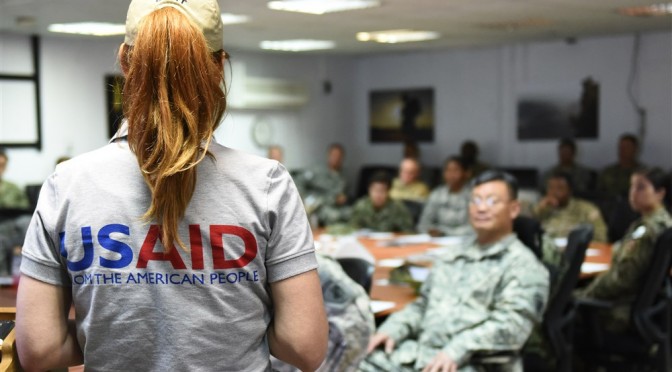
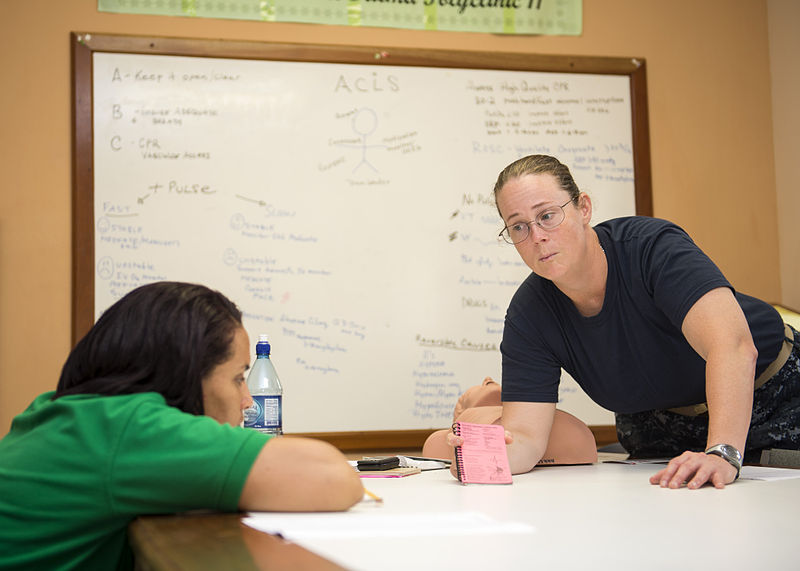
Dana Chivers, European Command advisor for the Office of U.S. Foreign Disaster Assistance (OFDA) Military Liaison Team (MLT) speaks to servicemembers during the Joint Humanitarian Operations Course at Joint Base Pearl Harbor-Hickam. The course is presented quarterly by OFDA and is designed to educate servicemembers on the role of U.S. government and the military when dealing with disaster relief events. The course combined presentations about the structure of U.S. and foreign relief agencies their practices and procedures and also included practical exercises to put servicemembers in the shoes of OFDA personnel. Photo Credit: Sgt. 1st Class Kevin P. Bell.
From the perspective of an organization involved in an HA/DR effort, one of these challenges – the need for a willing partner – is beyond the control of that organization. But organizations have more control over the remaining challenges, some of which occur during the response efforts (the importance of communicating and coordinating; not overwhelming or sidestepping another organization; understanding roles and responsibilities), and some of which should be worked out long before the response efforts begin (relationships and experience; standards and SOPs). In particular, organizations can work together to address that latter group of challenges when no crisis is occurring, because it will be too late when the crisis occurs.
David Broyles, Ph.D. is a senior research scientist at CNA, a nonprofit research and analysis organization located in Arlington, VA. The views expressed here are his own.
Last week, the U.S. Naval War College hosted the annual EMC Chair Symposium, with this year’s offering bringing in experts from around the world to discuss maritime strategy. Vice Admiral Charles Michel, Vice Commandant of the U.S. Coast Guard, kicked off the event by engaging in an energizing discussion on the missions and functions of the U.S. sea services, with a special focus on current and future U.S. Coast Guard capabilities and activities. Understandably, he spent much of his time examining the traditional security, presence, and safety aspects of maritime operations. He also provided insight into the unique ways that the Coast Guard complements forward deployed U.S. Naval forces. As a key component of this forward deployment and naval presence dialogue, he reminded participants that humanitarian assistance and disaster relief (HA/DR) remains a core mission for militaries.
Participants spent the better part of the two-day event discussing challenges and opportunities facing the U.S. sea services. We had spirited dialogue on a broad range of warfighting issues viewed through the lens of maritime strategy. Prior to the last panel of the symposium, a HA/DR “urban humanitarian response” discussion, I was struck by the manner in which many attendees translated an overarching fear of Chinese and Russian aggression to pivot away from the non-warfighting roles that militaries fill. As my colleague and symposium chair, Dr. Derek Reveron has both written and said time and again, “navies do much more than fight wars.”1
We are at a critical point in history from a humanitarian perspective, with over 60 million people displaced across the globe – more than at any time since World War II. The United Nations (UN) and the humanitarian community are currently responding to four “L3 Emergencies” in Iraq, South Sudan, Syria, and Yemen. This designation reflects the global humanitarian system’s classification for a response to the most serious, large-scale humanitarian crises.2 A quick scan of the news reveals many other areas of the world where vulnerable populations face monumental challenges. While climate change impact predictions diverge greatly depending on the source, the UN Refugee Agency (UNHCR) estimates that between 250 million and one billion people across the globe will become displaced from their region or country in the next 50 years.3 As significant, heartbreaking, and perilous as the current migration crisis in the Mediterranean Sea is, it pales in comparison to what the world may face in the near future if even the low end of climate change projections prove to be true.
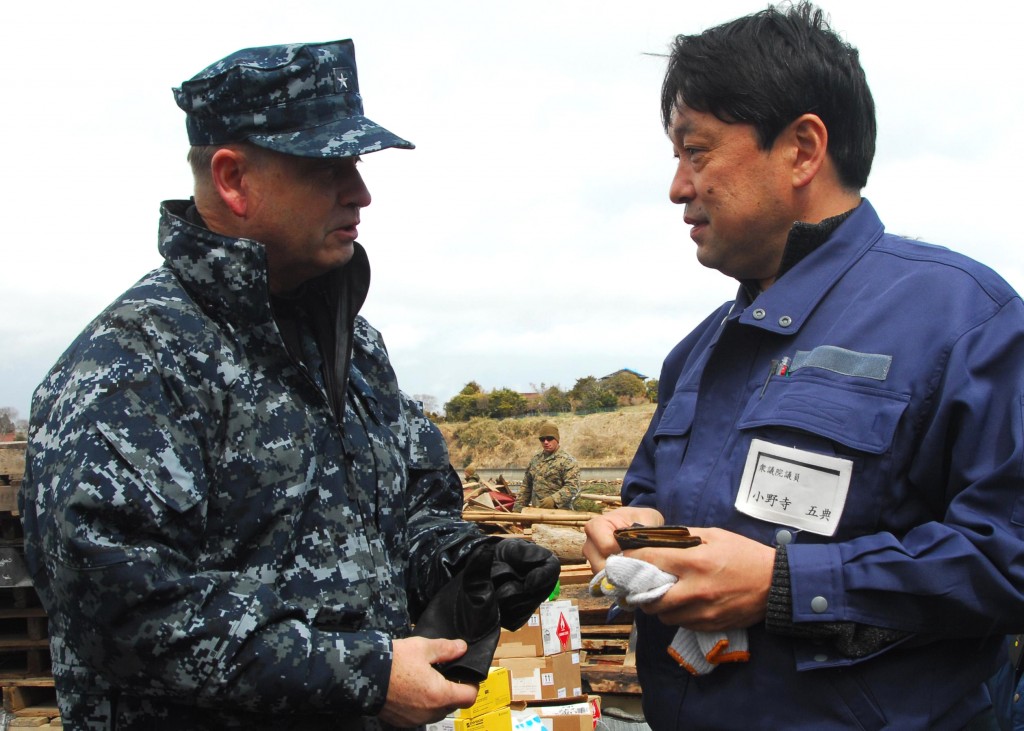
Rear Adm. Jeffrey S. Jones, director of Coalition Naval Advisory and Training Team, speaks with a resident of Oshima, to discuss the progress of disaster relief operations. Marines and sailors assigned to the 31st Marine Expeditionary Unit are on Oshima Island to help clear a harbor and assist with cleaning debris from roads and a local school in support of Operation Tomodachi.Petty Officer 3rd Class Eva Mari.
The U.S. Navy and Marine Corps team spends much of its operational life training and exercising for war. We buy and maintain warships, combat aircraft, attack submarines, and amphibious capabilities that enable us to fight and win decisively. Many of these capabilities also provide critical life-saving support during natural disasters and complex emergencies. Because of the forward deployed nature of our naval forces, versatile multi-mission platforms, and ability to operate from the sea with minimal sustained footprint ashore, we are optimally positioned to conduct HA/DR operations. One area that the sea services need to spend additional time focusing on is the understanding of how military HA/DR missions can better integrate into civilian humanitarian responses. We must increase our education, training, and simulation opportunities in HA/DR to become more proficient when asked to respond.
The 2014 Quadrennial Defense Review ranked HA/DR #12 of 12 military missions, with respect to how the Secretary of Defense and Joint Staff plan to distribute forces to U.S. Combatant Commanders.4 Despite being the lowest priority, history has proven that our military will respond to save lives and alleviate human suffering when called upon to do so. A 2003 study by the Center for Naval Analyses found that from 1970 to 2000, U.S. military forces were diverted from normal operations 366 times for HA/DR operations, while only 22 times for combat.5While these numbers do not reflect the duration of each operation, they still provide a telling story about the frequency in which our military has responded to natural disasters and humanitarian crises.
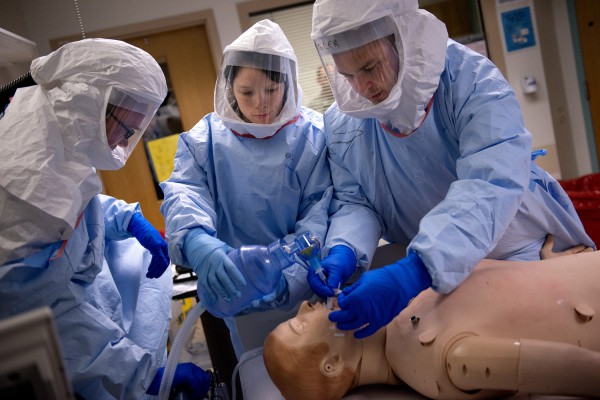
U.S. Navy Cmdr. (Dr.) Ryan Maves, Lt. Sarah Bush and Lt. j.g. Braden Spangler perform medical procedures on a simulated Ebola patient during a week-long rapid response training course. Maves, Bush and Spangler are part of a military medical response team that can rapidly respond and assist civilian medical personnel in the event of an Ebola outbreak in the United States. (U.S. Air Force photo/Master Sgt. Jeffrey Allen)
To highlight what many argue is a systemic lack of understanding within the U.S. military on the current state of the international humanitarian system and how it functions, below is a “pop quiz” for CIMSEC readers. These are ten of the most important questions (and yes, there are many more…) that military personnel must understand in order to quickly and successfully integrate military capabilities into civilian humanitarian responses. (Note: answers are at bottom of the article for inquiring minds who want to know.)
What are the four fundamental humanitarian principles and why are they so important?
What is a humanitarian actor?
What is the lead federal agency in the U.S. government for disaster response overseas and what relationship do they have with the U.S. military?
What international organization brings together humanitarian actors to ensure a coherent response to emergencies? Within this organization, who is responsible for facilitating civilian-military coordination, and what are the range of potential strategies for effective coordination?
What is the “Cluster System”?
What are the “Sphere Standards”?
What are the “Oslo Guidelines”?
What is a “MITAM”?
What key information systems do humanitarian actors utilize to communicate?
What are the key military capabilities that are routinely needed to augment the humanitarian community’s response to large-scale disasters?
After you write your answers down, please scroll to the bottom to see how you fared. There is no grading scale, because I suspect most of you, like the majority of the students who come through Newport, will quickly agree that we all have a lot to learn to be able to work effectively in the humanitarian space. It is in this intricate environment where civilian organizations operate 24 hours a day, 7 days a week, 365 days a year, to help vulnerable populations around the world – through both sustained developmental efforts as well as disaster relief activities.
If you struggled with this academic exercise, or have taken part in the chaos that is a HA/DR operation and appreciate how different this mission set is from traditional naval operations, then you may agree in principle at least, with the following recommendations for improving our abilities in this area.
The U.S. Sea Services should make small changes within their education and training efforts to ensure that our personnel have a baseline understanding of foundational issues in civilian-military humanitarian response. While the UN, U.S. Agency for International Development (USAID), and U.S. Pacific Command’s Center for Excellence in Disaster Management all provide excellent training in this area, collectively they reach a relatively small audience. Generally speaking, our war colleges have minimal elements within their curricula that allow students to comprehend the most crucial civilian-military humanitarian issues. Very few HA/DR exercises and simulations are run on a regular basis, with one exception being the earthquake scenario within U.S. Pacific Command’s ‘Rim of the Pacific’ (RIMPAC) biannual exercise. RIMPAC brings together international militaries, humanitarian actors, and academics in a dynamic environment to simulate a complex response and learn from one another. Combining smaller “mini-exercises” for HA/DR within larger warfighting exercises, when appropriate, makes sense from both a fiscal and preparedness perspective.
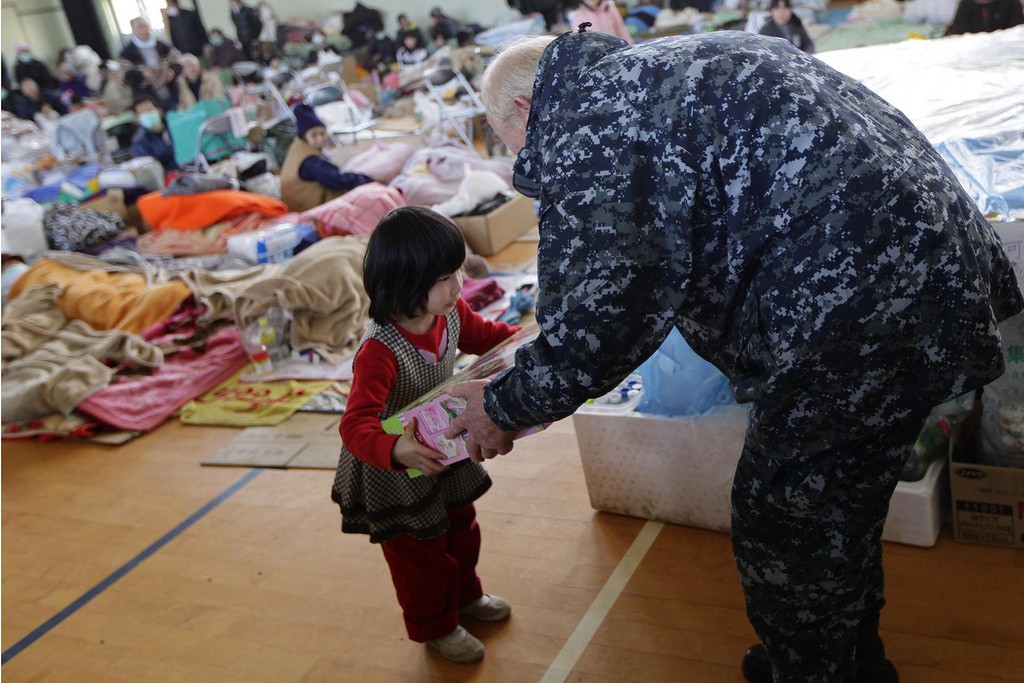
Navy Adm. Robert F. Willard, commander of U.S. Pacific Command, gives a toy to a child while touring a shelter facility in Ishinomaki city, Miyagi Prefecture, Japan, March 23, 2011. (Photo by: Lance Cpl. Steve Acuff)
The Naval War College recognizes the importance of HA/DR education, and thanks to a formal partnership with the Harvard Humanitarian Initiative, is collaborating closely with the UN’s Civil-Military Coordination Section, as well as several other universities, including Stanford, Yale, and Oxford. Our Civilian-Military Humanitarian Response Program aims to advance civilian-military engagement and coordination during complex emergencies and natural disasters, and improve the U.S. Navy’s effectiveness in conducting HA/DR operations. These collaborations have already informed curriculum, especially in our specialized planning courses that target operational (navy component and numbered fleet) and tactical (expeditionary strike group) staffs who will likely plan and execute HA/DR operations. We are working to develop new courses and simulations that will bring military and humanitarian personnel together in the classroom and during exercises. These partnership activities will help the humanitarian community create innovative frameworks for improving disaster coordination.
The U.S. Sea Services must, and will, spend the majority of their operational lives thinking about warfighting and maritime security. Current education and training systems ensure we retain our competitive advantage over future threats. However, minor investments in HA/DR education and training will help improve the predictability, effectiveness, efficiency, and coherence in deploying and employing military assets in support of humanitarian responses. This will allow us to build greater trust and confidence between humanitarian actors and military personnel, and ultimately improve our ability to respond during future natural disasters and complex emergencies.
Humanity, Neutrality, Impartiality, and Operational Independence.
“These principles provide the foundations for humanitarian action. They are central to establishing and maintaining access to affected people, whether in a natural disaster or a complex emergency, such as armed conflict. Promoting and ensuring compliance with the principles are essential elements of effective humanitarian coordination.”6 Militaries must have an appreciation for the principles so they can better understand the humanitarian system they are integrating into and minimize potential disruptions and negative effects in the humanitarian space.
What is a humanitarian actor?
Humanitarian actors are civilians, whether national or international, UN or non-UN, governmental or non-governmental, which have a commitment to humanitarian principles and are engaged in humanitarian activities. Military actors are NOT considered humanitarian actors. “Even if they fulfill or support humanitarian tasks, the military is a tool of the foreign policy of a Government, and as such is not perceived as neutral or impartial. The separation of humanitarian and political or military objectives is not given or at least unclear – and military units are certainly not primarily perceived as humanitarians by the civilian population.”7
What is the lead federal agency in the U.S. government for disaster response overseas and what relationship do they have with the U.S. military?
What international organization brings together humanitarian actors to ensure a coherent response to emergencies? Within this organization, who is responsible for facilitating civilian-military coordination, and what are the range of potential strategies for effective coordination?
United Nations Office for the Coordination of Humanitarian Affairs (UN OCHA). UN OCHA’s Civil-Military Coordination (CM-Coord) Section has been designated the focal point in the UN system for humanitarian civil-military coordination. It supports relevant field and headquarters-level activities through the development of institutional strategies to enhance the capacity and preparedness of national and international partners. CM-Coord is “The essential dialogue and interaction between civilian and military actors in humanitarian emergencies that is necessary to protect and promote humanitarian principles, avoid competition, minimize inconsistency, and when appropriate, pursue common goals. Basic strategies range from coexistence to cooperation. Coordination is a shared responsibility facilitated by liaison and common training.”8
This is UN OCHA’s system for managing a response. “Clusters are groups of humanitarian organizations (UN and non-UN) working in the main sectors of humanitarian action, e.g. shelter and health. They are created when clear humanitarian needs exist within a sector, when there are numerous actors within sectors and when national authorities need coordination support. Clusters provide a clear point of contact and are accountable for adequate and appropriate humanitarian assistance. Clusters create partnerships between international humanitarian actors, national and local authorities, and civil society.”9
“The Sphere Handbook puts the right of disaster-affected populations to life with dignity, and to protection and assistance at the centre of humanitarian action. It promotes the active participation of affected populations as well as of local and national authorities, and is used to negotiate humanitarian space and resources with authorities in disaster-preparedness work. The minimum standards cover four primary life-saving areas of humanitarian aid: water supply, sanitation and hygiene promotion; food security and nutrition; shelter, settlement and non-food items; and health action.”10
These are UN OCHA guidelines for improving the effectiveness of foreign military and civil defense assets in international disaster relief operations.11While not binding, they often frame how international militaries will interact with humanitarian organizations during actual responses.
What is a “MITAM”?
USAID OFDA often employs a “Mission Tasking Matrix” to request specific support requirements from the U.S. military. This is currently in the form of an excel spreadsheet and prioritizes requests for military support.12
What key information systems do humanitarian actors utilize to communicate?
What are the key military capabilities that are routinely needed to augment the humanitarian community’s response to large-scale disasters?
Airlift (both rotary wing and fixed wing)
Air traffic control
Communications
Engineering and construction
Intelligence, surveillance, and reconnaissance
Logistics and supply
Medical
Operational planning expertise
Relief supplies including water production and utilities
Sealift (depending on the geography of the affected nation)
Search and rescue
Security (with caveats)
David Polatty is a civilian professor at the U.S. Naval War College, where he teaches strategic and operational planning and leads the College of Operational & Strategic Leadership’s new “Civilian-Military Humanitarian Response Program.” He is also a Captain in the Navy Reserve and currently commands NR U.S. European Command J3. The views and opinions in this article are his own and do not represent the views or position of the U.S. Naval War College, U.S. Navy, or Department of Defense.
In our current information age, there appear to be many trends that are reshaping the naval approach to operations in support of HA/DR. Among them are the following:
The extremely broad availability of advanced information and communications technologies that place unprecedented powers of information creation, processing, and distribution in the hands of almost anyone who wants them – friend and foe alike;
The increasing complexity of missions as naval forces increasingly form partnerships with various civilian agencies and nongovernmental organizations;
The rising importance of decentralized operations;
The data deluge – the unprecedented volume of raw and processed information with which humans must contend.
All of these trends are reinforced by the rapid rise of social media. Many naval analysts are conducting research that will give insight into how social networks can be exploited, especially during HA/DR operations.
Deeper Civil-Naval Integration Will Be Needed for HA/DR
To help frame and inform studies about the true value of “soft power” missions in the future, CSIS conducted a study in March, 2013 of “U.S. Navy Humanitarian Assistance in an Era of Austerity.” Chaired by Admiral Gary Roughead (USN Ret.), formerly Chief of Naval Operations, the study discusses the emergence of proactive humanitarian assistance and the need for deeper civil-military integration. This will be a challenge unless the military has the cultural knowledge to know whom to communicate with during these missions.
There are still major barriers to using social media for naval operations when warfighters respond to crises. For example, how can we use social networks for theater operations in such a way that the data can be combined with traditional command and control tools (usually classified) for naval operations? How can we overcome the considerable challenge posed by information overload? How can we reconcile the traditional decision-making of hierarchically oriented commanders with that of the civilian sector which is currently cooperative and collaborative?
Until recently, most basic research has focused on developing technical solutions to filter signals from noise in online social media. But this is starting to change. There is less emphasis on techniques such as keywords to filter or classify social network data into meaningful elements and more emphasis on introducing new methodologies to come to a conclusion about the importance, utility, and meaning of the data.
I have also been looking for alternative methodologies to evaluate the impact of incorporating information from social media streams in HA/DR operations. Analyses have shown that naval officers often lack the regional cultural knowledge to know whom to communicate with in HR/DR missions and must build working relationships with new groups of stakeholders and responders for each mission. Naval officers are required to develop the cultural connections to conduct the mission and the operational data shows that this process often takes too long. It may be that social media can facilitate these bonds and relationships.
Social media is changing the way information is diffused and decisions are made, especially for HA/DR missions when there is increased emphasis on commands to share critical information with government and nongovernmental organizations. As the community of interest grows during a crisis, it will be important to ensure that information is shared with appropriate organizations for different aspects of the mission such as evacuation procedures, hospital sites, location of seaports and airports, and other relevant topics. Social media can increase interoperability with non-military organizations and create a faster decision cycle. For example, studies have shown that even using traditional messaging, in the first 14 days of the U.S. Southern Command’s Haiti HA/DR mission, the community of interest grew to more than 1,900 users!
Operational conditions vary considerably among incidents and coordination between different groups is often set up in an ad hoc manner. What is needed is a methodology that will help to find appropriate people with whom to share information for particular aspects of the mission during a wide range of events. A potential methodology might be to pro-actively establish relationships before a crisis occurs and a model for doing this is presented below. The model mimics the famous experiment of social psychologist Stanley Milgram, who provided the first empirical evidence of “six degrees of separation” when constructing paths from friend to friend as in a social network.
The Stanley Milgram Experiments
In his famous series of experiments in the 1960’s, Stanley Milgram hypothesized that short paths can be found to quickly reach a target destination when an individual mails a letter to someone he or she knows on a first-name basis with the instructions to forward it on in this way toward the target as quickly as possible. The letter eventually moved from friend to friend, with the successful letters making the target in a median of six steps. This kind of experiment – constructing paths through social networks to distant target individuals – has been repeated by a number of other groups in subsequent decades.
The Model
In an approach similar to the Milgram experiments, I propose to use a unique message addressing rule which constructs social networks as events occur. It is an approach to intelligent agent-based computations that builds on behavioral models of animal colonies. These animal models show how colonies can detect and respond to unanticipated environmental changes without a centralized communications and control system. For example, the ant routing algorithm tells us that when an ant forages for food, it lays pheromones on a trail from source to destination. When it arrives at its destination, it returns to the source following the same path it came from. If other ants have travelled the same path, the pheromone level is higher. Similarly, if other ants have not travelled along the path, the pheromone level is lower. If every ant tries to choose the trail that has higher pheromone concentration, eventually the pheromones accumulate when multiple ants use the same path and evaporate when no ant passes.
Just as an ant leaves a chemical trace of its movement along a path, this simulated agent attaches traces of previous contacts by means of “digital pheromones” to each message that it sends. This is done by ensuring that all communicators along a path are kept aware of all previous communicators in the path. Suppose, for example, “A”, “B”, and “C” represent three naval warfighters using a social network. “A” starts a path on a particular topic by sending a message to “B”. “B”, in turn, decides to send a message to “C” on the same topic. Thus far, this is similar to the Milgram experiment, in which a “path” was created as a letter was forwarded from friend to friend until it reached a designated “target” in the network. However, in this case the target “emerges” from the interaction of A, B, and C. Another major difference is that a simple message addressing rule is used that asks each communicator to “copy” all previous communicators on a topic when it chooses to send a message on that topic.
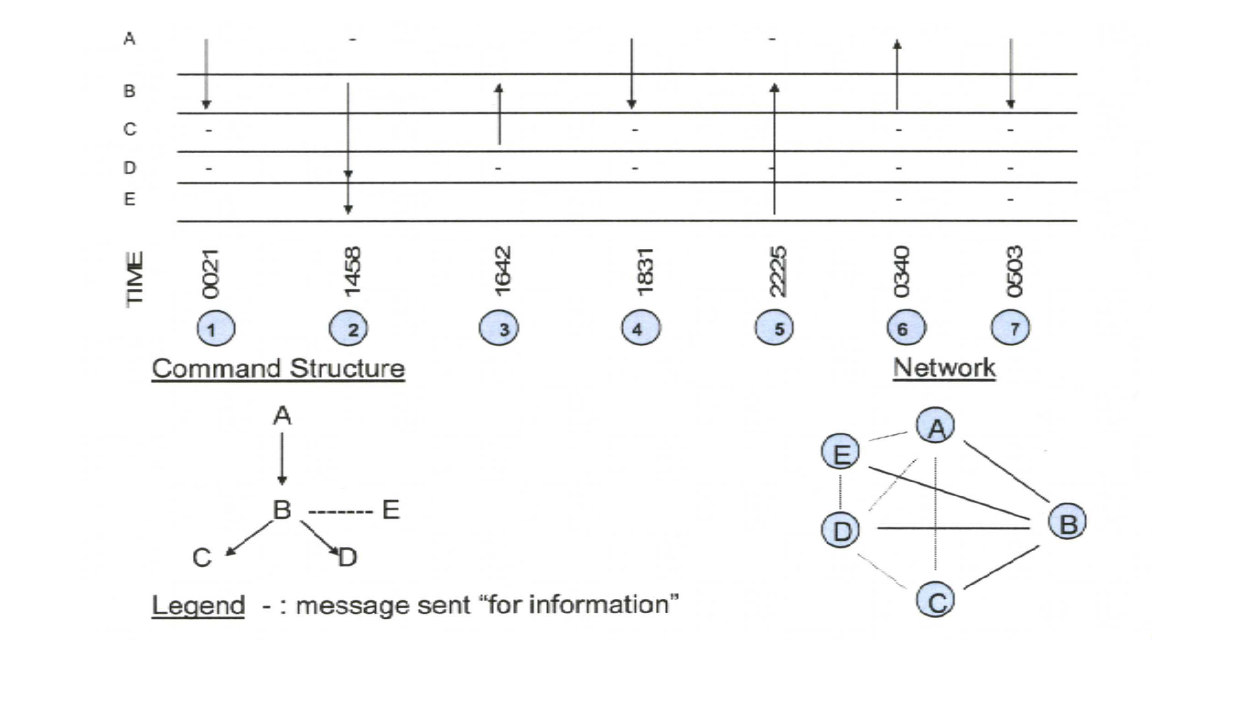
The diagram below illustrates an analysis of an actual event in which A, B, C, D, and E (who are commands represented on the Y-axis) communicated using traditional messaging during a humanitarian assistance operation. The diagram shows that 7 messages were sent between the commands for this event. (An arrow from A to B means “A sent a message to B”.) So, for example, message 1 is from command A to his subordinate Command B at 0021 and starts the message path asking for supplies to be sent to the area. (Command A also sent this message to B’s subordinates “for information”.) In message 2, Command B addressed his own subordinate Command D, as well as Command E, a non-government organization, who ultimately sent the supplies.
In the event illustrated above, the third message from C to B asks the status of supplies. Because C was addressed in the first message, he knew of the request for supplies. However, Command C was not copied in the 2nd message from B and did not know about this message. This is why I suggest that a message-addressing rule will be very important in the future use of social media. It will achieve two major objectives:
It will guarantee that all warfighters along the path are automatically kept informed of previous communicators in the path on the topic. This provides the important feedback that socio-technologists have shown to be very important in the control of large-scale coordination during evolving operations;
It avoids keywords by defining a topic through communication that represents a path in a social network. This provides a way to deal with changing topics and an uncertain organizational structure in an evolving crisis.
Conclusion
I have developed an approach to coordinate activities during HA/DR missions as naval warfighters continue to see greater use of nonhierarchical communications for complex interactions. Collaboration with external partners is expected to grow when conducting HA/DR missions. If a social network of trusted coordinators were established before a crisis occurred, military and civilian commanders would already have working relationships with each other and could plan HA/DR missions in advance. Deeper integration could be achieved using social media to exchange information and the right group of trusted collaborators would be pro-actively defined. Such an approach would assist in sustaining planned assistance in an era of global austerity.
Marjorie Greene is a research analyst at CNA. She has more than 25 years of management experience in both government and commercial organizations and has recently specialized in finding S&T solutions for the U.S. Marine Corps. She is active in both the Military Operations Research Society and IEEE, where she serves on the Medical Technology Policy Committee and the Bioterrorism Working Group.
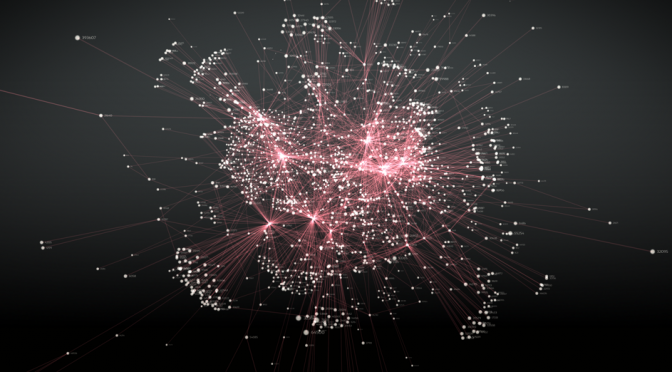
Featured Image Source: Open DNS Security LabsVisualization of Canada’s Internet Infrastructure
By CAPT John C. Devlin (ret.) and CDR John J. Devlin
The US Navy has a long history of providing Humanitarian Assistance and Disaster Relief (HA/DR) to our partner nations. These operations are a vital part of US Navy maritime strategy by ensuring regional stability through building partner nation capacity and expanding our sphere of influence. When successful, HA/DR missions prevent atrocities and armed conflict. Admiral Mullen in his 2011 National Military Strategy said, “preventing wars is as important as winning them, and far less costly.”1 The Departments of Defense and State need complementary strategies to export America’s greatness and win the peace rather than win the war. With the rampant expansion of barbaric totalitarian ideologies, collaboration is in America’s best interest. CNO Admiral John Richardson expressed this more succinctly at the recent Future of War Conference: “I want to be the best at not fighting Russia and China.”2
For this reason, the operational structure, manpower utilization, and assessments of impact for HA/DR missions will need to be studied and refined. Numerous articles have been written on CIMSEC and elsewhere concerning the paucity of US Navy ships and the extraordinary costs to build and maintain them. We have read about the rebalance to Asia where the Chinese are expanding along the nine-dash line and the pivot back to the Middle East where Russia, unopposed, began conducting an air campaign in Syria, followed by the Iran’s reneging on the nuclear deal before the ink was dry. America needs to grow allies rather than trying to project military might in a global full court press.
In the USSOUTHCOM area of responsibility, both Russia and China strive to establish footholds of influence. Since 2005, China has invested $100 billion dollars in foreign aid to the region, while Russia has courted leadership in Cuba, Venezuela, and Nicaragua.3 To counter these activities, USSOUTHCOM engages in continuous partner nation capacity building bilateral and multilateral exercises. These exercises are augmented by humanitarian and civic assistance programs. In the USSOUTHCOM AOR, the biennial Operation Continuing Promise, delivered by the USNS Comfort (T-AH 20) platform, represents the major medical-civil engagement activity.
What is the ideal platform from which to deliver the HA/DR mission package?
USNS Comfort and her sister ship Mercy (T-AH 19) are large ships with an enormous operating cost. Both are converted San Clemente class oil tankers whose keels were laid over 40 years ago. Maintenance of the vessels is costly, their suitability debatable, and their funding is continually in jeopardy.4 Additionally, the vessels’ drafts are 33 feet, forcing them to anchor well offshore in most locations, transporting personnel by two unstable organic tenders and transporting equipment by helicopter. The Continuing Promise 2015 Directorate of Medical Services Lessons Learned identifies transportation delays as a significant negative impact on mission package delivery.5 Many feel that Comfort’s value, impact-to-operating cost ratio, is rapidly declining and this is reflected in the Navy’s 2016 budget reduction of 150 full operating status per diem days for USNS Comfort.6
Perhaps linking this mission with scheduled deployments would be more cost effective and yield greater regional impact. Global fleet stations (GFS) have been proposed by Captain Wayne Porter. “Global fleet stations were to operate in cooperation with host nations, and would provide basing facilities for U.S. federal agencies and nongovernment organizations… as a way to shape regional security by using capabilities that would normally have been considered support functions.”1 A pilot GFS was initiated in April of 2007 using the high speed HSV 2 Swift tasked from USSOUTHCOM. The next year Naval Surface Warfare Center Carderock Division published a paper titled: Global Fleet Station: GFS Station Ship Concept. These global fleet stations are akin to the new Afloat Sea Basing ships. They support LCACs and other amphibious craft and aircraft. Expanding their role to scheduled humanitarian assistance tasks might be in the best interest for regional security and expansion of US sphere of influence. Other options include utilizing LHD and LHA platforms. These amphibious landing ships possess hospital bed capacity for hundreds of patients, including critical care beds, and up to four operating rooms.7 Both the GFS Ship Station concept and amphibious landing ship option utilize air-cushion landing craft (LCAC).
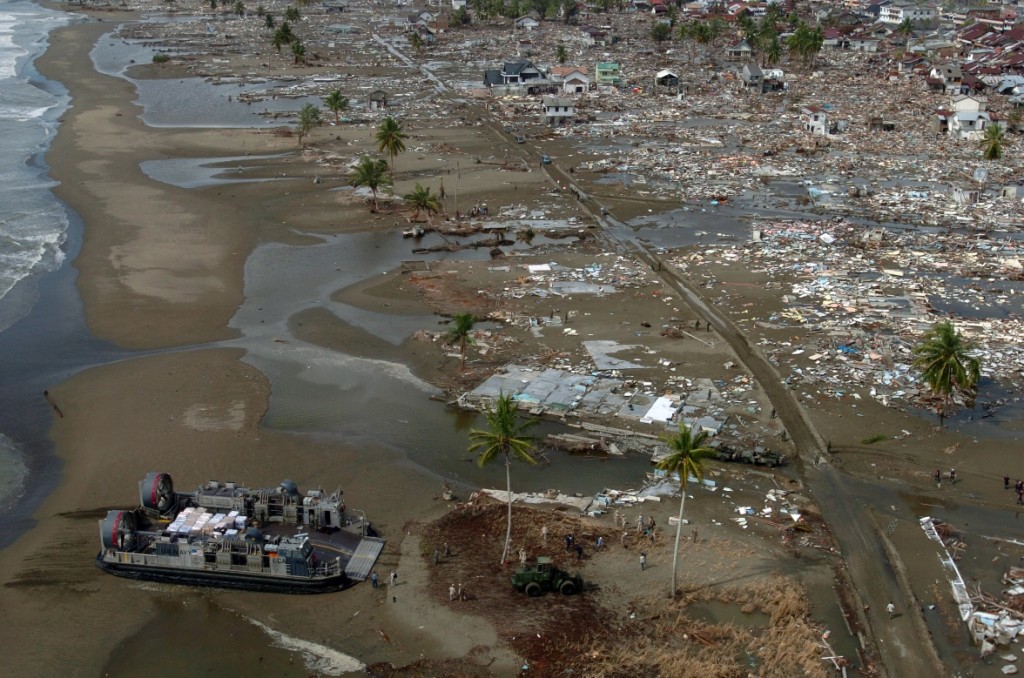
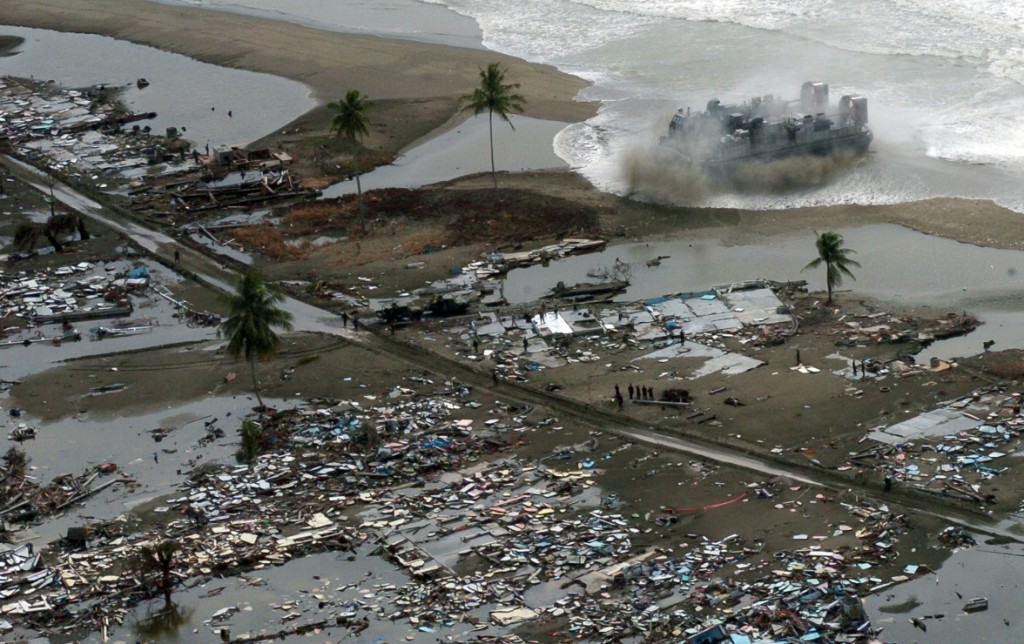
LCAC Delivering Disaster Relief Supplies in Sumatra after the 2005 Tsunami.Air Cushioned Vehicles can Access 70% of the World’s Shorelines even after a disaster.
Use of the LCAC would ameliorate identified mission inefficiencies associated with the use of existing organic tenders and locally procured commercial tenders. The LCAC can operate in 70% of the earth’s littoral regions. It does not require pier-side support. It can carry CONEX containers outfitted as mobile clinics to perform routine clinical procedures or more advanced mobile surgical suites. Using the LCAC in this role would necessarily mean a greater number of them, which could be converted to their traditional amphibious mission when necessary.
How are personnel most effectively leveraged to accomplish the HA/DR mission?
According to the Foreign Assistance Act of 1961, the “principle objective” of US foreign aid is “the encouragement and sustained support of the people of developing countries in their efforts to acquire the knowledge and resources essential to development, and to build the economic, political, and social institutions that will improve the quality of their lives.” This principle objective harmonizes well with the Core Humanitarian Standard on Quality and Accountability, essentially the consensus document which informs non-governmental humanitarian activities.8 One of the principle mechanisms by which USNS Comfort personnel contribute to partner nation capacity building is through subject matter expert exchanges.
Subject matter expert exchanges (SMEEs) are collaborative efforts where physicians, nurses, educators, and other healthcare domain experts meet with partner nation peers to discuss common goals, best practices, and perspectives unique to each nation. In the end, partner nations learn about technology and practices that may improve healthcare delivery in their country and US personnel learn about cultural and regional context of healthcare delivery, improving future interoperability for contingencies. Ultimately, SMEEs build partner nation capacity and, therefore, adhere to the “principle objective” for US foreign aid while fostering goodwill and facilitating Navy familiarity. SMEE participants are often leaders and decision-makers in their own right or are closely associated with their country’s leadership, thereby, quickening our sphere of influence.
U.S. Navy Lt. Cmdr. Suzanne Maldarelli, right, a medical officer, conducts a subject matter expert exchange on advanced cardiac life support with Lissette Recinos, a public health nurse, at a hospital in Toledo, Belize, June 27, 2014, during Southern Partnership Station (SPS) 2014. SPS is an annual deployment of U.S. ships to the U.S. Southern Command’s area of responsibility in the Caribbean and Latin America. The exercise involves information sharing with navies, coast guards and civilian services throughout the region. MC3 Andrew Schneider.
Manpower to fulfill the partner-nation requested SMEEs is drawn from the same manpower pool as that which supports the medical engagement sites and surgical activities. Metrics reported up the chain of command include numbers of patients seen at medical engagement sites, number of procedures performed, number of subject matter expert exchanges occurring, and number of construction projects completed. However, these individual activities do not receive equal attention. The progression of USSOUTHCOM public affairs newsroom publications demonstrates the drift in focus away from capacity building and toward short-term successes. By the midway point of Operation Continuing Promise 2015, public affairs had stopped highlighting the number of community assistance projects and expert exchanges, showcasing only the numbers of patients seen and surgeries performed.9 At any given time, less than 10% of provider manpower was leveraged for capacity-building through subject matter expert exchange while the majority was dedicated to onboard surgical support and direct patient care ashore at medical engagement sites. This manpower distribution is not in alignment with the principle objective of US foreign aid and sacrifices long-term impact for short-term gains. Future missions should focus on SMEEs in lieu of patients seen with the requisite manpower distribution.
How do we determine the success of HA/DR missions?
US medical-civil engagements foster collaborative solutions to mutual problems and strengthen regional partnerships. In this sense, US Department of Defense medical-civil activities are a form of battlespace-shaping. However, what performance metrics can we employ to determine success and impact in military global health engagement?
Identifying the most meaningful performance metrics has been elusive. A 2009 USAID critique of its evaluation practices found that only 9% of the 296 evaluations utilized an experimental design with randomization and control-group comparison.10 Developing metrics for Department of Defense humanitarian activities has been equally elusive. Some have suggested tracking indicators of general health such as sanitation, pediatric injury rates, and access to dental care.1,11 Unfortunately, improvements in these indicators of healthcare are difficult to attribute to an individual military operation.
However, use of civilian marketing influence metrics may inform the military’s evaluation of humanitarian and civil engagement activities. As opposed to patients seen and procedures performed, measures of effort, defense strategists and military planners should focus on post-operation measures of impact. Social media and internet surveillance are excellent tools by which to measure success. Civilian marketing experts evaluate “brand” and “influencer” metrics to determine if resources allocated to a particular marketing campaign yield sufficient market return.12 Similarly, defense analysts and/or our host nation counterparts could partner with social media providers and other information technology professionals to determine several metrics:
Using IP address origins, determine how much message traffic is generated in general and to US healthcare or humanitarian agency websites specifically after a medical-civil health engagement concludes.
Identify if there is a surge in how many times the US is mentioned online.
Track how many white papers or fact sheets are downloaded from US aid agencies or healthcare websites.
Additionally, communication with USAID could determine how many new inquiries to State Department representatives in the partner nation are received and how many new medical-civil engagement projects were organized after USNS Comfort’s departure.
These metrics better indicate long-term impact of humanitarian missions, degree of influence gained after these missions, and could better inform decisions regarding how frequently a recurring mission should return to a location. Although social media metrics are limited as they only represent areas of Latin America where internet is relative accessible, the region is an emerging market and internet accessibility is predicted to expand exponentially in the near future.13
Conclusion
The Navy’s HA/DR missions in general and Operation Continuing Promise specifically will play a larger role in cultivating regional influence during peacetime and battlespace-shaping for future combat operations. For this reason, the operational structure, manpower utilization, and assessments of impact for HA/DR missions should be studied and refined. Use of alternative operational platforms, more flexible manpower allocation, and alternative metrics of success could improve mission accomplishment and potentially supplement task organizations in times of war.
John C. Devlin, CAPT (ret), USN, Director of Navy Programs, ISPA Technology, Inc.
John J. Devlin, MD, CDR, USN, Emergency Physician / Officer-in-Charge, Medical Engagement Sites, Operation Continuing Promise 2015.
The views expressed in this article are those of the author(s) and do not necessarily reflect the official policy or position of the Department of the Navy, Department of Defense, or the United States Government.
References
Haynes PD, Toward a new maritime strategy. Naval Institute Press, Annapolis, MD, 2015.
Continuing Promise 2015 DMS Lessons Learned document, September 21, 2015.
Department of the Navy Fiscal Year 2016 Budget Estimates, Operation and Maintenance: Justification of Estimates, February 2015. Available at http://www.secnav.navy.mil/fmc/fmb/Documents/16pres/OMN_Vol1_book.pdf, accessed March 20, 2016.
Core Humanitarian Standard. Group URD, HAP International, People in Aid, and the Sphere Project, 2014. Available at http://www.corehumanitarianstandard.org/files/files/Core%20Humanitarian%20Standard%20-%20English.pdf, accessed March 20, 2016.
Trends in Development Evaluation Theory, Policies and Practices, USAID, August 17, 2009.
Haims MC et al., “Developing a prototype handbook for monitoring and evaluating Department of Defense humanitarian projects.” RAND Corporation, Santa Monica, CA, 2011.
Americas Quarterly, “Sixty Percent of Latin Americans Will Have Internet Access in 2016,” May 8, 2015. Available at http://www.americasquarterly.org/content/sixty-percent-latin-americans-will-have-internet-access-2016, accessed 3/20/2016
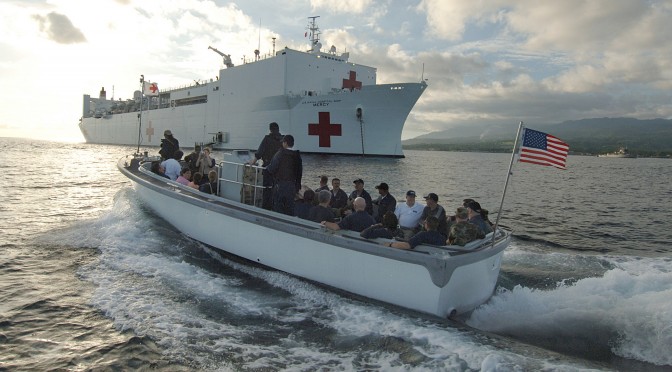
Featured Image: During a five-month deployment to Southeast Asia, medical teams and crew return to hospital ship USNS Mercy via one of two utility boats following a day of providing medical care to the Zamboanga region of the Philippines. Photo by MCC Edward Martens.