Fix the Navy’s Flawed System of Warfighting Development

Notes to the New CNO Series

By Dmitry Filipoff

“After their examination, the recruits should then receive the military mark, and be taught the use of their arms by constant and daily exercise. But this essential custom has been abolished by the relaxation introduced by a long peace. We cannot now expect to find a man to teach what he never learned.” –Vegetius, De re militari

For the U.S. Navy, the first 30 years of post-Cold War experience featured a major institutional reorientation toward the low-end spectrum of operations in a highly permissive threat environment. This facilitated widespread dysfunction across critical warfighting development functions that are crucial for preparing the Navy for war. The result has been one of the most pivotal eras of decay and atrophy of high-end warfighting skill in the modern history of the U.S. Navy.

A pointed example of the U.S. Navy’s atrophy in warfighting development can be seen in its combat training program and weak opposition forces. For decades, the U.S. Navy’s primary format for training carrier strike groups consisted of training only one warfare area at a time against opposition that was deliberately made to lose. No matter how poorly U.S. Navy forces perform in their pre-deployment exercises, they will still get certified as ready for war. This is because it is ultimately more important for the Pentagon to push naval forces out the door and meet demand signals on time, rather than to ensure its naval forces feature genuinely high readiness for great power war. This system has been normalized over decades and led to a deeply distorted understanding of what deploying naval forces are actually capable of.

This 30-year era of atrophy is some of the most fundamental background context for understanding the current state of the modern U.S. Navy. It is also the formative career experience of a full generation of naval officers and heavily shaped them. This experience has unfortunately contributed to major blindspots over first-order considerations of how a Navy prepares for great power war, as well as shortfalls in tactical literacy in high-end warfighting. This has made it difficult for the Navy to overcome the systemic dysfunction that resulted from its post-Cold War experience, and effectively pivot toward high-end warfighting to meet the rise of China’s superpower fleet.

The widespread problem in tactical literacy is especially consequential, and its impact is hard to overstate. Almost everything the Navy does boils down to its tactical warfighting implications, whether it is what force design it should have, how it should operate, or who it should promote. Almost everything is a function of tactics and has a direct tactical implication. But tactics are not minor details or actions – they are the governing logic of how fleets are destroyed in combat. And that logic infuses everything a Navy does.

If the Navy does not effectively understand that logic, then so much naval policymaking and administration will be seriously impaired when the warfighters do not have a good idea of what the combat is going to look like or how to prepare for it. It is extremely difficult to make good decisions about what force structure will be relevant, how to design warfighting concepts, or how to reform force generation, if the warfighters do not  understand how the fighting is going to work.

These issues are reflected in how the governance of the Navy’s warfighting development has a fundamental structural problem. The Navy is one of the U.S. military services that does not have a high-echelon warfighting development command for the whole service. There is no command in the Navy that is charged with acting as a true integrator of the warfighting development of its communities. Instead, those functions are heavily concentrated in community silos, who develop their forces with great independence. OPNAV N7 and NWDC have warfighting development in their names, but they do not have the actual core equities and authorities that are befitting of a true service-wide warfighting development command. They do not control combat training or tactical development, and they cannot compel the community warfighting development centers to make tradeoffs for the sake of integrating into an overarching warfighting concept.

But high-end warfighting is inherently combined arms warfighting and fleet-level warfighting. A fleet warfare doctrine must feature a combined arms doctrine that features deliberate tradeoffs and holistic integration across multiple types of forces, rather than a doctrine that is only a sum of parts that were separately grown by independent communities. This flawed architecture seriously impairs the Navy’s ability to generate and then implement service warfighting concepts, especially ones that yield real binding directives for how the Type Commands update their warfighting development.

The Navy should consider establishing a high-echelon warfighting development command that is empowered with the right authorities to truly integrate community tactics into fleet-level doctrine, and lead a broad range of warfighting development reforms. It should make reforms that ensure many warfighting development functions are better integrated and feature more responsive feedback loops that get quickly updated to pace the threat environment. SMWDC’s Red Sea combat lessons process is a positive example of sharpening these feedback loops, and there are many others that deserve similar updates.

The Navy should also systematically review and update its curriculum, qualifications, and administrative requirements to place greater emphasis on tactical warfighting and ensure the content is accurately pacing the high-end threat environment. It should also update career incentives and promotion precepts to ensure tactical warfighting skill and contributions to warfighting development are more heavily weighted in career progression. Lastly, the Navy should advocate for more service-retained deployments so it can resource its warfighting development agenda with more ready naval forces, rather than have almost all of them exclusively go toward combatant command demand signals.

Thankfully much of the system of warfighting development does not run through the Pentagon’s annual budgeting process. This should hopefully afford service leadership far more decision-space in making reforms, and making them quickly. Things like combat exercise regimes, tactical development agendas, certifications, qualifications, and curriculum can likely be changed far more quickly and substantively than a program of record in a POM submission. Updating a training syllabus can have a near-term, deckplate-level, fleet-wide impact on the Navy’s warfighting skill in a way few things can.

These efforts will be a concrete way to put warfighting first at an institutional level and elevate the importance of lethality. A reformed system of warfighting development will do far more than equip the Navy with better governance and readiness for great power war. It can set the stage for a fleet that dominates future high-end conflict, and help the U.S. Navy finally put a historic era of atrophy behind it. 

Dmitry Filipoff is CIMSEC’s Director of Online Content. He is the author of the Fighting DMO and How the Fleet Forgot to Fight series. He is the author of “Distributed Maritime Operations: Solving What Problems and Seizing Which Opportunities?,” and coauthor of “Learning to Win: Using Operational Innovation to Regain the Advantage at Sea against China.” Contact him at Content@cimsec.org. 

Featured Image: PORT HUENEME, Calif. (Feb 27, 2025) – The Arleigh Burke-class guided-missile destroyer USS Fitzgerald (DDG 62) conducts a port call onboard Naval Base Ventura County (NBVC) Port Hueneme. (U.S. Navy photo by Master-at-Arms 1st Class Jon Cason)
What Unifies the Foundry, Fleet, and Fighting Triad? Warfighting Focus

Notes to the New CNO Series

By CDR Paul Viscovich, USN (Ret.)

Which part of a spear makes it lethal? The shaft. Without its alignment of all vectors behind the tip, a spear is no more deadly than a stone. Likewise, unless the Foundry and Fleet behave like a shaft, focusing all their energy toward delivering ordnance on target, the warfighting leg of the triad is compromised. Fleet readiness consists of the manning, training, maintenance, and security programs that underpin it. But not only do these programs often fail to support one another, they are usually in direct competition for limited resources. Achieving effective balance and coordination will require an inexorable focus on warfighting that only the CNO can provide.

A model for this already exists in the Naval Special Warfare community. They recognize that to prioritize one thing – warfighting – it is necessary to reject all conflicting priorities. Whatever does not contribute directly to combat readiness they eliminate. Two things allow the SEALs to achieve this. First, their entire culture is dedicated exclusively to the mission. Second, the NAVSPECWAR chain of command is uncompromising in removing anything that distracts from this priority. It deliberately insulates the Teams from administrative interferences that bedevil the traditional warfighting communities.

By contrast, the warrior ethos of Naval Air, Submarine, and Surface leadership has been eroded by an eight-decade absence of deadly conflict with a peer adversary. It has been replaced by an administratively-obsessed culture that defines excellence in terms of passing rote inspections and scripted drills that often mask warfighting deficits but enable positive reporting. Our focus has shifted from “Rising Suns” along the cockpit to “Es” on the bridgewings.

Though individual commanding officers may strive mightily to create a warfighting focus within their units, the broader chain of command’s overriding insistence that they check all the administrative boxes will suffocate their efforts. At best, they can only put warfighting on the margins of an already thinly-stretched crew and demanding schedule. U.S. Navy flag officers are now mostly trained, groomed, and selected to perpetuate this bureaucracy which is top-heavy with administration.

Personnel is policy. If restoring a serious warfighting culture throughout the fleet is to be the CNO’s legacy, they will need like-minded subordinates now and successors in the future. The CNO must deliberately cultivate a critical mass of reformers that can sustain change at the working level and beyond the tenure of the CNO themself. Start by identifying promising, independent-thinking junior admirals and captains for promotion. A reputation for being “difficult” might be an attribute to look for, if it means they can be constructive change agents that are unafraid to challenge calcified orthodoxy. Then lobby influential Congressional leaders to champion the candidacies of these officers when they are poised to ascend to higher command.

An independent perspective that is not beholden to active-duty career influences and incentives could be useful. In guiding cultural overhaul, consider appointing a blue ribbon panel of retired officers to recommend programs and policies to cut for the non-essential time and financial burdens they place on the fleet. The composition of this board should include several SEALs, as they are the experts on eliminating bloat.

The CNO has inherited a fleet that has suffered creeping administrative overload for years. Unless the CNO can put an end to the suffocating administrative accretions from decades of poorly prioritized requirements, our next war may feature more “victory marks” on the enemy’s bridgewings and fighter cockpits than on ours.

Paul Viscovich is a retired Surface Warfare Officer with 20 years’ service, twelve of that on sea duty. He is a frequent contributor to CIMSEC.

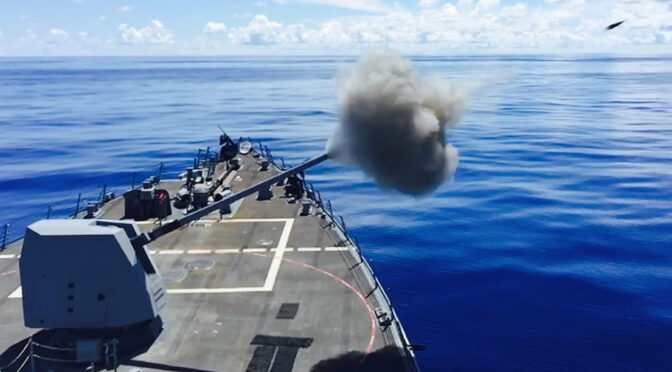
Featured Image: PACIFIC OCEAN (May 25, 2016) The guided-missile destroyer USS Spruance (DDG 111) fires its MK-45-inch gun during a self defense live fire exercise. (U.S. Navy photo by Boatswain’s Mate 3rd Class Daniel Erb/Released)

We are at Risk of Forgetting the Lessons of the 2017 Collisions

Notes to the New CNO Series

By John Cordle

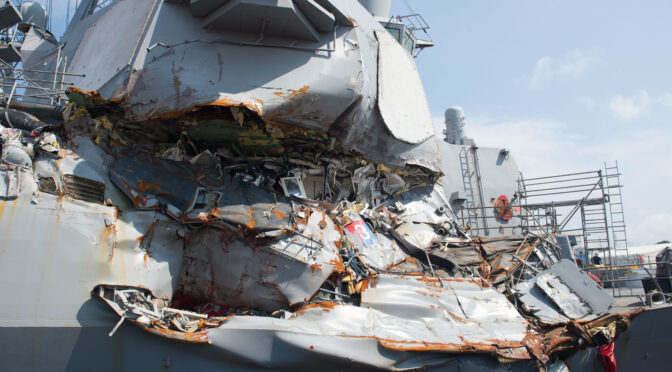
A common saying in safety organizations is to consider the “half-life of scared” as a measure of the decay of institutional urgency after an accident. In 2017 the U.S. Navy lost 17 sailors in two tragic collisions that prompted an assessment of how the Navy looked at fatigue, human-centered system design, and an overzealous “can-do” attitude. The United States Fleet Forces Comprehensive Review (CR) recommended 112 corrective actions. In the ensuing two to three years, the Navy checked off all those actions as complete and built a system to ensure that the changes were enduring – as recommended by the report. Recent events, however, specifically a series of Class “A” mishaps in the past year, call into question the effectiveness of those changes across the Navy enterprise.

It was my unique honor to take part in the investigations of two of these three events, where I interviewed over a dozen Sailors who came within a few feet or seconds of losing their lives in a violent manner. It was my job to analyze these situations for signs of stress and fatigue and decide if these contributed to the incidents. I will never forget their stories.

Unfortunately, the timing and classification of these reports are such that they are not all complete as of this writing. I cannot discuss the findings here, but I encourage the CNO to have his staff bring them to him – the complete reports, not just the summaries – and read the Human Factors sections closely. I would have done this as part of my job, but as of my retirement in May of this year, both Human Factors positions in the Surface Force are vacant and unlikely to be filled soon (if at all) due to the hiring freeze and other new government personnel policies.

This action essentially “unchecks” the block for one of the major CR recommendations, ironically titled Sustaining Change: “(8.3.4.1 – Establish Human Performance Expertise at all Type Commander Staffs).” This all comes at a time when our naval forces are engaged in sustained combat operations which can easily lead to the same challenges that manifested themselves in 2017 – fatigue, poor system design, manning shortages, and an overzealous “can-do” attitude.

In letters to the last two CNOs in this forum, one in 2019 and one in 2023, I recommended that the lessons of the CR, which was primarily focused on the Surface Fleet, be applied to the entire Navy. I recommend these two articles to the CNO for action as well – before it is too late. The red flags are there – fatigue, manning shortages, and the “can do” attitude – if we are willing to look and come to grips with them.

Last year, as I was enrolling a Sailor into a sleep study on the USS Ford Carrier Strike Group, he shared that he was sleeping in the berthing compartment on the USS Fitzgerald just above where seven of his shipmates perished in the collision. He helped save some of his friends and still lives with the trauma of that day.

He shared that he was thrilled to participate in a study whose origins lie in the events of 2017. We had a friendly conversation, and he closed by asking me to “Make sure that we are not forgotten.” I told him I would do my best,” hence this letter.

Organizational drift to failure is always a risk, and an important protection against it is constant, critical self-assessment. These three mishap reports – viewed holistically – are a perfect opportunity to do just that. The question should not be “have we completed all of the CR recommendations?” But “did they work?” Recent events indicate they might not have.

A peer recently said to me, “Near misses aren’t enough to drive real change – only more deaths will do that.” I hope that is not true. The other question should be, “Would the Navy response be different if one or more of those Sailors in the LCAC, the F/A-18, or onboard the USS Harry S Truman had lost their life?”

The CNO’s appointment comes at a critical time for shipbuilding, ship repair, and warfighting. But Admiral Caudle’s well-articulated commitment to focus on Sailors’ well-being and resilience will be critically important as we prepare for potential conflict in the future. It would be tragic for us to relearn the same lessons of 2017 less than a decade later, so this is my message to the new CNO – Please consider a holistic examination of recent near misses to evaluate the effectiveness of the CR corrective actions and their application to the entire Navy.

Captain John Cordle, PhD, is a retired Surface Warfare Officer who served as a Type Commander Personnel Officer and Chief of Staff, and twice Commanding Officer of Navy warships, USS Oscar Austin (DDG-79) and USS San Jacinto (CG-56). He is the recipient of the U. S. Navy League John Paul Jones Award for Inspirational Leadership. He has been recognized as the Naval Institute and Surface Navy Association Author of the Year.

Featured Image: The guided missile destroyer USS Fitzgerald sits in Dry Dock 4 at Fleet Activities Yokosuka, Japan, for repairs and damage assessments, July 13, 2017. (U.S. Navy photo by Petty Officer 2nd Class Christian Senyk)

Train to Win Below the Threshold of War

Notes to the New CNO Series

By Vince Vanterpool

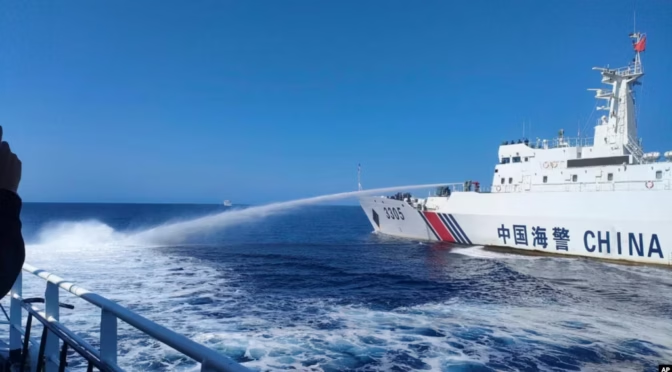
In support of developing a new Navy Deterrence Concept, the U.S. Navy needs to develop and train to new tactics and techniques in how to operate just below the threshold of armed conflict. The PRC and PLAN are very comfortable in this realm under the doctrine of their “Three Warfares” and have only grown bolder in their day-to-day operations in the Pacific. The recent collision between PLAN and CCG vessels provided the world a reminder of how dynamic and volatile the situation has become, but it will not dissuade the PLAN from further attempts to exert sea control and sea denial through non-lethal means.

In recent years, the strategy of Integrated Deterrence has taken the form of increased multilateral partnerships, exercises, and patrols to include ASEAN nations, Japan, Australia, and even European powers such as England and France. Additionally, the Pentagon has implemented VIPER (VI personnel) as a means to better broadcast accurate narratives for incidents and interactions at sea. The services have developed operational concepts for countering future maritime threats through Distributed Maritime Operations (DMO), Expeditionary Advanced Base Operations (EABO), and the Multi-Domain Task Force (MDTF). However, these initiatives are falling short of truly deterring the PLAN and are not providing tactical-level personnel with the training necessary to win in situations that remain just below hostile acts of war.

In training events and schoolhouses, students often find themselves stuck between the two extremes of routine peacetime operations and preparing for the high-end fight, neglecting the nuance of what comes between those stages. Commanding Officers, Officers in Charge, and Mission Commanders, as well as the personnel under their command, need to be better prepared to interact with a more aggressive and competent PRC that will exploit the seams in our current policies to either force our hand as the aggressor or erode our influence in peacetime. This preparation can only come from practice, but not always at the console or in the cockpit, but in discussions and forums, guided and mediated by JAGs, warfare commanders, and personnel familiar with PRC coercion tactics. The tactical and operational commanders need to have earnest discussions and wargames or tabletop discussions to experiment and refine policies, processes, and tactics.

The actions seen against the Filipinos by the PRC is only the beginning. There may be similar actions against U.S. assets in the future. In order to adequately deter and defeat these future attempts, the Navy Deterrence Concept needs robust tactics and techniques for naval units operating at the tactical level just below the threshold of armed conflict.

LT Vince Vanterpool is currently serving as Chief Engineer onboard USS Preble (DDG-88). Vince completed his Division Officer tours onboard USS McCampbell (DDG-85) and USS Shiloh (CG-67), and earned his Master’s in Operations Research from the Naval Postgraduate School during his shore tour.

Featured Image: A Chinese Coast Guard ship, right, uses its water cannons on a Philippine vessel as it approaches Scarborough Shoal in the disputed South China Sea on Dec. 9, 2023. (Philippine Coast Guard photo)

Fostering the Discussion on Securing the Seas.