Anchor Acquisition and Force Development on Targeting China’s C4ISR

Notes to the New CNO Series

By Nicholas Weising

Admiral Daryl Caudle’s tenure as CNO began on August 25th, 2025, meaning his four-year term includes the end of the Davidson window in 2027, when China will have reached its milestone of developing sufficient defense capability to forcefully annex Taiwan. The key to China succeeding is maintaining their anti-access/area denial (A2/AD) approach intended to keep adversary forces out of the first island chain. U.S. Navy operational concepts must make an explicit priority of targeting the C4ISR architecture that fundamentally enables China’s A2/AD approach and have it serve as a core organizing principle for Navy acquisition and force development.

The center of China’s A2/AD strategy involves long-range precision-strike (LRPS) missiles, encompassing anti-ship, anti-air, and anti-surface capabilities. The DF-21D is a road-mobile ballistic missile capable of targeting a moving carrier strike group at 1,450 kilometers away. The DF-26 is an intermediate-range ballistic missile capable of hitting Guam, Okinawa, and other American military installations in the region. The DF-17 is a road-mobile missile that delivers a hypersonic glide vehicle that can penetrate air and missile defenses. These are the primary long-range conventional weapons the PLA Rocket Force (PLARF) has at its disposal. The PLARF’s LRPS capabilities can attack carrier strike groups and military bases across the First Island Chain and up to the Second Island Chain on short notice.

The ability to establish and contest air control over Taiwan would be pivotal in any scenario, but the effects of China’s A2/AD posture are most acute in the air domain. Advanced sensors, integrated air defenses, and surface-to-air missile systems create a highly contested environment. Aircraft are limited by endurance and mission availability rates, meaning they cannot maintain presence indefinitely. Even the most capable U.S. jet fighter today has a combat radius of only about 600 nautical miles without aerial refueling. This constraint goes back to the origins of modern airpower. Fighter aircraft were first designed for the European theater, where dense networks of airfields exist. Meanwhile, the Indo-Pacific has vast stretches of water and land separated by hundreds or thousands of miles. In a Taiwan contingency, sorties from Japan or Korea would almost certainly require midair refueling and would struggle to maintain a consistent presence in the battlespace. This is why carriers remain indispensable. Yet the PLARF LRPS capabilities threaten to box carriers out of the region.

C4ISR capabilities enable A2/AD architecture. Admiral Caudle should treat C4ISR as the principal target in any campaign against the PLA and develop the Navy accordingly. The CNO must prioritize a layered approach that targets hostile sensing and command and control, while reinforcing friendly sensing and command links to create decision advantage. The CNO should scale up electronic warfare and cyber teams so they can effectively deny enemy ISR, disrupt missile targeting, and a play a more predominant role in wartime naval operations. The CNO should invest in communication architectures that can survive contested environments and accelerate investments in space-based sensors to create more distributed killchains. At the same time, the Navy should also invest in deception methods to complicate enemy targeting, and rehearse operations in degraded conditions so commanders and crews can operate confidently when links are contested.

Neutralizing Chinese C4ISR should be a top CNO priority, and serve as an organizing principle for guiding the investment of resources, the design of exercises, and the management of acquisition. Such an approach will maximize the competitiveness of the U.S. Navy.

Nicholas Weising is a Program Assistant at the Center for Maritime Strategy.

Featured Image: A KJ-500 airborne early warning (AEW) aircraft attached to an aviation regiment with the navy under the PLA Southern Theater Command prepares to take off for a real-combat flight training exercise on January 9, 2020. (eng.chinamil.com.cn/Photo by Qin Qianjiang and Zeng Qi)
A Navy for War in the Age of Intelligent Missiles

Notes to the New CNO Series

By Craig Koerner

The U.S. model of delivering firepower continues to predominantly take the form of short-range weapons delivered from smart and expensive tactical platforms, defined as platforms which primarily use organic sensors to find and engage targets. These are quickly becoming obsolete in modern warfare given the rise of long-range missiles coupled with long-range sensor architectures. In the age of modern microelectronics, missiles have increasingly capable seekers for independently and accurately targeting enemy ships and aircraft despite countermeasures. Compared to penetrating aircraft, missiles are cheaper, faster, and far more capable of penetrating defenses. Given targeting, long-range missiles often outperform platforms delivering short-range weapons.

The platform-weapon model long used by the U.S. creates a force that delivers warheads more cheaply and with greater magazine depth than a missile-centric force, but only if platform attrition rates are kept extremely low. This is unlikely when facing modern missiles from a great power, or from any country that can buy and target such missiles. Therefore, when fighting any competent military power, missiles should be launched from low-signature vehicles that never see the targets but shoot from over the horizon, including ground vehicles, submarines, stealthy surface combatants, inconspicuous and cheap surface ships, and cargo aircraft.

Reconnaissance for deploying missile-launching craft and providing targeting data to their missiles is vital to the killchain. Ships and aircraft conducting line-of-sight reconnaissance from the sea surface or the air are likely to be detected and destroyed by missiles. If using active radar, targeting and destruction becomes even more likely. Survivable terrestrial line-of-sight reconnaissance should only be provided by units hiding in clutter and using passive or LPI sensors.

Satellites will be critical for providing over-the-horizon targeting. The economy of orbiting smaller satellites in large multiples (such as 60 at a time via Starlink) gives satellites far greater resistance to anti-satellite weapons than was possible with the giant, exquisite previous generation of ISR satellites. Satellites can also provide coverage and targeting capabilities over contested areas that traditional battle management aircraft would struggle to penetrate. Expendable drones provide yet another avenue for providing over-the-horizon targeting by identifying targets and inducing the targets to defend themselves by radiating. Specialized reconnaissance forces should make up a greater part of our force structure to satisfy the information demands of modern long-range killchains and to defeat adversaries in the hider-finder competition.

Unable to hide, the future of conventional air and sea-surface platforms is grim. When fighting competent opponents, those few, valuable, and conspicuous legacy platforms are likely to be destroyed. Modern warfare is not boxing, it is hide-and-seek. We should redesign our forces accordingly.

Dr. Craig Koerner is a research professor in the Strategic and Operational Research Department within the Center for Naval Warfare Studies at the Naval War College. He is a faculty member and co-founder of Halsey Alfa. He specializes in the study of conventional warfare between high technology powers from World War One onwards. The views expressed here are the author’s own and not necessarily those of any organization with which he is affiliated.

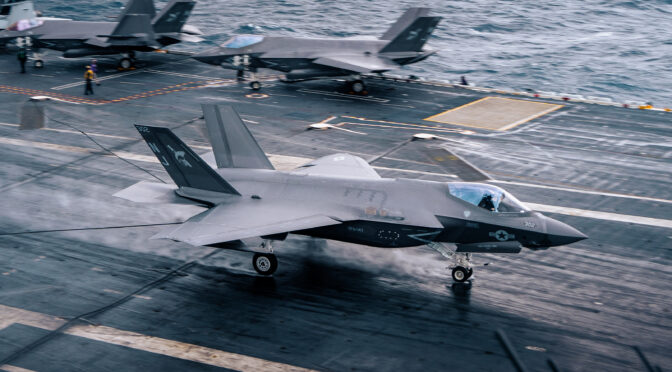
Featured Image: An F-35C Lightning II, from Strike Fighter Squadron (VFA) 147, lands on the flight deck of Nimitz-class aircraft carrier USS George Washington (CVN 73) while underway in the Atlantic Ocean, Dec. 6, 2023. (U.S. Navy photo by Mass Communication Specialist 2nd Class Nicholas A. Russell)

The Submarine Force Needs More Flexible Training Tools

Notes to the New CNO Series

By Andrew Pfau and Bridger Smith

Shore-based team trainers – attack centers – are critical for submarine crews preparing for deployment to exercise the full range of tactical skills in a challenging training environment. These trainers focus on modeling complex ocean environments, sensors, and warships, resulting in a high-cost trainer with only two to three attack centers at each shore facility. The limited number of trainers coupled with high demand means that submarine crews in shipyard availabilities are low priority for these trainers, often going weeks between opportunities to use them. If the Navy wants a more lethal submarine force, it requires more low-cost training options for Pre-Commissioning Units and those in long shipyard overhaul.

Only one submarine schoolhouse, in Pearl Harbor, is co-located on the same base as a shipyard. The Navy’s other public and private shipyards require sailors to travel to and from the schoolhouse, creating a time and financial burden on sailors. When attack centers are unavailable, shipyard units resort to studying manuals or discussing scenarios with whiteboard diagrams. These are clearly less than ideal training conditions, especially when shipyard sailors are considered the reserve surge force for deploying submarines.

A lower-fidelity, modular trainer, operated by one sailor in a classroom would provide a low-cost, high-density training asset for the submarine force. This “attack center in a box” would run on basic laptops, linking together four to five tactical watchstanders in the same training environment, utilizing off-the-shelf technology. It would not replace shore trainers but augment the higher-fidelity training they provide. Sailors could increase training “reps and sets,” execute a more consistent and higher density training schedule, and reduce qualification time. When watchteams train in the attack center, there would be greater training value with less time spent on basic skills and more time on the complex problems the higher-fidelity trainer provides.

Tabletop wargames also provide submariners with an opportunity to hone tactical decision-making skills at a low financial and readiness cost. Watchteams could wargame tactical decisions, exploring alternative paths and various tactical scenarios. The opportunity to pilot and test new technologies and tactics in low-risk environments would provide valuable user-centric feedback and would shift risk to the left of the more high-demand trainers. Wardrooms would be introduced to the principles of wargaming and practice integrating with surface and air units for theater anti-submarine warfare. A simple, flexible, wargame that uses knowledge sailors already possess and can be learned quickly provides countless repeatable training opportunities.

As shipyard availability delays continue to challenge the submarine force, sailors assigned to the these units require better and more consistent training tools. Sailors must be ready to support at-sea operations and units must quickly transition to a combat-ready state after shipyard periods. Low-cost, high-density training tools like wargames and an “attack center in a box” can provide opportunities for sailors to build and maintain perishable at-sea skills, leading to a more ready and lethal force.

Andrew Pfau is a submarine officer currently assigned as the Navigator aboard USS COLORADO (SSN 788) undergoing a CNO availability at Pearl Harbor Naval Shipyard. He is a graduate of the U.S. Naval Academy and the Naval Postgraduate School.

Bridger Smith is a submarine officer currently assigned to the INSURV Board of Inspection and Survey. He was Navigator aboard USS COLUMBUS (SSN 762) undergoing a CNO availability at Huntington Ingles Industry Shipyard in Newport News, VA. He is a graduate of the U.S. Naval Academy and the Naval Postgraduate School.

These opinions are expressed in a personal capacity and are not intended to reflect official views or policies of the Department of the Navy or the U.S. government.

Featured Image: Ohio-class ballistic missile submarine USS Nevada (SSBN 733) docked in Naval Base Kitsap’s Delta Pier’s dry dock, Dec. 28, 2023. (U.S. Navy Photo by Mass Communication Specialist 2nd Class Adora Okafor)

Revisiting A Modest Proposal for Improving Shipyard Production and Repair Capacity

Notes to the New CNO Series

By Ryan Walker

It came as a great surprise to me that, despite disliking being a submariner in a shipyard, I quite enjoyed working as a test engineer/technician at Electric Boat. Shipyards have defined my adult life, and despite my current career forcing me to move away from them, I greatly appreciate the experience. From both a yardbird on the deck plate and a shipyard historian, there were a few things to take into consideration.

In the short-term, existing shipyards are the only production environments on which we can reasonably depend. While funding is flowing to shipyards, the customer (Congress) is not always reliable, incredibly demanding (for good reason), and shipyard production is a diseconomy of scale that relies on a high level of capital investment with relatively low margins restricted by the customer. It is an unattractive prospect for a private company to decide to venture into. This assumption has thus far proven correct, as no new shipyard is projected to open by 2029, though there does appear to be diversification of the shipyard’s work and supply network.

The question shifts to how to accelerate production with facilities today without waiting for a miracle or new production facility. My experience standing midwatch at Portsmouth Naval Shipyard and being the Third-Shift “Operability” technician at Electric Boat taught me that fewer personnel are present outside of First Shift. Current shipyard operations concentrate too much work into first shift, creating bottlenecks in tight spaces and diminishing returns, oftentimes well past the point where returns are negative (and makes parking a nightmare).

The solution is a modified Dupont shift schedule, an 8-4-2-10 model, that could sustainably increase shipyard output without burning out the workforce. This schedule divides the labor pool into two ten-hour shifts across an eight-day cycle, with each crew working four days on, four days off. By spreading work across two balanced shifts, we reduce congestion, improve coordination, and extend productive hours from 60–76 per week to potentially 140.

The benefits go beyond productivity. A predictable four-day-off cycle improves morale, attracts new talent, and offers resilience in the face of illness, burnout, or future disruptions. It also creates a built-in training pipeline: experienced workers on staggered shifts can mentor new hires and build institutional knowledge while preparing for future expansion. The 8-4-2-10 is a modern adaptation of the Second World War-era production tempo, designed to meet today’s labor realities while maximizing throughput.

This proposal requires buy-in from labor unions, management, and policymakers. It challenges the cultural norm of the five-day workweek and demands investment in oversight, scheduling, and support infrastructure. But the alternative is continued stagnation or waiting for another miracle of production. We cannot afford to wait for new shipyards to come online while our current facilities operate below capacity.

I recommend the Chief of Naval Operations push the 8-4-2-10 as a potential realistic solution rooted in historical insight, operational experience, and a deep respect for the challenges facing the shipyard worker. If implemented thoughtfully, the 8-4-2-10 schedule could become a model for other defense programs, reinforcing readiness while preserving workforce well-being.

Ryan C. Walker served as a submariner in the USN from 2014-19. Ryan is currently a PhD researcher at the University of Portsmouth and an Adjunct Naval History Professor at the United States Naval Community College. His first book, The Silent Service’s First Hero and has published several articles and chapters in edited collections on American submariners, American Naval-Capital towns, and British Private-Men-of-War. The opinions expressed are those of the author alone.

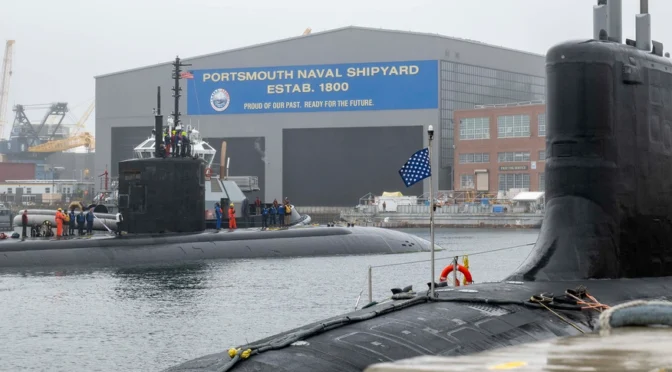
Featured Image: KITTERY, Maine (Nov. 21, 2024) — The Los Angeles-class attack submarine USS Hampton (SSN 767) arrives at Portsmouth Naval Shipyard, Kittery, Maine, for a scheduled maintenance period. (U.S. Navy photo by Mass Communication Specialist 1st Class Charlotte C. Oliver)

Fostering the Discussion on Securing the Seas.