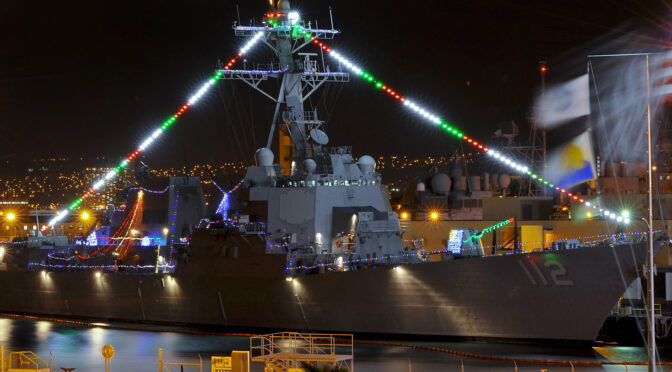
For the next two weeks, CIMSEC will be featuring short stories submitted in response to our Call for Fiction.
These thoughtful stories examine the future of maritime security and war at sea. Authors creatively envision emerging threats and technologies through novel scenarios and narratives. These stories can help us gaze into the future and flesh out the possibilities of future conflict.
Below are the authors and stories that will feature during this edition of CIMSEC’s annual fiction week.
Riding a wave of success during his Asia tour, President Donald Trump triumphantly announced the U.S. would be working with South Korea to build nuclear submarines.1 To those familiar with the AUKUS (Australia-U.K.-U.S.) deal, this may seem a repeat of that effort to build nuclear submarines with Australia. By all accounts, this is not what is at hand.
South Korea’s growing investment in American shipbuilding could foster the development of ships capable of using next generation small modular nuclear reactors (SMNR), to include their use on modified South Korean submarines appropriate to their operational needs. This likewise has applicability to Japan, who should be included should the effort proceed.
Given the unique naval needs of South Korea and Japan, their decades of experience in building conventional submarines, and the U.S. need for allies in reviving its maritime industry – this deal could be very opportune. That said, it will not be AUKUS and to succeed it must also contribute to a revival of America’s shipbuilding to best serve America’s national interests.
South Korea’s National Security Situation
South Korea’s capital, Seoul, is within range of hundreds of North Korean artillery pieces. For them danger is always near, and has focused their military to the threat ever since the armistice paused the Korean War.2 Adding to the dangers, the North has in recent years accelerated development of its own nuclear-armed submarine-launched ballistic missile – the Pukguksong series that began testing in 2015 and now has six iterations.3 Given this at-sea nuclear threat, as in the Cold War, there will be a necessity of locating and keeping track of North Korean submarines with nuclear-armed SLBMs, like the SSB 841 Hero Kim Kun Ok launched in September 2023.4
An Oct. 2, 2019 North Korean Pukguksong-3 SLBM test. (Rodong Sinmun photo)
Beyond the North Korean threat, China has also encroached into its waters and strong-armed the South. Most notably, the Chinese Communist Party was the hand behind political interference and public agitation in 2017 over the placement of the THAAD missile defense system.5 Keeping its economy free of coercion will require a Navy able to keep the People’s Liberation Army Navy (PLAN) in check in the East China Sea and Yellow Sea. Should war break out in Asia over the fate of Taiwan, critical shipping routes through the South China Sea and potentially across the North Pacific will need to be guarded.
Unlike the Australian strategic challenges that drive them to pursue a nuclear submarine in the AUKUS initiative, South Korea’s maritime threats are closer to home. This operational situation prioritizes stealth and on-station endurance with the ability to conduct high-speed sprints without needing to come near to the surface to recharge submarine batteries. These operational requirements inform South Korea’s submarine program, today led by production of its 3,600 ton KSS-III Batch-2 submarine with 10 vertical launch cells and torpedo tubes built by shipbuilder Hanwha.6 SMNRs offer a way to enhance the lethality on a potentially modified South Korean submarine like a future batch of the KSS-III.
October 22, 2025 – Hanwha Ocean launches the first KSS-III Batch-II submarine, Jang Yeongsil ship (SS-087) (ROK Navy photo)
A Brief History of SMNRs Backfitted on Conventional Submarines
Twice in the recent past have navies attempted to extend the undersea endurance of existing conventional submarines with small modular nuclear reactors. The first was in the mid-1980s, when the Soviet Navy installed a 600kWh VAU-6 600 nuclear power plant on a project 651 (Juliett-class) diesel submarine and greatly extended its range.7 The implications of this development were never felt in the West, as the Cold War was coming to a rapid end by the time this was completed.
The idea of greatly increasing the tactical capabilities of existing conventionally-powered submarines has surfaced again. For the past several years, experts looking over satellite images of China’s sole naval nuclear shipyard at Huludao have noticed the expansion of production lines and what appeared as components of a new class of nuclear-powered warship. The answer would be clear in September 2024 following months of speculation that a new larger Yuan-class conventional submarine was being readied for sea with a new type of propulsion.8 That month, reports of its pier side sinking drew a subsequent U.S. Department of War response that confirmed it was a variant being fitted out with an auxiliary nuclear power plant. And so the Soviet idea was reborn with Chinese characteristics.
Given China’s large and modern conventionally powered submarine fleet, its use of SMNRs to complement air independent propulsion would have severe ramifications for the U.S. and its allies. Already fairly stealthy, the latest Yuan-class Chinese submarine would see its endurance greatly extended and survivability improved with the ability to sprint at high speeds to evade hostile contacts without having to come to the surface to recharge its batteries soon afterwards. Moreover, the limited nuclear construction capacity at Huludao could be augmented by numerous conventional submarine shipyards, with SMNRs being produced and backfitted on Yuan-class submarines in shipyards like Wuchang and Jiangnan.
Schematic of Soviet Juliet-class submarine equipped with a VAU-6 small power plant. (Graphic via Global Security.org)
Shared Allied Interest in SMNRs
As news broke of President Trump’s announcement on building nuclear submarines with South Korea, Japan also got interested.9 Japan is no stranger to maritime nuclear propulsion with its own Mutsu launched in 1969 and retired in 1992.10 This ship was a flawed attempt at exploring the commercial potential of nuclear power, with unacceptable radiation leakage dooming the ship. Recently, there have been calls by Japanese politicians to pursue developing a nuclear submarine – a call first triggered by the AUKUS initiative in 2021 and now with a potential U.S.-South Korean project.
Like South Korea, Japan too has a robust, successful, and longstanding conventional submarine program. The latest addition to the Japanese Maritime Self Defense Forces (JMSDF) is the 3,000 ton Taigei-class.11 However, Japan’s operational needs are more extended than South Korea’s, given its expansive archipelago that stretches deep into the Pacific Ocean and critical shipping lanes threatened by Russia, China, and North Korea. This threat is in part why Japan began a military modernization during the later Cold War to protect its shipping lanes 1,000 miles from Japan – a mission that lives on today. As such, the added endurance and survivability offered by SMNRs as an augmented power source for existing conventional submarines would be welcome.
A comparison of speed and endurance characteristics between conventional, SMR, and nuclear subs. Click to expand.
Additionally, both Japan and South Korea are today the only viable rivals to China’s shipbuilding colossus. As such, both are looking to invest in the U.S. as a means of expanding market share, which could be amplified by harnessing the potential of SMNRs to cleanly power the next generation of commercial ships and revolutionize the maritime industry. However, only the U.S. has the experience (thanks to its naval nuclear program) and capacity (based on existing nuclear research and development) to bring this new nuclear technology quickly to market with confidence.
Recent developments have the hallmarks of a potential consortium of investors forming to bring SMNRs to sea and soon. Already two South Korean shipbuilders have invested in the U.S. and Japan has signaled investments are coming. What especially stands out is the investments since December 2024 in Philadelphia Shipyard by South Korean shipbuilder Hanwha. The proverbial canary in the coal mine is how well Hanwha will be able to turn a profit in the long term when taking orders for commercial ships at its new American shipyard.
Newer to the scene is Hyundai, another South Korean shipbuilder, who has joined into a partnership with American naval ship and submarine builder Huntington Ingalls Industries (HII).12 The scope of this new partnership is relatively undefined as of November 2025, but signals an intent to deeply integrate into domestic American naval shipbuilding. The most explicit expression of this is a commitment of $150 billion by the South Korean government to back investment in American shipbuilding.13 On the other hand, Japan has only recently signaled its intent to move into the American market, with $4 billion of government backing to $2.5 billion of private investment.14 Focusing some of this foreign investment in what could be a market-setting technology can leverage the shipbuilding capacities and expertise of allies, while mitigating the risks in getting SMNRs to sea.
Key submarine bases and operating areas in the western Pacific. (Heritage Foundation graphic)
Proliferation and Compromised Supply Chain Concerns
In the case of both Japan and South Korea, there are grounds for concern regarding the potential for compromised maritime industrial supply chains and information security. Less of a concern is the threat of proliferation of weapons-grade nuclear material in the SMNRs under development. This is due to the use of lower enriched nuclear fuel (approximately 5% compared to weapons grade above 90%) and the fuel assemblies that complicate the separation and refinement of the fuel to weapons grade.
Nonetheless, memories of Brazil’s past attempts to develop a nuclear submarine as pretext for a nuclear weapons program are informative and cautionary.15 Putting a check on such possibilities are counter-proliferation protocols enshrined in the so-called “123 agreement” named for the section 123 of the 1954 Atomic Energy Act. These agreements are conditional by the U.S. prior to entering into any agreed transfer of nuclear technology or materials. Both Japan and South Korea have active 123 Agreements.16
Regarding maritime supply chains, however, both Japan and South Korea conduct significant shipbuilding related activity in China.17 This is primarily in the prefabrication of sections or modules and supply of components like pumps or solenoids that are then assembled outside China. Should either nation enter into a new SMNR developmental project and associated shipbuilding endeavor with the U.S., exposure to associated Chinese supply chains must be addressed, especially as it relates to military use in South Korean and Japanese submarines.
A sunken Chinese submarine at a shipyard near Wuhan, China, on June 15, 2024. (Planet Labs PBC photo via AP)
Finally, tight information security, such as done with Naval Nuclear Propulsion Information (NNPI) addressed for AUKUS, will be a necessity. A complicating factor for allies will be the dual-use applicability of SMNRs and how to ensure associated high information security for both military and commercial programs. Thankfully, the U.S. has current information-sharing agreements with both Japan and South Korea that includes industrial security. In 2025, memorandums of understanding signed with both South Korea and Japan make clear an intent to bolster supply chains as the three nations progress and work together in reviving America’s maritime industry.18 However, statements of intent are not enough to ensure the sensitive next-generation nuclear power technology behind SMNRs remains an American comparative advantage.
The Optimum Pathway for American Maritime SMNR
Developing SMNRs and then putting them to sea on commercial and backfitted allied conventional submarines will be a multifaceted task. First, the technology needs to be perfected in a way that makes it compatible for use in commercial shipping and scaled for use as an alternative power source for today’s conventional submarines built in Japan and South Korea. Second, trust in sharing sensitive nuclear technologies for SMNR will be needed, to include their safe operation and maintenance. Third, an industrial plan will need to be implemented for building SMNRs that can be installed on commercial ships and on allied conventionally powered submarines. To preserve American investment in developing next generation SMNR and foster an American comparative advantage in the global maritime market space, construction and installation should be initially confined to occur at U.S. shipyards. Much of this can be accomplished taking a similar approach used for the AUKUS optimum pathway and as advocated in an earlier Heritage Foundation report.19
Almost two years after its September 2021 announcement, the Australian government, in concert with U.K. and the U.S., announced the “optimum pathway” to deliver a domestic nuclear submarine capability.20 This plan addresses developing domestic nuclear industrial competencies, training a cadre of nuclear-certified shipyard workers to sustain this nuclear fleet, and begin the nuclear training of the crew of these future boats. Unlike AUKUS, development of overseas SMNR construction would not be a goal. Nonetheless, bringing a SMNR forward with allies like South Korea and Japan will require a similarly multifaceted approach to ensure it is viable and safe.
Recommendations
The U.S. and its allies should form a private-public consortium to inform and oversee development of a naval SMNR. There are several designs all progressing to working prototypes with initial criticality (first time nuclear fission) tests before the end of the decade.21 This consortium would be critical in accelerating the testing and maturity of viable designs currently being planned at the federal nuclear test labs in Idaho (i.e. INL). Given the commercial and potential military use, the effort should be led by U.S. Department of Energy with technical support from Naval Reactors (design), Coast Guard (regulatory), and Maritime Administration (commercial use).
Putting an operational SMNR on a commercial ship or submarine is likely at least seven years away. Waiting until that time to develop the demand for commercial shipping would guarantee its failure or worse, cede dominance of this capability to hostile competitor China. As such, orders for new commercial ships (i.e. ultra large container ships, LNG carriers, etc.) today should be of designs that are forward-compatible for installation of SMNRs.22 This would also guarantee those ships meet stringent International Maritime Organization (IMO) carbon requirements while removing uncertainty that has delayed ship orders over which green energy will be embraced by the market. As the second and third largest shipbuilders, Japan and South Korea are best placed to ensure uptake of this new technology. Moreover, information security amongst members of this consortium will be paramount, especially as variants of the SMNR are installed on allied submarines. For AUKUS, this was an early achievement given the bedrock of the Five Eyes intelligence sharing program.23 A similarly structured approach, but narrowly focused on SMNR use, would be warranted with allies Japan and South Korea.
Today there is one U.S. shipyard owned by a South Korean shipbuilder. Philadelphia Shipyard, owned by Hanwha since December 2024, is a natural choice to base this new endeavor and future SMNR installations. Already Hanwha is continuing the U.S. Maritime Administration’s (MARAD) third of five National Security Multi-mission Vessel (NSMV) and making a $5 billion capital investment to upgrade the shipyard for orders of 10 new medium-range tankers and bulk carriers.24 Doing nuclear shipyard work here will require added investments to attract future SMNR builders to locate fabrication and installation facilities nearby. In the meantime, future upgrades should be done with an eye to nuclear certification of the yard.
This shipyard should not be the only place where this type of commercial nuclear maritime installation will occur. Given the national security aspects of backfitting SMNRs on submarines, shipyards with history in naval shipbuilding make the most sense. In this case, the expertise of HII and its budding partnership with Hyundai makes a natural fit for backfitting operations of SMNRs. Caution is warranted in this case, as the U.S. submarine industrial base is tardy in growing its capacity to meet U.S. orders for nuclear submarines.25
As such, HII and Hyundai, to include Japanese submarine builders Kawasaki and Mitsubishi Heavy Industries, with American submarine shipbuilders HII and Electric Boat, should look to set up facilities favorable to shipyards not involved in building American or AUKUS nuclear submarines. A logical choice is the former naval nuclear shipyard at Mare Island, which has dry docks, warehouses, and pier space ready to be upgraded to the purpose. Moreover, there is ongoing Navy and Coast Guard maintenance being done on cutters and naval logistic ships, providing ample workload to justify the investment until SMNRs become operational.
Designing, building, and installing SMNRs on commercial ships and allied submarines is one thing, operating them is another. For AUKUS, this was addressed by embedding Australian sailors on U.S. and U.K. nuclear submarines and sending Australian shipyard workers to American shipyards to learn the nuclear trades. It is too early to know if this will succeed, but the goal is to create the institutional culture and expertise to securely maintain and safely operate nuclear-powered ships. Unlike AUKUS, this new SMNR endeavor will have a commercial aspect which will mean the U.S. Maritime Administration and its Merchant Marine Academy at Kings Point will need to resurrect its defunct nuclear training program. This program was begun to crew and conduct associated shipyard nuclear work for the first and only U.S. nuclear powered commercial ship in 1964 – the Savannah, subsequently retired in 1972. The U.S. Coast Guard, the lead agency for regulating maritime credentials in the U.S., too must revisit its certification programs to include standards for crew and shipyard workers on SMNR-powered commercial ships. Given that allies will be involved, associated programs will have to be opened for their training and certification.
NS (Nuclear Ship) Savannah, the first commercial nuclear power cargo vessel, en route to the World’s Fair in Seattle in 1962. (Photo via National Archives and Records Administration)
Initial Steps
There will be a lot of work ahead should the President’s words prove prophetic, and a new national endeavor is launched with allies to build nuclear-powered commercial ships and backfit allied conventional submarines. When AUKUS was announced an 18-month assessment and planning phase was begun before actual work was undertaken. A similar planning effort will be critical, though need not be as long as 18 months. Given this, a potential optimum pathway for SMNRs should take the following steps.
Establish a White House-Led Planning Cell. The President of the United States should formally invite both Japan and South Korea to send delegates to a planning cell to formulate a pathway to developing and operating SMNRs for commercial shipping and backfitting their conventionally powered submarines. The primary goal of this group is to produce an agreed regulatory framework, credentialing program, and industrial plan with associated investment strategy. This in total would represent the optimum pathway for this endeavor.
Reestablish Civilian Nuclear Training and Credentialing Programs. The Secretary of Transportation should direct the Maritime Administrator to re-establish the nuclear program at the Merchant Marine Academy and seek funding from Congress. This should be accomplished within two years to ensure adequately credentialed crew and shipyard workers ready when the first SMNR installed and operated by early 2030s. Additionally, the Maritime Administrator must further direct these programs be open to participating allies, staff, and students to ensure a coherency amongst participants and assist in rapidly standing up an SMNR-powered commercial fleet. Lastly, the U.S. Coast Guard must conduct a review and as needed update to its credentialing and regulatory standards appropriate for operating SMNRs at sea and associated shipyards and port operations.
Create an SMNR Information Sharing Framework. The U.S. Chief of Naval Operations should direct the development and approval of a dedicated information sharing classification and handling standard that can be agreed to by all participant nations. This would be similar but distinct from Naval Nuclear Propulsion Information that Australia was allowed to gain access to as part of AUKUS. The goal is to prevent unauthorized access to sensitive design and operational details regarding SMNR in both commercial and military uses.
Designate and Certify American Shipyards for SMNR Work. The Secretary of Energy should seek and act on the recommendation of Naval Reactors and the Maritime Administration to designate shipyards for work on maritime SMNRs. Initially two shipyards should be named – one focusing on the commercial uses and a second suitable for naval installation on conventional submarines.
Establish SMNR Support Facilities in Participant Nations. The Secretary of State, with the advice of Submarine Forces Pacific and the Maritime Administrator, should update existing nuclear agreements and establish support facilities overseas. Initially, the only participants to consider should be major shipbuilders and treaty allies South Korea and Japan. As such, commercial and military facilities should be established in both countries to support future SMNR operations. For the time being, all major refueling and maintenance should be conducted in the U.S. Importantly, both Japan and South Korea (re-negotiated in January 2025) already have “123 Agreements” with the U.S. for peaceful nuclear cooperation.
Conclusion
President Trump’s comments may have preempted and even accelerated what has been a slowly developing effort – joint development and operation of at-sea SMNRs. Done right, advanced SMNR technology will offer an avenue to develop a new American maritime industrial comparative advantage while rapidly making allied conventional submarines many times more lethal against competitors.
Captain Brent Sadler (Ret.) joined the Heritage Foundation as a Senior Research Fellow in 2020 after a 26-year naval career in nuclear submarines and as a foreign area officer. He has extensive operational experience in the Western Pacific, having served at Seventh Fleet, Indo-Pacific Command, as Defense Attache in Malaysia, and as an Olmsted Scholar in Tokyo, Japan.
References
[1] Paul McLeary and Phelim Kine, “Trump Will Arm South Korea with a Nuclear Submarine,” POLITICO, October 29, 2025, https://www.politico.com/news/2025/10/29/trump-south-korea-nuclear-submarine-00629402 (accessed November 9, 2025).
[2] Terence Roehrig, “South Korea: The Challenges of a Maritime Nation,” NBR, December 23, 2019, https://www.nbr.org/publication/south-korea-the-challenges-of-a-maritime-nation/ (accessed November 9, 2025).
[3] Sam-man Chong, “The Implications of North Korean SLBM for KSS-III Submarines,” Korea Institute for Maritime Strategy, January 27, 2024, pg. 2-3, https://drive.google.com/file/d/1dYb2_ui_BaLe4rC8VhuDmeMuI309OBJH/view?pli=1 (accessed November 9, 2025).
[4] Josh Smith and Soo-Hyang Choi, “North Korea Unveils First Tactical Nuclear-Armed Submarine,” Reuters, September 8, 2023, https://www.reuters.com/world/asia-pacific/north-korea-launches-new-tactical-nuclear-attack-submarine-kcna-2023-09-07/ (accessed November 9, 2025).
[5] Ethan Meick and Nargiza Salidjanova, “China’s Response to U.S.-South Korea Missile Defense System Deployment and Its Implications,” July 26, 2017, pg. 7-10, https://www.uscc.gov/sites/default/files/Research/Report_China%27s%20Response%20to%20THAAD%20Deployment%20and%20its%20Implications.pdf (accessed November 9, 2025).
[6] Chen Chuanren, “South Korea Launches First KSS-III Batch 2 Submarine,” Asia Military Review, October 28, 2025, https://www.asianmilitaryreview.com/2025/10/south-korea-launches-first-kss-iii-batch-2-submarine-foc/ (accessed November 9, 2025).
[7] “VAU-6 Auxiliary Nuclear Power Plant (ANPP) Dollezhal eggs – Submarines,” Global Security, https://www.globalsecurity.org/military/world/russia/reactor-vau-6.htm (accessed November 9, 2025).
[8] Brent Sadler, “China’s Great Submarine Sinking: What We Know and Why It Matters,” National Security Journal, October 9, 2024, https://nationalsecurityjournal.org/chinas-great-submarine-sinking-what-we-know-and-why-it-matters/ (accessed November 9, 2025).
[9] “Japan Eyes Nuclear Subs After U.S. Gives OK to S. Korea,” Asahi Shimbun, November 7, 2025, https://www.asahi.com/ajw/articles/16143129 (accessed November 9, 2025).
[10] Kaoru Ohno, “Nuclear Powered Ship Mutsu Designated as Special ‘Ship Hertiage’,” Japan Atomic Industrial Forum Inc., https://www.jaif.or.jp/en/news/4725 (accessed November 9, 2025).
[11] Kosuke Takahashi, “Japan Launches Sixth Taigei-class Submarine,” Naval News, October 14, 2025, https://www.navalnews.com/naval-news/2025/10/japan-launches-sixth-taigei-class-submarine-for-jmsdf/ (accessed November 9, 2025).
[12] “Huntington Ingalls, HD Hyundai Sign MOA to Expand US-Korea Shipbuilding Cooperation,” WorkBoat, October 27, 2025, https://www.workboat.com/huntington-ingalls-hd-hyundai-partner-to-expand-u-s-korea-shipbuilding-cooperation (accessed November 9, 2025).
[13] Chris Panella, “White House says South Korean shipbuilding giants are going to pour billions into reviving America’s shipbuilding industry,” Business Insider, October 29, 2025, https://www.businessinsider.com/trump-south-korean-shipbuilders-will-invest-billions-into-us-industry-2025-10 (accessed November 9, 2025).
[14] “Report: Japan and U.S. to Sign Memorandum on Shipbuilding Cooperation,” The Maritime Executive, October 26, 2025, https://maritime-executive.com/article/report-japan-and-u-s-to-sign-memorandum-on-shipbuilding-cooperation (accessed November 9, 2025).
[15] Michael Barletta, “The Military Nuclear Program in Brazil,” Center for International Security and Arms Control, August 1997, pg. 6, https://www.files.ethz.ch/isn/22239/14_Military_Program_Brazil.pdf (accessed November 19, 2025).
Carlo Patti, “Origins and Evolution of the Brazilian Nuclear Program (1947-2011),” Nuclear Proliferation International History Project, November 15, 2012, https://www.wilsoncenter.org/publication/origins-and-evolution-the-brazilian-nuclear-program-1947-2011 (accessed November 19, 2025).
Shane Ward, “The Strategic Rationale for Brazil’s Nuclear Submarine Does Not Hold Water,” Georgetown Security Studies Review, https://gssr.georgetown.edu/the-forum/topics/defense/the-strategic-rationale-for-brazils-nuclear-submarine-does-not-hold-water/ (accessed November 19, 2025).
[16] “123 Agreements for Peaceful Cooperation,” U.S. Department of Energy, July 11, 2025, https://www.energy.gov/nnsa/123-agreements-peaceful-cooperation (accessed November 11, 2025).
[17] Kawasaki Heavy Industries (KHI) has significant operations in China across various business segments, including shipbuilding, robotics, hydraulic equipment, and environmental systems, primarily through joint ventures and local subsidiaries: https://global.kawasaki.com/en/corp/sustainability/creation/rd.html (accessed November 11, 2025).
Mitsubishi Heavy Industries (MHI) does not have wholly-owned shipyards building complete vessels in China, but it has several joint ventures, licensing agreements, and service operations in the country related to marine machinery, engines, and engineering services: https://www.mhi.com/group/mhimsb/company (accessed November 11, 2025).
Hanwha Shipbuilding has operations in China, specifically a shipyard in Shandong province that builds ship components for final assembly in South Korea. These components are critical to the company’s production and supply chain: https://www.hanwhaocean.com/en/whoweare/gn/aff/ (accessed November 11, 2025).
[18] “Fact Sheet: President Donald J. Trump Drives Forward Billions in Investment from Japan,” The White House, October 28, 2025, https://www.whitehouse.gov/fact-sheets/2025/10/28195/ (accessed November 11, 2025).
“Memorandum of Understanding Between the Government of the United States of America and the Government of the Republic of Korea regarding the U.S.-ROK Technolgy Prosperity Deal,” The White House, October 29, 2025, https://www.whitehouse.gov/articles/2025/10/u-s-korea-technology-prosperity-deal/ (accessed November 11, 2025).
[19] Brent D. Sadler, “AUKUS: U.S. Navy Nuclear-Powered Forward Presence Key to Australian Nuclear Submarine and China Deterrence,” The Heritage Foundation, October 27, 2021, pg. 7-9, https://www.heritage.org/sites/default/files/2021-10/BG3662.pdf
[20] “Pathway to Australia’s Nuclear-Powered Submarine Capability,” Australian Submarine Agency, March 14, 2023, https://www.asa.gov.au/sites/default/files/documents/2024-10/Nuclear_Powered_Capability_Fact_Sheet_0.pdf (accessed November 9, 2025).
[21] “Advanced Small Modular Reactors (SMRs), U.S. Department of Energy, https://www.energy.gov/ne/advanced-small-modular-reactors-smrs (accessed November 9, 2025).
[22] Brent D. Sadler and Peter St. Onge, “Regaining U.S. Maritime Power Requires a Revolution in Shipping,” The Heritage Foundation, May 15, 2023, pg. 18-20, https://www.heritage.org/sites/default/files/2023-05/SR272.pdf (accessed November 9, 2025).
[23] Adam Broinowski, “AUKUS Pillar 2,” Parliament of Australia, August 15, 2024, https://www.aph.gov.au/About_Parliament/Parliamentary_departments/Parliamentary_Library/Research/FlagPost/2024/August/AUKUS_Pillar_2 (accessed November 9, 2025).
[24] “Hanwha Announces $5 Billion Philly shipyard Investment as Part of South Korea’s Commitment to US Shipbuilding Growth,” Hanwha, August 25, 2025, https://www.hanwha.com/newsroom/news/press-releases/hanwha-announces-5-billion-philly-shipyard-investment-as-part-of-south-koreas-commitment-to-us-shipbuilding-growth.do (accessed November 9, 2025).
[25] “U.S. Navy Shipbuilding Is Consistently Over Budget and Delayed Despite Billions Invested in Industry,” GAO, April 8, 2025, https://www.gao.gov/blog/u.s.-navy-shipbuilding-consistently-over-budget-and-delayed-despite-billions-invested-industry (accessed November 9, 2025).
Featured Image: The JMSDF submarine Taigei (SS-513) (JMSDF photo).
The United States has significant national interests in Antarctica, but it currently lacks the maritime capacity to secure them. The United States sent more commercial vessels (42) and citizens (over 50,000) to the Southern Ocean than any other country during the 2023/2024 season. The United States, unlike many other nations, can also conduct unannounced inspections of stations and equipment in the region. However, the U.S. government is reducing its icebreaker capacity in the region by removing two vessels from service, continuing to rely on one heavy icebreaker that is beyond its expected service life. As of this writing, the United States has yet to take concrete steps to design and build appropriate vessels to ensure continued access in the region.
While Washington has acted to eventually address icebreaker shortcomings in the Arctic, it has not taken similar steps to protect its Antarctic interests. Therefore, as it starts the lengthy process of planning and building Polar Security Cutters for Antarctic operations, the United States should increase its collaboration with South American countries. Doing so will strengthen already-positive relations with key South American countries, protect American citizens and economic interests, and help the United States leverage Antarctic Treaty provisions to maintain peace in the region amid growing geopolitical interests.
Antarctic Governance: Like Nowhere Else in the World
Antarctica, which lies south of 60°S, has been governed since 1961 not by countries acting as sovereigns across different territories, but by international cooperation across the entire region through the Antarctic Treaty. The Treaty freezes unrecognized conflicting territorial claims and their resulting maritime claims, prohibits military activity (except for peaceful purposes), and encourages international collaboration to advance scientific research. As the map shows, seven countries claim territory in Antarctica—Argentina, Australia, Chile, France, New Zealand, Norway, and the United Kingdom—and Argentina, Chile, and the UK overlap. The Treaty is widely recognized as the first Cold War arms control and inspection regime, largely due to its two-tiered compliance-monitoring process, which includes unannounced inspections anywhere in the region.
A map of Antarctic territorial claims. (Graphic via DiscoveringAntarctica.org.uk)
Antarctic Treaty members have negotiated additional binding agreements, including the Protocol on Environmental Protection to the Antarctic Treaty and its Annexes (Protocol), which entered into force in 1998. The Protocol establishes environmental standards, such as limiting waste and pollution and prohibiting non-scientific mining in the region and makes recommendations that are considered at the annual Antarctic Treaty meeting. As of November 1, 2025, there are 29 Antarctic Treaty Consultative Parties that make consensus-based decisions on the governance of the region including on issues that originate under the Environmental Protocol. Another 29 countries have ratified the Treaty but cannot participate in its decision-making.
A separate but related agreement is the Convention for the Conservation of Antarctic Marine Living Resources (CAMLR Convention), which entered into force in 1982. The Convention establishes rules that conserve Antarctic marine ecosystems and use an ecosystem-based management approach that allows fishing so long as it is done in a sustainable manner. The Convention establishes by consensus the rules for catching krill and toothfish, which is likely called Chilean Sea Bass, on your menu, and has established two marine protected areas in the region. Similar to other regional fishing arrangements, there are a variety of at-sea and port tools to verify compliance with its decisions, including vessel licensing and monitoring, the Catch Documentation Scheme for toothfish, and an inspection system. There are 27 members of the Convention that participate in its decision-making process, of which all but Namibia and the European Union are Parties or Consultative Parties to the Antarctic Treaty.
Antarctic Capabilities: Land and Water
There have never been any indigenous people in Antarctica, so the only human presence are government-sponsored stations or maritime commercial activities. As noted earlier, seven countries have territorial claims “frozen” by the Treaty, which serve as incentives and justification for domestic funding to maintain stations in the region.
Overall, twenty-eight countries have established 75 stations to support scientific research, although their mere presence has geopolitical implications, which include tacitly supporting those frozen claims (by the seven claimants) or denying those frozen claims (by all other countries, including the United States, which has denied the possibility of any country claiming sovereignty in Antarctica for over one century). Per the Council of Managers of National Antarctic Programs (COMNAP), roughly 5,000 staff and scientists could work at these stations during the height of the austral summer, while less than 2,000 remain during the Antarctic winter. To date, the stations are not integrated into commercial operations—meaning there are no hotels for tourists, ports for fishing vessels, or hospitals for medical emergencies—but their facilities and equipment could provide limited assistance in case of emergencies.
The U.S. Antarctic Program (USAP) has the largest presence on the continent, with three stations that house approximately 1,400 people. The United States has the sole station at the South Pole, which is the continent’s single most geopolitically and symbolically important property. It also has the largest station, McMurdo on the Ross Sea, with approximately 1,200 beds, and the 46-person Palmer Station on the Antarctic Peninsula. Per COMNAP, the only other countries that reported more than 200 beds on the continent are Argentina (11 stations, almost 600 beds), Australia (six stations, less than 300 beds), Chile (13 stations, almost 400 beds), China (five stations, 300 beds), and Russia (10 stations, 340 beds).
McMurdo Station in 2013. (National Science Foundation photo)
While the globe enters a new era of international tensions and a shake-up of the international system, international cooperation among national programs in the form of emergency response, logistical support, and scientific collaboration has been the norm throughout the region since the mid-1950s and shows no sign of slackening. France and Italy operate the only jointly managed station, called Concordia, but many stations operate near and collaborate with each other to increase efficiency and safety in the most remote and challenging portion of the globe. A few examples include King George Island (which has stations by Argentina, Brazil, Chile, China, Poland, Russia, and South Korea), Larsemann Hills (which has stations by Australia, China, India, and Russia), Queen Maud Land (which has stations from Germany, India, Japan, Norway, Russia, and South Africa) and the Ross Sea (which has New Zealand and U.S. stations next to each other, as well as stations from China, Italy, and South Korea around 200 miles away). In this light, the Chinese-Russian plan to collaborate in the particularly challenging West Antarctic region is not unusual and is certainly not prohibited, although it is worth monitoring.
Twenty-four countries notified fellow-Treaty members of the operation of 50 vessels, both traditional and icebreakers, to conduct and support the terrestrial stations. (There is no widely accepted definitionof what constitutes an icebreaker.) During the 2023/24 season, the United States operated in five vessels in the Southern Ocean, three of which were icebreakers of varying capacity. Despite the well-known icebreaker deficit, the United States has since declared that it will not operate two of those three icebreakers, the R/V Laurence M. Gouldand R/V Nathaniel B. Palmer, which leaves only the USCGC Polar Star, the sole U.S. heavy icebreaker, to fly the U.S. flag in the region. This means the United States will need to rely on foreign-flagged vessels to conduct its operations in the region.
Coast Guard Cutter Polar Star (WAGB 10) visited Palmer Station, a United States research station on the Antarctic peninsula, March 3, 2023, after completing a successful deployment in support of Operation Deep Freeze 2023. (U.S. Coast Guard photo by Petty Officer 3rd Class Aidan Cooney)
Argentina and Chile would be the natural partners for such U.S. activities. The Chilean Navy operated seven vessels in the Southern Ocean during 2023-24, making it the country with the largest government maritime capacity in the region, including the domestically built icebreaker, Almirante Viel. During the same period, Buenos Aires deployed four vessels to the region. Argentina and Chile regularly conduct joint surprise inspections to verify Treaty compliance and rescue patrols in a vast maritime region.
Their Antarctic “gateway” cities, Ushuaia, Argentina, and Punta Arenas, Chile, compete for investment in Antarctic activities. However, competition does not mean a lack of cooperation, as both navies have for decades collaborated on an annual Joint Antarctic Naval Patrol that monitors maritime traffic and assists in emergencies. Future U.S. icebreakers could benefit from training alongside navies with extensive experience operating in the Southern Ocean.
Other South American countries are also heavily investing in expanding their presence in the Southern Ocean. Brazil annually deploys two icebreakers to Antarctica —the Ary Rongel and the R/V Almirante Maximiano —and is domestically building another vessel to replace the Ary Rongel. Additionally, Peru operates a relatively new icebreaker, the BAP Carrasco. Non-South American countries are active in the Southern Ocean but deploy fewer government vessels there. Notable icebreakers active in the region are operated by Australia (RSV Nuyina), France (FNS L’Astrolabe), Germany (RV Polarstern), Italy (RSV Laura Bassi), Japan (R/V Shirase), South Korea (RV Araon), New Zealand (HMNZS Aotearoa), and the UK (RRS Sir David Attenborough).
As for Washington’s global competitors, China has the Xue Long and Xue Long 2 icebreakers, as well as four krill-fishing ships. Russia has six vessels: two for tourism, one for fishing—the Yantar 31, a vessel NATO countries closely monitor due to suspicions of intelligence operations—and three for government operations, including the Akademik Fedorov and Akademik Tryoshnikov icebreakers. Additionally, Russia’s Akademik Aleksandr Karpinsky, which is under U.S. sanctionsand accused of spoofing, regularly goes to the region. As in the United States, these vessels are in high demand by their national Antarctic programs to meet operational needs in the region.
China’s Xuelong-2 icebreaker. (Photo via School of Oceanography, Shanghai Jiao Tong University)
However, the majority of vessels operating in the Southern Ocean do not support the above terrestrial government operations but are commercial vessels conducting tourism and fishing activities. Sixteen countries reported 110 commercial tourist vessels operating in the region, led by the United States (42) and followed by France (16). Per the International Association of Antarctic Tour Operators (IAATO), over 122,000 tourists went to Antarctica during 2023-2024, almost all of whom did so on a cruise ship. Over 54,000 (44%) of the tourists were U.S. citizens, by far the most of any single nationality visiting the region. It is worth recalling that tourism in the Southern Ocean is not without risk, as demonstrated by the deaths of four American citizens in three different events during the 2022/23 season and the sinking without loss of life of the Explorer in 2007. However, despite the known risks, the vessels, even those carrying considerable numbers of American citizens, are not generally reviewed by the U.S. Coast Guard to meet safety and operational standards.
As for fishing, 11 countries reported 45 vessels operating in the Southern Ocean during the 2023/24 season, with South Korea reporting the most (11), followed by Ukraine with 5. European fishing fleets captured by far the largest share of krill and the two subspecies of toothfish, with Norway catching 67% of krill and France catching 40% of the toothfish. It is important to note that commercial mining for hydrocarbons and other minerals is prohibitedsouth of 60°S, a restriction that does not expire or require renewal, so no specialized commercial drilling vessels have been reported in the Southern Ocean.
Beyond commercial and U.S. citizen security interests, U.S.-flagged vessels are important for conducting the unannounced in-person inspections authorized by the Antarctic Treaty, since the vast majority of stations in Antarctica are coastal. The United States has conducted the most inspections—15—but the most recent one was in 2020and relied heavily on the Polar Star to inspect three stations, including the Chinese Qinling station. Australia (11), the UK (7), and Argentina and Chile (each with 6) are also leaders in conducting these inspections. The Treaty’s inspection provision allows for aerial inspections, but in-person inspections are more effective at identifying actions that could threaten U.S. national interests and deterring countries from taking those steps in the future.
Conclusion: Act Now Before Luck Runs Out
Due to decades of neglect, the United States lacks icebreaking vessels for the two polar regions, a deficit that will take years to reverse. The situation could change, though. President Trump signed the One Big Beautiful Bill Act in Julythat allocates almost $8 billion to build icebreakers “to ensure timely presence of the Coast Guard in the Arctic and Antarctic regions,” and in October, an agreement with Finland’s President to expedite building Arctic icebreakers. Additionally, the U.S. National Science Foundation hasinitiated the long bureaucratic process to design and build a vessel to replace the Palmer. However, none of these vessels will be available anytime soon, and little progress has been made to build the Polar Security Cutters required to operate in the Southern Ocean. This means the United States will need to rely on good luck and its partners rather than U.S. vessels to advance its maritime interests in the Southern Ocean and the Antarctic mainland.
While Washington and agencies like the U.S. Coast Guard develop plans to (eventually) design, build, and deploy Polar Security Cutters, South American countries are the ideal partners for advancing U.S. interests in Antarctica, including keeping the region peaceful through the Antarctic Treaty system and protecting U.S. citizens. As for operations in Antarctica and surrounding waters, Washington’s top priority will continue to be the annual breakout of McMurdo station on the Ross Sea, which is necessary to support the geopolitically vital U.S. South Pole station and activities in the Ross Sea region. Another priority is scientific operations to advance our polar knowledge and the United States’ ability to influence Antarctic governance. Moreover, the United States must continue to conduct periodic unannounced inspections of coastal stations operated by other countries to verify compliance with the Antarctic Treaty and advance U.S. national interests. The United States should also develop new strategies to increase protection of U.S. citizens in the region, including how best to prevent or manage emergencies in the environmentally challenging Antarctic region.
To achieve the aforementioned goals, icebreakers and polar-capable vessels need to be deployed. To remedy the lack of icebreakers operated by the United States, Washington can increase U.S. collaboration with some South American countries – namely Argentina, Brazil, Chile, Colombia and Peru. These partnerships would support the Antarctic Treaty system, support U.S. interests in Antarctica, and improve bilateral relations with critical regional partners that are very active in Antarctica and the Southern Ocean. Finally, increased U.S.-South America engagement within the Antarctic Treaty system would further reinforce the peaceful and open nature of the region. Ultimately these partnerships would provide the support needed until the United States eventually addresses its deficit in Polar Security Cutter icebreakers in the Antarctic.
William Muntean is the former Senior Advisor for Antarctica at the U.S. Department of State and regularly lectures and comments on Antarctic geopolitics. He is a non-resident Senior Associate at the Americas Program in the non-partisan Center for Strategic and International Studies think tank and runs the Antarctic Intelligence consulting firm.
Wilder Alejandro Sánchez is an analyst who focuses on international defense, security, and geopolitical issues across the Western Hemisphere, Central Asia, and Eastern Europe. He is the President of Second Floor Strategies, a consulting firm in Washington, DC, and a non-resident Senior Associate at the Americas Program, Center for Strategic and International Studies. Follow him on X/Twitter: @W_Alex_Sanchez.
Featured Image: Coast Guard Cutter Polar Star (WAGB 10) transits through pack ice in the Southern Ocean, Dec. 28, 2022. Polar Star was en route to Antarctica in support of Operation Deep Freeze, a joint service, inter-agency support operation for the National Science Foundation, which manages the United States Antarctic Program. (U.S. Coast Guard photo by Petty Officer 3rd Class Aidan Cooney)