Force Structure Perspectives Series
By Dmitry Filipoff
As a part of CIMSEC’s Force Structure Perspectives Series, CIMSEC discussed the Battle Force 2045 fleet design with Capt. Trip Barber (ret.), who was the Navy’s chief analyst of future force structure and capability requirements on the OPNAV staff as a civilian from 2002 to 2014. In this conversation, Capt. Barber discusses the Navy’s longstanding resistance to new ship types, whether Battle Force 2045 can be afforded, and how to begin building this new fleet.
The Secretary of Defense recently announced a new fleet plan for a future U.S. Navy of 500 ships, a major increase over today’s fleet of around 300 ships. Among many changes, the fleet emphasizes substantial additions in areas such as sealift, unmanned warships, submarines, and smaller surface combatants. What do you make of the size of this fleet and its mix of platforms?
The public dialogue about Navy force structure assessments focuses too much on total ship count. A force structure assessment is actually a set of a dozen or so separate requirement numbers, each for a specific class or general type of ship, that happen to add up to a total. Having a surplus of one ship type does not generally compensate in capability terms for having fewer than needed of a different type, even if the total fleet number matches the overall goal.
The Navy is at about 300 ships today and there are 20 or more budget cycles that will pass before the aspirational number of 500 or so can be reached. Political leadership, the world situation, and technology will change a lot over those 20 cycles, and new numbers will emerge. The total is irrelevant. Whether large seagoing unmanned vessels are counted or not counted in this number is a political issue.
What really matters about the latest force structure assessment is that the proportional mix among types of ships has significantly changed, and multiple new types of ships, including unmanned, appear in the new fleet mix. All previous assessments had been constrained to only address the types of ships that were in the established shipbuilding program of record, and the overall proportional mix within their totals did not change much, except for submarines. This type of more fundamental change has not happened at this scale in any force structure assessment since the 1980s, and it is a big deal.
The types of changes in the most recent force structure assessment are pretty much aligned with what I wrote in my January 2019 Proceedings article on fleet design, so of course I think they are a good idea! The proportional increases in logistics ships, unmanned, and undersea warships and the rebalancing of the surface combatant force toward a greater fraction of smaller but still multi-mission warships are all the right general direction to go. So is the shift to smaller amphibious warships and the consideration of incorporating larger numbers of smaller carriers in the aircraft carrier force.
The devil is in the details for all of these – what characteristics and capabilities (and cost) do we give these new types of ships as they march through our acquisition process, and go from the concepts in the assessment to the requirements that go to the shipbuilders for execution? It is the natural tendency of this process to pile capability requirements (and cost) onto anything that passes through, which could exacerbate the force affordability issues that already are a concern.
This new force structure may be used to execute Navy and Marine Corps warfighting concepts, including Distributed Maritime Operations (DMO), and Expeditionary Advanced Base Operations (EABO). These concepts and the new fleet design embody leadership’s thinking on the nature of future warfighing tactics and operations. Are these warfighting concepts mature or flexible enough to provide a long-term foundation for building this redesigned fleet? Are trends in tactics and technology adequately captured?
The way the naval services have been planning to fight, with concentrated Navy battle force formations and Marines storming ashore for forcible entry, has been made irrelevant by threatening military technology developments and proliferation, at least against great power adversaries. We are in a world of hider-finder competition and precision missile strikes, so distributing forces and firepower and making the units of the force somewhat smaller and more numerous is a better approach. That is what the new fleet and Marine Corps design is based on.
Whether this works and how well it works will depend on things still to be decided and developed, such as how to network a distributed force that includes unmanned systems to the degree and with the resilience needed, and how to get the force in place on the timeline needed in wartime and then support this force logistically. These are hard, unsolved questions. CNO Gilday’s recent memos initiating the “Project Overmatch” and “A Novel Force” efforts are the steps needed to begin coming to grips with these hard questions in order to develop (and fund) real solutions. This level of focused work should have begun earlier, but at least it is now beginning.
Could this design be resilient against a competitor’s adaptations once they see a new fleet being built? Could this fleet spur changes in the threat environment that diminish its competitiveness by the time it would be fielded around 2045?
I hope we do not declare this force structure assessment and fleet design to be the perpetual endstate. It will need to adapt and adjust over time in our ongoing and dynamic move-countermove strategic competition with an adversary that is much richer and smarter than the Soviet Union ever was. And this in an environment where, due to our digital networking of everything and where cybersecurity is always playing catch-up, our moves are seen and understood far faster by the other side.
We have long been building a Navy of platforms (ships and aircraft) that are large and expensive, and necessarily have very long service lives to amortize that capital expense. So our rate of change at the major platform level is dragging a huge “sea anchor” that slows it down. We can either reduce the size and cost of this capital equipment and give it shorter service lives so we turn it over more rapidly (such as the 1950s “Century Series” approach for jet fighters the Air Force wants to emulate), or we can make our larger capital equipment more rapidly adaptable so that its sensors, weapons, and systems can turn over rapidly, and then actually fund that rapid turnover of non-capital equipment payloads. We have not been doing either of these sufficiently over the past two decades and the right answer to pace adversary responses is probably some balance between them – a set of smaller, short-life platforms (probably largely unmanned) and a complimentary set of larger manned warship “nodes” designed with the space and margin for rapid system modernization.
The decisive battlespace in future warfare will be in the information domain and it will powerfully affect the outcome in the maritime domain, so our response to threat adaptations has to start there, not with ships. We are not focusing on this dimension of warfare as seriously as our adversaries are and it is hurting the competitiveness of our fleet.
The Navy has long been concerned about whether it can sustainably increase the size of the fleet within traditional levels of shipbuilding funding. How can we view the affordability and sustainability of this fleet?
The fleet size of 500-plus ships of the new mix and types, like the fleet design of 355 program-of-record ships that preceded it, is unaffordable to either procure or to crew and sustain within any reasonable estimate of what funding the nation will provide to its Navy over the next 20 years. The nation needs a capable Army, Air Force, Marine Corps, Space Force, and intelligence community in addition to a Navy in order to meet the full range of challenges from our defense strategy. A seismic-scale rebalancing within the existing defense topline, always the hope of those who see the need for a bigger Navy, is unlikely. So is a much greater overall defense topline.
The discussion of fleet affordability to date has been focused on acquisition cost, but a fleet this large will have enormous sustainment costs as well. “Unmanned” systems are not completely unmanned – the people who operate them and keep them seaworthy are just not embarked and their numbers are still significant.
The fleet we actually get the funding to build and operate will be smaller than 500-plus ships, but needs to be larger than today’s 300, and it should have some numbers of the new types of ships that the new fleet design calls for. The proportional mix of types within a smaller, more cost-constrained overall fleet size may not be exactly the same as this assessment. That is a subject for follow-on work once the real level of long-term funding that will get bipartisan support becomes clearer.
This process was notable for including the direct involvement and direction of the Office of the Secretary of Defense, which initially rejected the Navy and Marine Corps force structure assessment delivered in January. What is unique about how this process played out and what can we learn for making future assessments?
The Navy lost control of this process by hanging on for too long to the existing program of record ship types as the basis for its long-term force structure assessment and by failing to fully accept the fact that the changing strategic and technological environment meant that the time had come for a wholesale change in the shape of the fleet and its ship types.
This level of change is institutionally very hard to accept and will never earn an internal consensus. It threatens community beliefs and disrupts the shipbuilding industrial base. However, multiple outside evaluations of the Navy’s fleet design over the preceding four years had said that the time had come for this level of change, and OSD finally stepped in to make it happen when the Navy did not move aggressively enough.
As a result of this top-down intervention the assessment now reflects multiple new classes of ships with significant uncertainty in their design and cost, and an overall size that is hard to reconcile with a long-term shipbuilding plan (especially considering the massive Columbia-class SSBN replacement) that is based on likely levels of funding. Ideally, in a Navy-driven change of this magnitude, the processes for doing this detailed translation of the new ship types into well-engineered shipbuilding programs would have been in place when the force structure assessment process ended. But as a result of the top-down OSD actions they are a bit out of synch.
What does it mean for U.S. naval strategy and great power competitiveness to build this fleet, and to build it soon? Does it address a gap between national strategy and the navy needed to execute it?
This new fleet will not be built soon no matter how much we wish for it. Requirements and designs for the new ship types the force structure assessment envisions are in many cases not mature. A skeptical Congress remains to be convinced that the Navy has thought these new ship types through in sufficient detail to justify near-term production funding. OSD does not go to these discussions, and so the Navy has to prove it knows what it is doing to Congress and that the timeline is realistic. Our track record has not earned their trust.
Our industrial base capacity to produce significantly more warships faster or to design multiple new complex ship types simultaneously does not exist, except for smaller craft such as unmanned vessels. The money to fund a much greater level of shipbuilding on a sustained basis is probably not in place or sustainable. And the fleet we have and what is currently under construction is made up of ships that will mostly last 30-50 years and will be the majority of any U.S. fleet for the next 20.
The Navy’s principal near- to mid-term response to great power challenges will have to come more from rapid enhancements to the systems, networks, and weapons of the current “legacy” fleet, and perhaps the first generation of fleet unmanned systems. There are many options for near-term means to achieve the expansive and ambitious ends that are stated in the national strategy, and a vastly larger Navy is just one of them.
Previous force structure assessments conducted in 2016 were later considered by some to be overly optimistic with respect to certain factors, such as available resourcing. How can we be confident in this new assessment, and that it will spur the change it recommends? What comes next to build this fleet?
Do not focus on the total number of ships in this assessment, that number is unaffordable and will not be reached (with the right mix of ships making it up) for decades, if ever. Many things will change before then. What mainly matters is that the Navy has said it needs several new types of ships soon, and fewer of several ship types that are currently in production. We should focus today on getting the requirements and designs right for these new types and start building the first ones as soon as we do. We should develop the industrial base plan that rebalances the types of ships we make so we can slow down the old and start the new without major disruption.
These are here-and-now issues. Someday, 20 or more years from now, we may build the last of these new ships and we will know then what that final number is. We do not need to know that today. What matters now is getting started on making these significant changes happen. They are the right thing to do and it is time to do them.
Trip Barber is a retired surface warfare officer and Navy Senior Executive Service civilian. He was the Navy’s chief analyst of future force structure and capability requirements on the OPNAV staff as a civilian from 2002 to 2014 and did 25 years of Pentagon time in his 41-year Navy career. He is an engineering graduate of the Massachusetts Institute of Technology and the Naval Postgraduate School. He is currently the Chief Analyst at Systems Planning and Analysis, Inc.
Dmitry Filipoff is CIMSEC’s Director of Online Content. Contact him at Content@cimsec.org.
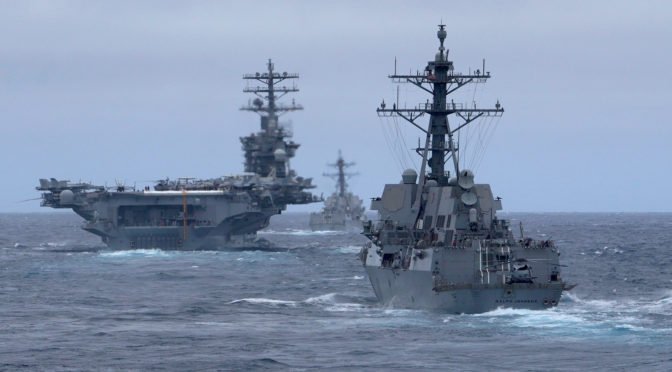
Featured Image: PACIFIC OCEAN (May 14, 2020) The Arleigh Burke-class guided-missile destroyers USS Ralph Johnson (DDG 114) and USS Sterret (DDG 104) transit the Pacific with aircraft carrier USS Nimitz (CVN 68) during a composite unit training exercise (COMPTUEX). (U.S. Navy photo by Mass Communication Specialist 3rd Class Andrew Langholf/RELEASED)