By Dan White and Hunter Stires
The international order has come under immense strain in recent years. Major wars have erupted between the great powers in Ukraine and the Middle East. The U.S.’s top geopolitical rivals have increasingly coalesced, with China and Russia both rapidly modernizing and expanding their arsenals of strategic weapons. Meanwhile, a Chinese invasion of Taiwan looms, possibly backed by Moscow. The current challenges make China’s years-old claims to the entirety of the South China Sea seem quaint and insignificant in comparison.
Hunter Stires, who served as the Maritime Strategist to the Secretary of the Navy during the tenure of Secretary Carlos Del Toro, views each of these challenges as interconnected parts of a global struggle for the Freedom of the Sea and the international order, with the central front in the South China Sea. Stires believes the future of global order rests on the extent to which China succeeds in claiming ownership to one of the world’s most important waterways and disrupting the centuries-old concept of the freedom of the seas upon which the modern global order was founded. Stires helped found the U.S. Navy’s Maritime Counterinsurgency (COIN) Project to better conceptualize and combat China’s battle to overturn the international order at sea. This interview captures Stires’ thoughts on the history of the Maritime COIN project and its ongoing relevance for intensifying strategic competition between the US and China.
Dan White: When most Americans think about China’s naval activities or aggressive behavior in the South China Sea, the predominant topic of discussion is challenging U.S. regional dominance and laying the groundwork for the invasion of Taiwan. You started the Maritime Counterinsurgency Project because you believe China’s actions in its near seas have much broader implications. Can you summarize what you believe is at stake and why Americans who may be skeptical of commitments to regional security in Asia should be concerned about China’s behavior, particularly in some of its more low-level aggressive behavior that it has exhibited towards our allies in the Philippines, or elsewhere in the South China Sea.
Hunter Stires: I think you hit the nail on the head, that when we think about China, we very often like to think about the big things. Every so often you hear about island building, although that was done about 10 years ago. You hear about the growth and the development of the People’s Liberation Army Navy, particularly in capital ships like carriers, cruisers, and destroyers.
What you don’t hear about are these lower intensity efforts to coerce and intimidate local civilian maritime populations in Southeast Asia. It bears repeating, half the world’s fishing fleet operates in the South China Sea. There are probably 3 to 4 million people who depend on access to this body of water for their livelihoods, whether as fishers, or resource extractors in the hydrocarbon industry, etc. China is subjecting this very substantial civilian population to a concerted campaign of intimidation and harassment.
What we are seeing, as you’ve noted, is that these Chinese forces will steal fishermen’s catch. They will confiscate radios and navigational equipment that are essential to safe navigation in busy waters. They will pour gasoline in drinking water supplies of Vietnamese fishermen to force them to return to shore. We see them ram and, occasionally sink or attempt to sink, not only civilian vessels, but ram Philippine Coast Guard vessels in attempts to sinks or disable them as the Coast Guard defend their sovereign rights to their exclusive economic zone as recognized under the UN Convention on the Law of the Sea.
And so, to your point about this broader implication of these kinds of seemingly minor activities in and of themselves, what’s really being contested are actually some of the foundations of that Rules-Based International Order. And beyond international order, it’s really one of the most fundamental principles of the modern system of international law, freedom of the seas.
Freedom of the seas is a principle that is four centuries old. It started with Hugo Grotius, who popularized the idea that the seas are open to everybody. They are a global commons for all mankind. And whatever rights countries have at sea is based on what they have on land. This was a foundational principle of customary international law.
More recently, it has been codified into the UN Convention on the Law of the Sea, which has been accepted by pretty much everyone—China included. The United States hasn’t ratified it because Congress had issues about deep-sea mining, but the rest of the time, we say this is a codification of customary international law, and therefore, we not only follow the law better than anybody else, we take the lead in enforcing it.
The freedom of the sea has been a foundational principle for the United States since before we were a country. It is a principle for which the United States has gone to war no less than six times, not counting numerous smaller constabulary actions by U.S. Naval Forces around the world over the past two and a half centuries.
China is trying to overturn this system of international law and the freedom of the seas, and replace it with its own sino-centric, hierarchical, authoritarian vision of what they refer to as “blue national soil.” As the phrase implies, this means the oceans can be claimed as if they are land. You basically fence off a patch of ocean and stick a flag in it, regardless of where that happens to be. In doing so, they seek to disenfranchise their less powerful neighbors from their rightful exclusive economic zones under international law.
There are generally two ways these two legal orders can contend with each other.
One is the conventional approach, which is where each side gets out their military, they have a fight, and then after the fight is over, the winner sequentially imposes their laws on the civilian population. That’s the sequential method, we generally refer to that as conventional war.
Now for the other option. If one side either doesn’t think they would win that fight, or if they just choose not to engage in that kind of conventional force-on-force confrontation, they have the option to decline battle with the defender of the established order and instead, seek to impose their own laws on a civilian population. That is what you are seeing China do. And we have a term for that kind of campaign design: it’s an insurgency.
Why does this matter, and why should Americans continue to care about the freedom of the seas? Taking a strictly national perspective here, the United States is dependent on the sea for its political, economic, and military access to the overwhelming majority of humanity, which lives outside North America.
If you want to reach anyone in the world in Europe, Asia, and Africa, you’ve got to travel there on or over the water. If the freedom of the sea goes away and can be overturned without so much as a shot being fired—which is a very real possibility if we allow China’s maritime insurgency to proceed unchecked—it will lead to the balkanization of the world’s oceans. This means a variety of avaricious coastal states come along in addition to China and lay claim to a patch of ocean, just because they really want to and have the means to enforce it.
This cuts against this fundamental principle of the rule of law in international affairs as opposed to might makes right. Over the last 80 years since World War II, that principle of the rule of law, has been very positive for humanity. The freedom of the sea in particular has been the foundation of the post-war international order. It is the fundamental enabler of the free and open trading regime that has lifted more people out of poverty and oppression than in any other period of time in human history. The freedom of the sea is worth defending.
In the present environment, where you have China seeking to undo the freedom of the sea without having to go to war against the guarantor of international maritime order, the challenge for the United States is to devise a strategy that can arrest China’s creeping expansionism without having to go to war ourselves, while reassuring these local civilian maritime populations that the rules have not, in fact, changed—that the rule of law remains in force and that they can continue to exercise their rights and pursue their economic interests.
Dan White: On October 28th, the National People’s Congress Standing Committee passed a new maritime law for China that will go into effect in May 2026. China is now creating a framework for settling local cases in its own courts and establishing a parallel regional system of maritime law.
Hunter Stires: That is very consistent with the way China has been pursuing its strategy in the South China Sea. As you said, China seeks to impose its own laws—made in Beijing—on the civilian maritime populations of its neighbors. They seek to do this, again, not by going to war, but by going out and imposing their laws and forcing these fishermen and oil and gas merchants to submit to Chinese dictates or face some pretty horrible consequences.
These laws are designed to intimidate. And now, by creating dispute resolution mechanisms, they seek to position themselves as the arbiter of who governs where, and how resources are allocated in the South China Sea.
The allegory of a mafia group, or a local street gang is instructive here. Imagine you’re minding your own business, living in your neighborhood, and then one day a bunch of scary-looking guys with guns decide they really like your neighborhood, too. And they have decided it’s now their neighborhood, and now nobody gets to walk down the street, nobody gets to operate or patronize a business, without acknowledging the authority of the gang.
It doesn’t matter who they are, by the way. This same story could be told about a Mafia syndicate, a street gang, a drug cartel, a terrorist group. It’s all the same modus operandi. The mafia calls it protection money, China calls it “joint development of offshore resources in the South China Sea.” And so now China is creating a court to adjudicate its protection rackets. Think about the opening of The Godfather. What is Don Corleone doing? He is receiving supplicants and adjudicating cases as a local potentate would in the old days of kings and princes. China would like to do this as well. That certainly fits with China’s vision of itself as the center of world civilization, as the Middle Kingdom surrounded by progressively expanding concentric rings of tributary states and vassals. This is very much in keeping with China’s strategic culture and its sense of itself as the hegemonic power in the region.
What is helpful for the United States and our allies and partners is that the countries that have lived for periods of their history under Chinese domination have found that they don’t like it. Now they are keen to maintain their independence, and especially from such a coercive group of international gangsters as the regime in Beijing. They don’t want to submit to that. And international law has given them rights to these resources under an international order that is fair and equitable—which, by the way, China itself substantially shaped.
The Chinese government claims that, “oh my goodness, the UN Convention of the Law of the Sea was decided before we were powerful, and we didn’t get a say.” That’s complete horseshit. The Chinese delegation was instrumental in the negotiations, particularly in the development of what has become the globally accepted concept of the Exclusive Economic Zone. So, the notion that they were not consulted, that this is like one of the unequal treaties or something that was imposed on China during its century of humiliation, it’s a load of baloney. We should all be much louder in calling it as such.
It’s a good system that is equitable, and we should stand up for it.
Dan White: The Maritime COIN Project began three years ago. How has China’s behavior in the South China Sea evolved since the project started? What changes in behavior has China exhibited in the South China Sea, and has its behavior in the South China Sea expanded into other areas?
Hunter Stires: I’ll back up a bit in terms of the origins of the idea and the project. The concept of maritime insurgency and counterinsurgency we originally put forward in a piece in Proceedings in 2019 called “The South China Sea Needs a COIN Toss,” with a companion piece called “Why We Defend Free Seas.”
The very first person to reach out after those articles was then-Rear Admiral Fred Kacher, who was on his way out to the 7th Fleet to take command of Task Force 76, the 7th Fleet’s amphibious Task Force. Shortly after he got out there, there was this major international incident off Malaysia involving a Malaysian-chartered survey ship called the West Capella, out exploring for oil inside Malaysia’s rightful Exclusive Economic Zone—that has the misfortune of being located inside China’s outlandish claim to indisputable sovereignty the 9-dash line.
And so, this is between March and April 2020, at the moment when COVID started and both of our carriers’ readiness in the region were greatly affected by COVID. Admiral Kacher basically goes to Vice Admiral Merz, the Commander of 7th Fleet, and says, “put us in coach,” because he has a baby flat top, the USS America, which at the time is the first ship in the U.S. Navy equipped with the F-35. So he’s got this very interesting group of capabilities, and he also commands the rotationally Forward Deployed Littoral Combat ships in Singapore. They then set about essentially implementing a trial run of this Maritime Counterinsurgency playbook, where it was a highly successful operational prototype.
Unlike the legacy naval playbook of taking large surface ships, driving through a disputed area, and then leaving, the thesis of the work of this task force was, “how do you influence the local civilian mariners?” The thesis is that the relationship with the civilians and their perceptions are the decisive relationship, not the relationship between U.S. forces and Chinese forces. Under these circumstances a transient operation is not going to have an impact on civilian behavior, whereas demonstrating a persistent presence at that point of gray zone attack is going to be much more effective.
Getting back to the local street gang allegory, it is about demonstrating you have the back of locals. The decisions of the civilians in that situation are going to be based on whether or not they believe that the defenders of the established order can protect them against the reprisals of the gang, should they choose to defy them. In this situation, if the local cops say, “you don’t need to pay the gang protection money,” but the cops are only there 10 minutes out of every day, and when the police cruiser rolling through, the gang will lie low but will reappear and take charge after the cruiser turns the corner.
This is not to say the U.S. Navy doesn’t need the SWAT team, the capability to break down your door, which it very much has in the region, but it also needs that persistent low-end presence, closer to that of the beat cop. This is where assets like littoral combat ships have the potential to be a very effective beat cop in the South China Sea. It’s frankly the mission they were actually designed for.
And so, Admiral Kacher starts out with his larger forces, his big deck amphib, a cruiser, and an Australian frigate. They show up, and they stick around. They are visible and persistent, with very clear public messaging to the world to say, “we are here in support of our Malaysian allies and partners in pursuit of their lawful economic interests.” Every level of the Pacific Fleet followed this very clear and consistent messaging, and the Chinese became quite reticent.
Eventually, Kacher’s big ships have to rotate out but in their place he starts bringing in those littoral combat ships to sustain that presence over time and to continue to demonstrate that persistence. Despite notable Chinese pressure, the Malaysians stuck it out and finished all their planned work as previously scheduled and the Chinese got noticeably de-escalatory. Within the next year, three major regional players, Indonesia, Malaysia, and the Philippines each took a more assertive posture to stand up for themselves and their economic and diplomatic interests in the South China Sea, which is something that hadn’t been seen in years of running the legacy playbook.
The success of that operational prototype was the genesis of the Maritime Counterinsurgency Project, mobilizing the leading minds of maritime strategy to think about how to sustain this effort in a systematic way.
The effect has been fairly noticeable. The Taiwanese press was all over it and covered the Project launch in the same breath as Nancy Pelosi’s visit to the island, framing both as examples of how the United States is putting serious thought into how to back up allies in the region against Chinese coercion. The Chinese were really quite displeased. There was a fair amount of coverage in both English language and Chinese language papers such as the South China Morning Post and the Global Times, basically saying “if the Americans actually do this, this is going to be a real problem for us.”
The effort coincided with the Marcos Administration coming to power in the Philippines, and the dawn of the Philippine Coast Guard’s assertive transparency campaign. U.S. naval operations have subsequently evolved in the region with increased deployments of littoral combat ships to places like Singapore, which give the U.S. Navy a cop on the beat in the South China Sea to serve as a force multiplier to our local partners.
By far the most significant positive change has been the growing strength and effectiveness of both the Philippine Navy and the Philippine Coast Guard. Over the last couple of years the Philippines Coast Guard has coupled its operations at sea with very clear messaging that they are there to protect their local civilian mariners against Chinese depredations. They are providing fuel and food supplies to fishermen and are directly challenging the China Coast Guard. They are filming it as well to show the world the brutish tactics that the China Coast Guard has practiced such as stealing fisherman’s cash, pouring gasoline in people’s drinking water, holding fishermen for ransom at several times for annual income, ramming and sinking boats. Showing the world that China is engaging in systematic maritime lawlessness, if not outright state piracy.
The Chinese have been ramping up their pressure on the Philippines in response. But the most important thing is that the Philippines hasn’t given up and as a result the Chinese have largely failed in achieving most of their objectives.
A number of other organizations have cropped up since the launch of the Maritime Counterinsurgency Project such as Project Myoushu at Stanford University’s Gordian Knot Center for National Security Innovation led by retired Air Force officer Ray Powell.
The U.S. Army, too, has gotten in the game in a pretty exciting way. Look at what General Charlie Flynn was able to accomplish at U.S. Army Pacific with the deployment of multi-domain task force assets and systems like the Typhon missile launcher to the Philippines. The Typhon represent a turnabout of the anti-access, area denial capabilities the Chinese had been trying to establish in the region for years. I highly recommend General Flynn’s contribution to the Maritime Counterinsurgency Project.
Rear Admiral Rommel Ong, the retired vice commander of the Philippines Navy, has made the observation based on the writings of counterinsurgency expert David Galula that the support of the population is gained by an active minority. He asserts that if you look at the entire region of Southeast Asia, and if you position the nations of the region as the population in that insurgency-counterinsurgency relationship, most of them are not going to get off the fence. There is a really long diplomatic tradition of hedging and neutrality in the region and deep relationships, economic and political and otherwise, with China. But he observes that all that is needed is an active minority to succeed here. This active minority can be the United States, Japan, and the Philippines.
I would add South Korea to this grouping as well. South Korea and Japan have played an indispensable role in the buildup of capability of the Philippine Coast Guard and the Philippine Navy. The Philippines now has a highly capable, Japanese-built coast guard and an increasingly capable South Korean-built navy.
China has attempted to reassert itself in response, recently declaring a 30-mile exclusion zone around Scarborough Shoal, declaring it a nature reserve. An ironic gesture given that Chinese activity, including dredging for giant clams, destroyed the place from an environmental standpoint.
The Philippines are holding their own, and their political will is a critical part of deterring China. Admiral Ong has also written about the importance of national will and references “The Cod Wars and Lessons for Maritime Counterinsurgency,” which discusses the brief maritime conflict between Iceland and Britain over access to fishing grounds in the Arctic.
Admiral Ong’s take away is that the Philippines is in a similar position to Iceland, and must sustain the same level of national will to afford the tactical innovation and assertiveness in the water to defend its interests against a bigger opponent. Looking at the Philippines and what they have been able to accomplish over the past couple years, I’d say they are working very assiduously to be more like Iceland in the Cod Wars, and as we know, Iceland won.
Dan White is an independent foreign policy analyst based in the New York Metro Area. Dan is a former member of the The Wilson Center and The Kennan Institute, and a veteran of the War in Afghanistan. Dan maintains a newsletter, OPFOR Journal, which analyzes strategic competitions with Russia, China, Iran and North Korea.
Hunter Stires served as the Maritime Strategist to the 78th Secretary of the Navy, where he was recognized for his work as one of the principal architects of the Maritime Statecraft strategy. He serves as the Project Director of the U.S. Naval Institute’s Maritime Counterinsurgency Project, a Non-Resident Senior Fellow with the Navy League’s Center for Maritime Strategy, and the Founder and CEO of The Maritime Strategy Group.
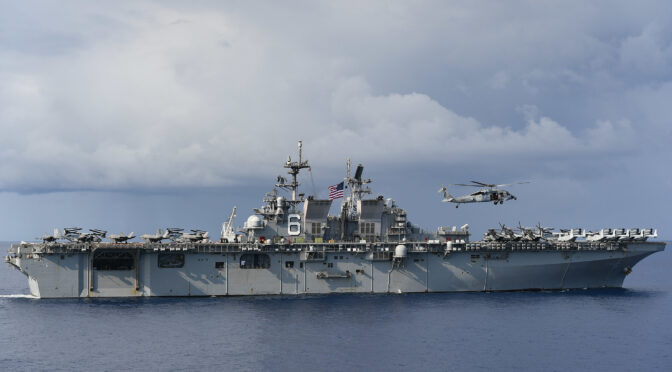
Featured Image: The amphibious assault ship USS America (LHD 6) transits in formation March 24, 2020. (U.S. Navy photo)