
Category Archives: Strategic Outlook

Predictions and forecasting.

Russia Resurgent Week: The Conclusion

By Matt McLaughlin

The Russia Resurgent Topic Week took a big-picture viewpoint of Russia and its strategic choices – and that was perhaps a fortunate approach. With ongoing developments every day with Russian activities in Syria, anything more time-sensitive would have been quickly rendered moot by events.

These events are instructive, though, in the sense that shootdowns and other Russia-NATO incidents are far from unprecedented – it is not difficult to argue that the East-West relationship is simply returning to form. That said, 2015 is not 1985, and the Russian military, in particular its navy, will take a very different form than in the last period of such tense relations. Michael Kofman addresses this, recognizing that although Peter the Great would recognize the Russian strategic imperatives at work, the fleet itself will be oriented toward the green water more than the blue. Small ships with powerful missiles can exert substantial coercive force within their home region, while a small number of legacy platforms like Kirov-class battlecruisers can continue to project power and prestige.

Of course, Russia itself has more grandiose plans, as described by Sean MacCormac in a re-posted article from September about Russia’s new maritime doctrine. Notable strategic priorities are control of the Arctic, presence in the Mediterranean, and cooperation with India and China as means of protecting Russian interests. A great global force is envisioned to provide the operational means to achieve these objectives, though the realities of shipbuilding may intrude.

Patrick Truffer examines the future of Russia’s fleet in great detail, looking at the current structure and capacity for new construction. He assesses the Russian Navy as capable of projecting power globally, but only in a single operation on a limited time horizon. Ongoing activities in Syria are readily displaying limits on Russian logistics and its virtually non-existent amphibious lift capability. But don’t forget a Russian submarine force that remains potent at the strategic level.

Dmitry Gorenburg makes similar points about shipbuilding capacity, while adding more description of operational doctrine and a force structure to implement it. Universal vertical launch tubes filled with precision-strike anti-ship and land-attack missiles can be fitted onto many varieties of small combatants, as well as submarines. These form “the heart of Russia’s naval modernization” and provide the multi-role ships necessary for a credible regional threat.

Shifting gears, Vidya Sagar Reddy finds signs of Sun Tzu’s influence in Russian strategy. By behaving aggressively in widely-dispersed theaters such as the Pacific Ocean and Black Sea, Russia is putting its principle competitor – the U.S. Navy – off balance. This gives Russia the initiative and ability to strike when and where its enemy is weakest.

Robert C. Rasmussen introduces readers to one of the tools Russia has been using to unbalance its foes – Reflexive Control Theory. If applied doctrinally to strategic communication, Reflexive Control Theory helps Russia keep outside powers uncertain as to real Russian intentions and operations. The end result is to induce foreign powers to make decisions favorable to Russian interests. This obfuscation has contributed, most notably, to keeping foreign powers from intervening in Ukraine, and (to use the most recent news) is probably at work in Russian accounts of its Syrian air strikes.

Despite superficial success – they’re operating in the Med, right? – Ben Hernandez asks if Russian maritime strategy is in fact adrift. This essay, re-posted from August, notes the extreme mismatch between rhetoric about the future and capability to build it. This has been described in other posts this week, but Ben adds that Russia could easily “paint itself into a corner” if it continues down this road. With nuclear weapons as the most cost-effective means of destruction, their employment in a fit of bellicosity grows more likely when Russian conventional capabilities cannot deliver the desired effects.

Finally, our gaze shifts to the Arctic, which appears in Russian strategic planning and is the subject of two posts. Laguerre Corentin makes the case that, in contrast with the bellicose rhetoric described in prior articles, Russia is positioned to pursue its objectives through application of international law and custom. It has had success with this approach since Czarist days, and is likely to continue to do so as long as its interests align with such methods.

Providing further analysis of Russia’s role in the Arctic, we reprise Sally DeBoer’s contribution from August about rival nations’ claims to Arctic territory. She examines Russian claims of the North Pole and other parts of the “donut hole” of high seas at the top of the world, as well as competing claims.

And closing out the week is a graphic depiction of the Soviet fleet of 1990 compared with the Russian fleet of 2015, researched and designed by Louis Martin-Vezian. The scale of the work ahead if Russia intends to reach the maritime heights of 25 years ago becomes clear.

Some have said over the years that post-Soviet Russia was only relevant on account of its nuclear arsenal. This was merely an excuse to ignore it in favor of other things as we met the supposed End of History. The fact is, Russia is, well, Russia – and as long as people call that territory home, those people will have certain interests that are not going away. Read a map; read a book; read the news. This week’s discussions have certainly not provided all the answers on Russian resurgence, though we hope to have offered a meaningful contribution; but to ignore the discussion and downplay Russia as a relic of the Cold War is folly. Russia is right where we left it, and will continue to make its impact felt.

Matt McLaughlin is a U.S. Navy Surface Warfare Officer. His opinions do not represent the Department of the Navy.

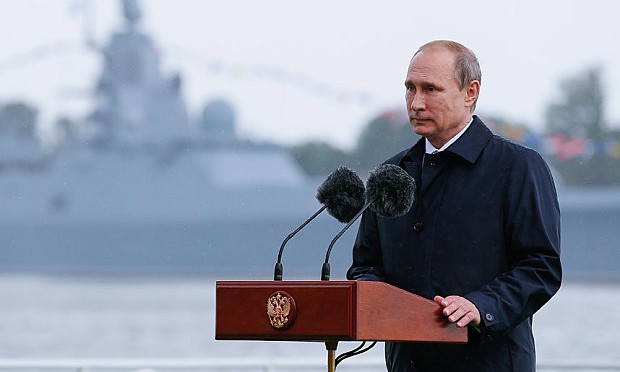
Cutting Through the Fog: Reflexive Control and Russian STRATCOM in Ukraine

Russia Resurgent Topic Week

By Robert C. Rasmussen

But if I wanted to I could take Kiev in two weeks.” – President Vladimir Putin

Introduction

As the Russian Federation continues to fuel a protracted war in Ukraine, it is employing a method of strategic communication that has left policy makers, media outlets, and ordinary people confused and worried. The decades-old Soviet doctrine of Reflexive Control Theory[i] is a method of information warfare at the strategic and operational levels. This use of Reflexive Control Theory is an attempt to influence the decision-making processes of the Ukrainian government, the rebels, the international community, and the Russian people.  It is designed to support Russia’s strategy of maintaining Ukraine as a semiautonomous region with independence as a mere formality.

[otw_shortcode_button href=”https://cimsec.org/buying-cimsec-war-bonds/18115″ size=”medium” icon_position=”right” shape=”round” color_class=”otw-blue”]Donate to CIMSEC![/otw_shortcode_button]

Reflexive Control Theory as Doctrine

Reflexive Control Theory was developed by Soviet military strategists in the 1960s. The premise is relatively simple: use deception and disinformation to shape an opponent’s perceptions of the situation so it voluntarily selects the courses of action most conducive to one’s own interests. It is exactly this type of application of Reflexive Control that a young Vladimir Putin would have learned in his early development at the 401st KGB School and in his career as a KGB/FSB officer. While in principle applicable at many levels, it particularly lends itself to communications at the strategic level.

Russia’s Use of Reflexive Control in Strategic Communications

Russia’s strategic communications regarding Ukraine are calculated to shape outside perception of Russian actions, and opponents’ reactions. In doing so, Russia hopes to induce actions that work in favor of the Russian government.[ii] A combination of the haze of battle and political obfuscation can help create whatever story Russia wants for whatever audience it wants. The targeted audiences for specific messaging campaigns are pro-Russian separatists, the international community, and lastly the Russian people.

Russia’s strategic communications towards the rebels in eastern Ukraine have focused on keeping them in the fight. Two key messages pushed by Russia to keep rebels fighting are the message about Ukrainians in power being anti-Russian fascists, and how Russian administration of their territory would be better for the people there. There has been additional focus on the damage caused by warfare and the disruption of the lives of ordinary people in order to continually focus the anger of the rebels and keep up their will to fight.

The focus on the international community seems to be deterrence from entering the conflict at all. By keeping the fog of war rolling over the combat zone and increasing chaos, the situation is unpredictable.  This unpredictability combined with a lack of political will effectively eliminates any possibility of direct action by an external actor.  Russian displeasure at international sanctions encourages other actors to take out their displeasure through sanctions instead of directly supporting Ukraine with personnel, equipment, and aid money. In a very real sense, sanctions are a diversion. Russia has a large territory with a large quantity of people. Russia has previously isolated and restructured its economy in a manner that ensured relative strategic successes, and this capability is within the generational memory of current leadership. Accepting sanctions in the short term is strategically analogous to giving up territory to Napoleonic and Nazi armies, knowing that time is on Russia’s side.

Messages to the domestic population create moral justification for supporting rebels and the prospect (now realized in an on-again, off-again fashion) of widespread combat operations in eastern Ukraine. The overwhelming majority of news media is either state-controlled or controlled by owners loyal to President Putin. Meanwhile Putin’s political party, United Russia, has a simple majority in the State Duma. There is an overwhelming support base that is loyal to Putin’s government. These elements, put together, create unquestioned messaging pushing the idea of a fascist government in Kiev that does not represent the views of even a plurality of Ukrainians. This “illegitimate” Ukrainian government, according to the message, is only in control due to the brute force of a small Euromaidan mob.  By sending humanitarian convoys with military escorts into Eastern Ukraine, Russia is trying to demonstrate its humanity. The point of this messaging is to focus popular rage on the Ukrainian government. Such rage can be channeled into support of sustained combat operations and weathering the effects of economic sanctions.

Conclusion

Russian strategic communications regarding Eastern Ukraine have involved messaging crafted with the doctrine of reflexive control in mind. The concept of reflexive control focuses on tricking an opponent or audience into making decisions that works to an actor’s advantage, and has been a core doctrine of Soviet and Russian security forces since the 1960s. This concept shows itself in the messaging that Russia has given to various audiences and its pronounced effects – it keeps separatists fighting, maintains popular support, and prevents foreign intervention.

Robert C. Rasmussen is a Second Lieutenant in the New York State Guard, and currently serves as Aide-de-Camp to a Brigadier General. He has a MA in International Relations and a Certificate of Advanced Studies in Security Studies from Syracuse University’s Maxwell School of Citizenship & Public Affairs. He also has a BA in International Relations & Geography from the SUNY College at Geneseo. He has previously worked as a Legislative Policy Fellow for the New York State Senate, a Research Intern at the U.S. Military Academy, and as a Research Intern the National Defense University. His views are his own and do not reflect the views of the New York State Guard or the New York State Division of Military & Naval Affairs.

Read other contributions to Russia Resurgent Topic Week.

[otw_shortcode_button href=”https://cimsec.org/buying-cimsec-war-bonds/18115″ size=”medium” icon_position=”right” shape=”round” color_class=”otw-blue”]Donate to CIMSEC![/otw_shortcode_button]

[i] Thomas, Timothy L., “Russia’s Reflexive Control Theory and the Military,” Journal of Slavic Military Studies, Vol. 17: 2004, 237-256, http://www.rit.edu/~w-cmmc/literature/Thomas_2004.pdf, Accessed: 4 September 2014.

[ii] Ginos, Nathan D., “The Securitization of Russian Strategic Communication,”  U.S. Army School of Advanced Military Studies, Defense Technical Information Center, Fort Belvoir: 2010, http://www.dtic.mil/dtic/tr/fulltext/u2/a536578.pdf, Accessed: 4 September 2014.

Russian Navy Reads the Art of War

Russia Resurgent Topic Week

By Vidya Sagar Reddy

The Russian Federation intends to restore prestige and territory lost with the fall of Soviet Union. The key military objectives associated with this geopolitical thrust are confronting the eastward expansion of the North Atlantic Treaty Organization (NATO) over the European continent and denying the United States free access and power projection in the global commons, specifically in the maritime domain. Vladimir Putin personally announced a new Russian maritime doctrine reflecting these objectives. In this process, the Russian Navy is showcasing characteristics reminiscent of Sun Tzu’s Art of War.

[otw_shortcode_button href=”https://cimsec.org/buying-cimsec-war-bonds/18115″ size=”medium” icon_position=”right” shape=”round” color_class=”otw-blue”]Donate to CIMSEC![/otw_shortcode_button]

Referring to Sun Tzu is not a new phenomenon for traditionally Western navies. Germany’s emperor Wilhelm II wished he could have read Sun Tzu before World War I and General Douglas MacArthur was known to have referred to his teachings. An analysis of Russia’s way of warfighting in Ukraine, especially across Crimea, revealed the application of Gerasimov Doctrine that advocated targeting an adversary’s weaknesses while avoiding direct confrontations. This is one of the significant principles of asymmetric warfare preached by Sun Tzu.

Sun Tzu’s famous dictum is that all warfare is based on deception. He counselled that one should appear weak when strong and strong when weak. He advised showing presence at places where not expected by the adversary and striking at weak points. Denial and deception were the key tactics employed by Russia when annexing Crimea and gaining the warm water port of Sevastopol permanently. The Russian Navy played phantom games within the territorial waters of Baltic countries and buzzed US warships in the Black Sea and the Pacific Ocean.

By showcasing presence and performing unsafe activities in the maritime zones flanking its territory and other areas of interest, the Russian Navy intends to deter its adversaries from concentrating their resources on its current maritime zones of interest – Europe and the Middle East. For Putin, Ukraine and Syria are the proving grounds for Russia’s re-emergence in the international order. It is imperative to deny other navies from gaining an upper hand in these zones either for military strikes or for reinforcing diplomatic manoeuvring.

However, the negligence on the part of Russian administration towards the navy weakened its strength and technological sophistication to directly confront the navies of the US and NATO. This makes it imperative for the Russian Navy to adopt the asymmetric means of warfighting. Therefore, the Russian Navy is enumerating the art of sea denial by constructing an ‘arc of steel’ between the Arctic and the Mediterranean via the Baltic and Black Seas. This resembles, at least in conceptual terms, China’s Anti-Access/Area Denial (A2AD) strategy in the Western Pacific, which is itself influenced by Sun Tzu’s teachings.

The students of Mahan know that the raison d’être of a navy is to keep open the sea lines of communication and protect the trade passing through them. A strong navy is especially critical for the US, concerned as it is with its relative decline in the global order after the wars in Iraq and Afghanistan and concentrating on economic rebuilding. By operationalizing a local but strong sea denial construct, the Russian Navy is setting a limit on its competitors’ power projection capabilities.

Lacking unimpeded access to the maritime domain also curtails free movement of trade and affects the economy of the US as well as of its allies and partners in Europe. This is what primarily concerned the US Chief of Naval Operations, Admiral John Richardson, as he spoke about the adverse impact of Russian maritime activity on the trade transiting the Mediterranean. In essence, the Russian Navy is practicing a prominent dictum of Sun Tzu – winning without fighting.

Apart from securing trade, the US Navy also performs global power projection for deterring and defeating aggression against American interests. Such a task involves providing sufficient numbers of warships fitted with advanced sensors and weapons. The political administration directs these assets to be deployed in certain areas of responsibility, protecting interests and responding to threats. The Obama administration ordered deployment of sixty percent of US naval assets to the Asia-Pacific for maintaining peace and stability in this region, upon which the US economic build-up is dependent.

A significant portion of these assets are appropriated as a response to China’s naval build-up and its assertive maritime activities. The US Navy is expected to handle any military aggression in this region without serious operational concerns arising in other areas of responsibility. However, it would be hard-pressed to contain the rise of a serious threat in another region with the backdrop of the US’ declining capability to fight and win two major regional contingencies simultaneously.

To relieve this situation, the US Navy and its patrons in the US Congress have vehemently opposed imposition of “sequestration” on the force’s budget, but constraints remain. A fierce battle erupted in Congress regarding funds for new ballistic-missile submarines (the Ohio Replacement Program). The construction of Ford-class carriers and Littoral Combat Ships is advancing but with criticism and budget shortfalls.

On the operational front, the US Marines are contemplating plans to hitchhike on private vessels to reach forward positions. And the US Navy is now operating in the Middle East without a carrier for the first time in recent years while the region is experiencing renewed conflicts. These issues point to the fact that the US Navy is indeed overstretched and short-funded.

This is the weak point Sun Tzu would strike at. Thus the Russian Navy has opened another contested maritime zone. To confront destabilizing Russian naval activity, the chief of the US Sixth Fleet is pressing for deployment of additional warships in his area of responsibility while Admiral Richardson contemplates enhanced presence in Europe.

If carried out, it might require transferring a few platforms intended for the Asia-Pacific before the US shipbuilding activity reaches a level to satisfy the emerging requirements. Attempting to convince the present White House administration of such a transfer would be in vain. Therefore the dilemma persists within the US Navy and the White House which maritime zone should be accorded primary focus.

By aggressively parading the navy and establishing its sea denial construct, Russia is aiming to incapacitate the navies of the US and NATO from performing their fundamental roles of protecting trade, safeguarding global commons and power projection. The Russian naval threat has driven the logic of numbers and maritime strategy of the US Navy to ground, forcing an overhaul. Without the American naval support, the NATO forces would also experience serious constraints. Thus the navy is emerging the spearhead of Russia’s re-emergence and offence against its adversaries by simply referring to Sun Tzu.

Vidya Sagar Reddy is a Research Assistant at the Observer Research Foundation, New Delhi.

Read other contributions to Russia Resurgent Topic Week.

[otw_shortcode_button href=”https://cimsec.org/buying-cimsec-war-bonds/18115″ size=”medium” icon_position=”right” shape=”round” color_class=”otw-blue”]Donate to CIMSEC![/otw_shortcode_button]

Russia Resurgent Week Kicks Off on CIMSEC

By Matt McLaughlin

Welcome to Russia Resurgent Week at CIMSEC, where we attempt to shed some light on Russia’s objectives, capabilities and constraints. Russia has occupied the headlines for a variety of reasons in recent weeks, but this is not the place to visit for the latest updates. Rather, this week investigates the broad phenomenon of post-Soviet Russia’s rise. What are its tools? What will it do with them, and where? How do recent events fit into a broader strategic framework?

An impressive stable of international writers has contributed on a variety of Russia-related subjects. Interspersed are some pieces published earlier on CIMSEC that complement the latest work. We hope that by the end of the week Russia will be slightly less of a mystery, if still an enigma.

1 – The Russian Navy: Strategies and Missions of a Force in Transition By Michael Kofman
2 – The New Russian Naval Doctrine By Sean MacCormac
3 – The Development of Russian Naval Capabilities after the Cold War By Patrick Truffer
4 – Shipbuilding Constraints Drive Downsized but Potent Russian Navy By Dmitry Gorenburg
5 – Russian Navy Reads Sun Tzu’s Art of War By Vidya Sagar Reddy
6 – Cutting Through the Fog: Reflexive Control and Russian STRATCOM in Ukraine By Robert C. Rasmussen

7 – Is Russia’s Maritime Strategy Adrift? By Ben Hernandez
8 – Russia in the Arctic: Aggressive or Cooperative? By Laguerre Corentin
9 – Yours, Mine and Moscow’s: Breaking Down Russia’s Latest Arctic Claims By Sally DeBoer
10 – Russian & Soviet Fleets, 25 Years Apart  By Louis Martin-Vezian

Matt McLaughlin is a U.S. Navy Surface Warfare Officer. His opinions do not represent the Department of the Navy.

[otw_shortcode_button href=”https://cimsec.org/buying-cimsec-war-bonds/18115″ size=”medium” icon_position=”right” shape=”round” color_class=”otw-blue”]Donate to CIMSEC![/otw_shortcode_button]