Asymmetry is a very popular word these days and, in my estimation, one applied too frequently to too many things. Prof. Robert Farley makes the point that asymmetric expectations lie at the foundations of decisions about all battles. “Combatants engage because they have different expectations about likely outcomes,” he says. But not every search for gaining advantage in battle is asymmetric. Using all available means and conditions to throw an opponent out of balance is a core of Liddell Hart’s indirect strategy. So perhaps returning to symmetry and conceptually focusing on symmetric warfare would help ease understanding of complex problems related to ship roles and design.
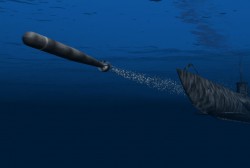
Asymmetry is a strategy of weak against strong. One side has no chance to match its opponent in a blow-for-blow fashion, and instead uses a type of attack for which the stronger opponent has developed ineffective defenses. This is more of a conceptual framework than anything tied to a particular weapon, and in fact the same weapon can be both asymmetric or symmetric attacks depending on its use. Torpedoes launched by a destroyer against a battleship constitute asymmetric warfare, but launched against another destroyer screening that battleship becomes symmetric. PLA Navy anti-access doctrine and capabilities are asymmetric versus the U.S. Navy, but the same capabilities linked to a more Mahanian concept would be symmetric versus JMSD Forces, or overwhelming versus the Vietnamese Navy. In the last case we would witness a reversal of roles.
Asymmetry is also a transient phenomena. Use of torpedo boats was seen by Jeune Ecole as an asymmetric strategy aimed at Britain’s Royal Navy and its commerce, but very soon the British were able to control this threat and reinstate the symmetry by creating the destroyer. The same torpedo, supported by excellent training, was part of an Imperial Japanese Navy asymmetric strategy in night actions against the (locally) numerically superior American counterpart. Radar soon nullified this concept, although as Capt. Wayne Hughes noted in his Fleet Tactics and Coastal Combat, it took some time for the U.S. Navy to grasp the concept of using the radar, in spite of the fact that it was already technically in service during the battle at Savo Island.
…and frozen yogurt surprises!
The advantage of conceptually coming back to symmetry as a guiding principle is seen in the way warships were built and designed in the past. A battleship was supposed to carry offensive weapons able to destroy the battle fleet of an enemy. At the same time, armor was to give it protection against similar (symmetric) opponents. In the case of cruisers the story was different, mostly because of Washington Treaty limitations, but the last cruiser designs without such limits returned to the need to fight opponents of the same class. For modern ships it would be much easier to think in terms of their primary mission, while taking as a rule ability to fight a similar class opponent.
Looking at a contemporary example, the LCS surface warfare mission package’s primary mission is to counter asymmetric threats, like swarm attack, but it lacks capabilities to counter a symmetric opponent like a missile corvette. My analysis could be viewed as an oversimplification, but could nonetheless help frame part of what should be a rational discourse among people who have no chance get to grips with real-world CONOPS. I like the way Master Chief Petty Officer Brett F. Ayer explains Offshore Patrol Cutter requirements.
Przemek Krajewski alias Viribus Unitisis a blogger In Poland. His area of interest is broad context of purpose and structure of Navy and promoting discussions on these subjects In his country
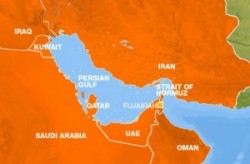
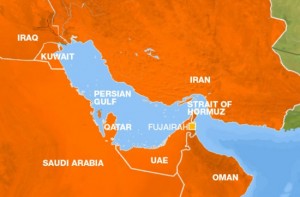
Late last year, Iran began threatening to close the strait of Hormuz in the Persian Gulf. At their narrowest point between Iran and Oman, the Strait are only 21 miles wide, but they have a perceived significance out of all proportion to their size, as some 17 million barrels of oil pass through them every day.
This story was recently brought home in a long article in the Financial Times on 5 October by author, Javier Blas. His source was a report by the US Energy Information Administration published 22 August 2012 entitled World Oil Transit Chokepoints.
Here is the gist of Blas’ argument. International sanctions have taken a grim toll on Iran. The Iranian economy is in horrendous shape, and the oil has lost 60% of its value since the beginning of the year. Merchants have gone on strike as a result. President Ahmadi-Nezhad is in his final term in office and he and his supporters have been increasingly sidelined by more conservative elements within the Iranian regime. Could it be, as Blas suggests, that Iran has less to lose now than ever before and that closing the strait — even if only a diversionary tactic by the president — is now more likely than ever?
It should be remembered that the 17 million barrels passing through the strait of Hormuz daily constitute only 35% of the world’s oil. Apart from Iran itself exporters of oil primarily threatened by closure of the strait would be the Gulf states of Kuwait, Bahrain, Qatar. All their oil goes through the strait. Iraq, the United Arab Emirates, and Saudi Arabia, would also be affected, but not all their oil moves through the strait (the respective figures being 87%, 55%, and 48% of exported oil). So these countries, in so far as they are exporters of oil, would suffer greatly if the strait were closed.
But Gulf states such as Abu Dhabi and Saudi Arabia have built pipelines which, when fully operational, will vastly reduce their reliance on the strait. It must be said, however, that the pipelines will only be ready in about 18 months, which may be too late. This strategy, though, is sound in principle, and other gulf states should find similar means to avoid relying on a single route of export.
What about the West? Though the effect of closing the strait would not be negligible, it would not be catastrophic either — at least as far as oil supply is concerned. Only 16% of America’s imported oil passes through the strait, followed by Germany’s total of 5% — numbers which are dwarfed by statistics for Japan, South Korea, India, and China whose respective figures are 82%, 74%, 63%, and 43%. So it would seem that western countries have much less to fear from a closure of the strait than does Asia, at least as far as oil supply is concerned.
None of this is to say that closure of the strait would not have a profoundly negative economic effect, which it certainly would. But the effect would not be permanent. And in every crisis lies opportunity. In the event that the strait were indeed closed, thereby denying enormous amounts of oil to Japan, South Korea, India and China, two countries may stand to gain from supplying them.
The first is Russia. Russia produces 10.41 million barrels of oil a day, just slightly higher than Saudi Arabia’s output. According to the CIA, Russian reserves must be about 60 billion barrels, and there is much more to be discovered, so we can expect output to go up. But this would surely be augmented by the supposed 100 or so billion barrels of oil in Central Asia, historically within the Russian sphere of influence, and which Russia would almost certainly monopolize. In theory Russia and Central Asia could well end America’s partial reliance on gulf oil and supply large amounts to Japan, South Korea, India, and China at the same time.
But the strategic concerns here would be enormous. Thanks to Presidents Putin and George W. Bush, Moscow now has renewed ties with Kabul, where it exercised influence throughout the 20th century. Could Russia pass up the opportunity to restart its drive towards the Indian Ocean in search of an ice-free port? Much of the necessary infrastructure is already in place, and if Russia developed oil reserves in the former Soviet Central Asian republics (as well as its own), transport to China and India via the Wakhan corridor in Afghanistan and rail links from Uzbekistan via Mazar-i Sharif through Afghanistan and Pakistan would be essential. Construction of such links has been in planning for some time. But a port on the Indian Ocean, perhaps with Pakistan’s coerced permission, would be ideal for transport of Russian oil to India and beyond. Thus American naval superiority in the Indian Ocean (based on the tiny British atoll of Diego Garcia) would be entirely outflanked, and the Fifth Fleet, stationed on Bahrain, could not offset this. The result might be naval race of terrifying scale.
If closing the strait of Hormuz could lead to Russian dominance of the Asian oil market, many will argue that it would be best to keep them open at almost any cost. Many may therefore be pleased to know that the second country standing to profit from closure of the strait is Canada. Alberta’s Oil Sands are expected to yield about 4 million barrels a day by 2015, a puny amount that is easily outstripped by Russia’s colossal daily output. But Canada’s reserves are greater than those of Russia and Central Asia combined. In 2008, the government of Alberta estimated that 1.75 trillion barrels of oil could be extracted from the OilSands. Admittedly, however, only about 10% of this can be extracted in an economically viable manner at present. But 1.75 billion barrels is still a formidable amount and might well match or surpass Russian and Central Asian reserves. Output could also be increased with more investment that would further benefit Canada by creating jobs.
Canadians might look forward to a day when domestic oil reserves foster a massive national industry with international reach, both to America to the south and across the Pacific — and this without the alarming geostrategic concerns attending the rise of Russia. It is also worth noting that exporting oil from Canada across the Pacific would obviate another oil transit chokepoint: the strait of Malacca connecting the Indian and Pacific oceans. Canada’s dominance as an ‘energysuperpower’, as some have said, would require an enormous amount of investment in infrastructure and political will to see it through, but it might well be worth it.
The high potential of the Oil Sands is not in doubt, but transport of oil through pipelines (notably the proposed expansion of the Keystone XL and the Gulf Coast Project) remains highly controversial both in Canada and the United States. And the environmental questions hanging over the Oil Sands themselves cannot be ignored either. So it may be some time before Canada can compete seriously with other oil-exporting countries — if ever. In the meantime, it will be best for everyone that the strait of Hormuz remain open. But Canadians may well wish to consider that Canada’s role as an ‘energy superpower’ may be infinitely preferable than other alternatives.
Michael Bonner studied Iranian history at Brasenose College in the University of Oxford. He is widely published on pre-Islamic Iran in both English and French, and his master’s thesis was published a year ago by Studia Iranica in Paris. Michael is a member of the Balkh Art and Cultural Heritage project, an archeological team based in Oxford devoted to the study of the ancient city of Balkh near modern-day Mazar-i Sharif in northern Afghanistan. Any views or opinions expressed in this article are solely those of the authors and the news agencies and do not necessarily represent those of the Atlantic Council of Canada. This article is published for information purposes only.
The U.S. runs a succesful series of Fleet Weeks across the country, bringing exposure to the sea services even in those corners of the country far from a sea. These events aim in part to educate Americans on the importance of their sea services for ensuring freedom of navigation for the 99% of overseas trade by volume that is transported by ship and the ability to project power abroad(CDR Doyle Hodges had a good article last week on the importance of international maritime security). From a self-interest standpoint, this outreach is also important when these citizens’ elected representatives look to make cuts to spending and military programs. After a decade of land wars, the sea services have some ground to make up. Last year, Gallup polled Americans on the relative importance of the different branches of the Armed Forces using the following question:
Just off the top of your head, which of the five branches of the Armed Forces in this country would you say is the most important to our national defense today?”
Respondents gave the Air Force 17%, Army 25%, Marines 24%, Navy 11%, Coast Guard 3% and equal importance 16%. In May 2001 the numbers were Air Force 42%, Army 18%, Marines 14%, Navy 15%, Coast Guard 0%, and equality at 9%. Operations in Iraq, Afghanistan, and Libya appear mostly to have bolstered perceptions of the Army, Marines, and equality at the expense of the Air Force; but this still leaves large room for improvement in the understanding and appreciation of the functions of the sea services.
Canada has a similar problem, and CIMSECian James Bridger calls it “Maritime Blindness.” Writing for the Atlantic Council of Canada, he states:
Maritime Blindness: Three Oceans is No Cure.
As a nation surrounded by three oceans and the great lakes, Canada’s maritime security has been of preeminent importance throughout the country’s history. A secure marine environment is also essential to Canada’s prosperity. Despite this marked significance, there has been recent concern that Canada has slipped into a state of “maritime blindness,” characterized by a general lack of awareness concerning issues of national and global oceanic security. This problem is particularly pronounced in central Canada, along the Toronto-Ottawa-Montreal corridor.
Seeking to address this weakness, The Atlantic Council of Canada (ACC) has taken a greater role in investigating and highlighting the strengths and weaknesses of Canadian maritime security and matters concerning our surrounding waters. Our goal is to raise public awareness and encourage debate about Canada’s most important frontier.
Doing good work in the land of Moose and Ice Hockey, James developed this idea into a primer on the Canada’s maritime background, and with another CIMSECian, Andrew Walker, in May kicked off the publication Maritime Nation to help Canada counter the effects of maritime blindness. In addition to helping illustrate the challenges and opportunities of the sea for the Canadian public, the products provide some good nuggets on Canadians approaches to maritime problems and concepts, such as a focus on maritime domain awareness:
Reflecting a “whole of government” approach to the problem, the Department of Defence, in cooperation with the Canada Border Services Agency, Department of Fisheries, Canadian Coast Guard, RCMP and Transport Canada, have recently established three Marine Security Operations Centres (MSOC)—located in Esquimalt, Halifax, and on the St. Lawrence Seaway.
If you have a few minutes, both the primer and the publication are easy to read and definitely worth a look, offering insights on cooperation with the U.S., and options arising from the unfreezing Arctic.
“What is International Maritime Security?” is an excellent post, framing the question against the common interests, threats, and resources of nations in the effort to keep maritime commons secure. Why are these dynamics and underlying processes so complex, and what we can do with that knowledge? Professor Mearsheimer’s work The Tragedy of Great Power Politics, notes Kurt Albaugh, helps provide some answers. It discusses great powers’ search for ultimate security, possible only through hegemony. But it leaves untold the story of great powers’ neighbors. These states have a need for national security disproportionate to the real threat, which Prof. Mearsheimer explains in following way:
When a state surveys its environment to determine which states pose a threat to its survival, it focuses mainly on the offensive capabilities of potential rivals, not their intentions.
Moreover, in such a case the “stopping power of water” likely doesn’t apply, not only because neighbors could share a land border but also because defensive power is not strong enough to check a great power’s short-distance naval assault. The Impact on the navy is important. In the event of a neighbor’s build-up, the smaller neighbor’s scarce financial resources would be devoted to building as much war-fighting capabilities as possible, depleting a budget very quickly. The maritime security mission becomes a “nice to have” item, especially protecting the maritime commons, which is possibly perceived more as a foreign affairs than defense issue. The corresponding fleet composition is summarized well with another observation made by D.K. Brown in Future British Surface Fleet: Options for Medium-Sized Powers, discussing individual ship design:
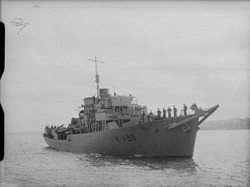
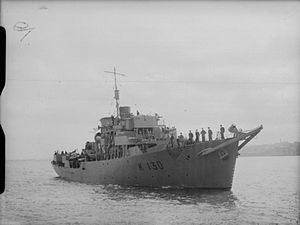
This is discussed by Khudyakov, who points out that one can optimise for maximum effectiveness at constant cost or for minimum cost at constant effectiveness. Carried to extremes, he sees the one leading to what he aptly calls the Super Battleship Paradox, the other, emphasising numbers at the expense of capability, to the Chinese Junk Paradox. One may, however, wonder if the Royal Navy’s Flower-class of World War II was so limited in capability that it fell into the latter category.
The end result is a navy consisting of a very few “Super Battleships” to defend against the great powers, and under-appreciated fleet workhorses like the Flower-class to carry out International Maritime Security missions. The Naval Diplomat might offer a solution to that problem. The concept of a “Fortress-fleet” operating under the umbrella of land-based aircraft and missiles would allow a smaller nation to forgo the “Super Battleships” and develop a fleet much more oriented toward International Maritime Security. Such “fortress” should satisfy demand for national security, cover the gap between a real threat and its perception, and allow the nation to build much lighter naval forces, which theoretically could be more focused on diplomatic and constabulary missions. Governments would be also more inclined to invest in dual-use, army and navy weapons like aircraft, instead of very expensive systems with only a naval application. Rooted in the views of A.T. Mahan, this distant descendant of his original concept answers partially its critics. Fleets thus freed to get involved in international cooperation in distant waters are no longer inactive and without initiative.
Przemek Krajewski alias Viribus Unitis is a blogger In Poland. His area of interest is broad context of purpose and structure of Navy and promoting discussions on these subjects In his country