Category Archives: History

Naval and maritime history section.

New Strategic Geography Ends “Long Army Century”

Some historians attempt to reframe the timeline of history in order to highlight trends that might otherwise remain submerged in more traditional categories. The British Marxist historian Eric Hobsbawn, for example, re-classified the long period from the French Revolution to the beginning of the First World War as the “long” 19th century. This change showcased a particular period of European ascendency through the Napoleonic, Revolutionary, Victorian and Edwardian periods. A similar effort might now be applied to the influence of the U.S. Army on United States strategic thinking. A “Long Army Century” is now drawing to a close due to new strategic geography and shrinking defense budgets.
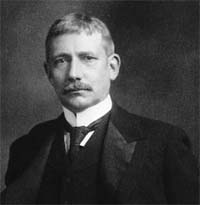
ElihuRoot
Elihu Root

The “long Army century” arguably began in 1904 with the selection of New York corporate lawyer Elihu Root as the Secretary of the Army by President William McKinley in 1899. While the U.S. Army had been victorious in Cuba in the Spanish American War, its organization, operations, and logistics during that conflict revealed deep flaws that might circumscribe future success. Root undertook an aggressive program that created the modern Army General Staff, the Army War College, and the Joint Army Navy board for inter-service cooperation.
The Chief of Staff system, modeled on methods then used by American business, was a great success. Root’s reforms created the “modern” Army that was able to mobilize large numbers of volunteers for the First World War. This system eagerly embraced new technologies such as the tank and the airplane, and was successful in deploying millions of Americans to fight in France in a relatively short time. The Army also had great influence over large numbers of civilians for the first time since the Civil War, as high ranking Army leaders served in key roles on the War Industries Board that coordinated U.S. war production.

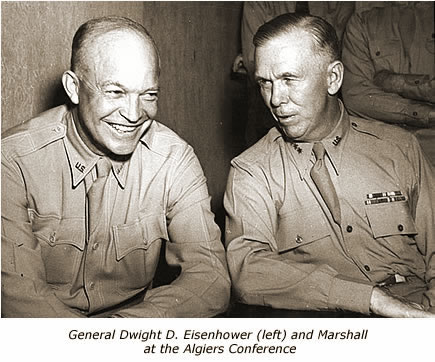
The end of the First World War brought a reduction in overall Army influence, but future influential leaders including George C. Marshall, Dwight D. Eisenhower, George Patton and many others were direct products of Root’s post-1903 reforms. These leaders fought the Second World War, and others again occupied significant roles in civilian government like General Leslie Groves who managed the Manhattan Project. The end of World War 2 should have brought about another reduction in Army strength and influence, but the emerging Cold War and the strong personalities of Marshall, Eisenhower, and other products of the Root Army War College had other ideas.
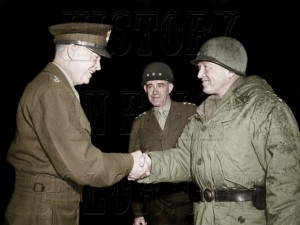
Eisenhower Patton
Eisenhower Patton Bradley

The Army targeted the Navy as unfairly hoarding resources in a “parochial” manner in order to gain its share of scarce financial resources at the beginning of the Cold War. One of the best ways to do this was to advocate for a unified “joint” military force with relatively co-equal branches under a supreme “generalissimo” of the U.S. armed forces. This is not surprising given the wartime experience of the post World War 2 U.S. Army leadership. Officers such as Marshall, Eisenhower, and Omar Bradley served primarily in the wartime European theater of operations where land and air warfare were the predominant modes of fighting. The “Battle of the Atlantic” against the German U-boat arm never fell under Eisenhower’s direct supervision. He and other Army officers respected the ability of naval forces to mount the Normandy invasion, but had little or no direct experience with naval combat. Postwar naval leaders such as Chester Nimitz, Forrest Sherman, and Arleigh Burke by contrast had experienced a relatively decentralized war in the Pacific. Nimitz and Army general Douglas MacArthur shared command authority and responsibility in a collaborative manner unlike the Army Chief of Staff system with one overall commander. As a result of this difference in leadership style and the fierce competition with the Navy and later the Air Force for funding, the Army enthusiastically adopted concepts of “joint” organization and control of the armed forces throughout the Cold War. Dwight Eisenhower as President tried to implement joint concepts of organization for the Department of Defense as a result of his war experience, but was thwarted in his efforts by key pro-Navy Congressional leaders.
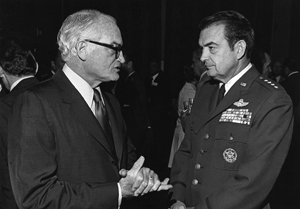
Goldwater Jones
Senator Goldwater and CJCS General David Jones

The long and unsuccessful Vietnam War and end of the military draft in 1973 should have brought about a reduction in Army strength and influence, but the Army was again able to avoid large cuts by shifting to an all-volunteer force and refocusing on the European threat posed by the Soviet Union. Army leadership continued to advocate “joint” leadership of the U.S. Armed Forces in pursuit of desired force structure. The passage of the Goldwater Nichols Act of 1986 further cemented “joint” aspects of U.S. military strategy, policy and operations. The Gulf War of 1991 seemed to confirm that “joint” organization was crucial to U.S. military success. Building on triumph in that conflict, the Army was able to secure a significant force structure in the negotiations that produced the post-Cold War “base force” in 1994. The looming specter of a revanchist Russia, desire to enable a “New World Order”, as well as the continuing specter of Saddam Hussein’s armed forces convinced many decision-makers that there was continued value in a large expeditionary ground force. The Army found further relevance after the terrorist attacks of 9/11 and the subsequent ground invasions and counterinsurgency operations in Iraq and Afghanistan.

The Army’s success on the battlefield in the last 100 years, especially in more recent “joint” operations has been largely enabled by favorable geography. Combat in and around the Eurasian landmass in both World Wars, the Korean and Vietnam conflicts, and recent wars in the Persian Gulf and Southwest Asia all featured airfields within short range of hostile targets and an emphasis on the effects of land-based operations. The geography of future conflict however would seem to be shifting to largely maritime and air struggles in the Indo-Pacific basin. This region’s large maritime spaces offer few immediate venues for employment of land power as did the plains of Europe, the deserts of the Middle East and the highlands of the Hindu Kush in Afghanistan. The Air Force and Navy, rather than the Army, have the central role in Pacific strategy. The shrinking U.S. defense budget in response to national debt, trade deficits and massive new social welfare spending also works against the maintenance of continued Army force structure and influence. Without a defined mission in an essentially air and maritime battlespace, the Army has resorted to a kind of “me too” strategy advocating its ability to support the other services Pacific efforts through coastal defense, which ironically was one of the U.S. Army’s first missions in the new republic.
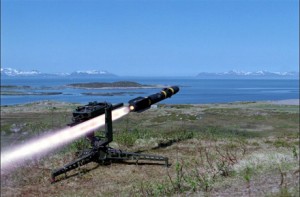
Hellfire-Missile-coastal-artillery

The Pacific Ocean, and the lands touched by its waves have always been of U.S. strategic interest. For the first time however since 1941 there is no comparable “land-based” strategic theater in competition with the Indo-Pacific region. The U.S. Army will likely have other expeditionary missions and conflicts in its future, and may again return to a level strategic influence like that it has possessed in the last 100 years. For the moment however, historians might be well served to give the present “Long Army Century” an endpoint in the early second decade of the 21st century.

Steve Wills is a retired surface warfare officer and a PhD student in military history at Ohio University. His focus areas are modern U.S. naval and military reorganization efforts and British naval strategy and policy from 1889-1941. He posts here at CIMSEC, sailorbob.com and at informationdissemination.org under the pen name of “Lazarus”.
100 Years Ago: Veracruz 1914 (Part 3)

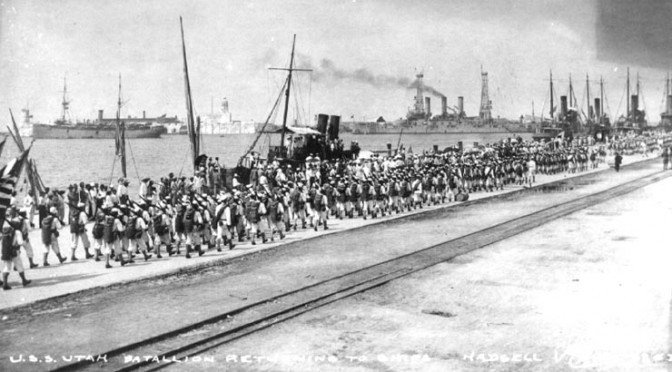
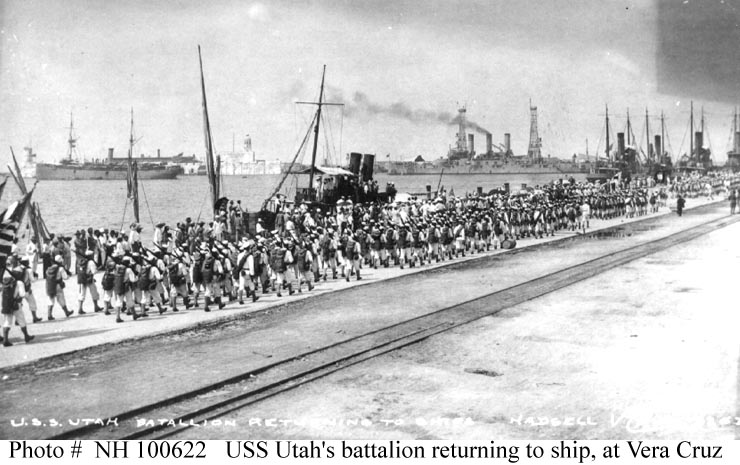
Sailors Returning to their Ships After Combat Ashore in Veracruz (Naval Historical and Heritage Command)

This is the third of a three part series on the American occupation of Veracuz in 1914. The first and second installments can be found here and here.

24 April marked the end of the combat phase of the U.S. invasion of Veracruz, with the “ABC Powers” of Argentina, Brazil, and Chile offering to mediate between the U.S. and Mexico.  President Wilson agreed to participate in these talks and ordered the troops ashore to refrain from offensive operations.

The negotiations proceeded to drag on even though one of Wilson’s original objectives behind the operation was was met in July when Mexican President Victoriano Huerta resigned.  However, negotiations with Venustiano Carranza, the head of the Constitutionalist opposition to Huerta who then took power, proved to be not particularly fruitful either, with the parties only coming to a satisfactory agreement for the withdrawal of American troops in November.

Of note, the other main reason for the invasion, preventing the delivery of the weapons onboard Ypiranga to Huerta’s army, was never achieved and did not matter regardless, as they were eventually delivered (the Americans let the ship leave Veracruz in early May and deliver its cargo at Puerto Mexico), but Huerta resigned before they could have any impact on helping the Army keep him in power. 

Probably the main reason why some history buffs know about Veracruz is the number of medals awarded to the participants, including men like Smedley Butler and John McCloy who each earned one of their two Medals of Honor there.  Members of the sea services earned fifty-five Medals of Honor for heroism or service during the four days of fighting.  One reason for that high number was that Veracruz was the first action in which Navy or Marine officers were eligible for the award.  Butler was embarrassed by his, stating in his biography that

“I received one, but I returned it to the Navy Department with the statement that I had done nothing which entitled me to this supreme decoration.  The correspondence was referred to Admiral Fletcher, who insisted that I certainly deserved the decoration.  The Navy Department sent the medal back to me with the order that I should not only keep it this time, but wear it also.”

Another frequently told anecdote has an admiral conducting an inspection in the 1920s, who upon seeing the medal on the chest of a man that had earned it in the First World War exclaimed “Holy smoke! Here’s a Medal of Honor that’s not for Veracruz!”

The U.S. Navy and Marine Corps both learned some lessons from Veracruz.  It marked Naval aviation’s first involvement in anything resembling combat.  It also marked one of the last instances that ship’s company sailors fought ashore as infantry, something that had been relatively common up to that time, with U.S. sailors having recently fought ashore in Latin America, Hawaii, Korea, Samoa, China, and the Philippines.  As for the Marine Corps, the 3,000 Marines eventually assembled and sent ashore was “the largest concentration of Marines in the history of the Corps, to date.”

While U.S. memories of Veracruz are almost non-existent today, it had a massive and lasting impact on Mexican attitudes towards its northern neighbor. In Jack Sweetman’s the Landing at Veracruz: 1914, he describes the occupation as “a kind of Caribbean Pearl Harbor.”  Even the Constitutionalists fighting against Huerta opposed U.S. military intervention in Mexican affairs, with Pancho Villa the only leading figure in Mexican politics who did not oppose the U.S. landing, ironic in light of him being the main target of another U.S. invasion a few years later.  Just as the niños heroiques of 1847 entered the pantheon of national heroes, martyred defenders of the Naval Academy like Cadet Virgilio Uribe and Lieutenant Luis Felipe José Azueta are remembered to this day.  A new adjective was added to the title of the Naval Academy, now known as the Heroica Escuela Naval Militar in honor of the cadets’ resistance to the norteamericano invasion.  This year the Mexican Navy is participating in a months-long series of events to mark the centenary of an event that the service actually played little part in.

Whether or not the Veracruz operation was a success is difficult to determine. Huerta was forced from office, but one would be hard pressed to prove that the American attack against Veracruz caused his removal.  It did not end the Civil War, with Mexico undergoing several more years (or decades, depending on when one believes that the Civil War actually ended) of chaos and violence.  A prominent event in Mexican history, it remains mostly a source of obscure service lore to Americans.

Lieutenant Commander Mark Munson is a Naval Intelligence officer currently serving on the OPNAV staff. He has previously served at Naval Special Warfare Group FOUR, the Office of Naval Intelligence, and onboard USS Essex (LHD 2).  The views expressed are solely those of the author and do not reflect the official viewpoints or policies of the Department of Defense or the US Government.


100 Years Ago: Veracruz 1914 (Part 2)

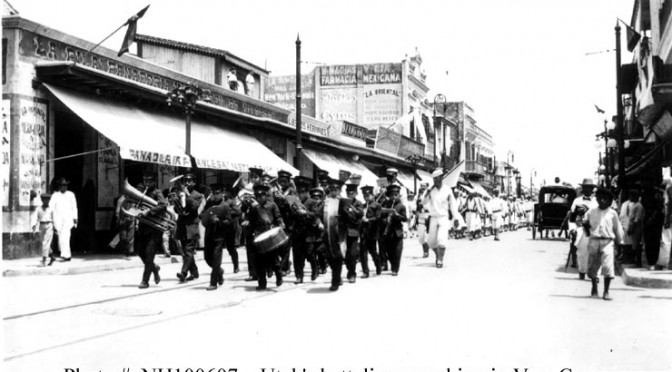
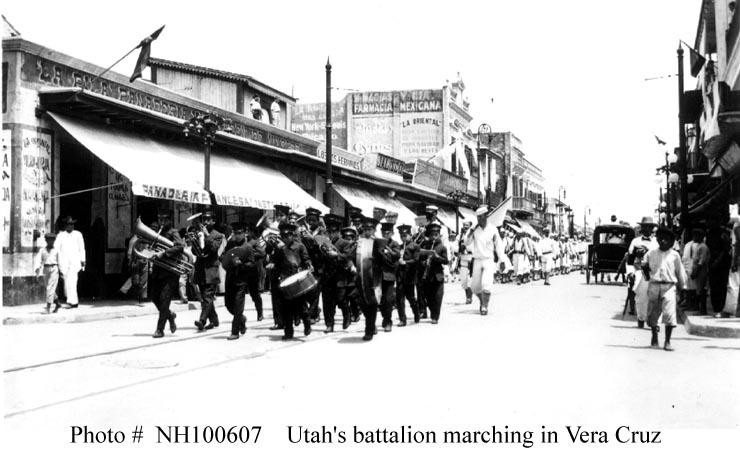
Sailors Parading through Veracruz (Naval Historical and Heritage Command)

This is the second installment in a three part series on the American occupation of Veracuz in 1914.  The first article can be found here.

On the morning of 21 April 1914, Rear Admiral Frank F. Fletcher, commander of the U.S. Navy task force offshore Veracruz, Mexico, complied with the order he had received from from Secretary of the Navy Josephus Daniels the night before. Fletcher ordered the landing of 1200 Marines and sailors from his ships to seize the customs house in Veracruz in order to prevent the delivery of the weapons onboard the German freighter Ypiranga to the Mexican Army, even before he was reinforced by ships commanded by his counterpart off Tampico, Rear Admiral Henry T. Mayo, and the Atlantic Fleet’s steaming from Norfolk. According to John Eisenhower’s Intervention! The United States and the Mexican Revolution, the Americans anticipated resistance from the Veracruz garrison of 600 soldiers, and 2000-3000 other Mexican troops in the region that could be augmented by militia and freed prisoners. Fletcher hoped that moving ashore quickly  would preempt a defense by local troops, enable a potential occupation, and allow him to avoid using his ships’ big guns to obliterate the city.

According to another account of the Veracruz operation, Jack Sweetman’s the Landing at Veracruz: 1914, the “Naval Brigade,” commanded by Captain William Rees Rush, the commanding officer of USS Florida, was composed of two regiments: the First Marine Regiment (22 officers and 578 men assembled from Marines onboard Fletcher’s ships) and the First Seaman Regiment (30 officers and 570 sailors from Florida and USS Utah).  They went ashore from their ships anchored in the harbor onboard whaleboats towed by motor launches to Pier Four in the port.

As soon the landings started, the American consul in Veracruz telephoned General Gustavo Maass, the local Mexican commander, encouraging him not to fight back and allow the Sailors and Marines to come ashore unopposed.  Maass, in a rage, instead immediately informed 100 men from a regiment billeted nearby to engage the Americans.  After a conversation with the Minister of Defense, Maass was forced to reverse himself, however, as the Minister instructed him to withdraw his troops ten miles inland to the town of Tejería.  The Mexican Army’s involvement in the fight thus almost immediately ended, with the bulk of resistance over the next few days conducted by Veracruz’s civilian residents, who had some military training and organization as a militia (the “Society of Defenders of the Port of Veracruz”) as part of a program Huerta had implemented the previous year.

That same morning, Ypiranga was sighted steaming towards the harbor and was interdicted by crew from USS Utah.  The master cooperated and provided shipping documents to the boarding team, which ironically showed that the weapons on the ship had not originated in Hamburg, but were Remingtons made in the U.S. that had been routed through Europe to evade Wilson’s embargo on arms exports to Huerta’s army.

With the Mexican Army out of the fight, one of the main sources of resistance left was from the Naval Academy, where cadets fired at the at the Americans landing at Pier Four.  They emulated the example of the niños heroiques, cadets at the Mexican military academy in Mexico City in 1847 who threw themselves to their deaths from the cliffs of Chapultepec to save the flag and avoid surrender to a previous generation of American invaders.  The cadets defending the Naval Academy in 1914 soon joined the ranks of the honored dead after fire from the guns of Fletcher’s ships silenced their resistance (enabled by Chief Boatswain John McCloy, who drove the motor launch he commanded towards the Academy, fired against it to draw a response, thus allowing the location of the defending cadets to be spotted and engaged by the ships’ guns, an act earning McCloy his second Medal of Honor).

That afternoon Admiral Fletcher cabled Washington with his first report of the landing stating that

“Mexican forces…opened fire with rifle and artillery after our seizure of the Custom House…Ypiranga arrived Veracruz two PM anchored in outer harbor and [was] notified he would not be allowed to leave port with munitions of war aboard.  Holding Custom House and section of city in vicinity of wharves and Consulate.  Casualties two PM four dead twenty wounded.”

The following day on 22 April, additional forces flowed into Veracruz with the arrival of ships and Marines from both Tampico and the Norfolk-based Atlantic Fleet, with the additional Sailors and Marines augmenting the Brigade ashore and expanding the American occupation throughout the whole city by engaging in fierce house-to-house fighting.  The famous Marine hero Smedley Butler, then a Major, described a urban battle scene not particularly different from those in which Marines would fight throughout the next century:

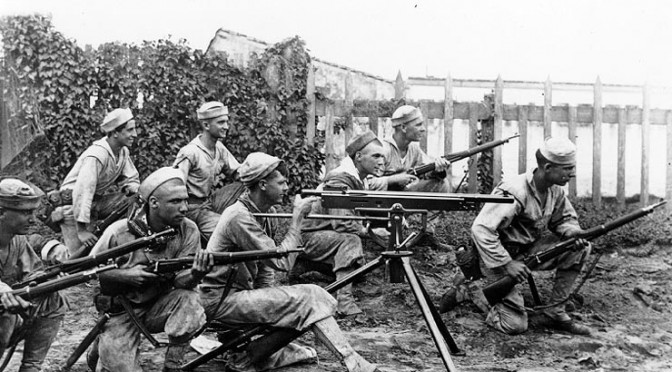
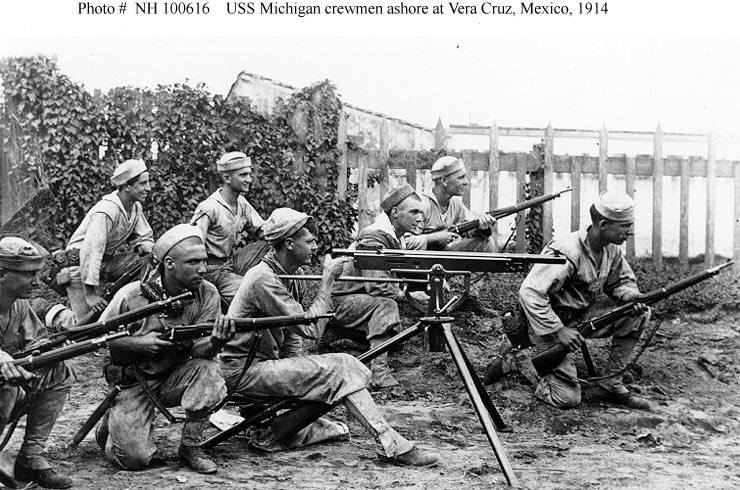
“The sailors who traveled openly through the streets were badly shot up, not only by Mexicans but in at least one instance by their own men, but the Marine casualties were slight.  Two of my men were killed and four or five wounded.  We Marines decided on different tactics than the sailors.  Stationing a machine gunner at one end of the street as a lookout, we advanced under cover, cutting our way through the adobe walls from one house to another with axes and picks.  We drove everybody from the houses and then climbed up on the flat roofs to wipe out the snipers.”

Meanwhile, in Washington, Secretary of State William Jennings Bryan apologized to the German government for the unlawful detention of Ypiranga.  Bryan, like President Woodrow Wilson and Navy Secretary Daniels was well known as a devout Christian with a pacifist reputation and opposition to the military adventurism of the previous Republican administrations in Latin America and the Philippines, but was ironically overseeing the violent invasion of one of the U.S.’s closest neighbors on remarkably flimsy grounds.

By 23 April Admiral Fletcher had transferred his command ashore with most of the resistance having melted away, but, according to Sweetman’s account, was unable to convince any of the local authorities to restore some form of government, as a law passed in the wake of the 1862 French invasion of Mexico made holding “office under a foreign power occupying Mexican soil” a criminal offense.  The official casualty figures by 24 April listed 126 Mexicans killed and 195 wounded (an amount probably significantly lower than the actual total, since these numbers were based only on wounded and dead recorded by local hospitals), with 17 killed and 63 wounded Americans.

Although the Naval Brigade had been reinforced and occupied virtually all of Veracruz, Admiral Fletcher was concerned that the Mexican Army was massing up to 16,000 troops in the vicinity of the city, dwarfing the number of Marines and Sailors ashore, many of whom were also needed back on ship in case of future operations at sea.  Therefore the U.S. Army’s Fifth Reinforced Brigade, commanded by Brigadier General Frederick Funston, was dispatched from the U.S. on 24 April, arriving a few days later.  After negotiating the status of the Marines, the Army troops went ashore and took responsibility for the city from the naval units in a ceremony on 30 April (the debate over who “owned” the Marines foreshadowed future arguments over task organization in a joint force.  Ultimately the Marines that were attached to Navy ships returned to their afloat commands, while the rest of the force “chopped” to Army control).  Despite significant support for a broader war with Mexico in the press and segments of Congress, Funston led an uneventful, combat-free, occupation of Veracruz for another seven months as the machinations associated with a diplomatic solution to the crisis were worked out.

Stay tuned for the third and final installment of this series, which discusses the aftermath of the occupation.

Lieutenant Commander Mark Munson is a Naval Intelligence officer currently serving on the OPNAV staff. He has previously served at Naval Special Warfare Group FOUR, the Office of Naval Intelligence, and onboard USS Essex (LHD 2).  The views expressed are solely those of the author and do not reflect the official viewpoints or policies of the Department of Defense or the US Government.

100 Years Ago: Veracruz 1914 (Part 1)

Sailors Ashore at Veracruz, 1914 (Naval History and Heritage Command)

This April marks the 100th anniversary of one of the strangest episodes in the history of the U.S. Navy and Marine Corps, the mostly forgotten 1914 occupation of Veracruz.

A relatively minor event during the lengthy and violent Mexican Revolution, it is also overshadowed by another American armed intervention in Mexico, the 1916 “Punitive Expedition” led by General John Pershing in pursuit of Pancho Villa.  The Veracruz occupation is remembered, if at all, for the embarrassingly large quantity of medals awarded to its participants, and as one of the numerous “small wars” conducted by the Marine Corps in the late nineteenth and early twentieth centuries.

The roots for the 1914 occupation of Veracruz started a few years earlier, in the chaos caused by the Mexican Revolution.  Porfirio Díaz had ruled Mexico as a dictator since the 1870s (re-elected as President through periodic sham elections), but was finally forced from office in 1911 in the face of an opposition coalition that represented the whole spectrum from liberals to warlords and bandits.  His successor, the aristocratic but principled liberal Francisco Madero, was soon overthrown and murdered during a 1913 coup led by General Victoriano Huerta, who proceeded to declare himself President.

The U.S. first began creeping towards possible military intervention in Mexico in 1911, with President Taft instructing the Army to create a “Maneuver Division” for use in potential contingencies south of the border.  Madero’s death during the Ten Tragic Days (La Decena Trágica) of February 1913, weeks before Woodrow Wilson’s inauguration following his defeat of both Taft and Theodore Roosevelt in the 1912 election, resulted in the deployment of U.S. Navy ships to ports on both the east and west coasts of Mexico to observe the situation and protect American citizens and interests.

A month later, in March 2013, Venustiano Carranza established the “Constitutionalist” opposition to Huerta’s government by bringing together another coalition of liberals, regional leaders, and warlords/bandits.  By the next spring, Constitutionalist forces had made their way to the vicinity of Tampico, where there was a substantial American presence (mostly due to Tampico’s central role in the Mexican oil industry).  Rear Admiral Henry T. Mayo commanded the U.S. Navy forces offshore Tampico.

A Farewell to Grog (and a Hello to Joe)

The direct cause of the U.S. seizure of Veracruz was enabled by the convergence of the U.S. Navy and Constitutionalist army on Tampico.  On 9 April 1914, personnel from USS Dolphin were mistakenly and briefly detained by Mexican soldiers (Federales loyal to Huerta) while buying fuel from a warehouse along the river near the front line between the two opposing Mexican armies.  Although the Mexican General in command of Huerta’s forces quickly released the American sailors and apologized, Mayo would only be appeased by the Mexicans giving a 21-gun salute to the U.S. flag after it was raised ashore in Tampico; a stipulation that would be unacceptable to any Mexican patriot.

In the following days, tensions were also raised by additional minor insults to U.S. honor, including the arrest of a “mail orderly” from USS Minnesota ashore in Veracruz, and the detention of a courier working for the embassy in Mexico City.  In response, on 14 April, President Wilson, whose personal and political distaste for Huerta and his manner of assuming power in Mexico was well known, ordered that the entire Atlantic Fleet immediately proceed from Norfolk to Mexico’s Gulf coast.

By 20 April the stakes had been raised even higher, as the President secretly informed a small group of Congressional leaders that he had been informed by the U.S. consul in Veracruz that a shipment of arms for Huerta’s army was on its way to Veracruz onboard a German cargo ship, Ypiranga.  Although Wilson wished to ask for congressional authorization for the use of force against Mexico, he did not wish to publicly disclose his knowledge of the Ypiranga shipment.

Later that night, Secretary of the Navy Josephus Daniels (most historically notorious for outlawing drinking onboard Navy ships) sent a warning order to Rear Admiral Frank F. Fletcher, commander of the ships off Veracruz, to “be prepared on short notice to seize customs house at Vera Cruz.  If offered resistance, use all force necessary to seize and hold city and vicinity”   The following morning, Fletcher received the order from Daniels to “Seize customs house.  Do not permit war supplies to be delivered to Huerta government or any other party.”

This is the first of a three part series on the 1914 invasion and occupation on Veracruz.

Lieutenant Commander Mark Munson is a Naval Intelligence officer currently serving on the OPNAV staff. He has previously served at Naval Special Warfare Group FOUR, the Office of Naval Intelligence, and onboard USS Essex (LHD 2).  The views expressed are solely those of the author and do not reflect the official viewpoints or policies of the Department of Defense or the US Government.