Category Archives: Global Analysis

A Geographical Breakdown of What’s Going on in the World

Déjà Vu at the 2018 Shangri-La Dialogue?

By Tuan N. Pham

Introduction

Last year, CIMSEC published an article analyzing Beijing’s decision to send an unusually low-ranking delegation head, Lieutenant General (LTG) He Lei who serves as the Vice President of the People’s Liberation Army’s (PLA) Academy of Military Science (AMS), to the 2017 Shangri-La Dialogue (SLD). The selection was a sharp departure from general past practice. In 2011, Beijing dispatched its Defense Minister (the highest-ranked representative to date) followed by the Vice President of the PLA AMS (lowest-ranked representative so far) the following year. From 2013 to 2016, the Chinese delegation was led by a deputy chief-level PLA general officer, closer in rank to the other attending defense ministers. This year, Beijing chose once again to send LTG He to the premier security forum in the Indo-Pacific region, despite last year’s pledge to send a delegation led by a four-star officer of Central Military Committee rank.

It was speculated that Beijing’s decision was a subtle refutation of last year’s stated agenda of “upholding the rules-based regional order, practical measures to avoid conflict at sea, and nuclear dangers in the Asia-Pacific” and pointed to a deeper problem that China has with the annual dialogue itself. Beijing chooses not to discuss its maritime disputes in any multilateral forum, asserting that bilateral negotiations are the appropriate mechanism to deliberate such contentious issues. The South China Sea (SCS) is a recurrent SLD topic – and China, much to its chagrin, has little influence over the non-friendly and as the Chinese might suggest, hostile agenda. There’s a growing sense within Beijing’s political elites that the SLD has become nothing more than an international forum to highlight (and shame) China’s perceived rule-breaking behavior in the region.

It was also suggested that Beijing may have been short-sighted. By downgrading its presence at the SLD, China ceded the strategic narrative and initiative to the United States and its allies. China yielded another highly visible international platform where its competitors could stake out their strategic positions, counter Chinese strategic messaging, and further challenge and encourage Beijing to become a more responsible global stakeholder that contributes positively to the international system.

The following analysis compares and contrasts the 2017 and 2018 dialogues in terms of Chinese themes, narratives, responses, and outcomes while trying to answer questions such as why did Beijing again send LTG He, what message is Beijing trying to convey, and what does it portend for the region in the near future?

2017 SLD Highlights

Australian Prime Minister Malcolm Turnbull delivered the keynote speech, averring that Asia’s future peace and prosperity depend on preserving the rules-based regional order that has worked so well for so long. He suggested that China can only expand its strategic influence to match its economic might within the bounds set by the same rules-based regional order. The message implied that Beijing was undermining the rules-based order in Asia and warned that a coercive China would drive its regional neighbors to bolster alliances and partnerships between themselves and the United States. Prime Minister Turnbull also exhorted his regional neighbors to assume greater responsibility for their own security and prosperity.

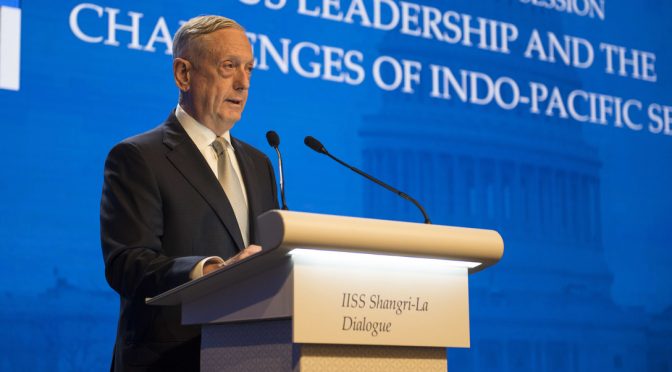
During the first plenary session (United States and Asia-Pacific Security), U.S. Secretary of Defense James Mattis called out China for disregarding other nations’ interests and international law, militarizing the SCS, and undermining regional stability. He reiterated that the United States would continue “to fly, sail and operate wherever international law allows, and demonstrate resolve through operational presence in the SCS and beyond.” Secretary Mattis urged China to recognize that North Korea has become a strategic liability and cautioned Beijing that seeking cooperation on Pyongyang did not mean Washington would not challenge Chinese activities in the SCS. Secretary Mattis also restated America’s steadfast commitment to the defense of Taiwan as outlined in the Taiwan Relations Act. 

During the second plenary session (Upholding the Rules-based Regional Order), then-Japanese Minister of Defense Tomomi Inada leveled similar criticism against China in her speech. She implied that Beijing bore most of the responsibility for the extant regional instability and criticized China for “unilaterally” altering the status quo in the East China Sea and SCS. Minister Inada also urged Beijing to follow international law and respect the prior year’s tribunal ruling on the SCS and expressed support for U.S. freedom of navigation operations (FONOPs) in the SCS.

Chinese diplomatic and media responses were expectedly swift and coordinated, but ultimately uninspiring. The PLA delegation held a media briefing on the summit’s sidelines at the end of the second day, defending China’s position as a rising power that abides by international law and the United Nations Convention on the Law of the Sea. The delegation repeated longstanding policy positions on Taiwan, North Korea, and the SCS while expressing frustration that Beijing is unfairly singled out for criticism. China’s Ministry of Foreign Affairs followed the tepid response the next day and called out Mattis and Inada’s statements on the SCS and Taiwan as “irresponsible.”  

During the second special session (New Patterns for Security Cooperation), LTG He presented a self-serving speech underscoring the need for a new Asia-Pacific security framework featuring “common, comprehensive, cooperative, and sustainable security.” LTG He emphasized China’s peaceful and benevolent rise that contributes to global peace and prosperity and promoted the ambitious Belt and Road Initiative (BRI) while promising to advance within the Association of Southeast Asian Nations the adoption of a Code of Conduct framework for the SCS.

2018 SLD Highlights

Indian Prime Minister Narendra Modi delivered the keynote speech. Although the tone of his speech was largely conciliatory and deferential to Beijing, Prime Minister Modi repeatedly used the term “Indo-Pacific,” highlighting the critical role that America plays in the regional (and global) order, and underscored the imperative for a common rules-based system based on the consent of all.   

IISS Shangri-La Dialogue 2018 – Keynote Address by Narendra Modi (Photo by IISS)

During the first plenary session (U.S. Leadership and the Challenges of Indo-Pacific Security), U.S. Secretary of Defense Mattis rebuked China for “intimidation and coercion” in the Indo-Pacific and declared that America does not plan to abandon its leading role in the region. He also specifically called out Beijing’s destabilizing militarization of the SCS, while further encouraging and challenging China to act responsibly in accordance with established global rules and norms.

During the third plenary session (Shaping Asia’s Evolving Security Order), the Vietnamese Minister of National Defense General Ngo Xuan Lich made the emphatic point that “under no circumstances could we excuse militarization by deploying weapons and military hardware over disputed areas against regional commitments.” Two weeks later, Vietnam’s Foreign Ministry denounced China’s recent redeployment of missiles to Woody Island as a serious violation of its sovereignty in the SCS (Vietnam also has its claims) and that this has threatened freedom of navigation and overflight in the SCS. Vietnam’s Foreign Ministry also “requests that China immediately put an end to these wrongful activities and withdraw the military equipments it had illegally deployed on Vietnams Hoang Sa Islands (Paracel) Islands.”

During the fifth plenary session (Raising the Bar for Regional Security Cooperation), the French Minister of Armed Forces Florence Parly and British Secretary of State for Defense Gavin Williamson largely echoed Secretary Mattis’ sentiments with the former making the bold statement on the SCS…“fait accompli is not a fate accepted” (referring to Chinese attempts to deny international access to the disputed waters). Both announced their intent to jointly sail their deployed naval vessels across the SCS to demonstrate their nations’ inherent right to traverse international waters and to send the “strongest of signals” on the importance of freedom of navigation.

Chinese diplomatic and media responses were again expectedly swift and coordinated, but much sharper and more assertive (and perhaps even better prepared) than last year. The PLA delegation forcefully defended Beijing’s military activities in the SCS and sharply criticized Secretary Mattis’ “irresponsible remarks” on the issue and for his unhelpful “hyping” of the situation. LTG He also took advantage of the public forum to reiterate Taiwan as a Chinese “core interest” and a “red line that cannot be challenged.” This is part of its deliberate campaign to push back hard against the Taiwan Travel Act, approval of marketing licenses to sell U.S. technology to Taipei that would allow for building of advanced Taiwanese submarines, a U.S.-Taiwan agreement to share defense research, and the dispatch of formal U.S. officials to the opening ceremony of a new office building to house the American Institute in Taiwan (the defacto U.S. Embassy).   

During the fifth special session (Strategic Implications of Military Capability Development in Asia-Pacific), LTG He vigorously defended Beijing’s actions and activities in the SCS to include the recent deployments of weapon systems to its military outposts. He re-asserted the Chinese strategic narrative that the islands belonged to China, Beijing was only acting to defend the country’s indisputable sovereignty, and that U.S. FONOPs were the “real militarization of the SCS.” He also reiterated the point that China has not obstructed any military vessels following international laws and was open to discussions on the interpretation of FON. The rest of his speech characterized the ongoing PLA reforms and modernization efforts as benign and largely defensive in nature, praised Beijing for its constructive role in the denuclearization of the Korean peninsula, and repeated last year’s talking points on the need for a new Asia-Pacific security framework and the BRI.   

So What’s Next

At the end of the day, the scope, nature, and extent of China’s present participation in the SLD can best be summed up as taking the middle road (hedging). Beijing wants to respond to any policy criticism and challenge any narrative counter to their own at the forum, but does not want to openly endorse or promote the SLD. It seems content for now to limit its role in the special session, and reserve the right to speak at the higher-visibility plenary session when warranted (only individuals of full ministerial rank can speak in plenary).

That said, Beijing may one day conclude that the juice may not be worth the squeeze. Why bother with the biased and fading SLD, when it can focus instead on building up its own Xiangshan Forum? This regional forum is already widely seen in Beijing as a growing counter to the SLD and an important part of a strategic agenda to displace the extant Western-oriented world order with one without dominant U.S. influence. If so, one can expect a re-emerged, revitalized, and restructured Xiangshan Forum after an unexpected and self-induced one-year hiatus.

The BRI (with its hidden nationalist agenda and subdued geo-strategic implications) ultimately needs an accompanying and complementary security framework with Chinese characteristics that the forum can help foster and promote under Beijing’s terms.

The new Chinese strategic approach calls for the balanced integration of interests – both long-term economic development with concomitant security reforms intended to restructure and realign global political and security order. This will be pursued in tandem with safeguarding and enhancing the internal apparatuses of China’s socialist and authoritarian system until it can be the center of that new Beijing-oriented global order. 

Conclusion

Beijing clearly views the SLD as an adversarial international forum used by its perceived strategic rival – Washington – and its allies to unfairly criticize (and contain) China. But despite the critiques, Beijing may also see some value (but not necessarily the overwhelming need) to participate in these multilateral dialogues and perhaps begrudgingly accept the criticism of China as a natural outgrowth of its rise as a global power.

Tuan Pham is widely published in national security affairs and international relations. The views expressed therein are his own and do not reflect the official policy or position of the U.S. Government.

Featured Image: SINGAPORE (June 1, 2018) Secretary of Defense Jim Mattis delivers remarks during the first plenary session of the Shangri-La Dialogue 2018 June 2. (U.S. Navy photo by Mass Communication Specialist 2nd Class Joshua Fulton/Released)

A New Gap in the High North and Forward Defense Against Russian Naval Power

By Steve Wills, CNA Analyst

The stand-up of a new NATO Maritime headquarters in Norfolk, Virginia, the re-establishment of the U.S. Navy’s East Coast-based Second Fleet and the prospect for a new NATO Maritime Strategy this year have again fueled interest in naval warfare in the wider Atlantic Ocean. One of the most commonly mentioned landmarks in this emerging environment is the iconic Greenland, Iceland, United Kingdom (GIUK) gap. The scene of the German battleship Bismarck’s passage to the Atlantic and the transit highway of early Russian ballistic missile submarines to their patrol stations near the United States and Europe, the GIUK Gap is synonymous with naval warfare in the Atlantic. Unfortunately, current references to the GIUK gap harken back to a different time and strategic situation that is markedly different from the situation today.

Despite early assessments that the Soviet Union was going to target the sea lines of communication (SLOC) crossing the Atlantic, the Soviets never intended to make interdiction of Atlantic convoys a priority mission. Defense of their ballistic missile submarines, countering Allied aircraft carrier battle groups, and littoral defense and support to the Soviet Army were always their main priorities. Today’s much smaller Russian Navy has similar missions and strategic geography, but now boasts long range cruise missile armament.

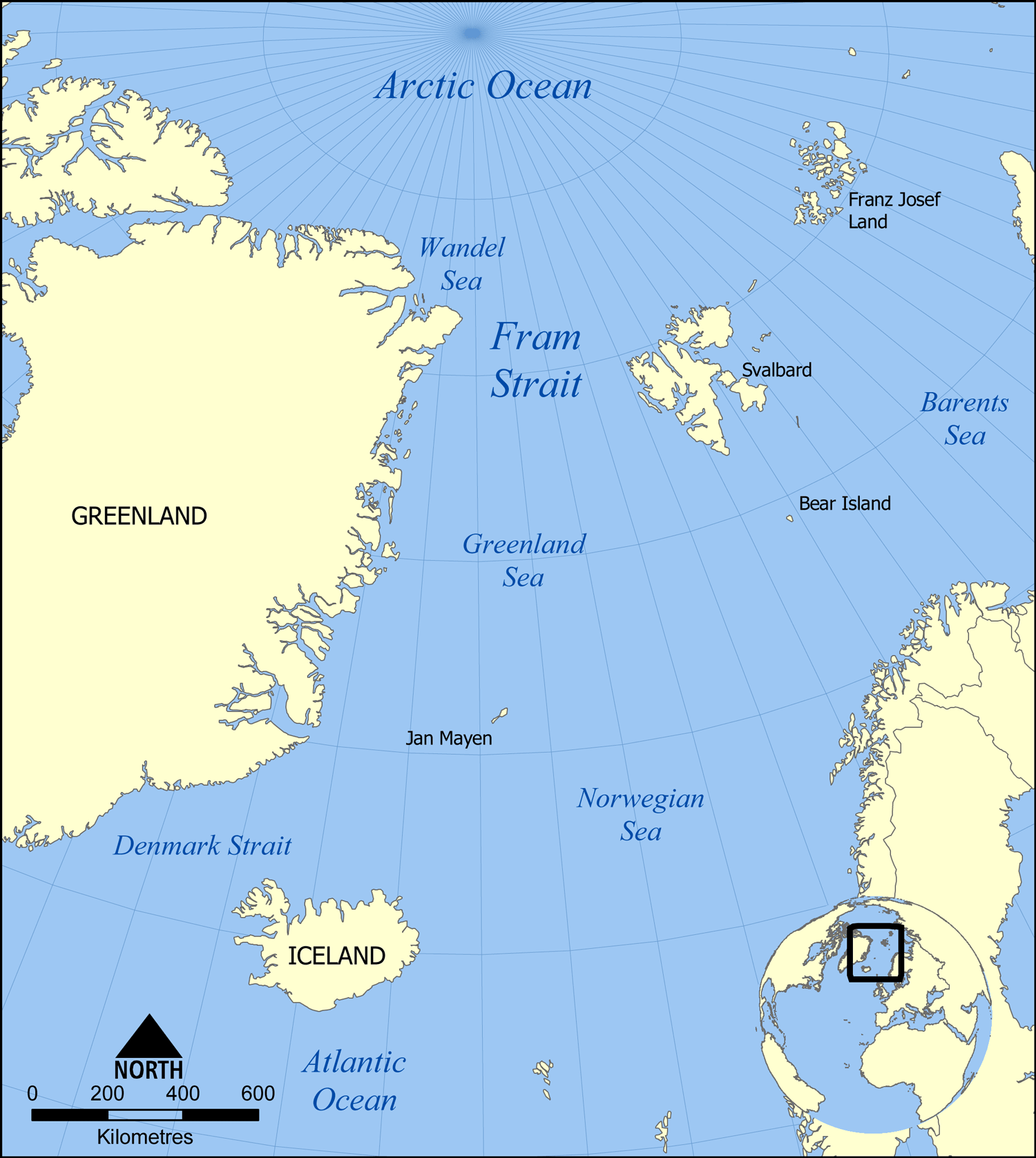
The NATO Alliance must return to a deterrent posture similar to that of the Cold War in order to prevent potential Russian aggression, but the locus of action is much further north than Iceland. The real “Gap” where NATO must focus its deterrent action is the Greenland, Svalbard, North Cape line at the northern limit of the Norwegian and Greenland Seas. It is again time to consider deterrent action and potential naval warfare in the “High North.”

Never the GIUK Gap Anyway

While important in the Second World War and perhaps the early and middle Cold War, the GIUK Gap did not have the same geographic significance in the late 1970s and 1980s. While earlier Russian ballistic missile submarines (SSBNs) had to first sail close to the U.S. coast and then to the middle Atlantic in order to launch their weapons, the advent of the Delta and Typhoon classes with improved sub-launched ballistic missiles (SLBMs) allowed Soviet missile boats to launch their weapons from the safety of Soviet littoral waters. Intelligence gathered by U.S. and Allied sources in the late 1970s suggested that rather than conduct a rerun of the failed German U-boat campaigns of the World Wars, Soviet submarines were to be deployed in a largely defensive posture close to the Soviet homeland. Earlier work by the Center for Naval Analyses had suggested that Soviet attack subs would be prepared to defend their own SSBNs, attack U.S. Navy carrier battle groups, and perhaps venture forth to attack U.S. SSBNs. But attacking logistics and commerce on the Atlantic SLOCs was a fourth-priority mission at best.

The High North region.

By the 1980s, the U.S. Navy was planning, in the event of a failure of deterrence, to take the war to the Soviet littoral waters and homeland. This was a global effort that included U.S. and Allied action against the Soviets in the Atlantic, Pacific, and Arctic Oceans, and the Mediterranean, Baltic, and Black Seas. U.S. submarines would stalk and sink their Soviet counterparts and SSBNs while U.S. carrier battle groups would attack Soviet bases on the Kola Peninsula (as well as other locations around the periphery of the Soviet state) to prevent a correlation of forces that allowed for a successful Soviet land attack in Central Germany.

A series of exercises begun in the early 1950s at the dawn of NATO’s existence had exercised both naval attacks on the Soviet homeland and the defense of Atlantic SLOCs, but the exercise effort moved into high gear in the 1980s. The advent of the aggressive Maritime Strategy meant the Navy would no longer focus on just the defense of SLOCs as it had been told during the Carter administration. Encouraged by Reagan administration Navy Secretary John Lehman and led by experienced flag officers such as Admirals “Ace” Lyons, and “Hammerin Hank” Mustin, a string of aggressive naval exercises in both the Atlantic and “high north” practiced to defend Norway, drive the Soviets back to their home waters, and attack their bases on the Kola peninsula. Instrumented by the SOSUS system and patrolled by aircraft based in Iceland, the GIUK Gap was a strong symbolic barrier, but it was at best the southern signpost of a war to be fought much further to the north. The late Cold War focus on the maritime high north “put Norway on both Brussels’s and Washington’s military strategic maps in an unprecedented way.”

The Reality of New Great Power Competition in the High North

The return of a revanchist Russia to the business of great power competition after a quarter century of decline has brought back Norway and its adjacent seas into U.S. and NATO strategic focus. The Russian Navy submarine force is less than a fifth of the size of its Soviet forebear. Many of these units will soon be ready for retirement, and are spread over four fleets. Despite those handicaps, Russian units are now equipped with the 3M-54 (Kaliber) cruise missile, which significantly extends Russian combat capability. This is also why the Russian Navy’s mission set now includes an emphasis on non-nuclear deterrence.

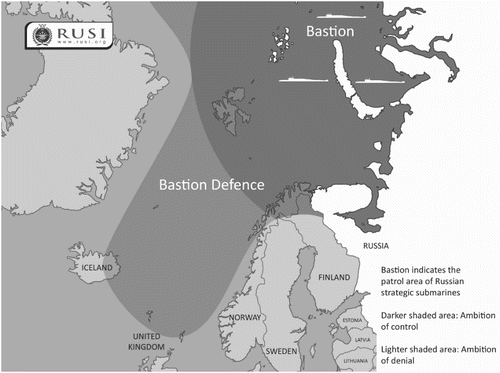
Soviet forces operating within their “bastion” defenses in the Barents Sea during the Cold War had to come south in order to engage NATO maritime forces and lacked a land attack cruise missile capability. Today’s Russian Navy can remain within its Barents bastion and still launch accurate attacks against ships in the Norwegian Sea and NATO land targets without leaving these protected waters. If the Russians do leave their bastions it would most likely be on raiding missions enabled by land attack cruise missiles. Russia has a long tradition of raiding for short-term tactical and longer-term strategic gain, and such operations could manifest themselves in the maritime environment.

Possible zones of Russian bastion defense. (RUSI)

NATO faces significant challenges in dealing with this renewed Russian threat. The Alliance’s naval forces are significantly smaller than during the Cold War and the United States Navy is less than half the size of its 1980s counterpart. Norwegian naval force structure is shrinking and even with planned qualitative improvements will not alone be sufficient for potential naval combat in the High North. Norway is set to significantly reduce its surface force through a planned decommissioning of its Skjold-class missile corvettes and remaining mine warfare ships in the next several years. The reductions are necessary in order to pay for new German-built submarines, P-8 Maritime patrol aircraft (MPA), and F-35A aircraft. The submarines and MPA purchases are appropriate force structure for potential combat in the Norwegian Sea south of Svalbard and north of Iceland, but reductions will result in a lack of surface patrol units necessary for maintaining sea control.

The F35A can support sea control, but may be occupied elsewhere in defense of Norwegian shore-based infrastructure. For example, the Russian Air Force has launched a number of mock attacks on the Norwegian Joint Command Center at Bodo in recent years and F-35 aircraft may be largely focused on the defense of Norwegian C4I infrastructure. The Norwegian Coast Guard which contributes significantly to patrol efforts in the region has decreased in strength from 31 to 15 units from 1992 to the present. These Coast Guard units are also lightly armed and insufficient for contesting and retaining sea control in the region.

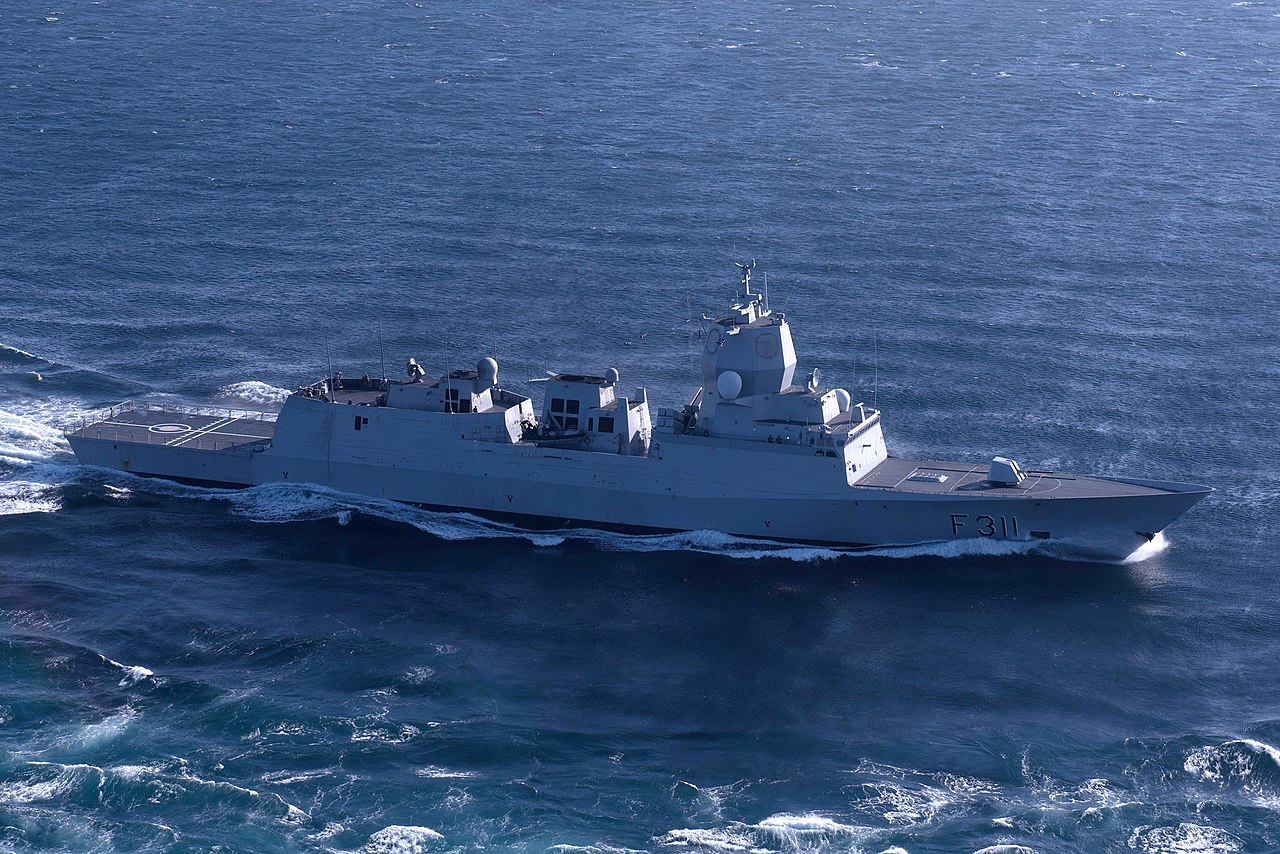
The only significant Norwegian surface force structure in the next decade is likely to be the AEGIS Nansen-class frigates. These ships are capable multipurpose surface combatants, but their small numbers will require a significant commitment of NATO forces to the Norwegian Sea early in a conflict with Russia to ensure that Russian units, especially nuclear attack submarines, do not transit the Norwegian Sea “SLOC” to the North Atlantic. A key element of the Nansen’s antisubmarine capability, the NH90 helicopter, has failed to deliver on its promised number of flight hours. While there may be enough helicopters for the frigates, there are no NH 90 helos with which to equip the Norwegian Coast Guard for its mission of Norwegian and Greenland Sea patrol and surveillance. The Norwegian Joint force is growing in capability, but even with improvements in air and subsurface units it likely cannot prevent passage of Russian Northern Fleet submarines through the Norwegian Sea.

The Royal Norwegian Navy frigate KNM Roald Amundsen (F311) underway in the Atlantic Ocean on 16 February 2018 as part of the U.S. Navy’s Harry S. Truman Carrier Strike Group (HSTCSG) while conducting its composite training unit exercise (COMPTUEX). (U.S. Navy photo by Mass Communication Specialist 2nd Class Scott Swofford)

Organizing for Maritime War in the High North

Once just the remote operating grounds of Russian ballistic missile subs, the Eastern Barents and Arctic Seas can now serve as bases for cruise missile platforms to threaten NATO units and land-based targets in and facing the Norwegian Sea. The NATO Alliance is moving in the right direction by reinstituting an Atlantic Maritime headquarters but more must be done to prepare for a conflict in the High North.

Increased Alliance submarine operations in the Norwegian, Barents and Arctic Seas serve to operationalize those headquarters changes. The North Atlantic SLOCs are important, but the Russians are not looking at the mid-Atlantic except for perhaps targets of opportunity. Joint and combined Allied activities that make use of the numerous air and port facilities around the Norwegian and Greenland Seas should be the main focus of JFC Norfolk. A NATO Joint Task Force (JTF) element, perhaps forward deployed afloat or ashore, may need to be present in the immediate area to direct operations.

Unmanned systems technology holds the promise of mobile, underwater detection grids that unlike the Cold War SOSUS nets can move themselves to better identify and localize submerged targets. The Norwegian and Greenland Seas are NATO lakes and receding sea ice has made for a wider and more open battlespace that allows for greater use of shore-based facilities in the region over a longer portion of the year. Small surface combatants such as the U.S. FFG(X) and LCS might operate in conjunction with unmanned units and maritime patrol aircraft and submarines to conduct a regional joint and combined antisubmarine warfare campaign.

Conclusion

A revanchist Russia does not directly threaten North Atlantic sea lines of communication, and the place to deter or engage them won’t be the GIUK gap. NATO must prepare to deter and if necessary engage Russian naval forces in the High North long before these units can get into range of resupply ships or NATO nation port facilities on the European mainland. The Alliance has taken positive steps to meet this renewed maritime challenge, but must not be haunted by U-boat and Soviet ghosts from past Atlantic wars. The place to respond to a new Russian naval threat is close to its home base and not astride critical transatlantic communication routes.

Steven Wills is a Research Analyst at CNA, a research organization in Arlington, VA, and an expert in U.S. Navy strategy and policy. He is a Ph.D. military historian from Ohio University and a retired surface warfare officer. These views are his own and are presented in a personal capacity.

Featured Image: Norweigan Navy Skjold-class corvette.

Sea Control 149: Former Secretary and First Lady of the Navy, John and Margaret Dalton, Pt. 1

By Travis Nicks

We were honored to speak with former Secretary of the Navy John Dalton and his wife, Margaret Dalton, about their service during the Clinton administration.

DOWNLOAD: Sea Control 149: Former Secretary and First Lady of the Navy, John and Margaret Dalton, Pt. 1

TN: Hi, and welcome to another episode of Sea Control. I’m Travis Nicks, the Vice President of CIMSEC, and on behalf of CIMSEC, I’m honored to be joined today by the former Secretary and first lady of the Navy, John and Margaret Dalton. Secretary Dalton served as the Secretary of the Navy from 1993 to 1998. In that time, Mrs. Dalton was instrumental in many quality of life improvements in our Navy, to include improvements in base housing, and has conducted many outreach efforts, even holding frequent visits to aircraft carriers for groups of congressional spouses. Mr. Secretary, Mrs. Dalton, thank you for joining us.

So starting off Secretary Dalton, you served as Secretary of the Navy from 1993 to 1998. Do you mind sharing how you became the Secretary of the Navy?

JD: Sure. I’ll be glad to. The reason I think I was considered to be Secretary of the Navy was because I had prior military service, and also prior service as a government official. I was president of Ginnie Mae, the Government National Mortgage Association in the Carter Administration. And after lunching in Dallas, and sat next to him, and got acquainted with him, and liked him, and decided to work in his campaign, and was actively involved in his campaign. When he was elected, he appointed me to be President of Ginnie Mae. That was my first government service. I really enjoyed it, and did that for two and a half years. And when they formed the Reelection Committee,– I was named Treasurer of the Carter-Mondale Reelection Committee. And I was a young man – I was 37 at the time. I was 35 when I got the Ginny Mae appointment, and 37 when I became the National Treasurer of the campaign. And we had, you know, children. When the seat became available on the Federal Home Loan Bank Board, after having worked in the campaign for about 6 months, I decided to ask the Chief of Staff of President Carter, Hamilton Jordan if I could have this seat at the Federal Home Loan Bank Board. I would still work on the campaign, but I, I’d taken a pay-cut to go into government, and another pay-cut to go on the campaign, and I have small children, and so I thought that would be a better way – better for me personally – so I was able to work that out and do that. After the election in 1980, when President Reagan was elected, I had another – well, on the Federal Home Loan Bank Board, the term didn’t end with the administration. It actually went through June of ’82. And so I stayed on for a number of months, and a headhunter approached me, and I took a job in San Antonio, Texas, and lived in San Antonio for twelve years in the savings and loans business, and then in the private equity business, and then back in the investment banking business – where I’d originally been when I was working for Goldman Sachs – when I met Jimmy Carter (Governor Carter).

But how I became Secretary of the Navy was, I was active in the Clinton campaign. I was active in the Democratic Leadership Council, which was the more moderate wing of the Democratic Party. And Governor Clinton was Chairman of the DLC, or the Democratic Leadership Council. So I got to know him through that. And when he announced his candidacy for president, I supported and was active in his campaign and when he was elected, because of what I’d done in the campaign, and the fact that I had served on active duty and been involved in the Carter Administration, so I had government experience.

Actually, what happened was, Henry Cisneros was Mayor of San Antonio, and he approached me about two weeks before the election and said who with their work in the campaign could serve adequately in the new administration. So I went there, and he said, “Would you please think about that and come see me, and tell me,” since Henry Cisneros was on the transition team. They were, eight or nine people that were on the Transition Committee before the election, and he was one of them. He solicited my advice about people who would serve in the administration. We talked a couple of weeks before the election, and he said, “We’re going to win, and you know, thank you for the names of these people that you think could serve well. But what about you?”

And I said, “You know, Henry, this is not a good time for me – personally, financially. And the only way I would go back into government service is if there were something meaningful that I could do.”

And he said, “I don’t know what you mean by meaningful, but the Cabinet is spoken for. Is there anything other than the Cabinet that you think you would be interested in?”

I said, “Yes, there is one job. The Secretary of the Navy.”

And he said, “I think you’d be great at that.” And he said, “Get me your resume. I’m going to go to Little Rock tomorrow, and I’m going to see Warren Christopher, who’s the chairman of the Transition Committee, and I’ll give him your resume.”

That’s how it happened.

TN: So you started off your time in the Navy at the U.S. Naval Academy and then with submarines, and then afterward, went to the Wharton School of the University of Pennsylvania. How did the Naval Academy help you in your professional career? And how did those early formative experiences in your career help you become Secretary of the Navy, and then your career afterward?

JD: Well, it helped me a great deal. First of all, some background. I had an uncle who was a Navy hero in WWII. And, you know, I was a young boy – I was born in ’41, so, I was. But the first naval officer I ever heard about was my uncle, Roy, who actually won the Navy Cross, the Silver Star, and five Distinguished Flying Crosses. I mean, he was a genuine hero in WWII. And so my impression of the Navy was very positive from the get-go, and I wanted to go to the Naval Academy. You know, as a young man particularly, in high school.

But I didn’t get the appointment out of high school. That’s truly the only place I applied, and I was sure that was where I was going to go, and I had good grades, and I was on the student council – and all that kind of thing. So I thought I would get the appointment, but I didn’t. And so I went to LSU for a year, and that was a great experience. And I was active in government politics, was elected to the student government association, and president of my pledge class – that kind of thing. And then, I went to see the Congressman here again – what we’re talking about earlier, the personal aspect of seeing the decision-maker is key – and I went to see Overton Brooks, who was our Congressman, and told him that he had not given me his principle appointment the previous year, but I’d gone to LSU and done well, and I hoped that he would give me the appointment this year. And, I said, “It’s not something you’ll regret, because I will do well there.”

He gave me the appointment and I went to the Naval Academy. I didn’t get off to a great start. The first time they published an UNSAT list, my name was on it. And I went out for the crew team and got cut and so forth. But I made the varsity plebe team, in soccer and lacrosse, and enjoyed that. And, you know, early on was the first time they had the aptitude scores for our company. I was number one in our company. In my youngster year – sophomore year – they took a group to the Air Force Academy. At that time, everybody spent a weekend at the air army at West Point, but this was the first time anybody there had gone to the Air Academy, and I was in the group that was selected for that. And I was a group commander in the second class year, and went on a foreign exchange cruise to the Royal Navy my first class year.

All those experiences were very helpful to me, both in my active duty service and in the training that we had. And the leadership skills we learned, and so forth, were helpful to me – both in business, and when I became Secretary of the Navy.

TN: Over the last decade, rapid innovation in technology has been at the forefront of discussion topics in the maritime security community – particularly in the U.S. Navy. And many specialized organizations – DIUX, CNO’s Rapid Innovation Cell, Deep Blue, et cetera – have been established and disestablished by Navy leaders with the initial objective of speeding up innovation. The relatively slow speed of integrating innovative technology into the Navy has been heavily criticized – inside and outside the Navy.

You served as the Secretary of the Navy during the mass-adoption of the World Wide Web, the personal computer, the cell phone, and other new technologies. How did you achieve the high speed of integration of innovative technologies that occurred under your leadership in the 90s, and in your experience, what is the most effective way for a Navy leader to set up our institution to more rapidly integrate modern technology into things like personnel management, maintenance, and operations?

JD: Well when I was in office, we had some major challenges with respect to acquisition. And we thought that the system needed an overhaul. So we adopted what was called “acquisition reform.” Nora Slatkin was the Assistant Secretary of the Navy for Research, Development, and Acquisition – RDA – she was very good in that job. John Douglas came after her, and he also was very good.

The two major weapons systems that we had to deal with were the F/A-18E/F Super Hornet and the Seawolf submarine. That was the biggest aviation challenge that we had, and that system was very successful in that it came in on time, on budget, and underweight. And that was unusual in that typically, major new weapons systems cost more and were delayed and, there were a number of alterations that were having to be done on them. So I think the acquisition reform that we instilled was able to project and to perform, and that system – that weapon system – was very successful.

Similarly, another major weapons system was to get the third Seawolf submarine built because it was a political issue. The previous administration, the George H. W. Bush administration, had been opposed to building the third Seawolf, and President Clinton wanted to have it done. But it was a political football. And I thought that we needed to build it for the industrial base. I mean, we needed to have that submarine so that Electric Boat at New London, and also the submarines that were built in Newport News, would not lose all their people if we went two or three years without building a submarine. And we were able to prevail on that issue, and you might recall, going back politically – Clinton was elected in ’92, and in ’94, it was a big sweep from the standpoint of the Republican Party winning most of the seats. I asked some of my friends on the Hill about the possibility about getting the third Seawolf built. And, you know, Phil Gramm (R-Texas) and others that I knew from Texas and other states said, “You can forget it. You’re not going to build or pull that off.”

Well, I thought it was so important that we dedicated a lot of resources to get that third Seawolf built. And we were successful, and we ended up getting 75 votes in the Senate for it. That’s not the exact number, but anyway, it wasn’t close, because we really worked it hard, and it was important. And then once we got that done, the next big thing was the new attack submarine – which is the Virginia-class submarine. And that, too, was an important victory for the Navy Department. And similarly we moved forward with the V-22 in the Marine Corps, and that was a big weapons system that was controversial and had some early failures in terms of people being killed – testing it and so forth. Those were big weapons systems that were all important and all needed some leadership to get done, and we were able to get that done.

In terms of the internet and the other things that you mentioned, that was all late in my term. I can remember having a tutor come in to help me learn how to use a computer, you know, he’s coming in once a week. I was a novice – and still am in many ways. At any rate, some of the technology that you mentioned was late in my administration.

TN: Was it a priority to integrate computers and the internet?

JD: Yeah. I knew there were some people who were using email. But I remember sending my first email to Richard Danzig who was more savvy than I was with new technology. And I said something about something that he sent me, and he sent me an email back that said, “Welcome to cyberspace.”

TN: That’s pretty good.

JD: Yeah, he’s a great guy. He was a great undersecretary and also an outstanding successor.

TN: The two of you worked together – you and Secretary Danzig created programs like NAVFIT98, the eval and fitness report system that we still use today, and a series of programs that were created in the mid-90s and were used for more than a decade, and in some cases, for decades afterward. From a personnel standpoint, did it seem like it would be important to inject the internet and computers and software into personnel management and into communications?

JD: Absolutely. I think those tools that you mentioned were very important. And I think that what we emphasized the most in the five-and-a-half years I was there was people and the importance of treating people with dignity and respect. I mean, the emphasizing our core values of honor, courage, and commitment. When I came into office, we had some significant issues with respect to dealing with people. We had the Tailhook Convention, and the discipline of all that was on my plate. We had the cheating at the Naval Academy. We had the change in the culture of the Navy from the standpoint of gays in the military and women in combat. And both of those things happened within six months of each other – which was a big culture shock to the Navy. When I assumed office, I had been there two weeks before there was a major headline in the Navy Times which read, “Navy Moral at All Time Low.”

TN: Wow.

JD: I had a leadership challenge on my hand, and I think we answered the bell with respect to that. But personnel and evaluation reforms – doing all of that properly and using the technology that we helped developed was very important to evaluating people and making sure that everybody got a fair say.

TN: What was it like dealing with those kinds of situations in the Naval Academy and Tailhook? I mean, I guess Tailhook was very early on.

JD: Well, Tailhook was the biggest. It was the thing I spent more time on than, early in my tenure, than probably anything else. And it was – some refer to it as the biggest blow the Navy has taken since Pearl Harbor. It was on the front page three days out of seven, some kind of story dealing with Tailhook for a long period of time. And so you can see how the people would be concerned about morale, when you’re reading negative stories about your organization all the time, on the front page of the newspaper.

MD: It also happened before he got there.

JD: Yeah, it happened two years before I got there, but the discipline of it was my responsibility.

TN: I’m just wondering – we’re going through what they’re calling the Fat Leonard Scandal right now, and it sort of has the bell ringing of the Tailhook time, particularly because of the impact it’s having on promotion, and other things.

JD: You know, it’s a very similar problem.

TN: How did you maintain morale in the Navy at all levels – in the Pentagon and in the fleet?

JD: I made a big point of accountability and responsibility. I let it be known that everyone in a position of authority was going to be held responsible. If they were in charge with a duty with respect to people, they had to carry out those responsibilities. And accountability and responsibility, treating every individual with dignity and with respect, and living by our core values of honor, courage, and commitment, were key. And you know, if people didn’t measure up, they weren’t going to be promoted. I took a tough stand on that.

MD: He also made it a point to visit as many ships and bases as he could and to let them know that not only did he expect that from them, but he also let them know that he cared about them and he cared about the Navy and what they were doing and what they were contributing.

JD: And I really do feel like that, when I left five-and-a-half years later, I felt like the Navy was stronger, the morale was better. The other problem we had was how we’re going to drawdown from the military and spend this money on other things.

Well, as a result, promotion rates were much lower than the normal, and I remember a year – less than a year – after I assumed office, we went to the fiftieth anniversary of D-Day in England. And President Clinton came aboard a ship – an aircraft carrier – to talk to all the sailors. And I saw David Kirken before the President had gotten there (he got on board earlier), and he was a principle adviser to President Clinton. And he came to me. He said, “What should the President know about the status of morale of the Sailors?”

And I said, “We got a problem.” And I said, “The problem is, promotion rates are really behind. But the good news is, promotion rates this year are higher than they were last year, and promotion rates are going to be higher next year than they were this year. And within three years, we’re going to be back like we’ve always been with respect to promotion rates.”

And he said, “I want you to tell the President that when he gets here.”

And so, the president already had his remarks planned for what he was going to say, but David Kirken called him over and the three of us visited for a moment, and I told him the same thing. I said, “Mr. President, these are the facts. Because of the drawdown, promotion rates have really been slow. And as a result, morale is slow. But, the good news is…”

And so President Clinton, without a note, gets up and goes through his spiel and he says, “But before I leave you today, I want you to know this. I know you’re concerned about your advancement rates and your level of promotion. But let me tell you young men and women, your promotion rates this year are going to be better than they were last year. And your promotion rates next year will be better than they were this year. And within three years, you’re going to be right back like you’ve always been.”

Aboard, the troops just rallied – I mean, he was as good a politician. He just heard what I said and he walked out onto the platform, and brought it to life. He came into office as the – I’m sure he didn’t get 20 percent of the vote from the armed forces, personally. But he earned the trust of the leadership and ultimately, the rank and file because he was able to do stuff like that. I mean, he was a good Commander in Chief even though the typical armed services personnel didn’t think he was going to be. But I think he genuinely earned their trust, and he was a fine Commander in Chief.

TN: You spoke about the drawdown and the reduction in funding, and the peace dividend, and the subsequent, dramatic drop in budgeting for the Department of Defense and the Department of the Navy. Much has been made in recent months about the strain of life while deployed at sea, and how that conversation has been driven by the collision of USS John McCain and USS Fitzgerald recently. The Senate Church Committee was very interested in the work week for sailors – how sleeping is, and the short maintenance in training timelines, and some of that that has been attributed to the remnants of the peace dividend period. I’m just curious how you see the budgeting from the 1990s having played out over the last 20 years, the predictions that you and undersecretary Danzig, and the three CNOs that you served with– how those predictions have manifested over time.

JD: Well, I think it’s the civilian leadership’s responsibility to make sure that the military has adequate resources. And we went through the quadrennial defense review every four years and reviewed what the needs were, and it was our job then to articulate those needs to the Congress and to the public and to generate the necessary resources. And I think we did well at that. I think you always want more than you can get. But I think we did well from the standpoint of generating the resources. And then the other thing you talked about was training, and I think that is more the leadership of the military’s responsibility. We don’t get – civilian leadership doesn’t get involved in the actual training of people and the dealing of the amount of sleep and the kind of thing you talked about. But I tried to always emphasize the importance of our people and that means quality of life issues, and Margaret was very helpful with respect to those issues. I can tell you some stories, and she’ll talk to you about that as well. But we made quality of life a priority, and Margaret deserves a lot of credit for things she did with respect to that. I know at that time we had six months deployments. That was a hard stop. And the CNO had to come see me if a ship was going to be deployed longer than six months. And it didn’t happen very often because he didn’t want to come to talk to me about a six-month deployment being longer than that. And so, it rarely happened in the five and a half years that I was there. And it sort of set the tone, that the Secretary of the Navy was interested enough in the quality of life of the Navy and the Marines. That was a stipulation that the CNO had to get it cleared for me if there was going to be a deployment longer than six months. And that sort of mindset permeated the Navy Department.

TN: As recently as 2011, I know that there was one aircraft carrier that went on deployment for 11 months, then turned around and went back to sea very shortly thereafter for several months at a time – that’s just incredible to hear.

JD: People start voting with their feet when that happens. I mean, today, I don’t think we have a retention problem. But if you continue to do 11 month deployments and they become commonplace…people have families and obligations and those kind of deployments, that long, really deteriorates the morale of Sailors and Marines. They understand if there’s an exception and they have to do something for the national security and that’s what they’re there for, but by the same token, they have personal lives that require our looking out for them.

TN: How were you able to strike that balance? Sounds that like you made a decision that you would focus more on quality of life than operational tempo, and I’m just curious how that conversation played out with the admirals that are focused more on operational tempo.

JD: Well, I think part of it was, you know, what I inherited with Tailhook and the cheating scandal and the drawdown and so forth. I wanted to emphasize people. And you know, if the Secretary of the Navy is talking about that kind of stuff…the admirals know that I select who goes where, in terms of who is going to be in what job, and if they flop the things that I’m for, it’s not going to be in their interest. So I think the tone does get set at the top. Clearly, you work with the admirals and generals of the Navy and the Marine Corps and they know more about the operational aspects of it than I do. I’d been out of the Navy – I left in 1969, I became Secretary in 1993. I mean, that’s a good period of time to be away from the naval service. I think I had the ability to assess the situation and make good decisions.

TN: Do you feel like your time that you’d been in business in those intervening years between 1969 and when you became Secretary of the Navy helped you make decisions quickly? We’ve been talking in the last year or so about how this particular administration’s been talking a lot about the importance of having business practices interjected into government. And you did have that experience. You had a long career in business and then came into government again.

JD: Well, I think that having a business background is useful. I mean, we’ve had many successful Secretaries of the Navy and Secretaries from other services who were not in business, but I think the practicality of meeting a payroll and assessing a bottom line and having things work well are useful. But I mean, similarly there are high qualities and traits that come from being a lawyer and from other occupations as well. I mean, I think my business experience was helpful. I also think my prior government service was helpful. I also think having served on active duty was helpful. There are plenty of fine Secretaries who didn’t do those things, but I think they were helpful to me.

TN: So shifting gears just a little bit, one more question about the drawdown, the financial drawdown, and the reduction in budgeting. 1990 saw a consolidation of the defense industry from about 37 firms to five prime firms. And we ended up with Lockheed Martin, General Dynamics, Raytheon, Northrop Grumman, and Boeing. I’m just curious how you feel like the consolidation of the defense industry has impacted the Navy.

JD: I mean, I still believe we have enough quality providers of resources, providers of equipment and operation needs that there’s enough competition from those five firms that (and they’re all quality firms and well-run organizations) and I’m not concerned about the consolidation. I think there’s adequate competition today.

John Dalton served as the 70th Secretary of the Navy from 1993 to 1998. 

Mary Dalton is Secretary Dalton’s spouse.

Travis Nicks formerly served as the Vice President of CIMSEC. These questions and views are presented in a personal capacity.

Cris Lee is Senior Producer of the Sea Control podcast. 

What Will the Future Hold for Arctic Economics?

By Rachel Gosnell

Introduction

The economic potential of the Arctic is vast, but the complexities of the region must be considered when analyzing the future of the Arctic. While the region north of the Arctic Circle is commonly viewed as a singular expanse, the reality is rather different. Within the Arctic – and amongst the eight Arctic nations – there exists noteworthy similarities but also tremendous variations. Indeed, the Arctic is a diverse part of the world that would be best characterized as several different subregions, all with unique resources, populations, accessibility, geostrategic importance, and challenges. It is critical to analyze economic drivers and political factors across the High North in order to evaluate the economic potential of the region, understand national security interests, and develop appropriate Arctic policy.

A Challenging Environment

One constant throughout the Arctic region is the hostile climate. Record setting cold, ice-covered waters, rapidly emerging storms, and high winds define the region. The warming trends of the High North, which the National Oceanic and Atmospheric Administration (NOAA) note are about double the rate of global warming trends, are of such a magnitude that the pace of sea ice decline and surface ocean warming is unprecedented. This warming is contributing to an alarming decline in ice coverage at sea and permafrost ashore. The warming trends are forecasted to continue at an increasingly rapid rate due to the albedo effect, making Arctic weather more unpredictable as the likelihood of fog, storms, and even ice floes rises in upcoming years. All Arctic states must confront these challenges and share a common interest in conducting research to better understand the scientific trends that are emerging in the region.

The majority – nearly half – of the Arctic’s four million inhabitants live in the Russian Arctic, with the largest communities located in Murmansk and Norilsk. These cities dwarf the largest comparable North American communities, though population trends indicate a slight shift toward growth in the Alaskan and Canadian Arctic. Yet the Arctic population in total is predicted to experience only a slight upward growth in the upcoming decades, with just a 4 percent growth rate predicted through 2030. When compared with the global growth rate projection of 29 percent over the same period, it becomes clear that the region will not becoming a booming source of labor. Indeed, the Business Index North 2018 report notes that many cities in the Arctic are confronting challenges stemming from the loss of the region’s youth – who move south in search of education and jobs – and a gender imbalance. Further, as the Arctic warms, attracting interest to the region, the indigenous communities are facing new challenges. Thawing permafrost is causing damages to infrastructure as the ground becomes less stable. Developing new infrastructure to support economic development will require innovative approaches in a region not experienced in such issues. The logistical difficulties of transporting building materials and expertise will further compound the issue. 

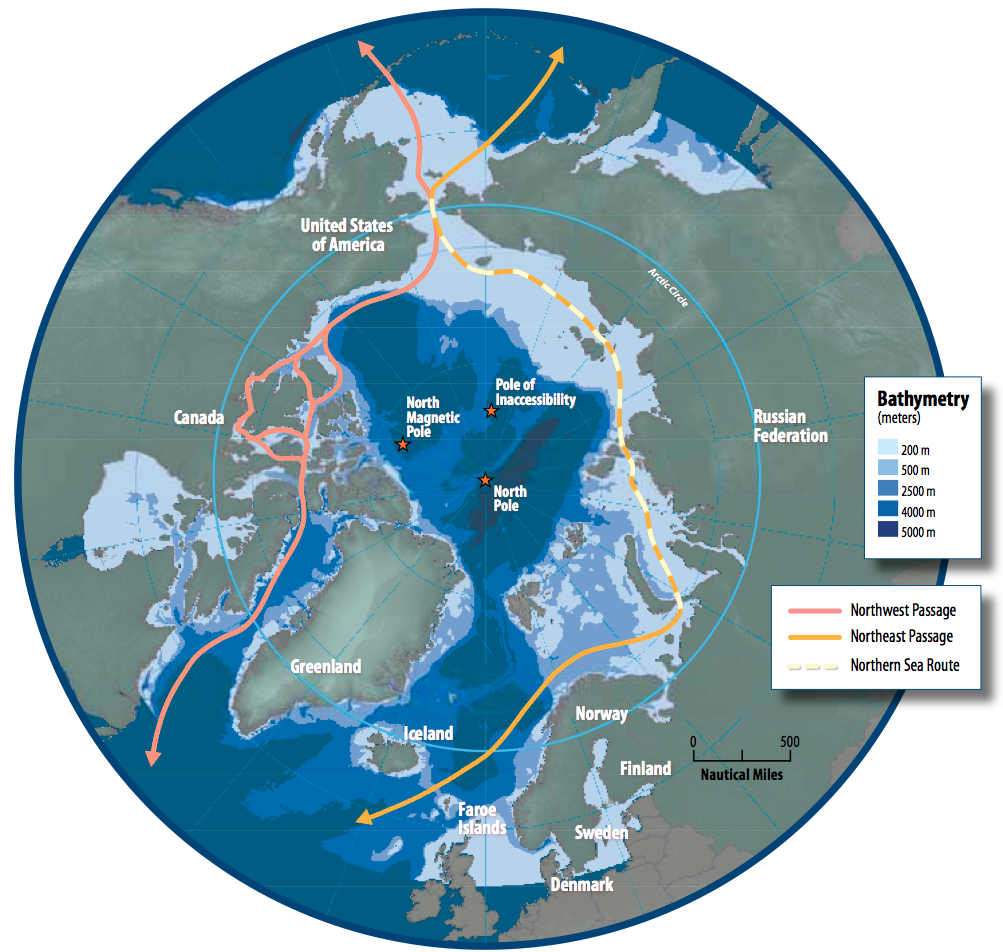
The warming trends, however, will certainly enable further economic activity in the region. Diminishing sea ice coverage is enabling greater maritime traffic. However, it remains unlikely that the northern routes will become competitors of the Suez Canal despite the difference and significantly shorter distance (approximately 4,700nm) from Northern Europe to East Asia that amounts to a decreased transit time of 12 to 15 days if weather conditions cooperate. Yet of the primary identified shipping routes through the Arctic – the Northern Sea Route (NSR), Northwest Passage (NWP), and Transpolar Route (TPR) – only the NSR will have extended periods of opening through approximately 2025. 

Map of the Arctic region showing shipping routes Northeast Passage, Northern Sea Route, and Northwest Passage, and bathymetry (Wikimedia Commons)

New Opportunities 

Shipping companies and countries alike are exploring the potential new trade routes. Putin has exclaimed that the Northern Sea Route will rival international trade lanes and indeed, there has been an increase of vessel activity in the region. In 2017, the Northern Sea Route Administration (NSRA) issued 662 permissions to vessels for navigation along the NSR, though only 107 of these for foreign (non-Russian) flagged vessels. During that year, the NSRA notes that 9.74 million tons of various freights were transported by vessels, though mostly between ports located along the NSR. Indeed, in 2017, there were only 24 vessels and 194,364 tons of cargo that transited the duration of the route – much less than the record high in 2013 when China’s COSCO and others sent cargos through to explore the possibility of a maritime route. That year, aided by exceptional weather conditions, 71 vessels and 1.36 million tons of cargo transited the Northern Sea Route. Yet this still pales in comparison to the Suez Canal traffic, which saw more than 17,600 vessels and 1.04 billion tons of cargo in 2017.

Weather and vessel size limitations – due to reduced water depths and widths limited to icebreaker accompaniment – will reduce the efficiencies of the commercial shipping industry, which values economies of scale and the just-in-time shipping model. Arctic shipping in its current state is not yet reliable enough to adhere to these requirements, although when the Transpolar Route opens it may become more appealing. China has already looked northward to link the “Polar Silk Road” to its broader One Belt One Road Initiative. Yet weather will remain a challenge, with unpredictable ice floes moving into vessel routes, harsh storms, and cold operating temperatures. The International Maritime Organization’s Polar Code was a solid effort to improve safety and establish training and operating standards for vessels in the Arctic, but it will likely need continuous updates to remain relevant. International coordination on Arctic maritime safety and emergency response will be critical to ensuring the prevention – or expeditious response – of a maritime crisis. Given the fragility of the environment, hostile conditions, and dearth of emergency response capabilities in the Arctic, cooperation will be critical to the future.

Another significant economic driver for the region is the abundant presence of energy both on shore and within the exclusive economic zones of the five Arctic coastal nations. Several countries have already submitted claims to further extend their claims under the Commission on the Limits of the Continental Shelf. This includes a number of overlapping claims, to include the Lomonosov Ridge – and the North Pole. Although the United States remains the sole Arctic nation that has not ratified the United Nations Convention on the Law of the Sea (UNCLOS) it appears that all Arctic nations will submit claims in accordance with UNCLOS. Yet the review of such claims make well take years due to the backlog of the Commission and the complexity of the review process. Until then, there remains a potential for disputes over economic resources, although Norway and Russia resolved the biggest dispute in the region peacefully in 2010. Currently the largest disputes in the Arctic are between the United States and Canada.

While oil and gas reserves are still unknown, it is estimated that the Arctic may hold nearly one-third of the world’s natural gas and thirteen percent of global oil reserves. Yet costs of exploring, developing, and extracting these resources are very high given the harsh environment, limited infrastructure, and difficulties posed. Given the current market prices, there is limited interest in pursuing these reserves in North America, though Norway and Russia are continuing development in the Barents and Kara Seas. The Chinese Nanhai-8 rig made an April 2018 discovery that may rank the Leningradskoye field as one of Russia’s largest natural gas fields. Indeed, China has also invested in the Yamal LNG project, which has ownership of 50.1 percent by Novatek, 20 percent by total, 20 percent by China National petroleum Company, and 9.9 percent by the Chinese Silk Road Fund. Production officially began in December 2017 and officials predict an annual production of up to 360 billion cubic meters of gas. The new Christophe de Margerie class of icebreaking LNG carriers – projected to be a total of 15 vessels at more than $300 million apiece – has commenced deliveries from Yamal to Asia. While the transit shipping of cargo may not be viable for decades, it is clear that Russia is intent on using the Northern Sea Route to ship commodities to market, albeit on a small scale when compared to the global maritime industry. Overall production of Arctic energy reserves will likely remain limited in the near future, unless the price of oil climbs significantly. Other sources of oil and gas – to include shale and using newer technology on older fields – will continue to remain a more economical option.

Mineral resources are also found in vast quantities throughout the Arctic, with all Arctic nations except Iceland possessing significant mineral deposits. While some new deposits are being revealed as ice coverage melts, it is likely that development in the near term will continue to focus on existing mines. It is predicted that infrastructure to these mines and areas will steadily be improved to permit future access.

Changes in climate are also likely to result in increased fishing in the Arctic. While there is little data on exact sizes of Arctic fishing stocks, it is likely that fish will continue migrations northward as the waters warm in the south. International fishing fleets will follow these fish, and the level of illegal and unreported fishing will likely rise due to the challenges of monitoring the vast region and lack of comprehensive maritime domain awareness. Yet this is also another opportunity for the Arctic coastal states to work together, in regulating and monitoring fishing. Likewise, the regulation of tourism in Arctic water – and the establishment of clear safety and emergency response protocols – will require cooperation from the Arctic states as the numbers of tourists rise. Indeed, the 2016 and 2017 Northwest Passage transits of the Crystal Serenity cruise ship and 1,800 passengers (900 guests) highlight the importance of developing both regulations and crisis response procedures as the adventure tourism industry continues to grow.

A final economic factor in the Arctic will be foreign direct investment. To date, the Arctic has received significant levels of FDI, with China being the largest source at an estimated $1.4 trillion invested into the economies of the Arctic nations from 2005-2017. Concerns arise over the potential for externalities associated with this investment, particularly given China’s record on labor and environmental issues. China’s recent Arctic White Paper establishes that China will continue to seek investment and other economic opportunities in the region. 

Conclusion

The Arctic is brimming with economic potential. Though the population will continue to be a small fraction of the global population, the region has significant natural resources and potential as a maritime trade route. With an annual economy presently exceeding $450 billion, it is likely that the region will experience further growth as the Arctic becomes increasingly accessible. Yet Arctic states must carefully regulate this growth in order to ensure protection of the environment, indigenous peoples, and their own strategic interests. This will further require significant cooperation amongst the nations of the High North – and those with interests in the region – in order to ensure the development and adherence to protocols and regulations that guide economic development. 

Rachael Gosnell is pursuing doctoral studies in International Security and Economic Policy at the University of Maryland, with a focus on maritime security in the Arctic. She holds a MA in International Security Studies from Georgetown University, a Masters in Engineering Management from Old Dominion University, and a Bachelors of Science in Political Science from the U.S. Naval Academy. She currently teaches Political Science at the U.S. Naval Academy. All views expressed are her own and do not reflect the U.S. Department of Defense or the U.S. Naval Academy.

Featured Image: Helicopter view of U.S. Coast Guard Cutter Healy (bottom left) stopped in the Arctic Ocean as Canadian Coast Guard Ship Louis S. St. Laurent (top right) comes alongside it. (Jessica K. Robertson/Public Domain)