Category Archives: Asia-Pacific

Analysis relating to USPACOM.

U.S. Options for the People’s Republic of China’s Maritime Militias

This article originally featured on Divergent Options and is republished with permission. Read it in its original form here

By Blake Herzinger


National Security Situation:  People’s Republic of China (PRC) Maritime Militias operating in the East China Sea (ECS) and South China Sea (SCS).

Date Originally Written:  February 21, 2017.

Date Originally Published:  April 6, 2017.

Author and/or Article Point of View: Author believes in freedom of navigation and maintenance of good order at sea in accordance with customary and written law of the sea. The article is written from the point of view of U.S. sea services leadership toward countering PRC maritime irregulars at sea.

Background:  The PRC employs irregular militia forces at sea alongside naval and maritime law enforcement units.  By deploying these so-called “blue hulls” manned by un-uniformed (or selectively-uniformed) militiamen, the PRC presses its maritime claims and confronts foreign sea services within a “gray zone[1].”  In keeping with national traditions of People’s War, PRC Maritime Militias seek advantage through asymmetry, while opposing competitors whose rules of engagement are based on international law.  The PRC Maritime Militia participated in several of the most provocative PRC acts in the SCS, including the 2009 USNS Impeccable incident, the seizure of Scarborough Shoal in 2012, and the 2014 China National Offshore Oil Corporation (CNOOC) 981 confrontation with Vietnam that also involved the smaller Vietnam Maritime Militia[2].

Significance:  On its surface, employing irregular forces may be an attractive option for a state facing a more powerful opponent, or for a state interested in “a less provocative means of promoting its strategic goal of regional hegemony” such as the PRC[3].  However, incorporating these irregular forces into a hybrid national strategy has deleterious impacts on the structure of the international legal system, particularly in maritime law and the laws of naval warfare[4].  PRC Maritime Militias’ use of “civilian” fishing vessels to support, and conduct, military operations distorts this legal structure by obfuscating the force’s identity and flaunting established international legal boundaries.

Option #1:  U.S. political and military leaders engage the PRC/People’s Liberation Army (Navy) (PLAN) directly and publicly on the existence and operations of the Maritime Militia, insist upon adherence to internationally-accepted legal identification of vessels and personnel[6], and convey what costs will be imposed on the PRC/PLAN if they do not change their behavior.

As an example, the Commander U.S. Pacific Fleet, Admiral Scott Swift, has voiced his frustration with PLAN unwillingness to acknowledge the existence of the PRC Maritime Militia and its relationships with state law enforcement and military forces[5]. In the event that the PRC declines to engage in dialogue regarding the Maritime Militia, discontinuing PLAN participation in the Rim of the Pacific exercise is the suggested response.

Risk:  Without clearly attaching costs to continued use of militia forces in operations against the USN, Option #1 is unlikely to affect PRC behavior.  Conveying possible imposed costs carries risk of further-degrading relations between the U.S. and PRC, but it is precisely PRC perceptions of their behavior as costless that encourages the behaviors exhibited by the PRC’s Maritime Militia[7].

Gain:  Option #1 is an excellent opportunity for the U.S. to underline its commitment to good order at sea and a rules-based maritime order.  By encouraging the PRC to acknowledge the Maritime Militia and its associated command structure, the U.S. can cut through the ambiguity and civilian camouflage under which the Maritime Militia has operated unchallenged.  In the event that the PRC declines to engage, conveying the possible imposition of costs may serve as a warning that behavior negatively affecting good order at sea will not be tolerated indefinitely.

Option #2:  U.S. Pacific Command’s Joint Interagency Task Force West (JIATF-W) assists the Association of Southeast Asian Nations (ASEAN) in developing and implementing an organic maritime domain awareness (MDA) capability with domestic, and international, interagency sharing and response capability.  For the purposes of this article, MDA will be understood to be a host-nation’s ability to “collect, fuse, analyze and disseminate maritime data, information and intelligence relating to potential threats to [its] security, safety, economy or environment[8].”

Risk:  Close to a score of abandoned information portals and sharing infrastructures have been tried and failed in Southeast Asia, a cautionary tale regarding the risk of wasted resources.  Building upon over 20 years of JIATF-W’s experience should help to mitigate this risk, so long as an MDA solution is developed cooperatively and not simply imposed upon ASEAN.

Gain:  By providing focused and long-term support to an ASEAN-led solution, the U.S. can make progress in an area where MDA has been plagued by reticence, and occasionally inability to share vital information across interagency and national borders.  Shared awareness and cooperation at sea will combat the ability of the PRC Maritime Militia to operate uncontested in the SCS by enabling more effective law enforcement and naval response by affected countries.  Working through existing regional institutions such as Singapore’s Information Fusion Centre would add increased value to Option #2.

Option #3:  Utilize U.S. Coast Guard (USCG) to provide law enforcement and maritime safety training support to states bordering the ECS/SCS interested in creating their own maritime militias.

Risk:  Expanding a concept that is damaging the rules-based order may increase the rate of disintegration of good order at sea.  Any observable indication that the U.S. is encouraging the creation of irregular maritime forces would likely be viewed negatively by the PRC.  Option #3 carries risk of engendering diplomatic or military conflict between the U.S. and PRC, or between the PRC and U.S. partners.

Gain:  Option #3 might provide some level of parity for states facing PRC militia vessels.  Vietnam has already made the decision to pursue development of a maritime militia and others may follow in hopes of countering the PRC’s irregular capability.  USCG involvement in the organizational development and training of militias might provide some limited opportunities to shape their behavior and encourage responsible employment of militia forces.

Other Comments:  Encouragement for the expansion of the Code for Unplanned Encounters at Sea (CUES) is not addressed.  The CUES  was adopted during the 2014 Western Pacific Naval Symposium (WPNS) and provides a basis for communications, maritime safety, and maneuvering guidelines for use by ships and aircraft in unplanned encounters at sea.  CUES is not a legally binding document, but an agreed-upon protocol for managing potentially escalatory encounters in the Pacific[9].  This author believes coast guards adjoining the contested areas of the ECS and SCS will continue to resist CUES adoption in order to maintain operational latitude.  Given the reticence of coast guards to accede to the agreement, drawing PRC Maritime Militia into CUES seems an unrealistic possibility.

Recommendation:  None.

Blake Herzinger served in the United States Navy in Singapore, Japan, Italy, and exotic Jacksonville, Florida. He is presently employed by Booz Allen Hamilton and assists the U.S. Pacific Fleet in implementation and execution of the Southeast Asia Maritime Security Initiative. His writing has appeared in Proceedings and The Diplomat. He can be found on Twitter @BDHerzinger. Divergent Options’ content does not contain information of any official nature nor does the content represent the official position of any government, any organization, or any group. 


Endnotes:

[1]  The South China Sea’s Third Force: Understanding and Countering China’s Maritime Militia, Hearings on Seapower and Projection Forces in the South China Sea, Before the Subcommittee on Seapower and Projection Forces, 114th Cong., 1 (2016)(Statement of Andrew S. Erickson, U.S. Naval War College). http://docs.house.gov/meetings/AS/AS28/20160921/105309/HHRG-114-AS28-Wstate-EricksonPhDA-20160921.pdf

[2]  Conor M. Kennedy and Andrew S. Erickson, “Model Maritime Militia: Tanmen’s Leading Role in the April 2012 Scarborough Shoal Incident,” CIMSEC, 21 April 2016, https://cimsec.org/model-maritime-militia-tanmens-leading-role-april-2012-scarborough-shoal-incident/24573

[3]  James Kraska and Michael Monti, “The Law of Naval Warfare and China’s Maritime Militia,” International Law Studies 91.450 (2015): 465, http://stockton.usnwc.edu/cgi/viewcontent.cgi

[4]  Ibid.

[5]  Christopher Cavas, “China’s Maritime Militia a Growing Concern,” DefenseNews, November 21, 2016,  http://www.defensenews.com/articles/new-website-will-allow-marines-to-share-training-videos

[6]  The South China Sea’s Third Force: Understanding and Countering China’s Maritime Militia, Hearings on Seapower and Projection Forces in the South China Sea Before the Subcommittee on Seapower and Projection Forces, 114th Cong., 1 (2016)(Statement of Andrew S. Erickson, U.S. Naval War College). http://docs.house.gov/meetings/AS/AS28/20160921/105309/HHRG-114-AS28-Wstate-EricksonPhDA-20160921.pdf

[7]  The Struggle for Law in the South China Sea, Hearings on Seapower and Projection Forces in the South China Sea Before the Subcommittee on Seapower and Projection Forces, 114th Cong., 1 (2016)(Statement of James Kraska, U.S. Naval War College).

[8]  Secretary of the Navy Approves Strategic Plan for Maritime Domain Awareness, U.S. Navy, Last updated 8 October 2015, http://www.navy.mil/submit/display.asp? story_id=91417

[9]  Document: Code for Unplanned Encounters at Sea, USNI News, Last updated 22 August 2016, https://news.usni.org/2014/06/17/document-conduct-unplanned-encounters-sea

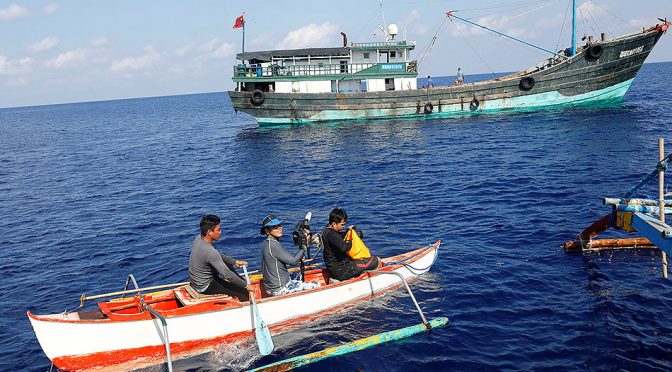
Featured Image: Reuters video journalist Peter Blaza (C), with assistant Oscar Abunyawan (R), films a Chinese fishing vessel docked on the mouth of Scarborough Shoal in the South China Sea, April 6, 2017. Picture taken April 6, 2017. (Erik De Castro, Reuters)

China’s Aircraft Carrier: ‘Dreadnought’ or ‘Doctrinal Dilemma’?

This post first appeared on the National Maritime Foundation and is republished with permission. Read it in its original form here

By Captain Gurpreet S. Khurana, PhD

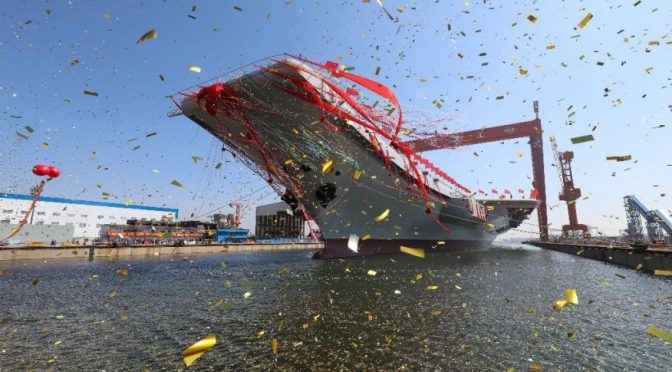
Less than five years after the China commissioned its first Soviet-origin aircraft carrier Liaoning in September 2012, it launched its first-ever domestic carrier – the Type 001A – on 26 April 2017. The new carrier is likely to be commissioned in 2020 as Shadong. Even though the Liaoning and the Type 001A are medium-sized conventionally powered (non-nuclear) vessels equipped with aircraft ski-jumps (not catapults), and thus far less capable than the super-carriers operated by the United States, the occasion was celebrated in China as a major achievement symbolic of China’s ‘great power’ status. A report indicates that a larger, next generation Type 002 carrier equipped with a steam catapult has been under construction since March 2015, and its follow-on carriers may be nuclear powered.  

The launch of the Type 001A is, indeed, a milestone in the development of China as a major naval power. It reminds us of the famous battleship HMS Dreadnought commissioned into the Royal Navy in 1906. The Dreadnought was a highly successful warship induction marking the dawn of the 20th century warfare at sea. It became iconic of a transformative naval capability in a manner that the older existing warships of the world began to fade into obsolescence as pre-Dreadnoughts. The celebration in Beijing similarly justified, given the achievement of China’s defense-technological endeavor within a relatively short period of time. It stands out rather conspicuously in comparison to India, which has been operating aircraft carriers since 1961, but is yet to commission its first indigenous carrier named Vikrant.

Moving from ‘symbolism’ to ‘substance,’ such ‘flat-tops’ are indeed valuable platforms for maritime force-projection, which, for centuries, has been an important naval mission of all major power navies. However, given China’s maritime geography and the kind of insecurities it encounters today from vastly superior adversarial navies of the United States and Japan operating in the western Pacific Rim, the PLA Navy’s growing doctrinal reliance on carriers seems to be an aberration. It may have been more prudent for China to focus on bolstering its existing Anti-Access/ Area-Denial (A2AD) operational doctrine with the naval doctrine of ‘sea-denial’ – particularly given the PLA Navy’s traditional strengths in submarine, sea-mine and missile warfare – rather than diluting its naval doctrine by adding the carrier-based ‘sea-control’ doctrine.

Chinese carriers will also be highly vulnerable in the western Pacific Rim, not only to the advanced navies, but also to the many unfriendly airbases and submarine bases of the littoral countries dotting the periphery of the East and South China Seas. It is well known that even the smaller countries in the region are building potent sea-denial capabilities against China. The recent induction of the six advanced Russian Kilo-class submarines into the Vietnamese Navy is a case in point. If a maritime conflict breaks out in the area, the PLA Navy carrier would surely be a prime target and any such successful targeting would be a major symbolic blow to China’s morale, and thus its war effort.

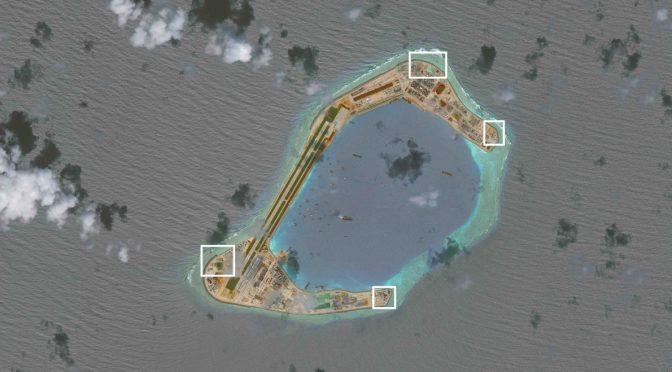
The Chinese believe that ‘sea-control’ is necessary to assert its maritime-territorial claims in the China Seas. This could have been achieved effectively – and at reduced risk – by optimally using the air-bases in the Chinese mainland and the occupied islands, which China is expanding through reclamation. Ironically, China’s island-building activity in the South China Sea has caused a major damage to China’s claim to its ‘peaceful rise’ theory, which is now being aggravated by its own carrier-building program. Furthermore, the program lacks operational credibility, much into the foreseeable future. It would take the PLA Navy many years to operationalize a full-fledged Carrier Task Force, and possibly decades to make it effective enough to achieve sea-control against advanced navies. Meanwhile, the process could cause an indelible dent in China’s objective to propagate a ‘benign’ and ‘constructive’ image in the Indo-Pacific region, including through its ‘One-Belt-One-Road’ (OBOR) initiative.

Chinese strategists also believe that carrier-based sea-control is necessary to protect their Sea Lines of Communication (SLOCs) in the Indian Ocean, as indicated by China’s recently articulated strategy of “open-seas protection” in its 2014 Defense White Paper. However, this could have been achieved – again effectively, and at reduced risk – by deploying its warships in its naval bases at strategic locations such as Djibouti and Gwadar.

China is likely to have at least three aircraft carriers in commission at any given time in the future. The Chinese have clearly gone too far ahead for any reappraisal of its aircraft-carrier program, possibly lured into the ‘command of the seas’ gambit of the major western naval powers, without factoring their own geostrategic conditions and circumstances. One may therefore, expect that the PLA Navy’s ‘doctrinal duality’ in terms of primacy to both ‘sea control’ and ‘sea denial’ may become its dilemma in the coming years.

Captain Gurpreet S Khurana, PhD, is Executive Director at the National Maritime Foundation (NMF), New Delhi. The views expressed are his own and do not reflect the official policy or position of the NMF, the Indian Navy, or the Government of India. He can be reached at gurpreet.bulbul@gmail.com.

Featured Image: In this photo released by China’s Xinhua News Agency, a newly-built aircraft carrier is transferred from dry dock into the water at a launch ceremony at a shipyard in Dalian in northeastern China’s Liaoning Province, Wednesday, April 26, 2017. (Li Gang/Xinhua via AP)

North Korea Week Concludes on CIMSEC

By Dmitry Filipoff

This week CIMSEC published articles analyzing European maritime security submitted in response to our Call for Articles. Submissions discussed various topics including key developments in North Korea’s pursuit of nuclear weapons, the strategic calculus of the players involved, and potential ways to resolve festering insecurity on the Korean peninsula. We thank our authors for their excellent contributions, listed below.

The Definition of Insanity: Carrots and Sticks with North Korea by Richard Kuzma

“There are two main tools left in the U.S. arsenal: economic sanctions and diplomacy. The first has been attempted, and leaves much to be desired. The second has received little play because it is politically unpopular to look ‘weak’ against North Korea.”

North Korea’s Sea-Based Nuclear Capabilities: An Evolving Threat by Matthew Gamble

“Of particular concern, North Korea has been making progress toward attaining a nuclear triad by developing a submarine-launched ballistic missile (SLBM) capable of delivering a nuclear warhead. After several failures, the DPRK successfully tested its first SLBM, known as the Pukkuksong-1/KN-11, in late August 2016.”

End States and Divided States: After the Kims by Matt McLaughlin

“However and whenever the Kim regime falls, it will be ugly – but some kind of end state will follow. Identifying the most desirable (or least undesirable) one will be critical to planning for North Korean contingencies.”

Putting Trump’s Reputation to Work in North Korea by Travis Lindsay

“The Korean peninsula now has more than one unpredictable player on the field. This gives substantial fresh upside in the potential to find solutions on the peninsula – with the downsides more terrible than ever.”

North Korea – Shaping the U.S. Response by Commodore Anil Jai Singh (ret.)

“Experts believe that each effort is bringing him closer to realizing his ICBM dream. What has led Kim to escalate this antipathy toward the U.S. to this extent and send out a very clear and unequivocal message that these developments are all aimed at the U.S. and its regional allies?”

Rethinking the Korean Peninsula Crisis by Ching Chang

“As the situation around the Korean Peninsula returns to normal now, we should reevaluate the Korean Peninsula crisis in order to identify where the misperceptions are that lead us to an overstatement of the reality in North Korea.”

Dmitry Filipoff is CIMSEC’s Director of Online Content. Contact him at Nextwar@cimsec.org.

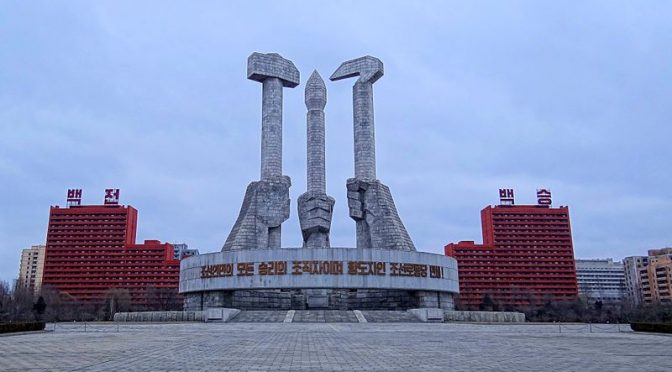
Featured Image: “The Monument to Party Founding” at Munsu Street, Taedonggang District in Pyongyang, North Korea. (Wikimedia Commons)

Rethinking the Korean Peninsula Crisis

North Korea Topic Week

By Ching Chang

Introduction

In the past few months, the Korean Peninsula has once again become the focus of security challenges in the Asia-Pacific. Accompanied with the unstable political situation after the impeachment of President Park Geun-hye, unanimously passed by the Republic of Korean Constitutional Court on March 10, 2017, Pyongyang decided to conduct a series of military exercises and a sixth nuclear test, making regional stability even worse.

The Republic of Korea and the United States of America started the annual military exercises known as Key Resolve and Foal Eagle in order to deter any North Korean adventurism before the next president was elected in mid-May. Simultaneously with the emerging crisis in the Korean peninsula, a dramatic summit between Beijing and Washington was held in early April. Donald Trump and Xi Jinping exchanged their perspectives on the Korean Peninsula at the Mar-a-Lago estate, though no clear and conclusive approach reached a consensus during this meeting.

Many observers had predicted that an imminent conflict may erupt then simply because both United States and North Korea had shown their forces in such a high profile manner. Nonetheless, some still argued that there was no possibility of any armed conflict since no signal of real war preparation ever appeared. Furthermore, all U.S.-ROK annual joint exercises are conducted with proper scales. No particular alert poise and combat readiness may prove any attempt to solve the North Korean threats with military contingency maneuvers. As the situation around the Korean Peninsula returns to normal now, we should reevaluate the Korean Peninsula crisis in order to identify where the misperceptions are that lead us to an overstatement of the reality in North Korea.

Strategic Dimensions of A Nuclear DPRK

First, how serious is the challenge that can be brought by the North Korean missile and nuclear program? Since 2006, Pyongyang has successfully conducted nuclear tests five times. Unquestionably, the North Korean regime can be defined as nuclear-capable. Nonetheless, we should not automatically assume that Kim Jong-un already owns any reliable nuclear weapon. We should remember that conducting a nuclear test in a well-managed underground facility is one thing; acquiring reliable nuclear weapons with a delivery vehicle through the weaponization process is another issue.

Key questions abound. Does a nuclear test and a missile test necessarily indicate a mature nuclear missile? Did Pyongyang ever prove that it has successfully completed the weaponization process from its primitive nuclear test yet? Can nuclear tests that happened in 2006, 2009, 2013 and twice in 2016 be sufficient to prove that North Korea may already own a mature nuclear weapon and the associated delivery vehicle? Do we need to review the historical records of various nuclear powers who developed their own nuclear arsenals? Is it unrealistic to assume that North Korea is capable of completing the weaponization process based on only a few tests? Even if North Korea has the luck to complete the weaponization process of its nuclear warheads and delivery vehicles within such a short period of time, has Pyongyang established a credible nuclear force yet?

Ko Yun-hwa (L), Administrator of Korea Meteorological Administration, points at where seismic waves observed in South Korea came from, during a media briefing at Korea Meteorological Administration in Seoul, South Korea, January 6, 2016. (Reuters/Kim Hong-Ji)

A well-articulated nuclear force is far more complicated than simply establishing a military force with nuclear weapons and delivery tools. The investment of command and control mechanisms that are compatible with the nuclear strategy may consume more of a budget than the nuclear weapon systems themselves. Force protection facilities and special forces for protecting the nuclear arsenal as well as other nuclear-related establishments are vital investments to build a mature nuclear force. We have already seen in the case of Pakistan and India how hard it is for them to retain their credibility of nuclear deterrence after their own nuclear tests. Arguably, we may also speculate that Pyongyang so far is only nuclear-capable, but to have any reliable nuclear arsenal and credible nuclear force, we have still yet to see.

Second, we should ask how North Korean nuclear capacity may convert into any political influence. It is very hard to see if Kim’s regime may use the nuclear weapon as a coercive means to take any offensive actions towards neighboring states. Has Pyongyang ever mentioned that the nuclear weapon will be used other than self-defense? Can North Korea afford a first-strike nuclear strategy? We should reconsider the purpose of Kim’s nuclear policy instead of misconstruing his real intention. Is a nuclear weapon a good choice to enhance the legitimacy of the government, thus assuring the political survivability of the regime? Given the case of the former Soviet Union, the answer is not ideal for Kim Jong-un. Can the nuclear arsenal enhance the political legitimacy of the North Korean government? This answer may also be disappointing. Kim’s nuclear policy has a very slim probability of reshaping the power structure in Northeast Asia and supporting the political survival of Kim’s regime. We should make no mistake in mistaking North Korea’s nuclear weapon for Iran’s anti-ship missile, which can immensely affect maritime transportation at the exit of the Persian Gulf. The nuclear weapons held by the North Korean may not have the same influence as other military assets in Kim’s hands, such as the hundreds of conventional artillery assets proximate to Seoul. 

https://gfycat.com/AromaticDisguisedCrab

North Korea has carried out massive artillery drills, possibly the largest in the country’s history, to mark the 85th anniversary of the founding of the country’s Army. (KCNA)

The China Factor

Third, the China factor in the Korean Peninsula should be clearly identified. There is much speculation on Beijing’s position towards Pyongyang. Undeniably, China is the only key ally to this isolated state. Nevertheless, the influence of China on North Korea is also limited. China has clearly addressed its position on the North Korean nuclear issue with several statements noted by the Chinese governmental white paper titled China’s Policies on Asia-Pacific Security Cooperation issued on January 11, 2017. It first admitted that “The nuclear issue on the Korean Peninsula is complex and sensitive ” which proves that managing a nuclear Korean Peninsula is a daunting challenge to Beijing, too. Unlike many accusations of China secretly helping Pyongyang develop its nuclear arsenal, this policy statement clearly indicated China’s disagreement with the existence of North Korea’s nuclear capability.

Moreover, China also clearly expressed the willingness to cooperate with the United States on this issue, stating “China has actively pushed for peaceful solutions to hotspot issues such as the nuclear issue on the Korean Peninsula and the Afghanistan issue, and played its due role as a responsible major country” and that, “The two countries have made steady progress in practical cooperation in various fields, and maintained close communication and coordination on major regional and global issues like climate change, the Korean and Iranian nuclear issues, Syria, and Afghanistan.” We, therefore, should remember that the Mar-a-Lago summit is not a starting point for the U.S.-PRC cooperation on the North Korean nuclear issue, but a reaffirmation of positions. More importantly, it makes the following statement:

“China is committed to the denuclearization of the peninsula, its peace and stability, and settlement of the issue through dialogue and consultation. Over the years, China has made tremendous efforts to facilitate the process of denuclearization of the peninsula, safeguard the overall peace and stability there, and realize an early resumption of the Six-Party Talks… the Democratic People’s Republic of Korea (DPRK) conducted two nuclear tests and launched missiles of various types, violating UN Security Council resolutions and running counter to the wishes of the international community. China has made clear its opposition to such actions and supported the relevant Security Council resolutions to prevent the DPRK’s further pursuit of nuclear weapons…other parties concerned should not give up the efforts to resume talks or their responsibilities to safeguard peace and stability on the peninsula.”  

We, therefore, may conclude with a clear picture of China’s position on Pyongyang’s nuclear adventurism.

However, it is necessary to remember another issue: the deployment of the THAAD missile system in the Korean Peninsula in recent months. Although Beijing hasn’t linked this issue with the North Korean nuclear issue yet, Washington should be aware of the sensitivity of this military maneuver. Given that the white paper states “Despite clear opposition from relevant countries including China, the U.S. and the Republic of Korea (ROK) announced the decision to start and accelerate the deployment of the THAAD anti-ballistic missile system in the ROK. Such an act would seriously damage the regional strategic balance and the strategic security interests of China and other countries in the region, and run counter to the efforts for maintaining peace and stability on the Korean Peninsula. China firmly opposes the U.S. and ROK deployment of the THAAD anti-ballistic missile system in the ROK, and strongly urges the U.S. and the ROK to stop this process.” Of course, the newly-elected South Korean President Moon Jae-in may have the possibility to change the decision of deploying the THAAD system. Nonetheless, Washington should consider how these two issues can be well-managed together before any linkage actually emerges in Beijing’s strategic calculus in the future.

China-DPRK Treaty Ties

Last but not least, during past several months, there has been a missing point rarely noted in commentary. The Sino-North Korean Mutual Aid and Cooperation Friendship Treaty signed on July 11, 1961 is still a valid security assurance granted by Beijing so far. Article Two is a provision of mutual military assistance in the event of security threats to either signatory. The phrases of assuring military intervention as “The two parties undertake jointly to adopt all measures to prevent aggression against either party by any state,” and “in the event of one of the parties being subjected to the armed attack by any state or several states together and thus being involved in a state of war, the other party shall immediately render military and other assistance by all means at its disposal,” gave the treaty characteristics of a pact for security alliance.

Also, Article Three notes, “Neither party shall conclude any alliance directed against the other party or take part in any bloc or in any action or measure directed against the other party,” which can possibly exclude the possibility of Beijing granting tacit consent to Washington for any military maneuver involving the decapitation of North Korean leadership or the destruction of its nuclear facilities with military strikes. Although it is very unrealistic to argue that the Article Three of this treaty may effectively restrict any cooperative diplomatic effort between Washington and Beijing towards Pyongyang, it is necessary to understand Beijing’s present position of interpreting the terms noted in this treaty.

Conclusion

The Korean Peninsula crisis will never be the catalyst for improving Sino-US relations, though both parties do share the concern of future development. There are so many issues on the mutual relations agenda between Washington and Beijing. On the other hand, the Korean Peninsula crisis is the best chance for the Japanese Abe’s regime to have an excuse to revise its constitution. For the Japanese concern on the Korean Peninsula is a “just cause” or only a “just because”, the strategy planners in Washington should well assess its significances. With many misconceptions already existing on the Korean Peninsula, the most valuable advice would be “always be aware of those who intend to fish in troubled waters”. Before taking prompt decisions and taking the viewpoints from media commentary, reviewing all the basic documents carefully should also be an essential element for formulating future policies.

Dr. Ching Chang was a line officer in the Republic of China Navy for more than thirty years. As a visiting faculty member of the China Military Studies Masters Program at the National Defense University, ROC, he is recognized as a leading expert on the People’s Liberation Army with unique insights on its military thinkings.

Featured Image: A North Korean soldier watches the South Korean side at the truce village of Panmunjom in the demilitarized zone separating the two Koreas in Paju, north of Seoul April 4, 2013. (Reuters/Lee Jung-hoon/Yonhap)