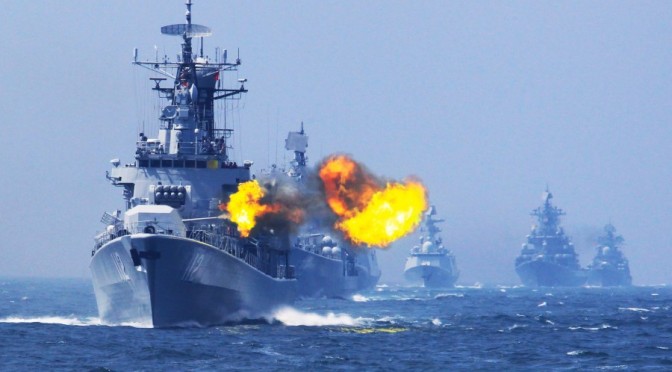
Category Archives: Asia-Pacific

Analysis relating to USPACOM.

The Hohenzollern Chinese Navy? Part One

The Hohenzollern High Seas Fleet

Recent Chinese pronouncements regarding the shift of their Navy from defensive to potential offensive operations contain a refrain with which naval historians are most familiar. It is a song once sung by another continental military power newly flush with a successful and expanding international economy.
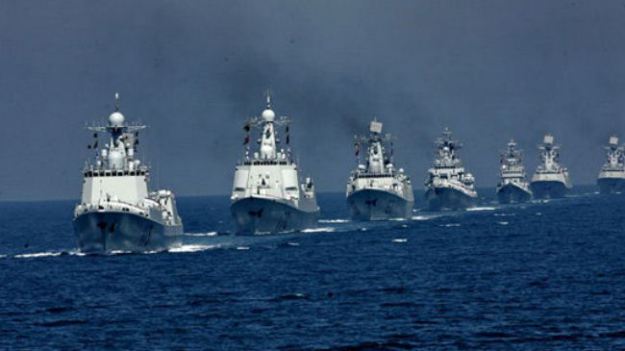
South China Sea fleet vessels.

China’s shift toward an offensive naval capability sounds very similar to the formation of the Imperial German High Seas Fleet (Hochseeflotte) in 1907. The Chinese and Hohenzollern navies have many commonalities in origin, training and choice of force structure. Their strategy, operational art and tactics are also remarkably similar to Kaiser Wilhelm’s fleet of the late 19th and early 20th century. The Chinese Navy may have also replicated the fatal flaw that left the High Seas Fleet incapable of achieving the victory it came so close to achieving in late 1917. Like the German imperial elite of the late 19th century, the Chinese Communist Party is now also seeking “a place in the sun” through President Hu Jinatao’s “new historic missions” assignment of 2004. China may too think that “its future is on the water” as did the Kaiser’s navy over a century ago. Such visions, however, for a fleet that has not seen battle against a peer opponent since 1894, can be dangerous.

Similar National Origins and Early Dismal Performance

Like Imperial Germany, the People’s Republic of China (PRC) is a continental land power that must look far into its past to find naval virtue. The Kaiser had to search back to the fifteenth century Hanseatic League in order to find heroic German maritime exploits that might be emulated by his own 20th century sailors. The PRC must equally rely on the historically remote Islamic Admiral Zheng He, who served the Ming Dynasty Yongle Emperor in the early 15th century as both a land and ocean-going commander. Both fleets were traditionally led by army officers and designed for coastal or at best littoral operations.

Both the German and Chinese fleets suffered from timid national leadership, and a paucity of training and operations that led to enforced idleness or defeat as late as the 19th century. Other Baltic powers often made short work of the Prussian Navy in war. The Swedes completely annihilated a Prussian fleet at the Battle of Frisches Haff in 1759. The Prussian Navy played practically no role in the three 19th century conflicts precipitated by Chancellor Otto von Bismarck that led to German unification. Its Danish, Austrian and French opponents either ignored, blockaded, or chased the small Prussian Navy from the seas. The Imperial Chinese Navy also suffered from neglect and poor performance from the Early Modern Period into the 20th century. The forces of the East India Company and the British Empire made short work of primitive Chinese warships in the two Opium wars of the mid 19th century. The French Navy destroyed the Chinese Fujian Fleet at the Battle of Fuzhou in 1884 and the Imperial Japanese Navy decisively defeated the Chinese Beiyang Fleet at the Battle of the Yalu River in 1894. The post-1949 People’s Liberation Army Navy (PLAN) has fought minor skirmishes against the Vietnamese, but has yet to engage anything approaching a regional, nor peer opponent in naval combat.
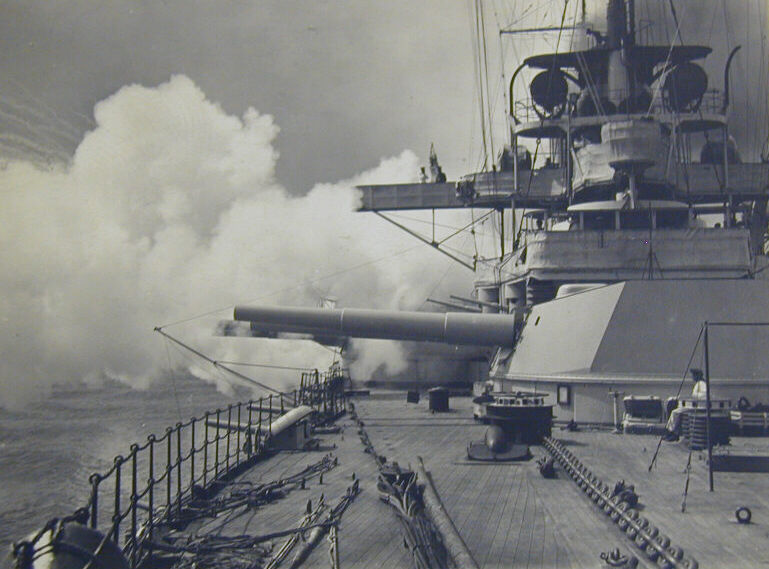
SMS Rheinland-focsle1914.
SMS Rheinland participates in a gunnery exercise, 1914.

The German High Seas Fleet and the PLAN both had to be “reborn” in new political and economic environments of their respective nations.  The united German state surged to new economic power between 1871 and 1906 and surpassed the British in steel production halfway into the first decade of the 20th century.1 Germany also came close to equally British world trade and coal production by 1914.2 Great Britain continued to prosper as both Germany and the United States surpassed Britain in key economic indicators and Britain’s Gross National Product grew from 1.32 billion to 2.1 billion Pounds over the period from 1870-1900.3 Despite these changes, the British Empire did not regard either Germany of the U.S. as a potential enemy, and Canada’s shared border with the U.S. caused more concern to the British in 1900 than did Germany’s economic growth.4 Germany, however, despite its unchallenged economic success decided to engage the British Empire in a naval building race that the British did nothing to instigate. Some historians have said the British detainment of several German ships transporting relief supplies to Dutch Boers during the Second Boer War (1899-1902), served as a catalyst for the passage of the German Second Naval Law which was much more provocative and aimed at Great Britain than its predecessor.5 Emboldened by economic success and military strength, and baited into action by its inability to influence sea lines of communication outside its sphere of influence, Germany embarked on a risky warship building competition with the established naval hegemon at the time and made that challenge right on that naval power’s home doorstep.

China has had an equally meteoric economic rise since the time it also changed political organization by throwing off its Maoist past and embracing state-sponsored capitalism. Like Imperial Germany, post Mao China has combined pride in economic growth with its aggressive continental past. The People’s Republic appears to have had the same sort of decisive “maritime moment” as Imperial Germany when the U.S. deployed two aircraft carriers to the Taiwan Strait in 1996 as a response to simmering tensions between the PRC and Taiwan. There appears to have been a similar rage amongst the Chinese Communist Party and military leadership over the 1996 US deployment, as there was from German Aristocrats, businessmen and military leaders over the seizure of German relief ships off South Africa in 1900. It is this kind of significant public support that allowed for the growth in the German Navy of the early 20th century and may play a role in public support for an expanded PLAN.

Both fleets also began as coast defense organizations led by Army officers and dependent on inexpensive denial capabilities. The early German Imperial Navy was first led by infantry General Albrecht von Stosch and General (and later Imperial Chancellor) Leo von Caprivi. It had few large ships and invested much of its effort in the development of torpedo craft and mine warfare. The architect of the High Seas battlefleet, Admiral von Tirpitz, and many of the Imperial Navy’s future senior officers came out of the German Navy’s torpedo boat arm. While Kaiser Wilhelm II played a very public advocacy role for larger and more capable surface ships, such expansion would not have been possible in the absence of strong support from the German business and political community. While perhaps not fervent navalists like the Kaiser, they certainly thought that having a Navy to protect emerging commercial interests was a good investment, and were willing to invest in Germany’s new naval effort. The spirit of American navalist Alfred Thayer Mahan’s writings on the importance of a battle fleet to a nation’s political and global economic health found as many adherents in Germany as it did in Great Britain, the United States, and Japan.

The early PLAN was also led by Army Generals. The most prominent advocate of improving Chinese naval capabilities was General Liu Huaqing, who served as PLAN commander from 1982-1987.6 China’s naval strategy from 1949 through the 1980’s was also remarkably similar to Germany’s in that it was focused on coastal defense and emphasized missiles, torpedoes and mines deployed from small, coastal combatants. China appears to have also embraced the theories of Alfred Thayer Mahan as Germany did a century ago and added the study of the American navalist’s works to the curriculum of its advanced naval education courses.7 

Part two of this article will examine how Hohenzollern Germany and the People’s Republic of China developed striking similarities in force structure, naval strategy, and deployment of their naval forces.

Read Part Two here.

Steve Wills is a retired surface warfare officer and a PhD candidate in military history at Ohio University. His focus areas are modern U.S. naval and military reorganization efforts and British naval strategy and policy from 1889-1941. 

1 Aaron Friedberg, The Weary Titan; Britain and the Experience of Relative Decline, 1895-1905, Princeton, NJ, Princeton University Press, 1988, p. 25.

2 Ibid, pp. 24-25.

3 Ibid, p. 24.

4 Ibid, pp 185-186.

5 Keith Wilson, editor, The International Impact of the Boer War, Abingdon Oxon, UK, Routledge, 2014, pp. 36-38.

6 https://cimsec.org/father-modern-chinese-navy-liu-huaqing/13291, last assessed 16 June 2015.

7 Howard J. Dooley, “The Great Leap Outward: China’s Maritime Renaissance”, The Journal of East Asian Affairs, 01 March 2012, p. 69.
Book Review: James Bradley’s ‘The China Mirage’

CIMSEC content is and always will be free; consider a voluntary monthly donation to offset our operational costs. As always, it is your support and patronage that have allowed us to build this community – and we are incredibly grateful.
Select a Donation Option (USD)

Enter Donation Amount (USD)

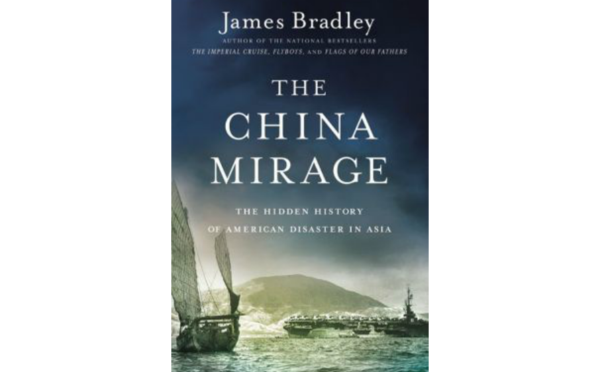
James Bradley. The China Mirage: the Hidden History of American Disaster in Asia. Little, Brown and Company. 417pp. $35.00.

915952_1_062215.mirage.png_standard

The United States has a troubled relationship with China. The confrontations over military budgets and the South China Sea are profound but they are not the first flash-points to develop in the relationship. The details of American involvement in China’s so-called “Century of Humiliation” are not widely known among Americans. In steps James Bradley, author of Flags of our Fathers, with his newest offering: The China Mirage. Bradley offers in the introduction to examine “the American perception of Asia and the gap between perception and reality.” While the book’s direction and intent are admirable, The China Mirage lapses into a mirage of its own, in which every American action in China is driven by economic exploitation, abject naivety, or criminal gullibility.

The China Mirage is organized chronologically and examines American involvement and missteps in East Asia. It begins with detailed treatment of the life of Warren Delano, the grandfather of Franklin Delano Roosevelt, who made the family’s fortune by opium smuggling and conveniently described his activities as “the China trade.” It continues in a grand historical arc covering both Roosevelt presidencies, both Sino-Japanese Wars (from 1894-1895 and 1937-1945), the Greater East Asia Co-Prosperity Sphere, Chiang Kai-Shek, Mao Zedong, the outbreak of World War II, the Chinese Civil War, the “who lost China” debate in the United States, the Korean War, and the Vietnam War. This feat is a tall order for any author and Bradley manages to keep the pace moving throughout his 400-page tome with vignettes from lives of Great People.

While the book is nominally about China, it spends a large portion examining the United States’ relationship with Japan. The long treatment of characters such as Theodore Roosevelt (TR) and Baron Kaneko, Japan’s

A photo of Kitaro Kaneko at his Harvard Graduation

Harvard-educated diplomat who built a strong relationship with TR, mentions China on the periphery but the reader can clearly see the fruits of Bradley’s research in his earlier book about TR’s presidency, The Imperial Cruise, shining through in this newest text. While the United States’ treatment of Japan was somewhat connected to China, the amount included in The China Mirage was excessive and distracting. At times, the narrative style is frenetic, moving back and forth between China and Japan fast enough to induce whiplash.
Bradley’s style is, at its core, polemic and his words drip with venom. He uses vivid portraits to weave a narrative about the various decision-makers on both sides of the Pacific who drove the hundred-year drama. Lurid details and shortcomings are front-and-center with the author’s voice providing commentary. The Republic of China is referred to as “The Soong-Chiang Syndicate”; American missionaries are called Chiang Kai-Shek’s “favorite sycophants”; Baron Kaneko’s interactions with TR are described as “canoodling.” China’s population is referred to as “Noble Chinese Peasants” to reflect American incorrect assumptions that the Chinese were ignorant and eager to adopt America’s Christian culture. The style is certainly not boring but, as the narrative progresses, it became more of a burden than a boon. The sarcastic use of terms such as “Southern Methodist Chiang” or “foreign devils” became distracting as they were used repeated throughout the entire book, implying that they were not just rhetorical flourishes but an opportunity for the author to express his disdain for many of the players involved.

In an ironic twist, The China Mirage ends up crafting caricatures which cleve as much to a fantasy as the American vision of the Noble Chinese Peasant which Bradley derides throughout the entire book. Theodore and Franklin Roosevelt appear as bumbling fools who were taken in respectively by the Japanese or Chiang Kai-Shek. The reader is treated to vivid, often unnecessary, digressions into the men’s Harvard connections and material opulence. FDR is essentially a

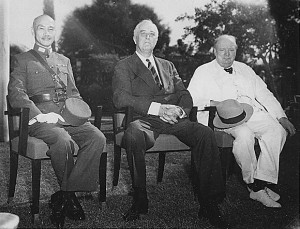
FDR sits between Chiang Kei Shek and Winston Churchill at the Cairo Conference.

tottering fool who lives large off opium money while being seduced by bureaucratic charlatans and bamboozled by colorful maps. These analyses both ignore the savviness of both of these men in their Presidential roles as well as the fact that one person, even a President, is unable to successfully implement policy without buy-in from others in the policy-making world. The book’s implied belief that these men’s personal failings single-handedly lead to policy-blunders is overstated.

On the other hand, Bradley lionizes Mao Zedong as a people’s champion who was a better choice than Chiang Kai-Shek to lead China. Mao is portrayed as the key character in anti-Japanese resistance during the Second Sino-Japanese War (1937-1945), exhorting the corrupt Chiang to “show some spine.” The problem with this assertion is that, unlike Bradley claims, Mao’s forces were barely ever involved in fighting against the Japanese. A vivid portrait is painted of Mao’s seemingly saintly activities in his Yan’an enclave in the 1930s without any mention of the thousands of Communists who were purged during those years to cement his hold on power. One could assume that this omission was mere oversight were not for the fact that, in a preceding chapter, Chiang Kai-Shek’s execution of a few journalists was given top-billing in the narrative. The reader gets the impression that the book has a purposeful slant and bias.

There are other conclusions which might cause some arched eyebrows. The decades-long recognition of Taiwan as the seat of the Chinese government is portrayed as a singular act of American arrogance and ignorance, yet non-recognition was the exactly same policy used by the United States with the German annexation of Austria in 1938 and the Soviet annexation of the Baltic States in 1940. A condemnation of the FDR Administration’s Lend-Lease policy, derided as an “attractive fiction that, after their wars were over, England, Russia, and China would return the materials the U.S. lent to them,” misses the fact that many of those materials were returned, even by the Soviet Union during the early stages of the Cold War. These attacks indicate that the objective of the narrative is to find any and every way to undermine the people whom the author does not like rather than focusing on the book’s main purpose: analyzing the United States’ relationship with China.

While the style and content might at times be suspect, Bradley does a valuable service by introducing historical issues which are not in the American mainstream: the sad legacy of the Exclusion Act and anti-Chinese violence in mid-19th century America; the lingering distrust in China of outsiders who preach a noble message but are perceived to act in their self-interest; the role the United States oil embargo played in the outbreak of war with Japan; the opportunity, though overstated and oversimplified, for the United States to broker an agreement with Mao before the Chinese Civil War formally began; the abominable treatment of people with China experience in the State Department during the early days of McCarthyism. These are important topics that should be more widely known so that the average American can have a more nuanced understanding how the Chinese people, rather than just the Chinese government, will react to American policy.
American policymakers will need to get the US-China relationship right if they want to successfully navigate a turbulent 21st Century. To achieve this, they will need to shelve preconceived notions of what China is and view on-the-ground facts rather than projecting their own culture and worldview. The China Mirage can be a jumping-off point for the uninitiated but recognize that, just like other historical narratives about China, it has its own shortcomings.

Matthew Merighi is CIMSEC’s Directors of Publications. He is also a Master of Arts candidate at the Fletcher School of Law and Diplomacy studying Pacific Asia and International Security.

Aiding India’s Next-Generation Aircraft Carrier: A Review

By Peter Marino

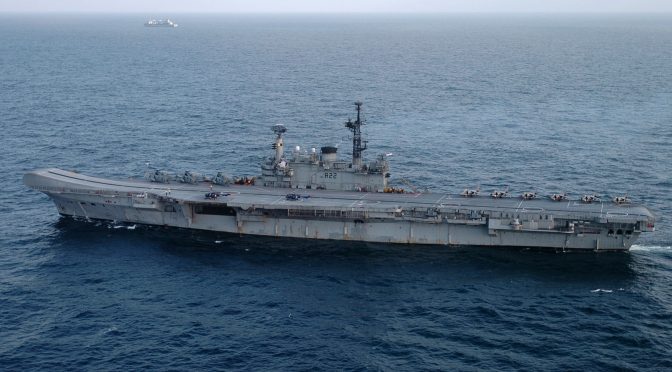
As global power shifts both to Asia and within Asia, strategic realignments between states are picking up pace. The US-India relationship is one such partnership that is receiving increased reassessment from specialists in both capitals. In his recent paper, Making Waves, Carnegie Endowment scholar Ashley Tellis weighs in on the topic, suggesting an expansion and deepening of the security relationship through a close collaboration on the design and construction of India’s next aircraft carrier class, the Vishal. I took a brief look at the paper and examined its stated and implicit conclusions.

Peter Marino holds an MSc in Global Politics from The London School of Economics and is a graduate of Norwich University. He lived in Shanghai from 2003 to 2008 and served as head of China development for London-based Aurigon, Ltd. He founded and sold Quaternion, a political risk startup, and is currently establishing a new Think Tank for International Affairs aimed at promoting engagement with the “Millennial Generation.” He also produces Globalogues, a video blog with commentary on global politics and economics. The views expressed in this article are his own.

10 Things You May Have Missed in DoD’s Asia-Pacific Maritime Security Strategy

CIMSEC content is and always will be free; consider a voluntary monthly donation to offset our operational costs. As always, it is your support and patronage that have allowed us to build this community – and we are incredibly grateful.

Select a Donation Option (USD)

Enter Donation Amount (USD)

This post originally appeared on Navy Grade 36 Bureaucrat. It can be found in its original form here.

At first glance, the recently released Asia-Pacific Maritime Security Strategy looks like a rehash of a lot of old points about the US’ position on Pacific matters.  But upon closer examination, there is a key shift in language that those of us who watch the region will take note of.  Here are ten things you might have missed:

1. It calls out the Senate directly on UNCLOS, but doesn’t address ISA.

Normally DoD publications don’t delve too much into policy matters with Congress.  But it’s hard to say that about this statement:

“This is why the United States operates consistent with – even though the U.S. Senate has yet to provide its advice and consent – the United Nations Convention on the Law of the Sea”

UNCLOS was originally opposed due to the International Seabed Authority (ISA), which does such un-American things like taxing sea bed mining for distribution to other countries and mandating technology transfer.  The military normally focuses on the navigation portion of UNCLOS, which it has abided by since the Regan era.  The problem comes when the US is encouraging nations to use UNCLOS while not actually having ratified the treaty.  There isn’t an easy solution, short of removing the ISA from UNCLOS, but expect to see UNCLOS ratification cries in the near future.

2. It calls out everyone on the South China Sea.

 It’s not just China.  Every claimant in the South China Seas has issues.  This document clearly spells that out, taking away a talking point from the PRC that the US is overlooking the other countries to focus on China.  But it pulls no punches on China, going after the “so-called Nine-Dash Line” as an excessive claim.

3. It spells out why the Senkakus became a problem.

Most people view the Senkakus as a bunch of rocks that China and Japan hold in dispute.  Very few know that the Japanese government bought them in order to prevent the Governor of Tokyo from buying them.  This was actually an attempt to prevent a clash with China, since the Governor was rightwing and would likely have stoked the issue.  This narrative has been lost to China’s narrative about how Japan “changed the status quo,” so it’s good to see it spelled out here.

4. It puts India as a model for dispute resolution. 

Comparing the India/Bangladesh maritime dispute resolution to what is occurring in the South China Sea is no accident.  This document clearly spells out US support to India, likely in an attempt to spur continued Indian investment in their “Look East” strategy.

5. It denies territorial sea around reclaimed islands.

This is big. 

“At least some of these features were not naturally formed areas of land that were above water at  high  tide and, thus, under international law as reflected in the Law of the Sea  Convention, cannot generate any maritime zones (e.g., territorial seas or exclusive economic zones).  Artificial islands built on such features could, at most, generate 500-meter safety zones, which must be established in  conformity with requirements specified in the Law of the Sea Convention.”

This is a clear US denial of any Chinese territorial claim of these features.  This has been implied before, but not ever strongly stated. On that same note…

6. Freedom of Navigation (FON) is coming to you.

One paragraph in particular tells us to expect more FON operations:

“Over the past two years, the Department has undertaken an effort to reinvigorate our Freedom of Navigation program, in concert with the Department of State, to ensure that we regularly and consistently challenge excessive maritime claims.”

Coming on the heels of stating that PRC reclaimed land is an excessive claim, this is a really good sign, although realize that future FON operations will likely include challenges to all claimants (and make diplomatic efforts interesting).

7. It accuses China of changing the status quo.

If you sit on a beach, you’ll watch the waves crash against rocks.  The seawater slowly erodes the rocks until they split open at seams you couldn’t have seen before.  This is analogous to China’s strategy in the East and South China Seas.  They have slowly worn away at seams around every other claimant, always claiming to “maintain the status quo” when in reality they are waiting for the other claimant to make the first move, then instantly cry that they are the victim.  Scarborough Reef is a classic example, yet the media has essentially ignored the issue.  Luckily, this document calls it out, stating “China is unilaterally altering the physical status quo in the region.”

8. It calls out A2/AD and how we would stop any short war.

It gives vague language to DoD efforts to combat A2/AD, but it does say that it’s happening, with “robotics, autonomous systems, miniaturization, big data, and additive manufacturing.”  It also later mentions that we’ll be dispersing around the Pacific, into more Japanese bases and places like Australia.  This complicates PRC targeting.  Will the PRC risk war with the US if we have units spread out everywhere?  They don’t have enough missiles to hit everything, and striking into a country like Australia means that any sort of “short, sharp war” on their part quickly expands…something that will cause a lot of angst on their end. 

9. It calls out information sharing with allies.

“This is why DoD is working closely with partners in the Asia-Pacific region to encourage greater information sharing and the establishment of a regional maritime domain awareness network that could provide a common operating picture and real-time dissemination of data.”

I’ve long argued that sharing data with allies is too hard.  At the CJOS-COE we worked hard to make Carrier Strike Groups use networks that supported integrating ships from non-“Five Eyes” countries, like Germany and Norway.  We proved that successfully, and in the Pacific we’ve integrated South Korean and Japanese ships before.  But what about Malaysia? Indonesia?  Brunei?  We get some play at RIMPAC, but not enough.  The disaster that was ABDA in World War 2 wasn’t that long ago.  We need to get friendly nation integration right before any shooting starts.

10. It’s got great graphics.

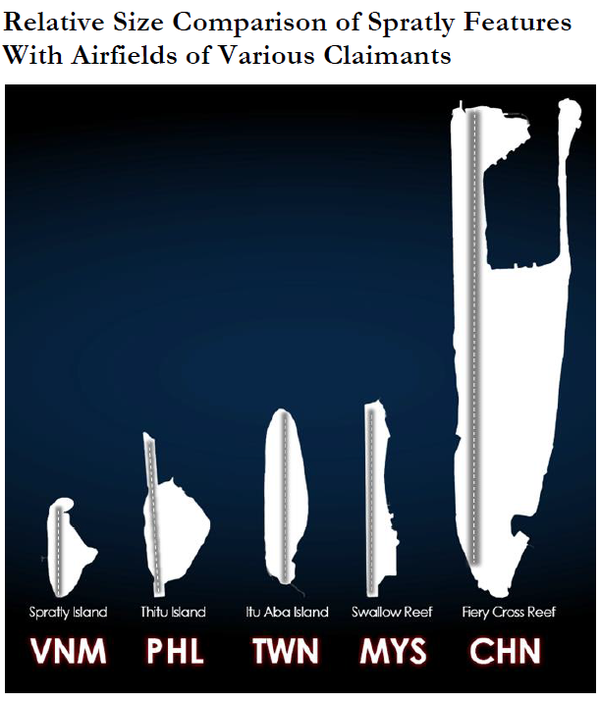
From the scale model of Fiery Cross Reef reclamation to a very nice and detailed map of South China Sea features, this is one of the few documents that uses more than just pretty pictures of military equipment.  Well done to the authors who picked quality illustrations to help drive their points home…almost as good as my choice of memes 🙂

Ryan Haag is the Hawaii CIMSEC President and an Information Warfare Officer navigating the uncharted waters of the Information Dominance Corps. He can be reached through his blog at The Navy’s Grade 36 Bureaucrat.