Lyle J. Morris is a policy analyst at the RAND Corporation, where he focuses on security developments in East and Southeast Asia. He has over ten years of experience researching and leading projects on Asia-Pacific security issues and has published recently on the rise of coast guards in East and Southeast Asia, maritime security in the Asia-Pacific, Chinese military modernization, and Chinese engagement in Africa. His articles have appeared in Naval War College Review, Asia Policy, The Diplomat, The National Interest, The China Brief, Aviation Week & Space Technology, Asia Maritime Transparency Initiative (AMTI),Asia Pacific Bulletin, and U.S. News and World Report, among others. Prior to joining RAND, Morris was the 2010-11 Next Generation Fellow at the National Bureau of Asian Research (NBR) and a research intern with the Freeman Chair in China Studies at the Center for Strategic and International Studies (CSIS). From 2004 to 2008, Morris lived in Beijing, China, where he studied Mandarin Chinese at Peking and Tsinghua Universities and later worked at Dentsu Advertising and the China Economist Journal. Morris received his master’s degree in international affairs from the Columbia University School of International and Public Affairs (SIPA), where he was the recipient of the George C. Marshall Prize in Strategic Studies for his paper on China’s experience with confidence-building measures. He holds a certificate in East Asian Studies from Columbia’s Weatherhead East Asian Institute. He received his bachelor’s degree in international business from Western Washington University.
Scott Cheney-Peters is CIMSEC’s Chairman of the Board of Directors.
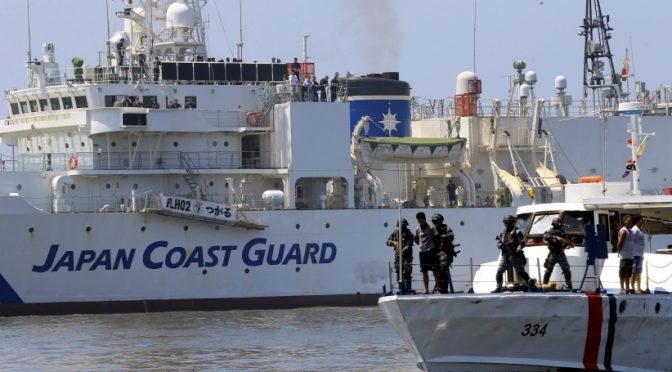
Photo: Philippine Coast Guard secures mock pirates during a rescue drill exercise with Japan’s Coast Guard off Manila Bay, Philippines, July 13, 2016 Photo by Romeo Ranoco/Reuters
In Europe, France is distinctive in claiming that its boundaries actually extend outside Europe into the Indian Ocean and Pacific Ocean, i.e. the ‘Indo-Pacific,’ through its overseas departments (département d’outre-mer), and overseas territories (territoire d’outre-mer), which are considered integral parts of France, and indeed thereby of the European Union. These Indo-Pacific possessions also have large Exclusive Economic Zones (EEZs). These give France important maritime interests to be maintained, and if need be defended, by the French Navy. French maritime strategy is two-fold. Firstly, locally-based naval ships patrol in the Indian and Pacific oceans. Secondly, regular deployments from metropolitan waters of the Jeanne d’Arc Group; the battle group centered around the aircraft carrier Charles de Gaulle and amphibious helicopter carrier Mistral, along with supporting destroyers, frigates, nuclear attack submarines, and air surveillance. As the current Chief of Staff Admiral Prazuck noted “our commitment to freedom of navigation calls for deployments to the Asia-Pacific zone several times each year.” Jeanne D’Arc 2017 consisted of a four-month deployment from March-June 2017 in the Indian Ocean and Western Pacific, described by France as “Indo-Pacific space … which is admittedly a long way from [metropolitan] France, but not from our territories.”
In the Indian Ocean, France’s possessions of Mayotte (population around 227,000) and Reunion (population around 840,000) in the southwest quadrant, are both considered as an “overseas department” (département d’outre-mer). They operate as “interlocking military stations” (Rogers), together with military facilities in Djibouti. In the southern (Terres Australes) quadrant are the uninhabited Kerguelen, St. Paul & Amsterdam and the Crozet islands which operate as “overseas territories” (territoire d’outre-mer) administered from Reunion. This residency status is why France was a founding member of the Indian Ocean Naval Symposium (IONS) established in 2008. France keeps a permanent naval presence at Reunion. This is further strengthened by regular deployment into the region of the Jeanne d’Arc carrier battle group; eight times during 2001-2017, which has included regular biannual joint exercises with India (Varuna since 1993) and the U.S. (Operation Bois Bellau in 2013).
In the Pacific, France is to be found in New Caledonia (population 270,000), Wallis & Futuna (population 12,000), and French Polynesia (population 270,000). Both New Caledonia and French Polynesia were admitted as full members of the Pacific Islands Forum (PIF) in September 2016. French “maritime naval zones” and local naval units are centered on New Caledonia and French Polynesia. It is from New Caledonia that France hosts the biannual Croix du Sud humanitarian and relief exercises. France has participated in a range of Pacific security mechanisms since their foundation; namely the Western Pacific Naval Symposium (1988 onward), with Australia and New Zealand in the FRANZ mechanism (1992 onwards), with the U.S., Australia and New Zealand in the Quadrilateral Defence Coordination Group (1998 onwards), and the South Pacific Defence Ministers mechanism (2013 onward.
Five key documents provide the strategic background to this Indo-Pacific maritime role:
France and security in the Asia-Pacific (2014, 2016)
Each of these can be looked at to see the development of this Indo-Pacific maritime role for France.
A national strategy for the sea and for the oceans (2008)
December 2008 witnessed the release by the Prime Minister’s Office of a Blue Paper titled A national strategy for the sea and for the oceans. This represented a call for future action. François Fillon’s ‘Preface’ as Prime Minister, was clear, “France has decided to return to its historic maritime role.” The 2008 Blue Book emphasized France’s overseas possessions and their EEZs:
“France, with its overseas départements and territories, is present in every ocean […] The creation of an economic zone has given France jurisdiction over nearly 11 million square kilometres of maritime space (of which more than 96% surround the overseas possessions), second only to the United States.” (p. 12)
These Exclusive Economic Zones (EEZs) were of significance for their resources, “many of France’s maritime assets are thus associated with these large overseas economic zones where this country has exclusive rights to resource exploitation” (p. 46), and “most of these zones are in the Pacific (around French Polynesia and New Caledonia) and the Indian Ocean (around the Kerguelen Islands)” (p. 46).
French naval power was stressed; “the French Navy’s wide range of capabilities maintain its [France’s] rank and presence throughout the world’s seas” (p.14). However, French naval assets remained a matter for French sovereignty:
“At the present stage of construction of the European Union, France does not intend to permanently allocate any of its sea-borne capabilities to an EU body or agency. France will continue to provide support for action coordinated by the EU or one of its agencies, by seconding the capabilities it chooses for specific periods of time or tasks” (p. 68).
Within the Indo-Pacific, the Indian Ocean was of immediate maritime importance for France, “the Indian Ocean is consequently well placed for the expression of France’s maritime policy, whether in our regional policy or in the action we promote with Europe, for example, against piracy” (pp. 72-73).
Maritimisation: La France face à la nouvelle géopolitique des océans(2012)
Continuing structural shifts towards the Indo-Pacific were noted, “the centre of geopolitical gravity is moving eastwards, highlighting the riparian nations of the Indian Ocean and Pacific” (p. 205). Given French possessions, “as a result there cannot be a maritime strategy without an overseas strategy (tr. p. 133), and that “the control of the maritime spaces is one of the keys of French power and influence on the international scene” (p. 140). Sea lane security across the Western Pacific, South China Sea and Indian Ocean was identified as of first rate importance for France, “more than ever, control of this maritime route between Europe and Asia becomes a major strategic issue” (p. 36)
In part this was a question of criminal activities and piracy, but what was also significant in this document was its repeated noting of Chinese naval growth (pp. 79-81,86,178) in which China’s naval assertiveness in the East China Sea, South China Sea and Indian Ocean (described as China’s ‘string of pearls’) was noted as a growing challenge to French interests, “what is at stake are our interests throughout the Indian Ocean and Pacific” (tr. p. 206).
Conversely, what the Senate report critiqued was French reductions of overall naval strength, including reductions in planned building of one aircraft carrier rather than two, and eight rather than seventeen Aquitaine-class anti-submarine frigates; which meant that “in other words we have reduced [naval] assets while the threats increased” (tr. p. 209). Consequently, the Senate report observed a future weakening of France’s maritime assets in the southern Indian Ocean (“a sharp deterioration in surveillance and intervention capacities on the high seas,” tr. p. 166) and in the southwest Pacific (“major capability disruption, with a strong impact on sovereignty and assistance missions in the national maritime areas […] with the withdrawal from active service of the Guardians of the Pacific in 2015. Years 2015 to 2019 appear to be particularly critical” (tr. pp. 166-167).
Defence and national security(2013)
In April 2013 a White Paper was published titled Defence and national security. The highest defense priority listed by it was simple “protect the national territory and French nationals abroad” (p. 47). While it painted a rosy picture of security in Europe (coming before Russia’s incorporation of the Crimea in 2014), France’s “national territory” of course extended outside Europe into the overseas departments and overseas territories. The 2013 White Paper made a point of highlighting (p. 14) that most of the overseas possessions were in the Indian and Pacific oceans, and came complete with around 1.5 million French nationals and resource-rich EEZs. Consequently it reiterated “France’s commitment as a sovereign power and a player in the security of the Indian Ocean and the Pacific (p. 29).
French Indian Ocean interests were highlighted, in particular the threat to them posed by piracy:
“The security of the Indian Ocean, a maritime access to Asia, is a priority for France and for Europe from this point of view […] The fact that the European Union’s first large-scale naval operation was the Atalanta operation against piracy clearly illustrates the importance of the Indian Ocean, not only for France but for Europe as a whole” (p. 56).
In those waters, a significant developing strategic partnership was highlighted whereby “as a neighbour[hood] power in the Indian Ocean, France plays a particular role here, reinforced by the development of privileged relations with India” (p. 56).
In the 2013 White Paper, China was now appearing as a concern (which it had not been in the 2008 White Paper) for France, given that “the equilibrium of East Asia has been radically transformed by the growing might of China” (p. 57). Conversely, the strategic partnership announced with Australia in 2012 was welcomed as showing their convergence on “regional matters relative to the Pacific and the Indian Ocean,” and more widely “it also confirms a renewed interest in a French presence on the part of countries in the region” (pp. 57-58).
National strategy for security of maritime areas(2015)
“Present in all seas and oceans around the world […] France thus has considerable assets which constitute coveted wealth and help to assert its position as a great maritime power. They give us rights, particularly to preserve our sovereignty and our sovereign economic rights […] our maritime area contributes to our rank as a major world power […] confirming its [France’s] rank as a major maritime power and its intention for economic development through sea” (p. 3).
Maritime threats came explicitly from piracy, but also implicitly from China:
Certain powers […] from East Asia […] are developing significant naval capabilities which could be able to counter our freedom of action at sea, pursue territorial ambitions in disputed maritime areas and thus threaten freedom of navigation in international waters” (pp. 4-5).
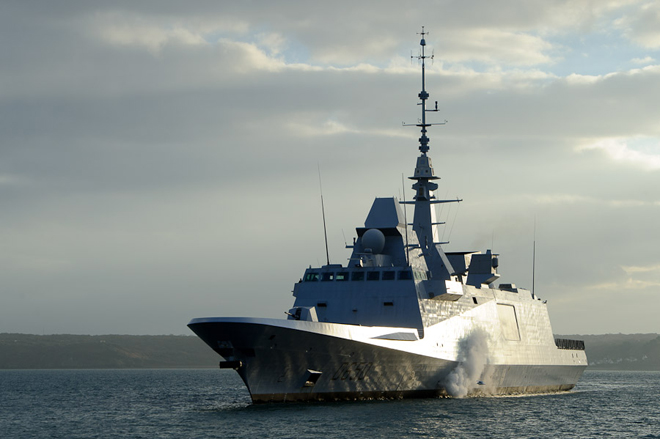
The multi-missions destroyer (FREMM) Aquitaine (Marine nationale)
French strategic remedies were internal balancing through “maintenance of a good level of ocean-going projection capacity, mainly provided by the resources of the French navy” (p. 49); and partly external balancing to “strengthen maritime cooperation with third-party States” (p. 42).
France and security in the Asia-Pacific(2014, 2016)
The Ministry of Defence document France and security in the Asia-Pacific was first released in April 2014 and then updated in June 2016. Whereas the 2014 document referred nowhere to the ‘Indo-Pacific’ as a geographic (and geo-strategic/geopolitical) term, the June 2016 version referred to it repeatedly, three times in Le Drian’s ‘Forward’ and five times in the main text.
Internal and external balancing was apparent in Le Drian’s ‘Forward,’ with strategic partners identified in the region:
“As a state of the Indian and of the Pacific Oceans, owing to its territories and its population, France permanently maintains sovereignty and presence forces there in order to defend its interests and to contribute to the stability of the region alongside its partners, primarily Australia, India, Japan and the United States. The long-existing links with the latter are tightening and France will continue to be committed in all aspects of regional security” (2016: p. 1).
The absence of China as a ‘partner’ was noticeable. Conversely, in a shot across the bow for Chinese restrictions in the South China Sea, an item unmentioned in the 2014 profile, Le Drian pledged that “responding to tensions in the South China Sea, France, as a first-rank maritime and naval Power, will continue to uphold freedom of navigation, to contribute to the security of maritime areas” (2016: p. 1).
In the main text, clear maritime priorities were flagged up. In a new comment, the 2016 paper stated:
“France has started to rebalance its strategic centre of gravity towards the Indo-Pacific, where it is a neighbour[hood] power […] Our armed forces stationed overseas and our permanent military basing in the Indian and the Pacific oceans confer to France a presence which is unique among European countries” (2016: p. 2)
Both the 2014 and 2016 papers stressed France’s maritime presence in the same wordage:
“France is present in all of the world’s oceans, owing to its overseas territories […] and thanks to its blue-water navy […] France’s primary obligation is to protect its territories and population (500,000 in the Pacific and over one million in the Indian Ocean)” (2016: p. 6).
Both papers used identical wording with regard to the geoeconomic significance (“extensive fishing, mineral and energy resources”) of France’s Exclusive Economic Zones, “located mainly in the Pacific (62%) and Indian Oceans (24%),” for which “France performs its protective mission thanks to its defence and security forces stationed in the region” (2016: p. 6).
A new issue, Chinese “reclamation works and the militarization of contested archipelagos” in the South China Sea were seen to “threaten the security of navigation and overflight,” on which France already “regularly exercises its right of maritime and air navigation in the area” (2016: p. 2).
Looking Forward
On the domestic front, the envisaged spending cuts of 7 percent for the 2016-2019 period were instead replaced in April 2015 by a 4 percent increase of 3.9 billion euros to underpin stronger oceanic maritime strength and with it a strengthened Indo-Pacific profile. Forward planning (Actualisation de la programme militaire 2014/2019) envisages that France “ will therefore consolidate its political commitment in Asia, the Indian Ocean, the Pacific … through its defense cooperation, an active military presence, [and] the development of strategic partnerships” (p. 6). France’s reassertion of its maritime position was completed with the ratification in February 2017 of the ordinance Espaces maritimes de la République Française (‘Maritime spaces of the French Republic’), which emphasized France’s intention to maintain, and defend its position in both the Indian and Pacific oceans. March 2017 witnessed a $4 billion frigate program being launched by the French defense ministry.
Meanwhile, France is actively pursuing Indo-Pacific maritime avenues. Le Drian remarked on conflict potential in the “Indo-Pacific region” at the Shangri-La Dialogue in June 2016; such that “France will therefore play its part in our collective responsibility to preserve and strengthen the stability and security of this region,” working with “our partners, in particular India, Australia, the United States, Singapore, Malaysia and even Japan,” with China absent from the listing.
In such a vein, the trip to India by Le Drian in September 2016 was the occasion for him to assert that “France confirms here that it is a credible actor of the Indo-Pacific zone, where – as I have been saying ceaselessly we have a prominent role to play” in the future. France’s strengthening links with India were on show in January 2017 at their Dialogue on maritime cooperation, explained by France as a “significant strengthening of cooperation between our respective navies for security and stability in the Indo-Pacific region.”
France’s strengthening links with Australia were on show in March 2017. The Joint Statement drawn up by Marc Ayrault, Minister of Foreign Affairs and International Development, with his Australian counterpart Julie Bishop, emphasized defense and security cooperation, especially naval, bilaterally and with third countries – “particularly in the Indo-Pacific region.” Given France’s strengthening links with India and Australia it is no surprise to find Le Drian in September 2016 arguing for a France-India-Australia trilateral framework; “we need to think of a three-way partnership that includes India if we want security in the Indo-Pacific region.”
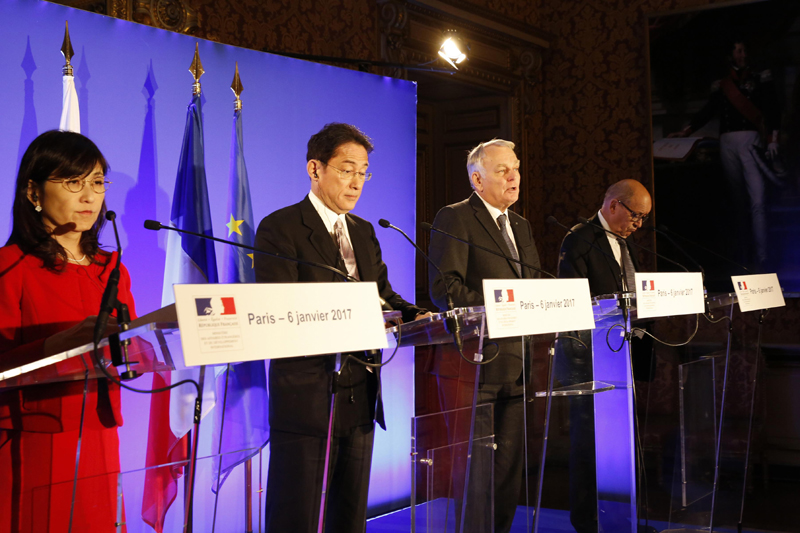
The Third Japan-France Foreign and Defense Ministers Meeting in 2017. (F. De la Mure / MAEDI)
France’s strengthening links with Japan were on show in the Franco-Japanese Joint Statement of January 2017 which talked of common Indo-Pacific concerns (“strategy for a free and open Indo-Pacific ocean”), and French naval presence (“a regular and visible naval presence in all maritime areas, including in the Indian and Pacific Oceans”). The visit of the Japanese leader to France in March 2017 was the occasion for France to pledge further military cooperation, “especially on the naval plane in the Pacific.” One sign of this will be France’s powerful Mistral amphibious helicopter carrier leading U.S. and Japanese troops in exercises at Tinian in the West Pacific in May 2017 in an implicit message to China.
Conclusion
Three Indo-Pacific maritime issues await French attention. In April 2016 at the Shangri-La Dialogue the French Defence Minister Le Drian argued since “the situation in the China seas, for example, directly affects the European Union,” so shouldn’t “the European navies, therefore, coordinate to ensure a presence that is as regular and visible as possible” in those waters?” EU responses remain unclear.
Two Indian Ocean related issues remain for French maritime strategy. Firstly, how far will French naval forces based in the Gulf continue operating against Daesh/ISIS forces in the Middle East, and how far there will be wider jihadist backlash in the Indo-Pacific? Secondly, the EU’s anti-piracy ATALANTA operation in the Gulf of Aden, currently renewed until 2018 and to which France has been contributing naval assets, has so far been run from Northwood in the UK. Given that the UK is due to leave the EU by April 2019, it would be logical for France as a resident power in the region and significant naval power to take over the coordination of the ATALANTA operation, if it continues.
Finally, Chinese maritime cooperation with Russia is of some concern to France. China-Russia joint naval exercises carried out in the Western Pacific and South China Sea help China’s maritime assertiveness in Indo-Pacific waters; but conversely the China-Russia joint naval exercises carried out in the Mediterranean and Black Sea help Russian maritime assertiveness in those European-related waters.
What this study has shown is that French maritime discussions have explicitly rediscovered the geo-economic and geopolitical significance of France’s possessions and strategic interests in the Indian and Pacific Oceans. France has become more active in deploying maritime assets and developing maritime partnerships in the region. This represents a structural shift in France’s maritime focus. Any change of administration, following the French Presidential Elections in April-May 2017, is likely to maintain this self proclaimed “rebalance” to the Indo-Pacific.
David Scott is an independent analyst on Asia-Pacific international relations and maritime geopolitics, a prolific writer, a regular presenter at the NATO Defence College in Rome since 2006 and the Baltic Defence College in Tallinn in 2017, and the Managing Editor of European Geostrategy. He can be contacted at davidscott366@outlook.com.
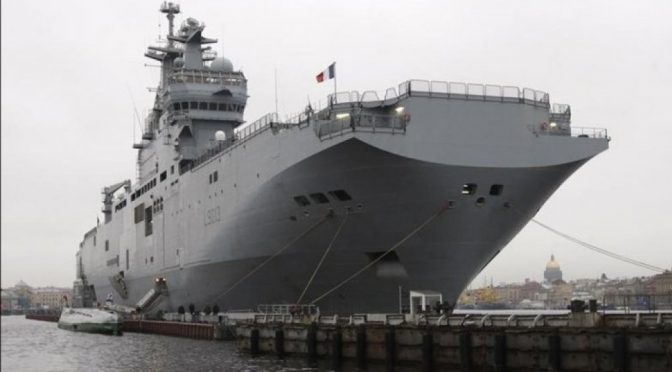
Featured Image: France’s Mistral amphibious helicopter carrier ship docks on the Neva River in St. Petersburg November 23, 2009. (Reuters/Alexander Demianchuk)
In the aftermath of the July 2016 ruling by the United Nation’s Permanent Court of Arbitration that broadly found China’s demarcation claims in the South China Sea to be without legal merit, it became apparent that legal decisions alone would do little to influence the status quo. Considering The Hague’s ruling against the strategic backdrop of power politics in the Asia Pacific, the need for a global maritime presence became clear. This presence connotes a significant maritime challenge for the European Union (EU), which remains a peripheral actor in the maritime security of the Asia-Pacific as several major powers oversee the geopolitical reordering of this critical region. The importance of the region for European trade and business, global economic stability, and international maritime security necessitates that the EU maintain more than just an economic and diplomatic presence in the region. Adding a dedicated maritime presence to the region will involve a balancing act between the competing interests of individual EU members while advancing a comprehensive and unified stance—this goes beyond simple matters of naval capability and capacity. As such, it is important that the international maritime community not treat this presence as a fait accompli, merely awaiting an executable maritime framework.
As the European Council on Foreign Relations summed up in 2013 in reference to Asia, the EU “does not have an automatic seat at the table and therefore must work all the harder to secure its own self-interests.”1 Since then little has changed, as China has increasingly expanded its territorial footprint, the EU has executed an uneven approach to maritime security in the Asia-Pacific region. This ineffectual response leaves Europe open to maritime security threats from afar.
The European Union’s Maritime Domain: A Unique Challenge
Given Europe’s long maritime history it is no surprise that the legal principle for freedom of the seas originated with a European—a Dutch lawyer to be specific—by the name of Hugo Grotius, who in the early seventeenth century wrote, ”Navigation was free to all and no one country could lay claim to the seas on the basis that their navigators were the first to sail on it.”2 Today, that principle exists within the United Nations Convention Law of the Sea (UNCLOS), which details provisions for navigation, archipelagic status and transit regimes, EEZs, territorial waters, and settlement of disputes. Today, the European Union faces a dynamic maritime environment with challenges ranging from border security to renewable resources and combating piracy. Of the EUs 28 member states, 22 have a combined coastline that extends 65,993 km encompassing the Mediterranean Sea, the Baltic Sea, the Black Sea, and the Atlantic Ocean.3 The length and breadth of this dynamic maritime environment, when coupled with the competing priorities of member states and coordination with non-member states, makes the EU’s maritime security strategy a unique challenge amongst maritime powers.
The EU addresses this complexity in the European Union’s Maritime Security Strategy (EUMSS), which recognizes the importance of protecting maritime interests worldwide while simultaneously recognizing that success depends on the ability to collaborate across regional and national levels.4 However, since the 2014 adoption of EUMSS, the EU has struggled to balance the myriad regional maritime issues with international maritime issues, showing that a unified maritime strategy for the global maritime domain is still far off. The unfolding situation in the South China Sea is perhaps the best example of the fissures and shortfalls inherent with the EU’s maritime strategy. The EU has so far remained outside the fray, issuing a tepid statement after the UN tribunal ruling in favor of the Philippines in July 2016.5 While many see this strategy as a case of prioritizing domestic issues over international issues, the issue is far more complex. The ever-evolving transatlantic relationship between the United States and Europe, the economic influence of China on Europe via initiatives like the One-Belt-One Road framework, and the declining naval power of European navies, all factor into Europe’s support of the maritime order in the Asia-Pacific.
Europe and Asia: A Complex Relationship
As a region, the Asia-Pacific is as dynamic as they come. Militarily, disputed islands, paramilitary forces, and militarization characterize the operating environment. Politically, Chinese realpolitik clashes with liberalism, pitting international governance against the rise of a regional hegemon. Meanwhile, from an economic standpoint the region is home to three of the world’s biggest economies, while over $5 trillion in global trade passes through the seas each year. This geo-political environment, coupled with the complex maritime geography of straits, archipelagic waters, and overlapping maritime claims means that international law is critical to maintaining an orderly system.6 Within this complex milieu lays the maritime challenge—protecting the Sea Lines of Communication (SLOC) critical to global economic prosperity.
This region holds significant interest for the European Union, but exactly what those interests are differs from member to member. These differences present difficulties for the EU’s development of a unified and actionable strategy in the South China Sea and the Southeast Asia region. China is the EU’s second largest trading partner, as a region ASEAN is the EU’s third largest trading partner, and South Korea, Japan, and India all place within the top ten. Collectively, this trade amounts to almost a trillion euros annually. Furthermore, there are more than 10,000 European companies operating within the Southeast Asia region.
The economic considerations are not solely defined by Europe looking east of the Suez; they are also largely influenced by China’s Eurasian ambitions. China’s One-Belt-One-Road initiative promises significant investment in Europe, especially the struggling economies of the South and East. Likewise, investments by companies such as the state-owned China Ocean Shipping Company (COSCO), which is upgrading the port in Piraeus, Greece, illustrate that this economic influence extends past mere business ventures.7 While the One-Belt-One-Road initiative is unlikely to radically alter the geography of trade routes and investment in port upgrades will not alter Greece’s naval posture, these activities do have the potential of altering and influencing the economic interdependence of EU member states. This creates scenarios where Europe needs to tread lightly as they balance economic and diplomatic interests against security interests, while simultaneously recognizing that the preferred balance will be different depending on the individual country.
European Diplomatic Efforts in the Asia-Pacific Maritime Domain
The divisions are not limited to economics. Politically, the EU has struggled to speak with one voice regarding issues within the Asia-Pacific. The EU’s presence in the Asia-Pacific is a complex web of arrangements, policies, dialogues, and statements that seek to balance the competing interests of individual members while advancing a comprehensive and unified stance. Starting in 2007, there have been a number of policy developments pertaining to the EU’s development of a comprehensive maritime strategy. In 2007, the adoption of the Blue Book, an Integrated Maritime Policy laid the groundwork for operational cooperation among member states. While not specifically addressing security concerns, the focus on trade and fisheries provided a template for future maritime security initiatives.8 A series of initiatives followed—Marine Strategy Framework Directive(2008) and theLimassol Declaration(2012)—that recognized the significance of dialogue and cooperation within the regional and international maritime realm as well as the importance of the legal framework laid out by UNCLOS. These policy trends expanded and in 2012, the EU’s Foreign and Security Policy in East Asia proffered guidelines for resolving disputes within the framework of UNCLOS and stresses the importance of freedom of navigation.9 The policy also notes the economic interdependence between the EU and East Asia, the potentially negative impact of competitive nationalism represented by the South China Sea issues, and the complexity of trans-Atlantic relations with the United States and extra-regional partners like Russia, Australia, New Zealand, and India.10 Furthermore, the Treaty of Amity and Cooperation in Southeast Asia (TAC), which the EU signed in July 2012, provides the framework for peaceful interactions in the region. Taken together these policies clearly articulate that EU interests are closely tied to those of the Asia-Pacific and the international maritime legal framework.
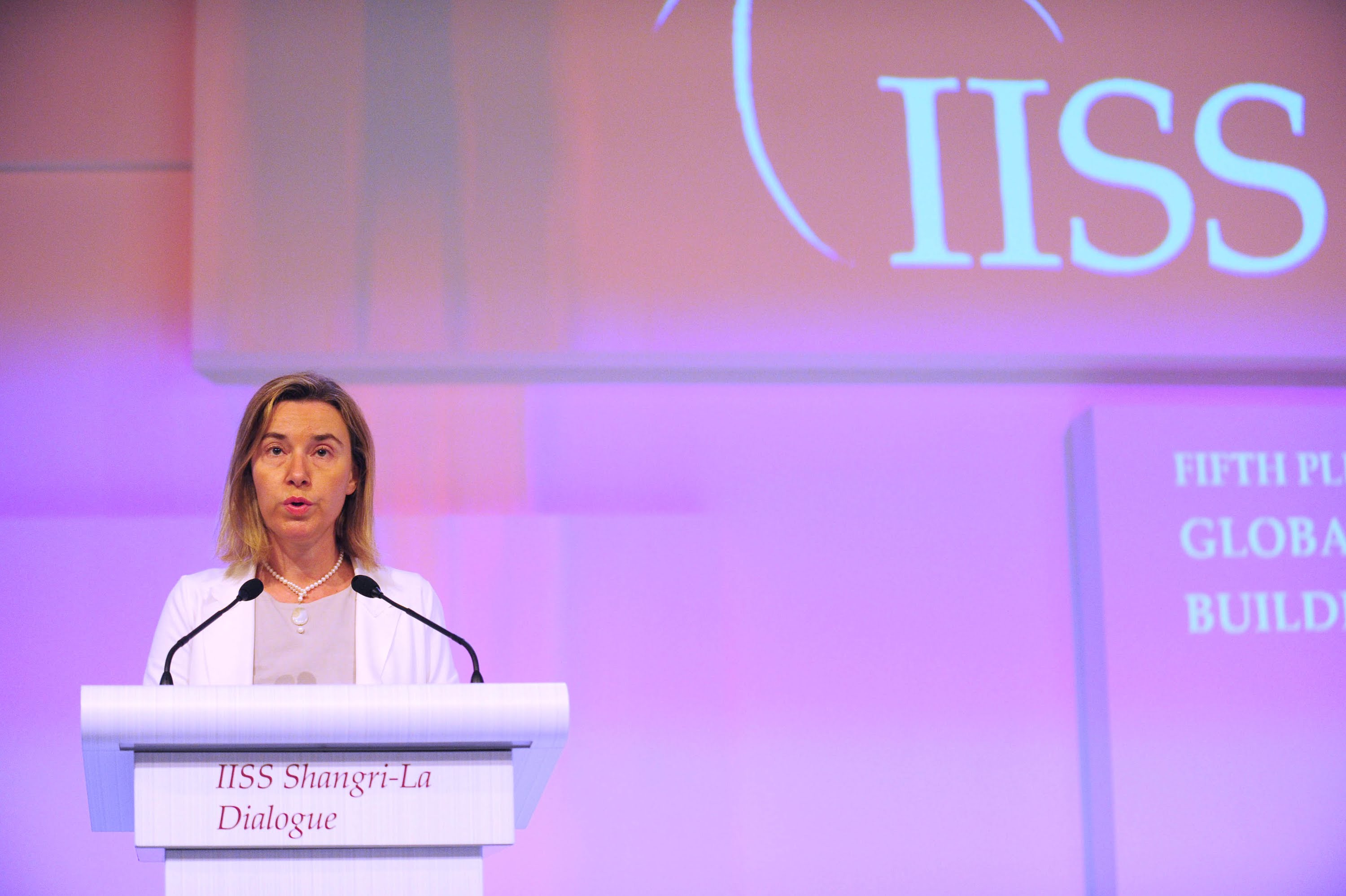
May 31, 2015 – 14th Asia Security Summit, Singapore– High Representative of the Union for Foreign Affairs and Security Policy and Vice-President of the European Commission Federica Mogherini gives a speech at the Shangri-La Dialogue. ( Frédérick Moulin 2015 – EU2015 – EEAS)
Beyond policies, the EU maintains a public dialogue—albeit uneven—that further emphasizes and recognizes the importance of the Asia-Pacific and an international maritime framework. It was at the 2013 Shangri-La dialogue in Singapore that the EU was represented as a whole for the first time by High Representative Catherine Ashton. During the dialogues, she referred to the EU’s long-term security plans and comprehensive approach in Asia. Missing from the 2014 dialogues, the EU’s message was one that prioritized concerns in Ukraine, the Middle East, and North Africa over those in far off Asia. While this prioritization of time and resources is notable, even wise, it did little to assuage Asian nations that may be looking to the EU as a model of multilateralism and an alternative to the United States. A notably different tone was struck in the 2015 dialogues, as EU High Representative Federica Mogherini discussed the EU’s, “strong interest in global security.”11 Representative Mogherini made specific mention of freedom of navigation, SLOCs, international law and the importance of promoting cooperation of confrontation and the need for “everyone to play by the same rules.”12
In addition to the Shangri-La dialogues, the EU, France, Germany, Italy, and U.K. signed the G-7 Foreign Ministers’ Declaration on Maritime Security which declares their commitment to “freedoms of navigation and over flight” and to an “international maritime order based upon the principles of international law, in particular as reflected in UNCLOS.”13 At the 2016 G7 Summit in Japan, members reiterated concern “about the situation in the East and South China Seas” and emphasized “the fundamental importance of peaceful management and settlement of disputes.”14 Unsurprisingly, the 2016 Shangri-La dialogues a month later discussed “China’s continued land reclamation and military build-up in the strategic maritime area” at length.i Within this context, the French Defense Minister made clear that joint EU patrols were forthcoming.15 However, a month later, the UN tribunal ruling in favor of the Philippines saw the EU struggle to issue a joint statement. And to say the resulting statement was benign is an understatement; among other things it failed to make any mention of sovereignty. Since then, the EU has been notably silent regarding the South China Sea despite growing evidence of China’s continued militarization of a number of islands.
European Presence in the Asia Pacific
Despite the attempts at providing a unified response under a common defense policy, the most active aspects of Europe’s involvement in the Asia Pacific come in bilateral terms. France has made numerous overtures toward supporting FONOPs in the South China Sea. The UK’s Royal Navy has perhaps the largest and most codified presence in the Asia-Pacific, though it is a shadow of the presence that it was until the waning years of the last century. The Five Power Defense Arrangement, the most notable European-Asian arrangement, is a multilateral agreement between the Commonwealth counties of U.K., Australia, New Zealand, Singapore and Malaysia whereby all powers will consult one another in the event of an attack (actual or threatened) against Malaysia or Singapore. This consultation brings no promise of military action or support, but nonetheless is pertinent for its formal acknowledgement of European-Asian mutual interests. Furthermore, four European countries—Denmark, the Netherlands, Norway, and the U.K.—are members of the Regional Cooperation Agreement on Combating Piracy and Armed Robbery against Ships in Asia (ReCAAP).16 ReCAAP, a multilateral counter-piracy operation that stretches from the Gulf of Aden to the East China Sea illustrates the naval capability of some European powers.17 Additionally, in 2016 Denmark, France, Germany, Italy, Netherlands, Norway, and the U.K. participated in the Rim of the Pacific (RIMPAC) maritime warfare exercise, signaling their support for Asian maritime security.18 Additionally, there are multilateral examples of EU maritime involvement: the Indian Ocean earthquake and tsunami in 2004, the Fukushima tsunami that occurred in 2010, and Typhoon Haiyan in the Philippines in 2014 all saw EU involvement.
In Conclusion: It’s Time to Grab a Seat at the Table
Despite policies, dialogues, and statements, the EU lacks a consistent presence in the region, which undermines their ability to influence political and economic events as they unfold. Alongside the 2016 UN tribunal ruling and discussions for a South China Sea Code of Conduct, the EU is losing its seat at the table as the maritime picture takes shape. If the EU expects to maintain influence in the Asia-Pacific it must accept that the geopolitical instability that defines the South China Sea and Asia-Pacific region requires a naval presence to manage risk, promote international order, and decrease the chances of armed conflict.
Setting aside EU institutional politics, there are a number of EU members who have navies capable of global power projection—France, Germany, Italy, the U.K., and Spain. While some members may need to operate in a coalition due to refueling limitations, the capability remains. Overall, the European picture reveals a maritime mindset more focused on the near than the far. This is shortsighted in terms of politics, economics, and military capabilities. Not least because any significant rebalance toward Asia without a corresponding increase in shipbuilding would require a considerable shift in resource allocation. Reversing the current decline in shipbuilding across Europe will take significant and immediate initiative. The EU should take advantage of their long-standing relationship with the U.S. concerning maritime security and their experience working alongside global partners to engender a workable maritime strategy in the South China Sea and the Asia Pacific. With the U.S. increasing its presence in the Europe, there is opportunity for Europe to reinvigorate the Transatlantic Partnership that has defined U.S.-European relations for decades.
Politically, no entity is better poised than the EU to understand the power dynamics and challenges that a regional organization faces when countering the influence of a rising—or in the case of Russia—resurgent hegemonic power. There are relevant lessons to be drawn from the territorial aggression that Russia exhibited in the annexation of the Ukraine. Most notably, that a nation that feels compelled to assume power in a region that they historically view as theirs will not be thwarted by politics alone. Reactionary policies are no substitute for proactive plans. The European Union’s hodgepodge of arrangements, policies, dialogues, and statements regarding the South China Sea, coupled with Chinese economic influence, declining naval power, and an inability to speak and act with one voice are eroding European influence at a time when a new regional order is taking shape in the Asia-Pacific region. To counter this erosion of influence the EU needs a strategy that moves past mere statements that support international norms and the rules laid out in UNCLOS and establish a maritime presence that protects SLOCs throughout the Asia-Pacific.
LT David M. Andre is a former Intelligence Specialist, and has served as an Intelligence Officer and Liaison Officer assigned to AFRICOM. He is currently serving as N2 for COMDESRON SEVEN in Singapore. He can be reached at dma.usn@gmail.com.
The views expressed above are the authors’ alone and do not reflect the official views and are not endorsed by the United States Navy, the Department of the Navy, the Department of Defense, or any other body of the United States Government.
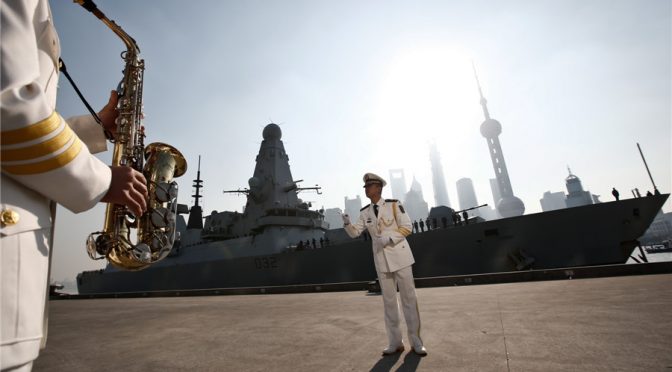
Featured Image: Members of the welcoming ceremony band play as British Royal Navy destroyer HMS Daring arrives at a port area of Huangpu River in Shanghai December 10, 2013. (Photo by Yang Yi/Asianewsphoto)
Through the U.S. Naval War College’s China Maritime Studies Institute, the authors have just published China Maritime Report No. 1, entitled “China’s Third Sea Force, The People’s Armed Forces Maritime Militia: Tethered to the PLA.” In it, they propose a more formal term for China’s maritime militia: the People’s Armed Forces Maritime Militia (PAFMM). The present article, the first in a three-part conclusion to their nine-part series on the PAFMM of Hainan Province, will instead use the term “maritime militia” to maintain consistency with all preceding installments and to facilitate discussion of China’s broader militia construction.
By Conor M. Kennedy and Andrew S. Erickson
Hainan Province’s unique geography makes its buildup of maritime militia units the spear tip of China’s prosecution of gray zone operations in the South China Sea: as a standing, front-line force whose leading units are lauded as models for other localities to emulate. This series has therefore examined Hainan’s leading maritime militia units, located in Sanya, Danzhou, Tanmen (in partsone and two), and Sansha. To understand these grassroots units and their development, it has delved deeply into their respective local environments. Having examined these leading entities in depth, it is time to take a province-wide look at larger policy processes and trends in implementation. This installment will also examine the intentions of China’s leaders to construct new elite militia units tailored to meet heightened requirements in China’s armed forces. This new type of front-line militia will serve as a standing force for more regular employment in support of China’s objectives at sea. Part 1 of this final series will therefore explore maritime militia building in a more systemic organizational context, chiefly at the Provincial Military District level; while Part 2 will address specific challenges and how they are managed. Part 3 will conclude this series by appraising the results of Hainan’s maritime militia construction effort and discussing some additional dynamics at play in the provinces. This first part will thus start by probing how a frontier province like Hainan responds to national level militia building initiatives and the measures taken by provincial leaders to oversee its implementation.
China’s national defense system is divided geographically into Theater Commands, previously termed Military Regions. Each Theater Command contains several Provincial Military Districts (MD), where the militia’s direct chain of command begins. As each province is divided into municipalities, each MD is divided into multiple Military Sub-districts (MSD); within each are numerous county-level and grassroots People’s Armed Forces Departments (PAFD). County-level PAFDs are staffed by active-duty personnel while the grassroots PAFDs are non-active duty organizations staffed by “full-time people’s armed forces cadres” (专职人民武装干部) who represent the direct interface between the militia and the PLA chain of command. Each MD oversees the militia work conducted by the MSDs and PAFDs within its area of responsibility.
Local governments provide funding and support while local military commands assume the bulk of responsibilities in maritime militia organization, training, and command. Government agencies such as the Maritime Safety Administration and the China Coast Guard (CCG) assist with aspects of maritime militia building pertaining to their bureaucratic functions, such as training in search and rescue and instruction on maritime law and regulations relevant to their operations.
The National Environment in Which Hainan Province and Its Militia Operate
Propelled by strategies and policies at the national and provincial levels, China’s Maritime Militia continues to grow and develop robustly. Many PLA and government leaders from all levels have some understanding or experience in building or working with the militia as an official component of China’s armed forces. Leaders from the top echelons of Central Military Commission (CMC), Party, and State leadership; as well as leaders of the PLA services, military regions, and provincial MDs; all attended the last National Militia Work Conference held in Beijing on 15 December 2011, a meeting to establish guidelines for nationwide militia work. President Xi Jinping himself likely became intimately familiar with the militia system during his career, particularly as the former deputy director of the Nanjing Military Region National Defense Mobilization Committee from 2000 to 2003. Overall militia policy is first set in Beijing and implemented through the principal civilian and military leaders of the provinces and counties via a dual leadership system of militia work (民兵工作双重领导制度). The militia itself represents an important personnel-centric line of effort in China’s Military-Civilian Fusion concept, recently elevated to a “national strategy.”
Ongoing PLA reforms mandate a reduction in militia personnel nationwide, continuing a trend of replacing outdated infantry militia units with technically capable militia more suited to supporting each of the PLA services in modern, informatized warfare. Maritime militia, meanwhile, are growing in proportion to their land-based counterparts as China prepares for “maritime military struggle,” as highlighted in its 2015 Defense White Paper. This seaward shift is materializing in national-level militia policy as well as in actual militia unit construction. Coastal cities like Shanghai and Beihaihave all reported increased maritime militia growth. However, as China’s southernmost province tasked with administering all of Beijing’s maritime claims in the South China Sea, Hainan bears commensurately large expense for border and coastal defense militia construction.
PLA reforms have also modified management of the MD system by splitting the former General Staff Department (GSD) into several new departments, one of which is the new Central Military Commission-level National Defense Mobilization Department (CMC-NDMD). Already deemed to be in “post-transfer” (转隶后) status by China’s military press, the MD system is now managed by the CMC-NDMD, relieving Theater Commands of many administrative burdens, including the supervision of militia work in the provinces. Discussion in the PLA over the exact role of Theater Commands in the development of national defense mobilization capabilities appears to be ongoing, indicating that the exact relationship between Theater and MD commands in the building and management of reserves has yet to be clarified. Huang Xiangliang, director of the National Defense Reserve Force Department of the Nanjing Army Command College, explains how the PLA reforms strengthened “centralized strategic-level leadership over the nation’s militia and reserves” by directly connecting MDs to the CMC. As the reserves diversify to meet the demands of each PLA service, Huang elaborates, those “services will put forward their requirements for the reserves, which will then be organized, trained, and supported by each level of the MD system.” For the maritime militia, this will entail greater numbers of specialized units trained to support People’s Liberation Army Navy (PLAN) operations.
Statements and policies guiding maritime militia construction are emerging from the CMC-NDMD. During a March 2016 interview, the newly promoted head of the CMC-NDMD Lieutenant General Sheng Bin confirmed the prominence afforded maritime militia building in the 13th Five Year Plan. China, he declared, will “adjust and optimize the scale, structure and layout of its militia and reserves, emphasizing construction of the maritime militia, coastal defense militia, emergency response militia, and new types of reserves.” Indeed, the Outline of the 13th Five Year Plan emphasizes strengthening the reserves and “maritime mobilization forces” in particular. On 28 July 2016, the head of the CMC-NDMD’s Militia and Reserves Department, Major General Wang Wenqing, also gave public guidance for solving common issues in maritime militia building.
Implementation is progressing apace. As CMC-NDMD Deputy Head Major General Hu Yishu describes in an October 2016 article in China’s Militia, a PLA Daily publication guiding national militia work, that revisions are underway on the nation’s Guidance Law for Maritime Militia and Border Defense Militia Military Training Work. This will regulate the tactics and training methods for “maritime militia participating in rights protection actions and support for PLAN actions.” With significant PLAN South Sea Fleet presence, the Hainan MD will likely see greater demand for maritime militia units configured to support PLAN operations in the South China Sea.
The Provincial Command
The Hainan MD’s military leadership published extensive articles in late 2015 comprehensively outlining missions, organization, training, and other aspects of Hainan’s maritime militia development and operations. The writings, by MD Political Commissar Major General Liu Xin and MD Commander Major General Zhang Jian respectively, appeared in National Defense, a domestically-oriented journal sponsored by the PLA Academy of Military Science. They reveal much about how the Hainan MD envisions and plans to execute national militia guidelines to help operationalize Beijing’s South China Sea strategy. Essential to directing a province’s construction of its maritime militia, such leaders directly promulgate militia construction requirements to their civilian government counterparts. The works of Liu and Zhang thus warrant close examination.
Invoking Chairman Xi’s and the Central Party’s guidance on maritime militia building and “strategically managing the ocean,” Political Commissar Liu Xin focuses on the role of the maritime militia in “maritime rights protection” (efforts to uphold and enforce China’s maritime claims). Liu explains how drawing in the people, especially fishermen, will help give China freedom of action—and the initiative—in maritime rights protection. According to Liu, the bulk of the maritime militia force will comprise the province’s original units, but will be led by newly created emergency response units with “new types” of maritime militia as the core. Evaluations will be strengthened to ensure there is a core force of “new-type fishing vessels” and “elite standing maritime militia emergency response units.” They must “be able to respond when called upon and win emergency maritime rights protection wars of initiative” (打赢海上应急维权主动仗). Liu’s remarks reflect a combination of higher combat readiness levels for emergency response units—i.e., the elite units—and the more regular rights protection roles of the majority of maritime militia units.
News reports state that Liu lead a new initiative in early 2016 to promulgate policies and plans for maritime militia organization and involvement in rights protection. Under his lead, the province passed the “13th Five Year Plan on Hainan Province’s Maritime Militia Construction,” providing systematic planning for missions; as well as guidelines, requirements, and measures for maritime militia building. Liu reportedly devoted great time and effort to key maritime militia construction issues, visiting numerous islands and reefs in the process. He was also reported to have been personally involved in multiple joint training events with active duty forces, emergency response plan drafting, and the strengthening of over ten maritime militia emergency response detachments. He also spent time working with local governments, ensuring that such pressing issues as expenditures and maritime militia base construction were included in their military affairs meetings.
Writing in more operational terms, MD Commander Zhang Jian explains how to increase the professionalization of maritime militia personnel and vessels. According to Commander Zhang, ships must be large-tonnage, high-speed, seaworthy steel-hulled fishing vessels strong enough to withstand collisions. These vessels should be drawn from fishing enterprises and cooperatives whose vessels frequent the sea areas in which their services are required for missions, as well as those vessels whose crews have previous experience engaging in rights protection. Furthermore, material and equipment are allocated according to the requirements of maritime rights protection and naval combat support, including communications and reconnaissance equipment and “defensive combat weaponry.” Personnel from different specialties should be grouped in units according to the following formulation: “Recruit experienced fishermen to serve as vessel operators as well as military personnel and veterans with maritime specialties to be core combatants; and select People’s Armed Forces cadres with maritime rights protection experience and medical staff with at-sea experience to be command and support personnel [respectively].” This implies that a mixture of personnel may crew maritime militia vessels, as embodied in the widespread phrase “determine troops based on the vessel” (以船定兵) for maritime militia organization. This style of organization could also conceivably be tailored to different missions. This is echoed in other provinces as well, such as Liu Xuan, head of the Shuidong Township PAFD in Guangdong Province. He stated in early 2016, “next year we will take in even more experienced and hardened fishermen with good work ethics, bolster them with primary militiamen, and hold targeted training in the subjects of maritime rights protection and war time support.” Liu Xuan’s statement indicates that formerly land-based coastal militia may also be assigned to maritime militia vessels. This demonstrates how local military commands are mobilizing current resources in varying ways to produce stronger maritime militia forces.
Commander Zhang stipulates three types of operations for the maritime militia:
Their use as “civilians against civilians for regular demonstration of rights” (以民对民常态示权). The government will take the lead in implementing command and organizing maritime militia to fish in even the more remote waters (within the Near Seas) with greater organization and scale. This ensures that a certain number of China’s fishing vessels are present in “China’s waters” at any given time, achieving regular presence and declaration of sovereignty. Maritime militia are to be summoned immediately when foreign civilian vessels from neighboring countries are found encroaching on fishing rights or disrupting Chinese development of islands and reefs, resource extraction, or scientific surveys. Such civilian countermeasures against other civilians are envisioned to gain the initiative rapidly.
Their use in “special cases of rights protection by using civilians in cooperation with law enforcement” (以民协警察专项维权). Maritime militia will “receive orders” from their command to conduct special rights protection missions when neighboring countries violate China’s maritime rights and interests and when China’s maritime law enforcement (MLE) requires their assistance. This often entails the combining of maritime militia and MLE forces to form a joint law enforcement force, whereby the militia participate directly in rights protection law enforcement actions by supplementing MLE forces. In these actions, together with MLE forces, maritime militia primarily conduct perimeter patrol (外围巡逻), sea area control (海区封控), alerting and expulsion (警戒驱离), confrontation (海上对峙), and combining to push back (合力逼退) foreign vessels.
“Participation in combat and support-the-front by using civilians to support the military” (以民援军参战支前). When a maritime armed conflict or maritime local war erupts, coastal cities and counties will organize their maritime militia to participate in combat and support-the-front operations, exploiting numerical advantages in personnel and vessels, as well as their familiarity with the seas, islands, and reefs. Units will conduct transport, supply, rescue, repair, and medical support in the Near Seas (Yellow, East China, and South China Seas) and on front-line islands, reefs, and mission areas. Meanwhile, maritime militia will assume direct combat support by coordinating with maritime combat forces to conduct reconnaissance, sentry duty, and guarding against surprise attacks.
The Hainan MD leadership emphasizes that Hainan’s maritime militia forces contain a core set of more professional units with higher levels of readiness, ensuring that militia forces can mobilize rapidly out to sea. These points echo the call to action by Major General Wang Wenqing, head of CMC-NDMD’s Militia and Reserves Bureau, for resolving issues involving maritime militia construction nationwide. He affirmed the emphasis on an elite standing force of maritime militia composed of captains, engineers, and veterans operating year-round. These are the elite front line units that are most likely entrusted with sensitive missions involving foreign vessels, such as potential interference in future U.S. Freedom of Navigation Operations (FONOPs) and routine operations; as well as the disruption and attempted sabotage of foreign survey vessels.
The National Border and Coastal Defense Conference, last held in Beijing on 27 June 2014, provides guidance for the Border and Coastal Defense Committees (BCDC) established to coordinate defense of territorial sovereignty, protect maritime rights and interests, and ensure border security. Organized in a similar fashion as the mobilization work of China’s National Defense Mobilization Committee System, the BCDC system assembles leaders and staff at each level of government and military command into a single body for planning border and coastal defense work. President Xi Jinping stated in the 2014 meeting that China’s border and coastal defense will “wield the features and advantages of joint military-law enforcement-civilian defense” (发挥军警民联防的特色和优势). Also contained in China’s defense white papers, such as the 2013 Diversified Employment of China’s Armed Forces, and featured frequently in Chinese reporting on the militia, this operational concept has been a part of China’s coastal defense system since the PRC’s founding. It is the primary means for the militia to participate in combat readiness for coastal defense. It entails the mobilization and integration of the various military, law enforcement, militia, and societal forces into a joint defense force.
Today, Hainan Province is actively implementing this joint defense concept. The joint military-law enforcement-civilian defense concept is also often referred to as the “three lines,” with the maritime militia constituting the front line, backed up by a second line of CCG and a third line of PLAN forces. The Hainan MD has reportedly held workshops and major exercises with active duty forces since 2013 to determine campaign and tactical guidance for the maritime militia. Located in a key maritime frontier province, the Hainan MD is continually working alongside the PLAN and CCG to fine-tune its joint military-law enforcement-civilian defense through large-scale exercises.
Provincial Implementation
Following the 2011 National Militia Work Conference, Hainan began a pilot project for maritime militia development in February 2012. The Hainan MD sent research groups to study grassroots maritime militia organizations, gaining better understanding of the force through meetings with unit leaders. On 20 September 2012, the Hainan Province Party Chief and Hainan MD First Party Secretary Luo Baoming launched a Provincial Committee Military Affairs Meeting on the subject of “Advancing to a New Level Party Control of the Military and Construction of National Defense Reserves in Preparation for Military Struggle in the South China Sea.” As Hainan Party Secretary since August 2011, Luo has been a champion of maritime militia building, instructing during a 2015 Provincial MD Conference on Maritime Defense Work that the province “expend great effort to strengthen maritime defense construction focusing on maritime militia.” While Luo was in Beijing in March 2016 working on his province’s 13th Five Year Plan, a Reuters reporter raised the topic of Hainanese fishermen acting as militia. Denying nothing, Luo stated publicly that the fishermen in his province participate in the protection of maritime rights and interests, and undergo training in self-defense. Meanwhile, other influential voices in the province, such as former head of the Provincial Government Center for Social and Economic Development Research Liao Xun, were emphasizing the role of the maritime militia in their writings.
Provincial civilian and military leaders were busy crafting policies and plans for bolstering the maritime militia, releasing the “Opinions on Strengthening Maritime Militia Construction” in 2013. This also resulted in an official “Notice on Further Strengthening Maritime Militia Construction” released by the Hainan Provincial National Defense Mobilization Committee. These two official documents stipulated manifold requirements for the 2013 annual reorganization of the militia force guided by the MD and executed by counties. This annual reorganization process is conducted to implement reforms and correct outstanding issues in militia organizations. The documents also required that provincial and county governments split the cost of maritime militia construction. By the end of 2013, the province added 28 maritime militia companies with 2,328 personnel and 186 vessels to its maritime militia force.
In early 2014, the State National Defense Mobilization Committee, the State Council-level coordinating body, hosted a symposium in Hainan entitled “Maritime Mobilization 1312” to ensure that each level of Hainan’s government focused on maritime militia development. The meeting featured maritime rights protection demonstration events in Tanmen Township’s harbor and also established a leading small group to coordinate the province’s maritime militia construction, headed by Provincial Deputy Party Secretary Li Xiansheng. National directives likely bolstered maritime militia readiness in the province, preparing them for the province-wide mobilization of maritime militia to defend the HYSY-981 oil rig in May 2014.
According to Political Commissar Liu, Hainan will develop its maritime militia in three phases. The first phase entails finding the proper regulations through pilot projects, research and discussion of tactics, and at-sea testing. The second phase will focus on increasing capabilities through intensified training of the new, elite maritime militia and improving its support system. There should also be further testing and evaluation to ensure that the maritime militia are readily available and operationally effective. The third phase will focus on the “regular use” of the maritime militia (mechanisms for enduring maritime militia organization and employment). This effort will integrate units into the “three lines” joint rights protection system and increase their ability to regularly conduct reconnaissance and escort support missions in relatively “remote waters” (within the Near Seas). Progress to date in Hainan’s maritime militia forces suggests that they may have begun phase one after the 2011 National Militia Work Conference; and entered phase two with the development of a core force of maritime militia, through the introduction of increasingly capable vessels, communications equipment, and joint training. Looking forward, increased maritime militia presence in the Spratlys may also be an indicator of advancing progress in phase three.
Since militia building must proceed in accordance with local conditions, different provinces may exhibit distinct practices in organizing their maritime militia forces. Reflecting their large marine economies, Hainan and Guangdong provinces have signed cooperation agreements involving many fields of social and economic development. During the recent meetings to deepen cross-provincial cooperation in September 2015, Hainan Party Secretary Luo made several proposals for the two provinces. These included cooperation in the 21st Century Maritime Silk Road, marine science and technical research, maritime joint rescue, rights protection and law enforcement, and—most pertinent to this article—maritime militia construction. It remains unclear if the provinces have fostered some form of cooperation regarding their respective maritime militia forces. In October 2015, however, Sansha City mayor Xiao Jie hosted a forum to consult with Guangdong- and Guangxi-based fishing companies on the development of Sansha’s marine fishing industry, including the Sansha Fisheries Development Company, a state-owned maritime militia organization. Cooperation in maritime rights protection efforts was one of Xiao’s key points to Guangdong and Guangxi fishing companies, suggesting that Party Secretary Luo’s provincial maritime militia cooperation initiative may have gained traction rapidly.
This image from the August 2014 edition of National Defense shows former director of Sanya City’s National Defense Mobilization Committee and city mayor Wang Yong “visiting” (看望) the maritime militia.
Despite apparent enthusiasm within Hainan’s leadership, however, there appear to be broader concerns about the lack of initiative shown by local governments across China in building the militia, centering on the “separation between construction and use” (建用分离). With little prospect for utilizing reserve forces, local governments may show less enthusiasm for supporting their construction. For example, the Lingshui County Government leadership used to avoid meeting its military counterparts, which previously consumed money and materials without providing reliable troops to respond in emergencies. Having the militia serve as a source of manpower during emergencies and disasters helps rectify this discrepancy, as encapsulated in the oft-used slogan “a reserve force that responds in times of war and emergencies” (一支战时应战、平时应急的后备力量).
The Tanmen Maritime Militia, for instance, is lauded for its daring rescues of mariners in distress over the years, providing an organic emergency response force that is most familiar with local marine conditions. A recent example was when the Sansha Maritime Militia was mobilized when a Hainanese fishing vessel ran aground near Fiery Cross Reef on 28 February 2017. Having received numerous distress calls, the Sansha Maritime Militia mobilized one of its vessels, Qiongsanshayu 000312, to attempt a rescue. However, shallow waters and poor weather conditions prevented them from getting close enough. After two days of standing by, a nearby PLAN helicopter flew in to evacuate the stranded fishermen.
Maritime militia play a significant role in responding to emergencies, helping local governments with search and rescue and disaster relief. When PLAN aviator Wang Wei went down in waters 70 miles south of Hainan after colliding with a U.S. Navy EP-3 plane in 2001, Hainan’s fishing fleet and militia contributed notably to the search effort. Sanya City alone organized over 500 fishing vessels to search at sea while more than 4,000 people and militia scoured the coast for Wang. Sanya’s PAFD Head Zhou Naiwu also ordered the Tianya Maritime Militia Rapid Response Unit out to sea to join the effort. Other neighboring localities involved included Ledong Autonomous County, which dispatched hundreds of fishing vessels and over 3,000 cadres, militia, and fishermen. That event demonstrates direct support by local government-built militia forces for national military objectives. Today, increasingly capable maritime militia forces can more effectively assist local governments and military organs in responding to future emergencies at sea.
July 2015: A maritime militia company from Chengmai County conducts “near seas” training. A banner declaring in Chinese and Vietnamese China’s maritime jurisdiction, likely in the Gulf of Tonkin, is hung across the port side of the vessel’s house. (Chengmai County Government Website)
Conclusion: Trolling Together for Sovereignty Claims
A confluence of national strategy, structural reforms, and development plans has informed China’s future national militia development, giving increased prominence to the maritime militia. The front-line maritime militia units documented throughout this series have developed and operated within the Hainan MD’s evolving reserve force structure and PLA chain of command. As such, Hainan’s principal military and civilian leaders have critically shaped maritime militia force development, and continue to do so. Part 1 of this series has illustrated how national-level guidance has resulted in actual implementation in China’s key maritime frontier province, and how the Hainan MD leadership envisions the construction and use of maritime militia under its jurisdiction in the South China Sea. Additionally, while fishermen constitute a core body of personnel to operate maritime militia vessels, there may also be a variety of other personnel aboard to fulfill other functions within their units. Part 2 will address specific policy implementation to date, and how Hainanese officials are working to manage challenges in maritime militia development to achieve further progress. Part 3 will evaluate the results of Hainan Province’s maritime militia construction and suggest corresponding implications. Due to the varying economic conditions and geographies among the provinces, understanding how MD leaders execute maritime militia force planning, construction, training, and utilization can help to anticipate the extent and limits of Chinese Maritime Militia capabilities at sea.
Conor Kennedy is a research associate in the China Maritime Studies Institute at the U.S. Naval War College in Newport, Rhode Island. He received his MA at the Johns Hopkins University – Nanjing University Center for Chinese and American Studies.
Dr. Andrew S. Erickson is a Professor of Strategy in, and a core founding member of, the U.S. Naval War College’s China Maritime Studies Institute. He serves on the Naval War College Review’s Editorial Board. He is an Associate in Research at Harvard University’s John King Fairbank Center for Chinese Studies and an expert contributor to the Wall Street Journal’s China Real Time Report. In 2013, while deployed in the Pacific as a Regional Security Education Program scholar aboard USS Nimitz, he delivered twenty-five hours of presentations. Erickson is the author of Chinese Anti-Ship Ballistic Missile Development (Jamestown Foundation, 2013). He received his Ph.D. from Princeton University. Erickson blogs at www.andrewerickson.comand www.chinasignpost.com. The views expressed here are Erickson’s alone and do not represent the policies or estimates of the U.S. Navy or any other organization of the U.S. government.
Featured Image:June 2013 Sansha Maritime Militia personnel were sent to a militia training base on Hainan Island to receive a week of intensive training by the Hainan Provincial Military District, including weapons training as shown in this photo.