Category Archives: Africa

Analysis relating to USAFRICOM AOR.

Egypt’s Acquisition of the Mistral Amphibious Assault Ship: An Operational Analysis

By Ben Ho Wan Beng

Introduction

The protracted “What happens to France’s two unwanted Mistrals” saga has seemingly drawn to a close with the agreement by Egypt late last month to acquire the highly capable amphibious assault ships (LHDs) for a total of €950 million. A number of commentators have argued that the rationale behind this eyebrow-raising decision is for Egypt to attain a maritime power-projection capability so as to hedge against rising Islamist violence in the region and a resurgent Iran. Indeed, one prominent defense journalist wrote of Egypt using the French-made Mistrals to quell trouble in neighboring hot-spots. In the same vein, another commentator spoke of the vessels giving their owners the ability to conduct expeditionary missions with significant ground and aerial assets.

That being said, the aforementioned statements are based on the assumption that Cairo would be able to effectively deploy the two ships in the first place. This is highly contentious, at least in the near term, for a number of reasons. They include Egypt’s dearth of experience in large amphibious-vessel and naval aviation operations, among others.

The Mistral’s Capabilities

Defense analysts often speak of the Mistral in glowing terms. Indeed, much has been made of the platform offering almost the same capabilities as the United States Navy’s potent Wasp-class LHD, but at only one-sixth the cost and crew size. And even though France officially calls the Mistral a bâtiments de projection et de commandement, or “projection and command ship,” it can also perform several other roles such as amphibious/heliborne assault and humanitarian
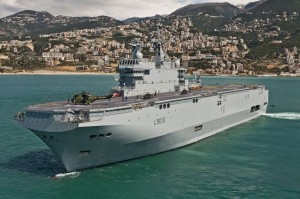
France's Mistral-class Dixmude warship in Jounieh bay, Lebanon. (Source: Wikicommons)
France’s Mistral-class Dixmude warship in Jounieh bay, Lebanon. (Source: Wikicommons)

assistance and disaster relief. With 69 beds for patients, it can even act as a hospital ship. An important component of the Mistral is its air wing, which consists either of 16 heavy or 35 light helicopters. It can also accommodate 450 troops (900 for surge operations), four small landing craft or two hovercraft, and a 40-strong Leclerc main battle tank (MBT) unit.

In recent years, France has put its Mistrals to good use in support of its foreign policy. For instance, during the 2006 Lebanon War, the lead ship of its class, the Mistral, was involved in the evacuation of French citizens from the Levant nation. Two years later, the same vessel provided humanitarian aid supplies, albeit indirectly, to victims of Cyclone Nargis in Myanmar. And in 2011, the Tonnerre was deployed with Tigre helicopter gunships off the Libyan coast to support France’s military intervention in that North African country.

Assessment

Ship Handling:

At first glance, therefore, the introduction of the Mistral into Egypt’s order of battle would seem to boost considerably the latter’s expeditionary capabilities. However, a more critical assessment  reveals that this would not be the case. Firstly, Egypt simply lacks the experience and know-how in handling a vessel like the Mistral. Warships are highly intricate technological entities. As cited in Seapower: A Guide for the Twenty-first Century (Routledge, 2013):

To… operate [warships] requires a mass of technical, industrial and professional skills, ashore and afloat, and a sophisticated system of management to mold them into an effective whole… Ships can be constructed relatively quickly, but the skills and capabilities which make up an effective navy can only be built up with long years of investment.

Indeed, Cairo’s experience in handling warships is limited warships significantly smaller than Mistral. The Egyptian military’s current largest amphibians are its three Polnochnys. This Polish-made landing ship is some 70 meters long and displaces 830 tons; in stark contrast, the corresponding figures for the Mistral are 200 meters and 21,000 tons. Furthermore, the mainstays of the Egyptian surface fleet – the formerly Knox- and Perry-class frigates procured from the U.S. Navy ­– are around 4,000 tons in displacement. Even the largest warship currently in Egyptian service is nowhere near the specifications of the Mistral. Egypt’s sole FREMM frigate, which is 140 meters long and displaces 6,000 tons, was commissioned into service only in June this year.

This dearth of experience in operating a large and complex multi-purpose naval platform like the Mistral would arguably be exacerbated by a failing that plagues most Arab militaries: their personnel’s deficiency in terms of technical skills. In Arabs at War: Military Effectiveness, 1948-1991 (University of Nebraska Press, 2004) Kenneth M. Pollack maintains that Arab armed forces, including Egypt’s, often show an inability to fully exploit the capabilities of the military hardware they possess. The Middle East defense expert adds that this lack of technical skills and other military weaknesses of the Arabs are likely to persist.

Then again, even First-World countries with highly educated citizens who are familiar with advanced technology can struggle with regard to operating LHDs. The time-frame in which Australia hopes that HMAS Canberra will achieve initial operational capability (IOC) and final operational capability (FOC) is illuminative of the challenges Egypt might face with its Mistrals. The Canberra – the lead ship of a new LHD class – was commissioned last November, and Australia is working towards its IOC and FOC to be attained in late 2015 and late 2017 respectively. In other words, Australia is hoping that HMAS Canberra will only be fully deployable a good three years after its commissioning.

That being said, media reports state the Mistrals will be delivered to Egypt in March next year and that their future crews have already begun training. To be certain, nobody will claim that Cairo could get its LHDs up and running within a meager six months. However, Egypt’s technical deficiency means that it could take a longer than than Australia to achieve operational capability with their LHD platforms. Furthermore, it must be noted that the Royal Australian Navy possesses some institutional knowledge in handling flat-tops, having operated light carriers during the Cold War. In stark contrast, Egyptian expertise in this area is essentially zilch. The crew of the two Mistrals will therefore need significant assistance from France and also Russia, as there are several Russian systems on-board the vessels.

Amphibious Operations:

A key mission the Mistral is expected to carry out is amphibious operations, and specialist skills and training are essential to the success of such endeavors, according to esteemed naval commentator Geoffrey Till.  Though Egypt has a small marine force, a Stratfor analysis suggests it is not proficient enough to deploy optimally from the Mistral. This particular report, however, does
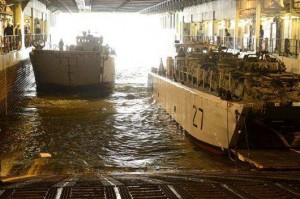
Amphibious Operations aboard a Mistral during Exercise LION MISTRAL in 2014.

not differentiate between the scales of amphibious operations to be conducted. Does it apply for large- or small-scale landings? It is certainly true that Cairo lacks experience in major amphibious operations. As a matter of fact, a Jane’s report argues that the Egyptian military cannot conduct “unilateral, opposed beach landings”, adding that it can only perform small-scale amphibious operations such as infiltrating special forces teams. Such an assessment is hardly surprising considering the fact the Polnochny landing craft can carry a maximum of 180 soldiers and six MBTs, while the Egyptian navy’s other amphibious asset, the Vydra landing craft of which it has nine, can deploy only 100 troops or three MBTs.

However, the Mistral is not built solely for major troop landings, but a range of missions scalable for different objectives. Indeed, Middle East security expert Ahmed S. Hashim believes that the platform would be used extensively for special forces ­­missions to combat Islamist extremism in the region. Such small-scale operations usually involve helicopters, but Egypt does not have the requisite experience vis-à-vis missions of this nature that are launched from ships at sea.

Sea-Based Aviation

This shortfall is manifested in the fact that Egypt’s sea-based aviation experience consists merely of operating an anti-submarine warfare helicopter or two from each of its formerly Perry- and Knox-class frigates. To be sure, the flight-deck and hangar-bay choreography on helicopter carriers like the Mistral is not as complex as that on regular flat-tops. That being said, operations involving several ship-borne helicopters – the Mistral has six launch spots on its flight deck for them ­– are nevertheless challenging, even more so for a navy with limited experience in sea-based aviation like
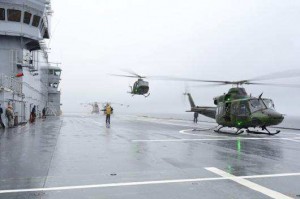
Flight Ops aboard Mistral during LION MISTRAL 2014.

Egypt’s. To compound matters, the Arab nation will have to train the crew for the navalized Ka-52K helicopters – an asset currently not in its order of battle – which could be procured for deployment on the Mistrals.

Integrated Task Force Operations

Finally, the Egyptians do not have any experience organizing their warships into task forces centered on a capital unit like the Mistral. The LHD makes for an inviting target for adversaries and hence has to be screened by consorts such as frigates and other surface craft as part of a task force. Having a fully operational entity of this sort, however, requires the Egyptians to imbibe the intricacies of maritime task force operations, and this would involve learning from scratch the doctrinal and technical expertise critical to such endeavors. For instance, each component of such a task force will have to train and operate together so as to improve their ability to fight as a coherent whole.

Much has been said about the uphill task the People’s Liberation Army-Navy, which had no experience with flat-tops prior to the commissioning of the Liaoning, is facing in creating a viable aircraft carrier battle group, and the consensus is that this could become a possibility only after several years of concerted effort. The same goes for any Egyptian Mistral task force becoming an effective fighting force. The Egyptian fleet’s lack of operational experience as a whole further complicates the issue. Indeed, it was only tangentially involved in the various Middle Eastern conflicts during the Cold War. In the post-Cold War period, Egyptian warships have been largely placed in the back-burner and have not even joined international peacekeeping missions.

Conclusion

Rounding up, Egypt’s acquisition of the Mistral seems to mark a quantum leap in its capacity to project force; the platform offers multiple capabilities previously unavailable to Cairo. Nonetheless, Egypt is unlikely to utilize the Mistral optimally because of its lack of experience in such crucial areas like handling such a sizable and complex vessel, ship-borne helicopter operations, and integrated naval task force maneuvers. With these in mind, it would be an extremely steep learning curve for Egypt vis-à-vis her most ambitious naval acquisition so far. While most nations, including advanced ones, also struggle with regard to adopting new military technology, Egypt’s case is especially pronounced considering its people’s general lack of technical proficiency.

Going forward, there has been talk of the Egyptian Mistrals operating with Saudi units as part of a joint Arab force; after all, Saudi money is believed to be behind the procurement of these platforms. However, “jointness” is difficult to achieve even between the service arms of a particular country, let alone with another country. Such an arrangement, if it ever materializes, is likely to further complicate Egyptian Mistral operations.

In the final analysis, it is worth noting that countries that are able to operate effectively aviation-capable platforms like the Mistral belong at least to the category of nations regarded as “medium powers”. Think Japan with its Izumo-class “helicopter destroyers” and South Korea with its Dokdos. This invariably raises the following question: was the Egyptian Mistral acquisition grounded in operational realities, or was it an vainglorious decision conditioned by the fact that large amphibious warfare ships are so du jour nowadays? During the Second World War, there was a famous saying in Japanese naval circles that went: “The three great follies of the world are the Great Wall of China, the Pyramids and the battleship Yamato.” In the near future, could this statement be modified to include the Mistral? Based on the current state of affairs, it is highly probable.

Ben Ho Wan Beng is a Senior Analyst with the Military Studies Programme at Singapore’s S. Rajaratnam School of International Studies; he obtained his master’s degree in strategic studies from the same institution. He would like to express his heartfelt gratitude to colleague Colin Koh Swee Lean for providing his insights on this article. Ben can be reached at iswbho@ntu.edu.sg. 
Tuning into Tunisia: An Assessment of Tunisia’s Naval Forces

CIMSEC content is and always will be free; consider a voluntary monthly donation to offset our operational costs. As always, it is your support and patronage that have allowed us to build this community – and we are incredibly grateful.

Select a Donation Option (USD)

Enter Donation Amount (USD)

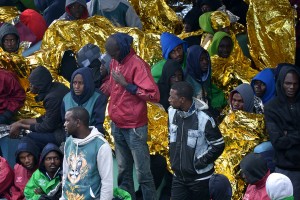
While much international attention is directed toward the flow of refugees from Syria and Iraq to Europe, which has prompted the partial suspension of the European Union’s Dublin Regulation by the German and Czech governments and even sent shockwaves through Canada’s ongoing federal election, hundreds of Libyans continue to make the perilous journey across the Mediterranean Sea. Kos Island has become famous around the world as the front line of the migrant crisis,

Migrants wait at a Lampedusa holding center. (Click image for source)

yet Italy’s Lampedusa continues to face an overwhelming number of both political refugees and economic migrants fleeing Libya in the wake of that country’s civil war and resulting unrest.

The Libyan Navy is in no position to be of assistance in managing the crisis. While it has a single Soviet-built Natya-class minesweeper still in operation, the remaining vessels of the Libyan Navy, comprised of a Soviet-built Koni-class anti-submarine warfare frigate and two Polish-built Polnocy-C-class landing ships, are reportedly undergoing refits in Malta and France. Though the Libyans doubtless possess some collection of small patrol craft, the force has thus far been unable to effectively police Libyan waters. In March 2014, an oil tanker from the rebel-held port of Sidra successfully evaded a Libyan Navy blockade, leaving a team of United States Navy SEALs to intervene and seize the tanker.

Fortunately, the Tunisian National Navy has proved itself to be a reliable partner in securing the Mediterranean and averting humanitarian disaster. In August 2015, Tunisia commissioned its first locally built patrol boat, Al Istiklal (Independence). This development made Tunisia the first country in the Arab world to develop a shipbuilding industry of its own and only the second in Africa, following South Africa’s lead. Reportedly, Al Istiklal is an 80-ton patrol boat that measures 26.5 meters in length and is 5.8 meters wide, enjoys a top speed of 25 knots and a range of 600 nautical miles, all while equipped with a 20mm cannon, two machine guns, and a thermal imaging camera. This expansion of  Tunisian maritime capabilities was bolstered by four patrol boats of unidentified classification from the United States Navy (USN) earlier in 2015, with a further three boats expected for delivery by the end of 2016.

It is difficult to accurately assess the size of the Tunisian National Navy, but best estimates place the total number of vessels operated by Tunisia at 40 gunboats or patrol

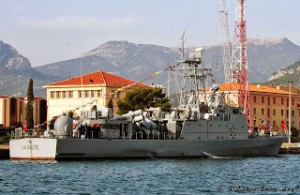
One of Tunisia's Combattante IIIM Class Fast Patrol Boats with MM-40 Exocet missiles. (La Galite 501 pictured)
One of Tunisia’s Combattante IIIM Class Fast Patrol Boats with MM-40 Exocet missiles. (La Galite 501 pictured). (Source: World Military Intel)

boats, one landing craft, and six other non-combat vessels. The largest vessel operated by Tunisia’s maritime forces, President Bourgiba, was a decommissioned Edsall-class destroyer escort, USS Thomas J. Gary, which was transferred to Tunisia in 1973 and rendered no longer operational by a severe fire in 1992, having served at sea for almost 50 years in total. Since then, the largest vessels operated by the Tunisian National Navy are its six Albatross-class fast attack craft manufactured in Germany by Lurssen, with a displacement of almost 400 tons each. In short, Tunisia’s maritime forces are non-expeditionary and have been focused entirely on coastal defense for more than two decades.

It is unclear whether the US sees the transfer of defense equipment like the aforementioned patrol boats as part of a broader effort to counter al-Qaeda in the Islamic Maghreb (AQIM) or other militant Islamist groups. But it certainly has paid dividends in rescue efforts. As recently as June 2015, Tunisian patrol boats saved some 650 migrants and refugees bound for Lampedusa on unsafe rafts. A June 2015 attack on a Tunisian beach resort by Libya-based terrorists, in which 38 people were killed, demonstrated how closely connected Tunisia’s security is with that of its neighbors, Libya and Algeria. As such, Tunisia is bound to continue to play a significant role in securing the North African coast. Nonetheless, it would be prudent for European members of NATO to press for a formalization of this relationship, similar in many respects to the Tactical Memorandum of Understanding struck with the Kingdom of Morocco in 2009 to secure Moroccan participation in Operation ACTIVE ENDEAVOR, NATO’s ongoing maritime mission to monitor traffic and combat terrorism in the Mediterranean. With or without European recognition, Tunisia appears set to be a maritime leader in its own right.

Paul Pryce is the Research Analyst for the Atlantic Council of Canada’s Maritime Nation Program and a long-time member of the Center for International Maritime Security (CIMSEC).

EUNAVFOR: Switching from pirates to migrants?

A human disaster is currently happening in the Mediterranean Sea where more than 10,000 migrants have been picked up as they attempted to enter Europe from Libya. The International Organization for Migration estimates that nearly 1,830 migrants have died on the sea route this year compared to 207 in the same period last year.

Traffickers started taking advantage of the breakdown of authority in Libya to pack boats with paying migrants willing to cross the sea for a better life. Meanwhile, the European operation against piracy in the Indian Ocean (EUNAVFOR Atalanta) has become a reference for possible maritime operation in the Mediterranean against those traffickers.

EUNAVFOR: an operation meant to fight piracy

ATALANTA
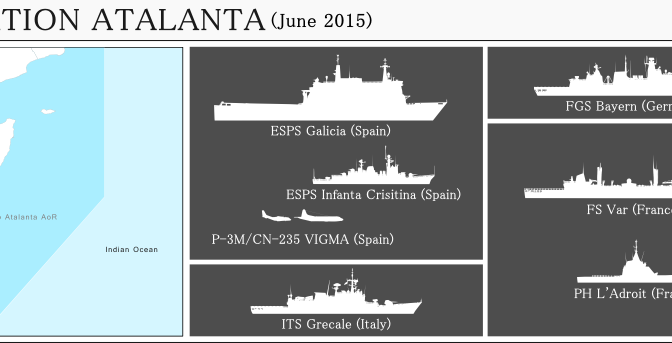
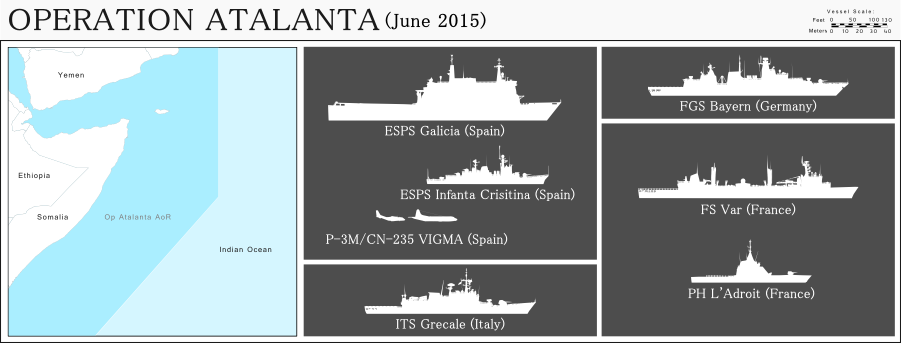
Operation Atalanta, as of June 2015. Along with AoR.

Created in 2008 as an operation to protect merchant ships against pirate attacks, mainly in the Gulf of Aden and particularly in the IRTC (International Recommended Transit Corridor) put in place to make sure vessels from the World Food Programme would reach the populations in need, Atalanta has become much more than a simple EU joint operation.

If the destruction of ships was not part of the original objectives of Atalanta, its actions soon grew offensive: in spring 2010, 18 months after its start, Atalanta adopted enhanced intelligence and surveillance methods allowing it to disrupt both “pirate bases” and pirate ships.

The tactics used by the EU operation (and by other forces) to enter a maximum of mother ships (not simple skiffs) was one of the operation’s success vectors. But those vessels were empty most of the time and no collateral risk was therefore expected.

Recognition means and intelligence

Operation Atalanta has strong recognition means with several maritime patrol aircraft based in different parts of the Indian Ocean (mainly in Djibouti and Seychelles) to regularly cover the area. From time to time, an AWACS aircraft is also required to lead strategic surveillance of the zone. And at the tactical level, some vessels (mainly Dutch) used maritime drones.

The interrogation of arrested pirates is a very important source of information and merchant ships that cross the zone play an important role in passing information to the  Maritime Security Centre – Horn of Africa, the maritime information centre set up at Northwood military headquarters in the UK and the various information collected in neighbouring countries (Kenya or Djibouti).

The Maritime Security Centre – Horn of Africa (MSCHOA) is an initiative established by EU NAVFOR with close co-operation from industry. It provides 24-hour manned monitoring of vessels transiting through the Gulf of Aden, whilst the provision of an interactive website enables the Centre to communicate the latest anti-piracy guidance to industry, and for shipping companies and operators to register their vessels’ movements through the region.

Owners and operators who have vessels transiting the region are strongly encouraged to register their movements with MSCHOA to improve their security and reduce the risk of attacks or capture. Additionally, the “Best Management Practices for Protection against Somalia Based Piracy” (BMP) and further information about combating piracy, and what action to take should they come under attack, can be downloaded on the MSCHOA’s website.

A further initiative was the introduction of Group Transits; vessels are co-ordinated to transit together through the IRTC. This enables military forces to “sanitise” the area ahead of the merchant ships. MSCHOA also identifies particularly vulnerable shipping and co-ordinate appropriate protection arrangements, either from within Atalanta, or other forces in the region.

In 2012, the need for ground actions was put forward.

Operations on land

In 2008, the crew of the Ponant, a French ship has been reported as having been taken in hostage by one of the four most powerful local groups, the Somali marines, who usually launched their operations from Garaad.

After the release of the Ponant, Admiral Gillier launched a helicopter raid by boarding commandos to intercept pirates on land. This air raid took place with the agreement of the Somali government. This is the only time where pirates were followed on land after the ransom was paid. The question was asked if the extension of Atalanta’s mandate would allow armed forces to track pirates on land. In April 2012, authorizations to destroy the logistics depots, i.e. “pirates bases” was obtained. These actions were also a way of saying to pirates “we can reach you anywhere.” This possibility of ground action, however, has been used only once, in May 2012, in an action by the Spanish navy. It was apparently enough to convince some local leaders that it was too dangerous for them to help pirates.

Recent actions in Yemen

In the margin of Atalanta, the French patrol boat L’Adroit was deployed on March 30, for two weeks off the Yemeni coast, where he led the evacuation of 23 French nationals from Aden, in difficult conditions. L’Adroit also escorted several Yemeni dhow between the ports of Djibouti and Al Mukah, contributing to the evacuation of nearly a thousand people from Yemen, including more than 500 Djiboutian refugees. The French ship then made call in Djibouti to refuel. Several authorities went on board, including the Ambassador of France to Djibouti, to congratulate the crew for its actions. L’Adroit now resumes his patrol off the Somali coast as part of the EU mission Atalanta to fight against piracy.

EUNAVFOR MED: Switching from pirates to migrants?

TRITON
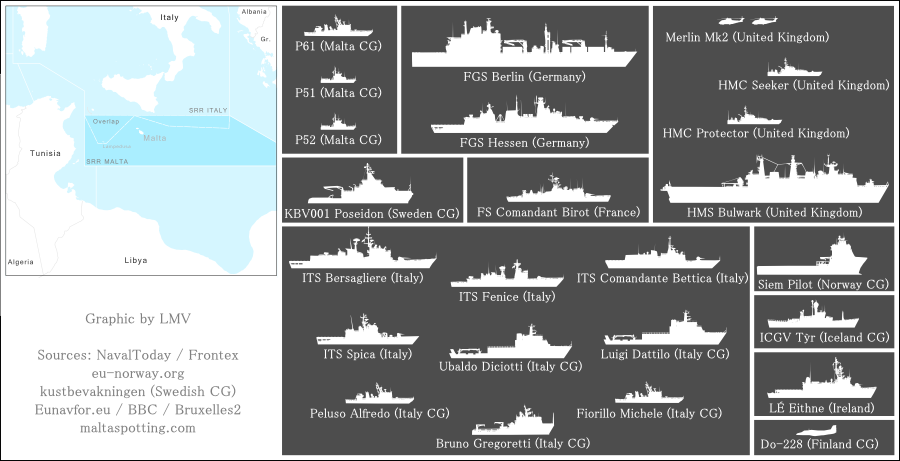
Operation Triton, as of June 2015.  Along with Malta’s SRR AoR.

This triple action: information, sea destruction and destruction on land was recently considered as a model for a possible CSDP operation against human traffickers in the Mediterranean. On 23rd April, an extraordinary European Council gathered to speak on the sensitive subject of migrants in the Mediterranean.According to a draft declaration, EU leaders turn towards Atalanta to reduce –if not end- the shipwrecks of migrants. We must “undertake systematic efforts to identify, capture and destroy the ships before they are used by traffickers”, the document reported.

The head of European diplomacy,Federica Mogherini, “was invited to immediately begin preparations for a possible security and defence operation, in accordance with international law.” The head of the Italian Government, Matteo Renzi, even requested the examination of the possibility of conducting “targeted interventions” against smugglers in Libya, which over the years became the country of embarkation of migrants and asylum applicants towards Italy and Malta.

If accepted, the organization of the EU military operation would be a first in the fight against illegal immigration but, of course, its implementation would take time. But in order to do destroy boats in Libya, a legal mandate is required from the UN. The ground action possibility for the Atalanta naval force in Somalia was almost never used because of its difficulty. EU leaders also need to think about measures to intervene during the crossing of migrant boats. And this would probably require giving more money to Frontex, the EU’s border control agency. However, the destruction of ships used by migrants already takes place at sea.

There are three main reasons for this:

First, abandoned vessels are a hazard to navigation, especially at night, when, because of their size and lack of lighting, they cannot be seen, even in good weather. Second, a ship lost at sea can be seen from an airplane and it is not always clear if anyone is onboard. To maintain the high quality of emergency rescue at sea, it is necessary to destroy those boats immediately after all migrants have been evacuated.Third, abandoning a vessel could lead to the risk of it being used once again by a new team of traffickers.

For example, German Chancellor Angela Merkel has officially confirmed on the 19th May during a joint press conference with President Hollande, that, since the beginning of sea rescue operations where the German navy was involved, “five inflatable boats and a wooden boat were sunk”.

The High Representative of the European Union for Foreign Affairs and Security Policy, Federica Mogherini, declared: “the fundamental point is not so much the destruction of the vessels but it is the destruction of the business model of the traffickers. If you look at business model of the traffickers and the flows of money involved in trafficking, it may be that that money is financing terrorist activities.” Stressing the same point, NATO Secretary-General Jens Stoltenberg said: “one of the problems is that there might be foreign fighters, there might be terrorists, also trying to hide, to blend in on the smugglings vessels trying to cross over into Europe.”

Know your enemy!

On 18th May, Ministers of Foreign Affairs and Defence of the 27 Member States of the EU (Denmark opted out of the common defence agreement after the Danish ‘no’ vote at the Maastricht referendum in June 1992) gave their “green light” to EUNAVFOR Med. Since the United Nations did not take any resolution yet, the operation should start with a first phase: the exchange of information and intelligence. This is fundamental, since, without an accurate tracking of information concerning different traffickers, different means employed, etc., it would be almost impossible to fight this traffic. This means air observation (maritime surveillance aircraft, UAVs, helicopters …) and imaging (radars, satellites, etc.).

Furthermore, if the goal is to neutralize these networks and to bring the perpetrators to justice, it is necessary, indeed, to have specific evidence against them. Laws also need to be updated to arrest traffickers on the high seas.

It will not be too difficult to organize action in the Libyan waters since most of the interested navies such as Greece, Italy, France, Spain etc. are already almost positioned in the international waters near Libya. The Mediterranean is really a “mare nostrum”. All European marine meet there to participate in combined manoeuvres (within NATO in general) or to visit the Indian Ocean – to participate in the anti-piracy operation in the operation of allies in Iraq, etc. – So, the cost for the navies to act through EUNAVFOR Med is reduced.

The General Operations Quarter installed in Rome, is already operational as it is currently used for Triton operation conducted under the aegis of Frontex (the European border control agency). Its military commander is Credendino Enrico, an Italian admiral. After this first phase centred on intelligence gathering and surveillance of smuggling routes leading from Libya to southern Italy and Malta, EU ships would start chasing and boarding the smugglers’ boats in a second phase. Summer is the high season for trafficking; this is why it is necessary to act quickly.

A dramatic situation but where is solidarity?

Despite the show of unity on the military action, the EU appears increasingly divided on the question of mandatory numbers of asylum seekers which should be accepted by member states, according to population size, wealth, and the number of migrants already hostel, as proposed by the European Commission on 13th May.

Ten countries have already spoke out against it, namely Spain, France, Britain and Hungary. Spanish Foreign Minister Jose Manuel Garcia-Margallo said the proposed quota for Spain doesn’t take into account the nation’s sky-high jobless rate of 24 percent and its efforts to prevent illegal migration from African nations. Police in the Sicilian port of Ragusa, meanwhile, arrested five Africans suspected of navigating a rubber life raft packed with migrants that was intercepted at sea last week. Hungary’s PM Viktor Orban has said the plan is “madness” and France’s Manuel Valls called it “a moral and ethical mistake”.

Why are all politicians so afraid to hold a hand to migrants? In 1979, French politicians and intellectuals put their disagreements aside and welcomed more than 128,531 Vietnamese and Cambodian refugees, fleeing communism and ethnic persecution, not knowing where to go.” Jean-Paul Sartre and Raymond Aron, two intellectuals, who were politically opposed, gathered around a common cause. A few months earlier, this heterogeneous coalition was established to charter a boat, with MSF, to travel around the South China Sea and bring relief and assistance to boat people in distress.

France hosted and helped migrants to settle and be integrated on its soil. Much of the Asian community in France, especially in the thirteenth arrondissement of Paris, is the result of this wave of immigration of boat people fleeing the former French colonies in Indochina.

Today, thousands of men and women are fleeing war in Syria – a former territory managed by France-,or the dictatorship in Eritrea, or the poverty of sub-Saharan Africa and no one is there to hand them a hand. David Cameron recently announced that he would send a ship of the Royal Navy in the Mediterranean but any migrant rescued by the British Navy would be deposited on the coasts of the closest countries, probably Italy.

We can find thousand of reasons not to help these people but I have one question: when did we stop being human?

After studying law and international relations, Alix started working on the first cycle of conferences “Defence and Environment: a new way of thinking” about the impact of defense activities on the environment. Alix served as a Navy officer and a political adviser to the New Zealand Consul in New Caledonia.  Since 2013, Alix is also the Asia-Pacific market analyst for the French and English publications of Marine Renewable Energy as a renewable energy consultant. She currently lives in New Caledonia. She is writing a PhD on the law of marine energy resources.

Louis Martin-Vézian is the co-president of the French chapter of CIMSEC, and produces maps and infographics features on CIMSEC and other websites. His graphics and research were used by GE Aviation and Stratfor among others.

OBANGAME EXPRESS 2015: Two steps forward. One step back.

Between 19 and 27 March OBANGAME EXPRESS, African Partnership Station’s annual exercise since 2011 took place off the coasts of West African states between Côte d’Ivoire and Angola. It is the fifth iteration of this exercise that has grown from nine participating nations in 2011 to 23 this year, including 12 Gulf of Guinea countries. Crucially, the framework for OBANGAME EXPRESS has changed since the last exercise. On 25 June 2013, 22 West and Central African countries signed the Yaoundé Code of Conduct, a document that obliges the member states to co-operate on preventing and prosecuting all forms of maritime crime and illicit activities at sea and to share information between each other. OBANGAME EXPRESS 2015 was the first exercise in this series to rehearse and test the new structure and, where they existed, procedures.

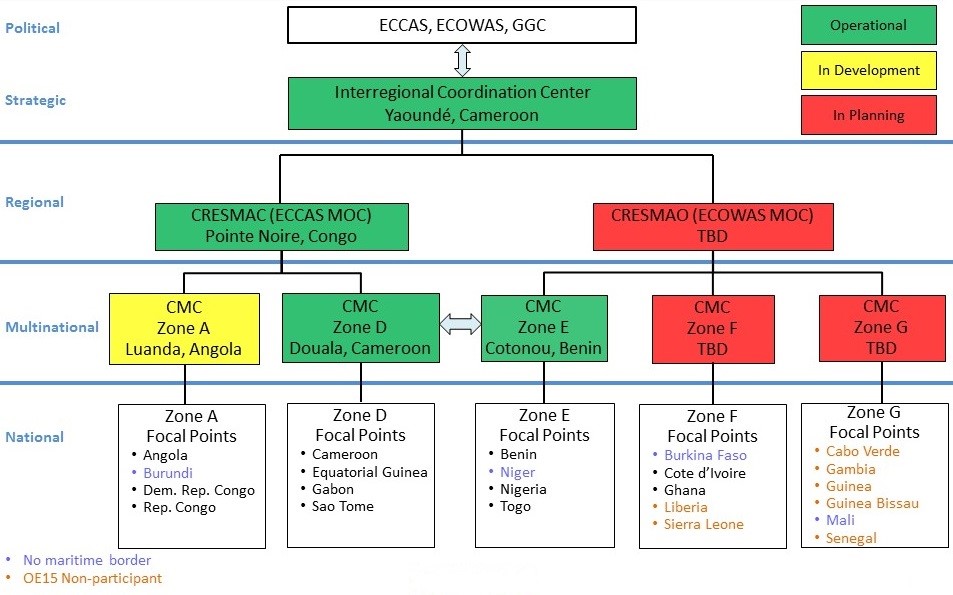
Broadly speaking, the Yaoundé Code of Conduct (YCoC) provides for a hierarchical information sharing and co-ordination structure that includes all countries from the two regional economic communities – the Economic Community of West African States (ECOWAS) and the Economic Community of Central African States (ECCAS). The YCoC structure envisages an Inter-regional Co-ordination Centre (ICC) for the strategic level, regional reporting centres for both ECOWAS and ECCAS and below those, for operational co-ordination, Multinational Co-ordination Centres (CMC), grouping the Gulf of Guinea countries into five zones: A, D, E, F and G.

The information sharing and reporting structure as envisaged by the Yaoundé Code of Conduct and the degree of implementation (in green) during OBANGAME EXPRESS 2015. (AFRICOM)

One of the key differences of this year’s OBANGAME EXPRESS was that it took place off all the Gulf of Guinea states’ coasts rather than in a single exercise area. This made for a realistic setting regarding the command and control as well as logistical challenges for the region’s navies.  It also allowed the YCoC structures to be tested with realistic timeframes, as target vessels transited through the Gulf of Guinea nations’ waters. It also added another layer of complexity to the already very demanding schedule of OBANGAME EXPRESS 2014. Was it too much, given some of the modest outcomes of last year’s exercise? Was it an exercise in window dressing? Or is the Gulf of Guinea on a good path towards becoming part of the “global network of navies” as the exercise’s officer in tactical command, Commodore John Rinko (USN), predicted during the opening ceremony in Accra, Ghana? The truth, as always in this region, is probably somewhere in between.

The core functionality that this exercise tested was that of the 21 Maritime Operations Centres (MOCs) on national, sub-regional and regional levels and their ability to communicate, co-ordinate and direct maritime interdiction operations (MIO) represented on a tactical level by patrol boats, boarding teams and special forces teams.

It became clear during the exercise that the information flow functioned broadly as envisaged by the YCoC despite a lack of reporting standards and procedures, absence of a common interpretation of the situation picture, organisational and technical deficiencies (which affected some MOCs more than others). There is also still an overreliance of many MOCs on tracking vessels via their Automated Identification System (AIS) signals. Given that the majority of criminally active vessels in the Gulf do not broadcast this signal, in addition to an increasing number of merchant vessel switching off their AIS as a self-protection measure as per industry guidance, it effectively reduces any Maritime Domain Awareness (MDA) capability to near zero outside coastal radar range. This is a particular challenge also for tracking and combating illegal, unregulated and unreported (IUU) fishing activities, since many fishing vessels do not have AIS transponders or choose to switch them off while poaching.


Additionally very few Gulf of Guinea nations, such as Ghana, have integrated their coastal radar stations into their MDA systems. Farther south, in the Republic and Democratic Republic of Congo and in Angola there is no meaningful coastal radar coverage at all at the moment. On a positive note: the Nigerian Navy, as the first Sub-Saharan navy ever, transmitted a radar picture via data link from a vessel to the MOC. Given the recent acquisition of three more large Offshore Patrol Vessels (OPV), this at least opens the prospect for a better surveillance of the Nigerian Exclusive Economic Zone (EEZ).

NNS OKPABANA intercepts the German frigate BRANDENBURG, which simulates a tanker carrying a cargo of stolen oil, on 24 March 2015. (Photo: German Navy/Steve Back)

Beyond the artificiality of the exercise, however, old suspicions and prejudices are hard to eradicate. While Nigeria and Cameroon played their part well in exercising tracking and intercepting suspect vessels at the border between Zone E and Zone D, Cameroon does not grant Nigeria the right of hot pursuit into her territorial waters in real life. Equally, the Ghanaian chief of naval staff, Admiral Biekro, casually announced the formation of an “information-sharing coalition” comprising Côte d’Ivoire, Ghana, Togo and Benin, conspicuously leaving out the elephant in the room. Circumspection in sharing information with Nigeria is widespread in the northern part of the Gulf of Guinea and, based on the performance of Nigerian criminal networks and their current relationship with the Nigerian political and military elites, certainly justified.

Nevertheless the Nigerian Navy was determined to contribute as best as it could in the face of political constraints. The detachment of one of the Nigerian Air Force’s precious ATR-42 Maritime Patrol Aircraft (MPA), which are used as reconnaissance planes in the campaign against Boko Haram in Nigeria’s northeast, was a signal that, whatever the shortcomings, Nigeria was willing to engage. Only a few days later, the same MPA flew out to south of Sao Tomé to assist in the real-world episode of the scuttled IUU fishing vessel THUNDER. This mission, too, reflects the spirit of the YCoC; Sao Tomé lacks air assets for Search and Rescue (SAR) – for the purpose of the exercise this had been simulated just a few days earlier by a Portuguese Air Force P-3 Orion flying out of Sao Tomé.

On the tactical level, results were also mixed, ranging from pleasant surprises to disappointments. All navies struggled with the absence of formalised and trained procedures for Maritime Interdiction Operations (MIO). The teams deployed by the African nations typically lacked consistent tactical skills for boat handling, boarding and close-quarter including room-clearing as well as command procedures. Poor communications equipment aggravated those shortcomings; usually only the team leader had a VHF radio to communicate with the mother ship. The dismal performance of the Nigerian SBS team was particularly disappointing after last year’s credible performance. However, this year’s team which boarded the German frigate BRANDENBURG in an opposed boarding scenario was actually a land-trained team that had seen combat in Nigeria’s northeast. The tactical deficiencies that this team displayed are a lesson for those (especially in the private sector) who believe that combat experience alone is sufficient qualification for succeeding in maritime security missions.

Togo’s embryonic MIO capability on the other hand made visible progress since last year. While tactics where still not near anywhere that would enable the Togo Navy to carry out anything else than compliant boardings, the team appeared more professional and self-assured than last year. Once on board, the team, which included specialists from other agencies, made a good job of securing the crime scene and preserving and collecting evidence.

A Togolese soldier provides rearward security for the Togo boarding team on the bridge of the target vessel BRANDENBURG during OBANGAME EXPRESS 2015. (Photo: German Navy/Steve Back)

Ghana’s MIO teams for the exercise received a three-day pre-sail training by the German Navy’s naval infantry. It was also a useful lesson for the Ghana Navy that the exercise should really test real arrangements rather than such made specifically for the exercise. In this case Ghana had hand-picked four MIO-teams from different vessels for OBANGAME EXPRESS. Lack of familiarity of the boarding officers with their teams as well as the inclusion of non-naval specialists from the Police, Fisheries etc. made for very mixed results.

The risks of the lack of formalised procedures were apparent during the real world incidents of the MT MARIAM and FV LU RONG YUAN YU 917. Both vessels were hijacked by Nigerian criminals in January and February 2015 respectively and subsequently recovered by Ghana Navy boarding teams from the patrol boats BLIKA and CHEMLE, both of which took part in the exercise. In the case of the MT MARIAM luck and good improvisation played a great part in the success of the mission. The Ghana Navy boarded the tanker 26 nm outside the port of Tema (the BLIKA having unwittingly passed the tanker INVICTUS, which had siphoned off the MARIAM’s cargo, on the way) with a boarding team comprising a mere seven persons (in addition to the two-man crew of BLIKA’s sea boat). The fact that five of the eight suspected pirates on the MARIAM were hidden away in a water tank without guns only emerged after a while and after the initial team (of five persons) had almost given up the search. The remaining three suspects were holed up in the chain locker. One of the apprehended suspects from the water tank was used as a mixture of human shield and go-between when the Ghana Navy team had to approach the only entrance to the compartment through a narrow corridor. Fortunately, the three remaining suspects gave up and then, bizarrely, tried to hide themselves in the small compartment. In the end it was perhaps fortunate that, whether abetted by the MARIAM’s crew or not, the Nigerian criminals chose to place themselves into a position where the small Ghana Navy team could deal with it effectively. However, the vignette also holds a strong message that in the case of a non-compliant or opposed boarding this vessel recovery would not have gone ahead or if it had, could have ended in disaster due to the inadequacy of the boarding team.

From exercise to reality: GNS BILIKA’s boarding team boards MT MARIAM, a tanker that had been hijacked under dubious circumstances off the Niger Delta on 11 January 2015. (Photo: Ghana Navy)

The Ghana Navy’s Flag Officer Fleet, Commodore Mark Yawson, and the Director of Operations, Commander Derrick Attachie saw this exercise as an opportunity to improve and to identify what should be the navy’s priorities in training and procurement. Clearly, this is what an exercise is designed to do, but in some cases there remains some doubt that even though there is a will to address deficiencies identified in the exercise capabilities may not be available. Low operational readiness of some navies, absence of reliable fuel supplies (even for the exercise), systematic communications infrastructure shortfalls (poor internet, a “gap” between VHF and HF coverage at sea) are not problems easily addressed without a significant increase in funding, which is unlikely to be forthcoming in the short-term. Some improvements, while noteworthy and laudable, are improvements from an extremely low level, such as those made by Côte d’Ivoire, Republic of Congo, Democratic Republic of Congo or Sao Tomé and Principe. In the latter case, in spite of great personal engagement by junior officers and NCOs, there appears to be very little top-level support. The evaluator for the Sao Tomé MOC pointed out that the centre did have a higher level of performance some years ago, but that it seemed the operation had been started from scratch again.

The true “success” of OBANGAME EXPRESS over the years is really in highlighting all these aspects and tracking progress – or absence thereof. The annual exercise also provides a benchmark and while the political message will always be one of continuous improvement, the analytic tools are actually fine-grained enough to register the nuances of change in either direction. As in 2014 the closer look at the individual results and how they came about raises the question of “sustainability” of the progress achieved so far. It is evident from this year’s results that gains made in the past can be lost in no time for as long as the effort does not become systemic.

There is a strong desire by the US to get other nations more involved in the maritime security effort. With the EU’s new Gulf of Guinea action plan the time may be auspicious to broaden the base of this capability-building effort with more permanent and long-term commitments by extra-regional powers (where this is desired), but with a view to “responsibility sharing”, rather than an open-ended engagement. This effort will be complex, given different priorities:  Europeans and Americans are worried about drug trafficking while most West African governments are more concerned with the smuggling of cigarettes and oil products. Piracy is another priority for the EU and the US while it is less important for many African politicians who have to fight against pirate fishing to be able to feed their growing populations. The road ahead is still long. And as this year’s exercise showed: it also is not straight.

Dirk Steffen is a Commander (senior grade) in the German Naval Reserve with 12 years of active service between 1988 and 2000. He took part in Exercise OBANGAME EXPRESS 2015 as an observer during the German Navy’s MIO-team training in Ghana before transferring to the Exercise Control Group as a Liaison Naval Officer. He is normally Director Maritime Security at Risk Intelligence when not on loan to the German Navy. He has been covering the Gulf of Guinea as a consultant and analyst since 2004. The opinions expressed here are his alone, and do not represent those of any German military or governmental institutions.