By LCDR Robert “Jake” Bebber USN
This article is part two of a two-part piece drawn from a recently completed report by the author that was published by The Journal of Political Risk, and is available in its entirety here.
What Must Be Done?
Part one of this article outlined some of the broad challenges facing American policy-makers and defense planners in the coming years. Part two explores the practical and policy implications of what must be done.
Considering these developments outlined in part one, U.S. mobilization efforts should take the following six steps:
- Shift the focus of strategic warning to identifying emerging disruptions and strategic latency.
- Develop a strategic intelligence capability to monitor and evaluate sources of U.S. power and identify areas of potential comparative advantage.
- Institutionalize a “whole of society” approach to peacetime preparedness.
- Reframe warfighting posture toward preparing to survive an initial blow, then transition to alternative capabilities that can achieve desired effects.
- Integrate allied and U.S. preparedness efforts, to include research and development, technology sharing, coordinated production, and political resiliency.
- Understand and educate the American people on the realities of sustained competition and conflict.
Strategic Latency, Warning, and Disruption Futures
Since the Second World War, the idea of “warning” has largely been linked to surprise military attacks. Pearl Harbor, the invasion of South Korea by North Korea, and September 11, stand out as hallmark examples of the types of surprise attacks that most concern policymakers. During the Cold War, this included not only a nuclear first strike, but also a surprise Soviet attack into Western Europe or a resumption of hostilities on the Korean peninsula. Other warning concerns would be events which might have dramatic impact on the geopolitical landscape, such as coups and revolutions, the outbreak of civil war, the assassination of a world leader, or the outbreak of a war involving a U.S. ally.
The nature of surprise assumes a level of unpreparedness – catching your adversary unprepared is why surprise is usually sought after. The American intelligence community, while it has many roles and functions, exists foremost to prevent surprise and provide strategic warning.
Cynthia Grabo describes warning as “an intangible, an abstraction, a theory, a deduction, a perception, a belief. It is the product of reasoning or of logic, a hypothesis whose validity can neither be confirmed nor refuted until it is too late [emphasis added].”1 It should not be confused with current intelligence, nor does it necessarily flow from a mere “compilation of facts” or the result of “majority consensus.” Rather it depends on exhaustive research, and usually the kind of holistic approach that the American intelligence community was not originally designed for.2 There are currently 17 federal agencies and military service components devoted to different collection and analysis emphases, each working independently under a broad umbrella agency, the Office of the Director of National Intelligence (ODNI). ODNI was established after the September 11, 2001, terrorist attacks, largely in response to the significant failures of the separate intelligence agencies to work together and share information and analytic expertise.
While anticipating a military surprise attack will remain an enduring requirement for the intelligence community, the emerging global trends and adversary campaigns reshaping the strategic environment will likely matter more in the coming decades. However, the current analytic techniques used by intelligence analysts are inadequate to identify these trends and are likely to result in a strategic warning crisis.3
Strategic latency refers to the potential for technologies to fundamentally shift the military and economic balance of power.4 China (and Russia to a lesser extent) leverage dual-use technologies to exploit commercial and supply chain vulnerabilities and hold critical information and economic “choke points.” Supply chain dominance provides control of the underlying infrastructure of the 21st century economy, from undersea cables to satellites. By controlling the electromagnetic spectrum and supporting supply chains such as media, advertising, entertainment, legal regimes, political lobbying, and public opinion management, China is approaching the point where it can achieve global information superiority, if not dominance. Information control enables population control.
The intelligence community’s inability to detect and anticipate latent disruptions results from the organizational structure of the community, the charges of its component organizations, and its analytic tradecraft. The 17 U.S. intelligence agencies that fall under ODNI’s purview are organized under either intelligence disciplines, such as communication intelligence or geospatial intelligence, service warfighting domains (air, land, sea, space), or domestic security and law enforcement functions. Its core responsibility is the fusion of these different disciplines into larger strategic intelligence support to the President and National Security Council.
Today’s intelligence community organization results from two major events: the 2001 terrorist attacks on New York and Washington, D.C., and the intelligence community’s erroneous assessment in 2002-3 of Iraq’s weapons of mass destruction program. The first represents a failure to detect an impending attack. The second represents a failure to accurately assess the state of an adversary’s capabilities. In both cases, cognitive limitations inherent to dealing with incomplete or ambiguous information led to intelligence and warning failures. Analysts do not approach their trade with a “blank slate,” but start with certain assumptions about foreign capabilities and intentions that have been developed through education, training, and experience. These assumptions form a mindset that influences what the analyst judges to be reliable and relevant. While this is often a strength, it is not error-free.5
However, the intelligence community’s ability to forecast latent disruptions is questionable at best. This places American national security at a severe risk since it directly impacts peacetime strategic competition and mobilization execution in the event of conflict. Yet understanding anticipatory behavior is central to financial asset management firms, and seven of the top ten firms reside in the United States. Before these firms make multi-billion dollar decisions, they perform deep research and analysis, evaluating an immense, diverse array of data sets, from predicting sea level rises to mobile communication use in India. These firms specialize in evaluating risks to capital investment.
Data sets are available almost instantaneously from a growing “Internet of Things” and ubiquitous sensors that constantly monitor human activity. Programmers use these data sets to build and refine predictive algorithms that drive risk management and investment. This methodological approach suggests humans telegraph their behavior through technology and investment decisions. This “Techno-Financial” intelligence capability is a critical requirement for better anticipating emerging disruptions.6 It is a multidisciplinary approach integrating behavioral economics, neuroscience, demographics, regulatory, legal, and other sectors. Interconnected technologies and complex networks are treated as living organisms, while investment is the fueling force that can predict future organism behavior.7
Along with a techno-financial intelligence capability, the intelligence community lacks a comprehensive methodology to “understand the ways individuals perceive and respond to various types of information.” It requires a knowledge of how humans communicate with others in groups, and “orient and respond to economic, social and political environments.” To detect these changing patterns in human group behavior, the intelligence community will need massive sets of diverse and cross domain data sets, along with the ability to process this data to yield understanding and prediction.8 Many of these data sets will overlap with techno-financial intelligence, and the two disciplines complement one another.
Intelligence and Investment for the Home Front
Underlying disruptions in the global economy, changing consumer behaviors, and advanced non-kinetic mass disruption attacks have left the American home front vulnerable. In many respects, war in the 21st century will be characterized not only by a lack of “front lines” but also the absence of any sanctuary. Traditional offensive and defensive operations may not apply, and the “battlefield” may be located in far off corners of the globe while simultaneously being fought in corporate boardrooms, small town hall meetings, and even family gatherings.
Mobilization and peacetime preparedness are best informed through a comprehensive program that identifies the sources of American power creation, evaluates changes and coming discontinuities, and conducts predictive analysis. The Department of Defense has been conducting this type of work through agencies such as the Office of Net Assessment and the Defense Science Board, yet for obvious reasons their efforts are mostly confined to understanding the military balance. Other agencies do track data and trends and make reports within their purview, such as the Department of Labor or Health and Human Services. However, no agency or interagency network or research institute is tasked with crafting a framework to evaluate sources of American power, anticipate opportunities to develop comparative advantages or to mitigate vulnerabilities, or to be used as the basis for policy formation and strategic decision-making. There is no framework that provides the understanding of complex network relationships and evaluates it as an organic whole.9
This is not to say that no one has suggested doing so. One such approach, Strategic Advantage by Bruce Berkowitz, argued that in order for the U.S. to remain the global leader in the 21st Century, it must achieve organizational agility, optimally manage risk, better navigate the crosscurrents of economic development and democratic institutions, and use its comparative advantages effectively. This requires a constant evaluation process of macro-trends in demographics, economics, commercial use, technology, health, and other factors, and how those factors shape national power and create opportunities and vulnerabilities. Importantly, there is a pacing element to power creation and sustainment based around economic constraints and the realities of American political support. In a complex threat environment with competing – and sometimes conflicting – interests, the challenge will be developing, selecting, and combining various capabilities (military, economic, diplomatic, etc.), and then recombining them as conditions change, while avoiding becoming so overcommitted in addressing one threat that we are unable to address others.10
Six principles guide this framework. This first is to understand the potential scenarios for world events, and the important variables (demographic, economic, technology, etc.) that underlie each scenario and identify the mileposts that might signal how these scenarios would play out. The second principle is to recognize the United States’ unique strengths that provide it outsized advantages and to identify how these strengths might be cultivated and exploited. Next, planning must anticipate that changes in the environment occur rapidly, and assumptions will likely not remain valid for more than three to five years, at best. Planning must also account for constraints on both resources and public opinion. Success will require an organizational approach that accommodates more risk and is agile enough to respond to changes in the environment. Finally, maintaining a strategic advantage will depend on the availability of resources, which emphasizes the centrality of economic growth toward national security, preparedness, and mobilization.11
From Whole-of-Government to Whole-of-Society
For a whole-of-society approach to be truly meaningful, it must reach beyond the federal, state, and local governments, as well as beyond traditional social institutions such as chambers of commerce and trade unions. A few lessons from the mobilization during the Second World War still apply, but none more so than organizing industrial mobilization around industry, rather than government, which was central to the explosive growth in American capacity to provide the bulk of war materiel for all allies. This was only possible because industry and labor led the approach. While the government stepped in to regulate consumption through the rationing of certain goods and services, production always remained voluntary and driven by incentive. As early as 1938, industrial mobilization planning was built around getting ahead of the problem to determine what was needed and when, rather than what American industry had the capacity to produce. This drove a requirements-based process while helping build production momentum.12
A major war in the 21st Century will certainly look much different in the production and employment of war materiel, but what might matter more is how the United States organizes its preparedness and mobilization planning to leverage its comparative advantages.
While it is important for the federal government to organize and sustain the effort, state and local governments must have a role in decision-making on national-level priorities. Key economic sectors in finance, logistics, transportation, health care, manufacturing, retail, telecommunications, and others represent a large source of national power. No less so are public education and institutes of higher learning, training and certification bodies, and community organizations such as the American Red Cross and United Way. Important in the 21st Century is the growing role of social media “influencers” and YouTube stars, as well as bottom-up capital generation like Kickstarter and community activism tools such as Change.org. Non-traditional platforms and organizations can bring innovative ways of thinking and alternative approaches to mobilization and preparedness planning.
Some states are approaching preparedness in novel ways. The Ohio National Guard has created the Ohio Cyber Reserve, teams of trained civilians available to assist municipalities with cybersecurity vulnerabilities and provide recommendations to reduce threats. They also provide workforce development training and education services in local schools. This approach can be expanded with government support to create citizen volunteer organizations modeled on the Civil Air Patrol to better utilize the large population of Americans who may not be interested in government or military service but have unique skill sets such as on-net operations, resiliency testing, critical infrastructure protection roles, and youth mentorship in science, technology, engineering and the liberal arts.13
“Survive, Then Transition”
The stages of mobilization are traditionally crisis mobilization, tactical mobilization, and strategic mobilization. However, the character of warfare in the information age suggests that adversaries will likely engage in non-kinetic disruption attacks, potentially on a mass scale, to achieve strategic effects well before initiating open hostilities. Disruptive attacks on preparation activities and material production will likely thwart or slow the U.S.’s ability to mobilize, marshal forces, and project power. These attacks may go on for months or years, in pursuit of long-term weakening by delegitimizing democratic institutions, sowing social discord, or even increasing the use of addictive opioids among the population, thereby rendering them unfit not only for military service, but unemployable in most industries. It might be wise to assume that the U.S. is under attack right now for the express purpose of rendering its mobilization and preparedness capability impossible.
As discussed above, policymakers should create a strategic warning regime tailored to detect these types of mass disruptive attacks, while building intelligence collection capabilities and analytic techniques to support strategic warning. Still, the ability of an adversary to initiate a surprise attack on a global scale, along with the complexity and high tempo of modern combat suggests that against a peer adversary like China, the United States and its allies could quickly find themselves overwhelmed in one or more theaters. Maintaining credible, forward deployed combat power is challenging now, and growing more so each day.
This suggests that the United States would have to develop deep enough stocks and magazines to sustain combat forces in the early stages of a conflict (the “staying power” that the Reagan Administration attempted to address). However, the current mix of highly exquisite and expensive weapons systems has left the resources available for war reserve stocks nearly non-existent. Therefore, once military forces and the homeland have survived an initial onslaught, the U.S. will face two choices: try to reconstitute and replace forces or begin a transition to new capabilities that can be fielded rapidly and inexpensively while achieving required operational and strategic results. The fact that the force design and its supporting defense industrial base cannot be meaningfully expanded to keep up with anticipated attrition levels suggests that new means of rapid capability employment will be required.
The Defense Department has expanded its efforts to go outside of the traditional defense industry base and encourage companies to do business with the Pentagon, giving the military access to unique products and services as well as alternative approaches to design, production and sustainment. Through initiatives like the Defense Innovation Unit and legislative action to expand the use of Other Transaction Authorities, the Defense Department has adapted many commercially available products to military use, from personal communication devices to unmanned systems.
Large companies are investing significantly in autonomy, artificial intelligence, and virtual reality to create new products, improve business logistics and administration, and meet changing consumer demands. Defense leaders should identify and improve upon lessons from employing non-traditional defense companies in order to transition to innovative and sustainable ways to deliver kinetic and non-kinetic capabilities. For example, there is a growing hobby in using a 3-D printer to create drones, leading to innovation in drone design, applications, time to develop, and reduced costs. In a strategic competition, actors can apply new and novel uses of information technology to dynamically impact global economies, public diplomacy, and influence campaigns to achieve strategic effects.
Integrating Allies into U.S. Preparedness
American security ultimately depends upon collective security, a fact that is often overlooked in preparedness planning. While the U.S. military and State Department have a long history of working with allies, friends, and partners to advance security interests, these efforts may not have the efficacy they once did, as China has aggressively sought to bond itself economically to American allies. Commercial and industrial interests are a strategic vulnerability to the democracies, unlike the Cold War where they were an asset. This has caused friction between the U.S. and its allies, especially concerning the use of Chinese companies to build critical infrastructure or operate maritime ports and transportation networks.
At present, only limited efforts exist to evaluate allied and partner nation industrial capacity, defense capabilities, research and development programs, dual-use technology development and applications, sustainment, and political resiliency. There is growing concern that as the gap between U.S. and allied military technology expands, interoperability between allied and coalition forces will become far more difficult. The inability to share resource, sustainment, and logistical burdens would place both U.S. and allied security at risk. The U.S.’s past successes in allied and coalition warfighting have largely been because of early agreement and understanding not only of the strategic objectives but also of partner burden sharing and mutual support. The U.S., given the size of its military, will likely have the largest share of the burden, and allies and partners must be able to receive and use American support.
Coordination of cross-domain operations, including space, cyber, and the electromagnetic domains, will be central to coalition warfighting and strategic competition campaigns that fall below the warfighting threshold. The U.S. will have allies of varying levels of sophistication, capabilities, and resources. Even allied and partner nations that operate comparable technology, such as Japan, South Korea, Israel, and the U.K., may have structural challenges that make coordination with the U.S. or with each other difficult.
U.S. policy continues to emphasize self-sufficiency and autarky for its defense industrial base. This policy needs to be re-evaluated considering the increasing use of commercial and dual-use technology, much of which is developed in allied and partner countries.
Fortunately, the U.S. and its allies have a long history of alliance management, cooperation on mutual interests, and integrated command structures. This is especially true for NATO, “Five-Eyes” partners, Japan, and South Korea. NATO established the Partnership Interoperability Initiative in 2014, which was also broadened to include Australia, Finland, Georgia, Jordan, and Sweden. NATO’s experience in the Balkans and Afghanistan highlighted many of the challenges forces had in standards, doctrine, logistics, and sustainment. The U.S. also maintained combined forces commands in Japan and South Korea, to include coalition war planning, exercises, basing, and sustainment.
Expanding integration and interoperability is one area of mobilization preparedness that holds a great deal of promise. These efforts should be deepened to include joint development of research, development, and dual-use technology goals; combined command, control systems; and intelligence, surveillance, and reconnaissance capabilities and domain awareness capabilities. This may necessitate expanding and improving the ability of U.S. and allies to share a common operating picture that enables tactical tracking to find, fix, and finish targets across coalition platforms.
Coordinated industrial base expansion, sustainment, tooling, and logistics support will be critical to maximizing comparative advantages that the alliance system provides. The U.S. and its allies should undertake further weapons system and platform development capabilities, to include non-traditional and dual use civilian-military capabilities. This may mean accepting the tradeoff between high-end, exquisite systems and moderately less capable, but still effective combat and non-kinetic systems that all parties can operate. In a strategic competition or conflict with China, and the immense industrial capacity it can harness, this could be the best option. It frees up a portion of the U.S. information technology and industrial base to develop and produce future high-end systems while spreading out the production of moderately capable systems that can be brought into the competition or conflict more rapidly.
Such an expansion will require a dedicated, regular, systematic evaluation of allied and partner capabilities, more frequent combined and coalition exercises, and deeper coordination of planning and planning assumptions. Early and often allied wargaming, to include frank discussions on potential strategic and political goals, will greatly improve planning assumptions and further guide research, development, production, and operational concepts that are tailored to better meet alliance goals.
Understand and Educate the American People
To paraphrase former Secretary of Defense Donald Rumsfeld, the U.S. will compete with the population it has, not the one it wants. That is, policy makers must realistically assess the willingness and desire of the American population to support and sustain another indefinite competition and conflict with a major power. The fiscal burden of creating and sustaining American power is likely to grow. This will come at a time when it will be incumbent on decision-makers to address the entire scope of national taxation and spending. Hard trade-offs will be required.
Yet fiscal constraints are only one piece of the puzzle. Even if the resources were readily available, it is not entirely clear that the population of 2020 is particularly interested in competing. The Cold War was born out of the Second World War, and early system shocks caused a reappraisal of U.S. efforts to rebuild the world order while being confronted with a global communist movement that had other designs.
Part of this is due to the nature of how the Cold War ended and the brief, unipolar moment the United States enjoyed. Little effort was given to recapitalizing the institutions necessary to meet a new, peer challenger. Even conservative, anti-communist stalwarts argued that it was time for America to become a “normal nation,” and shed the burden of global leadership. The lack of an existential threat made such calls even more appealing.
Recent polling suggests that a smaller portion of younger generations – Generation “Z” and Millennials – view the United States as “better” than all other countries, an idea commonly called “American exceptionalism.” At the same time, significant gaps exist between the younger and older generations on perceived threats to America, with Millennials pointing to “climate change” (62%) as a bigger threat than “the development of China as a world power” (35%), “North Korea’s nuclear program,” (55%) or the “rise of authoritarianism around the world” (42%).
To be sure, as one ages and experiences the world, the perception of threats will likely change, and generations do not hold monolithic views that remain etched in stone. Evidence suggests that the public is growing far more wary of China as a threat, and CCP leadership’s complicity in covering up the danger of the COVID-19 pandemic may further incur the American public’s anger. The vast majority of Americans still believe that a future with U.S. leadership is far better than a world led by Beijing.14
Yet it would be the most profound failure of policy for the United States to execute a grand strategy designed to compete with, and if necessary, fight Communist China if popular consensus is not there. Indeed, it would be disastrous. This is more important for younger generations as it is they who will face most of the sacrifice. The underlying assumption behind competing with China is that the American people are invested in the cause. If that assumption is misplaced, then a competition strategy cannot succeed, and the U.S. is likely to suffer a catastrophic loss.
Implementing a competition strategy will require not only public debate, but also public accountability, and the willingness to craft policy and strategy around the constraints of public opinion. While public opinion can be moved, the case must be made. This must be central to American grand strategy, strategic competition, mobilization, and preparedness planning. The current complacency regarding the public’s declining trust in institutions and America’s role in the world is dangerous. Foreign powers actively engage in strategies to undermine American political legitimacy and resiliency, but they need only accentuate the domestic trends that are already present.
Preparedness and mobilization planning remain central to America’s ability to defend its interests and the cause of freedom. This is worth fighting for. But it cannot be defended without the support of the people. It is a political case that must be made at all levels of government and society. It will require a renewed effort toward public education, and frank, honest debate about the sacrifice required. To best make the case, policy makers have to meet the American public where they are, using terms that convey the gravity of the situation and the stakes involved.
LCDR Bebber is a Cryptologic Warfare officer assigned to Information Warfare Training Command Corry Station in Pensacola, Florida. The views expressed here do not represent those of the Department of Defense, Department of the Navy or the U.S. government. He welcomes your comments at jbebber@gmail.com.
Endnotes
1 Cynthia M. Grabo, Anticipating Surprise: Analysis for Strategic Warning (Lanham: University Press of America, 2004), 4.
2 Grabo.
3 Maureen Rhemann, “Intelligence Analysis in a Post-Heuer World: Why We Don’t Recognize New Forms of Warfare and 6 Intelligence Take-Aways From Neuroscience” (Reperi Analysis Center, 2020).
4 Celeste Chen, Jacob Andriola, and James Giordano, “Biotechnology, Commercial Veiling, and Implications for Strategic Latency: The Exemplar of Neuroscience and Neurotechnology Research and Development in China,” in Strategic Latency: Red, White, and Blue, ed. Zachary S. Davis and Michael Nacht (Livermore: Lawrence Livermore National Laboratory, 2018).
5 Richards J. Heuer, “Limits of Intelligence Analysis,” Orbis Winter (2005): 76–77.
6 Techno-Financial Intelligence was pioneered by the Reperi Analysis Center (RAC) in 1999 to detect future disruption blending leading data sets to detect asymmetric pre-cursors and perfected with advanced algorithms in 2020. It assumes behavior is telegraphed and users 7-S/ADP and other processes.
7 Maureen Rhemann, “What We’ve Learned from 20 Years of Techno-Financial Intelligence” (Reperi Analysis Center, 2020).
8 James Giordano and Rachel Wurzman, “Integrative Computational and Neurocognitive Science and Technology for Intelligence Operations: Horizons of Potential Viability, Value and Opportunity,” STEPS 4 (2016): 32–37.
9 For a brief overview of how China approaches this challenge, see the Appendix on Comprehensive National Power which is found in the longer study published at the Journal of Political Risk.
10 Bruce Berkowitz, Strategic Advantage: Challengers, Competitors, and Threats to America’s Future (Washington, D.C.: Georgetown University Press, 2008).
11 Berkowitz, 231–32.
12 Herman, Freedom’s Forge: How American Business Produced Victory in World War II.
13 Robert Bebber, Interview: Dr. Peter W. Singer, January 16, 2020.
14 Devlin, Silver, and Huang, “U.S. Views of China Increasingly Negative Amid Coronavirus Outbreak.”
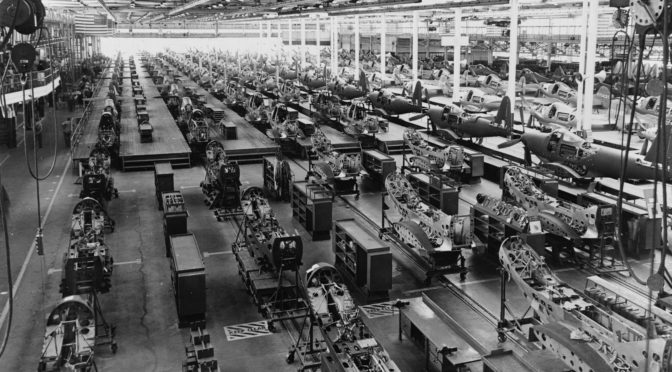
Featured Image: Fighter aircraft under construction at the Bell Aircraft Corporation plant at Wheatfield, New York. (U.S. National Archives)