Category Archives: Current Operations

On-going Naval Ops or Maritime Current Events

The Nature of Sea Control and Sea Denial

Sea Control Topic Week

By Dr. Ching Chang

The Awareness of Maritime Dominance

The desire of sea control comes from awareness of the maritime dominance. Various human societies have created maritime civilizations through their access to maritime activities. Without maritime activities, no human society could have had the opportunity to produce maritime interests. If maritime interests that stem from these maritime activities may fully satisfy all the parties involved then there is naturally no ground for the occurrence of maritime struggle.

Nonetheless, the reality of maritime interest follows the same economic rule that limited production fails to satisfy unlimited demand. The competition for maritime dominance was accompanied by maritime struggles in various forms. Armed campaigns, commercial competitions, and diplomacy are accommodated into the integrated efforts of maritime struggles. The command of the sea is the final concept born from maritime struggles as the general goal for safeguarding maritime interests generated by maritime activities and all the associated dependence.

As for sea control, it is only a part of the concept included by the command of the sea concept since sea control is alternatively parallel with sea denial, another important approach within the command of the sea concept. We may define sea control as acquiring and securing the privilege to utilize the maritime space in the period of time as expected. Nonetheless, whether the adversaries and neutral parties may use the same maritime space at the same time is not necessarily the concern of sea control approach. On the other hand, we may also define sea denial as excluding adversaries from utilizing the maritime space in an expected period of time and place of choosing. Integrating these two aspects of sea control and sea denial together and their effects on the nature of choice can serve as a foundation for maritime operational design for earning command of the sea.

The Nature of Sea Control

What is the objective of sea control? Can the sea itself be controllable? What is the exact essence of sea control? The maritime space is a medium for transportation and communication. Nonetheless, the realization of sea lanes of communication might not be necessarily confined to the maritime space itself but the platforms for transportation in the maritime space.

The sea itself cannot not be explicitly controlled; neither can it be occupied like land. To exercise sea denial is essentially targeting the attempts or aspirations by other parties to exploit sea space. Basically, there are two different schemes, deterrence and compellence, to achieve sea denial. Deterrence is literally to force other parties not to take certain actions they would rather to do originally. On the other hand, compellence is actually to force other parties to take certain actions that they are not willing to do in the beginning.

The goal of sea denial is similar to exercising other forms of power that it may also manipulate others’ decisions and actions. It may adopt a deterrence scheme to discourage others to challenge the privilege of utilizing the maritime space. Otherwise, should the deterrence scheme fail, it may also actively adopt compellence schemes to defend the privilege of using the maritime space within a period of time. The essential element is targeting the decisions and actions of those who attempt to challenge the privilege of utilizing the maritime space, not the specific maritime space itself.

We also need to identify the causal relationship between freedom of navigation and sea control. To safeguard a sea lane of communication is to secure the maritime communication lines at the operational level in order to further support other strategic and operational maneuvers. It is not always necessary to occupy specific maritime space to undermine or destroy maritime communication lines. This is different in nature compared to breaking communication lines or transportation networks on land which are often attained by destroying vital transportation nodes such as tunnels or bridges, or occupying physical space.

However, paralyzing maritime transportation is executed by destroying the maritime platforms directly since it is relatively hard to “occupy” a maritime space unless one has truly uncontested maritime supremacy. The matter is to exercise sea control in order to terminate adversaries’ freedom of navigation, or vice versa, to eliminate adversaries’ freedom of navigation in order to achieve the status of sea control. Sea control and freedom of navigation, or alternatively known as safeguarding the sea lanes of communication, are both the ends and means of the command of the sea concept.

One should always recall that the value of maritime space is justified by its connectivity. To secure a maritime space by excluding the presence of other parties through sea denial but in the process also precluding substantial maritime activities (such as civilian commerce) can quickly become counterproductive. However, to dominate a maritime space of poor connectivity is like to occupy a desert none have interest in. To exercise sea control in a maritime space that an adversary rarely ever attempts to challenge can sometimes suggest the maritime space in question is perhaps not so important to a greater ambition of command of the seas.

There are many misperceptions about sea control. First, the sea control is only a means to secure the privilege of utilizing the maritime space. And subsequently, the major utilization of the maritime space is maritime transportation. We therefore may conclude that the freedom of navigation or the maritime communication lines should be the true purpose of sea control efforts. Second, the maritime space could not be occupied or controlled like land territories, though blockade operations can still be practical in a maritime campaign. Blockade operations are actually exercising a form of sea denial as a function of sea control.

Last but not the least, three major factors, force, space and timing, at the operational level are still interrelated in exercising sea control. The forces necessary for conducting a sea control scheme are decided by the scale of the maritime space and the length of duration expected by utilizing the maritime activities there. Also, the size of the adversaries’ forces to challenge this privilege may also be the variable in the overall sea control formula. The process of sea control is always interactive.

Conclusion: Can There Only Be One?

Human societies may divide land into different spheres of influence and draw borders, but will this become the case in the maritime space in an era of great power competition? The value of maritime activity is derived from its connectivity. Occupying or dominating a maritime space but disconnecting it from other parts of the global oceans is a misuse of power born from the historical experience of landpower applied to the maritime theater.

Dr. Ching Chang was a line officer in the Republic of China Navy for more than thirty years. As a very productive commentator on the Chinese military affairs, he is recognized as a leading expert on the People’s Liberation Army with unique insights on its military thinkings.

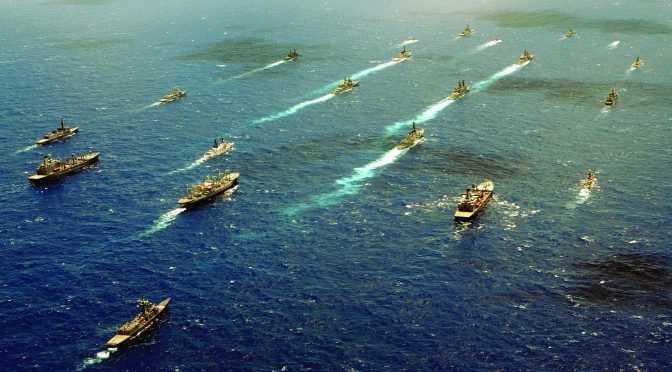
Featured Image: ParticipanxvParticipants from the RIMPAC 2000 exercise establish a flotilla off the coast of Kauai. (Photo via U.S. Military Sealift Command)

Bringing Back Sea Power from the Deckplate on Up

Sea Control Topic Week

By ENS Olivia Morrell

Deckplate Sea Power

Sea Power is of the utmost importance in terms of global control of both economic and geographical regions. Walter Raleigh wrote in the 17th century, “whosoever commands the sea, commands the trade; whosoever commands the trade of the world commands the riches of the world, and consequently the world itself.” The U.S. has remained the leading force at sea, and in recent years has re-affirmed its dedication to command at sea. A Cooperative Strategy for 21st Century Sea Power lists sea control as one of the five essential functions of the Navy. Sea control and sea power are terms written about in no short supply, and that are constantly highlighted by the leaders of our combatant forces. While sea power is by itself a complex issue, the means by which we achieve it are far more intricate.

The most important challenges faced by the U.S. Navy in achieving sea power are not technological, but human. The current strategy laid out by the U.S. on Sea Power is multi-faceted and dynamic, but does little to address the day-to-day challenges of our Sailors. An expectation of being the most elite Navy in the world is impossible to achieve through strategic placement of assets if we can’t properly man and train our assets. When the Navy decided to change the policy on female hair standards, training was completed across the fleet, statements were put out by the Chief of Naval Operations, and questions were addressed by leadership. When incidents at sea occurred during the summer of 2017, ships and shore commands across the fleet took an operational pause to examine safety and training. Why then, is there not a training for Sailors regarding our strategic policies and involvements across the globe?

The strategies of the U.S. Navy are still heavily influenced by the 19th Century writings of men like Alfred Thayer Mahan and Julian S. Corbett. Both men have written extensively on the importance of Sea power, as well as on how to achieve it. While each have distinct opinions, both agree that command of the sea serves national politics, and that it is not enough to merely have control of commercial shipping. Battle, the ability to engage in and respond to threats, must always be the underlying design of a Navy. We must ensure that we not only have the resources and plans to execute such decisive action, but also the human capability and training to do so efficiently. Corbett wrote in Some Principles of Maritime Strategy in 1911, “it is not enough that a leader should have the ability to decide rightly; his subordinates must seize at once the full meaning of his decision and be able to express it with certainty in well-adjusted action.” In other words, it is not enough that our combatant commanders know the central strategy and governing tactics that guide and shape our daily lives, they must also be able to communicate and empower their Sailors to execute.

The Navy is unique to most other branches of the military in that we train in the same environment that we fight in. Our day-to-day job consists of preservation and maintenance of the weapon, vehicle, and berthing in which we will deploy. While most forces train at home to prepare for the environment in which they will fight, we operate every day in the environment from which we will fight. Marines and Soldiers must learn to manage their expectations for engagement as many who joined with the desire to fight on the frontlines may never step foot in a hostile environment. Sailors on the other hand, rarely asked to engage in hand-to-hand combat, will be “in the field” from the moment they pull out of homeport and will remain in a hostile, dangerous environment until their homecoming. Whether operating off the coast of Florida or transiting through the Straits of Malacca, Navy ships are constantly engaged in mission-focused operations. Due to the environment in which we operate, we must remain vigilant and ready to execute combat missions at all times. This need for vigilance has been tragically embodied in the recent collisions at sea of the USS John S. McCain and USS Fitzgerald. The requirement for constant readiness to fight is demonstrated by the 59 Tomahawk missiles that were successfully launched into Syria in 2017, as well as countless other operations Navy vessels are engaging in on a daily basis. Unfortunately, our ability to respond to the order to launch missiles was not met by our ability to safely navigate our vessels. Even more unfortunately, 17 Sailors paid dearly for that imbalance.

Sea power must start at the deckplates. Naval officers and chiefs are taught that deckplate leadership is vital to ensuring that Sailors are taken care of, maintenance is done properly, and ultimately that the mission is accomplished. Deckplate leaders are leaders that are constantly present in the lives of their Sailors, who know what the orders they give actually mean, and who are engaged from the moment an order is given until it is accomplished. This type of leadership must extend beyond the demands of routine maintenance and preservation. We need leaders on the deckplates who know and can adequately represent the strategic objectives of the Navy to the Sailors on whom that mission depends. When Marines are training for a deployment to the Afghanistan, they train in simulated combat environments that help prepare them for the desert heat, as well as the intense atmosphere they will encounter. We must learn to adapt simulation tactics to our needs in the Surface Navy. Sending the bridge watchstanders to a simulator a couple times a year will not suffice. Strategy is at the forefront of Marine Corps training, every Marine knows the impact he or she has on the mission, and the role they play. The strategy of the surface Navy is on such a large scale, that it often is not felt by individual Sailors in the way it can be felt by a Marine practicing tactical team maneuvering or executing room-clearing procedures. The tactics of the surface Navy involve ships as a whole where captains and key watchstanders are sometimes the only people on board who know the role of the ship in the operational theater. Many of those watchstanders do not even understand the role their ship plays in the Navy’s larger strategy for sea power. Clearly communicating that role to every Sailor on board is the only way that we can begin to operate at the elite level which our nation’s strategy requires.

What this means today, is that we need to do a better job at training the whole Sailor and the whole ship. We need to impart on every Sailor and officer the value and importance of their role and ensure every aspect of our mission is met. It is not enough to drive our ships well, nor is it enough to launch missiles with accuracy. Every Sailor on board every ship in our fleet is important, from the ships forward deployed to the ships in the yards, it must be clear what we are working toward. Small tactical mistakes, maintenance deficiencies, and lackluster training must be treated with as much regard as a combat error. The only way to ensure that care is given to the smallest of tasks on board our ships, is to train and emphasize sea power from the deckplates up.

Olivia J. Morrell is from Albuquerque, NM, and graduated with a degree in Oceanography from the Naval Academy in 2017. She is currently a Surface Warfare Officer onboard the USS Cole (DDG-67), in Norfolk, Virginia. These views are presented in a personal capacity.

Featured Image: PHILIPPINE SEA (August 24, 2018) Aviation Electronics Technician 2nd Class William Decker (left), from Pinedale, Arizona, and Aviation Electronics Technician 2nd Class Matthew Thomas, from Port St. Lucie, Florida, assigned to Strike Fighter Squadron (VFA) 195, perform maintenance on the Advanced Targeting Forward Looking Infrared System aboard the Navy’s forward-deployed aircraft carrier, USS Ronald Reagan (CVN 76).  (U.S. Navy photo by Mass Communication Specialist 3rd Class Kyleigh Williams)

Narcosubs: Technological Innovation in the War on Drugs

By Javier Guerrero C.

Last year, the Colombian Navy detected and captured the first electric narco-submarine.1 Demonstrating the innovative capacities of Colombian drug traffickers, narco-submarines, drug subs, narco-semisubmersibles, self-propelled semisubmersibles, or simply narcosubs, are maritime custom-made vessels used principally by Colombian drug traffickers with the purpose of smuggling illicit drugs to consumers or transshipment countries. This year only one of such vessels have been captured, and given their technical characteristics seems a step back in the ‘evolution’ of narcosub technology. Such is the paradox of security and maritime interdiction in the War on Drugs. The very process of thwarting a particular method or route creates the conditions to propel technological innovation on the drug traffickers’ side. The narcosubs are one of many of these innovations.

The term “narcosub” encompasses a diversity of watercraft that includes semisubmersible and fully submersible vessels. Several entries on CIMSEC (here, here, and here) have already delved into the characteristics of the narcosubs and their potential capacities to threaten regional security. In addition, several studies in the security field, such as by Ramirez and Bunker,2 as well as academic articles, have also attempted to provide technical evidence and policy advice. To summarize, narcosubs are characterized by the use of maritime diesel engines, a rudimentary system of refrigeration, no facilities, fiberglass hulls, and a valve which can be activated in case of being captured that allows water to fill the hull and sink the vessel. Narcosubs are not made to last, as smugglers mostly discard such vessels after ending their one-way journey. Smugglers have been using narcosubs from at least as early as 1993, but the majority of captures have been made since 2005. Narcosubs are described by the Navy as vessels that are highly difficult to detect and/or track, due to their lack of emissions, small wake, and low heat signature, preventing visibility all around. 

Despite the centrality of innovation in the War on Drugs, there have been few attempts to understand the process. Given that 90 percent of the cocaine from Andean countries is transported using maritime routes,3 it is necessary to analyze the development of drug trafficker and state agency technologies in the maritime environment. That is to say, the study of the game of cat and mouse between interdiction and evasion.

This binary can be understood as the symbiotic relationship that creates the conditions for innovation, generating a constant arms race between drug traffickers and state agencies. Different versions of the genesis of the narcosubs mill around, from Pablo Escobar’s mastermind idea, boosted by the semi-mythical image of the drug baron with the economic means and savvy to contract specialized naval engineering. According to this
version, Pablo Escobar supposedly conceived the idea of a submarine after watching a James Bond movie. In this story a Russian and an English engineer were hired to design the submarines while Pablo’s brother took took care of the electric circuits.4 A common narrative in describing narcosub building is to assume some form of hierarchical organization, both in terms of decision making and knowledge. That is, the participation of a ‘cartel’ with capabilities to hire ‘expert knowledge’ such as naval engineers who then recruit builders. The diffusion of the technology is also assumed to be the result of transnational organized crime networks. Others suggest that narcosubs are the transfer of military innovation by the guerrilla groups FARC or ELN to their drug trafficking enterprises.5

Innovation in the design and building of these vessels is so commonplace that the adjective ‘first’ is often repeated. The truth about narcosub design and building may be more prosaic. The variety of watercraft labeled under the banner of narcosubs summarizes some of the key features of the innovation and counter-innovation competition in the War on Drugs.

The Evolution of Narcosubs

The narcosubs demonstrate a variable combination of materials, designs, and building. Even narcosubs found in the same shipyard vary in several features. In this sense, each narcosub is a unique way to solve the problem of transporting large amounts of illicit drugs, producing a complex timeline that is problematic to define using traditional innovation concepts, such as incremental or radical innovation, but also to define as the result of pull/push factors. The process of innovation in the War on Drugs can be better described using the concept of dispersed peer innovation,6 in which the design and construction of these vessels, not being bound by standardized procedures, profits from the possibilities of creating their own designs with high degrees of flexibility. In this sense, it is possible to say that what smugglers produced with the narcosubs are different versions of a ‘techno-meme’ that gets combined with the local knowledge of maritime routes and boat building. Those involved in the process of outlaw innovation are able to mix locally available knowledge of traditional boat building with off-the-shelf technologies.

One key issue when studying the evolution of narcosubs and other forms of drug traffickers innovations is how entwined they are with other forms of maritime drug transport. The process of incremental innovation does not necessarily produce a particular method that replaces older strategies. For example, a technical analysis of improvements of the go-fast boats or fishing boats demonstrates that there are few steps between semisubmersible methods and submersible ones. These few steps are provided by the availability of the knowledge to build such vessels within the relatively small areas where narcosubs can operate.

What it Takes to Build a Narcosub

Little is known about the day-to-day decisions on design and modification of such vessels. Official documents say little about the narcosub builders, but a set of documents allows us to take a glimpse at the organization of a narcosub enterprise. These include the Supreme Court of Justice ruling on the extradition of Colombian nationals to the United States in order to be judged by courts in the U.S. for criminal offenses, including narcotics violation, and reports from the law enforcement agencies and military.

Several facts can be derived from the analysis of such documents. Narcosub builders are often independent of the owners of the cocaine. Several opportunistic relationships are undertaken, with drug traffickers either contacting the builders or the builders contacting the drug traffickers. As part of a plea bargain, a narco-submarine builder narrates how as a part of his organization he carried out and presented blueprints of ‘his’ narcosubs, and descriptions of the areas where the vessels could be built and launched. As part of his negotiation with prospective buyers, he shared his past experience of success in the building and operation of these boats.

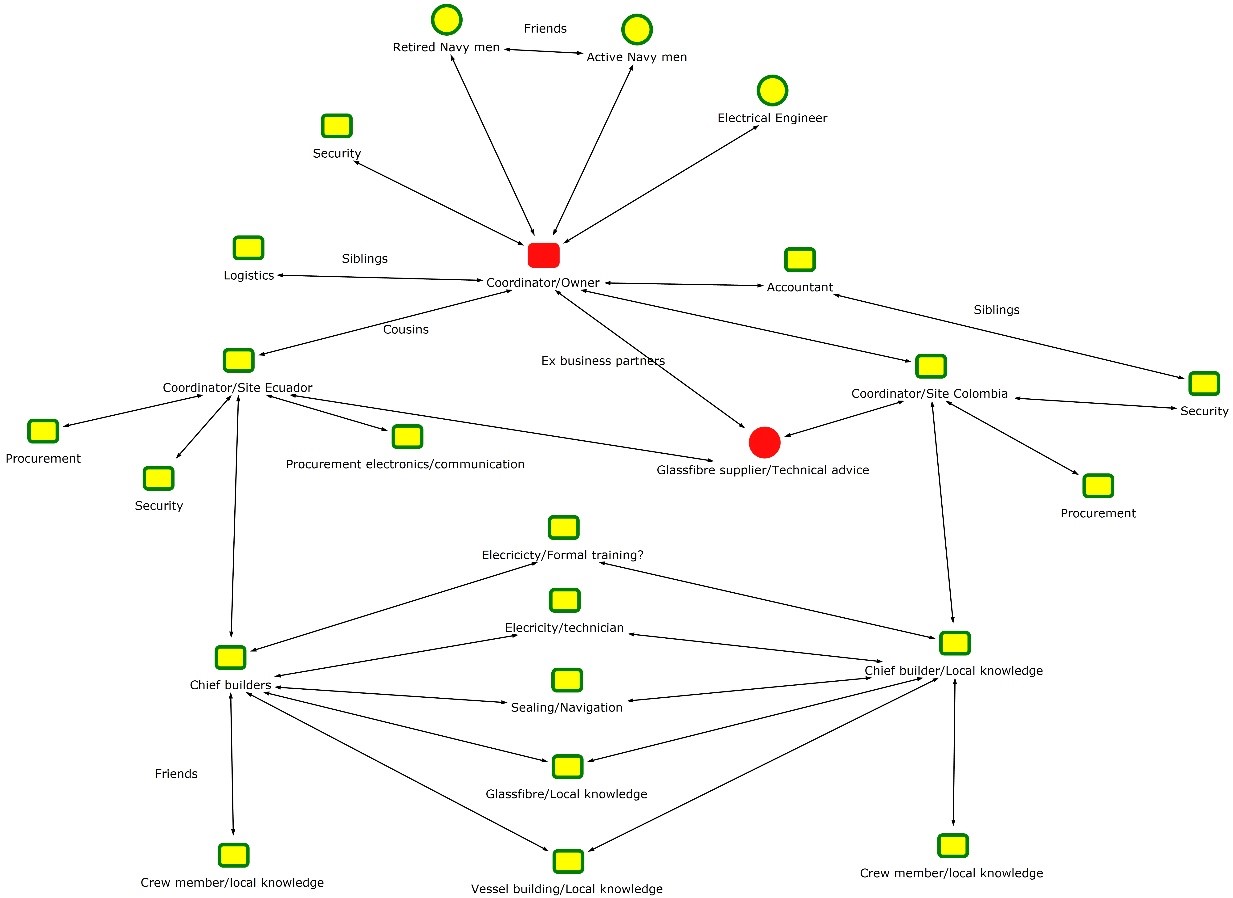
Figure 1: Narcosub Building Team

Figure 1 reconstructs the main links in a narcosub builder organization and shows the multiple forms of knowledge and relationships that can be found in such an organization. While some aspects of the design are carried out by specialists such as electrical and mechanical engineers, others are left to people with local knowledge, such as knowledge about fiberglass handling and coating. In this organization, another individual, the provider of the fiberglass, also plays the role of quality assurance guaranteeing that, in fact, the vessel is correctly waterproofed. Other individuals are in charge of the logistics, such as the purchase and transport of materials and personnel to shipyards. Finally, some individuals are hired as crewmen. They test the vessel and provided feedback to builders.

The organization described in the legal files is interesting because it has two different construction sites; one in Colombia’s South Pacific and one on the Ecuadorian coast. The organization boss was not actually involved in the construction of the narcosubs, but he was the main source of finance. The main builder of the narcosubs is considered a “chief” within the organization. Besides providers of drugs, every shipyard has an administrator accompanied by a chief of security. The description provided does not delve into the process of designing and building narcosubs specifically, but shows the participation of people with formalized knowledge and others in possession of craftwork knowledge, such as the people involved in the woodworking and the fiberglass construction, some of whom worked in both shipyards. The fiberglass work was supervised by another specialist, who provided expert knowledge and supervision at both sites. This person was not part of the organization, but was the provider of the fiberglass. In the same organization, a mechanical engineer was identified, who was in charge of the design and building of the hatches, steering mechanisms, and galvanization of the narcosubs.

The innovation in narcosub technologies is then carried out by a multitude of different groups with little incentive to collaborate among themselves. This gives rise to a wide variation of submersible and semisubmersible designs. Such technical decisions are taken by builders and drug traffickers in a context in which the actions of other groups and their enemy (law enforcement and military) are not always known.7 Narcosub builders are able to configure a complex design using a mix and match approach. Blending off-the-shelf solutions, local traditional knowledge, and technical-formal knowledge produces hybrids such as low-profile narcosubs using truck diesel engines.

Drug smugglers do not just compete with the state, they also compete with other drug rings and other narcosub builders. This complex pattern of competition plays a role that promotes further local innovations. Through trial and error they master the building principles of the narcosub and introduce minor variations into their models. The variation and innovation in narcosub technologies, as well as the interpretation that actors, smugglers, and enforcement agencies make of such innovations, creates changes in a co-evolutionary fashion. In this way, the choices of the illicit actors, competing among themselves and against the state, continuously destabilizes and changes the landscape in which they act, triggering a situation in which multiple players attempt alterations, which create new adaptations.

Conclusion

It has been argued that smugglers often have the capacity to change their strategies and designs after they been detected by law enforcement and the military. Nevertheless, a more complex understanding of the pattern of innovation in the War on Drugs, in which explanations are not given in terms of push/pull between state agencies and drug smugglers, but take into account multiple layers of competition and sources of knowledge, will provide better tools to control the illegal flows. One main consequence of this would be to escape the fallacy of flexibility, in which the explanations of the process innovation in the War on Drugs is given solely based on drug traffickers’ actions.

Javier Guerrero C. is a Lecturer at the Instituto Tecnológico Metropolitano (Medellín, Colombia). In addition, he is a Post-Doctoral researcher at Centro de Estudios de Seguridad y Drogas, Universidad de los Andes (Bogotá, D.C, Colombia). Javier is currently researching the intersections between technology, security and the War on Drugs and the history of technology in the War on Drugs. He may be reached at the following addresses: javierguerrero@itm.edu.co; je.guerreroc@uniandes.edu.co

Endnotes

[1] http://www.dailymail.co.uk/news/article-4739460/Colombian-army-seizes-electrical-drug-narco-submarine.html 

[2] http://scholarship.claremont.edu/cgi/viewcontent.cgi?article=1029&context=cgu_facbooks

[3] http://www.dtic.mil/dtic/tr/fulltext/u2/1016658.pdf

[4]  Escobar, R., & Fisher, D. (2009). The Accountant’s Story Inside the Violent World of Medellin Cartel. New York: Hachette Book Group.

[5] Jacome Jaramillo, Michelle. “The Revolutionary Armed Forces of Colombia (FARC) and the Development of Narco-Submarines.” Journal of Strategic Security 9, no. 1 (2016): : 49-69.
DOI: http://dx.doi.org/10.5038/1944-0472.9.1.1509
Available at: http://scholarcommons.usf.edu/jss/vol9/iss1/6

[6] Hyysalo, S., & Usenyuk, S. (2015). The user dominated technology era: Dynamics of dispersed peer-innovation. Research Policy, 44(3), 560–576. https://doi.org/http://dx.doi.org/10.1016/j.respol.2015.01.002 

[7] http://revistas.flacsoandes.edu.ec/urvio/article/view/2943

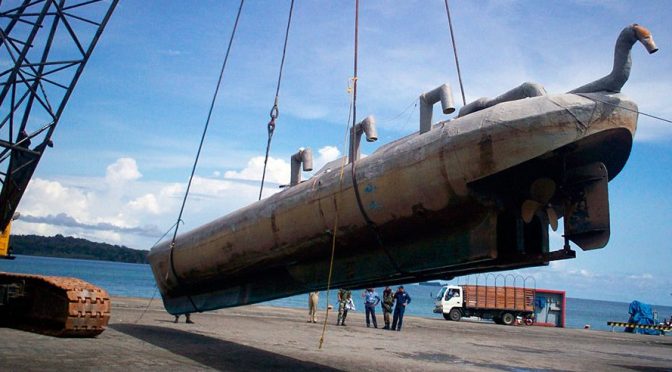
Featured Image: A makeshift submarine is lifted out of the water at Bahía Malaga on the Pacific coast, in 2007. (Colombian Navy/Reuters)

Lost In The Fog: Putting Warfighting Proficiency First in SWO Culture

By Themistocles

Current commentators consider the combination of collisions, groundings, and senior reviews of 2017 to be a watershed event for the Surface Warfare community. Rather than a wakeup call for the community, 2017 should be viewed as a culminating point for the Surface Warfare community overall and the Surface Warfare Officer (SWO) culture in particular. Just as Napoleon’s policy objectives failed to bring Europe under his rule, despite brilliant military victories,1 many post-Cold War policy decisions for the Surface Warfare community, as admitted by past and current leadership, were misinformed. In some cases, they appear to have done more harm than good to the Surface Warfare community. More importantly, those changes in policy drove changes in the SWO culture. And, while many people debate the merits of some of those earlier policy decisions, the debate is lost in the fog and the SWO community is missing the real opportunity to reclaim its warfighting excellence by recreating the culture which led to victories within the last century in the same waters in which sailors died in 2017.

By identifying the warfighting traits the community believes necessary to lead, fight, and win at sea, by developing a modern approach to promotions and assignment processes, and by leveraging readily available techniques and solutions in use by leading industrial sectors,2 the SWO community can return to a culture built on warfighting competence and professional proficiency – excellence – that it once exemplified as it stood as the premier community in the Navy. This is no small task. But it is readily doable and doable in short order.

Leveraging Modern Techniques And Solutions To Restore SWO Warfighting Excellence

The national and global competition for talent in business, industry, and academia has driven the development of a variety of techniques and solutions to help organizations win the competition. Current techniques and solutions include compliance with federal and state job application laws, tailored machine reading, and the ability to develop specific questions or processes in an effort to find the right talent. Applicants build their profile and post or submit their resume. Depending on the traits the customer is looking for, applicants are screened. If their profile and resume are assessed to not meet the desired factors, applicants are notified by email that they are no longer needed to participate in the screening process. Or, if they score high enough, applicants may be required to participate in another level of screening in the form of a battery of questions or other online exercises – all before a single human has reviewed their submission. Of course, articles abound about how inhuman and unfair the process has become. However, more and more talent is migrating to these online processes to find employment and more and more organizations are paying for these services in order to win the competition for talent. These existing techniques and solutions could be applied to improve and align warfighting skill sets and proficiency for the SWO community.

Developing the Warfighting Trait Model

For starters, past naval heroes were not rated by the same processes used today. However, unstructured data in the form of biographies, articles, battle reports, and other sources can be processed using current cognitive processing methods to glean or extract a set of character traits common to those past naval heroes deemed to have exhibited warfighting excellence. In parallel, a cadre of junior officers, with very few select retired flag officers as advisors, can separately develop a set of warfighting traits.3 It is essential that the ideal of warfighting excellence is captured by this group. Once both sets of warfighting traits are generated, they are then synthesized into a single warfighting trait model that would exemplify an individual with premier warfighting excellence. With the ideal trait model in hand, the Surface Warfare community can then embark on “scoring” individual warfighting proficiency reflective of its officers’ performance.

Scoring Individual Warfighting Capability

Returning to warfighting excellence to reinvigorate and restore the SWO culture may necessitate a reconsideration of not only the factors by which warfighting excellence is determined but also an expansion of the data set from which those factors are pulled. The existing performance evaluation system and its fitness reports, and how they are used, do not meet the need and do not drive warfighting excellence. Fitness reports serve a purpose and can continue to serve as one source of data for an officer’s performance. However, there are a myriad of unique and high performing skills demonstrated daily in the fleet. Yet, the proficiency with which those skills are performed is not assessed or recorded. Reportedly, every landing onboard an aircraft carrier is an opportunity to rigorously and objectively score the pilot’s performance, and provide critical feedback in the performance of this critical warfighting skill. The Surface Warfare community should immediately adopt an approach similar to that used by Naval Aviation.

For example, the shiphandling skills necessary to get a ship underway may be observed or scored during the Basic Phase or periodically in a simulator, but there are dozens more special details which are not required to be scored. Similarly, ships routinely go alongside for underway replenishment, but this opportunity is lost for assessing shiphandling proficiency.

In a healthy command, the plan-brief-execute-debrief (PBED) process is alive and well, but scoring against community-wide professional standards does not exist. Establishing such standards and scoring an officer’s performance to those standards would contribute to establishing officer’s warfighting capability and proficiency scores. Table 1 lists some of the means to establish an officer’s warfighting scores.
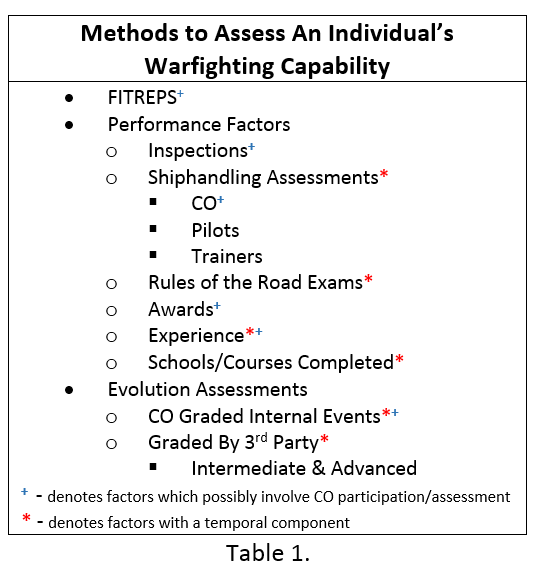
Some aspects of the warfighting scores would necessarily have a temporal component as proficiency degrades over time, especially time spent away from the waterfront. For example, an Executive Officer (XO) who last took a ship alongside for replenishment at sea four years ago would (and should) have their warfighting capability score appropriately degraded. All things being equal, the XO who went alongside yesterday is likely to be much more proficient at that skill than the XO who went alongside four years ago.

Consider other Navy communities such as Explosive Ordnance Disposal (EOD), Divers, and Aviators. They all have skills that have an “expiration date.” In order to maintain proficiency and prevent triggering a requalification requirement, the skill must be demonstrated at some objectively established periodicity. While the periodicity can be lengthened such that the importance of the qualification is diminished, it must be a consistent standard to restore the warfighting excellence of the SWO community. If maintaining proficiency in basic shiphandling evolutions really is important to the SWO profession and culture, then SWOs will necessarily spend some of their shore duty in shiphandling simulators for their periodic assessments and community leadership will resource the requirement. Going to the Joint Staff for a 22-month tour will not be an excuse for not maintaining proficiency in warfighting skills.

Also listed in Table 1 are those methods that are available to and fully within the purview of a ship’s Commanding Officer (CO). This should help alleviate any concern the community might have on eroding the CO’s ability to lead or develop their wardrooms. While most of the methods are self-explanatory, it should be noted that the scores achieved during the Basic Phase are absent. Fundamentally, the Basic Phase is a training event. As such, introducing those scores into an officer’s warfighting capability score could diminish the training opportunity. In other words, activities that are primarily for training must be treated as such allowing mistakes to be made and learning to occur without concern about an officer’s warfighting capability score. Additionally, a CO’s assessment averages, just as with fitness reports, would need to be tracked as a forcing function to prevent inflating scores.

As an officer approaches a career milestone, such as a selection board or a slate, their warfighting capability score firms up and is then compared to the warfighting trait model. It is this comparison that determines their ranking within their respective cohort. For a selection board, this rank determines whether or not they are selected. Gone are the days where careers are determined by a system which is “as fair and unfair to everyone equally.” A bad briefer will not send the community’s best to “the crunch.” The Board members will know the warfighting trait model and they will be able to see the officer’s score against that model. They will see the score trends over a specific assignment and throughout the officer’s career. This way, warfighting competence and professional proficiency become the primary determinants for selection and assignment.

While most of the discussion has been focused on the determination of an individual’s warfighting capability score and proficiency, similar approaches can be used to assess shipboard teams and the ship as a whole fighting unit.

Slating For Unit Warfighting Excellence

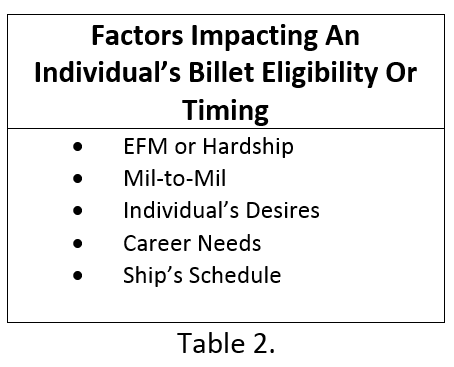
Another benefit of knowing an individual’s warfighting capability score is developing slates which better support the fleet’s warfighting readiness needs by ensuring a ship’s overall warfighting capability score remains above a minimum level through slating officers to that ship using their warfighting capability scores.4 Consider that when a group of individuals come into their slating window, their warfighting capability score is again determined. The group is then ranked and divided into top, middle, and bottom thirds (or quarters). For example, a prospective Department Head who ranks in the top quarter will get slated to a ship where the current Wardroom’s overall warfighting capability score indicates they could use some talent. Of course, there is risk that an officers’ duty preferences will not align with the fleet’s needs, but that issue exists today and will continue to require the same quality engagement by community leaders. Detailers will still need to understand factors listed in Table 2. While Table 2’s factors are important to an officer’s quality of service, they are not factors for determining warfighting excellence. By grouping a slate by quarters or thirds, flexibility is created which allows accommodating factors in Table 2. But, the entering argument for the entire officer slating process is warfighting capability and professional proficiency.
The existence of a strong, objective warfighting excellence scoring system would allow the Surface Warfare community to manage warfighting capability within individual ships and across the fleet. It will provide a means by which the performance of individual ships and the fleet can be improved.

Things to Guard Against

The process of driving the SWO culture back to warfighting excellence and professional proficiency will be challenging and there are those who will fight the change tooth-and-nail. Senior officers will see this as an attack on “their Navy.” Detailers will see this as a challenge to their primary activities. Senior mentors and advocates will see this as an affront to their mentoring and their confederation of mentees. Some will see this approach as a challenge to various support organizations external to DON, such as the Surface Navy Association. Many will immediately start looking for ways to game or manipulate the system, eroding its effectiveness. These things must be anticipated and guarded against as a new process that attempts to change culture will have to face friction posed by existing culture.

Conclusion

If SWO warfighting excellence is the reason that the Surface Warfare Community exists, and if warfighting competence and professional proficiency is the critical need for the current and future maritime warfighting environment, the SWOs must rise to the challenge. By leveraging modern techniques and solutions to develop an objective and rigorous system of assessing warfighting capability for SWOs throughout their career, and by using the warfighting capability scores to make warfighting competence and professional proficiency the centerpiece of promotion and assignment, the SWO community will realize its greatest potential and return to a level of professionalism not seen since the end of World War II.

Themistocles is a pseudonym whose choice is intentional in order to focus on the subject of the article rather than the author. There is also the parallel in the choice of Themistocles that, while some of the ideas presented may not be popular with the establishment, the discussion and discourse prompted by these ideas may again assist in establishing the preeminence of the naval power of the world’s greatest democracy. Statements and opinions expressed in this article represent personal views and not that of the DoD or DoN.

Bibliography

Weldman, Thomas. War, Clausewitz and the Trinity. New York:  Routledge, 2013.

[1] Weldman, War, Clausewitz and the Trinity, 79.

[2] While there is a vibrant debate about what is and what is not ‘artificial intelligence’, ‘machine learning’, and other relatively new terms, this paper focuses on the fact that there are modern techniques and solutions available rather than attempting to define terms which are new, changing and not yet agreed upon by the wealth of experts debating them.

[3] The involvement of and control by current flag and senior naval officers in articulating this set of warfighting traits must be purposefully limited so that an independently developed set of traits can be achieved. The concern is that traits which may have contributed to the current culture will be captured inadvertently. Additionally, the flag officer advisors’ role is to guide the junior officers and constructively challenge their ideas to strengthen their product. The flag officer advisors to have no veto over or approval authority regarding the junior officers’ results.

[4] A unit’s overall warfighting excellence score has further implications in how and when they are employed by operational commanders. However, those possibilities are not discussed here in order to keep the discussion focused on improving the SWO culture.

Featured Image: Pacific Ocean (April 21, 2018) USS Stockdale (DDG 106) fires its Mark 45 Mod 4 5-inch gun during a live fire exercise as part of a Cruiser-Destroyer (CRUDES) Surface Warfare Advanced Tactical Training (SWATT) exercise. (U.S. Navy photo by Mass Communication Specialist 2nd Class Amanda A. Hayes/released)