Category Archives: Current Operations

On-going Naval Ops or Maritime Current Events

Enabling More Effective Naval Integration into Humanitarian Responses

Naval HA/DR Topic Week

By David Polatty

Last week, the U.S. Naval War College hosted the annual EMC Chair Symposium, with this year’s offering bringing in experts from around the world to discuss maritime strategy. Vice Admiral Charles Michel, Vice Commandant of the U.S. Coast Guard, kicked off the event by engaging in an energizing discussion on the missions and functions of the U.S. sea services, with a special focus on current and future U.S. Coast Guard capabilities and activities. Understandably, he spent much of his time examining the traditional security, presence, and safety aspects of maritime operations. He also provided insight into the unique ways that the Coast Guard complements forward deployed U.S. Naval forces. As a key component of this forward deployment and naval presence dialogue, he reminded participants that humanitarian assistance and disaster relief (HA/DR) remains a core mission for militaries. 

Participants spent the better part of the two-day event discussing challenges and opportunities facing the U.S. sea services. We had spirited dialogue on a broad range of warfighting issues viewed through the lens of maritime strategy. Prior to the last panel of the symposium, a HA/DR “urban humanitarian response” discussion, I was struck by the manner in which many attendees translated an overarching fear of Chinese and Russian aggression to pivot away from the non-warfighting roles that militaries fill. As my colleague and symposium chair, Dr. Derek Reveron has both written and said time and again, “navies do much more than fight wars.”1

We are at a critical point in history from a humanitarian perspective, with over 60 million people displaced across the globe – more than at any time since World War II. The United Nations (UN) and the humanitarian community are currently responding to four “L3 Emergencies” in Iraq, South Sudan, Syria, and Yemen.  This designation reflects the global humanitarian system’s classification for a response to the most serious, large-scale humanitarian crises.2 A quick scan of the news reveals many other areas of the world where vulnerable populations face monumental challenges.  While climate change impact predictions diverge greatly depending on the source, the UN Refugee Agency (UNHCR) estimates that between 250 million and one billion people across the globe will become displaced from their region or country in the next 50 years.3 As significant, heartbreaking, and perilous as the current migration crisis in the Mediterranean Sea is, it pales in comparison to what the world may face in the near future if even the low end of climate change projections prove to be true.
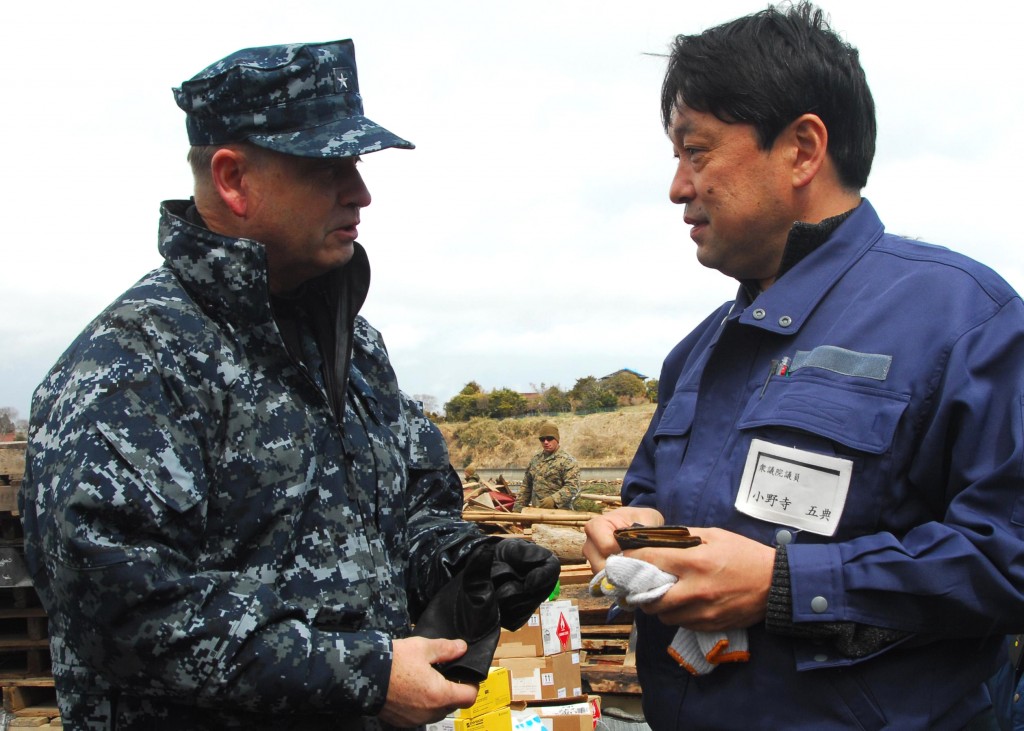
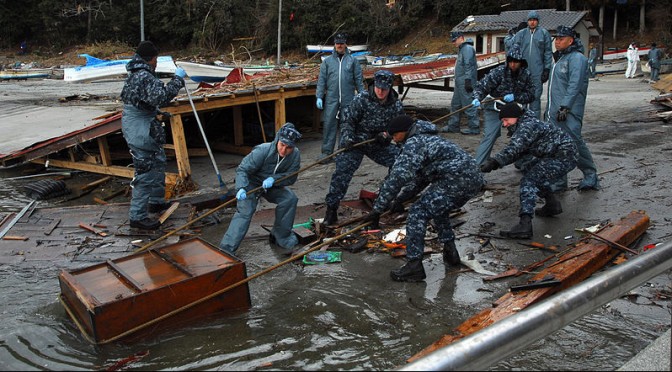
Rear Adm. Jeffrey S. Jones, director of Coalition Naval Advisory and Training Team, speaks with a resident of Oshima, to discuss the progress of disaster relief operations. Marines and sailors assigned to the 31st Marine Expeditionary Unit are on Oshima Island to help clear a harbor and assist with cleaning debris from roads and a local school in support of Operation Tomodachi.Petty Officer 3rd Class Eva Mari.

The U.S. Navy and Marine Corps team spends much of its operational life training and exercising for war. We buy and maintain warships, combat aircraft, attack submarines, and amphibious capabilities that enable us to fight and win decisively. Many of these capabilities also provide critical life-saving support during natural disasters and complex emergencies. Because of the forward deployed nature of our naval forces, versatile multi-mission platforms, and ability to operate from the sea with minimal sustained footprint ashore, we are optimally positioned to conduct HA/DR operations. One area that the sea services need to spend additional time focusing on is the understanding of how military HA/DR missions can better integrate into civilian humanitarian responses. We must increase our education, training, and simulation opportunities in HA/DR to become more proficient when asked to respond.

The 2014 Quadrennial Defense Review ranked HA/DR #12 of 12 military missions, with respect to how the Secretary of Defense and Joint Staff plan to distribute forces to U.S. Combatant Commanders.4 Despite being the lowest priority, history has proven that our military will respond to save lives and alleviate human suffering when called upon to do so. A 2003 study by the Center for Naval Analyses found that from 1970 to 2000, U.S. military forces were diverted from normal operations 366 times for HA/DR operations, while only 22 times for combat.5 While these numbers do not reflect the duration of each operation, they still provide a telling story about the frequency in which our military has responded to natural disasters and humanitarian crises.
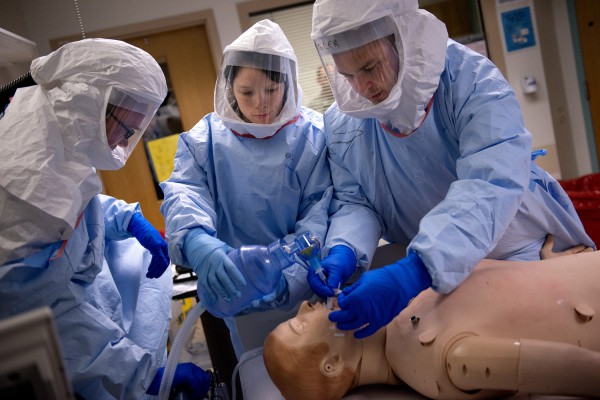
U.S. Navy Cmdr. (Dr.) Ryan Maves, Lt. Sarah Bush and Lt. j.g. Braden Spangler perform medical procedures on a simulated Ebola patient during a week-long rapid response training course. Maves, Bush and Spangler are part of a military medical response team that can rapidly respond and assist civilian medical personnel in the event of an Ebola outbreak in the United States. (U.S. Air Force photo/Master Sgt. Jeffrey Allen)

To highlight what many argue is a systemic lack of understanding within the U.S. military on the current state of the international humanitarian system and how it functions, below is a “pop quiz” for CIMSEC readers. These are ten of the most important questions (and yes, there are many more…) that military personnel must understand in order to quickly and successfully integrate military capabilities into civilian humanitarian responses. (Note: answers are at bottom of the article for inquiring minds who want to know.)

  • What are the four fundamental humanitarian principles and why are they so important? 
  • What is a humanitarian actor? 
  • What is the lead federal agency in the U.S. government for disaster response overseas and what relationship do they have with the U.S. military? 
  • What international organization brings together humanitarian actors to ensure a coherent response to emergencies? Within this organization, who is responsible for facilitating civilian-military coordination, and what are the range of potential strategies for effective coordination? 
  • What is the “Cluster System”? 
  • What are the “Sphere Standards”? 
  • What are the “Oslo Guidelines”? 
  • What is a “MITAM”? 
  • What key information systems do humanitarian actors utilize to communicate? 
  • What are the key military capabilities that are routinely needed to augment the humanitarian community’s response to large-scale disasters?

After you write your answers down, please scroll to the bottom to see how you fared. There is no grading scale, because I suspect most of you, like the majority of the students who come through Newport, will quickly agree that we all have a lot to learn to be able to work effectively in the humanitarian space. It is in this intricate environment where civilian organizations operate 24 hours a day, 7 days a week, 365 days a year, to help vulnerable populations around the world – through both sustained developmental efforts as well as disaster relief activities.

If you struggled with this academic exercise, or have taken part in the chaos that is a HA/DR operation and appreciate how different this mission set is from traditional naval operations, then you may agree in principle at least, with the following recommendations for improving our abilities in this area. 

The U.S. Sea Services should make small changes within their education and training efforts to ensure that our personnel have a baseline understanding of foundational issues in civilian-military humanitarian response. While the UN, U.S. Agency for International Development (USAID), and U.S. Pacific Command’s Center for Excellence in Disaster Management all provide excellent training in this area, collectively they reach a relatively small audience. Generally speaking, our war colleges have minimal elements within their curricula that allow students to comprehend the most crucial civilian-military humanitarian issues.  Very few HA/DR exercises and simulations are run on a regular basis, with one exception being the earthquake scenario within U.S. Pacific Command’s ‘Rim of the Pacific’ (RIMPAC) biannual exercise. RIMPAC brings together international militaries, humanitarian actors, and academics in a dynamic environment to simulate a complex response and learn from one another. Combining smaller “mini-exercises” for HA/DR within larger warfighting exercises, when appropriate, makes sense from both a fiscal and preparedness perspective.
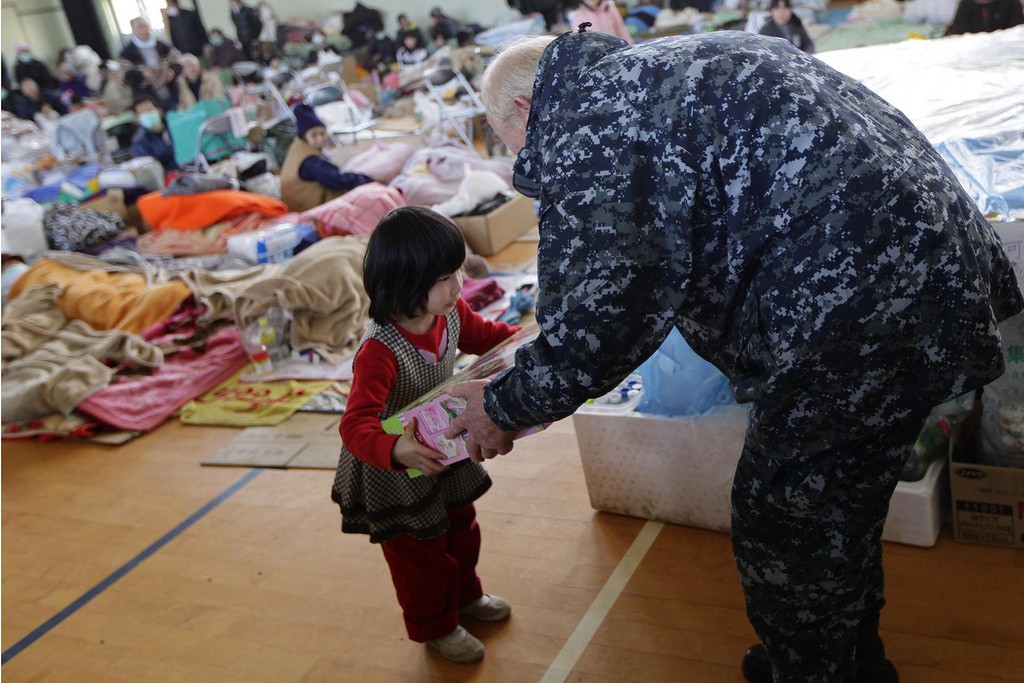
Navy Adm. Robert F. Willard, commander of U.S. Pacific Command, gives a toy to a child while touring a shelter facility in Ishinomaki city, Miyagi Prefecture, Japan, March 23. Willard and John V. Roos, U.S. ambassador to Japan, assisted in the delivery of relief supplies to displaced citizens. Since March 12, Marines and sailors have delivered food, fuel, water and supplies to disaster-stricken areas near Sendai as part of Operation Tomodachi. (Photo by: Lance Cpl. Steve Acuff)
Navy Adm. Robert F. Willard, commander of U.S. Pacific Command, gives a toy to a child while touring a shelter facility in Ishinomaki city, Miyagi Prefecture, Japan, March 23, 2011. (Photo by: Lance Cpl. Steve Acuff)

The Naval War College recognizes the importance of HA/DR education, and thanks to a formal partnership with the Harvard Humanitarian Initiative, is collaborating closely with the UN’s Civil-Military Coordination Section, as well as several other universities, including Stanford, Yale, and Oxford. Our Civilian-Military Humanitarian Response Program aims to advance civilian-military engagement and coordination during complex emergencies and natural disasters, and improve the U.S. Navy’s effectiveness in conducting HA/DR operations. These collaborations have already informed curriculum, especially in our specialized planning courses that target operational (navy component and numbered fleet) and tactical (expeditionary strike group) staffs who will likely plan and execute HA/DR operations. We are working to develop new courses and simulations that will bring military and humanitarian personnel together in the classroom and during exercises. These partnership activities will help the humanitarian community create innovative frameworks for improving disaster coordination.

The U.S. Sea Services must, and will, spend the majority of their operational lives thinking about warfighting and maritime security. Current education and training systems ensure we retain our competitive advantage over future threats. However, minor investments in HA/DR education and training will help improve the predictability, effectiveness, efficiency, and coherence in deploying and employing military assets in support of humanitarian responses. This will allow us to build greater trust and confidence between humanitarian actors and military personnel, and ultimately improve our ability to respond during future natural disasters and complex emergencies.

Pop Quiz Answer Key

  • What are the four fundamental humanitarian principles and why are they so important?
    • Humanity, Neutrality, Impartiality, and Operational Independence.
    • “These principles provide the foundations for humanitarian action. They are central to establishing and maintaining access to affected people, whether in a natural disaster or a complex emergency, such as armed conflict. Promoting and ensuring compliance with the principles are essential elements of effective humanitarian coordination.”6 Militaries must have an appreciation for the principles so they can better understand the humanitarian system they are integrating into and minimize potential disruptions and negative effects in the humanitarian space.
  • What is a humanitarian actor?
    • Humanitarian actors are civilians, whether national or international, UN or non-UN, governmental or non-governmental, which have a commitment to humanitarian principles and are engaged in humanitarian activities. Military actors are NOT considered humanitarian actors.  “Even if they fulfill or support humanitarian tasks, the military is a tool of the foreign policy of a Government, and as such is not perceived as neutral or impartial. The separation of humanitarian and political or military objectives is not given or at least unclear – and military units are certainly not primarily perceived as humanitarians by the civilian population.”7
  • What international organization brings together humanitarian actors to ensure a coherent response to emergencies? Within this organization, who is responsible for facilitating civilian-military coordination, and what are the range of potential strategies for effective coordination?
    • United Nations Office for the Coordination of Humanitarian Affairs (UN OCHA). UN OCHA’s Civil-Military Coordination (CM-Coord) Section has been designated the focal point in the UN system for humanitarian civil-military coordination. It supports relevant field and headquarters-level activities through the development of institutional strategies to enhance the capacity and preparedness of national and international partners.  CM-Coord is “The essential dialogue and interaction between civilian and military actors in humanitarian emergencies that is necessary to protect and promote humanitarian principles, avoid competition, minimize inconsistency, and when appropriate, pursue common goals. Basic strategies range from coexistence to cooperation. Coordination is a shared responsibility facilitated by liaison and common training.”8
  • What is the “Cluster System”?
    • This is UN OCHA’s system for managing a response. “Clusters are groups of humanitarian organizations (UN and non-UN) working in the main sectors of humanitarian action, e.g. shelter and health. They are created when clear humanitarian needs exist within a sector, when there are numerous actors within sectors and when national authorities need coordination support. Clusters provide a clear point of contact and are accountable for adequate and appropriate humanitarian assistance. Clusters create partnerships between international humanitarian actors, national and local authorities, and civil society.”9
  • What are the “Sphere Standards”?
    • “The Sphere Handbook puts the right of disaster-affected populations to life with dignity, and to protection and assistance at the centre of humanitarian action. It promotes the active participation of affected populations as well as of local and national authorities, and is used to negotiate humanitarian space and resources with authorities in disaster-preparedness work. The minimum standards cover four primary life-saving areas of humanitarian aid: water supply, sanitation and hygiene promotion; food security and nutrition; shelter, settlement and non-food items; and health action.”10
  • What are the “Oslo Guidelines”?
    • These are UN OCHA guidelines for improving the effectiveness of foreign military and civil defense assets in international disaster relief operations.11 While not binding, they often frame how international militaries will interact with humanitarian organizations during actual responses.
  • What is a “MITAM”?
    • USAID OFDA often employs a “Mission Tasking Matrix” to request specific support requirements from the U.S. military. This is currently in the form of an excel spreadsheet and prioritizes requests for military support.12
  • What are the key military capabilities that are routinely needed to augment the humanitarian community’s response to large-scale disasters?
    • Airlift (both rotary wing and fixed wing)
    • Air traffic control
    • Communications
    • Engineering and construction
    • Intelligence, surveillance, and reconnaissance
    • Logistics and supply
    • Medical
    • Operational planning expertise
    • Relief supplies including water production and utilities
    • Sealift (depending on the geography of the affected nation)
    • Search and rescue
    • Security (with caveats)

David Polatty is a civilian professor at the U.S. Naval War College, where he teaches strategic and operational planning and leads the College of Operational & Strategic Leadership’s new “Civilian-Military Humanitarian Response Program.”  He is also a Captain in the Navy Reserve and currently commands NR U.S. European Command J3.  The views and opinions in this article are his own and do not represent the views or position of the U.S. Naval War College, U.S. Navy, or Department of Defense.

1 http://www.navy.mil/submit/display.asp?story_id=93802

2 http://www.unocha.org/where-we-work/emergencies

3 http://www.worldbank.org/en/news/feature/2014/10/14/cambio-climatico-mas-desplazados-que-un-conflicto-armado

4 http://archive.defense.gov/pubs/2014_Quadrennial_Defense_Review.pdf

5 http://www.people.fas.harvard.edu/~gorenbur/all%20responses.pdf

6 https://docs.unocha.org/sites/dms/Documents/OOM-humanitarianprinciples_eng_June12.pdf

7 https://docs.unocha.org/sites/dms/Documents/UN%20OCHA%20Guide%20for%20the%20Military%20v%201.0.pdf

8 https://docs.unocha.org/sites/dms/Documents/v.2.%20website%20overview%20tab%20link%201%20United%20Nations%20Humanitarian%20Civil-Military%20coordination%20(UN-CMCoord).pdf

9 http://www.unocha.org/what-we-do/coordination-tools/cluster-coordination

10 http://www.sphereproject.org/handbook/

11 https://docs.unocha.org/sites/dms/Documents/Oslo%20Guidelines%20ENGLISH%20(November%202007).pdf

12 https://www.usnwc.edu/mocwarfighter/Link.aspx?=/Images/Articles/Issue1/MITAM_Example_(MOC_Warfighter).xls
Applying Interagency Concepts from Domestic Disaster Response to Foreign HA/DR

Naval HA/DR Topic Week

By Robert C. Rasmussen

A Warm Sunny Day

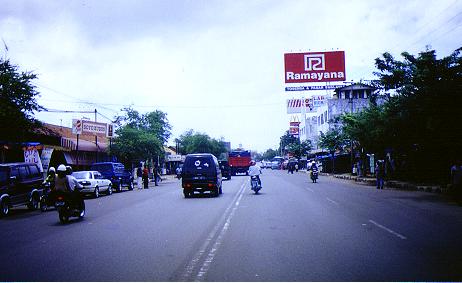
It is a warm and sunny October evening in Cilegon, Indonesia. As the city of 416,000 moves through its afternoon rush, a strong shake is felt.  It stops after two minutes, and then a loud explosion is heard coming from the west, with a large mushroom cloud enveloping the sky. Traffic on National Highway 3 is at a standstill.  People are getting out of their cars trying to determine what has just happened. Some of them, realizing that the explosion has come from the Sunda Strait, abandon their vehicles, and start running south up a hill, as a thirty meter tsunami appears on the horizon heading towards the coast. Those who survive the tsunami are then enveloped in a cloud of burning ash.

1
Cilegon, Indonesia. Source: City of Cilegon

Several hours later, local authorities are helpless, and the Indonesian military is completely overwhelmed.  Reinforcements are being flown in from other parts of the country. The low-lying areas of Cilegon are completely destroyed, along with more than 1,500 towns and villages in both Banten and Lampung Provinces. At least five million people are estimated to be dead. The Prime Minister accepts an offer of aid from the Ambassador of the United States. At this point, the close to ten million more people who survived the disaster lack access to food, clean water, or housing.  Furthermore, weather reports are showing that the first storm of the monsoon season will reach the affected area within the next 72 hours. Meanwhile, an Amphibious Ready Group transiting the Malacca Straits receives orders to sail to Cilegon. Its orders also indicate that the ARG Commander is to assume command of the Joint Task Force being formed from U.S. military personnel.

litho
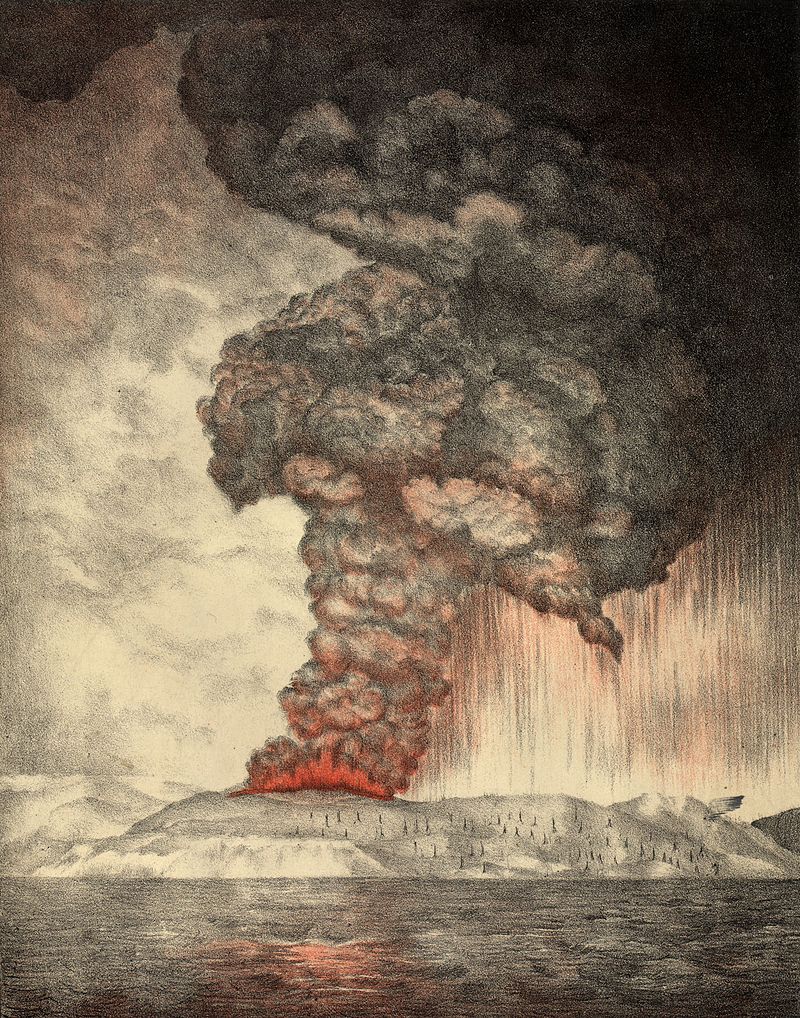
1888 Lithograph of 1883 Eruption of Krakatoa: Parker & Coward. Source: Wikipedia.

This disaster has happened before. The last major explosion of Krakatoa, a volcanic island situated in the Sunda Strait, occurred in 1883, causing a pyroclastic flow with a 50 km radius, and sent a thirty meter high tsunami across the Sunda Strait in all directions. The noise of the explosion was heard as far away as Alice Springs, Australia, and Mauritius.  Skeletons found laying on pumice were found washing ashore in East Africa for several years afterwards. The official death toll was around thirty-six thousand. The area around Krakatoa has a significantly higher population today, and major eruptions of the mountain have been recorded as occurring between every 100-250 years.1 It is not uncommon for disasters of a large magnitude to be followed by a subsequent event that exacerbate the conditions for survival, such as monsoon events, like Winter Storm Athena that followed a month after Hurricane Sandy.2

Introduction

In the scenario described above it is very likely that the assistance of the United States will be requested by the host nation, and it is very likely that in an archipelagic nation, such as Indonesia, naval forces will be the first to arrive. It is also distinctly possible that a Naval or Marine officer will be appointed as Joint Task Force Commander. The doctrine on how to respond to disasters or provide humanitarian assistance depends on where a Joint Task Force is responding and whether or not it is inside or outside the United States. 

For Domestic Disaster Response/Humanitarian Assistance missions there is a set framework in the form of the Incident Command System (ICS), the National Incident Management System (NIMS), Multiagency Coordination System (MACS), and National Response Framework (NRF). These include a common operating language and procedures that allow for integration of responding agencies and unity of effort.3 The major proponent of doctrine for domestic response within the Department of Defense is U.S. Northern Command.4 The military forces that most commonly exercise these missions are within state military forces such as the Army & Air National Guard, as well as State Defense Forces5 and Naval Militias in those states that have such organizations.6

When it comes to Foreign Disaster Response and Humanitarian Assistance, there is no common operating language, procedures, and organizational structures.  Instead, the doctrine that is put forward for foreign response displays the common organizational structures needed for integration – namely where a commander should deploy Liaison Officers. However, this doctrine does not integrate common operating language and procedures to better facilitate the mission. Meanwhile, other agencies of the Federal Government, especially U.S. Agency for International Development’s Office of Foreign Disaster Assistance, not only utilize ICS and MACS in their response doctrine, but teach that doctrine to host nation response forces.7

Current Doctrine on Defense Support to Civil Authorities

During a domestic disaster response/humanitarian assistance operation, utilized doctrine focuses on Defense Support to Civil Authorities (DSCA) that is largely controlled by U.S. Northern Command (NORTHCOM).  The design of the DSCA mission is largely built around supporting the United States’ federalist system. The most important laws relating to this doctrine are the Stafford Act of 1988, the Insurrection Act of 1807, and the Posse Comitatus Act of 1869. 

The concept here is that all disasters are local disasters first. Under the Stafford Act and other supporting state legislation, when local governments are responding to a disaster and their resources become overwhelmed, they must first request assistance from surrounding counties under Emergency Mutual Assistance Compacts (EMAC).  If those resources become overwhelmed, a County Executive may request the Governor to declare a State of Emergency, which then allows the Governor to allocate funding and deploy resources to support the affected area. In turn, if a state’s resources become overwhelmed, then the Governor will request EMAC resources from other states. If those resources become overwhelmed, a Governor may request the President to declare a Federal State of Emergency, which allows federal resources to be allocated to the response. During a State of Emergency declared by a Governor, State Military Forces may be utilized in the response – during a Federal State of Emergency, National Guard forces operating under Title 32 USC (Militia of the United States) orders may be utilized.8

3
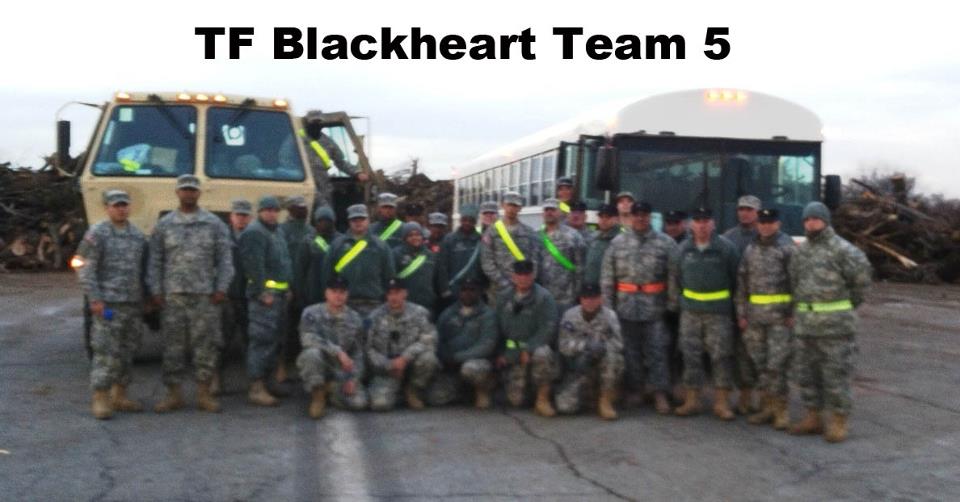
TF Blackheart Team 5 (Joint NY ARNG/NY State Guard Platoon) at the end of Operation Hurricane Sandy Phase IV, 16 December 2012). Photo taken at FOB Floyd (Floyd Bennett Field, Brooklyn, NY), Source: Author.

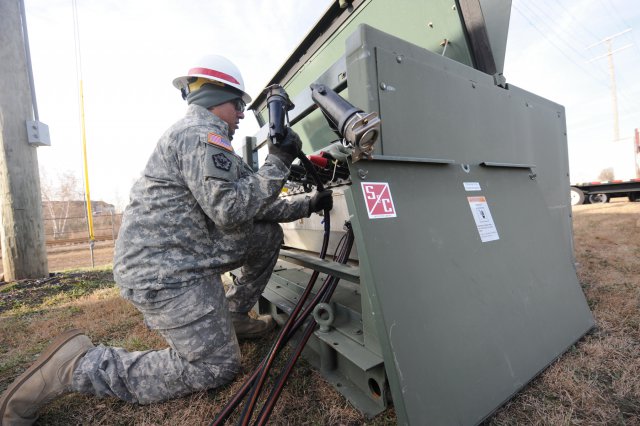
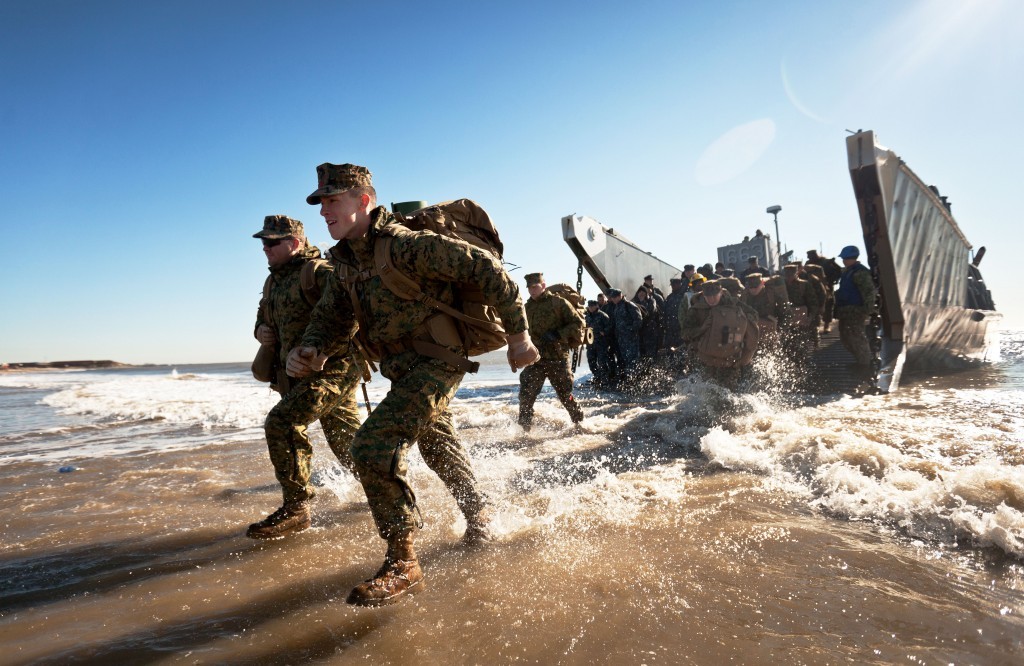
Under the Posse Comitatus Act of 1869, there are limits to how the Armed Forces of the United States operating under Title 10 USC may be utilized for domestic response missions. 9  Title 10 forces cannot be used for direct response or humanitarian assistance, but can be used for various support activities.   For example, during the response to Hurricane Sandy, Marines from the Wasp Amphibious Ready Group conducted an amphibious landing at Breezy Point, Far Rockaway, Queens, and began distributing meals and heater packs.10 However, they were later withdrawn due to issues with the Posse Comitatus Act.  Around the same time Joint Task Force Sandy (New York Army National Guard 53rd Troop Command) troops began arriving.11 Meanwhile, the U.S. Army 19th Engineer Battalion’s Headquarters Company and two Engineer Companies deployed from Fort Knox, Kentucky, where they conducted pumping operations to mitigate flooding of twenty-seven stories of subterranean infrastructure across New York City, and the 249th Engineer Battalion provided prime power services, along with general support from the U.S. Army Corps of Engineers’ New York District.12 

9999
A Regular Army soldier from the 249th Engineer Battalion (Prime Power), U.S. Army Corps of Engineers, turns on a generator in Lakehurst, NJ, after Hurricane Sandy. Source: U.S. Army.
1212
Marines from the 26th MEU conduct an amphibious landing in the Breezy Point neighborhood of Far Rockaway, Queens, NY. Source: Department of Defense.

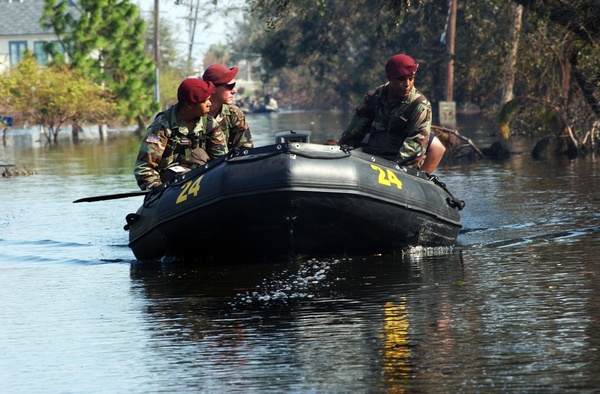
The provisions of the Insurrection Act of 1807 allow for the exceptions where Title 10 troops may be used for response to a disaster.  In these provisions a disaster would have to lead to law and order to break down.  Since all disasters are local, first Title 32 troops- both in the state of disaster, as well as those called in under EMAC must be unable to enforce order, and then federal troops can be utilized after the President has declared a Federal State of Emergency.13 A great example of Title 10 troops being deployed to enforce law and order after a natural disaster was when the 82nd Airborne Division was deployed in the aftermath of Hurricane Katrina.  This occurred primarily due to the failures of the initial response, and the fact that half of the Louisiana Army National Guard (256th Infantry Brigade Combat Team), was deployed to Iraq at the time.14

1422
Soldiers from the 82nd Airborne Division conducting Search & Rescue Operations in flooded sections of New Orleans. Source: Department of Defense.

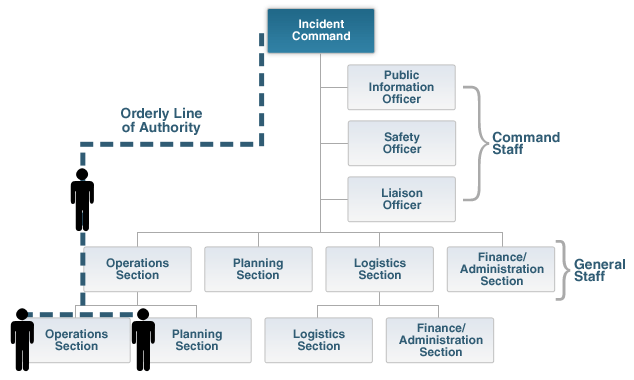
In order to facilitate the integration of military forces at all levels, the common operating language of ICS, MACS, and NRF, are taught to National Guard troops, and troops assigned to U.S. Northern Command.  Incident Command System is organization at the tactical and operational level that allows for personnel from multiple agencies to integrate into mission-specific organizations to facilitate unity of effort- led by an Incident Commander.  For example, during the response to the Deepwater Horizon oil spill, an ICS organization was created utilizing all agencies of the U.S. Government and the Incident Commander was Admiral Thad Allen, USCG (Ret).15 

7
ICS Organization Chart. Source: Federal Emergency Management Agency.

The Multiagency Coordination System (MACS) is the policy working group of the response. Such a group is facilitated by an Emergency Operations Center, and consists of policymakers with the ability to make strategic decisions.  Their mission is to implement policies that assist the ICS organization responding to the disaster to better accomplish their mission. Conversely the National Response Framework (NRF) is a document that establishes agency responsibilities and roles in a variety of disaster responses.16  

Current Doctrine for Foreign Humanitarian Assistance/Disaster Response            

The doctrine for Foreign Humanitarian Assistance/Disaster Response is similar to the doctrine for Defense Support to Civil Authorities, but there is no common operating language or framework. The doctrine first looks at how a host nation requests assistance and how a mission is assigned to military forces in an area.  When a disaster occurs, the host nation government requests assistance from the United States through the Ambassador. The Ambassador, through the Department of State, provides that request to the President, who approves or denies it. From that point the lead agency for coordination is the U.S. Agency for International Development through its Office of Foreign Disaster Assistance, which is similar to the role FEMA plays in domestic response. 

888
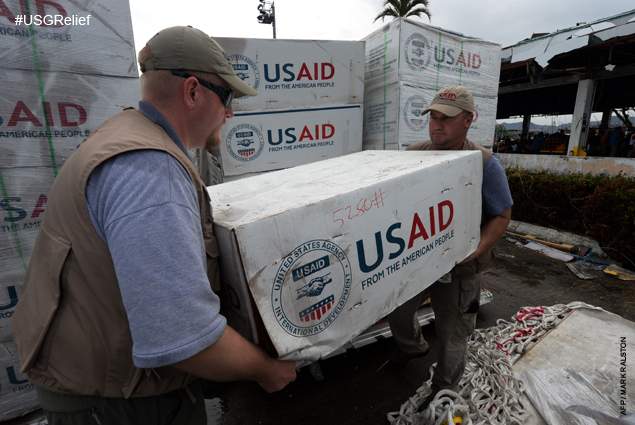
Members of USAID’s Disaster Assistance Response Team loading aid boxes onto a U.S. Navy Seahawk Helicopter at Tacloban Airport on 17 November 2013. Source: U.S. Agency for International Development.

From this point it is determined if defense support will be needed for the mission- if so it is requested through the Department of Defense, who in turn tasks the mission to the appropriate Geographic Combatant Command.  In turn, the Geographic Combatant Commander will appoint a JTF Commander, who will provide resources.  Once the Joint Task Force arrives on site, it must integrate with other agencies of the U.S. Government, host nation forces, and any International/NGO forces.  How that integration occurs is completely up to ad-hocracy, coming up with an organizational structure on the fly.17 

The doctrine primarily focuses on where to deploy Liaison Officers.  It recommends deployment to a series of coordination centers for: the host nation Government, the U.S. Embassy, UN Country Team/Mission Headquarters, Information Centers, Intelligence Centers, and the list goes on.  Most importantly, the focus is that the U.S. Government Joint/Interagency Task Force responding to this disaster has to respond immediately, but go through the entire process of integration and develop a common operating language simultaneously. 

854
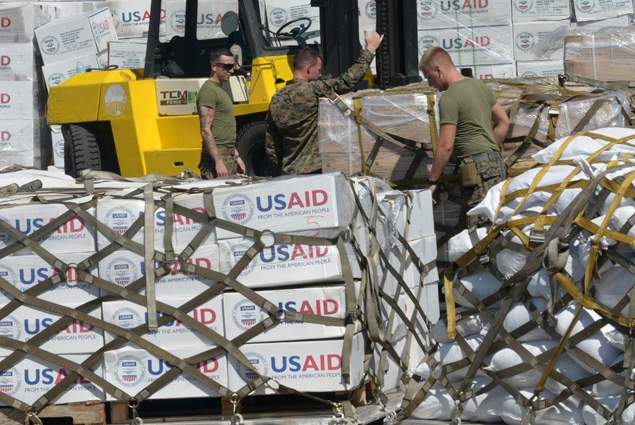
Marines in Manila, Philippines, loading pallets of USAID relief boxes onto a KC-130 to be delivered to victims of Super Typhoon Haiyan in Tacloban on 15 November 2013. Source: U.S. Agency for International Development.

Recommendations for ICS Doctrine in Foreign Humanitarian Assistance/Disaster Response

ICS doctrine should be adapted to Foreign Humanitarian Assistance/Disaster Response, in order to help increase the efficiency of U.S. Armed Services response to foreign disasters.  ICS is already being utilized by civilian U.S. Government agencies for their response doctrine, especially the USAID, which is the federal coordinating agency for foreign disaster response. The federalist system of disaster response currently utilized in statutes and doctrine is similar to foreign response. The United States is after all a supranational organization of fifty sovereign states (who have given up little chunks of their sovereignty).  Each state has its own government structure and security forces (including military forces) that operate under the orders of a Governor, and the United States Government cannot intervene without the request of that Governor (except for limited circumstances). Such a system can be in place for international response.

A basic ICS education should be taught to all service members who may be deployed on a foreign HA/DR mission. This is a very simple syllabus, and could be taught over short periods of time, and would include curriculum already available through the FEMA Independent Study Program. The various centers where LNOs can be deployed can simply be defined as Emergency Operations Centers, and JTF Commanders can integrate at a minimum with other U.S. Government Agencies in an ICS Organizational HQ. The Ambassador, USAID Response Team, and Global Combatant Command Response Team can serve as a MAC Group for U.S. Government Response, and integrate with the Host Nation’s policymaking group. A Joint Interagency Task Force at the Global Combatant Command can serve as a reach back center for the MAC Group, and in turn reach back to National Command Authority in Washington. 

In order to facilitate an integrated doctrine for both Defense Support to Civil Authorities and foreign HA/DR, it would be important to centralize proponency for that doctrine. The best place to do so would be within the Political-Military Affairs Branch of the J-5 Directorate (Strategic Plans & Policy) of the Joint Staff. At a minimum, integrating this common operating language and structure into the doctrine for Foreign HA/DR will allow U.S. Military Forces to integrate with other U.S. Government agencies.  Domestic and foreign disaster assistance should utilize doctrine that is built around integrating military forces into a whole of government response, whether or not they are forces from the National Guard under state control integrating with state and federal agencies or federal troops integrating with host nation response agencies during a disaster.

Conclusion

Both domestic and foreign Disaster Response/Humanitarian Assistance missions are essentially the same mission, but simply occur in different spaces. Both missions should have the same doctrine, in order to help U.S. military forces integrate with other response forces quickly in order to more efficiently respond to disasters. Integrating the ICS, MACS, and NRF doctrine from FEMA into the training for active duty forces that may perform HA/DR abroad will help achieve the goals of that mission. 

Robert C. Rasmussen is a Second Lieutenant in the New York State Guard, and currently serves as the Aide-de-Camp to the Commanding General of the New York State Guard.  He holds a MA in International Relations and a CAS in Security Studies from Syracuse University, and BA in International Relations & Geography from SUNY Geneseo. He served on State Active Duty in support of Operation Hurricane Sandy from November 2012-January 2013.  His views are his own and do not reflect those of the New York State Division of Military & Naval Affairs.

1 Dunk, Marcus,  “Will Krakatoa Rock the World Again?  Last Time It Killed Thousands and Changed the Weather for Five Years, Now It Could Be Even More Deadlier…”  Daily Mail Online,  31 July 2009, http://www.dailymail.co.uk/news/article-1203028/Will-Krakatoa-rock-world-Last-time-killed-thousands-changed-weather-years-deadlier.html.

2 Author participated in disaster relief operations attached to Task Force Blackheart (642nd Aviation Support Battalion, NY ARNG) and Team Sandy (Joint Task Force Empire Shield) from 19 November 2012-22 January 2013.

3 Federal Emergency Management Agency, “National Incident Management System,” https://www.fema.gov/national-incident-management-system. 

4 Department of Defense, “Joint Publication 3-28: Defense Support to Civil Authorities,” http://www.dtic.mil/doctrine/new_pubs/jp3_28.pdf, 31 July 2013.

5 Department of Defense Inspector General, “Evaluation of Department of Defense Interaction with State Defense Forces,” 30 April 2014, http://www.dodig.mil/pubs/documents/DODIG-2014-065.pdf. 

6 McNeil, Deano, “Naval Militia: an Overlooked Domestic Emergency Response Option,” In Homeland Security, 30 April 2015, http://inhomelandsecurity.com/naval-militia-an-overlooked-domestic-emergency-response-option/. 

7 U.S. Agency for International Development, “Disaster Risk Reduction- East Asia & the Pacific,” 30 September 2012, https://www.usaid.gov/sites/default/files/documents/1866/eastasia_drr_fs01_09-30-2012.pdf. 

8 Federal Emergency Management Agency, “IS-700: Introduction to the National Incident Management System,”  31 October 2013, https://training.fema.gov/is/courseoverview.aspx?code=IS-702.a. 

9 National Guard Association of the United States, “NGAUS Fact Sheet: Understanding the Guard’s Duty Status,” http://www.ngaus.org/sites/default/files/Guard%20Statues.pdf.

10 II Marine Expeditionary Force, “Marines Land at Breezy Point,” 9 November 2012, https://www.youtube.com/watch?v=XZhZFRRgtWg.

11 Author served with the New York State Guard Element of Headquarters, Joint Task Force Sandy from 3-19 November 2012.

12 U.S. Army Corps of Engineers New York District, “Army Corps Responds to Hurricane Sandy,” New York District Times, January 2013, http://www.nan.usace.army.mil/Portals/37/docs/nydistricttimes/2013/New%20York%20District%20Times%20Hurricane%20Sandy%20Edition.pdf. 

13 Brinkerhoff, John, “Understanding the Posse Comitatus Act and the Insurrection Act,” Defense Technical Information Center, 2008, http://www.dtic.mil/dtic/tr/fulltext/u2/a494995.pdf. 

14 Department of the Army, “The Army Responds to Hurricane Katrina,” 10 September 2010,  http://www.army.mil/article/45029/The_Army_response_to_Hurricane_Katrina/. 

15 Marine Log, “Thad Allen Named National Incident Commander for Deepwater Horizon Spill,” 1 May 2010,  http://www.marinelog.com/DOCS/NEWSMMIX/2010may00010.html.

16 Federal Emergency Management Agency, “IS-701: NIMS Multiagency Coordination System,”  12 October 2010, https://training.fema.gov/is/courseoverview.aspx?code=IS-701.a. 

17 Department of Defense, “Joint Publication 3-29: Foreign Humanitarian Assistance,” 3 January 2014, http://www.dtic.mil/doctrine/new_pubs/jp3_29.pdf. 

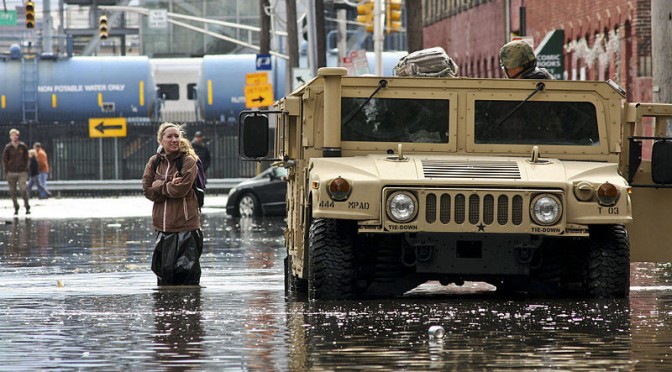
Featured Image: Soldiers assist residents displaced by Hurricane Sandy in Hoboken, N.J., Oct. 31, 2012. The soldiers are assigned to the New Jersey National Guard. U.S. Army photo by Spc. Joseph Davis.

How Lessons from HA/DR Can Prepare Naval Forces for Combat

Naval HA/DR Topic Week

By Greg Smith

When disaster strikes near the sea, U.S. naval forces are often the first available to execute humanitarian assistance and disaster response (HA/DR) missions.  With due regard to the suffering, destruction and loss caused by these disasters, it is possible to note that in many ways these tragedies become opportunities for U.S. naval forces to prepare leaders for combat operations. HA/DR involves a greater sense of urgency and higher stakes than scheduled exercises and training. Especially for the junior officers who participate, HA/DR operations enhance understandings of joint, combined, and interagency coordination and provide an opportunity to develop judgment through prudent risk-taking. 

HA/DR operations entail unique, unscripted collaboration with joint and interagency partners. With unity of effort and time as the common enemy, military and civilian organizations cut through red tape and temporarily set parochial interests aside. For leaders at every level, the result is a fundamental and significantly-improved understanding of the capabilities of the “others” with whom they have worked, operated, planned, and communicated during the HA/DR operation.

3sep15VP26Home-2
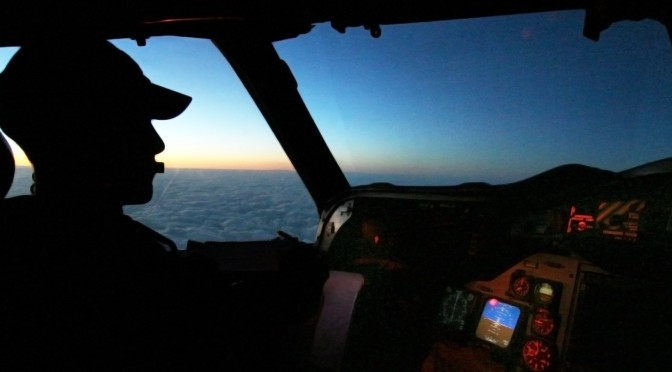
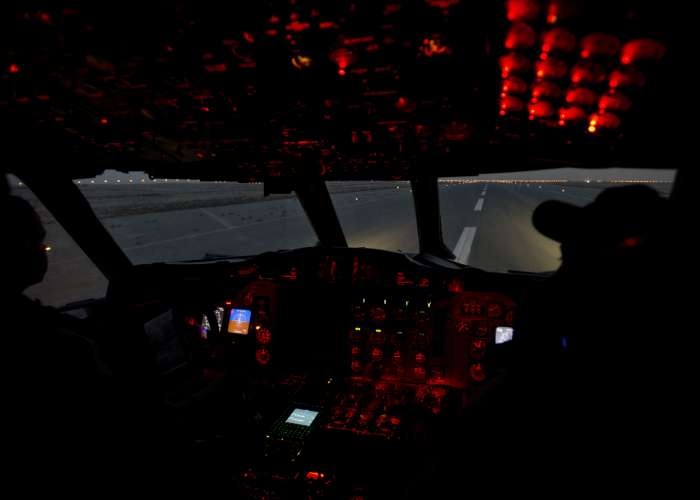
The flight crew aboard a P-3C Orion maritime patrol aircraft assigned to Patrol Squadron (VP) 26 taxi the aircraft after returning from a maritime surveillance patrol in the Middle East. Photo by MC1(SW) Steve Smith.

Anecdotally, the author observed this benefit of HA/DR experience during instruction in Joint Military Operations at the U.S. College of Naval Command and Staff in 2007. Most of the officers in the seminar had served in support of Operations Enduring and Iraqi Freedom in some capacity, and two army officers — a Green Beret and a Special Operations Aviation Regiment pilot — had seen significant combat. For the most part, the army officers outperformed the rest of the seminar in knowledge of joint and service doctrine. However, in understanding joint and interagency capabilities, coordination challenges, and command and control requirements, an E-2C Hawkeye pilot, with extensive experience supporting Hurricane Katrina HA/DR efforts, far surpassed even the army combat veterans. This was not a poor reflection on those army officers (or the rest of the seminar); rather it illustrated the training value of HA/DR missions. The lessons learned and shared during the seminar may significantly enhance the ability of officers to command, coordinate, plan and execute future joint, combined, and interagency operations. 

HA/DR also provides an opportunity for junior officers to take prudent risks, pushing themselves and their equipment further than they might otherwise do in peacetime. Making time-critical decisions when lives are on the line develops sound judgment far better than simulations or scripted training scenarios. During training, the most conservative approach is often the most prudent, potentially reinforcing a risk aversion that might not serve officers well in combat. On January 12th 2010, the day a devastating earthquake struck Haiti, a U.S. Navy P-3C Orion waited on deck in El Salvador in a two-hour ready-alert posture in support of counter-drug operations. When tasked to provide reconnaissance over Haiti, the crew expedited departure and was airborne in less than 90 minutes. Within four hours of the earthquake, the Orion was recording critical imagery of Haiti in support of the HA/DR effort that would be named Operation Unified Response. With minimal guidance, the crew was required to make countless time-critical decisions that illustrate the value of HA/DR to the development of sound judgment in naval officers. 

Knowing that they would be the only aircraft over Haiti for some time, the P-3 crew began to ascertain the best way to remain on station for as long as possible. Several prudent risk calculations followed. First, the plane would land in Jacksonville, Florida, which was closer to Haiti than El Salvador. Jacksonville also had the technical ability to process the collected video and expedite that intelligence to those directing the response. Second, they would deliberately shut down two engines in flight to minimize fuel consumption.1 Landing after thirteen hours in flight, the crew relied on the existing support organizations in Jacksonville to deliver the collected imagery, perform daily maintenance on the aircraft and make billeting arrangements. This enabled the crew to take a third prudent risk and execute a second mission with minimal turn-around time. In the forty hours following the earthquake, the crew safely collected more than twenty hours of full motion video and hundreds of images of Haiti’s bridges, roads, ports, and airfields. The junior officers who led the crew balanced guidance found in Navy instructions with the urgency of the mission, taking prudent risks to gather intelligence for planners of HA/DR operations and to assist the earthquake victims. The judgment and leadership skills developed in this effort will be invaluable during combat operations.

554128313
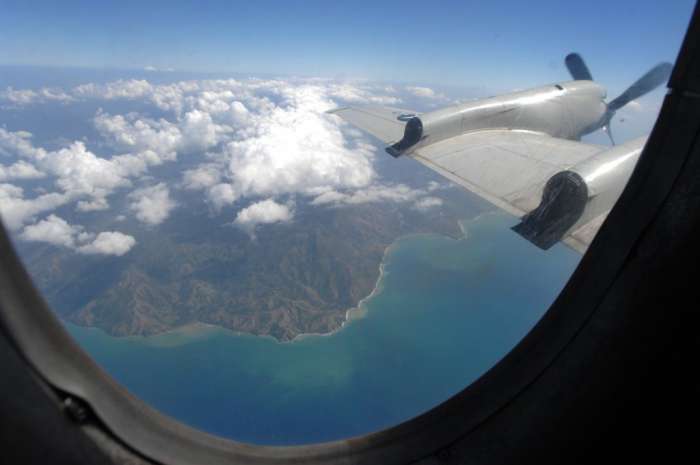
A P-3 surveils Haiti after the earthquake. Photo Source: John Pemberton/The Times-Union.

Of course, there are important differences between HA/DR and combat operations. The unclassified nature of HA/DR facilitates coordination. The use of any and first-available communication methods (email, mobile phone, unsecured radios) greatly enhances collaboration with host nations, civilian government agencies, non-governmental organizations, and forces afloat or ashore.   In addition, access to airfields and ports as well as entry and overflight requirements are expedited, waived or not applicable for forces rendering assistance. During combat operations, the Department of Defense and State Department work tirelessly to enable access for supporting units and staffs in the theater of operations.  Maintaining supply routes through Pakistan and access to Manas Air Base in Kyrgyzstan to support combat operations in Afghanistan, for example, demanded constant effort by staffs, planners, and senior leaders, including the Secretary of Defense and Secretary of State. Coordination with partner nations and the U.S. interagency is required during HA/DR, but the willingness to waive access restrictions for military units during HA/DR is often much greater than for combat operations.

These significant differences between HA/DR and combat operations give cause to reevaluate the DoD’s classification policies and methods for ensuring access.   Unclassified communications facilitate coordination with interagency, non-governmental and foreign partners. If partnering is critical to the success of future combat operations, the Department of Defense should consider modifying classification or clearance policies to facilitate coordination during combat in some cases. When speed is more important than secrecy or surprise, existing U.S. classification standards could be a hindrance to success. Similarly, the ability to cut through red tape, in both U.S. and partner-nation bureaucracies, could facilitate access during HA/DR missions and benefit future combat operations. Absent the urgency of HA/DR, relationships are required to enable this type of expediency.  Developing and maintaining interagency and partner nation relationships that enable access should be a priority for naval forces during peace time.

HA/DR requires naval forces to collaborate, innovate, and take prudent risks to accomplish the mission. These operations provide exposure to joint and interagency operations and offer opportunities for junior officers to make decisions under pressure, facilitating the development of skills that can be valuable in combat. Lessons from HA/DR operations in interacting with interagency and nongovernmental partners abroad should lead U.S. naval forces to rethink classification policies and access strategies. Naval forces should continue to respond to natural disasters to render assistance and save lives. As we seek increasingly adaptive, flexible and agile forces, these missions can prepare naval forces, especially junior officers, for future combat operations.  

Commander Greg Smith, USN, is a  P-3C naval flight officer and the former commanding officer of VP-26.  He is currently serving as a Federal Executive Fellow at the Johns Hopkins University – Applied Physics Lab (APL). The views expressed are his own and do not represent the views of the U.S. Navy or APL.

 1 The four-engine P-3C Orion can increase its endurance at certain weights and airspeeds by loitering (i.e. deliberately shutting down) an engine in flight.  During long missions, three-engine flight has been common throughout the 60-year history of the Orion. Loitering two engines can further increase endurance, but it is rarely prudent to do so.   

Other Than War: HA/DR and Geopolitics

Naval HA/DR Topic Week

By Joshua Tallis

Military Operations Other Than War. Maritime Irregular Activities. Maritime Security Operations. The terminology with which we refer to humanitarian assistance and disaster relief (HA/DR), among other non-traditional functions, draws a clear distinction: there is war, and then there is everything else. Under such categorization, HA/DR is often something to do until more important responsibilities come along. That is not to say that the men and women of the United States Navy are not committed to making the world a better place. It is to say, however, that too often HA/DR runs the risk of being divorced from a wider strategic narrative.

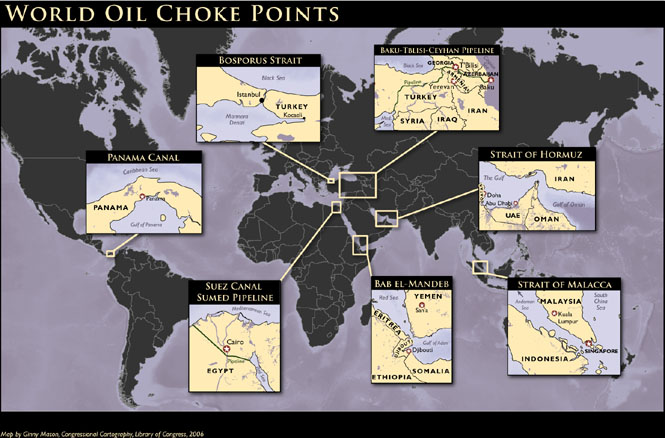
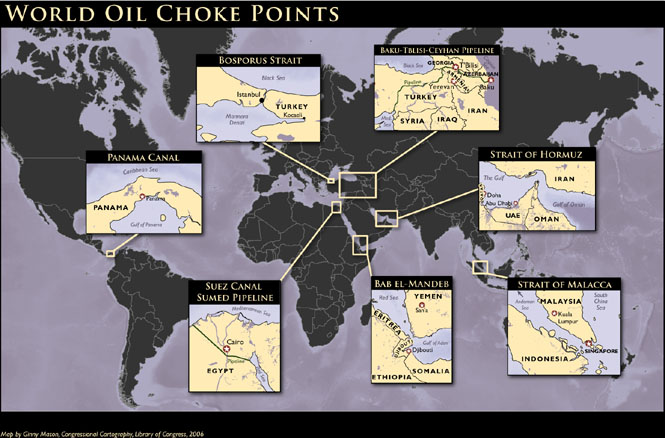
Take, for example, the reemergence of China. The People’s Liberation Army Navy (PLAN) is perhaps decades away from posing an equal challenge to the U.S. Navy outside of its near abroad, if it ever rises to that point. Yet, in the years until China develops the infrastructure, ships, and knowledge base to steam globally, it will not lie dormant. In that time, the strategic and political landscape will be shaped globally in part by a battle for soft power, building relationships, currying favor, and stabilizing troubled choke points.

chokepoints_small
Critical maritime chokepoints. Source.

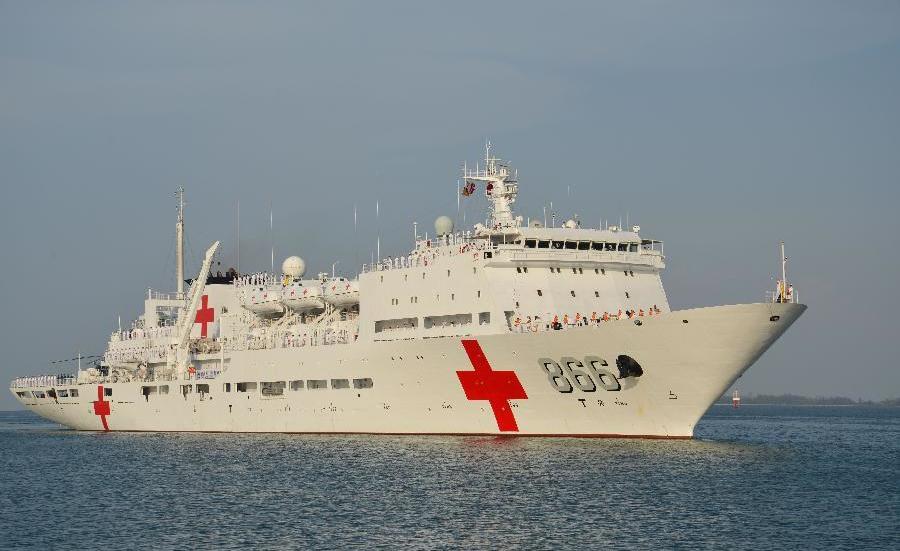
Under this guise, humanitarian assistance and disaster relief are not ancillary to the broader strategic landscape, but pivotal in its construction. Already we can see elements of this mindset, not only in Chinese development projects throughout the world, but in the use of the PLAN for displays of soft power. The Chinese hospital ship Peace Ark, for example, after previous stops in Asia and Africa, deployed for the first time to the Caribbean Sea in the fall of 2011.1 And while the U.S., according to a posture statement from SOUTHCOM in 2014, deploys about 700 medical professionals to the Basin annually, such contributions (in an already low-priority combatant command) may shrink even further. Cuba, by way of contrast, has used similar missions to sustain regional favor and influence in the face of longstanding ostracism from the U.S., sending 30,000 medical professionals into the Basin, many to Venezuela.2 And while more doctors for a poor region is always a good thing, goodwill may be, in important measure, a zero-sum contest when we take the geopolitical long view.

132460717_21n
Chinese hospital ship Peace Ark. Xinhua Photo.

HA/DR helps shape local political contexts, and it is within such contexts that future American diplomats and soldiers (and those of other nations) will operate. Though HA/DR is a moral imperative in its own right, without the expectation of a quid pro quo, it stands to reason that in an anarchic political landscape, nations will gravitate towards a country they have seen to have their best interests at heart.

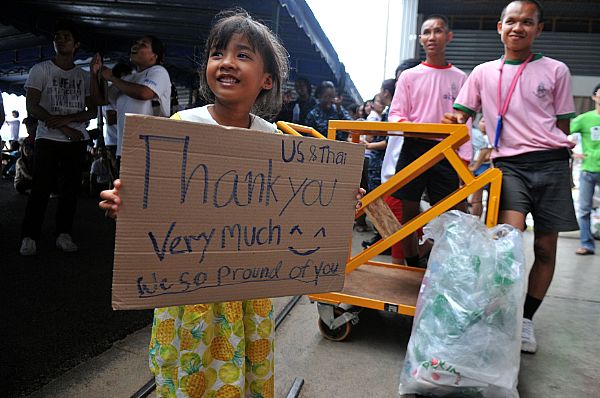
What might that look like? Humanitarian assistance and disaster relief operations offer a wide swath of the developing world an opportunity to interface positively and intimately with the faceless American war machine. Such operations introduce a new generation to what the United States does and what global leadership means. Moreover, it signals that the United States is invested in maintaining presence and stability, something incredibly important at a time when many have called into question American commitments to allies from Europe, to the Middle East, to the Asia-Pacific. In such an era, increased goodwill, through genuine engagement with local communities, could provide the foundation for easing concerns over an American retrenchment, subtly but importantly shifting the prevailing narrative of an American withdrawal. That is, after all, a difficult narrative to sustain while American sailors are frequently seen distributing medical or food aid. Or, HA/DR could signal the opposite, that another country is more invested in the region’s success than the United States. The decision rests with Washington.

111023-N-WW409-696 UTAPAO, Thailand (Oct. 23, 2011) A child from the local community holds a sign thanking the U.S. Sailors from the guided missile destroyer USS Mustin (DDG 89) and members from the Royal Thai Armed Forces during a community service event organized by the Princess Pa Foundation, Thai Red Cross Society. More than 40 Sailors from Mustin volunteered their time with the local community and members from the Royal Thai Armed Forces with assisting in preparing more than 5,000 packages. (U.S. Navy photo by Mass Communication Specialist 1st Class Jennifer A. Villalovos/Released)
UTAPAO, Thailand (Oct. 23, 2011) A child from the local community holds a sign thanking the U.S. Sailors from the guided missile destroyer USS Mustin (DDG 89) and members from the Royal Thai Armed Forces during a community service event organized by the Princess Pa Foundation, Thai Red Cross Society. More than 40 Sailors from Mustin volunteered their time with the local community and members from the Royal Thai Armed Forces with assisting in preparing more than 5,000 packages. (U.S. Navy photo by Mass Communication Specialist 1st Class Jennifer A. Villalovos/Released)

This, consequently, gives rise to another example of the strategic importance of HA/DR: the threat posed by unstable choke points. The fallout from climate change, deforestation, illegal, unreported and unregulated fishing, pollution, sea level rise, coastal erosion, corrosion of estuaries, depleted fish stocks, mass migration, poverty, urbanization on the coasts—all suggest that intensely poor littoral communities around the world will fall under greater pressure in the coming decades (as expressed well by David Kilcullen, for example, in Out of the Mountains). Increasingly at-risk populations (which continue to grow), with fewer financial opportunities, and with fewer communal ties as a result of migration and urbanization, will face ever more common and ever more devastating extreme weather. Dislocation, poverty, and dissatisfaction are recipes for instability and could threaten critical junctures in the Gulf of Aden, the Caribbean, or the Straits of Malacca and Singapore, to name just a few.

Failure to secure such communities when they are at greatest peril will inevitably have reverberating implications for the maritime space. This has obvious overtones for the war on terror as well. Since September 11, we have understood that countering violent extremism requires, in part, a battle of ideas. That means wielding soft power and making positive impacts on the lives of those most in need and most at risk. HA/DR provides an opportunity to portray tangible benefits from a relationship with the West, to expose whole populations to the ‘other,’ and to let U.S. sailors continue to serve as ambassadors for the American idea.

Ultimately, the responsibility of the United States Navy will remain to prevent and, if need be, win high-end conventional wars. Seen in that lens, however, HA/DR is all too often relegated to the backbench in strategic conversations. In reality, missions on the softer end of the operational spectrum present an opportunity to prevent and win battles that may be fought by those who are barely in grade school now. Humanitarian assistance and disaster relief shape the geostrategic landscape in subtle but consequential and potentially enduring ways. Until HA/DR is incorporated into that broader discussion, it will remain simply one of many operations other than war.

Joshua Tallis is a PhD candidate at the University of St Andrews’ Centre for the Study of Terrorism and Political Violence. He is a Research Specialist at CNA Corporation, a nonprofit research and analysis organization located in Arlington, VA. The views and opinions in this article are his own and do not necessarily represent the position of the University or CNA.

1 http://www.andrewerickson.com/2011/09/pla-daily-offers-latest-details-on-peace-ark-hospital-ships-1st-medical-mission-to-caribbean/

2 SOUTHCOM Posture Statement from General Kelly, 2014.

Featured image: Sailor holding an aid recipient’s hand. Source.