Category Archives: Capability Analysis

Analyzing Specific Naval and Maritime Platforms

Accelerating the Renaissance of the U.S. Navy’s Amphibious Assault Forces 

Unmanned Maritime Systems Topic Week

By George Galdorisi

Perspective

The United States has entered an era of great power competition against peer adversaries who are seeking to shape the world to their needs and upset the global international order.1 This challenge is addressed in the highest levels of U.S. policy documents, from Global Trends: Paradox of Progress, to the National Security Strategy, to the National Defense Strategy. Indeed, the National Defense Strategy explicitly calls for the United States to “Build a More Lethal Force” to deal with these threats.”2

The U.S. Navy and Marine Corps are critical components of this more lethal force. As the Navy’s Design for Maintaining Maritime Superiority 2.0 (Design 2.0) notes, “The U.S. Navy must be ready to conduct prompt and sustained combat incident to operations at sea.” Design 2.0 also calls for “Deepening integration with our natural partner, the U.S. Marine Corps.”3 As Brigadier General Christian Wortman, Commanding Officer of the Marine Corps Warfighting Lab, noted at the recent USNI/AFCEA West Symposium “We are back and completely integrated with the Navy.”4

This call for enhanced Navy-Marine Corps integration comes at a time when, in the words of a former Marine Commandant, “The Marine Corps is returning to its amphibious roots,”5 and when the demand for amphibious forces is at a high level. As Ryan Hilger noted in his recent CIMSEC article, “Ground Component Commanders (GCCs) continue to signal a demand for amphibious forces, reaching high enough to justify 40 amphibious ships required to meet requested presence requirements.”6

This sea change in U.S. strategic focus comes at a time of accelerating technological change. As Michelle Flournoy, former undersecretary of defense for policy, noted recently, “We are in the most intense technological revolution the world has ever seen.”7 Today, one of the most rapidly growing areas of innovative technology adoption by the U.S. military involves unmanned systems. In the past several decades, the U.S. military’s use of unmanned aerial vehicles (UAVs) has increased from only a handful to more than 10,000, while the use of unmanned ground vehicles (UGVs) has exploded from zero to more than 12,000.

The use of unmanned surface vehicles (USVs) and unmanned underwater vehicles (UUVs) is also growing, as USVs and UUVs are proving to be increasingly useful for a wide array of military applications. The expanding use of military unmanned systems (UxS) is already creating strategic, operational, and tactical possibilities that did not exist a decade ago.

America’s Amphibious Assault Forces: Leading a Paradigm Shift

Last summer, the Smithsonian Channel featured a series, “The Pacific War in Color.” One part of this program told the story of amphibious assaults on Japanese-held islands, such as Iwo Jima, Okinawa, Tarawa, Peleliu, and others. These assaults involved armadas of amphibious ships and hundreds of landing craft that were part of each forcible entry operation. In each case, the attacking force faced significant opposition getting Marines onto the beach.

https://gfycat.com/LeafyImmenseHuman

Aerial raw footage of the 1945 Iwo Jima landings (Romano Archives)

In the post-Cold War era, amphibious assault forces have not been the most capable part of the U.S. Navy. In the years after 9/11—while the Marine Corps was engaged in Iraq and Afghanistan and not primarily embarked on amphibious ships—the amphibious assault fleet was, at best, an afterthought. Today, as the United States faces a plethora of threats across the globe, there is a new emphasis on amphibious warfare.

According to Lieutenant General David Berger, commander of the Marine Corps Combat Development Command, and nominee to be the next Commandant of the Marine Corps, “We need to be prepared for large-scale amphibious operations. We might do it differently in the future, but we can’t ignore it.”8

For decades, when a crisis emerged anywhere on the globe, the first question a U.S. president often asked was, “Where are the carriers?” Today, that question is still asked, but increasingly, it has morphed into, “Where are the expeditionary strike groups?” The reason is clear. These naval expeditionary formations—built around a large-deck amphibious assault ship, an amphibious transport dock, and a dock landing ship—have been the ones used extensively for a wide array of missions short of war, from anti-piracy patrols, to personnel evacuation, to humanitarian assistance and disaster relief. And where tensions lead to hostilities, these forces are the only ones that give the U.S. military a forcible entry option.

U.S. naval expeditionary forces have remained relatively robust even as the size of the Navy has shrunk from a high of 594 ships in 1987 to 272 ships in 2018. Naval expeditionary strike groups comprise a substantial percentage of the current fleet. Indeed, the blueprint for the future fleet the Navy is building, as seen in a recent Congressional Research Service report, maintains—and even increases—that percentage.9

An article in Marine Corps Gazette highlighted Marine Corps thinking on future amphibious assault operations:

“While forcible entry operations are often thought of exclusively in terms of initiating a continental campaign, an application some analysts assume to be unlikely, it may be more probable in the 21st century that they are conducted as part of a joint campaign that is maritime in character. It ought to be self-evident from looking at a map that military competition in the near seas will involve an amphibious component—to include amphibious assault when and where required.”

The Gazette article goes on to note that “a film about a modern amphibious operation would likely be boring, as there would be no dramatic scenes of large units fighting their way across a heavily defended beach.”10

Navy and Marine Corps expeditionary forces have been proactive in looking to affordable new technology to add capability to their existing and future ships. One of the technologies that offers the most promise in this regard is unmanned systems. These unmanned systems can reduce the risk to human life in high-threat areas, deliver persistent surveillance over areas of interest, and provide options to warfighters—particularly given their ability to operate autonomously.

 The U.S. Navy’s commitment to unmanned systems is seen in the Navy’s Force Structure Assessment, as well as in a series of Future Fleet Architecture Studies. In each of these studies—one by the CNO staff, one by the MITRE Corporation, and one by the Center for Strategic and Budgetary Assessments—the proposed future fleet architecture featured large numbers of air, surface, and subsurface unmanned systems.11 These reports highlight the fact that the attributes unmanned systems can bring to the U.S. Navy Fleet circa 2030 have the potential to be transformational.

One of the major challenges to the Navy and Marine Corps to making a substantial commitment to unmanned maritime systems is the fact that they are relatively new and their development has been under the radar for all but a few professionals in the research and development, requirements, and acquisition communities. That is now changing. The Department of Defense 2017-2037 Unmanned Systems Roadmap highlights a large number of Navy and Marine Corps unmanned systems, particularly unmanned maritime systems (USVs and UUVs).12

Design 2.0 has clearly articulated the importance of unmanned systems to the Navy and Marine Corps future warfighting effectiveness. The publication’s “Line of Effort Green: Achieve High Velocity Outcomes,” demonstrates the Navy’s commitment to making unmanned systems a key component of the future fleet, highlighting air, surface and subsurface unmanned systems.13 Additionally, this commitment to unmanned systems programs is reflected in program documents such as the 2018 Navy Program Guide and the 2018 Marine Corps Concepts and Programs.

The Navy and Marine Corps have taken the lead in orchestrating an unprecedented number of exercises, experiments, and demonstrations to introduce new, cutting edge technologies—especially unmanned maritime systems—into the Fleet and Fleet Marine Forces. Many of these technologies are mature commercial off-the-shelf systems that are currently being used for other military and commercial applications. These events have put new technology directly into the hands of Sailors and Marines and have accelerated the amphibious force renaissance.

Testing and Evaluating Unmanned Systems

During the recent USNI/AFCEA “West” Symposium, Chief of Naval Operations Admiral John Richardson noted, “Our strategic Achilles Heel is our inability to get new technology into the hands of our warfighters fast enough.”14 This is especially true with emerging technologies that are revolutionary—not merely evolutionary.

As with many novel naval technologies: ironclads, submarines, aircraft, nuclear power, directed-energy weapons, as well as others, is it typically not the most prominent communities where this experimentation takes place, but rather, in those parts of the Navy and Marine Corps that have traditionally been out of the spotlight and who need a technology boost. Today, it is the amphibious assault Navy that has been notably proactive in experimenting with emerging unmanned systems.

The Navy and Marine Corps have a number of ways to test and evaluate unmanned maritime systems. While some of this testing and evaluating—especially in the early stages of unmanned maritime systems development—occurs at industry facilities or at U.S. Navy laboratories, once these systems are more mature, they are fielded in a wide-array of Navy and Marine Corps events in the operational environment where they will ultimately be used. Brigadier General Wortman emphasized this point during the USNI/AFCEA Wes” Symposium where he noted, “We need to do more Fleet and MEF level exercises.”15

As the Department of the Navy has become increasingly interested in unmanned maritime systems, this testing and evaluating has accelerated in a number of exercises, experiments and demonstrations, such as the Ship-to-Shore Maneuver Exploration and Experimentation (S2ME2) Advanced Naval Technology Exercise (ANTX), the Surface Warfare Distributed Lethality in the Littoral Demonstration, and the Navy-Marine Corps Bold Alligator series of exercises.

The Ship-to-Shore Maneuver Exploration and Experimentation Advanced Naval Technology Exercise is a prime example of the Department of the Navy’s push to test and evaluate unmanned maritime systems. S2ME2 ANTX was especially important to the Navy and Marine Corps as the amphibious ship-to-shore mission is one of the most challenging tasks the military must undertake.

Due to the enormous stakes involved in putting troops ashore in the face of a prepared enemy force, S2ME2 ANTX had a heavy focus on unmanned systems—especially unmanned surface systems—that could provide intelligence, surveillance, and reconnaissance (ISR) as well as intelligence preparation of the battlespace (IPB). These are critical missions that have been traditionally been done by Sailors, Marines, and Special Operators, but ones that put these warfighters at extreme risk.

There is growing realization of the need to insert new technology to make the amphibious assault force more effective in the face of robust adversary defenses. In an address at the 2018 Surface Navy Association Symposium, Marine Corps Major General David Coffman, Director of Expeditionary Warfare (OPNAV N95), noted the need to make U.S. Navy amphibious ships, “More viable, lethal and survivable, with a focus on command, control, communications, computers, cyber and intelligence (C5I).”16 Clearly, the ISR and IPB missions depend on these capabilities, and it is unmanned systems that can provide this function without hazarding personnel.

During the S2ME2 ANTX the amphibious assault force proactively employed an unmanned surface vehicle to thwart enemy defenses. A MANTAS USV (an eight-foot version of a family of stealthy, low profile, USVs) swam into the “enemy” harbor (the Del Mar Boat Basin on the Southern California coast), and relayed information in real-time to the amphibious force command center using its TASKER C2 system. Subsequent to this ISR mission, the MANTAS USV was driven to the surf zone to provide IPB on water conditions, beach gradient, obstacle location and other information crucial to planners prior to a manned assault. 

Carly Jackson, Naval Information Warfare Center Pacific’s Director of Prototyping for Information Warfare and one of the organizers of S2ME2 ANTX, explained the key element of the exercise was to demonstrate new technology developed in rapid response to real world problems facing the fleet and noted that the exercise was focused on unmanned systems with a big emphasis on intelligence gathering, surveillance, and reconnaissance.17

In many ways, S2ME2 ANTX was a precursor to Bold Alligator, the Navy-Marine Corps exercise designed to enhance interoperability in the littorals. Bold Alligator was a live, scenario-driven exercise designed to demonstrate maritime and amphibious force capabilities. The 2nd Marine Expeditionary Brigade (MEB) led the exercise and operated from dock landing ships USS Fort McHenry (LSD-43) and USS Gunston Hall (LSD-44); amphibious transport dock USS Arlington (LPD-24).18

Bold Alligator took the concepts explored during S2ME2 ANTX to the next level, employing two different size (six-foot and twelve-foot) MANTAS USVs in the ISR and IPB roles to provide comprehensive reconnaissance of beaches and waterways. These systems were employed during the Long Range Littoral Reconnaissance phase of the exercise.

The 2nd Marine Expeditionary Brigade used the larger (twelve-foot) MANTAS USV, equipped with a Gyro Stabilized SeaFLIR230 EO/IR Camera and a BlueView M900 Forward Looking Imaging Sonar to provide ISR and IPB for the amphibious assault. This sonar was employed to provide bottom imaging and analysis within the surf zone of the amphibious landing area. This latter capability is crucial in amphibious operations in order to ensure that a landing craft can successfully enter the surf zone without encountering mines or other objects.

While S2ME2 was confined to a relatively constrained operating area off the coast of Southern California, Bold Alligator was played out over a wide geographic area. This included a Command Center at Naval Station Norfolk, Virginia, and operating units employing forces in a wide area of the Atlantic Ocean, North and South Onslow Beach, Camp Lejeune, North Carolina, as well as in the Intracoastal Waterway near Camp Lejeune.

During the Long Range Littoral Reconnaissance phase of Bold Alligator, Navy and Marine Corps operators at Naval Station Norfolk were able to remotely control both the six-foot and twelve-foot MANTAS USVs and drive them off North and South Onslow Beaches as well as in the Intracoastal Waterway. Once positioned, both MANTAS USVs streamed live, high-resolution video and sonar images to the command center at Naval Station Norfolk several hundred miles away.

The latter capability is crucial in amphibious operations in order to ensure that a landing or other craft could successfully navigate a waterway or enter the surf zone without encountering mines or other objects. Clearing a path for LCACs or LCUs to safely pass through the surf zone and onto the beach during an assault is a make-or-break factor for any amphibious operation. Having the ability to view these images in real-time enables decision makers not on-scene to make time-critical go/no go determinations. The value of providing commanders with real-time ISR and IPB is difficult to overstate, and it is likely that this capability will continue to be examined in other expeditionary exercises going forward.

Sustaining the Amphibious Assault Force Renaissance

The ship-to-shore movement of an expeditionary assault force was—and remains—the most hazardous mission for any navy.  The value of real-time ISR and IPB is difficult to overstate. It is this ability to sense the battlespace in real time that will spell the difference between victory and defeat.

For this reason, it seems clear that the types of unmanned systems the Department of the Navy should acquire are those systems that directly support naval expeditionary forces that conduct forcible entry operations. This suggests a need for unmanned surface systems to complement our expeditionary naval formations represented by the amphibious assault navy. These commercial off-the-shelf technologies are available today and the Department of the Navy would be well-served to put them into the hands of warfighters now.

Captain George Galdorisi (USN – retired) is a career naval aviator whose thirty years of active duty service included four command tours and five years as a carrier strike group chief of staff. He began his writing career in 1978 with an article in U.S. Naval Institute Proceedings. He is the Director of Strategic Assessments and Technical Futures at the Naval Information Warfare Center Pacific in San Diego, California. 

The views presented are those of the author, and do not reflect the views of the Department of the Navy or Department of Defense.

References

[1] Global Trends: Paradox of Progress (Washington, D.C.: National Intelligence Council, 2017), accessed at: https://www.dni.gov/index.php/global-trends-home.

[2] The National Defense Strategy (Washington, D.C.: Department of Defense, January 2018)

[3] Design for Maintaining Maritime Superiority 2.0 (Washington, D.C.: Department of the Navy, December 2018) accessed at: https://www.navy.mil/navydata/people/cno/Richardson/Resource/Design_2.0.pdf.

[4] Brigadier General Christian Wortman, panel remarks, USNI/AFCEA “West” Symposium, February 13-15, 2019.

[5] Otto Kreisher, U.S. Marine Corps Is Getting Back to Its Amphibious Roots, Defense Media Network, November 8, 2012, accessed at: https://www.defensemedianetwork.com/stories/return-to-the-sea/.

[6] Ryan Hilger, Cost and Survivability: Acquiring the Gator Navy,” Center for International Maritime Security, April 8, 2019, accessed at: https://cimsec.org/cost-and-survivability-acquiring-the-gator-navy/39784

[7] Michelle Flournoy, keynote remarks, Second Front “Offset Symposium,” March 5, 2019.

[8] Lieutenant General David Berger, keynote remarks, National Defense Industrial Association Expeditionary Warfare Conference, Annapolis Maryland, October 16-18, 2018.

[9] Navy Force Structure and Shipbuilding Plans: Background and Issues for Congress (Washington, D.C.: Congressional Research Service, October 19, 2018).

[10] George Galdorisi and Scott Truver, The U.S. Navy’s Amphibious Assault Renaissance: It’s More than Ships and Aircraft,”  War on the Rocks, December 12, 2018.

[11] See Navy Project Team, Report to Congress: Alternative Future Fleet Platform Architecture Study, October 27, 2016, MITRE, Navy Future Fleet Platform Architecture Study, July 1, 2016, and CSBA, Restoring American Seapower: A New Fleet Architecture for the United States Navy, January 23, 2017.

[12] Department of Defense Unmanned Systems Integrated Roadmap 2017-2042 (Washington, D.C.: Department of Defense, August. 28, 2018).

[13] Design for Maintaining Maritime Superiority 2.0.

[14] Admiral John Richardson, Chief of Naval Operations, keynote address, USNI/AFCEA “West” Symposium, February 13-15, 2019.

[15] Brigadier General Christian Wortman USMC, Commanding Officer Marine Corps Warfighting Lab, Panel remarks, USNI/AFCEA “West” Symposium, February 13-15, 2019.

[16] Meagan Eckstein, “Navy, Marines Eyeing Ship Capability Upgrade Plans that Focus on Weapons, C5I,” USNI News, January 17, 2018, accessed at: https://news.usni.org/2018/01/17/navy-marines-eyeing-ship-capability-upgrade-plans-focus-weapons-c5i?utm_source=USNI+News&utm_campaign=3de4951649-USNI_NEWS_DAILY&utm_medium=email&utm_term=0_0dd4a1450b-3de4951649-230420609&mc_cid=3de4951649&mc_eid=157ead4942.

[17] Patric Petrie, “Navy Lab Demonstrates High-Tech Solutions in Response to Real-World Challenges at ANTX17,” CHIPS Magazine Online, May 5, 2017, accessed at http://www.doncio.navy.mil/CHIPS/ArticleDetails.aspx?id=8989.

[18] Information on Bold Alligator 2017 is available on the U.S. Navy website at: http://www.navy.mil/submit/display.asp?story_id=102852.

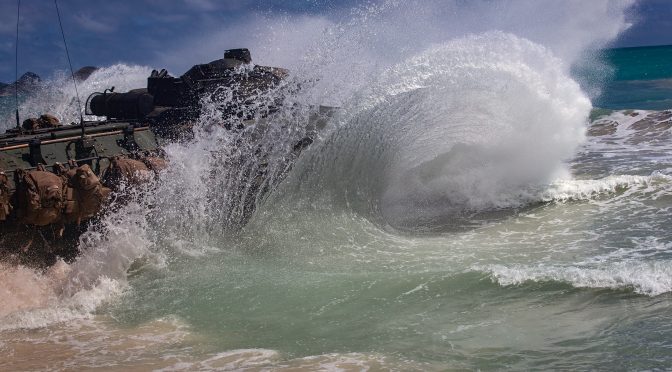
Featured Image: MARINE CORPS BASE HAWAII, Hawaii (April 9, 20190) A U.S. Marine Corps amphibious assault vehicle assigned to Combat Assault Company, 3d Marine Regiment, crashes into the tides as it enters the water during an amphibious assault exercise at Marine Corps Training Area Bellows, Marine Corps Base Hawaii, Apr. 9, 2019. The unit conducted a simulated beach assault to improve their lethality and cooperation, as a mechanized unit and force in readiness. (U.S. Marine Corps photo by Sgt. Alex Kouns)
Autonomous Pickets for Force Protection and Fleet Missile Defense

Unmanned Maritime Systems Topic Week

By 1st Lt. Walker D. Mills

As the U.S. Navy shifts to reprioritize great power competition in line with the 2018 National Defense Strategy, close-in missile defense has taken on new importance. It is estimated the People’s Liberation Army Rocket Force, the branch of the Chinese military equipped with short, medium, and long-range ballistic and cruise missiles has an arsenal of thousands of missiles. As of yet, only the more recent classes are known to have guidance for striking maritime targets, but that may change. In addition, the People’s Liberation Army Navy (PLAN) has surface vessels of all sizes with hundreds more anti-ship missiles. At the low end is the Type 22 missile boat with eight missiles, and at the high end is the new Type 055 with 112 vertical launch cells that can be loaded with a variety of ordnance. These new PLAN missile capabilities has produced palpable anxiety in the US defense establishment. Last week in a confirmation hearing for the future Commandant of the Marine Corps and Chief of Naval Operations, Senator Richard Blumenthal (D-CT) asked how the Navy was planning on dealing with the “great risk” to their surface fleet. He was not the only Senator to voice his concern. 

Though anti-ship missiles have not yet been used in in large-scale fleet combat, they have been used to deadly effect by aircraft and smaller surface combatants after their debut in the Yom Kippur War. All previous incidents also occurred in coastal or littoral waters. By all accounts, if and when large-scale, salvo-type fleet combat does occur, it will cause damage unseen since the large naval battles of the Second World War. In fact, there is perhaps no precedent for the destructive capacity of missile volleys except for the large-scale kamikaze attacks on the U.S. naval force during the battle of Okinawa.1 During the battle, hundreds of kamikazes were deployed and sunk over forty U.S. warships.2 Okinawa remains one of the costliest battles for the U.S. Navy in any conflict.

Kamikaze employment and tactics mirror what missiles salvos could look like today. The kamikazes were often based at austere airfields considered unsuitable for conventional operations, making them harder to identify by U.S. forces while also being low cost compared to the damage they could inflict.3 Toward the end of the war kamikaze pilots had mastered the use of terrain to mask their approach on U.S. radars – similar to low-level or sea-skimming flight in missiles today. They would approach from different directions and rapidly converge on suitable targets in waves as large as 300, maneuvering erratically to avoid anti-aircraft fire.4 Consider this description of a kamikaze attack on U.S. ships during the Battle of Okinawa from Robert C. Stern’s book Fire from the Sky:

“The enemy stayed low over the horizon to the west, out of sight of our radars and CAP… For a minute or two, every plane maneuvered for position in all quadrants and then, obviously on signal, a coordinated attack was launched.”5

 It has even been argued by naval historian D.M. Giangreco, that just before the end of the war the Japanese discovered that their wooden training planes didn’t show up on U.S. radars – they were essentially stealth weapons.6 Regardless, the Japanese thought the kamikaze squadrons were effective enough that they prepared the bulk of their remaining aircraft – some 10,500 – for kamikaze operations against any future U.S. landing on the Japanese home islands.7

The U.S. Navy responded to this threat with three main approaches. They expanded fleet formations and used destroyers and combat air patrols as pickets – often posting pickets as far as seventy-five miles out from the ships they were protecting. The Navy also employed new technology like radars and proximity-fuzed munitions, and massively proliferated anti-aircraft weapons across its ships.8 According to figures from Giangreco:

“By June 30, 1945, 2,381 twin mounts had been installed on Navy ships in the Pacific, and 10,180 single mounts remained throughout the fleet. The numbers of quad, double and single 40-mm mounts stood at 1,585, 3,045 and 510 respectively.”9

And he goes on to note that despite this massive proliferation of point defense weapons, Chief of Naval Operations Admiral Ernest King still considered his ships under-protected.

https://gfycat.com/BlankAdventurousBoar

A Japanese Kamikaze attack on the USS Essex (CV-9) on 25 November 1944.

Together, these three lines of effort blunted the effectiveness of kamikaze attacks and helped defend the carriers and amphibious ships, but at a huge cost to the pickets, and even then, the defense was not impenetrable. Of the 41 ships sunk or damaged beyond repair in the Battle of Okinawa over half were destroyers or other escorts on picket duty and a further ten were minesweepers that had been sent to the picket role because of the high losses the pickets sustained.10 The pickets were effective, but at a huge cost to their crews. This response to kamikaze attacks provides a model for a response to the looming threat of anti-ship missiles. It is the best example of the U.S. Navy enduring a period of heavy and continuous missile salvo-like attacks in support of operations ashore.

Unmanned Systems for Fleet-Wide Missile Defense 

The merger of small and medium unmanned surface vessels (S/MUSVs) and extant close-in weapons systems can dramatically increase the survivability of the U.S. surface fleet. The Navy is already calling for the development and fielding of new USVs. The Navy is experimenting with the Sea Hunter MUSV and should be searching for potential roles beyond anti-submarine warfare (ASW). 

At the aforementioned confirmation hearing, future Chief of Naval Operations Admiral Bill Moran assured a questioning Senator Gary Peters (D-MI) that the Navy is rapidly moving forward on unmanned systems.

“…We need to get after [unmanned surface vehicles] so the we can experiment with these to test out the concepts that we believe they are capable of doing, looking at different types of capabilities to put on different types of these vessels…”

But overall, he expressed confidence that they could be the way forward for the surface fleet:

“Down the road if these capabilities prove out to be as effective as some other current manned capabilities then they would start to add to and compliment the manned platforms we have and be part of our battle force.”

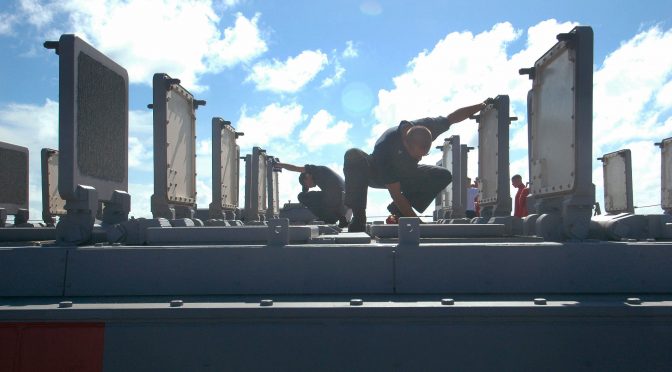
In addition to ongoing ASW experiments, another beneficial use would be to mount one or more close-in weapons systems (CIWS) on the MUSV and have them act as pickets for other ships in the fleet. The Phalanx CIWS currently mounted on many U.S. ships is already completely autonomous. It fires a twenty-millimeter cannon at targets based on pre-programed parameters. These new pickets would be completely autonomous and require only human intervention for reloading, refueling, and maintenance. Originally intended as a long-endurance submarine hunter, the Sea Hunter platform would be ideal for picket duty. Autonomous pickets could accompany high-priority ships like aircraft carriers or amphibious ships during strait transits and high-risk movements. They could also defend ship-to-shore movements and beachheads against missiles, aircraft and small surface vessels depending on their programming. These autonomous pickets could also act as surge defense for key naval installations and other key maritime terrain. The point-defense capability that CIWS can provide is also a gap ashore with the Marine Corps. The Phalanx CIWS is a capable and versatile weapon system far better than the twenty and forty-millimeter Bofors guns used against Japanese aircraft and can now be upgraded to carry Rolling Airframe Missiles (RAM) which significantly increase their interception range. It has also been used to protect ships against close flying aircraft, small boats, and drones, further proving its versatility.

https://gfycat.com/FineSparklingAtlanticspadefish

Pacific Ocean -The Close In Weapon System (CIWS) onboard Coast Guard Cutter BERTHOLF fires during Combat System Ship Qualification Trials on Feb. 23, 2009. (U.S. Coast Guard video/PA3 Henry G. Dunphy)

Autonomous pickets are not limited to just kinetic weapons. They could integrate directed energy weapons into their defensive capabilities as well, perhaps in a triad with gun and missile point defenses. They would also be ideal platforms from which to deploy softkill countermeasures like chaff, electronic warfare, jamming. They could be mounted with multi-spectrum decoys imitating larger ships to draw anti-ship missiles toward themselves and away from higher-value manned platforms.

Mounting autonomous platforms with defensive systems for force protection side-steps the significant ethical question of lethal autonomous platforms because the precedent has already been set. The Navy has already deployed the autonomous defensive systems like CIWS and Aegis for decades and can modify the engagement parameters  to fit any environment. Pursuing defensive, autonomous weapons for missile defense is a way to continue developing relevant and lethal weaponry without “taking the human out of the loop” for strike operations.

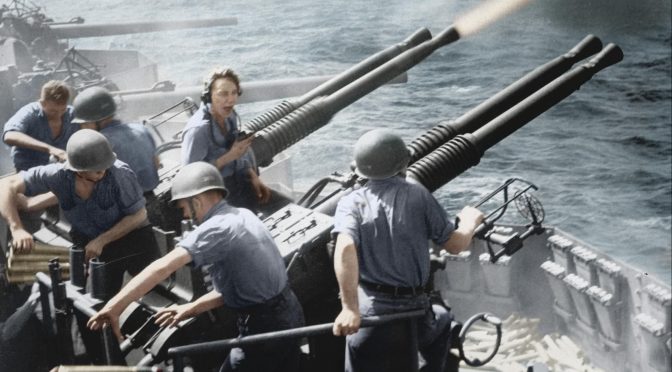
The biggest limitations of the weapons is their relatively short range – the twenty-millimeter cannons are limited to only a few thousand meters, and their limited magazine capacity. But both of these disadvantages can be offset by putting more of them on unmanned platforms further out from the fleet and mixing in missile, directed energy, and softkill countermeasures. Images of U.S. Navy ships late in the Second World War show ships that have anti-aircraft weapons on nearly every square meter of available deck space – and new classes of ships had even more gun mounts yet planned.

There is an inherent risk with the Navy’s classified new operational concept – Distributed Maritime Operations. Distributing combat power can reduce the ability of ships to mutually support each other and increases the risk to the force. More simply put – if vessels that are normally used to escort a carrier are sent farther away they have less of an ability to protect the carrier. The Navy can compensate for this by fielding autonomous picket ships – which are far cheaper than building more conventional vessels both in the initial purchase price and in sustainment costs because they have no crew. This type of lethal yet cheap and potentially sacrificial vessel is also what the Navy needs to compliment the new Littoral Combat Ships which have relatively poor organic defensive capability. USVs will prove key to operationalizing the DMO, and adding them to supplement the fleet precludes the need to add or upgrade the CIWS already mounted. Even a small number of autonomous pickets could be shared among the fleet – always protecting the most at risk assets, whether it be a capital ship, naval facility, or other key objective. Fortunately, there is evidence the Navy already understands the opportunity that is USVs. Defense News reported this week that the Navy has budgeted $2.7 billion for unmanned surface vessels over the next five years but that the Navy doesn’t know “…how it would introduce those technologies into a fleet that has for the most part fought the same way since the Cold War.” Autonomous pickets are one possible way.          

Conclusion 

In all cases, the ability to form a protective perimeter of unmanned systems beyond the edge of the fleet would significantly boost survivability and increase options for the fleet commander by lowering risk. A flotilla of autonomous pickets, armed with effective CIWS and multi-spectrum missile countermeasures, can function as a powerful yet affordable force multiplier. Such a force would provide the Navy with an increased ability to operate and project power inside an anti-access, area-denial (A2/AD) network and help the fleet weather storms of missile salvos. The methods of how the U.S. Navy adapted to the kamikaze threat in the Second World War provides an excellent case study for this concept and a strong argument for its implementation. As the Navy continues to experiment with new roles and missions for unmanned systems, unmanned force protection and missile defense is an ideal mission.

Walker D. Mills is an active duty Marine Corps infantry officer. He is currently studying Spanish at the Defense Language Institute in preparation for an exchange tour in Colombia. He has previously been deployed to the Western Pacific as part of the Marine Corps’ Unit Deployment Program. These views are presented in a personal capacity.

References

[1] Wayne P. Hughes, Fleet Tactics and Coastal Combat, The Naval Institute Press (Annapolis, MD: 2000) 167-168.

[2] D.M. Giangreco, Hell to Pay: Operation Downfall and the Invasion of Japan 1945-47, Naval Institute Press (Annapolis, MD: 2009)

[3] Ibid, 113.

[4] John Keegan, The Second World War, Penguin Books (New York, NY: 1989) 573.

[5] Robert C. Stern, Fire from the Sky: Surviving the Kamikaze Threat, Naval Institute Press (Annapolis, MD: 2010) 321.

[6] Giangreco, Hell to Pay, 182.

[7] Ibid, 118.

[8] Denis Warner and Peggy Warner, The Sacred Warriors; Japan’s Suicide Legions, Van Nostrand Reinhold Company (New York, NY: 1982) 185.

[9] Giangreco, Hell to Pay, 111.

[10] Bernard Millot, Divine Thunder:  The Life and Death of the Kamikazes, McCall Publishing (New York, NY: 1971) 206-207.

Featured Image: 40mm guns firing aboard the U.S. aircraft carrier USS Hornet (CV-12) on 16 February 1945, as the planes of Task Force 58 raid Tokyo. (Wikimedia Commons)

Battle Force Missiles: The Measure of a Fleet

By Keith “Powder” Patton, CDR, USN

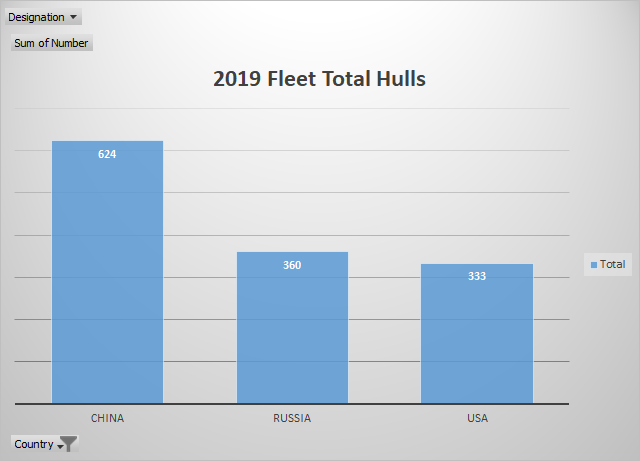
Calculating the power of a fleet is a daunting and imprecise task. In the Washington Naval Treaty, tonnage and gun caliber were used as metrics to set the ratio of capital ships between leading world navies. Capital ships were seen as the supreme arbiters of a naval conflict. The London Naval Treaty established similar rules for tonnage and gun caliber for smaller combatants. The United States Navy counts battle force ships, which includes combat logistics forces, toward its end strength. The battle force ship metric is simple hull count, with T-AKE, PC, LCS, DDG and CVN classes all being counted as equals, despite vastly different mission, size, manning, and capabilities. By a simple measure of hull count from 2018-2019 Jane’s Fighting Ships, the USN has 10 percent fewer warships than Russia, and is half the size of China’s fleet.

2019 Fleet total hull count by country.

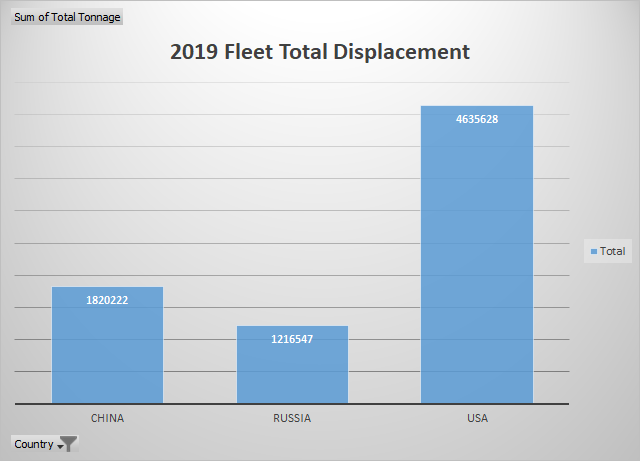
However, when tonnage is used as the metric, the picture changes dramatically:

2019 Fleet total tonnage by country.

This change is unsurprising. The nature of the fleets are significantly different. The USN tends to operate much larger ships optimized for long range power projection. China and Russia have many missile-armed patrol boats and corvettes compared to the relatively few U.S. Cyclone class PC and corvette-like LCSs.

However, does the metric of tonnage truly measure the power of a fleet? The interwar period treaties considered both tonnage and caliber of guns. These two metrics were related, in that larger guns required a larger vessel to carry them. In general, there also was a direct correlation between the caliber of the gun and its destructive power.  Tonnage also affected how much armor could be carried to protect against gun hits. Another metric used to compare warship power was broadside throw weight. This was the total mass of shells a ship could deliver in a broadside against an adversary. A heavier broadside could be expected to triumph against less armed opponents. However, in the modern era, guns have been eclipsed by missiles as the primary weapon of naval combat. While battleships carried far more powerful weapons and were relatively immune to the deck guns of small combatants, the same is not true of missiles today.  Very similar if not identical anti-ship missiles are carried by small patrol combatants and mounted on the largest combatants, sometimes in identical quantities (eight being a popular number). While the defensive and damage control capabilities of larger vessels may be greater, it still seems likely that a few missile hits will knock most ships out of action, if not sink them. If missiles are the true measure of a fleet’s combat power, then neither tonnage nor hull count is an appropriate metric, because neither is directly related to a ship’s missile capabilities.

For the sake of this analysis, we will borrow Robert O. Work’s concept of battle force missiles (BFM) from his “To Take and Keep the Lead” monograph. BFMs are missiles that “contribute to battle force missions such as area and local air defense, anti-surface warfare, and anti-submarine warfare. Terminal defense SAMs, which protect only the host ship, are not considered a battle force missile.” Thus, weapons like RAM, ESSM, SA-N-9, Mistral, and HHQ-10 point defense SAMs would not count toward the tally of BFM. ASROC, Harpoon, Tomahawk, Standard Missiles and non-U.S. equivalents do count. Generally speaking, BFMs cannot be reloaded at sea, unlike shorter-range defensive missiles. They are too large and unwieldy. As such, they also serve as a cap on the offensive or defensive power a ship can provide. When BFMs are exhausted, the ship must return to a secure friendly port to rearm.

The ship numbers and missile capacity considered below were taken from Jane’s Fighting Ships 2018-2019 as a standard reference. In some cases, there are issues with overlap. For example, some U.S. Mk 41 VLS cells can carry a BFM, or quad-packed ESSM, which would not count. Russian vessels are able to fire SS-N-16 Starfish anti-submarine missiles from their torpedo tubes. While SS-N-16 (like ASROC) would count as a BFM, Jane’s did not have a magazine capacity of how many were carried by Russian warships. So, this BFM-launched via surface ship torpedo tube was ignored. Submarine heavy weight torpedoes were counted. While they may not be missiles, they are a primary anti-surface warfare weapon and, in some subs, are interchangeable with BFMs for strike or anti-ship missions. Finally, there was not complete data for all classes (e.g. number of torpedoes carried), so data was extrapolated from similar designs. The results of this BFM count are in the chart below.

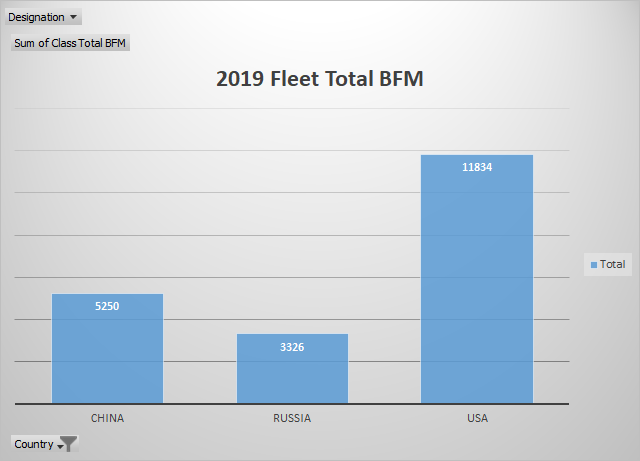
2019 Battle force missile total by country.

This accounting of fleet firepower shows the USN has more than twice the BFM of the Chinese PLAN. The gap is even larger if the contribution of carrier-born aircraft is considered. The U.S. has an almost twenty-fold advantage in fixed-wing aircraft operating from ships. Carrier-born aircraft, especially from CATOBAR carriers, can carry multiple BFM and can reload aboard the carrier. In addition, the carrier can have its magazines reloaded at sea, something other ships cannot do with their BFMs. However, it is worth noting that China’s BFM count gained over 1000 missiles since 2017, and the U.S. number has been relatively static.

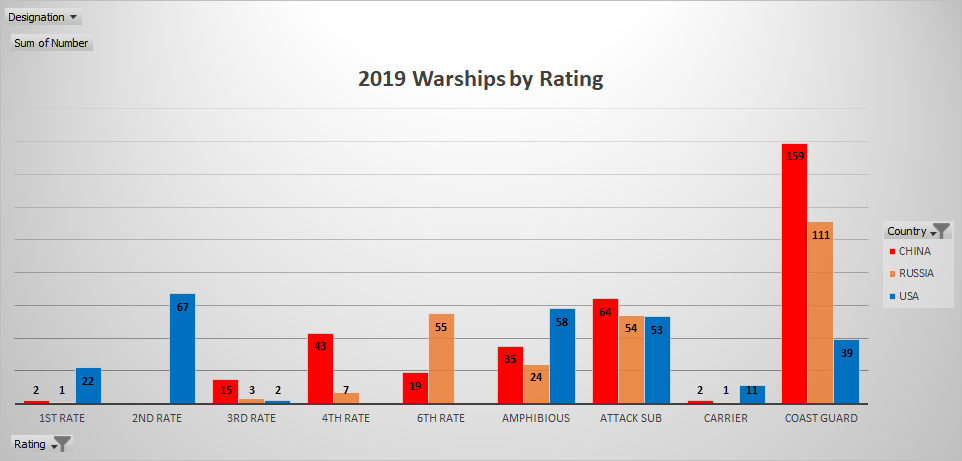
Using BFM as a fleet metric also allows for different ship sizes. A U.S. Flight IIA Burke class DDG with 96 VLS tubes provides the same BFM capacity as 12 patrol boats with 8 missiles each. Who would win in such an engagement would probably hinge on who had better intelligence, surveillance, and reconnaissance (ISR) support to target the other first. However, twelve patrol boats also have the advantage of being able to be in multiple places at once and needing at least 12 hits to defeat far more than the Burke could likely endure.  Continuing with Robert Work’s characterization, we can classify ships by their BFM count. Currently, warships have classifications of cruiser, destroyer, frigate, corvette or similar based more on politics than clear distinctions. What Work recommended was similar to the old system of classifying ships by guns. In this case, missiles instead of guns. First-rate warships (>100 BFM), second-rate (90-100 BFM), third-rate (60-89), and on down to unrated warships with negligible missile capability. For this analysis, the author augmented Work’s lower ratings with fourth-rate (40-59 BFM), fifth-rate (20-39 BFM), sixth-rate (6-19 BFM), and unrated as < 6 BFM. This reclassification produces the following fresh perspective:

2019 Warships by rating.

There is a clear USN preference for heavily armed surface combatants compared to potential adversaries. The one Russian Kirov is rated as a first-rate warship, but is barely a blip compared to the U.S. Ticonderoga-class cruisers. The Chinese Type 055 arriving into service will provide China with first-rate warships as well, but still a fraction of the number the USN has. The two U.S. Zumwalt DDGs in 2019 are third-rate ships-of-the-line, but have scores of better armed compatriots compared to the Chinese third-rate vessels. None have a fifth rate combatant (6-20 BFM) unless it is a submarine.

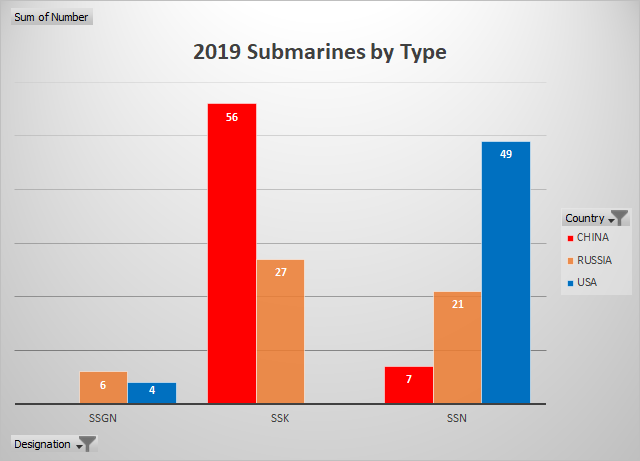
The chart above could spark concern at the rough parity in attack submarines between the U.S., Russia, and China. However, when broken down by type of submarine, the picture changes. The USN relies exclusively on nuclear-powered submarines to provide longer range, greater speed, and more submerged endurance compared to diesel or air-independent propulsion (AIP) submarines. This is because the U.S. plans an “away game” with submarines deployed far from U.S. shores, while Russia and China expect to be using their larger conventional submarine fleets close to home.

2019 Number of submarines by type per country.

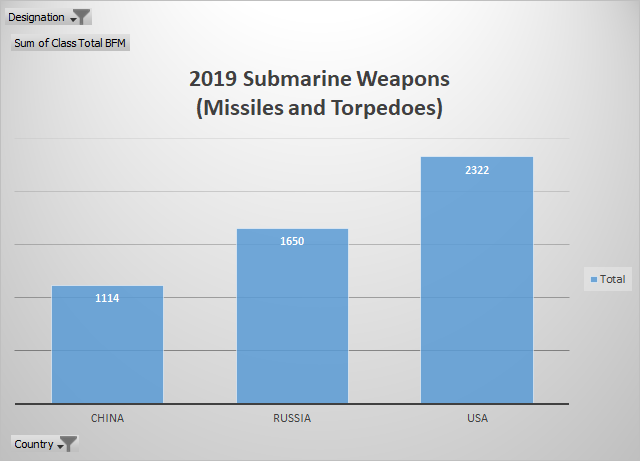
When the metric of BFMs (including torpedoes) is applied, the U.S. is also shown to have a significant lead in subsurface firepower. While the U.S. has fewer SSGNs than Russia, they carry far more missiles per submarine. The three Seawolf SSNs also have an extra-large torpedo load, as do Los Angeles and Virginia class SSNs fitted with vertical launch tubes, to give them more weapons than other subs their size. This allows them to stay in the fight longer before returning to reload. Newer Virginia class submarines will have the Virginia Payload Module (VPM) installed, further increasing their firepower.

2019 Number of submarine weapons by country.

Of course, any single metric will fail to capture the power of a fleet. Informed opinions will differ on the correct offensive and defensive load mix for a warship, or the qualities of a Harpoon ASCM compared to a P-270 Moskit, 3M-54 Club, or YJ-18. Some of these issues are discussed by Alan Cummings in his 2016 Naval War College Review article on Chinese ASCMs in competitive control. In that article, he shows that for anti-ship firepower, U.S. surface vessels are severely over-matched. However, after 2016, VLS options for surface strike (SM-6 and Maritime Strike Tomahawk) have become feasible. Since the mixture of weapons in a VLS tube battery is variable, the number of cells may now provide a better metric than calculations assuming weapons loads. In addition, one must consider crew quality, training, and readiness as components of fleet power. National character and experience as a sea power also come into play. However, all of these qualities are hard to ascribe metrics to, and arms control treaties and analysts focus on measurable and verifiable metrics.

Conclusion

In the end, a fleet must be measured against what it is expected to do. For power projection abroad, a large number of BFMs (or carriers supporting strikes) would be more capable of performing the mission. Close to home, vessels can more easily return to friendly ports to rearm BFMs, so the total at sea may be less important. Even at equal numbers of BFMs, a fleet concentrating them on a smaller number of high-capacity platforms would be less able to control sea-space than a fleet that spread the same number of missiles over a half-dozen combatants. The more distributed fleet would also be more tolerant of losses. Currently, the USN has its power concentrated in high-end warships, be they carriers, large surface combatants, or nuclear submarines. However, this also makes the USN susceptible to major losses, especially if defenses don’t work as well as expected.

The U.S. has a significant lead in BFMs, but also has global commitments which may drastically reduce how many BFMs can be committed to a particular theater. In the western Pacific, the PLAN is rapidly narrowing this lead. As the United States builds towards a 355-ship Navy, it will need to carefully consider the missions required and, in wartime, the firepower required, to accomplish them.

Commander Keith “Powder” Patton is the Deputy Chair, Strategic and Operational Research Dept (SORD) at the Naval War College. The views expressed in this piece are his own and do not represent the official views of the Navy or the Department of Defense.

Featured Image:  September 3, 2005. US Navy (USN) Sailors aboard the Arleigh Burke Class (flight I); Guided Missile Destroyer, USS FITZGERALD (DDG 62) inspect the MK 41 Vertical Launching System (VLS) for water to prevent electrical failure. (Photo by: PHAN Adam York, USN)

A Bomber for the Navy

This article originally featured on Over The Horizon and is republished with permission. Read it in its original form here.

By Will Spears and Ross Hobbs

Abstract: Rather than sending the B-1 Lancer into early retirement, the Department of Defense could transfer it to the Navy for duty as a land-based ship-killer. Considering its speed, range, payload, and flexibility to employ the new Long-Range Anti-Ship Missile (LRASM), the B-1 is an ideal candidate for rebirth as a Sea Control Bomber.  

For better than a decade, the United States’ defense establishment has agonized over China’s aggressive military modernization. A growing arsenal of land-based anti-ship missiles abets an increasingly capable and assertive Chinese navy, threatening to quietly transform the East and South China Seas into de-facto Chinese territory if not forcefully challenged. The military aspects of this competition demand an ability to fight in the contested environment, prompting the development of concepts like the former Air-Sea Battle and its successor, JAM-GC, as well as a steady drumbeat of calls from senior leaders for disruptive thinking and creative solutions.

It was in this spirit of disruptive thinking that, at a CNAS-hosted panel discussion titled “A New American Way of War,” former Deputy Secretary of Defense Robert Work casually offered up a fascinating bit of heresy:

“If the Air Force is getting rid of the B-1 bomber, I’d say ‘You are out of maritime strike.’ We’re going to give the B-1 to the Navy, we’re going to load up with 3,000 LRASMs, and we’re going to base them in Guam and all over the place, and in the first 72 hours [of a conflict] they are going to go out and hunt down and kill every ship in sight.”

Amateurs gush disruptive ideas all the time, but when an industry heavyweight like Robert Work speaks out, it’s prudent to explore his opinions. Work’s conjecture was nested in a broader discussion, beginning around the 53-minute mark, lamenting the self-imposed limitations of “jointness” in driving procurement decisions. Rather than treating land-based strike as a proprietary mission of the Air Force, Work suggests that the Navy revive its concept of the Patrol Bombing (VPB) Squadron, which employed land-based aircraft to sink enemy ships in WWII. A force of LRASM-equipped naval patrol bombers, Work contends, could destroy an adversary’s fleet from the air without tangling with its anti-ship missile systems.

“In other words,” Work continued, “give the whole Chinese anti-access / area denial network no targets to shoot at.”

Secretary Work is not the only defense expert to propose that the Navy get into the bomber business. Analyst Robert Haddick devoted several pages of his influential book Fire on the Water to the idea. Unlike Work, Haddick proposed that the Navy acquire its own fleet of the next-generation Long Range Strike Bomber (or what has become the B-21), in a joint arrangement with the Air Force. To pay for it, Haddick suggested that the Navy scale back on purchases of the Gerald R. Ford-class aircraft carriers, F-35C Joint Strike Fighters, and DDG-51 Arleigh Burke-class destroyers, which he argued would be of limited usefulness in a missile-contested environment. Haddick wrote:

“With these stealthy bombers instead, the Navy would have maritime airpower that would actually be useful against China’s navy under way in the heavily defended Near Seas and against the PLA’s naval bases and ‘anti-navy’ forces—missions too dangerous for the Navy’s aircraft carriers and destroyers.”

Work and Haddick both recognized that a Navy-operated bomber runs against contemporary notions of “jointness,” notions which Work characterized as a “monolithic cudgel.” They both emphasized the importance of mission effectiveness, or “what can get the job done,” over parochial service interests or respect for swim lanes. For Haddick, specifically, it’s all about who is responsible to achieve control of a contested sea—a perennial Navy mission. If the Navy will be held accountable to control the sea, Haddick argued, then it should have the tools necessary to do it. That, to Haddick, means bombers. He continued:

“Under the theories of Air-Sea Battle and joint operational access, it shouldn’t matter which service, or combination of services, actually does the work. But in practice, the Navy will have the most intense interest both in maritime challenges, such as land-based “anti-navy” forces, and in development of the capabilities and doctrine necessary to cope with such challenges. Top-level policymakers interested in making sure the “anti-navy” problem is fixed will have a strong reason to assign the problem—and the resources—to the Navy.”

2
A B-1B releases a LRASM during early trials of the AGM-158C anti-ship missile. The B-1 is the first aircraft to become operational with the weapon. (Lockheed Martin)

Fire on the Water was published in 2014, and while it has become required reading in war colleges for its depiction of China’s military expansion, Haddick’s call for a naval variant of the Long-Range Strike Bomber never garnered much attention. Concern over the high-end fight has only grown, though, and Work’s recent conjecture is a case in point which reframes Haddick’s argument. A rigorous testing program has determined the B-1 could fly through 2040 without a major life extension, but the Air Force has decided to retire it early to make room for the B-21 Raider. What if, instead of going to the boneyard, the B-1 were reassigned to the Navy?

The B-1 as a Sea Control Bomber

The Rockwell B-1 has had an interesting ride as a program of record. Designed to replace the 1960s-era B-52 as the Air Force’s primary nuclear bomber, the first B-1A flew in 1974. It was canceled by the Carter administration before entering production but then revived as the B-1B Lancer under Reagan. The B-1B featured improved avionics and greater payload than its predecessor, as well as an 85 percent reduction in radar cross-section at a slight penalty to speed. 100 were built; 63 remain in service today. It was divested of the nuclear mission in 1994, its enormous bomb bays repurposed to a variety of conventional attack munitions.

A classic example of Cold War-era design for lethality, the B-1 offers a combination of speed, flexibility, payload, and range that remains unmatched in its class. Capable of traveling for hours at near supersonic speeds, it can surge across vast oceans faster and with less refueling support than any current US or allied nation aircraft. It is also more maneuverable than other bombers and far more flexible. B-1 crews train at both high and low altitudes to perform a variety of mission sets, including large-scale standoff weapon attacks, large-scale Joint Direct Attack Munition (JDAM) attacks, Close Air Support (CAS), Strike Coordination and Reconnaissance (SCAR), Non-traditional Intelligence, Surveillance, and Reconnaissance (NTISR), and Air Operations in Maritime Surface Warfare (AOMSW) which includes Counter Fast Attack Craft (FAC)/Fast Inshore Attack Craft (FIAC), Aerial Mine Laying, and War at Sea against surface vessels.

The Navy’s primary use for the B-1 would be for the delivery of standoff weapons like LRASM or the Joint Air-to-Surface Standoff Missile (JASSM) against peer adversaries. These could destroy high-end warships and coastal cruise missile systems on short notice and from a comfortable distance, creating multiple avenues of approach for distributed naval forces. In scenarios short of war, they provide a powerful deterrent to maritime aggression, demonstrating both the capability and the resolve to project power into a contested environment. In asymmetric or low-intensity conflicts the B-1 would continue to deliver the same versatile combat power that it has for decades, only it would be administered by the Navy instead of the Air Force.

This versatility is probably the B-1’s most compelling feature. Of all bombers in service, the B-1 doesn’t just carry the largest payload (75,000 pounds; the B-52 and B-2 carry 70,000 and 40,000 pounds respectively), but its repertoire of supported weapons and combat systems is among the most elaborate fielded by any aircraft today. Included are the aforementioned long-range standoff weapons (LRASM and JASSM), as well as GPS- and laser-guided JDAMs (GBU-31, 38, 54), unguided bombs and sea mines (Mk-82, 84, 62, 65), and a multitude of sensors including the Sniper targeting pod and a Synthetic Aperture Radar. It also features a powerful defensive avionics suite, capable of providing electronic countermeasures against advanced threat systems.

Some examples of potential Navy combat loadouts and mission sets are below. B-1 squadrons normally train to a minimum of two aircraft for a given mission, so the ordnance brought to bear would probably reflect some multiple of the following:

  • Sea Denial: 24 LRASM
  • A2/AD Rollback: 8 LRASM & 16 JASSM
  • Strategic Attack: 24 JASSM
  • Aerial Mine Laying: 84 Mk-62 or 12 Mk-65
  • Counter FAC/FIAC: 10 CBU-105D/B and 6 GBU-54
  • CAS for SOF/USMC: 8x GBU-31, 6x GBU-38, 6x GBU-54

3
Two U.S. Air Force B-1B Lancer bombers fly from Andersen Air Force Base, Guam, for a mission, with an escort of a pair of Japan Self-Defense Forces F-15 fighter jets and U.S. Marines’ F-35B fighter jets in the vicinity of Kyushu, Japan, in this photo released by Air Staff Office of the Defense Ministry of Japan August 31, 2017. (Air Staff Office of the Defense Ministry of Japan/HANDOUT via REUTERS)

In addition to firepower, versatility is also a function of range. Without aerial refueling, the B-1 can fly for over 8 hours, or approximately 3,500 nautical miles. To put this in perspective, it can fly from Hawaii to Guam without refueling, or perhaps more pertinently, from Guam to the Taiwan Strait and back. With refueling, B-1 missions have exceeded 24 hours. A notional Concept of Operations could distribute the B-1 fleet between CONUS naval air stations and established overseas airbases like Andersen (Guam), Hickam (Hawaii) and Al Udeid (Qatar). Like they are today, these would remain on-call 24/7 for immediate response to emergent tasking with or without aerial refueling. Deployed in concert with missile-bearing attack submarines, and empowered by flexible refueling options like carrier-based unmanned tankers, a distributed force of Sea Control Bombers would present a complex and risk-prohibitive planning dilemma to any would-be maritime aggressor.

Many critics would argue that any new aircraft acquisitions should be unmanned. That may be true, provided that we ignore the unresolved issues with autonomous targeting in a communications-denied environment. At any rate, the B-1 is not a new acquisition; it is a thoroughly established system. In this sense it can serve as a proof-of-concept, buying time for an autonomous replacement to achieve Initial Operational Capability (IOC).

Costs

For navalists intrigued by the B-1’s superlative capabilities, excitement should be tempered with respect for its costs. Unsurprisingly, the B-1 is a labor-intensive beast, demanding 74 maintenance man-hours per flying hour (MMH/FH) with an estimated cost per flying hour of $70K (to be fair, the B-52 also costs about $70K per flying hour, while the B-2 costs between $110K and $150K). These are Air Force estimates and may not be perfectly fungible with the Navy’s models for aircraft ownership costs, but their implications are clear. Even if the B-1 fleet were reassigned to the Navy “free of charge,” there is little doubt that manning and maintaining it would be expensive.

4

Then there’s the matter of age. Due to factors like fatigue and diminishing manufacturing sources, aircraft tend to become more expensive to keep airworthy as they get older. While various modernization efforts have prevented the B-1 from falling into obsolescence, the airframe is clearly in the “aging” phase of its life cycle, as Congressional Budget Office analysts found that the B-1’s cost per flying hour grew by a real rate (i.e., independent of inflation) of 2.9% between 1999 and 2016.

5

Some of the B-1’s ownership costs will be reduced through modernizations as moving parts are eliminated and high-failure electronics are replaced with solid-state circuitry. Some of these modernization efforts are in progress today; others were shelved with the decision to retire the B-1 but could be revived. Additional savings could be gleaned by accepting sacrifices in performance, as might be prudent upon reassignment of the B-1 to a different mission. For instance, if the Sea Control mission set does not require supersonic speeds, the B-1 could be outfitted with engines that are less powerful but more reliable and fuel-efficient. Any such modifications would demand an initial injection of funding, though, as would the necessary modernizations to keep the airframe flying through 2040 or beyond.

Heresy

When viewing B-1’s costs against the anticipated price of the B-21 Raider program, it’s little surprise that the Air Force is ready to retire it. It is hardly efficient to support four different classes of bomber simultaneously. Their decision raises the question, though: If the B-1 is too expensive for the Air Force, whose primary mission is long-range strike, then how could it be affordable to the Navy, whose primary mission is not long-range strike? If the B-1 were reassigned to the Navy without additional funding to man and maintain it, then it could easily turn into a financial albatross, diverting resources from core Navy priorities (e.g., warships) to essentially duplicate the capabilities of a sister service.

The heresy of a Navy-operated, land-based long-range bomber crosses service lines. For the Air Force, it would represent an intrusion upon what has long been its operational territory as well as the original rationale for its existence as an independent armed service. From a more practical standpoint, rather than turn over a fully furnished weapons system to another service, Air Force leadership would almost certainly prefer to gut the B-1 and its associated logistics tail, keeping the useful parts inside the Air Force.

For the Navy, practical concerns could be difficult to distinguish from emotional resistance, because taking on the B-1 would probably demand sacrifices in some programs more traditionally recognizable as “Navy.” In theory, being land-based should have no bearing on the B-1’s legitimacy as a naval instrument, because the Navy has long relied upon land-based aircraft. Platforms like the P-8 Poseidon and the MQ-4C Triton are critical elements of today’s balanced fleet. In reality, though, a heavy bomber like the B-1 would upset the balance, instantly becoming one of the Navy’s most exquisite and potent offensive weapons. It would give credence to the charge, which the Navy denies carefully, that major surface combatants and aircraft carriers are too vulnerable to fight under threat of weapons like the DF-21D.

At issue is the Navy’s sense of identity, and whether it is derived from what a navy is (ships and aircraft… but principally ships) or what a navy does (control the maritime domain). Indeed, many of the Navy’s traditional missions would receive no value from the B-1. It cannot pull into a new ally’s port for a courtesy visit, nor can it board and search a vessel suspected of trafficking weapons. It cannot destroy a midcourse ballistic missile, nor can it hunt and kill enemy submarines. What the B-1 can do is sink ships, a lot of them, and quickly. It can do this on short notice across vast distances, and it can do it without engaging “A2/AD” missile systems. That the Navy could use a weapon like that is beyond dispute; whether it should, depends on what the Navy would give up and the relative importance of the Sea Control mission. It is worthy of analysis.

Ultimately, it may not be about what either service wants, but what Congress wants. The B-1 fleet is a major investment of national treasure, and Congress could decide that it should be kept airworthy through the entirety of its service life as a matter of good stewardship. Some representatives, ostensibly concerned about peer adversaries and a relative decline in US military power, may prefer to keep the B-1 flying in whatever capacity could be justified. Under this scenario, it would certainly be simpler and cheaper to keep it under the Air Force, unless Congress was persuaded that the Navy would make better use of it.

6
B-1B Lancer flying over the Pacific Ocean. (U.S. Air Force Photo/Staff Sgt. Bennie J. Davis III)

Closing Thoughts

The B-21 is expected to reach IOC in the mid- to late- 2020s, with the phase-out of B-1 beginning in 2030. Air Force Global Strike Command has already begun to shift focus away from the B-1, having announced intentions to extend the B-52 through 2050. Once the B-21 starts flying, support for B-1 will almost certainly stop. Considering these timelines, if B-1 were to be reassigned to the Navy, the ideal time for transition would be sometime between 2028 and 2030.

The B-21, similar to the B-2 in its design concept and stealth features, is not capable of replacing the B-1’s speed, flexibility, or payload. The early retirement of the B-1 will represent a decline in flexible US striking power across all Unified Combatant Commands at a time when it is needed most. Ideas for keeping that power at the ready, however unorthodox, should be explored thoroughly. This article’s purpose has not been to advocate for the B-1’s reassignment to the Navy, but to advocate for its consideration by a third party independent of service biases. Without thorough and professional analysis, there are too many variables at play to comment on whether this idea would be good or bad for the Navy, the Air Force, or the nation. This much is certain though: The B-1’s continued service would be bad for the PLA Navy.

LCDR Will Spears is a US Navy submariner and a student in the Multi-Domain Operational Strategist concentration at the Air Command and Staff College. He has served aboard multiple attack submarines in the Western Pacific area of responsibility. 

Maj Ross “RAW” Hobbs is a B-1 Weapons Officer Instructor Pilot and a student in the Multi-Domain Operational Strategist concentration at Air Command and Staff College.  He has over 2,000 hours of flying in the B-1 and other platforms with multiple deployments, including the Western Pacific area of responsibility.

The views expressed are those of the authors and do not necessarily reflect the official policy or position of the Department of the Navy, the Department of the Air Force or any organization of the US government.

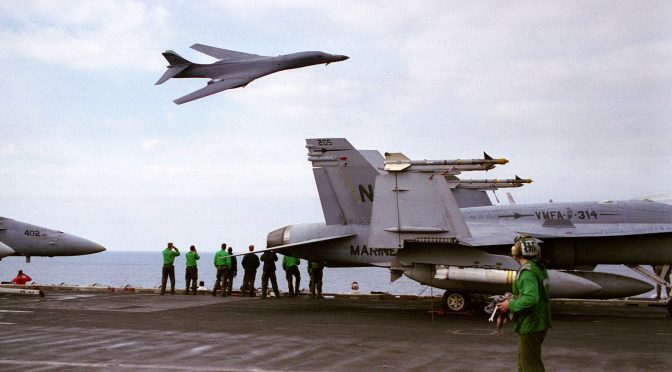
Featured Image: A U.S. Air Force B-1 Lancer Bomber flies by the aircraft carrier USS NIMITZ (CVN 68). Nimitz is deployed to the Persian Gulf in support of Operation Southern Watch, 12/25/1997 (PH2 Christopher G. Ware)