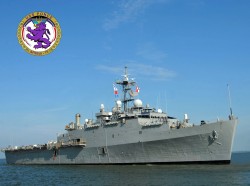
The contributions of Civilian Mariners (CIVMARS) from Military Sealift Command (MSC) are normally associated with the Combat Logistics mission; however, recent experiments with USS PONCE and other hybrid-manned ships demonstrate a compelling case for further CIVMAR integration into U.S. Naval units. MSC has been in existence since 1949 as an operator of non-naval government ships, in its current name and organization since 1970, and an operator of naval service support ships since 1972. The Navy first experimented with the assignment of CIVMARs to combatant ships in 2004, when MSC personnel were assigned to the USS Mount Whitney (LCC 20). Subsequent to that first trial the Navy has also re-assigned its Safeguard class salvage ships completely to MSC control and converted substantial parts of the ship’s complement of the tenders USS Emory S. Land and USS Frank Cable. Most recently the Navy assigned CIVMAR’s to the first Afloat Forward Staging Base (AFSB) USS Ponce, formerly LPD 15 forward deployed in the Persian Gulf. When the Navy decided to reverse the decommissioning of PONCE, the 360 billets were liquidated and the only means of manning the ship in haste were CIVMARs and Individual Augmentees (IA’s) from the Fleet. Ponce’s proven worth after one year of operations presents an attractive means for delivering capability at a reduced cost when considering Ponce is operating with 140 fewer personnel than the naval version of the Landing Platform Dock (LPD). Questions remain whether the low cost of employing CIVMAR’s minimum manning methods can help conserve Navy resources for other priorities?
The first efforts to integrate CIVMAR’s into combatant naval vessel crews came in the early 2000’s as the Navy’s inventory of conventional steam-powered ships plummeted due to age and replacement ships employment of different propulsion systems. Many Civilian mariners are former naval personnel and have extensive experience in the operation of steam propulsion plants. They were considered an ideal choice to keep aging naval steam plants properly resourced and functional at a lower cost than current naval personnel who would require re-training to operate legacy propulsion systems. A 2005 report by the Center for Naval Analysis (CNA) warmly endorsed the concept of using CIVMARs in a host of positions on combatant ships. The study also recommended that the Navy adopt many CIVMAR low cost/minimum manning techniques as a way to both improve U.S. warship maintenance and operation. The experiments on Ponce and other ships have tested many of the CNA report’s proposals. The results indicate some distinct organizational, operational, and cultural differences in the MSC and U.S. Navy. An updated version of the CNA 2005 report is in order. It should determine what strengths and weaknesses greater assignment of CIVMAR’s to combatant ships would bring, as well as consider what CIVMAR best practices the Navy might adopt in order to reduce costs but preserve combat efficiency.
The CIVMAR community has a number of professional strengths. First and foremost, CIVMAR’s emphasize pre-planned and economical operations. “Routine” and “predictable” is entirely in line with their merchant background. Their mission is to move a ship and its cargo on as straight a line as possible from point (a) to point (b) at its most economical speed and do so with the bare minimum of fuel, personnel, and other resources. To meet these requirements, CIVMARs operate precisely and professionally in all ship handling and engineering procedures. Deck officers are licensed with a significant higher level of navigation skills than that of the standard U.S. Navy officer and engineering officers not only orchestrate and manage the engineering plants, but are hands-on operators who actually conduct many equipment repairs. CIVMARs are paid by the hour and are on the ship to work. The Commanding Officer of Ponce put it very succinctly as follows; “You will not find TVs in CIVMAR workcenters. They are “workcenters” not “entertainment centers…and when you pay by the hour, you manage by the hour.”
The CIVMAR community also brings cultural disadvantages that make integration with naval personnel a challenge. The CIVMAR focus on regular, cost efficient operation does not always lend itself to the non-routine and unpredictable operations of a combatant warship. CIVMAR Engineering officers do not “tear down” equipment for inspection or as part of regular maintenance. They do not drill down equipment during casualty control drills, shift equipment daily, or subject their plants to excessive changes in speed that are regular operating characteristics of warships. They are very proficient in damage control, but if an MSC ship suffers damage, the operating ethos is to save the ship rather than fight the ship. CIVMAR bridge officers and topside personnel are equally devoted to routine rather than multi-disciplinary operations. The bridge on an MSC ship operates with a fraction of the personnel assigned to a U.S. Navy condition 1 or even condition 3 watch, but the expectations for what that watch is capable of are significantly reduced. CIVMAR deck officers drive in straight lines. They are unaccustomed to steaming boxes or formation operations and they are not familiar with concepts like navigating swept channels and are unfamiliar with maneuvering to avoid missiles/torpedoes. The concept of having the Combat Information Center (CIC) disagree with their course and speed recommendations can be disconcerting to some CIVMAR Mates of the Watch (MOW’s). Some of these cultural divisions between MSC and USN are significant, and would require a good deal of patience and maturity on the part of both communities for effective integration within the lifelines.
Despite these big differences, the CIVMAR experiment on USN ships to date has been generally successful, especially in getting further service life out of aging steam-powered ships. There are aspects of MSC operation from which the U.S Navy could certainly benefit. The MSC system of engineering watch standing and record keeping (both automatic and paper records) was sighted by several USN officers as more efficient and easier to use than current Navy procedures. A CIVMAR-style engineering watch organization might be beneficial on diesel-powered amphibious warfare ships like the Landing Ship Dock (LSD) class where consistent, most economical speeds are more the norm than in surface combatant vessels. Navy Officers of the Deck (OODs) and Navigators would benefit from the U.S. Coast Guard-tested standards of CIVMAR navigation knowledge. The Navy might consider the assignment of a CIVMAR navigator to smaller Navy ships in a role similar to the Master position of the days of sail. Such an officer would be subordinate to the executive officer and perhaps serve as the actual navigator and principle advisor to the ship’s commanding officer on all aspects of good seamanship. The amount of training potential embodied in this individual is enormous and benefits might include an enhanced knowledge of navigation at all levels of the ship’s company. A similar position might be considered for a ship’s engineering department in the form of a Maintenance expert along the lines of the old ship’s carpenter from the sailing navy.
In conclusion, the U.S. Navy has proven success with using CIVMAR’s to gain additional service life from aging ships. Successful integration of these two different cultures on combatant ships remains to be seen, but the model seems to be working on the ships where it is currently employed. Finally, the U.S. Navy should consider further exploiting the wealth of knowledge inherent in the CIVMAR ranks by assigning senior CIVMAR experts to smaller combatants as navigation and maintenance experts. The education benefit for all hands in such an assignment is substantial and might significantly improve naval standards for navigation and maintenance in smaller crews at minimum cost. The Navy should also commission a follow-up study to the 2005 CNA report on CIVMAR manning on Navy ships in order to re-assess those concepts in light of results from the experiments on Ponce, Mount Whitney, and the submarine tenders. The CIVMAR experiment has been useful, but needs a re-evaluation based on these recent experiences in order to move effectively forward.
Steve Wills is a retired surface warfare officer and a PhD student in military history at Ohio University. His focus areas are modern U.S. naval and military reorganization efforts and British naval strategy and policy from 1889-1941. He posts here at CIMSEC, sailorbob.com and at informationdissemination.org under the pen name of “Lazarus”.
The fight over funding the federal government and raising its debt limit may be over for the moment, but other debates rage on. One of the more vexing ones that has been touched upon most recently in the arguments over possible military intervention in Syria is the relationship between America’s defense posture and its role in the world.
Both parties, in fact, seem to be at a loss in grappling with this question. While the Administration has had to walk a fine line regarding appearing weak over threats made with regard to Syria and landing the U.S. in a war it does not want, the Republicans and like-minded conservatives have been debating amongst themselves policies ranging from American retrenchment, advocated by the likes of Rand Paul, and paying the price of continuing and indeed extending American primacy, as advocated by organizations such as the American Enterprise Institute.
Lost in the heated argument, however, are certain immutable facts regarding the situation America is actually in when it comes to defending itself and its allies. The picture that emerges does not look good either for those who want America to come home or for those who favor a more expanded international security role. Looking at it, though, is the first step toward any kind of sane defense policy, one which probably will not resemble that advocated by either camp.
Submitted for consideration, therefore, are eight of these realitiesm:
1. America’s defense posture is driven largely by its expensive and possibly unsustainable counterproliferation policy.
Ever since the fall of the Soviet Union, and to some extent before, U.S. foreign policy has fixated on preventing the horizontal proliferation of nuclear weapons. While the exact number of weapons held by states already recognized as nuclear powers (particularly the five declared nuclear states under the Non-Proliferation Treaty) might be up for negotiation, the U.S. has endeavored with all the means at its disposal to prevent new nuclear powers from emerging. Although a wide variety of policy tools are at the U.S.’ disposal to accomplish this, the most critical ones have involved the U.S.’ overall military posture: the U.S. has sought either to reassure allies that it would come to their aid (with its nuclear arsenal) if they were attacked, or else to use force to prevent hostile states from acquiring nuclear arsenals of their own. The former policy has encompassed the likes of South Korea, which the U.S. is reported to have talked down from building its own nuclear arsenal in the 1970’s. The fact that three key U.S. allies in the Pacific – Japan, South Korea, and Taiwan – could easily go nuclear in a matter of weeks or months if they ever feared for their safety and doubted U.S. resolve reinforces the point: the U.S. has to maintain enough spare military capability to defend these allies if it wants to convince them they do not need nuclear arsenals of their own.
It used to be that the U.S. protected key allies because they could not protect themselves. Increasingly, the U.S. protects its allies because it fears they will protect themselves.
Interestingly, this also has effects when it comes to the U.S.’ management of its nuclear deterrent against larger powers. Since the U.S. military cannot be everywhere at once, a critical component of the U.S. security umbrella is its willingness, if necessary, to use nuclear weapons in a crisis – this being the case, it cannot renounce the first-usage of nuclear weapons as some arms control advocates have suggested. That is, unless, of course, it comes up with far, far more conventional resources, for the problems of which see what follows.
As for preventive warfare, the fact that this policy led to a woefully misguided war in Iraq – in which suspicions of a nascent nuclear arsenal turned out to be completely false – has not prevented two successive U.S. presidents – Bush and Obama – from threatening the use of force to shut down or delay the Iranian nuclear program. (While it is essentially too late to do anything about North Korea’s nuclear program, the latter is almost certainly the exception that proves the rule: the U.S. has done everything it could afford to do, and it remains militarily engaged, even if it has avoided open war.)
There are other reasons why the U.S. maintains so much force projection capability, of course. What cannot be denied, however, is that as long as the U.S. remains committed to preventing a nuclear arms race along the edge of the Eurasian landmass (what the strategist and former U.S. national security adviser Zbigniew Brzezinski called the “arc of crisis”), its military commitments to the world at large cannot be allowed to shrink. Which brings us to…
2. There is no one else who can shoulder or share the burden of enforcing the counterproliferation regime, and a number of powerful states are seeing to it that the U.S. carries great expense from doing so.
By all publicly available accounts, Iran bled the U.S. in Iraq after it invaded to stop a purported Iraqi nuclear arsenal; it then held great influence over, and access to, the new, Shi’ite led government. The next time, wherever it occurs, will be worse. We have only to imagine what China or even Russia might do in the event of a U.S. invasion of Iran.
Conversely, there is literally no great power anywhere – not Europe, not China, not Russia – that can either wage war to stop would-be nuclear proliferators or guarantee the security of smaller states that might otherwise seek arsenals for their own defense – even if any of these states had any inclination to do so. As long as the U.S. remains committed to keeping the nuclear genie in the bottle, it is on its own. And speaking of which…
3. America’s strategic rivals are getting more powerful.
China and Russia are both modernizing their militaries. Russia plans to modernize its military extensively by 2020, with a particular emphasis on new fighters for its air force and submarines for its navy – the projected expenditure by the end of the decade amounts to $650 billion – about a third of Russia’s annual gross domestic product. (For comparison, imagine a U.S. rearmament program that deployed $500 billion a year for ten years on top of current U.S. expenditure.)
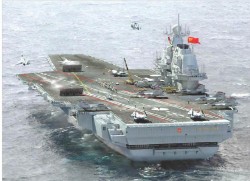
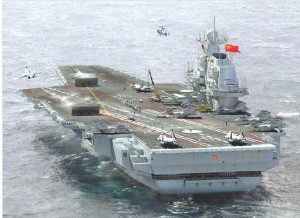
Notional chinese carrier from unclass 2009 ONI report.
China is in the process of acquiring aircraft carriers and long-range precision-strike capabilities that will both expand its military reach and pose a problem for U.S. naval operations in the Pacific. It is in the process of testing missiles that – potentially – could sink U.S. aircraft carriers in a naval confrontation before they were in range to launch their aircraft. Iran has also tested a short-range version of this technology, which could potentially render aircraft carriers – the most lethal and most expensive assets in the U.S. military and the very symbol of American power – as irrelevant as battleships in World War Two.
Defending U.S. allies, in other words, will be more difficult in the next ten years than in the past twenty. Of course, that’s only if the U.S. can even use its military in such a scenario, because…
4. America’s greatest strategic rival is also its greatest foreign creditor.
The U.S.’ ability to defend its allies is in one sense dependent upon the goodwill of the state it might have to defend many of them from, namely, China. Although as of this writing U.S. federal debt is essentially being monetized (at the rate of about $85 billion a month) by the U.S. Federal Reserve, once the long-anticipated “taper” begins, the U.S. will once again be resorting to foreign credit markets. To date, China, with about $1.3 trillion of the $12 trillion of U.S. debt held by the public, is the U.S.’ largest single foreign creditor, narrowly beating Japan’s $1.15 trillion. (In the larger picture, about 47 percent of U.S. federal debt held by the public is owned by foreign governments.)
It is far from clear what might happen to the U.S.-China debtor-creditor relationship – or the U.S.’ relationship with any of its other international creditors – in a crisis. But at the moment, with the U.S. running deficits in excess of $700 billion annually, a situation that, although ameliorated by the sequester, will get worse in this decade as entitlements are strained by an aging population, the U.S. has to tread carefully. We do not know what would happen to the bond markets if the U.S. attempted to fight a war its foreign creditors disapproved of. There are powerful incentives for foreign creditors to say nothing (they obviously do not want their assets to fall in value), but that is not the same thing as saying that there are no risks. Speaking of budgeting…
5. Where the defense budget is concerned, it doesn’t get any better than this.
A less-remarked-upon consequence of the fiscal “sequester” has been a slow erosion of overall U.S. military readiness. On 19 September, the chiefs of staff of the various armed forces testified before the House Armed Services Committee that extension of the current fiscal path prescribed by the Budget Control Act of 2011 – the fiscal compromise that led to the so-called “fiscal cliff” and “sequester” of government spending – would leave U.S. military readiness at an all-time low. Most dramatically, according to Army Chief of Staff Gen. Ray Odierno’s testimony, 85 percent of U.S. Army brigade combat teams would be unready to fulfill their mission requirements. All of the services have already furloughed civilian employees as a result of the sequester, and all of them now face personnel cuts in fiscal year 2014.
The “sequester” was part of a larger effort to control federal spending at a time when deficits had topped $1 trillion a year. Although federal discretionary spending is now being cut in accordance with these measures, little has been done to address the most important long-term drivers of federal debt: Medicare, Medicaid, Social Security, and related entitlement spending, all of which are likely to increase as members of the postwar baby boom generation hit retirement age (the first people generally thought to belong to that demographic began to reach age 65 in 2011). Until these large segments of the federal budget are addressed, even the sequester will not keep deficits down. The latest CBO projection has U.S. federal debt held by the public beginning to climb relative to GDP around the year 2018 after a temporary decline. This, of course, assumes nothing goes seriously wrong with the U.S. economy in the interim.
Not only do deficits remain a long-term problem, but when faced with a choice between their retirement programs and their foreign policy, or between investment capital in an anemic economy and their foreign policy, it is quite likely Americans will choose the former, and there is little that can be done about this for the foreseeable future. It is simply unlikely there will be much more money for anything more than maintaining the status quo in the near future, and even that will be costly and politically divisive.
(It is sometimes claimed either that defense should be excluded from a solution to America’s fiscal problems or that the required increases in defense spending to maintain the status quo are minimal. Neither is persuasive. Political realities dictate that all options remain open for solving America’s fiscal problems, and however small the increases that are asked for may be, the fact remains both that more will ultimately be needed later and that literally nothing is available. It is not possible to discuss spending increases and budget cuts at the same time.)
In the face of rising challenges to its interests and its allies, the U.S. will have to make do with what it has. And it hasn’t been very good about that so far…
6. America’s defense procurement process is hugely wasteful, makes it near-impossible to know how much we “need,” and could cause the U.S. to lose a war.
There is far, far too more that can be said about this than there is space here to write, but, in short, there are serious problems with the way the American military gets its weapons that are rooted in the structure of American governance itself. Put simply, defense projects are local employment programs even when they are national liabilities. Even congressmembers who want to avoid excessive defense spending find it difficult to resist the temptation to vote for programs that route defense money to their districts. In many respects, they would be foolish not to, since, unless a concerted effort is made, the money will likely be spent somewhere regardless, and, from the point of view of their constituents, might as well be spent in their districts so as to recoup tax dollars that would otherwise go elsewhere.
The result is so well-known it has led to its own peculiar slang, documented by defense reform advocates such as Donald Vandergriff, Pierre Sprey, Chuck Spinney, and others. “Front-loading” refers to a contractor offering Congress an overoptimistic cost projection for a weapons system, on the theory that when it costs more, Congress will sink in the requisite extra cash. “Gold-plating” refers to making a weapons system as complex, elaborate, and expensive as possible, the better not only to sell more goods to the federal government, but also to spread the ensuing expenditures among more congressional districts to make a program harder to kill.
The result can be seen in weapons systems like the F-22 and F-35. As a number of defense analysts – notably Pierre Sprey, James Stevenson, and Robert Dilger – have noted, these fighters are larger, more visible, and (certainly in the F-35’s case) less maneuverable than an F-16, have less fuel available for combat, have poor pilot visibility due to the need to maintain “stealth,” probably are not very stealthy since their vaunted targeting radar systems amount to a homing beacon for missiles and since stealth coating is notoriously difficult to maintain, cannot operate at the same operations tempo due to the need for complicated maintenance, and cost several times more than an F-16. The Air Force’s F-16C fighters were obtained in the 1990’s for about $30 million apiece in today’s dollars; the “flyaway” cost (the pricetag for a single new model, without research or maintenance costs) of an F-22, before the program was cancelled, was $137 million. The flyaway cost of an F-35 ($153-199 million, depending on the version) has now exceeded that figure. Ironically, the F-22 was cancelled because the F-35, which was not designed for air combat and has fewer capabilities, was supposed to be cheaper.
(It is often claimed that one advanced “5th generation” fighter such as the F-22 can defeat several F-16’s. This occurs in tests where the F-16’s are not allowed to use radar-seeking technology to target the F-22’s, and in which radar-guided missiles from the F-22’s are assigned unrealistic kill probabilities. In either case, this ignores the fact that one can get several F-16’s and their pilots for the cost of one F-22. It also ignores the historical fact, documented in a 2006 presentation by James Stevenson, that, because of the dynamics of air combat, the more planes that are involved in an engagement, the closer to 50-50 their odds of survival become, regardless of how they are built.)
What this means in practice is that equipment that are too expensive to replace all at once are replaced slowly, resulting in aging. Sometimes this has alarming results: in 2007, older models of the F-15 had to be grounded because they were too old to fly safely; replacements have been slow in coming. Given the costs involved, the F-35 is currently projected to replace all of the Air Force’s F-16 fleet by sometime in the 2030’s.
While this is a particularly egregious example, what is true of the latest fighter weapons systems is true of other systems as well. The piling on of irrelevant and expensive systems and the obsession with high technology over tactical function doomed the Army’s Future Combat System; similar concerns have been voiced regarding the Littoral Combat Ship and other naval vessels.
What all this means is that discussion of how big the defense budget should be becomes meaningless when no one knows how much waste is acceptable. Likewise, it means that the U.S. may soon field weapons systems that are both too few in number and inadequate for the missions they are assigned – a situation that, if push came to shove, could cause America to lose a war.
A concerted effort to resolve this state of affairs in favor of better, cheaper weapons systems that could be delivered on time would require achieving consensus among a large number of lawmakers from both parties in both houses of Congress, in order to overcome the prisoner’s dilemma involved in funding defense programs. The problems involved are obvious to anyone who reads the news.
Supposing that something could be done, advocates of reform of defense procurement often suggest that the defense budget be cut in the hopes that austerity will force sanity on the process. But it is not clear that it would force enough sanity, particularly given that the U.S. is facing rising military challengers, and particularly given that the U.S. faces tough choices about how to deploy its power in the world that it has yet to address. In particular…
7. The U.S. is a sea and air power that has been acting like a land power.
As many, from Alfred Thayer Mahan to scholars such as Karen Rasler and William Thompson, have noted, sea power – the type of power that can be projected globally – is crucial to maintaining supremacy worldwide. (In modern times, airpower also contributes to this capability.) Major world powers maintain their preeminence by their ability to strike anywhere across the globe, as well as their ability to keep sea lanes open to their commerce and keep potential foes at arm’s length. Sea powers are more easily challenged when they become bogged down on land – spending money on large, expensive land wars such as modern “nation-building” means a military top-heavy with land forces that are only deployable in a limited context. (Rasler and Thompson’s book advancing this argument, The Great Powers and Global Struggle, although rather technical, is very much worth a read for those with a serious interest in this subject.)
When resources become scarce and a world power is starved of fiscal oxygen, one would expect blood to concentrate in vital organs: one would expect it to abandon land-based commitments in favor of maintaining its navy and, in the modern era, its air force. Yet the fact is that the U.S. has spent most of the past decade involved in manpower-intensive, land-based police operations that forced it to push all available surplus resources into increasing the size and capabilities of its two land services, a trend that has only recently been reversed and will take time to undo. Since that time, virtually all of the debate surrounding U.S. foreign policy to date has concerned foreign nation-building, rather than the more pressing question of how to maintain naval and aerial preeminence in order to deter potential adversaries from attacking us or our allies and respond quickly in an emergency.
Which brings us to the crux of the matter.
8. Nothing in the foreign policy debate within the U.S. to date has addressed these basic problems.
Those who want America to take a more modest view of its international role must deal with the reality that the nuclear counterproliferation regime – which everyone professes to be concerned about – depends on a large, flexible, and forward deployed U.S. military and a massive alliance network. These concerns cannot simply be wished away; they drive to the very heart of what the U.S. has to fear in the modern world, more so even than great power rivalry in its own right. They determine which allies the U.S. must keep and protect, in which regions American power must be deployed, what type of arms races the U.S. must engage in, who is the enemy, who is a friend, and, in short, who matters. There is no easy way out of this problem. To pursue American retrenchment over the long term is to decide – probably for our lifetimes – that a world full of nuclear armed states would be an acceptable price to pay for whatever benefits are sought by drawing down our forces and our posture.
On the other hand, those who want America to intervene in conflicts such as that in Syria, and believe this type of intervention to be crucial to the national security, must address the fact that there simply isn’t any more money for such activities, and that there are more important things to be worried about. They are, at best, missing the point altogether. At worst, they are wasting valuable resources at a time when no expenditure can be thought unimportant – when the money simply isn’t there.
It would be good if, in the course of our public debate about our role in the world, which, like it or not, we will have, we paid attention to these troublesome facts that do not seem to want to go away.
References:
Cirincione, Joseph. Bomb Scare: The History & Future of Nuclear Weapons. (New York: Columbia University Press, 2007. (For U.S. reassurance of South Korea, see p. 57)
Wheeler, Winslow (ed.). America’s Defense Meltdown: Pentagon Reform for President Obama and the New Congress (in particular, “Reversing the Decay of American Air Power,” the chapter by Pierre Sprey and Robert Dilger on the future of U.S. air superiority). Stanford University Press, 2008.
Rasler, Karen and William Thompson. The Great Powers and Global Struggle. The University Press of Kentucky, 1994.
Martin Skold is currently pursuing his PhD at the University of St. Andrews in Scotland, with a dissertation focused on analyzing long-term security competition between states.
In the din of East African security issues, the navy of Africa’s most populous nation has fallen out of the international eye. With continued pressure on diversified procurement, increasing capability, and new international cooperation, Nigeria’s Navy is slowly growing to fill a void dominated by piracy, petroleum smuggling, and other criminal elements that is re-engaging international attention in Western Africa. Whereas the state of Somalia has been quite unable to manage its offshore affairs, the Nigerian Navy has plotted a course out to sea under the pall of its severe security challenges. If the challenges of oversight, funding, and collusion don’t capsize their efforts, it may become a quite fine sailing.
Procurement-Let’s Go Shopping:
Since 2009, Nigeria has been pursuing an aggressive new procurement program. During the last Nigerian naval modernization period, the late 1970’s and early 1980’s, Nigeria purchased a vast number of vessels from Germany (LST’s) , France (Combattantes), the UK (Thornycraft), Italy (Lerici minesweepers), and others. Unlike the procurement processes familiar in larger navies, such those of NATO, Nigeria ran an “open-source” program, pulling already-proven foreign systems off the foreign shelf. This new buildup is similar, with some new attempt to build local ship-building capacity.
NNS Thunder, the former USCG Chase
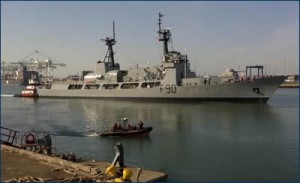
The three big ticket “ship of the line” purchases are the 2 “Offshore Patrol Vessels” and the NNS Thunder. The NNS Thunder is the old school “off the shelf” style ship purchase, bringing a Hamilton-class High Endurance Cutter, the ex-USCG Chase, into Nigerian service in 2011. The “Offshore Patrol Vessels” were commissioned with China Industry Shipbuilding Corporation and approved for purchase by President Jonathan in April of 2012. The fleet’s major combatant until the NNS Thunder was the NNS Aradu, an over 30 year old vessel and Nigeria’s only aviation-capable ship. The new contenders will add a total of 5 new 76mm Oto Melara’s added to the fleet, a none too shabby improvement of overall firepower for littoral operations. The 45 (NNS Thunder)/ 20 (OPV’s) day endurance will give the Nigerian Navy an impressive new stay-time for continuous at-sea opeartions. Arguably most important is that all three vessels have maritime aviation capabilities that will greatly expand the reach and ISR component of Nigerian maritime operations. These three ships are right on target to fill critical gaps in Nigeria’s capabilities.
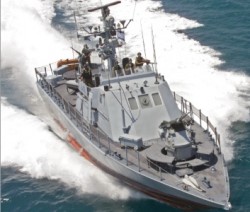
Nigerian Navy Shaldag mk III
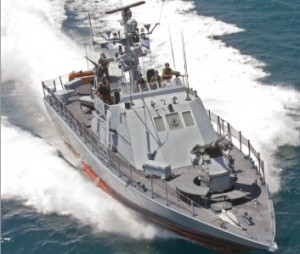
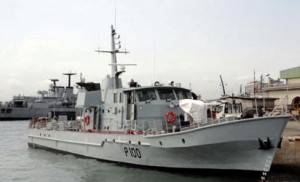
Nigeria’s littoral squadrons are also scheduled for improvement. Nigeria is purchasing several brown-green water patrol craft to bolster her much-beleaguered inshore security where smuggling of all kinds is rife. Singaporean Manta’s and Sea Eagle’s, US Defender’s, Israeli Shaldag Mk III’s, and others will add potent brown and green water assets to Nigeria’s toolbox.
On small ship for a ship, one large ship for Nigerian Shipwright kind.
However, not all of Nigeria’s purchases are imports. Thi package also begins the cultivation of indigenous ship-building capability. One of the aforementioned OPV’s is scheduled for 70% of its construction to occur in Nigeria. To more fanfare, the NNS Andoni was commissioned in 2012. Designed by Nigerian engineers and produced locally with 60% locally sourced parts, it is considered a good step forward for building local expertise and capability in the realm of the shipwrights. More local capacity and expertise will further increase the ease with which ships bought locally, or abroad, can be maintained.
Popped collars, midriff, and tiny shorts? Worst pirates EVER!
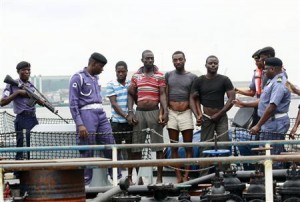
Ships are all well and good, but what matters is what you do with them and how. Though the scale of offshore criminality is likely in total hovering around 10 billion, and the entire naval budget is roughly a half billion, the Nigerian Navy is moving more aggressively to course-correct their coastal regions. Several instances include a successful gun battle in August, ending the careers of six pirates, further arrests for oil theft in september, and a nice little capture of pirates in August for which photo opportunities were ensured for the press. The Nigerian Navy is further attempting to extend the “immediacy” of their reach by establishing Forward Operating Bases, like the ones at Bayelsa and Delta states. These and many other instances are the nickles-and-dimes as the Nigerian Navy chips away at the corners of their behemoth security challenge at sea. Every journey begins with a single step, and though the Nigerian Navy has reached a bit of a trot, they have a long way to go. But even in the Navy, no man is an island. With a limited budget and math-rough half of the budget going to the army, the Nigerian Navy needs support. The civil and military authorities are moving closer to that “joint” model with the Memorandum of Understanding between the Nigerian Air Force (NAF) and the Nigerian Maritime Administration and Safety Agency (NIMASA) on the use of NAF assets in Anti-Piracy operations. With an existing MoU between NIMASA, this creates further points of coordination between civil, naval, and air force assets in a coordinated battle against criminals at sea. It’s no J3/J5 shop, but it’s a start.
Nigeria is no stranger to international cooperation. Many forget that in August 26th, 1996, ECOMOG (under ECOWAS) actually conducted an amphibious assault into Liberia led by Nigerian military units. From peacekeeping in Liberia, to Sierra Leone, to Darfur, to Mali, etc… etc… Nigeria troops have been a staple of many peacekeeping efforts. Now, their typical face abroad, the boots on the ground, is pulling back to the homeland to fight Boko Haram. However, the navy is still extending its project to integrate into partnership programs through both engagement at home and extending the hand abroad. Nigeria is an active catalyst of the regional security regime. For one, ECOWAS is a factor at sea as well as land. At an ECOWAS conference ending 9 OCT, the naval chiefs of Nigeria, Niger, Benin, and Togo agreed to a common “modality” for the combating of terrorism and agreed to set up a “Maritime Multinational Coordination Center” in Benin to coordinate security efforts. It also doesn’t hurt to host the maiden run of a major procurement/policy forum in your continent, namely the “Offshore Patrol Vessels Conference” for hundreds of African and interested parties. Networking, though an intangible product, is an important way of building institutional strength and connections. Nigeria also engages with US and NATO training missions, like the most recent Operation African Wind: a training exercise for the Armed Forces of Nigeria and other regional militaries in conjunction with the Netherlands Maritime Forces under the auspices of the United States sponsored African Partnership Station. In Lagos and Calabar, units will learn about sea-borne operations, jungle combat, amphibious raids, etc… over 14 days of training and 4 days of exercises. Finally, Nigeria’s navy has made a very respectable show of striking out by conducting a “world tour” of sorts with the new NNS Thunder. The NNS Thunder made a tour around Africa before crossing the Indian Ocean for an historic visit to Australia this month for International Fleet Week. The Nigerian Navy seems determined not to remain shackled by their previous bad position, and is aggressively pursuing an expanded mission and self-image through more than just procurement. Despite the challenges ahead, they’ve demonstrated a reach few of their continental compatriots can lay claim to. It may not help against pirates, but it should be a fine addition to espirit de corps.
The Nigerian Navy is making good progress. With new ships, expanded operations, and continued engagement the bow is pointed in the right direction. However, without maintaining the engineroom and navigational equipment by battling corruption and putting enough fuel in the diesels by increasing their defense budget, the Nigerian Navy will find itself floundering in the storm.
Matthew Hipple is a surface warfare officer and graduate of Georgetown’s School of Foreign Service. He is Director of the NEXTWAR blog and hosts of the Sea Control podcast. His opinions may not reflect those of the United States Navy, Department of Defense, or US Government. Did he mention he was host of the Sea Control podcast? You should start listening to that.
The challenges facing East African maritime security are many, and without viable measures taken to combat growing sea-born threats, the region is destined to remain in a state of instability and war. The absence of a formidable naval power in the area has allowed illicit smuggling activity to flourish in the Indian Ocean and the Gulf of Aden, and has also allowed state and non-state actors to manipulate the lawlessness to their own advantage, leading to increased insecurity in the region. Looking past East Africa’s most publicized maritime problem, piracy, I would like to discuss two equally threatening, but less well-known issues, currently inhibiting its stability.
Illicit Trafficking
The first major issue that arises due to inadequate regional naval capabilities is the widespread smuggling of illicit arms, drugs and people into, out of and throughout East African countries. The influx of drugs, munitions and other illicit goods, arm and fund terrorist organizations and militias not only on Africa’s Eastern coast but in the rest of the continent as well. Somalia’s al Shabaab, Kenya’s al Shabaab affiliate, al Hijra, and the Congolese rebel group M23, are all examples of groups sustained through illegal maritime smuggling.
Weapons enter the region not just through the vulnerable Gulf of Aden and the Somali coastline, but also through considerably more stable and peaceful countries like Kenya and Seychelles. Once ashore, illicit materials easily find their way through the hands of corrupt government officials to destabilizing, violent actors. New intelligence estimates point to growing cross continental smuggling networks between groups like al Shabaab and North Africa’s Al Qaeda in the Islamic Maghreb, heightening the importance for a secure Eastern shore.
Human trafficking, another dangerous issue, further highlights the permeable nature of the regions’ maritime borders. According to the International Organization for Migration, in the first four months of 2012, 43,000 migrants traveled from East Africa, through the Gulf of Aden and the Red Sea, to Yemen. This constant flow of migrants in and out of the region allows for a massive human smuggling market.
In recent news, there have been reports of the success of the NATO fleet in reducing piracy in the Gulf of Aden and the Indian Ocean. But under Operation Ocean Shield, NATO vessels are strictly tasked with counter-piracy measures and are unable to intervene in the practice of illicit trafficking occurring in those same bodies of water. While good work is being done to prevent piratical attacks, illegal smuggling of people, munitions, and other goods remains unchecked.
Kenya’s Unilateral Maritime Power and its Consequences
It’s hard being best on the block.
The second problem that surfaces is due to an uneven balance of power. Kenya possesses the overwhelming naval advantage in the region, allowing it hegemonic rule over maritime boundaries. Kenya has 23 ships in its fleet, which were mainly acquired through Western allies such as the United States, France, Spain and Great Britain. Kenya’s offensive capabilities are limited and its fleet only has two amphibious assault vessels, which were most recently used to attack the terrorist-held Somali city of Kismayo in September 2012. While the Kenyan fleet is small when compared to international standards, it is far more powerful than any other East African country.
Kenya’s Southern neighbor, Tanzania, has a navy that consists of seven attack vessels and twelve patrol vessels obtained from the Chinese between 1969-1971. Tanzania’s navy is effectively untested and would likely be unable to engage in any meaningful military action to secure its coastline. To Kenya’s north, Somalia has no navy to speak of, and has been reliant on the Kenyan naval power in helping secure key al Shabaab stronghold’s along Somalia’s Southern coast.
The absence of another equal, or at least, threatening East African power in the Indian Ocean allows Kenya to exert undue control over its maritime neighbors. Kenya and Somalia are in the middle of a maritime border dispute that is currently leaning in favor of Kenya. The Somali government believes the border should be drawn perpendicular to the coastline, whereas the Kenyan government wants the border to be drawn along the line of latitude. Complicating the issue are potential underwater oil reserves and existing oil licenses granted by both countries for exploration in the disputed area. Kenya continues to push for exploration agreements with private companies, despite the inability of the two countries to delineate an agreeable maritime boundary, aggravating an already tense relationship.
Further irritating Kenyan and Somali border relations, are corrupt Kenyan Navy officials who have taken advantage of Somalia’s fledgling central government and have begun to encroach on its sovereignty. A UN report released in July 2013, asserted that following al Shabaab’s defeat in Kismayo, the Kenyan Navy took over control of the port. It now controls all goods coming into and going out of Kismayo, and corrupt Kenyan officials collect revenues from the port that should instead be managed by the Somali government. Kenyan Navy personnel even flouted the UN ban on charcoal exports from Kismayo, despite protestations from the Somali government and international organizations.
Kenya’s unilateral maritime power allows corrupt individuals to adhere to their own rules of engagement and many times disregard international norms, infringing on neighboring countries’ maritime, and land-based sovereignty. This severely threatens stability in the region as this manipulation of power creates tenuous and volatile relationships with other East African nations and the international community.
The First Steps
When thinking of possible solutions to help increase naval power and maritime security in East Africa, it is hard to imagine viable near-term options. Some governments have taken steps to try to address maritime vulnerabilities. Kenya passed a law in 2010 formerly recognizing human trafficking as a crime. Also in 2010, the semi-autonomous Somali state of Puntland established the Puntland Maritime Police Force. It was first created as an anti-piracy body but it has had some success in intercepting arms, drugs and human smugglers. These measures are good first steps, but broader, regionally agreed upon action must be taken.
It is hard, however, for these countries’ governments to justify spending money to secure their nations’ maritime borders, when the there is no certainty of peace on land. But of course, it is necessary to understand that without maritime stability, that peace cannot be assured.
Breuk previously worked at the American Enterprise Institute’s Critical Threats Project, and published articles on issues relating to security in the Horn of Africa. She received her B.A. in International and Comparative Politics from Brown University and is currently studying in North Africa.