All posts by Guest Author

Distributed Lethality, Non-traditional Fleets, and the Law of War

Distributed Lethality Topic Week

By Chris Rawley

In simplest terms, the U.S. Navy’s distributed lethality concept complicates the enemy’s targeting problem by dispersing larger numbers of platforms capable of offensive action over a wide geographic area.  With no significant increases in fleet size anticipated for the foreseeable future, it is incumbent that all avenues be pursued that will optimize the use of scarce ships.

[otw_shortcode_button href=”https://cimsec.org/buying-cimsec-war-bonds/18115″ size=”medium” icon_position=”right” shape=”round” color_class=”otw-blue”]Donate to CIMSEC![/otw_shortcode_button]

A video recently released by the Surface Force U.S. Pacific Fleet shows a variety of ships besides surface combatants equipped with anti-ship missiles and unmanned aircraft capable of targeting these weapons.  In addition to amphibious vessels, a Lewis and Clark Dry Cargo/Ammunition ship is depicted (minute 1:21) with a drop-in missile module. This ship, and 29 others in the U.S. Navy’s Combat Logistics Force (CLF), are controlled by the Military Sealift Command (MSC) and manned by professional civilian mariners (CIVMARS).  The introduction of armed naval auxiliaries in the U.S. fleet would raise a number of important operational and legal questions.

https://www.youtube.com/watch?v=21dFaIIeXpU

In what sort of tactical situations might an offensively-armed replenishment ship be worthwhile?  Distributed lethality requires distributed logistics. Meaning, surface combatants operating alone or in small groups will require fuel, food, ammunition, and parts. In a major theater war, traditional replenishment ports will be placed at risk by mines, theater ballistic missiles, terrorist surrogates, and other area-denial capabilities. To mitigate these risks, underway replenishment has been a mainstay of U.S. naval surface ship operations for nearly a century. A CLF ship armed with self-defense weapons and a small number of medium ranged surface-to-surface missiles operating in tandem with a group of cruisers and destroyers (CRUDES) provides additional magazine capacity for the surface combatants.

Conversely, oilers operating solo while transiting to or from underway replenishment stations are an appetizing target for would-be adversaries. In some cases, these ships would require a dedicated “shotgun” surface combatant to protect their precious cargoes. But these escorts would take scarce CRUDES ships away from other offensive duties. CLF ships equipped with additional self-defense weapons, be they remotely-operated crew served machine guns or short-ranged surface-to-air missiles (like the SeaRAM), will enable defense against a variety of potential attackers. However, the possibility that CLF ships are capable of not just defending themselves, but of fighting back, will challenge indirect enemy strategies that rely on attrition of our logistic forces.  A CLF ship would target its over-the-horizon weapons by either cueing off another platform’s sensors or using organic manned or unmanned aircraft.  These ships sometimes deploy with MH-60s, which can carry their own weapons, but can also assist in targeting a ship’s missiles.  For longer ranges, future unmanned air vehicles such as DARPA’s TERN prototype could support CLF-launched missile engagements over hundreds of miles. Besides the aforementioned weapons, CLF ships providing replenishment operations within adversary threat envelopes will need to employ counter-targeting techniques and some will carry Surface Ship Torpedo Defense Systems.

Non-traditional or Normal?

I’ve been guilty of using the phrase “non-traditional” naval vessels when referring to auxiliaries engaged in naval operations other than logistics. A recent example would be MSC’s Expeditionary Fast Transports serving as Partnership Station platforms. Historically, however, civilian-run shipping has been integral to naval warfare for as long as humankind has fought on the seas. Lincoln Paine discusses a number of non-traditional fleets in The Sea and Civilization, an amazingly comprehensive chronology of all aspects of maritime trade and warfare. In lieu of a powerful navy, the early Roman Empire established coloniae maritimae (maritime colonies), which exempted their men from service in the legions in exchange for their promise to destroy invading enemy vessels. A millennium later, Byzantium held off Muslim invaders at sea with a largely provisional force of merchants and fishermen. In the 19th Century, pirates turned privateers were engaged as naval commerce raiders by various states including Spain, Mexico, and the Republic of Texas.

In World War I, the British Admiralty encouraged merchant vessels to arm themselves with deck guns, ostensibly for the purposes of defense. Some of these merchants took it upon themselves to actively attack German shipping, often using false flags. The German Empire, as one might expect, grew to view these vessels as belligerents, rather than as neutral shipping, a role they were initially accorded by international law. Then in World War II, thousands of American merchant ships were protected by Naval Armed Guards, who manned anti-aircraft weapons and up to 3″ deck guns. Merchant mariners supported these gun crews by passing ammunition, but were also trained to employ the weapons when necessary, and many did so, distinguishing themselves in battle.
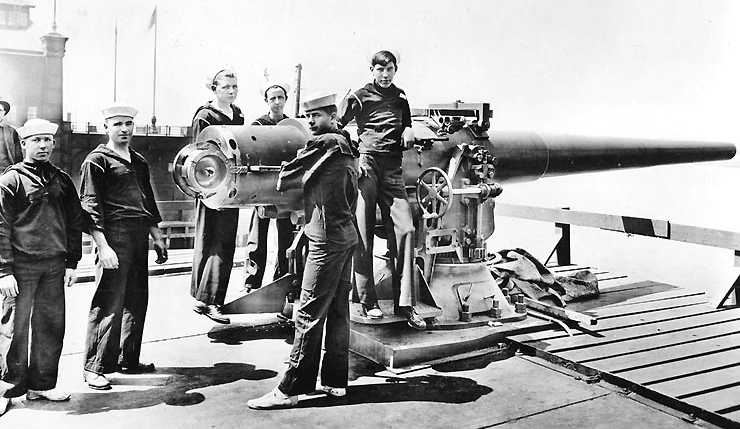
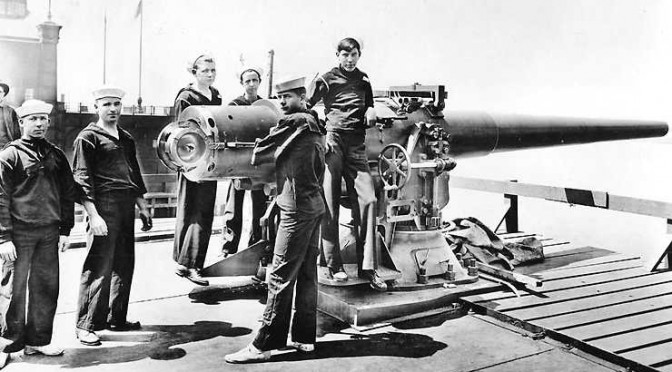
WNUS_6-50_mk8_Mongolia_stern_pic
Historical Precedence: Naval Armed Guard Sailors Man the stern 6″ (15.2 cm) gun on S.S. Mongolia in May 1917 (U.S. Naval Historical Center Photograph # NH 41710) .

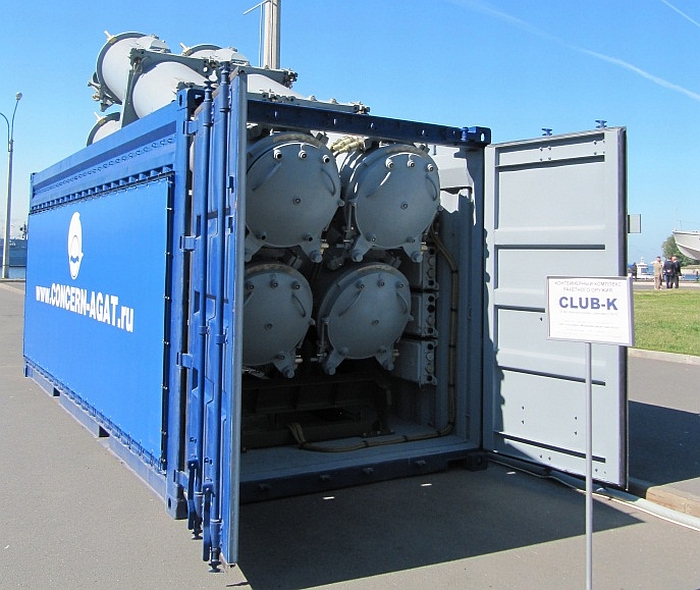
More recently, we’ve watched the emergence of China’s rather sizable maritime militias, which are a key aspect of the PLAN’s expansion strategy in the South China Sea. These sorts of maritime surrogates have kept up with changing naval technology. Today, instantaneous data communications have made over-the-horizon networked targeting by civilian craft a distinct possibility. Additionally, concealable anti-ship weapons, such as Russia’s Club-K containerized missile system, could raise the threat posed by merchant shipping. These non-traditional fleets are not anomalies, but rather mainstays of offensive naval warfare.  How does this historical reality reconcile with modern legal norms of international armed conflict?

Nuances Riding on a Single Letter

Traditional prohibitions against civilians taking a direct part in hostilities are based on a duty to discriminate between combatants who may be lawfully targeted and non-combatants who may not be intentionally targeted. International humanitarian law is also designed to protect duly-recognized combatants from prosecution and provide for status as prisoners of war. In modern times, these distinctions have been interpreted to prohibit civilians aboard a warship from serving as a weapons release authority or standing tactical watches.  Besides CIVMARS, a host of civilians routinely ride naval ships, including maintenance contractors, college instructors, and Morale, Welfare, and Recreation planners; all of course, in non-tactical roles.
img23_700px
The hidden shipping threat: Russian Club-K containerized missile system.

To understand the legal nuances behind arguments for and against non-traditional naval vessels undertaking offensive operations, it’s worth examining the distinction the U.S. Navy makes between warships and naval auxiliary vessels.1 In accordance with Navy Regulations, Article 1259, a commissioned warship – designated USS – requires “a personal flag or command pennant of an officer of the Navy, or a commission pennant.” U.S. Naval Ships (USNS) operate under the control of civilian mariners, and therefore do not technically qualify as warships. Under the same regulations, in some circumstances, a USNS ship can be reclassified as a USS hull, but this requires approval by the Secretary of the Navy.  These conventions are supported by Article 29 of the United Nations Convention on the Law of the Sea (UNCLOS), which states a warship is “a ship belonging to the armed forces of a State bearing the external marks distinguishing such ships of its nationality, under the command of an officer duly commissioned by the government of the State and whose name appears in the appropriate service list or its equivalent, and manned by a crew which is under regular armed forces discipline.” The 1994 San Remo Manual on International Law Applicable to Armed Conflicts at Sea also provides a non-binding, but widely-accepted view of naval auxiliaries in warfare.

Auxiliaries are vessels, other than warships, that are under the exclusive control of the armed forces of a state. Some interpretations of international law infer that naval auxiliaries (non-warships) may defend themselves and other friendly forces in the vicinity, but may not be used to conduct offensive belligerent acts. Under the strictest legal interpretations, MSC ships would be prohibited from a range of activities to include launching anti-ship weapons, but also to missions as innocuous and defensive as clearing a channel of mines for the safe passage of commercial shipping. International agreements are important, but we should not ignore historical precedence and operational necessity that may force auxiliaries into combat roles. As further precedence, not every vessel conducting offensive missions in the U.S. Navy meets the criterion required for warship. For example, combatant craft of the Navy’s Special Boat Teams and Coastal Riverine Squadrons are not commissioned warships, but may carry out offensive operations. Of course, these boats are run by Navy crews, and a commissioned officer resides at some point in their chain of command (though not always embarked).
150214-N-RB579-018-e1424780150356
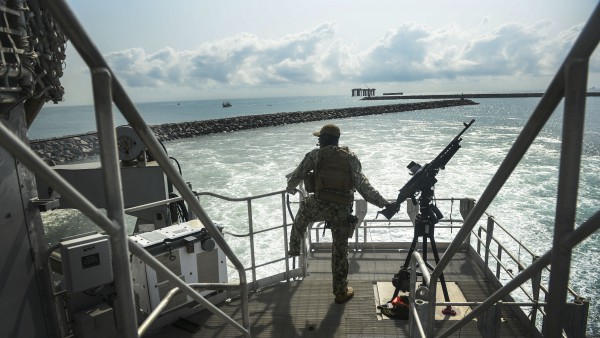
Embarked Security Team (EST) watchstander on the Military Sealift Command’s Expeditionary Fast Transport (T-EPF-1) in Sekondi, Ghana, Feb. 14, 2015 (US Navy photo).

Given generally-accepted views of international law, what are the alternatives available to include naval auxiliaries as offensives nodes in a distributed lethality regime? A handful of warships in the U.S. Navy, including USS Ponce (AFSB(I) 15), two flagships, and submarine tenders, feature a hybrid crewing model. These ships are commanded by a commissioned naval officer, though their navigation and engineering functions are primarily conducted by CIVMARs. This hybrid crewing approach enables them to conduct or command offensive operations in accordance with international law. Implementing this approach on a wider scale would require the reclassification of armed CLF ships to USS and the introduction of permanent Navy crews, an option not necessarily supported by today’s manpower budgets.

Embarking military detachments to operate defensive and offensive weapons might be another acceptable alternative. Over the past few decades, the combat logistics force has transitioned from USS ships, to USNS ships embarking military detachments (MILDETS) run by a junior surface warfare officer, and now to primarily USNS ships with no MILDETS. When embarked, MILDETS mostly handled command and control (C2) functions. Many of these roles have been absorbed by CIVMARS, but others, like operating self-defense weapons, are still supported by embarked Navy security teams. It’s possible that arming a CLF ship and operating its weapons systems with a MILDET, without reclassifying it as USS could put a ship’s status as naval auxiliary in jeopardy during hostilities. However, like merchant shipping that was targeted during the World Wars, that becomes largely an irrelevant academic argument once ordnance starts flying and logistics ships become primary targets themselves.

In an era of declining Navy end strength and increasing personnel costs, it is no longer fiscally prudent to assign full time military detachments to every ship that might require one in wartime.  The Navy’s reserve component (RC) provides a feasible C2 alternative which can be surged forward during contingency operations, while meeting legal and operational requirements for offensive operations. In recent years, military detachments for theater security cooperation missions onboard MSC ships have been created ad hoc from cross-decked active duty Sailors or sourced from existing staffs such as Destroyer Squadrons. In the event of a major contingency, it is likely that these staffs will be tied up with their primary missions and unable to dedicate manpower to supporting auxiliary C2 requirements. In recognition of these demands, the Military Sealift Command recently established a dedicated Navy Reserve unit designed to provide C2 elements for MSC ships involved in non-logistics missions. This nascent capability has been demonstrated with embarked detachments onboard various MSC ships during fleet exercises and security cooperation missions.

The expansion of additional RC military detachments should be explored that support not only theater security missions, but future offensively-armed combat logistics force ships. The advantages of this capability residing in the reserve force are several: The first relates to cost.  On average, a part-time reservist costs the navy approximately one fifth of an active duty Sailor. In peace-time, reservists would train for the mission by embarking CLF ships to support weapons testing and fleet exercises, and surge forward if required for contingency missions.  Additionally, reserve Sailors, some of them with licensed merchant credentials themselves, have a strong knowledge of MSC ship unique operating procedures and understand how to integrate well with CIVMARs. The habitual relationships dedicated reserve units build with CIVMAR crews have proven valuable in other missions.

Regardless of whether the decision is made to increase the weapons capabilities of our Military Sealift Command ships, additional RC detachments would provide the legal and operational top-cover necessary to perform other traditional naval operations on these vessels in peace and war to include maritime security operations, mine-countermeasures, special operations direct action support, and amphibious raids.

Chris Rawley is a Captain in the U.S. Navy Reserve and serves as Commanding Officer for the Navy’s sole unit dedicated to providing command and control detachments aboard Military Sealift Command vessels. The opinions and views expressed in this article are those of the author alone and are presented in his personal capacity. They do not necessarily represent the views of U.S. Department of Defense, the U.S. Navy, or any other agency. 

[otw_shortcode_button href=”https://cimsec.org/buying-cimsec-war-bonds/18115″ size=”medium” icon_position=”right” shape=”round” color_class=”otw-blue”]Donate to CIMSEC![/otw_shortcode_button]

1 The author is not an operational law attorney.  The reader is encouraged to seek out other legal interpretations.
The Legal Implications of Arming MSC Ships

Distributed Lethality Topic Week

By Tony Freedman with contributions from Mark Rosen

What are the legal implications of arming MSC ships, both for self-defense and for a more robust offensive role?

With the apparent shortage of amphibious ships, the prospect of using Military Sealift Command’s (MSC) auxiliary ships to add depth to Navy and Marine Corps operations is being considered. These ships could be used to supplement the low end of military operations to provide sealift for missions such as a humanitarian assistance/disaster relief (HA/DR) and noncombatant evacuation. They could also provide an alternative platform for high end operations, such as launching offensive weapons, or become a floating base to support offensive operations. However, these ships are not a simple substitute for combatants or amphibious ships. Operationally, they lack ship-to-shore connectors and communication systems, and are not survivable (built mostly to commercial, not military standards). Additionally, these ships are currently not equipped to defend themselves. While adding weapons would not increase the ship’s survivability, it would provide some defensive capability and the potential to conduct offensive missions. This changes the nature and role of these ships. Unlike warships, these ships are manned by civilian crews, either Civil Service Mariners (CIVMARS) or licensed U.S. citizen contract mariners (CONMARS), which introduce questions regarding their legal status if weapons systems are added to the mix.1 Despite legal reviews by MSC and Navy legal experts, the use of civilian manning is relatively untested and may pose a legal risk to civilian crews. Below, we outline legal precedents that come into play in regard to risk to civilian crews. There are two main aspects of concern: first is the potential lack of legal protection and the second, the willingness of crews to potentially go into harm’s way.

[otw_shortcode_button href=”https://cimsec.org/buying-cimsec-war-bonds/18115″ size=”medium” icon_position=”right” shape=”round” color_class=”otw-blue”]Donate to CIMSEC![/otw_shortcode_button]

The first concern is the potential lack of legal protection under article 4 of the Geneva Convention. Under the law of armed conflict (LOAC), civilians that support military operations receive legal protections including prisoner of war (POW) status. While MSC ships crews always have the right to self-defense, their legal protections depend on whether the individual is classified as a lawful combatant or not. The key is whether the activities conducted by the civilians are considered to be 635508601340653813-military-sealift-command-logo“belligerent.”2 Even though civilians may accompany the armed forces they may not be intentionally targeted and, if they are ever captured, would be entitled to POW status. However, civilians that “cross the line” and involve themselves in belligerent activities would not be entitled to the combatant privilege (immunity). In other words, they can be prosecuted as common criminals or worse as illegal combatants. The civilians would risk prosecution by the International Criminal Court or some other body if an “offense” occurred in an adversary’s territorial waters.  

Historically, U.S. policy safeguards civilians from conducting belligerent duties, per se, by aligning with internationally recognized roles for authorized civilians who accompany the armed forces, such as deck, engineering, purser, or supply duties that do not cause direct impact on the enemy. Civilians that command or man weapons systems (apart from self-defense purposes) do have a direct impact. In line with U.S. policy, naval auxiliaries have been operating for many years and maintain their status as “state vessels,” which are entitled to sovereign immunity so long as the vessel is operated for non-commercial service and does not engage in belligerent acts.3 In spite of these distinctions, a hostile nation could take a more restrictive view by viewing the ship holistically as a single unit, meaning any civilian aboard the ship vicariously participates in any activities that the ship conducts against the enemy.

The second concern with the addition of weapons, particularly offensive weapons, is the willingness of civilian crews to operate these ships in forward locations. One compounding issue that needs to be resolved is whose authority does the civilian crew fall under: military or civilian? Many scholars contend that the concept of “regular armed forces discipline” applies to civilian crews as it does for military crews. In 2007, the Uniform Code of Military Justice (UCMJ) was amended to allow for civilian personnel accompanying or serving with the armed forces to be subject to the UCMJ during contingency operations. However, the constitutionality of this amendment is not yet settled. Specifically, U.S. citizens are afforded certain trial rights (to include jury trials) under the Fifth and Six amendments of the U.S. constitution that military members do not enjoy.

We conclude that the use of weapons aboard MSC ships is appropriate if used for defensive purposes. However, there still remains a risk to the civilian crews with regard to whether these weapons can be used in certain roles which approach belligerent activities, for instance, if the weapons are operated by military personnel with direct civilian support. Direct use and control of weapons by civilians could place the crew under risk of prosecution if captured by a foreign adversary. Furthermore, there is the potential for unintended consequences and risk to future U.S. operations. As a leader in international law and in naval operations, the United States should not set a precedent for confusion between belligerents and non-belligerents which could result in a breakdown of LOAC/LOS norms that we depend on. If the world loses confidence in the LOAC because the U.S. is perceived as ignoring the rules, then the U.S. could lose the rights and protections assured by LOAC, such as sovereign immunity for our ships in foreign ports.

Dr. Tony M. Freedman is a senior research scientist at CNA; he has led studies on mine warfare, non-traditional platforms, afloat forward staging base (AFSB), Special Forces, and SSGN operations. Additionally, he was the Deputy Test Director (Testing Analysis, & Evaluation) to the Joint Command and Control War on Terror Activities (JC2WTA) Joint Test and was CNA’s on-site scientific analyst to OPNAV N00X at the Pentagon. Prior to CNA, Dr. Freedman worked in academia and industry.

Mark E. Rosen, an international and national security lawyer, is senior vice president, general counsel, and corporate secretary at CNA. Rosen is a retired Navy Captain (JAGC) and served in various international law positions in the Pentagon including the ocean policy legal advisor to the Deputy Chief of Naval Operations for Plans, Policy, and Operations; political military planner, Strategic Plans and Policy Directorate (J-5), Joint Staff; and head of the International Programs Branch, Navy International Law Division, Washington, DC. Views expressed are his own.

[otw_shortcode_button href=”https://cimsec.org/buying-cimsec-war-bonds/18115″ size=”medium” icon_position=”right” shape=”round” color_class=”otw-blue”]Donate to CIMSEC![/otw_shortcode_button]

Notes:

1 There is little legal distinction between CIVMARs or CONMARs according to the LOAC. However, CONMARs do have fewer legal protections than CIVMARs under most bilateral status of forces (SOFA) agreements that DoD has negotiated. Depending on where these vessels operate, the availability of SOFA protections, and the practical benefits of being able to issue a CIVMAR an official passport, should be given weight in deciding whether to make use of CONMAR crew.

2 The definition of “belligerent” is often referred to as taking part in hostilities.

3 The U.S. Navy’s claims sovereign immunity (freedom from involuntary boarding, inspection, arrest, or the imposition of coastal state environmental regulations) for all government owned and most leased vessels provided they are engaged in non-commercial service. While the term “naval auxiliary” is not defined in the Law of the Sea (LOS) Convention, the rights and entitlements of such vessels is established in years of state practice and learned texts like the San Remo Manual and the Naval War College’s Commander’s International Law Handbook.

Enabling Distributed Lethality: The Role of Naval Cryptology

Distributed Lethality Topic Week

By LCDR Chuck Hall and LCDR David T. Spalding

The U.S. Navy’s Surface Force is undergoing a cultural shift.  Known as “Distributed Lethality,” this strategy calls for our naval combatants to seize the initiative, operate in dispersed formations known as “hunter-killer” surface action groups (SAG), and employ naval combat power in a more offensive manner. After years of enjoying maritime dominance and focusing on power projection ashore, the U.S. Navy is now planning to face a peer competitor in an Anti-Access/Area Denial (A2AD) environment. Long overdue, Distributed Lethality shifts the focus to one priority – warfighting.  Far from a surface warfare problem alone, achieving victory against a peer enemy in an A2AD environment will require leveraging all aspects of naval warfare, including naval cryptology.

[otw_shortcode_button href=”https://cimsec.org/buying-cimsec-war-bonds/18115″ size=”medium” icon_position=”right” shape=”round” color_class=”otw-blue”]Donate to CIMSEC![/otw_shortcode_button]

Naval Cryptology has a long, proud history of supporting and enabling the Fleet. From the Battle of Midway in 1942, to leading the Navy’s current efforts in cyberspace, the community’s expertise in SIGINT, Cyber Operations, and Electronic Warfare is increasingly relevant in an A2AD environment. Led by Commander, U.S. Fleet Cyber Command/U.S. TENTH Fleet, the community is comprised of officers and enlisted personnel serving afloat and ashore and who are well integrated with the Fleet, intelligence community, and U.S. Cyber Command. Given its past history and current mission sets, naval cryptology is poised to enable distributed lethality by providing battlespace awareness, targeting support, and effects, in and through the electromagnetic spectrum and cyberspace.   

Battlespace Awareness

Battlespace Awareness, as defined in the Information Dominance Roadmap, 2013-2028, is “the ability to understand the disposition and intentions of potential adversaries as well as the characteristics and conditions of the operational environment.”  It also includes the “capacity, capability, and status” of friendly and neutral forces and is most typically displayed as a Common Operating Picture (COP).  To be effective, however, battlespace awareness must seek to provide much more than just a COP. It must also include a penetrating knowledge and understanding of the enemy and environment — the end-user of which is the operational commander. The operational commander must be able to rely on predictive analysis of enemy action in the operational domain to successfully employ naval combat power in an A2AD environment.  

Naval Cryptology has historically provided battlespace awareness through the execution of Signals Intelligence (SIGINT) operations.  During World War II, Station HYPO, located in Pearl Harbor and headed by Commander Joseph Rochefort, collected and decrypted the Japanese naval code, known as JN-25. Station HYPO’s exploitation of Japanese naval communications was sufficient to provide daily intelligence reports and assessments of Japanese force dispositions and intentions. These reports were provided to naval operational commanders, to include Admiral Chester W. Nimitz, Commander in Chief, U.S. Pacific Fleet and Commander in Chief, Pacific Ocean Areas. On May 13, 1942, navy operators intercepted a Japanese message directing a logistics ship to load cargo and join an operation headed to “Affirm Fox” or “AF.”  Linguists from Station HYPO had equated “AF” to Midway in March after the Japanese seaplane attack on Hawaii (Carlson, 308) and was thus able to confirm Midway as the objective of the upcoming Japanese naval operation.  Station HYPO was also able to give Nimitz the time and location of the Japanese attack point: 315 degrees, 50 nm from Midway, commencing at 7:00AM (Carlson, 352). This allowed Nimitz to position his forces at the right place, designated Point Luck, northeast of Midway, placing the U.S. fleet on the flank of the Japanese (Carlson, 354). Had Station HYPO’s efforts failed to provide this battlespace awareness, Admiral Nimitz would not have had enough time to thwart what might have been a surprise Japanese attack.  

Photo shows work being done on the Japanese Naval code J-25 by Station HYPO in Hawaii. The Japanese order to prepare for war was sent in J-25 prior to the attack on Pearl Harbor, but decoders had been ordered to suspend work on the Naval code and focus efforts on the diplomatic code. Later, enough of J-25 was broken to be used as an advanced warning to the Japanese attack on Midway. NSA photo.

Victory at Midway was founded on the operational commander’s knowledge of the enemy’s force construct and disposition. Currently the product of both active and passive, organic and non-organic sensors, achieving battlespace awareness in an A2AD environment will require more emphasis on passive and non-organic sensors, and increased national-tactical integration in order to prevent detection and maintain the initiative.  The “hunter-killer” SAGs will be entirely dependent upon an accurate and timely COP – not just of enemy forces, but of dispersed friendly forces as well.  Just as battlespace awareness enabled triumph against the Imperial Japanese Navy, so too will it be the very foundation upon which the success of distributed lethality rests. Without it, the operational commander cannot effectively, and lethally, disperse his forces over time and space.    

Targeting Support

Another key enabler of the Surface Navy’s shift to the offensive will be accurate and timely targeting support.  Though support to targeting can come in many forms, as used here it refers to the triangulation and precision geolocation of adversary targets via communications intelligence and radio direction finding (RDF).  In an environment in which options to “fix” the enemy via radar or other active means introduces more risk than gain, RDF presents itself as a more viable option.  Indeed, the passive nature of direction finding/precision geolocation makes it particularly well suited for stealthy, offensive operations in an A2AD environment.  Leveraging both organic and non-organic sensors in a fully integrated manner — RDF will provide “hunter-killer” SAG commanders with passive, real-time, targeting data.     

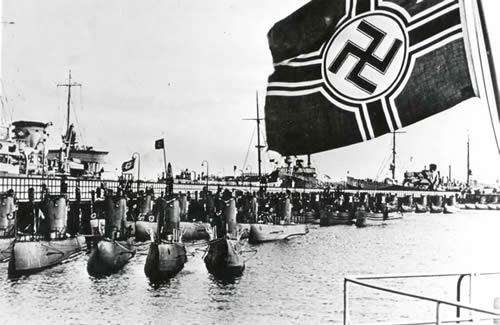
Perhaps one of the best historical examples of Naval Cryptology’s support to targeting can be seen in the Battle of the Atlantic. The Third Reich had threatened the very lifeline of the war in Europe as Admiral Donitz’ U-boats were wreaking havoc on Allied merchant vessels throughout the war. Though America had begun intercepting and mapping German naval communications and networks as early as 1938, it was not as critical then as it was upon entry into the war. By the time America entered the war, the U.S. Navy’s SIGINT and cryptanalysis group, OP-20-G, boasted near 100 percent coverage of German naval circuits. Many of these circuits were used for high frequency (HF), long range shore-ship, ship-shore, and ship-ship communications. The ability to both intercept these communications and to locate their source would be necessary to counter the Axis’ attack. That ability was realized in an ever growing high frequency direction finding (HFDF) network.

The HFDF network originally consisted of only a handful of shore stations along the Atlantic periphery. Throughout the course of the war it grew to a rather robust network comprised of U.S., British, and Canadian shore-based and shipborne systems. The first station to intercept a German naval transmission would alert all other stations simultaneously via an established “tip-off” system.  Each station would then generate a line of bearing, the aggregate of which formed an ellipse around the location of the target.  This rudimentary geolocation of German U-boats helped to vector offensive patrols and enable attack by Allied forces — thus taking the offensive in what had previously been a strictly defensive game.  The hunter had become the hunted.        

German U-boats threatened the very lifeline of the war in Europe by wreaking havoc on Allied merchant vessels throughout the war.

Enabling the effectiveness of increased offensive firepower will require more than battlespace awareness and indications and warning.  Going forward, Naval cryptologists must be agile in the support they provide — quickly shifting from exploiting and analyzing the enemy, at the operational level, to finding and fixing the enemy at the tactical level. Completing the “find” and “fix” steps in the targeting process will enable the “hunter-killer” SAGs to accomplish the “finish.”

Cyber Effects

Finally, cyber.  Receiving just a single mention, the original distributed lethality article in Proceedings Magazine refers to the cyber realm as, “the newest and, in many ways most dynamic and daunting, levels of the battlespace—one that the Surface Navy, not to mention the U.S. military at large—must get out in front of, as our potential adversaries are most certainly trying to do.” Indeed, the incredible connectivity that ships at sea enjoy today introduces a potentially lucrative vulnerability, for both friendly forces and the adversary. Similar to battlespace awareness and targeting, Naval Cryptology has history, albeit limited, in cyberspace. Cryptologic Technicians have long been involved in Computer Network Exploitation (CNE) and the Navy was the first service to designate an enlisted specialty (CTN) in the cyber field. According to the FCC/C10F strategy, not only do they, “operate and defend the Navy’s networks,” but they also, “plan and direct operations for a subset of USCYBERCOM’s Cyber Mission Forces.”  The combination of history and experience in cyberspace, coupled with the FCC/C10F designation as the Navy’s lead cyber element, clearly places the onus on naval cryptology. As the Navy seeks to protect its own cyber vulnerabilities, and exploit those of the adversary, the execution of effective cyber operations by the cryptologic community will be critical in enabling distributed lethality.

Going Forward

Today, through a wide array of networked, passive, non-organic sensors, and integration with national intelligence agencies and U.S. Cyber Command, naval cryptology is well-positioned to enable distributed lethality by providing battlespace awareness, targeting support, and effects, in and through the electromagnetic spectrum and cyberspace. Yet, similar to the surface force, a cultural shift in the cryptologic community will be required. First, we must optimize national-tactical integration and better leverage and integrate off-board sensors. The uniqueness of the A2AD environment demands the integration and optimization of passive, organic and non-organic sensors in order to prevent counter-targeting. Second, we must prioritize the employment of direction finding and geolocation systems, ensuring they are accurate and sufficiently integrated to provide timely targeting data for weapons systems. This will require a shift in mindset as well, from simple exploitation to a focus on “find, fix.” Third, we must continue to lead in cyberspace, ensuring cyber defense in depth to our ships at sea while developing effects that effectively exploit adversary cyber vulnerabilities. Finally, naval cryptology’s role in distributed lethality cannot occur in a vacuum — increased integration with the Fleet will be an absolute necessity.

Distributed lethality is the future of Naval Surface Warfare — a future in which the cryptologic community has a significant role. In order to ensure the Surface Force can seize the initiative, operate in dispersed formations known as “hunter-killer” SAGs, and employ naval combat power in a more offensive manner in an A2AD environment, Naval Cryptology must stand ready to provide battlespace awareness, targeting support, and effects, in and through the electromagnetic spectrum and cyberspace.

LCDR Chuck Hall is an active duty 1810 with more than 27 years of enlisted and commissioned service.  The opinions expressed here are his own.

LCDR David T. Spalding is a  former Cryptologic Technician Interpretive.  He was commissioned in 2004 as a Special Duty Officer Cryptology (Information Warfare/1810).  The opinions expressed here are his own.

[otw_shortcode_button href=”https://cimsec.org/buying-cimsec-war-bonds/18115″ size=”medium” icon_position=”right” shape=”round” color_class=”otw-blue”]Donate to CIMSEC![/otw_shortcode_button]

Works cited:

Ballard, Robert. Return to Midway. Washington, D.C: National Geographic, 1999.

Parshall, Jonathan. Shattered Sword : The Japanese Story of the Battle of Midway. Dulles, Va. Poole: Potomac Chris Lloyd distributor, 2007.

Carlson, Elliot. Joe Rochefort’s War: the Odyssey of the Codebreaker Who Outwitted Yamamoto at Midway. Annapolis, MD: Naval Institute, 2011. Print.

Distributed Lethality: Old Opportunities for New Operations

Distributed Lethality Topic Week

By Matthew Hipple

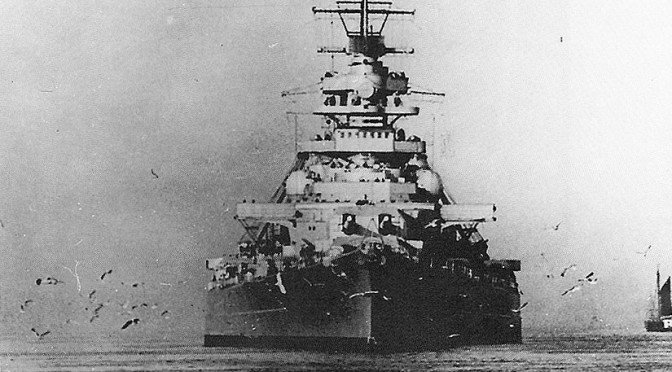
The BISMARCK, a single ship capable of striking fear into the heart of an entire nation.
The BISMARCK, a single ship whose threat was sufficient to muster an entire fleet for the hunt.

The essence of naval warfare has always been opportunism – from the vague area of gravity generated by an in-port “fleet in being,” to the fleet-rallying threat generated by even a BISMARK or RANGER alone. The opportunity is generated by forces more mobile and self-contained than any army, more persistent than an air force, and empowered to act with no connection to higher authority in a domain that leaves no trace.  It is that ability for a small number of independent ships, or even a single vessel, to provide opportunity and create, “battlespace complexity,” that is distributed lethality’s core. Distributed lethality is not naval warfighting by new principles; it is a return to principles.

[otw_shortcode_button href=”https://cimsec.org/buying-cimsec-war-bonds/18115″ size=”medium” icon_position=”right” shape=”round” color_class=”otw-blue”]Donate to CIMSEC![/otw_shortcode_button]

The best defense is not an overwhelming obsession with defense.

Unfortunately, the virtuous autonomy of the past was, in part, only protected by the limited technology of the day. As technology allowed, decentralized execution was replaced by the luxury and false confidence of constant connection to higher authority through an electronic umbilical. It is the kind of devolution that turned into Secretary Gates’ nightmare, “I was touring a [Joint Special Operations Command] in Kabul and discovered a direct line to somebody on the NSC, and I had them tear it out while I was standing there.” In parallel, America began the ahistorical project of investing all offensive opportunity not even in a single class of ship, but a single ship surrounded by a fleet obsessed with its defense.  As early as 1993, President Clinton stated that when a crisis broke out, his first question would be, “where is the nearest carrier.” Sorry, other ships! For the Navy to sensibly rebalance, distributed lethality must succeed. For distributed lethality to succeed, we must decentralize and de-tether mission command, weapons release authority, and weapons support systems.

Decentralized and disconnected methods of command must be embraced, as centralization is only an imagined luxury. Modern centralization is based on the assumption we will have the connectivity appropriate for it. This is no longer tenable in a world of increasingly advanced peers and hyundaized lesser adversaries. Anti-Access, Area-Denial (A2/AD) depends on opponents making themselves visible, of which electronic emission is critical. A2/AD will also inevitably seek to disrupt our C2 connections.

doyle-dday
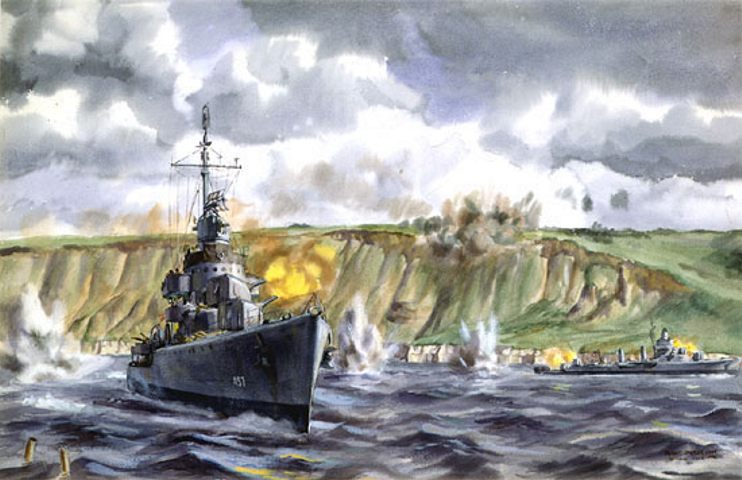
“Permission? We don’t need no stinkin’ permissions.” “The Battle for Fox Green Beach,” watercolor by Dwight Shepler, showing the Gleaves class destroyer USS Emmons(DD 457) foreground and her sister-ship, the USS Doyle, to the right, within a few hundred yards of the landing beach, mixing it up with German shore batteries on D-Day.

The current major-node CWC concept will need to be broken down to a more compact, internal model designed around the Hunter Killer Surface Action Group. Rules of Engagement must be flexible to the point that American commanders need not look over their shoulders to a higher OPCON. Consider, the destroyer CO’s at Normandy didn’t consider waiting for direction or requesting approval before shifting from small boat screening to shore bombardment from the shoals. They recognized the opportunity – the necessity – and executed of their own will.

In contrast, today it might be a regular occurrence to double-and-triple check our actions with American OPCON while operating with NATO in TACON off Somalia. American CO’s could use the freedom to make pragmatic, on-the-spot decisions not only for immediate concerns of mission effectiveness, but as representatives of their higher military command and, potentially, the state. Coalition commanders would have greater trust in the spot decisions of their American counterparts, rather than worry they sit precariously atop a changing several-step staffing process.

Though encouraging equivalent RoE flexibility for coalition partners may be challenging, our autonomy may encourage our partners to interpret their home nation guidance in a flexibility equivalent to their trust in the US commander they fight beside. That lack of hesitancy will be critical during a conflict, and in that sudden moment in the South China Sea or Mediterranean when a small SAG of coalition partners find themselves in the midst of a conflict that has just begun. Imposing the peacetime discipline necessary to trust the CO’s we have trained, prepared, and empowered to do their jobs is the only thing that will jump-start a shift in a mind-set now dominated by subordination. 

In the execution of more flexible orders, ships must be re-invested with control of their own weapon systems. CO’s oversee non-nuclear weapon systems that they do not control – that are solely the purview of off-ship authorities. In particular, as weapon systems like Tomahawk become deployable for ASuW, off-ship authority’s iron grip on their control must break.  This decentralization also matters outside the stand-up fight at sea. The organic ability to program and deploy Tomahawk missiles for land strike allows surface ships to execute attacks of opportunity on land infrastructure, or execute and support opportunistic maritime raids as groups of marines harass adversaries, or turn isolated islands into temporary logistics or aviation operations bases. For winning the sudden-and-deadly fight in the littoral environment but integrating with opportunistic amphibious operations, the surface fleet could find some inspiration from the USS BARB, the only submarine in WWII to “sink” a train with its crew-come-amateur-commandos. From Somalia to the South China Sea, naval commanders should be told what to do, not how – and be allowed to do it. The less reliant the force is on these ephemeral links and the less these links are unnecessarily exercised in peacetime, the greater a force’s instinct to operate independently and with confidence in an imposed or needed silence. 

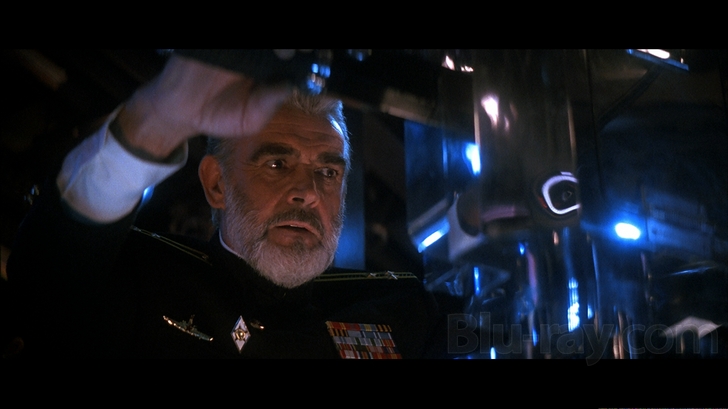
CAPT Ramius, relieved to discover he is not dealing with "some buckaroo."
CAPT Ramius, relieved to discover he is not dealing with “some buckaroo.”

There may be a level of discomfort with decentralization and disconnection. If leaders fear the impact of a “strategic corporal,” surely a “buckaroo,” as  CAPT Ramius would call him, that would be truly horrifying. That fear would be a reflection of a failure of the system to produce leaders, not the importance and operational effectiveness of independence. There is a reason the US once considered the Department of the Navy to be separate and peer to the Department of War – noting the institution and its individual commanders as unique peace and wartime tools for strategic security and diplomacy. Compare today’s autonomy and trust with that invested in Commodore Perry during his mission to Japan or Commodore Preble’s mission to seek partnership with Naples during the First Barbary Pirates War. Reliance on call-backs and outside authority will gut a naval force’s ability to operate in a distributed manner when those connections disappear. Encouraging it by default will ensure the muscle memory is there when needed.

Finally, Distributed Lethality requires the hardware to allow surface combatants to operate as effective offensive surface units in small groups. The kinetic end of the spectrum, upgraded legacy weapons and an introduction of new weapon systems has been extensively discussed since the 2015 Surface Navy Association National Symposium when VADM Rowden and RADM Fanta rolled out Distributed Lethality in force. However, weapon systems are only as good as the available detection systems. Current naval operations rely heavily on shore-based assets, assets from the carrier, and joint assets for reconnaissance. In the previous Distributed Lethality topic week, LT Glynn argued for a suite of surveillance assets, some organic to individual ships, but most deploying from the shore or from carriers.  Presuming a denied environment, and commanders empowered to seek and exploit opportunities within their space, the best argument would be for greater emphasis on ship-organic assets. They may not provide the best capabilities, but capabilities are worthless if assets cannot find, reach, or communicate with a Hunter-Killer SAG operating in silence imposed by self or the enemy. They also prevent an HKSAG from being completely at the mercy or limitations of a Navy or joint asset coordinator – while simultaneously relieving those theater assets for higher-level operations and opportunity exploitation.

Ultimately – distributed lethality is the historical default mode of independent naval operations given a new name due to the strength of the current carrier-based operational construct. Admiral Halsey ordered CAPT Arleigh Burke to intercept a Japanese convoy at Bougainville, “GET ATHWART THE BUKA-RABAUL EVACUATION LINE ABOUT 35 MILES WEST OF… IF ENEMY CONTACTED YOU KNOW WHAT TO DO.” The surface fleet must embrace a culture assuming our commanders “KNOW WHAT TO DO.” We must build an operational construct in which acting on that instinct is practiced and exercised in peacetime, for wartime. The operational and diplomatic autonomy, as well as the OLD IRONSIDES style firepower of single surface combatants, is necessary to rebalance a force gutted of its many natural operational advantages. Distributed lethality must return the surface force to its cultural and operational roots of distributed autonomy, returning to the ideas that will maximize opportunity to threaten, undermine, engage with, and destroy the adversary.

Matthew Hipple is the President of CIMSEC and an active duty surface warfare officer. He also leads our Sea Control and Real Time Strategy podcasts, available on iTunes.

[otw_shortcode_button href=”https://cimsec.org/buying-cimsec-war-bonds/18115″ size=”medium” icon_position=”right” shape=”round” color_class=”otw-blue”]Donate to CIMSEC![/otw_shortcode_button]