All posts by Guest Author

Saving the Lives of Maritime Passageways: The Coast Guard and Maritime Chokepoints

NAFAC Week

By Victoria Castleberry

The need for security of international maritime trade has never been greater as over 90 percent of internationally traded goods are transported via maritime shipping and 70 percent of maritime shipped goods are containerized cargo.1 Most trade vessels are funneled through one or more of six strategic chokepoints around the world: the Suez and Panama Canals, Strait of Malacca, Strait of Bab el-Mandeb, Strait of Gibraltar, and the Strait of Hormuz.2 Perhaps the most unique of these chokepoints is the Strait of Hormuz, and the presence of six 110’ Coast Guard Cutters in its vicinity. Coast Guard presence provides what no other U.S. asset can to this hostile region: provide security without an escalation of arms and the facilitation of transnational cooperation through various interagency programs. Expanding this model of strategic deterrence by increasing the U.S. Coast Guard’s presence internationally, the United States will be capable of protecting our most precious passages, promote international cooperation, and give the U.S. an advantage in determining how the international maritime waterways are governed.

According to the Energy Information Administration, the Strait of Hormuz exports approximately 20 percent of the global oil market and a total of 35 percent of all sea-based trade.3 With such a valuable resource transported through a small area, the necessity of security for this strait is clearly essential to the international market. Unfortunately, tensions within the region are rising and the risk of port closure, piracy, and military interference are all real possibilities that the global market may face when transporting through this region.4 In an effort to counter potential mishaps the United States has already utilized the Coast Guard to provide an authoritative yet non-threatening presence in the Persian Gulf that over time has proven effective.

Currently the Coast Guard spearheads several programs in Patrol Forces Southwest Asia (PATFORCESWA).5 Programs in the region specialize in the training of Coast Guards from around the world to bolster international maritime security cooperation. These programs help to support Article 43 of the United Nations Convention on the Law of the Sea (UNCLOS) agreement which requires user and bordering states to cooperate for the necessity of navigation and safety for vessels transiting.6 This specific call to duty for the user and bordering states by UNCLOS is a mission set specialized by the Coast Guard. The Coast Guard is currently operating in Freedom of Navigation Operations, escorting of military vessels, hosts an International Port Security Liaison Officer program, and possesses a Middle East Training Team responsible for conducting operations in conjunction with foreign militaries.7

As previously stated, the Coast Guard currently offers programs which work toward international cooperation for maritime security. Programs offered in the Persian Gulf include the International Port Security Liaison Officer (IPSLO) program and the Middle East Training Team (METT). These programs act as partnerships between the U.S. Coast Guard and foreign militaries to build up and sustain their own Coast Guards, as well as improve their own port security to facilitate trade between all nations.8 The IPSLO program allows for a “sound foundation from which countries can build their own domestic maritime security system.” This foundation is built through the education and enforcement of the international codes.9 Other programs such as the METT regularly participate in “theater security cooperation engagements with foreign navies and coast guards throughout the region.” These teams focus on teaching other coast guards and navies proper procedure for LE boarding and smuggling interception.10 These are the programs which need support to protect maritime chokepoints globally.

Lieutenant Jared Korn, USCG, was the Operations Officer aboard USCGC Adak, one of the six cutters deployed to PATFORCESWA. When asked about situations experienced while deployed within the Persian Gulf region, LT Korn described instances where Iranian vessels would approach the cutter and eventually depart. LT Korn to explained that in whole, the U.S. Coast Guard is an internationally recognizable symbol for aid, security, and is notably less threatening than a grey-hulled naval vessel within the Persian Gulf region.11

The presence of the U.S. Coast Guard in the Persian Gulf has been an effective tool in deterrence of hostiles within the region. This model can and should be applied to the other strategic chokepoints around the world. In 2014 the Panama Canal was faced with 44 reported piracy attacks, the Suez Canal is similarly plagued with piracy, off the coast of Somalia pirates have collected ransoms for over 10,000 dollars.12 Other strategic chokepoints such as the Strait of Gibraltar, Strait of Malacca, and Strait of Bab el-Mandeb would also benefit from the presence of the U.S. Coast Guard within their regions. Although these regions are not experiencing as severe of a threat to their maritime trade route imminently, prevention-based presence could avoid severe consequences of trade shutdown in these strategic chokepoints. The best way to do this is to grow the U.S. Coast Guard’s patrol craft fleet internationally as well as the training programs which aid in the diplomatic relations and sovereignty of nations’ security.

Although the solution of expanding the Coast Guard’s mission internationally is possible, it does have two potential obstacles. The first obstacle is public perception, the second, asset availability. Public perception of law enforcement today is already at an all-time low. By allowing our only armed service with law enforcement capabilities to shift its mission internationally the United States runs the risk of the American people’s perceptions shifting as well.13 The positive perception by the American people of the Coast Guard is at risk of being diminished due to the perception of war-like actions by our domestic maritime law enforcement. More clearly, however, is the logistics. As the smallest branch of the armed services the U.S. Coast Guard accomplishes its mission set with just a fraction of the assets, personnel, and budget as her Department of Defense counterparts. Expanding the mission set of the Coast Guard will only spread these resources more thin without congressional budgetary aid to gradually build up international forces overseas.

The solution to the problem of securing strategic maritime passageways is a complex one. The solution cannot escalate tensions, must facilitate international cooperation, be non-intrusive, and help bolster nations’ forces. In many of the strategic chokepoints around the world, tensions run high. The necessity for diplomatic operations makes the Coast Guard the best choice to accomplish this mission. Expanding the United States Coast Guard’s assets and programs internationally will allow for these requirements to be met and give the United States a strategic advantage in the control of international maritime security.

Victoria Castleberry is a student at the Coast Guard Academy. She is a junior who studies government and focuses on security studies. She is the varsity coxswain for the women’s crew team. She participates in the cadet musical and was recently a dancer in the musical Footloose.  She has 2 dogs named Ezekiel (Zeke) and McCain (Mac) and grew up in Northern Virginia. She will be stationed in Puerto Rico on the USCGC Richard Dixon this summer. She hopes to become a Deck Watch Officer and drive big white boats somewhere south of the Mason-Dixon Line and attend law school.

Bibliography

Allen, Craig, Jr. “White Hulls Must Prepare for Grey Zone Challenges.” U.S. Naval Institute, November 2016: 365.

Castonguay, James. “International Shipping: Globalization in Crisis.” Witness Magizine. n.d. http://www.visionproject.org/images/img_magazine/pdfs/international_shipping.pdf (accessed March 28, 2017).

Katzman, Kenneth, Neelesh Nerurkar, Ronald O’Rourke, R. Chuck Mason, and Michael Ratner. “Iran’s Threat to the Strait of Hormuz.” Congressional Research Service, 2012: 1-23.

Korn, LT Jared, interview by Victoria Castleberry. Operations Officer CGC Adak Interview (March 29, 2017).

Rodrigue, Jean-Paul. “Stragetic Maritime Passages.” The Geography of Transport Systems. n.d. https://people.hofstra.edu/geotrans/eng/ch1en/appl1en/table_chokepoints_challenges.htm (accessed March 27, 2017).

US Coast Guard. United States Coast Guard. December 12, 2016. https://www.uscg.mil/lantarea/PATFORSWA/ (accessed March 30, 2017).

—. United States Coast Guard. December 21, 2016. https://www.uscg.mil/d14/feact/Maritime_Security.asp (accessed March 31, 2017).

Williams, Colonel Robin L. Somalia Piracy: Challenges and Solutions. Academic Reseach Project, Carlisle Barraks: United States Army War College, 2013.

1.  Castonguay, James. “International Shipping: Globalization in Crisis.” Witness Magizine. n.d. http://www.visionproject.org/images/img_magazine/pdfs/international_shipping.pdf (accessed March 28, 2017).

2. Rodrigue, Jean-Paul. “Stragetic Maritime Passages.” The Geography of Transport Systems. n.d. https://people.hofstra.edu/geotrans/eng/ch1en/appl1en/table_chokepoints_challenges.htm (accessed March 27, 2017).

3. Katzman, Kenneth, Neelesh Nerurkar, Ronald O’Rourke, R. Chuck Mason, and Michael Ratner. “Iran’s Threat to the Strait of Hormuz.” Congressional Research Service, 2012: 1-23.

4. ibid.

5. US Coast Guard. United States Coast Guard. December 12, 2016. https://www.uscg.mil/lantarea/PATFORSWA/ (accessed March 30, 2017).

6. United Nations. United Nations Convention on the Law of the Sea, § Part III Straits Used for International Navigation (n.d.).

7. US Coast Guard. United States Coast Guard. December 12, 2016.    _______https://www.uscg.mil/lantarea/PATFORSWA/ (accessed March 30, 2017).

-United States Coast Guard. December 21, 2016.        https://www.uscg.mil/d14/feact/Maritime_Security.asp (accessed March 31, 2017).

8. United States Coast Guard. Maritime Security

9. United States Coast Guard. Maritime Security

10. ibid.

11. ibid.

12. Williams, Colonel Robin L. Somalia Piracy: Challenges and Solutions. Academic Reseach Project, Carlisle Barraks: United States Army War College, 2013.

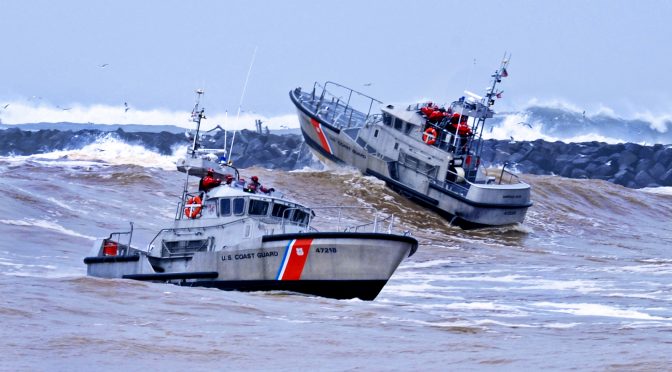
Featured Image: ASTORIA, Ore. – Two Coast Guard 47-foot motor lifeboat crews comprised of members from smallboat stations throughout the Thirteenth District train in the surf at Umpqua River near Winchester Bay, Ore. (Coast Guard photo by Petty Officer First Class Shawn Eggert)
Understanding Systems of International Order

Note: Original title of essay: “Understanding Systems of International Order: Challenging Existing Evaluation Criteria”

NAFAC Week

By Kimberly Ross

Foundational literature exploring the respective merits and shortcomings of unipolar, bipolar, and multipolar international orders largely evaluate these systems in terms of their durability and propensity for peace.1 This essay serves to challenge these criteria as the main bases for evaluation, arguing that consideration of global prosperity and human rights is key in assessing the advantages of each system. It is beyond the scope of this essay however, to evaluate the three systems’ abilities to generate prosperous and fair environments, as empirical support for these claims would be distorted for the sake of argument. Instead, this essay seeks to make a claim for the inclusion of prosperity and human rights criteria in understanding and appraising international balances of power.

Realist international relations (IR) theory assumes the global order is naturally anarchical, meaning power balances resulting in peace defy relational norms and indicate success.2,3 It is for this reason propensity for peace is so highly valued in analyses of these systems, as seen in the work of Wohlforth, Ikenberry, Mastanduno, and others.4 Sustained, ‘true’ peace ensures stability, leading to the second quality valued in power balance assessments: durability. Any power balance with longevity similarly defies patterns of relations between states. Thus, scholars maintain peace and durability are the most important qualities to consider in evaluating international systems.5

These two qualities are undoubtedly important, but should not be the sole basis for understanding which system is preferred. It is assumed stability is inherently peaceful; stability only exists when all major actors accept the status quo. Stability however, could also be derived from the violent oppression of minor powers into supporting roles. A number of scholars reflect upon the Cold War as a tension-filled but stable period of bipolarity, as both powers were the only match for each other’s capabilities.6 As Nuno P. Monteiro rightly points out, peace in this context is only evaluated in terms of direct nuclear war between the superpowers.Narratives of Cold War peace overlook the numerous proxy wars waged on behalf of each power’s ideology, resulting in a singularly violent period within international politics.8 Smaller powers are often forced into their roles in conflicts due to powerful states’ oppressive assertions of influence.

Smaller powers similarly fall prey to natural resource exploitation under all three systems of power balance. Globalization has exacerbated this reality, creating unequal systems of production and consumption.9 International power balances give way to asymmetrical and oftentimes oppressive systems, a fact many regard as the nature of state relations. While minor powers may always be destined to suffer harsh realities, in advocating for either a unipolar, bipolar, or multipolar system it is important to value that which most effectively minimizes the unsavory consequences of inequality. 

A successful world order is one which assures relative prosperity and human rights for all. In systems where a minority of powerful states benefit from the labor and exploitation of the majority of the population, power balances are not only unequal but extremely skewed. This arguably results in increased instability as minor powers vie to dismantle the status quo.10 Therefore, it is within powerful states’ best interests to move toward leveling the playing field to ensure the durability of their dominance. It is for this reason prosperity and human rights are two of the best markers by which to measure the success of an international power structure.11 These two conditions factor heavily into minimum living standards generally accepted by the international community and should be prioritized in the evaluation of unipolar, bipolar, and multipolar systems.

The realist assumption that states are self-interested actors offers an immediate rebuttal to this argument. Major powers in all three systems are arguably strong to a point where they are unthreatened by the discontent of less capable actors.12 However, it should be noted that sustained resistance, even from much less capable powers, has the ability to drain the resources of major powers to a point of disrupting the status quo in their favor. Although states may be self-interested, they are not always rational. Given the appropriate pressures, it may be within states’ best interests to engage in power redistribution to ensure the longevity of their status.

Proponents of the peace-durability evaluation criteria would point out that prosperity and human rights are impossible to guarantee in the absence of peace. While this argument certainly holds merit, the anarchical nature of international relations systems means peace is an abnormality.13 Within the current system of unipolarity, the United States has been at war for over 25 percent of its total time as global hegemon.14 Moreover, only recently in history have questions of basic standards of living and human rights begun to be seriously considered.15 In advocating for any one international power balance system, peace should be a central goal but not at the expense of the protection of adequate living standards and human rights.

As previously stated, it is beyond the scope of this essay to empirically evaluate each system’s ability to generate prosperity or foster human rights, however, data-driven monitoring structures are needed for future evaluations. One method to examine the prosperity enjoyed under each system could be through comparative examination of GDP and global economic inequality statistics. Reliance upon these sources has shortcomings, especially since the bulk of contemporary globalization has occurred under United States hegemony. The use of tools such as the Legatum Prosperity Index may provide more useful for deriving meaningful findings.16 In measuring human rights, one can employ the United Nations Commission on Human Rights’ set of indicators which assess topics ranging from the rights of disabled persons to ratification of treaties on a yearly basis.17

Adequate living standards and human rights are central to evaluating the attractiveness of international power-balancing structures. Use of statistics on these standards should be integrated into scholarly considerations of system merits.

Kimmie, who hails from Springfield, Virginia, represents Vassar College at NAFAC 2017. She is a senior who is majoring in International Studies and French. Kimmie is passionate about all things relating to international relations, but harbors a special interest for counter-terrorism operations in the Middle East and Maghreb. Kimmie also greatly admires Harriet Beecher Stowe, as not only does she embody some great ideals, but Kimmie is related to her as well. If Kimmie could travel anywhere, it would be New Zealand. Finally, Kimmie was inspired to write her paper not only because of the looming deadline, but because she finds the aspect of human rights integral to understanding the changing climate of great power dynamics around the globe.

Works Cited

Bate, Roger. “What is Prosperity and How Do We Measure It?” American Enterprise Institute Development Policy Outlook no. 3 (2009): 1-7. poseidon01.ssrn.com/delivery.php.

Cohen, Michael. “Peace in the Post-Cold War World.” The Atlantic, December 15th, 2011. www.theatlantic.com/international/archive/2011/12/peace-in-the-post-cold-war-world/249863.

“Human Rights Indicators.” UNHCR. Accessed March 15th, 2017. http://www.ohchr.org/EN/Issues/Indicators/Pages/HRIndicatorsIndex.aspx.

Ikenberry, G. John, Michael Mastanduno, and William C. Wohlforth. “Introduction: Unipolarity, State Behavior, and Systemic Consequences.” World Politics 61, no. 1 (2009): 1-27.

Krugman, Paul and Anthony J. Venables. “Globalization and the Inequality of Nations.” The Quarterly Journal of Economics 110, no. 4 (1995): 857-880.

Mingst, Karen A. and Ivan M. Arreguín-Toft. Essentials of International Relations, Fifth Edition. (New York: W.W. Norton and Company, Inc., 2010). 

Monteiro, Nuno P. “Unrest Assured: Why Unipolarity is Not Peaceful.” International Security 36, no. 3 (2011): 9-40.

UN General Assembly. Universal Declaration of Human Rights. December 10th, 1948, 217 A (III). http://www.refworld.org/docid/3ae6b3712c.html.

Waltz, Kenneth N. “The Stability of a Bipolar World.” Daedalus 93, no. 3 (1964): 881-909.

Wohlforth, William C. “The Stability of a Unipolar World.” International Security 24, no. 1 (1999): 5-41.

Consulted works 

Wohlforth, William C. “Unipolarity, Status Competition, and Great Power.” World Politics 61, no. 1 (2009): 28-57.

1. Nuno P. Monteiro, “Unrest Assured: Why Unipolarity is Not Peaceful,” International Security 36, no. 3 (2011): 9.

2. Karen A. Mingst and Ivan M. Arreguín-Toft, Essentials of International Relations, Fifth Edition (New York: W.W. Norton and Company, Inc., 2010), 83-96.

3. This essay employs realist theory in its discussions as much of the literature on unipolar, bipolar, and multipolar systems relies upon the theory’s assumptions in evaluating the international political order.

4. See consulted sources in bibliography for further reading. 

5. William C. Wohlforth, “The Stability of a Unipolar World,” International Security 24, no. 1 (1999): 7.

6. Kenneth N. Waltz, “The Stability of a Bipolar World,” Daedalus 93, no. 3 (1964): 882-887.

7. Monteiro, Unrest Assured, p. 17.

8. Michael Cohen, “Peace in the Post-Cold War World,” The Atlantic, December 15th, 2011, www.theatlantic.com/international/archive/2011/12/peace-in-the-post-cold-war-world/249863.

9. Paul Krugman and Anthony J. Venables, “Globalization and the Inequality of Nations,” The Quarterly Journal of Economics 110, no. 4 (1995): 857-868.

10. Monteiro, Unrest Assured, p. 20-23.

11. Prosperity in this instance refers to the baseline economic standards which guarantee the right to an adequate standard of living as established by the 1948 Universal Declaration of Human Rights.

12. G. John Ikenberry, Michael Mastanduno, and William C. Wohlforth, “Introduction: Unipolarity, State Behavior, and Systemic Consequences,” World Politics 61, no. 1 (2009): 8-10.

13. Monteiro, Unrest Assured, p. 17.

14. Ibid, p. 11.

15. UN General Assembly, Universal Declaration of Human Rights, December 10th, 1948, 217 A (III), http://www.refworld.org/docid/3ae6b3712c.html.

16. See Roger Bate, “What is Prosperity and How Do We Measure It?,” American Enterprise Institute Development Policy Outlook no. 3 (2009): 1-7, poseidon01.ssrn.com/delivery.php.

17. “Human Rights Indicators,” UNHCR, accessed March 15th, 2017, http://www.ohchr.org/EN/Issues/Indicators/Pages/HRIndicatorsIndex.aspx.

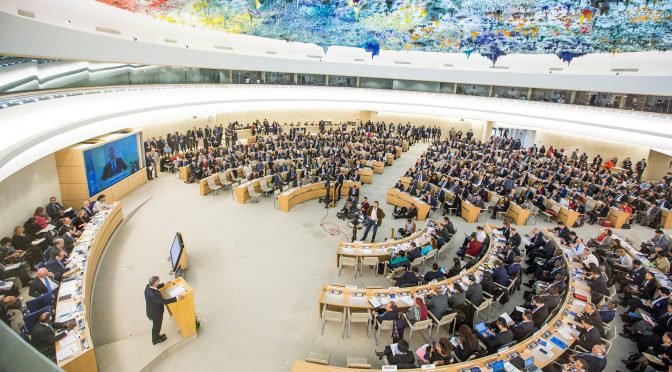
Featured Image: A wide view of the Human Rights and Alliance of Civilizations Room at the Palais des Nations during the high-level segment of the Human Right Council’s thirty-fourth regular session. (UN Photo/Elma Okic)

The Threat, Defense, and Control of Cyber Warfare

NAFAC Week

By Lin Yang Kang

The Internet has grown phenomenally since the 1990s and currently has about 3.5 billion users who make up 47 percent of the world population.1 Out of the 201 countries surveyed, 38 percent have a penetration rate of at least 80 percent of its population.2 The ubiquity and reliance on cyberspace to improve the efficiency and capability of government, military, and civilian sectors lead to the Internet of Things (IOT) for day-to-day operations and in this pervasiveness of the use of Internet lies the potential for devastating cyber-attacks.

This paper seeks to discuss the crippling effects and dangers of cyber-attacks and outline the defensive responses against and control of cyber warfare.

The lethality, and hence appeal of cyber warfare, lies in its asymmetric3 and stealthy nature. Little resource, such as teams of experienced hackers, is required to render a disproportional amount of devastating damage to the core and day-to-day operations of both the government as well as the military. Unlike conventional warfare where a military build-up and transportation of resources are tell-tale signs of preparation, cyber-attacks can be conducted without warning. In this regard, it is akin to covert operations, such as the use of Special Forces or submarines, with added advantage of not exposing soldiers to the risk of harm. Coupled with the inherent difficulty in pinpointing attribution,4 subjects of a cyber-attack are left with the choice of either doing nothing except to try to recover or to retaliate against the suspected attacker without concrete proof and lose moral high ground, neither of which is optimal.

An example of a well-coordinated attack demonstrating the covert nature of cyber warfare occurred in 2007 when the Estonian government and government-related web-services were disabled.5 Though no physical damage was inflicted, it created widespread disruption for Estonian citizens. While Russia was the suspected perpetrator, it was never proven or acknowledged. In 2010, it was discovered that Iranian nuclear centrifuges that are responsible for enriching uranium gas had been infected and crippled by a malware, codenamed “Stuxnet.”This successful insertion of this malware effectively set the Iranian nuclear program back for a few years and demonstrated an effective and non-attributable way7 to pressurize if not exert will without the use of military might as it achieved what the United Nations Security Council (UNSC) had hitherto failed to do, i.e., curtail the development of nuclear weapons by Iran.

The above examples illustrate the potential damage of small-scale and limited cyber-attacks. Extrapolating from these examples, it is conceivable that the damage from a successful large-scale cyber-attack on a well-connected country that relies heavily on IOT can range from disruption of essential services, crippling confusion and even operational paralysis of both government and the military. For the government, a cyber-attack across every essential means and aspects of daily living including but not limited to destruction of financial data, records and transactions, forms of travel, communication means, and national power grid create chaos and confusion resulting in psychological shock that will in turn sap the will and resilience of the citizens. For the military, the irony is that the more modern and advanced a military is with its concomitant reliance on technology and network centric warfare, the more vulnerable it is to a potential cyber Pearl Harbor attack that will render its technological superiority over its adversary impotent. Given the symbiotic relation between the government and the military, a successful simultaneous cyber-attack on both government and the military can achieve Sun Tze’s axiom that the supreme art of war is to subdue the enemy without fighting.

Given its unique nature and unmatched demonstrated potential for lethality, it is understandable the attractiveness of cyber warfare as an instrument of choice for all players, both state and non-state actors and even individuals. As with all other forms of warfare, the need for defense against should be proportional to the threat. It is a game of cat and mouse,8 where hackers seek to find security vulnerabilities while defenders attempt to patch them up as soon as they are exploited and redirect the attackers to digital traps, preventing them from obtaining crucial information or cause damages. Specialized cyber warfare military branches have been formed in many countries, and extensive cyber defensive measures and contingency plans are being developed by government, military, and civil sectors of states. Through inter-cooperation, potential attacks could be resolved in the shortest time possible and minimize disruption, while preventing future attacks. As the world begins to witness the increasing use of cyber warfare as a weapon, cyber-attacks may not be as easy to conduct as before as states that understand the lethality of such attacks seek to safeguard their nation.9

Beyond defense at the national level, there is a lack of well-defined norms on the rules of cyber warfare as the international law community is still interpreting how current law of war can apply to cyber warfare. Recently, Tallinn Manual 2.0 was published by NATO’s Cooperative Cyber Defence Centre of Excellence (CCDOE) and is to date the most detailed study of how existing international laws can govern cyber operations.10 However, it currently serves as a reference and is non-binding. It is crucial for nations to iron out the rules for cyber warfare together and abide by it, ensuring that it will not affect the lives of civilians and minimize potential damages to non-military installations by cyber-attacks and cyber warfare.

Cyber warfare is a real and growing threat which has the potential to create disruption that the world has yet to witness. As nations become even more reliant on cyberspace as it ventures into automation and smart cities, they need to invest adequately in cyber defense and ensure that this new frontier is well-guarded. Apart from dealing with it domestically, on an international level, rules of cyber warfare need to be clarified and be abided by the international community to safeguard civilians. Cyber warfare may be threatening, but if the international community abides by clarified rules of cyber warfare and has sufficient cyber defensive measures established, the potential devastation caused by cyber-attacks could be minimized.

Yang Kang is a naval officer from the Republic of Singapore and a freshman at the Nanyang Technological University (NTU) in Singapore currently studying Electrical and Electronics Engineering. Before attending NTU, Yang Kang underwent midshipman training in Midshipman Wing, Officer Cadet School of the Singapore Armed Forces and was appointed Midshipman Engineering Commanding Officer during the Advanced Naval Term, his final phase of training.

Bibliography

Barker, Colin. “Hackers and defenders continue cybersecurity game of cat and mouse.” ZDNet. February 04, 2016. Accessed March 28, 2017. http://www.zdnet.com/article/hackers-and-defenders-continue-cyber-security-game-of-cat-and-mouse/.

Davis, Joshua. “Hackers Take Down the Most Wired Country in Europe.” Wired. August 21, 2007. Accessed March 21, 2017. https://www.wired.com/2007/08/ff-estonia/.

Geers, Kenneth. Strategic cyber security. Tallinn: NATO Cooperative Cyber Defence Centre of Excellence, 2011.

Zetter, Kim. “An Unprecedented Look at Stuxnet, the World’s First Digital Weapon.” Wired. November 03, 2014. Accessed March 21, 2017. https://www.wired.com/2014/11/countdown-to-zero-day-stuxnet/.

“Cyber Warfare Integral Part of Modern Politics, New Analysis Reaffirms.” NATO Cooperative Cyber Defence Centre of Excellence. December 01, 2015. Accessed March 15, 2017. https://ccdcoe.org/cyber-warfare-integral-part-modern-politics-new-analysis-reaffirms.html.

“Global Cybersecurity Index & Cyberwellness Profiles Report.” April 2015. Accessed March 23, 2017. https://www.itu.int/dms_pub/itu-d/opb/str/D-STR-SECU-2015-PDF-E.pdf.

“NATO presents the Tallinn Manual 2.0 on International Law Applicable to cyberspace.” Security Affairs. February 05, 2017. Accessed March 25, 2017. http://securityaffairs.co/wordpress/56004/cyber-warfare-2/nato-tallinn-manual-2-0.html.

“Internet Users by Country (2016).” Internet Users by Country (2016) – Internet Live Stats. Accessed March 20, 2017. http://www.internetlivestats.com/internet-users-by-country/.

“Internet Users.” Number of Internet Users (2016) – Internet Live Stats. Accessed March 20, 2017. http://www.internetlivestats.com/internet-users/.

“The Asymmetric Nature of Cyber Warfare.” USNI News. February 05, 2013. Accessed March 20, 2017. https://news.usni.org/2012/10/14/asymmetric-nature-cyber-warfare.

“The Attribution Problem in Cyber Attacks.” InfoSec Resources. July 19, 2013. Accessed March 25, 2017. http://resources.infosecinstitute.com/attribution-problem-in-cyber-attacks/#gref.

1. “Internet Users.” Number of Internet Users (2016) – Internet Live Stats. Accessed March 20, 2017. http://www.internetlivestats.com/internet-users/.

2. “Internet Users by Country (2016).” Internet Users by Country (2016) – Internet Live Stats. Accessed March 20, 2017. http://www.internetlivestats.com/internet-users-by-country/.

3. “The Asymmetric Nature of Cyber Warfare.” USNI News. February 05, 2013. Accessed March 20, 2017. https://news.usni.org/2012/10/14/asymmetric-nature-cyber-warfare.

4. “The Attribution Problem in Cyber Attacks.” InfoSec Resources. July 19, 2013. Accessed March 25, 2017. http://resources.infosecinstitute.com/attribution-problem-in-cyber-attacks/#gref.

5. Davis, Joshua. “Hackers Take Down the Most Wired Country in Europe.” Wired. August 21, 2007. Accessed March 21, 2017. https://www.wired.com/2007/08/ff-estonia/.

6. Zetter, Kim. “An Unprecedented Look at Stuxnet, the World’s First Digital Weapon.” Wired. November 03, 2014. Accessed March 21, 2017. https://www.wired.com/2014/11/countdown-to-zero-day-stuxnet/.

7. The United States and Israel were allegedly responsible for this cyber attacked but as with the Estonian example, it was never proven or acknowledged.

8. Barker, Colin. “Hackers and defenders continue cybersecurity game of cat and mouse.” ZDNet. February 04, 2016. Accessed March 28, 2017. http://www.zdnet.com/article/hackers-and-defenders-continue-cyber-security-game-of-cat-and-mouse/.

9. “Global Cybersecurity Index & Cyberwellness Profiles Report.” April 2015. Accessed March 23, 2017. https://www.itu.int/dms_pub/itu-d/opb/str/D-STR-SECU-2015-PDF-E.pdf.

10. “NATO presents the Tallinn Manual 2.0 on International Law Applicable to cyberspace.” Security Affairs. February 05, 2017. Accessed March 25, 2017. http://securityaffairs.co/wordpress/56004/cyber-warfare-2/nato-tallinn-manual-2-0.html.

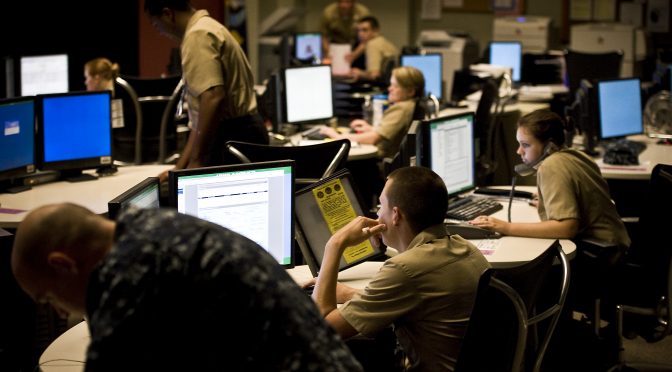
Featured Image: U.S. sailors assigned to Navy Cyber Defense Operations Command man their stations at Joint Expeditionary Base Little Creek-Fort Story, Va., Aug. 4, 2010. NCDOC sailors monitor, analyze, detect and respond to unauthorized activity within U.S. Navy information systems and computer networks. (U.S. Navy photo by Petty Officer 2nd Class Joshua J. Wahl)  

Science Diplomacy in the Arctic

NAFAC Week

By Jackie Faselt

As icecaps melt and access to natural gas and oil reserves increase, the Arctic rises in importance on the geopolitical stage. In addition to the various groups of indigenous people who reside in the Arctic, eight countries Russia, Finland, Sweden, Norway, Iceland, Denmark, Canada, and the United States have claimed interest in the Arctic. Diplomacy between the different groups is required for cooperation and organization in the complicated region. Due to its importance in environmental security, sizable natural resource reserves, and remote location, the Arctic incentivizes cooperation through science diplomacy.

Science diplomacy is defined by the Royal Society and American Association for the Advancement of Science as threefold: “Informing foreign policy objectives with scientific advice, facilitating international science cooperation, [and] using science cooperation to improve international relations between countries.”1 Science diplomacy has accomplished much in the past, both between allied nations, and in situations when traditional lines of cooperation were fraught. For example, the warming of relations with China during the Nixon administration and cooperation in the International Space Station both resulted, or were sustained in part due to science diplomacy.2 It should be noted, however, that there are barriers to science diplomacy. Policymakers and scientists alike can be confused about how this type of diplomacy is different from general scientific cooperation and additionally, “after generations of colonialism and geopolitical maneuvering, developing nations may be wary of science engagement with the North.”3 The Arctic region has existing channels of successful science diplomacy, which hopefully can be sustained into the future.

In 1909 Robert Peary, and American explorer, reached the North Pole and claimed it for the President of the United States. Since then, Russia, Finland, Sweden, Norway, Iceland, Denmark, and Canada have all made claims or asserted influence in the region.4 The first international agreement regarding the Arctic came from the United Nations Convention on the Continental Shelf, which was signed in 1958 and allowed for coastal states to explore resources on their continental shelf.5 It was superseded by the UN Convention on the Law of the Sea, which “grants coastal states a 200-nautical-mile exclusive economic zone and allows them to assert control over territory beyond that limit if they can prove, geologically, that the seabed is an extension of their continental shelf.”6 However, it is notable that the United States did not sign the agreement until 2013 and still has yet to ratify it.

International agreements and organizations in the Arctic specific to the scientific community began gaining ground over 30 years ago. In 1990, the International Arctic Science Committee (IASC) was created, and the following year the Arctic Environmental Protection Strategy agreement was adopted by the eight arctic states as well as some indigenous communities.7 These international organizations and agreements provide a base not only for scientific cooperation, but also science diplomacy. For example, the mission statement of the IASC contains all three components of science diplomacy as stated by the American Association for the Advancement of Science: informing policy, promoting cooperation, and using that cooperation to progress international relations. The mission statement includes the following objectives:

  • “Provides objective and independent scientific advice on issues of science in the Arctic and communicates scientific information to the public;
  • Initiates, coordinates and promotes scientific activities at a circumarctic or international level;
  • Promotes international access to all geographic areas and the sharing of knowledge, logistics and other resources;”8

The Arctic Council was formed in 1996 with all the arctic states, as well as six groups of indigenous peoples, serving as members. It houses six scientific working groups: Arctic Contaminants Action Program, The Arctic Monitoring and Assessment Program, Conservation of Arctic Flora and Fauna Working Group, Emergency Prevention, Preparedness and Response Working Group, Protection of the Arctic Marine Environment, and the Sustainable Development Working Group.9 As the Arctic becomes increasingly more important for environmental security, these institutions can act as the foundation for increased science diplomacy.

Global climate change has brought the Arctic closer to the forefront of the international stage. The Arctic Ocean is currently warming at double the rate of any other place on our planet.10 As ice caps melt, the region has become more accessible to both countries and private corporations to drill for oil and gas in large, untouched reserves.11 Both the environmental and the resource importance of the region requires the involvement of scientists and technologists at the Arctic. Due to the remoteness of the region and the harshness of the environment, cooperation has been incentivized for cost sharing of logistic and facility resources.12 There are enough common interests among the Arctic states to incentivize cooperation. These de-facto partnerships can be used as a foundation on which to build further collaboration, through traditional and science diplomacy channels.

While there are existing structures to promote science diplomacy in the Arctic, improvements can be made. Recommendations for improved science diplomacy include increasing partnerships between the government, the private sector, universities, and NGOs, as well as involving youth in scientific diplomacy efforts.13 There has also been efforts to promote, “greater scientific expertise within the Foreign Service and the State Departments,” in order to institutionalize scientific diplomacy channels.14  The countries that have created official positions of Science & Technology Advisors to Foreign Ministers are New Zealand, Oman, Poland, Senegal, Japan, the United Kingdom, and the United States.15 If more Arctic states follow suit, science diplomacy can continue to grow in the Arctic.

The foundation of science diplomacy has been established in the Arctic and can be sustained and expanded if the Arctic states decide to follow the incentives of cooperation that is inherent in the unique region. The Arctic states should capitalize on this opportunity and push for expanded science diplomacy efforts. 

Jackie Faselt is a senior at Tufts University interested in international security and technology policy. On campus, she is involved in Alliance Linking Leaders in Education and the Services (ALLIES), a civil-military relations club. She has interned at the National Defense University in the Center for Technology and National Security Policy, as well as at the Consortium for Gender, Security, and Human Rights.

Bibliography 

“About Us – Arctic Council.” Arctic Council, May 23, 2016. http://arctic-council.org/index.php/en/about-us.

Berkman, Paul. “Stability and Peace in the Arctic Ocean through Science Diplomacy.” Science & Diplomacy 3, no. 2 (June 2014). http://www.sciencediplomacy.org/perspective/2014/stability-and-peace-in-arctic-ocean-through-science-diplomacy.

McCormick, TY. “Arctic Sovereignty: A Short History.” Foreign Policy, May 7, 2014. https://foreignpolicy.com/2014/05/07/arctic-sovereignty-a-short-history/.

National Research Council (U.S.), and National Research Council (U.S.), eds. U.S. and International Perspectives on Global Science Policy and Science Diplomacy: Report of a Workshop. Washington, D.C: National Academies Press, 2012.

“New Frontiers in Science Diplomacy: Navigating the Changing Balance of Power.” The Royal Society, January 2010. https://www.aaas.org/sites/default/files/New_Frontiers.pdf.

“Science & Technology Advisors to Foreign Ministers Panel Dialogue.” Tufts Fletcher School, February 19, 2017. http://fletcher.tufts.edu/Calendar/2017/02/19/Science-Technology-Advisors-to-Foreign-Ministers-Panel-Dialogue-.aspx.

The International Arctic Science Committee. “About IASC – International Arctic Science Committee.” Accessed March 17, 2017. http://iasc.info/iasc/about-iasc.

“The Power of Science Diplomacy: A View from the South.” NEWSLETTER A PUBLICATION OF THE WORLD ACADEMY OF SCIENCES, 2014.

“United Nations Convention on the Continental Shelf.” Council on Foreign Relations. Accessed March 17, 2017. http://www.cfr.org/world/united-nations-convention-continental-shelf/p21071.

1. National Research Council (U.S.), eds., U.S. and International Perspectives on Global Science Policy and Science Diplomacy: Report of a Workshop (Washington, D.C: National Academies Press, 2012), 27.

2. “The Power of Science Diplomacy: A View from the South,” NEWSLETTER A PUBLICATION OF THE WORLD ACADEMY OF SCIENCES, 2014, 2.

3. “The Power of Science Diplomacy: A View from the South”, 7.

4. TY McCormick, “Arctic Sovereignty: A Short History,” Foreign Policy, May 7, 2014, https://foreignpolicy.com/2014/05/07/arctic-sovereignty-a-short-history/.

5. “United Nations Convention on the Continental Shelf,” Council on Foreign Relations, accessed March 17, 2017, http://www.cfr.org/world/united-nations-convention-continental-shelf/p21071.

6. TY McCormick

7. Paul Berkman, “Stability and Peace in the Arctic Ocean through Science Diplomacy,” Science & Diplomacy 3, no. 2 (June 2014), http://www.sciencediplomacy.org/perspective/2014/stability-and-peace-in-arctic-ocean-through-science-diplomacy.

8. The International Arctic Science Committee, “About IASC – International Arctic Science Committee,” accessed March 17, 2017, http://iasc.info/iasc/about-iasc.

9. “About Us – Arctic Council,” Arctic Council, May 23, 2016, http://arctic-council.org/index.php/en/about-us.

10. Paul Berkman

11. ibid

12. “New Frontiers in Science Diplomacy: Navigating the Changing Balance of Power” (The Royal Society, January 2010), https://www.aaas.org/sites/default/files/New_Frontiers.pdf., 25

13. National Research Council (U.S.), eds., U.S. and International Perspectives on Global Science Policy and Science Diplomacy: Report of a Workshop, 38-39.

14. ibid

15. “Science & Technology Advisors to Foreign Ministers Panel Dialogue,” Tufts Fletcher School, February 19, 2017, http://fletcher.tufts.edu/Calendar/2017/02/19/Science-Technology-Advisors-to-Foreign-Ministers-Panel-Dialogue-.aspx.

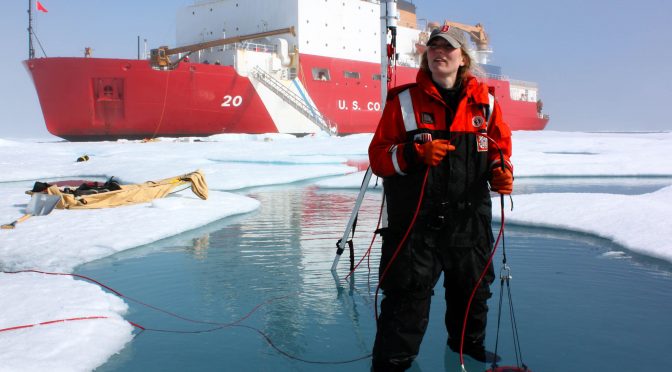
Featured Image: ICESCAPE scientist and Clark geography Professor Karen Frey takes optical measurements in a melt pond, with the U.S. Coast Guard Cutter Healy in the background. (NASA’s Goddard Space Flight Center/Kathryn Hansen)