All posts by Guest Author

Radioactive Tsunamis: Nuclear Torpedo Drones and their Legality in War

By Raul (Pete) Pedrozo

Introduction 

Russia and North Korea are both fielding a novel type of naval weapon – nuclear-armed torpedo drones. These new weapons introduce a variety of strategic and operational challenges that further complicate a worsening threat environment. They also pose critical legal questions about whether their intended concepts of operation are lawful. These weapons have a fearsome potential to weaponize the maritime environment, and precise questions of their legality should be resolved in order to dissuade their proliferation. 

North Korea and Russia’s Doomsday Torpedoes

On July 28, North Korea displayed a new nuclear-armed drone torpedo at the 2023 Victory Day Parade in Pyongyang. Although its official classification is unknown, the new weapon is likely a Haeil-class drone torpedo. The nuclear torpedo drone is approximately 52 feet long and 5 feet in diameter, has an estimated range of about 540 nautical miles, and can be fitted with a conventional or nuclear warhead. It could therefore be used against targets in both South Korea and Japan. The torpedo drone appears to have three air filters over the propulsion space for snorkeling, is likely powered by a diesel-electric (battery) propulsion system, has an average speed of 4.6 knots, and can operate at depths between 260-300 feet. Given the size of the drone, North Korea does not have a submarine large enough to launch it, which suggests that the new weapon system will need to be launched from shore, a floating platform, or a modified surface vessel.

The nuclear-armed underwater drone can be used to attack coastal naval installations or cities with little or no warning, providing North Korea with a strategic nuclear weapons delivery option that is difficult to detect and defend against. Thus, the Haeil-class drone provides North Korea with an additional strike option, increasing the resilience of its nuclear forces and making them less vulnerable to preemption or counterattack.
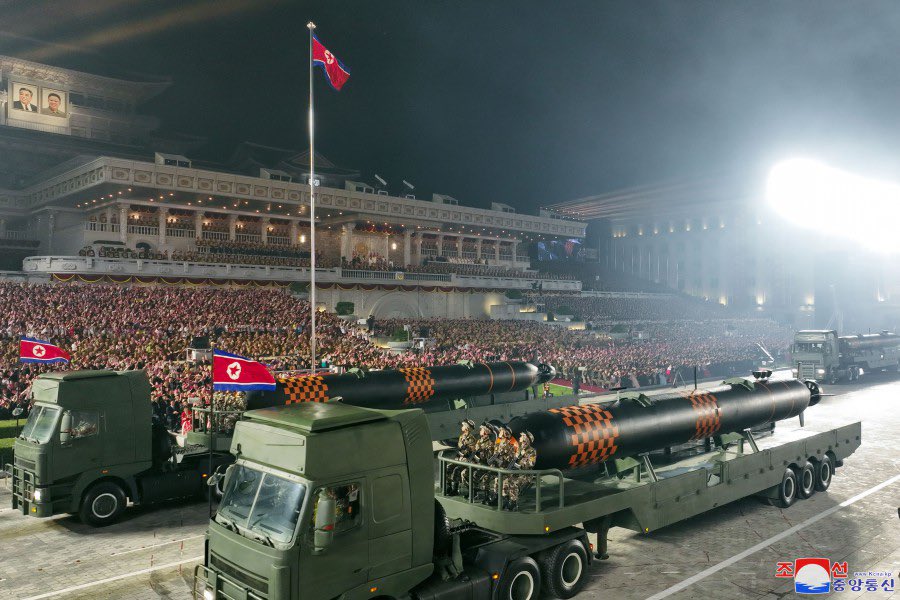
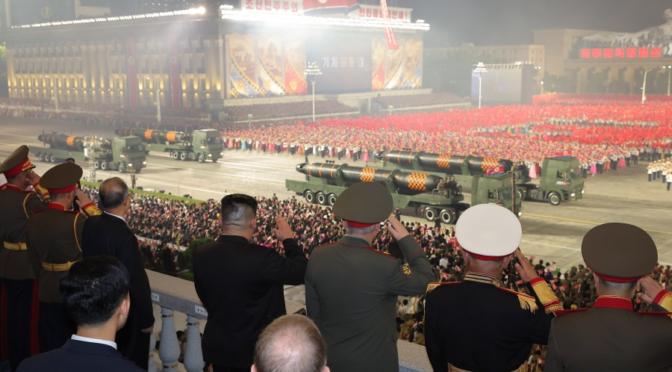
Pyongyang, July 27, 2023 – Haeil-class nuclear torpedo drones feature in a North Korean military parade. (Photo via North Korean state media)

The Haeil-class drone torpedo is similar to (but smaller than) the Russian Poseidon, an intercontinental, nuclear-powered, nuclear-armed autonomous torpedo that was first revealed by the Russian Navy in 2015. The Poseidon (also known as Kanyon or Status 6) can reportedly operate at speeds of around 70-100 knots and at depths of around 3,300 feet, which means it can outrun and out dive any conventional torpedo. The weapon is also equipped with “acoustic tracking devices and other traps” that make it difficult to detect. Moreover, the drone is equipped with its own power source—a nuclear reactor—which gives the torpedo unlimited range. Once launched, the drone is designed to be controlled by both remote communications and onboard automation. In January 2023, TASS reported that Russia had produced the first batch of Poseidon torpedoes for “use by the [K-329] Belgorod special-purpose nuclear submarine.” The Belgorod submarine can carry up to six Poseidon torpedoes, and will deploy to the Pacific Fleet area of responsibility as early as late 2024 or early 2025.
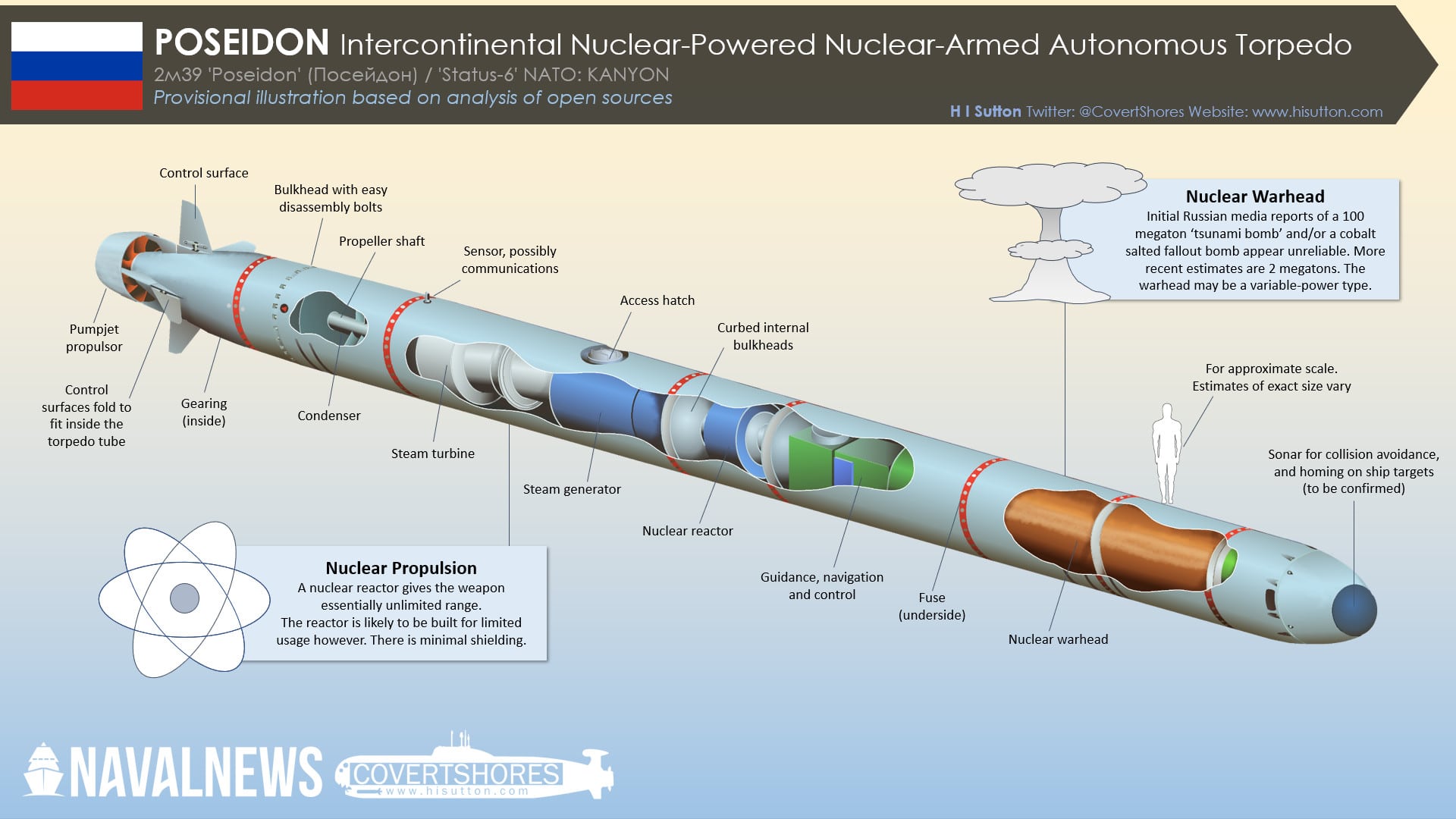
Click to expand. Cutaway illustration of Poseidon, based on analysis of images released by Russia. (Graphic by H I Sutton)

These drone torpedoes can be armed with up to a 100-megaton nuclear warhead, but their primary method of destruction is less about directly impacting targets. Instead, they focus on weaponizing the immediate aftereffects of nuclear detonations in the maritime environment. These nuclear torpedo drones are designed to trigger a radioactive tsunami-like ocean swell that destroys coastal cities and renders them uninhabitable, potentially resulting in large-scale displacement and millions of deaths. The legality of this concept of operations deserves closer scrutiny.
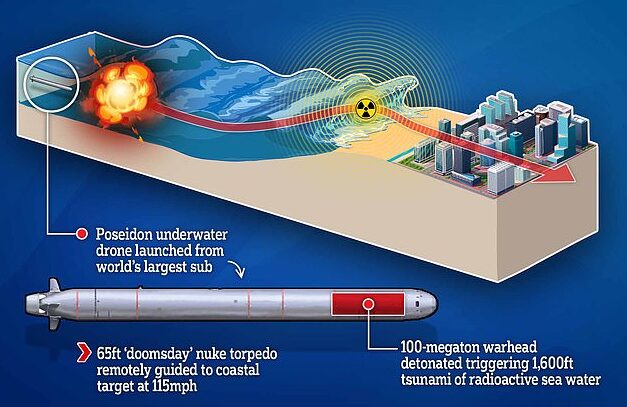
Depiction of nuclear torpedo drone concept of operation. (Graphic via DailyMail)

Legal Means and Methods of Warfare

Generally, the legal right of the belligerents to adopt means or methods of warfare during an international armed conflict is not unlimited (AP I, art. 35; HR, art. 22; Newport Manual, § 6.1). Specifically, a belligerent does not have the unlimited right to inflict superfluous injury or unnecessary suffering on the opposing belligerent (HR, art. 23; Newport Manual, § 6.1). Weapons law “regulates which weapons and means can lawfully be used during an armed conflict,” and is comprised on both customary international law and treaties (St. Petersburg Declaration; Newport Manual, § 6.2). The customary international law principle of distinction and the prohibition of unnecessary suffering regulate the legality of the means of warfare (Newport Manual, § 6.2). Weapons law is also codified in treaties, such as the Environmental Modification (ENMOD) Convention and Additional Protocol I (AP I) to the 1949 Geneva Conventions.

Damage to the environment is a concern. AP I places restrictions on weapons that “are intended or may be expected to cause widespread, long-term, and severe damage to the natural environment (AP I, art. 35(3); Newport Manual, § 6.3).” AP I further provides that the belligerent shall take care “in warfare to protect the natural environment against widespread, long-term and severe damage,” which includes a prohibition of the “use of methods or means of warfare which are intended or may be expected to cause such damage to the natural environment…” that prejudices the health or survival of the civilian population (AP I, art. 55(1); Newport Manual, § 6.3). The International Committee of the Red Cross interprets “long-term” to include damage over a period of decades (ICRC Commentary to AP I, ¶ 1453(c)).

The ENMOD convention prohibits States’ parties from engaging “in military or any other hostile use of environmental modification techniques having widespread, long-lasting or severe effects as the means of destruction, damage or injury to any other State Party (ENMOD Convention, art. I; Newport Manual, § 6.3.1).” For the purposes of the Convention, the terms “widespread,” “long lasting,” and “severe” have been interpreted by the convention’s Consultative Committee of Experts. “Widespread” means “encompassing an area on the scale of several hundred square kilometres.” “Long-lasting” means “lasting for a period of months, or approximately a season.” Finally, “severe” means “involving serious or significant disruption or harm to human life, natural and economic resources or other assets.” (See ENMOD, Understanding Relating to Article I). “Environmental modification techniques” are defined in article II as “any technique for changing—through the deliberate manipulation of natural processes—the dynamics, composition or structure of the earth, including its biota, lithosphere, hydrosphere and atmosphere.” Thus, the convention prohibits the use of “modification techniques that result in the environment itself being characterized as a weapon, rather than prohibiting certain military activities that cause damage to the environment (Newport Manual, § 6.3.1).”

The prohibitions in AP I and the ENMOD Convention are, therefore, not duplicative (ICRC Commentary to AP I, ¶ 1450). AP I protects the natural environment against damage which could be inflicted on it by any weapon, whereas the ENMOD Convention prevents the use of environmental modification techniques as a weapon. Additionally, AP I only applies during an international armed conflict, whereas the ENMOD Convention has a wider application—it applies to the use of environmental modification techniques for hostile purposes, even in cases where there is no international armed conflict.

On the one hand, the ENMOD Convention prohibits the deliberate manipulation of natural processes to change “the dynamics, composition or structure of the Earth, including its biota, lithosphere, hydrosphere and atmosphere, or of outer space, with the intention of damaging the armed forces of another State…, its civilian population, towns, industries, agriculture, transportation and communication networks, or its natural resources and wealth (ICRC Commentary to AP I, ¶ 1451).” Therefore, the convention does not prohibit environmental modifications that cause widespread, long-lasting, or severe damage as such, but only if they are used to cause damage to another State (ICRC Commentary to AP I, ¶ 1452).

AP I, on the other hand, “prohibits damaging the natural environment by any means whatsoever, whether direct or indirect, as opposed to effects on the human environment,” that is, “to external conditions and influences which affect the life, development and the survival of the civilian population and living organisms.” (ICRC Commentary to AP I, ¶ 1451). AP I therefore prohibits the use of any means that cause widespread, long-term, and severe damage to the natural environment (ICRC Commentary to AP I, ¶ 1452).

Taken together, AP I and the convention prohibit: (a) “any direct action on natural phenomena of which the effects would last more than three months or a season…;” (b) any direct action on natural phenomena of which the effects would be widespread or severe… regardless of the duration…” or (c) “any method of conventional or unconventional warfare which, by collateral effects, would cause widespread and severe damage to the natural environment as such, whenever this may occur over a period of decades (ICRC Commentary to AP I, ¶ 1453).”

Conclusion

Armed with multi-megaton nuclear warheads, these torpedo drones will be detonated along an adversary’s coast to create a powerful radioactive tsunami to destroy coastal cities and naval bases. Given that the concept of operations for these new weapons might unlawfully modify and weaponize the natural environment, both the North Korean Haeil and Russian Poseidon torpedo drones are likely unlawful weapons per se under the law of armed conflict.

The unleashing of environmental forces in such a manner is contrary to the law of war and likely violates the ENMOD Convention, which prohibits any method of warfare for changing—through the deliberate manipulation of natural processes—the dynamics, composition, or structure of the Earth (DoD Law of War Manual, §§ 6.10.1-6.10.2; FM 6-27, ¶¶ 2-139, 2-140). Examples of environmental effects likely to be widespread (encompassing an area of several hundred square kilometers), long-lasting (for a period of months or a season), or severe (serious or significant disruption or harm to human life, natural and economic resources, or other assets) likely include the inducement of a radioactive tsunami. Unlike a conventional or nuclear weapon designed to destroy enemy forces, the Haeil and Poseidon torpedoes weaponize the natural environment to inflict destruction and ignore the distinction between the enemy’s armed forces and the civilian population. (Newport Manual, § 6.3.1). As parties to AP I and the ENMOD Convention, both North Korea and Russia have legal obligations not to use environmental techniques that are prohibited by the Convention, or to employ means or methods of warfare that can cause widespread, long-term, and severe damage to the natural environment.

Professor Raul (Pete) Pedrozo, Captain, USN, Ret., is the Howard S. Levie Professor on the Law of Armed Conflict, U.S. Naval War College, Stockton Center for International Law. Prior to his retirement from active duty after 34 years of service, he served in numerous positions advising senior military and civilian Defense officials, including as the senior legal advisor to Commander, U.S. Pacific Command. He also served as the Director of the Navy’s International and Operational Law Department in the Pentagon.

The views expresses are those of the author and do not necessarily reflect the views of the Department of Defense or the U.S. Naval War College.

Featured Image: Pyongyang, July 27, 2023 – Supreme Leader of the Democratic People’s Republic of Korea Kim Jong Un applauds as Haeil-class nuclear torpedo drones are featured in a military parade. (Photo via North Korean state media)
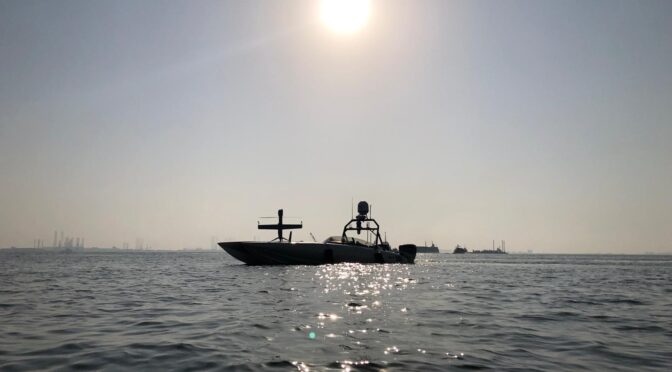
Exercise Digital Horizon: Accelerating the Development of Unmanned Surface Vehicles

By George Galdorisi

The international community has been tremendously proactive in undertaking operations, exercises, experiments, and demonstration to accelerate the development and fielding of unmanned surface vehicles, reflecting the real importance of these systems to world navies. Much of this work has occurred in and around the Arabian Gulf under the auspices of Commander U.S. Fifth Fleet and Task Force 59.

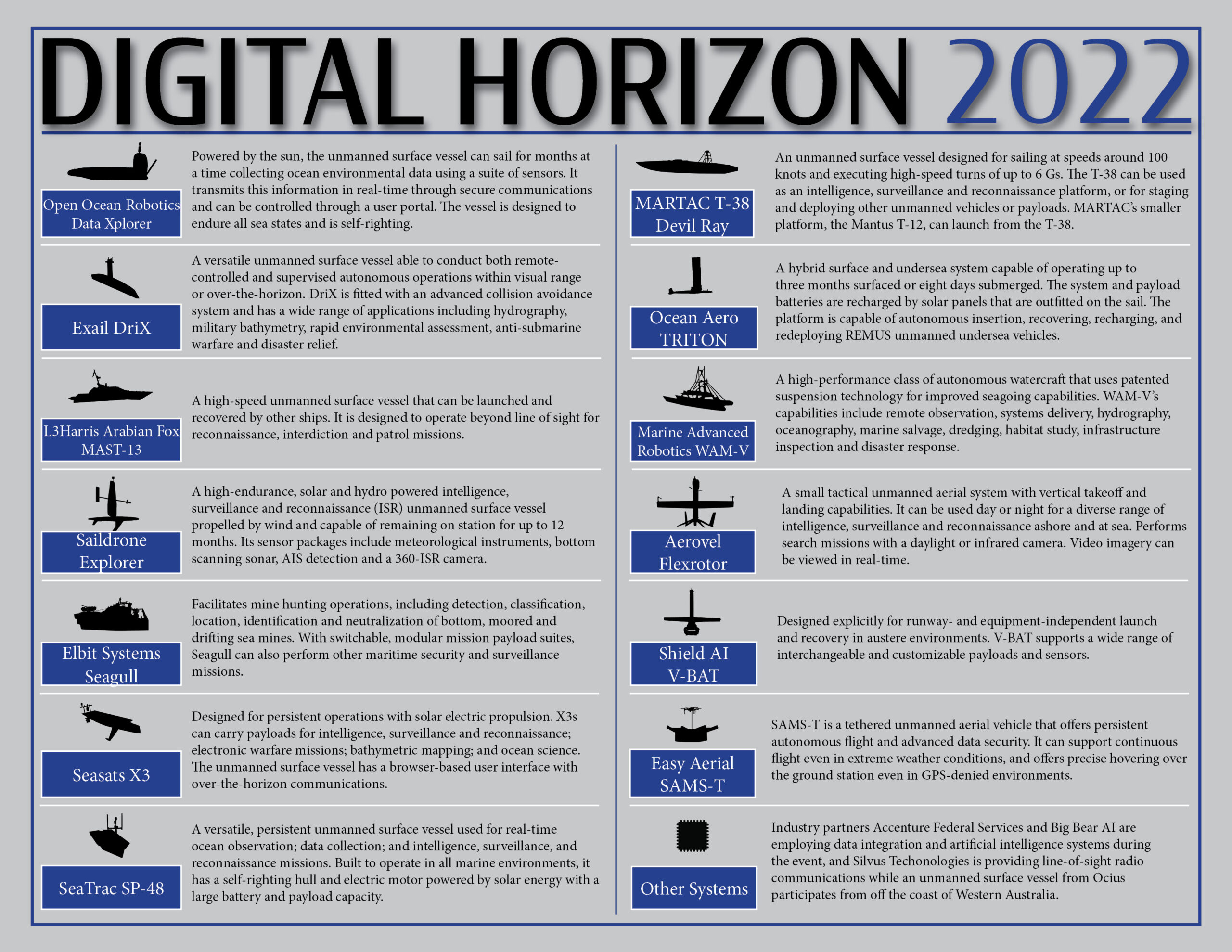
These ambitious exercises throughout the course of 2022 provided a learning opportunity for all participating navies. These culminated in the capstone unmanned event, Exercise Digital Horizon, a three-week event in the Middle East focused on employing artificial intelligence and 15 different unmanned systems: 12 unmanned surface vehicles (USVs) and three unmanned aerial vehicles (UAVs).

A key goal of Digital Horizon was to speed new technology integration across the 5th Fleet, and to seek cost-effective alternatives for Maritime Domain Awareness (MDA) missions. As Carrington Malin described the importance of Digital Horizon:

“Despite the cutting-edge hardware in the Arabian Gulf, Digital Horizon is far more than a trial of new unmanned systems. This exercise is about data integration and the integration of command and control capabilities, where many different advanced technologies are being deployed together and experimented with for the first time.

The advanced technologies now available and the opportunities that they bring to enhance maritime security are many-fold, but these also drive an exponential increase in complexity for the military. Using the Arabian Gulf as the laboratory, Task Force 59 and its partners are pioneering ways to manage that complexity, whilst delivering next-level intelligence, incident prevention and response capabilities.”1

Digital Horizon brought together emerging unmanned technologies and combined them with data analytics and artificial intelligence in order to enhance regional maritime security and strengthen deterrence by applying leading-edge technology and experimentation.2 Vice Admiral Brad Cooper, commander of U.S. Naval Forces Central Command, U.S. 5th Fleet and Combined Maritime Forces introduced the exercise and highlighted its potential: “I am excited about the direction we are headed. By harnessing these new unmanned technologies and combining them with artificial intelligence, we will enhance regional maritime security and strengthen deterrence. This benefits everybody.”3

Click to expand. Graphic illustration depicting the unmanned systems that will participate in exercise Digital Horizon 2022. The three-week unmanned and artificial intelligence integration event involved employing new platforms in the region for the first time. (U.S. Army graphic by Sgt. Brandon Murphy)

Captain Michael Brasseur, then-commodore of Task Force 59, emphasized the use of unmanned maritime vehicles to conduct intelligence, surveillance and reconnaissance missions, including identifying objects in the water and spotting suspicious behavior.4 He noted: “We pushed beyond technological boundaries and discovered new capabilities for maritime domain awareness to enhance our ability to see above, on and below the water.”5

During Digital Horizon, Task Force 59 leveraged artificial intelligence to create an interface on one screen, also called a “single pane of glass,” displaying the relevant data from multiple unmanned systems for watchstanders in Task Force 59’s Robotics Operations Center (ROC). Reviewing what was accomplished during this event, Captain Brasseur marveled at the pace of innovation: “We are challenging our industry partners in one of the most difficult operational environments, and they are responding with enhanced capability, fast.”6

One of the features of Digital Horizon, and in line with the first word of the exercise, “Digital,” was the ability of one operator to command and control five unique drones, a capability long-sought by U.S. Navy officials.7 The Navy is acutely aware of the high cost of manpower and is dedicated to moving beyond the current “one UXS, multiple joysticks, multiple operators,” paradigm that has plagued UXS development for decades.

Digital Horizon was a unique exercise from the outset. Task Force 59 worked with the Department of Defense’s Defense Innovation Unit (DIU) in order to leverage that organization’s expertise as a technology accelerator. Additionally, given the U.S. Navy’s ambitious goals to rapidly test and subsequently acquire USVs to populate the Fleet, CTF-59 used a contractor-owned/contractor operated (COCO) model to bring a substantial number of unmanned systems to Digital Horizon, well beyond those already in the inventory. This approach sidestepped the often clunky DoD acquisition system while providing appropriate oversight during the exercise and gaining operational experience with new systems.

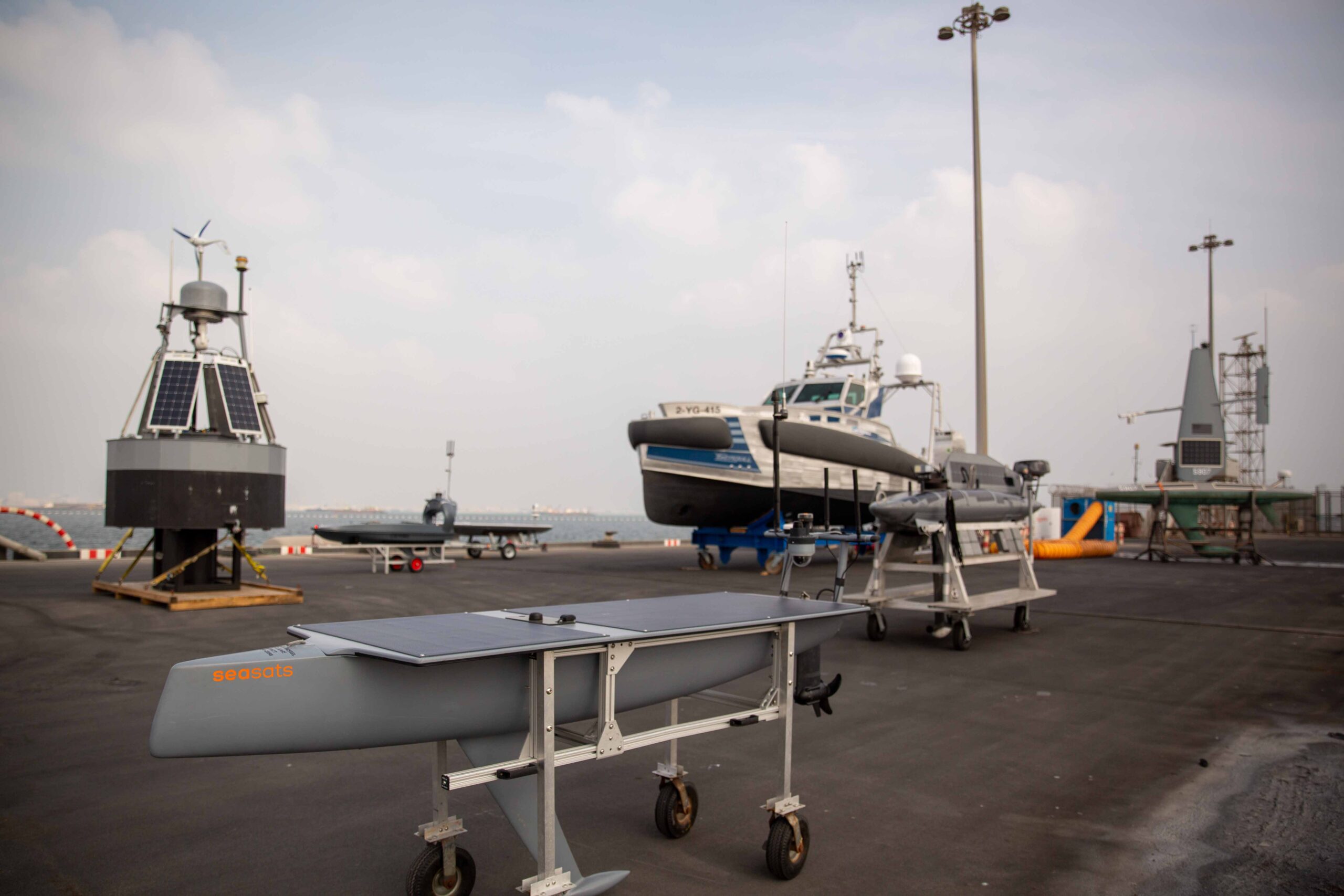
MANAMA, Bahrain (Nov. 19, 2022) Various unmanned systems sit on display in Manama, Bahrain, prior to exercise Digital Horizon 2022. (U.S. Army photo by Sgt. Brandon Murphy)

Another distinctive feature of Digital Horizon involved launching and recovering small UAVs from medium-size USVs. This lash-up leveraged the capabilities of both unmanned assets, enabling the long-endurance USVs to carry the shorter-endurance UAVs to the desired area of operations. This “operationalized” a CONOPS that emerged from the U.S. Navy laboratory community years ago.8

The results of Digital Horizon lived up to the initial hype. During a presentation at the 2023 Surface Navy Association Symposium, here is how Vice Admiral Cooper described what was accomplished during Digital Horizon:

“We are creating a distributed and integrated network of systems to establish a “digital ocean” in the Middle East, creating constant surveillance. This means every partner and every sensor, collecting new data, adding it to an intelligent synthesis of around-the-clock inputs, encompassing thousands of images, from seabed to space, from ships, unmanned systems, subsea sensors, satellites, buoys, and other persistent technologies.

No navy acting alone can protect against all the threats, the region is simply too big. We believe that the way to get after this is the two primary lines of effort: strengthen our partnerships and accelerate innovation…One of the results from the exercise was the ability to create a single operational picture so one operator can command and control multiple unmanned systems on one screen, a ‘Single Pane of Glass’ (SPOG)…Digital Horizon was a visible demonstration of the promise and the power of very rapid tech innovation.”9

The results of Digital Horizon could change the way the world’s navies conduct maritime safety and security. Having multiple unmanned systems conduct maritime surveillance, with the operations center then using big data, artificial intelligence and machine learning to amalgamate this sea of data into something that commanders can use to make real-time decisions, enables navies to “stretch” their crewed vessels and use them for more vital missions than merely conducting surveillance.

As one example of how Digital Horizon brought together COTS unmanned surface vehicles with COTS systems and sensors, the T-38 Devil Ray was equipped with multiple state-of-the-art COTS sensors to provide persistent surveillance. The T-38 provided AIS, full motion video from SeaFLIR-280HD and FLIR-M364C cameras, as well as the display of radar contacts on a chart via the onboard Furuno DRS4D-NXT Doppler radar. These were all streamed back to Task Force 59’s Robotics Operations Center via high bandwidth radios and SATCOM.

These exercises and initiatives are important if the Navy is to convince a skeptical Congress that its plans for unmanned systems are sound, and represent an important course change in the way the Navy intends to communicate with Congress, by “showing, not telling” what its unmanned systems can do.10 This approach is vital, for as long as Congress remains unconvinced regarding the efficacy of the unmanned systems the Navy wishes to procure; it is unlikely that funding will follow.11

Secretary of the Navy, Carlos Del Toro, explained this new “show, don’t tell,” philosophy built on an ongoing series of exercises, experiments and demonstrations, further indicating that he believes the Navy is “on the same page as Congress:”

“The Navy has a responsibility to be able to prove that the technology that Congress is going to invest in actually works and it meets what we need to address the threat. I think that’s the responsible thing to do…I don’t see it as a fight between Congress and the Department of Navy. I think we’re aligned in our thinking about what has to be done.”12

Indeed, in remarks at the Reagan National Defense Forum, Secretary Del Toro said the Navy intends to stand up additional unmanned task forces around the globe modeled after what Task Force 59 accomplished during Digital Horizon, noting:

“We’ve demonstrated with Task Force 59 how much more we can do with these unmanned vehicles—as long as they’re closely integrated together in a [command and control] node that, you know, connects to our manned surface vehicles. And there’s been a lot of experimentation; it’s going to continue aggressively. And we’re going to start translating that to other regions of the world as well. That will include the establishment of formal task forces that will fall under some of the Navy’s other numbered fleets.”13

Secretary of the Navy Del Toro continued this drumbeat during the U.S. Naval Institute/AFCEA “West” Symposium in February 2023. In a keynote address describing the Navy’s progress and intentions regarding integrating unmanned systems into the Fleet, he emphasized the progress that CTF-59 had made, especially in the area of successfully integrating unmanned systems and artificial intelligence during Digital Horizon.14

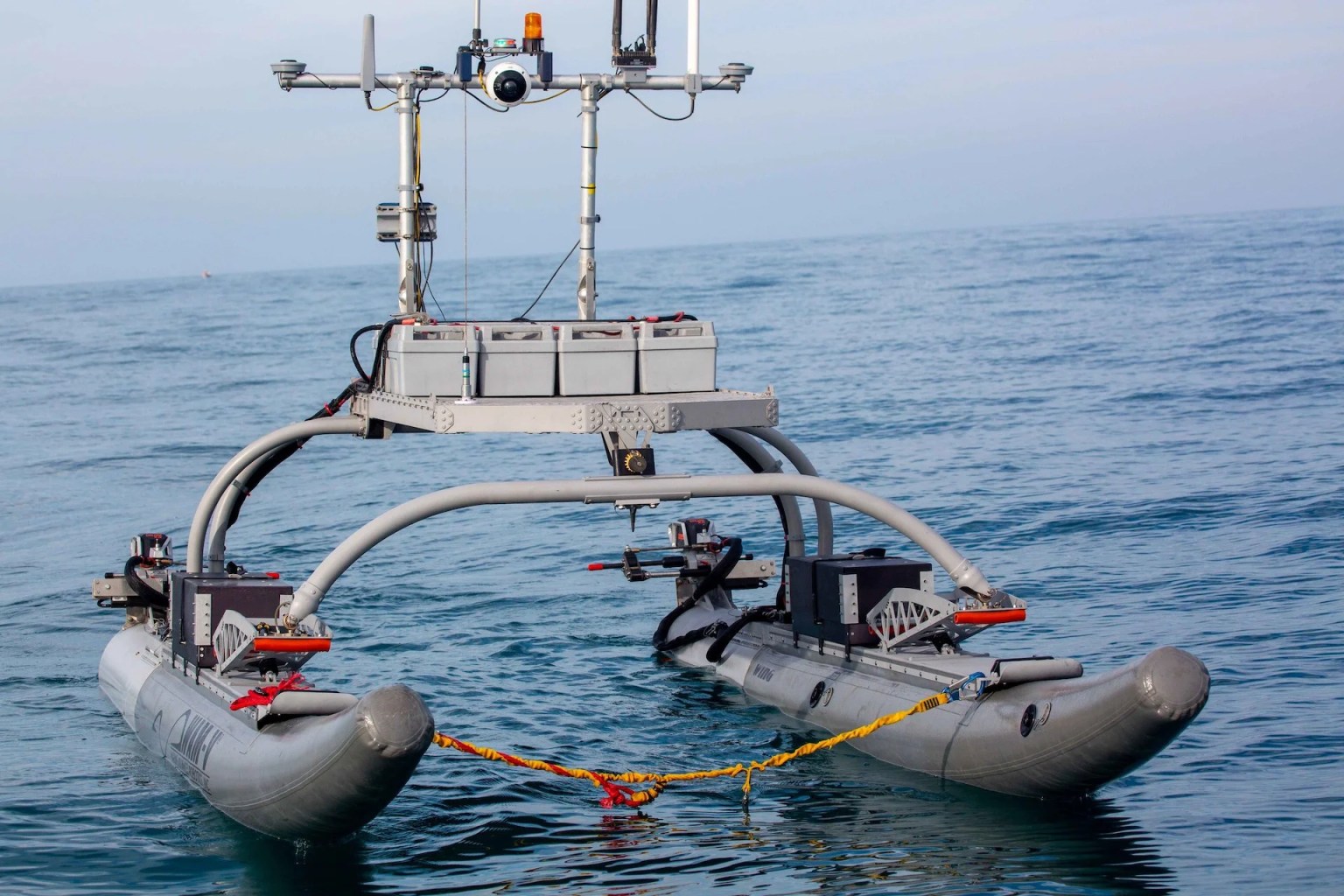
A Marine Advanced Robotics WAM-V unmanned surface vessel operates in the Arabian Gulf, Nov. 29, during Digital Horizon 2022. (U.S. Army photo by Sgt. Brandon Murphy)

Importantly, the U.S. Navy has now created the infrastructure to accelerate the testing and evaluation of unmanned surface vehicles. In 2019, the Navy stood up Surface Development Squadron One to provide stewardship for unmanned experimentation and manned-unmanned teaming.15 In 2022, seeking to put additional emphasis on unmanned maritime vehicles, the Navy established Unmanned Surface Vessel Division One (USVDIV-1), under the command of Commander Jeremiah Daley.16

This new division oversees medium and large unmanned surface vessels out of Port Hueneme Naval Base in Ventura County.17 Unmanned Surface Vessel Division One is engaged with the Fleet to move the unmanned surface vessels further west and exercise autonomy, payloads, and hull, mechanical and electrical (HM&E) systems to ensure that future programs of record (LUSV and MUSV) are successful from inception, and that they provide lethality and combat effectiveness for future naval and joint forces.

Digital Horizon presages a new paradigm in the way navies will think about uncrewed assets, no longer as “vehicles” but rather as “systems” that are nodes in a web of assets delivering far greater capability than the sum of the parts. World navies will conduct ambitious unmanned exercises, experiments and demonstrations throughout 2023 and beyond, and the lessons learned from Digital Horizon will no doubt inform those efforts.

Captain George Galdorisi (USN – retired) is a career naval aviator whose thirty years of active duty service included four command tours and five years as a carrier strike group chief of staff. He began his writing career in 1978 with an article in U.S. Naval Institute Proceedings. He is the author of 15 books, including four New York Times best-sellers. The views presented are those of the author, and do not reflect the views of the Department of the Navy or the Department of Defense.

References

1. Carrington Malin, “A Testbed for Naval Innovation,” Middle East AI News, December 1, 2022.

2. Aaron-Matthew Lariosa, “US Navy Highlights TF 59 Contributions to Fleet’s Unmanned Vision,” Naval News, January 23, 2023.

3. “U.S. Launches New Unmanned & AI Systems Integration Event,” U.S. Naval Forces Central Command Public Affairs, November 23, 2022, accessed at: https://www.cusnc.navy.mil/Media/News/Display/Article/3226901/us-launches-new-unmanned-ai-systems-integration-event/.

4. J.P. Lawrence, “Navy’s ‘Influx’ of Aquatic and Aerial Drones Tested in the Middle East,” Stars and Stripes, December 1, 2022.

5. “Digital Horizon Wraps Up: Task Force 59 Perspective, Second Line of Defense, December 22, 2022.

6. Geoff Ziezulewicz, “New in 2023: Here Comes the First-Ever Surface Drone Fleet,” Navy Times, January 3, 2023.

7. Justin Katz, “Accenture Demos Data Vis, C2 for Multiple USVs During Navy’s Digital Horizons Exercise,” Breaking Defense, December 16, 2022.

8. Vladimir Djapic et al, “Heterogeneous Autonomous Mobile Maritime Expeditionary Robots and Maritime Information Dominance,” Naval Engineers Journal, December 2014.

9. Audrey Decker, “5th Fleet Commander Details ‘Digital Ocean’ After TF-59 Reaches FOC,” Inside the Navy, January 16, 2023.

10. See, for example, George Galdorisi, “Catch a Wave: Testing Unmanned Surface Vehicles Is Becoming an International Endeavour,” Surface SITREP, Winter 2022.

11. “Navy Failing to Make ‘Critical Pivot’ In Unmanned Investment,” Inside the Navy, October 10, 2022.

12. Justin Katz, “Show, Don’t Tell: Navy Changes Strategy to Sell Unmanned Systems to Skeptical Congress,” Breaking Defense, March 10, 2022.

13. Jon Harper, “Navy to Establish Additional Unmanned Task Forces Inspired by Task Force 59,” Defense Scoop, December 4, 2022.

14. Remarks by the Honorable Carlos Del Toro, Secretary of the Navy, at the U.S. Naval Institute/AFCEA “West” Symposium, February 16, 2023.

15. Meagan Eckstein, “Navy Stands Up Surface Development Squadron for DDG-1000, Unmanned Experimentation,” USNI News, May 22, 2019.

16. “Navy to Stand Up New USV Command This Summer,” Inside the Navy, January 13, 2022.

17. Joshua Emerson Smith and Andrew Dyer, “Navy Ramps Up Efforts on Unmanned Vessels,” San Diego Union Tribune, May 16, 2022, and Diana Stancy Correll, “Navy Creates Unmanned Surface Vessel Division to Expedite Integration of Unmanned Systems,” Navy Times, May 16, 2022.

Featured Image: T38 Devil Ray during Exercise Digital Horizon. (Photo by Dave Meron)

Deak Parsons – The Story of the Atomic Admiral

By Rob Gates

The recent movie Oppenheimer focuses, as expected, on J. Robert Oppenheimer, the eponymous hero of the story and Director of Project Y in Los Alamos. However, it overlooks another important figure – Navy Captain William “Deak” Parsons, an Associate Director of Oppenheimer’s and leader of the Ordnance Division of the Manhattan Project. Parson’s substantial contributions warrant a closer examination, especially his evolution in becoming the “Atomic Admiral.”

Beginnings

William Sterling Parsons was born in Chicago in November 1901 but grew up in Fort Sumner, New Mexico after his father moved the family there in 1909. He was largely homeschooled although he attended the local elementary school for six years starting at age 8. He skipped grades and caught up to and passed his contemporaries. He finished grade school at home after being pulled out of the local school, and started at Santa Rosa High School. He moved from freshman to junior in one year. He was encouraged to take the Naval Academy exam before his senior year, passed it, and became the second alternate. He received the appointment when neither the principal nor first alternate passed the exam.

He reported to the Naval Academy at age 16 for the physical exam. He was viewed as too short and underweight and was rejected. He argued before the examining board that he was younger than the other candidates and, of course smaller, and that he would be the required size when he reached their age. The board bought his argument and gave him a waiver. He became a member of the class of 1922, overlapping with Hyman Rickover’s time at the academy. His family called him Bill but, as was custom at the Naval Academy, he was given a nickname – Deacon, as a play on his last name, which was shortened to Deac or Deak.

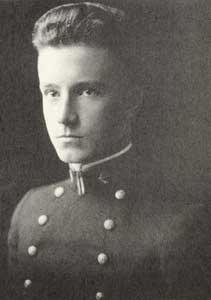
Deak Parsons as a Midshipman. (Photo via U.S. Naval Academy)

Early Career

His first assignment after graduation was as a gunnery officer on the USS Idaho (BB-42). After a successful tour, he was sent to the Naval Postgraduate School (NPS) in Annapolis in 1927, where he was a student in the ordnance course and studied under Dr. Charles C. Bramble.1 At the conclusion of the NPS course, students were required to take a field posting, and Parsons came to Dahlgren in early 1930. While there, Dr. L.T.E. Thompson saw promise in him and advised Parsons to become an Engineering Duty Officer so his shore assignments would not be interrupted by periods of sea duty. Parsons saw himself as a line officer and declined the advice. In June 1930, he was assigned to the USS Texas (BB-35).

At the end of that tour, in 1933, he was assigned to the Bureau of Ordnance (BuOrd) as liaison to the Naval Research Laboratory. This proved to be an important assignment, where he was introduced to radar. He became something of an expert in radar and one of its strongest advocates in the Navy, especially for fire control. His advocacy, however, resulted in little as his superiors in the Bureau of Ordnance did not share his enthusiasm.

His next assignments were at sea. He served as the Executive Officer on the USS Aylwin (DD-355) from June 1936 until March 1938. He was then assigned as gunnery officer to improve the gunnery scores of USS Detroit, the flagship of Rear Admiral William R. Sexton, who was serving as Commander of destroyers in the Pacific’s battle fleet. In mid-1939, Parsons was assigned to the Naval Proving Ground in Dahlgren as Experimental Officer. 

Early War Years and the VT Fuze

As Experimental Officer he was responsible for planning and scheduling all testing at Dahlgren. Merle Tuve (of the National Defense Research Committee, NDRC) visited Dahlgren in 1940 to discuss concepts for improved anti-aircraft defense. Parsons knew of Tuve from his radar work and began collaborating with him. He offered Dahlgren’s facilities for testing the early versions of the VT fuze. There was promise but little success in testing at first with 90 percent of the fuzes failing. Finally in January 1942, there were 26 successful tests of a batch of 50 fuzes – exceeding BuOrd’s 50 percent threshold – and Parsons recommended that the fuze go into production. The Navy took over program direction and scheduling but wanted the Office of Scientific Research and Development (OSRD), specifically Vannevar Bush and Merle Tuve, to retain technical direction. Parsons was detailed from Dahlgren to serve as Bush’s deputy overseeing the work of Tuve’s Section T.

Testing of the fuze continued with a successful test in the Chesapeake Bay near Tangier Island in June 1942. The USS Cleveland (CL-55) engaged and destroyed three target drones, reportedly with only three shots. The Cleveland was immediately sent to North Africa and then the Pacific. When an inventory of 5,000 fuzes was available at Mare Island,2 plans were made to send them to the fleet for testing in combat. Parson went onboard the USS Helena (CL-50) and, on January 5, 1943, the ship successfully engaged two Aichi dive bombers and shot down both. He and others spent the next three months training crews in the Pacific on the use of the new weapon.

He returned to Dahlgren at the end of March, hoping to wrap up his fuze work and be assigned sea duty in the war zone. It was not to be.

Project Y – The Manhattan Project at Los Alamos

Vannevar Bush was concerned about Brigadier General Leslie R. Groves’ direction and Army dominance of the Manhattan Project, as well as Groves’ insensitivity to scientists. The Military Policy Committee met and recommended some changes. Groves also wanted an ordnance and fuze expert assigned to the project. No qualified Army officers were available and the opportunity to assign a navy officer, and one who understood military-scientist relationships, presented itself. Bush knew Parsons from his VT fuze work and recommended him to Groves.

Parson subsequently received orders to report to Admiral Ernest King, Commander in Chief, United States Fleet and Chief of Naval Operations, without delay. In a ten-minute meeting, King filled him in on Project Y and then had him meet with General Groves. Groves approved of his appointment and had him meet with J. Robert Oppenheimer, Project Y Director, the next day. Parsons was assigned to King’s staff with the rank of Captain on June 1, 1943 and named Associate Director of Project Y and Head of the Ordnance Division.3

Within a few days the Parsons and Oppenheimer were on the train bound for Los Alamos.4 They spent the time talking before they reached their destination, where they laid out their philosophies and the new organizational structure. Oppenheimer was happy to turn over the responsibilities for ordnance matters to Parsons and to focus on physics. Likewise, Parsons’s strength was in “weaponizing” the bomb and addressing the operational problems associated with its combat delivery.

Parsons had to bring on additional staff and approached people he knew from the VT fuze and radar work. He also went back to the Naval Proving Ground and recruited several people, including Thomas Olmstead, a technician, Norris Bradbury, an expert in exterior ballistics, and Frederick Ashworth, the senior naval aviator at the Proving Ground. Parsons was later criticized for his propensity to hire Navy people.

Parsons also went to Dahlgren for ballistic testing of the gun-type bomb shape. The testing was performed using Parsons’ “sewer pipe” bombs. The test bombs were made by cutting a standard bomb in half and extending the bomb by inserting a length of sewer pipe. The NPG employees and aviators speculated on what they were testing but apparently, no one guessed the right answer.

Parsons’s division was primarily responsible for developing the gun-type/Uranium-235 bomb that was initially called “Thin Man” (after Franklin D. Roosevelt) and, later, “Little Boy.” The division also studied the implosion-type/Plutonium bomb known as “Fat Man” (after Winston Churchill). Plutonium had advantages over Uranium-235, and when it was discovered that it was not suitable for a gun-type bomb, the implosion-type bomb took on greater importance. There was another reorganization in July 1944 and Parsons’s group took on the responsibility of making both bombs combat-deliverable.

From the beginning, Parsons had planned on being the weaponeer for the first combat use of the bomb and expressed that to Groves. When the push to completion started – called Project Alberta – in March 1945, Parsons informed Groves that in accordance with his (Groves) wishes, he was going to be the weaponeer when Little Boy was used. He was officially named the Officer in Charge of the Los Alamos Overseas Technical Group and weaponeer on the first mission.

Frederick Ashworth had been brought in to work with the Army Air Force on the B-29. Parsons planned to fly in a B-29, piloted by Ashworth, over the test at Trinity as a dress rehearsal for the first mission. It did not transpire as he hoped for because he was required to stay 25 miles away from the test site. Nevertheless, he had a great view of the Trinity detonation.

Ashworth led the group that selected Tinian Island as the location of the B-29 base. Once it was constructed, the elements of the bomb, Los Alamos staff, and the 509th Composite Group (under the command of Col. Paul Tibbets) were moved to Tinian. Parsons also went to make final preparations.

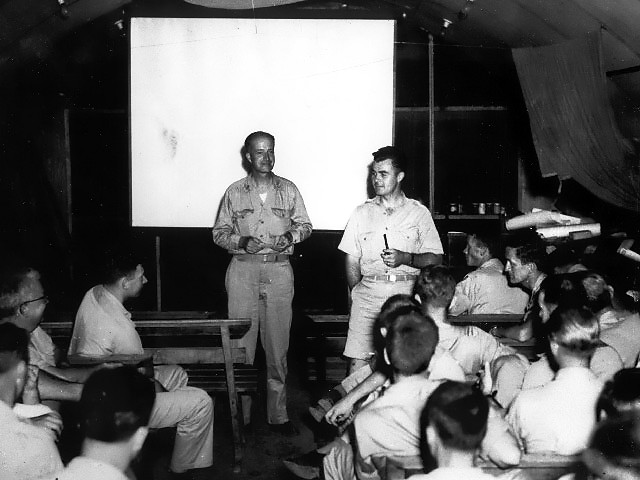
Deak Parsons (left), standing next to Col. Paul Tibbets, briefs the 509th Composite Group on Tinian. (Photo via Wikimedia Commons)

After weather delays, the mission was scheduled for August 6. Groves’ direction was that the bomb was to be assembled on the ground before the flight. But Parsons had seen four overloaded B-29s crash on takeoff and was concerned about taking off with a fully armed atomic bomb. Early on August 5, he expressed his concerns to Brigadier General Thomas Farrell, deputy director of the Manhattan Project, reportedly saying, “If that happens tomorrow morning, we could get a nuclear explosion and blow up half the island.” He decided to disregard Groves’ instructions and arm the bomb in flight. He spent the rest of the day (and evening) developing and practicing the process to do just that.

The B-29 took off at 0245 on August 6 and, after it reached cruising altitude, Parsons and Electronics Test Officer, Lieutenant Morris Jeppson entered the bomb bay. Jeppson held the flashlight while Parsons followed the 11-point checklist that he had developed the previous day, and placed the gunpowder-armed fuze behind the Uranium-235 “bullet.” At 0630, Parsons directed Jeppson to return to the bomb bay and replace the green safety plug with a red plug. The bomb was now fully armed, and was successfully dropped at 0915.

That essentially ended Parsons’s role in the Manhattan Project. Ashworth was the weaponeer on the second mission when the Fat Man bomb was dropped on Nagasaki on August 9. The war ended five days later.

Postwar Years

Parsons knew that when he accepted the Manhattan Project assignment that he had given up the opportunity for wartime command at sea. After the war, he concluded that without that command experience, his chances for promotion and his future in the Navy were not good. As it happened, he was promoted to Commodore and Rear Admiral while on Tinian. It also turned out that he was in demand because of his atomic experience and was named technical deputy to the Commander, Operation Crossroads.5 He went on to other positions, including Director of Atomic Defense under the Deputy CNO (Air), and Deputy Director of the Armed Forces Special Weapons Project under General Groves. He also reprised his role as technical deputy to Commander, Operation Sandstone, a series of atomic bomb tests conducted in April 1948. These and other assignments led to his being known as the “Atomic Admiral.”

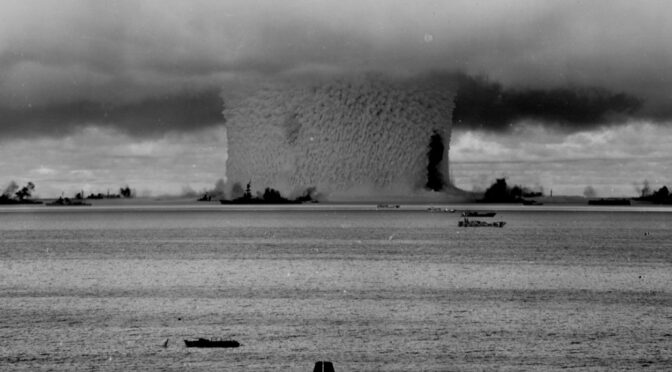
Detonation of Shot Baker during Operation Crossroads on July 25, 1946.

In 1951, he finally got his command at sea when he was named Commander, Cruiser Division Six in the Atlantic Ocean and Mediterranean Sea. In March 1952, he became Deputy Chief, Bureau of Ordnance and his future looked bright, He used his influence to promote research and establish Navy laboratories and, because of his expertise, was involved in many technical initiatives. He was busy to the point of exhaustion.

When he went to Los Alamos in 1943, he worked closely with Oppenheimer. They lived in adjacent houses on “Bathtub Row” (so called because they were the largest houses in Los Alamos and the only ones on the mesa with bathtubs) and their families became close. They stayed in touch after the war and occasionally vacationed together.

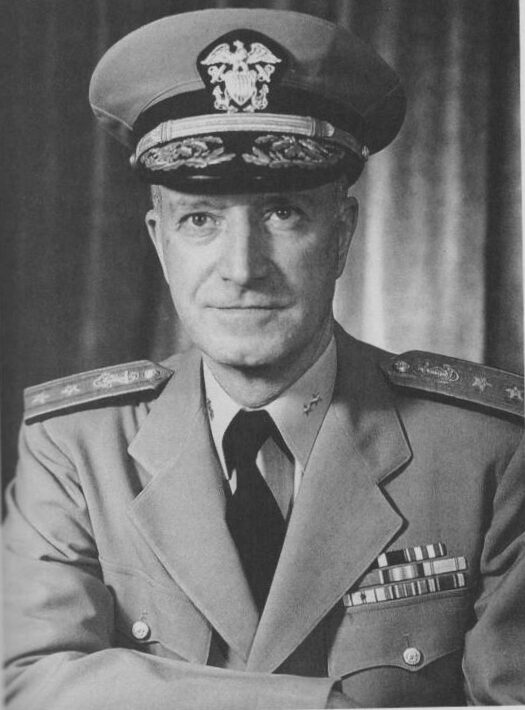
Rear Admiral Deak Parsons. (Photo via Nuclearmuseum.org)

When Parsons learned that President Eisenhower had decided that a “blank wall be placed between Dr. Oppenheimer and secret data,” effectively negating Oppenheimer’s Q-level security clearance, according to Parson’s wife, he became “visibly upset” and began to suffer chest pains. He concluded that it was not a heart attack but, when he was no better the next morning, his wife insisted that he go to the Bethesda Naval Hospital. While being prepared for an electrocardiogram, the Atomic Admiral died at the age of 52 on December 5, 1953.

Although Deak Parsons died young, his contributions to the Navy were significant and his legacy is intact. His early Navy career was much like many other junior officers of the time, but even then, his expertise in ordnance and gunnery were apparent. His legacy came later in his career and is mostly seen in his technical contributions, beginning at the Naval Proving Ground. His partnership with Dr. L.T.E. Thompson had a great impact on the Proving Ground and the Navy. Their vision was of a naval laboratory where scientists and officers would work closely together on creative research that was key to the Navy’s future. This vision would take root and set the pattern for Navy laboratories that has persisted to the present. His contributions to the Variable Time fuze and Project Y show the successful application of that principle to some of the most important projects of World War II. After the war, Parsons became the Navy’s leading authority on nuclear issues and an early advocate of nuclear power for ships and nuclear strike capability for aircraft carriers. In short, he helped lead the Navy into the nuclear age. He was on track to become the Chief of the Bureau of Ordnance when he died. Undoubtedly, many more accomplishments would have followed.

Robert V. (Rob) Gates, a retired Navy Senior Executive, served as the Technical Director at the Naval Surface Warfare Center (NSWC), Indian Head Division, and in many technical and executive positions at NSWC, Dahlgren Division, including head of the Strategic and Strike Systems Department. He holds a B.S. in Physics from the Virginia Military Institute, a Masters in Engineering Science from Penn State, and a Masters and PhD in Public Administration from Virginia Tech. He is a graduate of the U.S. Naval War College.  Dr. Gates is the Vice President of the board of the Dahlgren Heritage Foundation.

Bibliography

Baldwin, Ralph B. The Deadly Fuze: Secret Weapon of World War II, Presidio Press, 1980.

Bird, Kai and Martin J. Sherwin, American Prometheus: The Triumph and Tragedy of J, Robert Oppenheimer, Alfred A. Knopf, 2005.

Christman, Albert B. Target Hiroshima: Deke Parsons and the Creation of the Atomic Bomb. Annapolis, Naval Institute Press, 1998.

Christman, Al, “Deak Parsons: Officer-Scientist.” U.S. Naval Institute Proceedings, 56-61, January 1992.

Christman, Al, “A New Kind of Officer.” U.S. Naval Institute Proceedings, 79-80, May 1998.

Furer, Julius Augustus, Administration of the Navy Department in World War II, Department of the Navy, 1959.

Gates, Robert V, “Dahlgren’s Secret: It’s People,” Northern Neck of Virginia Historical Magazine, 9458-9470, December 2022.

McCollum, Kenneth G., Ed, Dahlgren, NSWC, 1977.

Rife, James P. and Rodney P. Carlisle, The Sound of Freedom: Naval Weapons Technology at Dahlgren, Virginia 1918-2006, NSWCDD, 2007.

Rowland, Buford and William B. Boyd, U.S. Navy Bureau of Ordnance in World War II, Bureau of Ordnance, Department of the Navy, 1953.

Stern, Philip M. and Harold P. Green, The Oppenheimer Case: Security on Trial, Harper & Row, 1969.

References

1. Interestingly, Bramble also has a connection to Dahlgren. He occasionally visited Dahlgren, while teaching at the NPS, to stay current in ordnance developments (starting in 1924). He came to Dahlgren in 1942 when ordnance work was moved out of Washington and stayed until 1946, when he went back to the NPS. He returned to Dahlgren in 1947 and stayed until the end of 1954. He was Dahlgren’s first Director of Research beginning in 1951. He was succeeded by Dr. Russell Lyddane, the first to be called Technical Director.

2. Ten per cent of each batch was sent to Dahlgren for testing.

3. He continued to be listed as a member of King’s staff since it provided “cover” and kept his actual assignment secret.

4. Groves prohibited senior project leaders and scientists from flying. He changed his policy in the spring of 1945.

5. Operation Crossroads was a pair of atomic bomb tests at Bikini Atoll in mid-1946.

Featured Image: The “Baker Day” atomic bomb test, Bikini Atoll, July 25, 1946.

Sea Control 453 – All Hands on Deck with Will Sofrin

By Nathan Miller

Will Sofrin joins the program to discuss his book All Hands on Deck. The book is about his experiences during an epic sail on the tall ship, Rose, from Newport, RI to San Diego, CA.

Will Sofrin is a master shipwright, former professional tall ship sailor, and has taught at MIT. He has sailed over thirty thousand miles in his career.

Download Sea Control 453 – All Hands on Deck with Will Sofrin

Links

1. willsofrin.com.
2. All Hands on Deck, by Will Sofrin, Abrams Press, 2023.

Nathan Miller hosted and produced this episode. Contact the Sea Control team at Seacontrol@cimsec.org.