
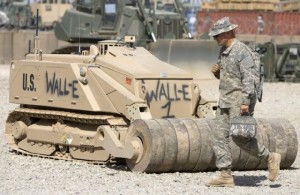
Our present-day pilotless platforms have been branded “drones” to their detriment. The word communicates a lack of adaptability or agency. For an increasingly automated fleet of machines, it denotes monotony and mindlessness: the droning of engines as a Predator lazily loops above the mountains, observing friend and foe alike. “Drone” is inappropriate for an ever-expanding suite of devices with greater close-in roles in combat. An AlphaDog, an EOD bomb-disposal bot, the DARPA Crusher, and the Battlefield Extraction Assistance Robot (BEAR) are not “drones.” To better describe our new combat compatriots and better comprehend their multitudinous uses and designs, let us properly christen our autonomous allies.
ComBot is the accurate alternative to “drone.” An obvious combination of Combat and Robot, it describes our soon-to-be automated assault associates in an easy-to-digest term. The name has a practicality lacking in most military monikers. It is not a shoe-horned acronym such as Close-In Weapons System (CIWS) pronounced “see-wiz” rather than “ki-wis” or “cue-z”. What layman would ever think of a high-tech Gatling-gun when they hear “CIWS”, or a pilotless aircraft when they hear “UAV”? However, the wordplay of ComBot makes the backing concept immediately recognizable. A rose by any other name may be just as sweet, but people abandoned the term horseless carriage for a reason; let’s update our language to match the concept.
Matt Hipple is a surface warfare officer in the U.S. Navy. The opinions and views expressed in this post are his alone and are presented in his personal capacity. They do not necessarily represent the views of U.S. Department of Defense or the U.S. Navy.
Discover more from Center for International Maritime Security
Subscribe to get the latest posts sent to your email.
Mr. Hipple,
I don’t like the term ‘drone’ but I like the term ComBat even less!
Robot (noun). A machine capable of carrying out a complex series of actions automatically.
Using the word robot implies a level of autonomy that simply does not exist anywhere except perhaps in a James Cameron film.
All we are doing with our unmanned systems is pushing the operator off board. It still takes an awful lot of manpower to run a Predator or Reaper orbit. USAF got right in trying to coin the term “Remotely Piloted Aircraft.”
***************
If you are looking to rename a system, try tackling the Littoral Combat Ship (LCS) which:
(1) – is no longer intended to operate primarily in the LITTORALS
(2) provides little/no COMBAT power, nor is it expected to survive in a COMBAT environment.
(3) cannot operate self-sufficently for extended periods at sea, and hence does not fit the common definiton of a SHIP.
I don’t think the names I would give LCS are appropriate for mixed company. I’m imagining that we might very much agree on that point.
However, to make these platforms useful and secure, we’re going to be pushing those operators out of the equation. I think this is going to happen soon; sooner for aerial ComBots than ground-pounders. Data-links back to operators require processing time for encryption, create massive vulnerabilities, and generally slog down some processes that would be better automated. I think this leads to a potentially foundational difference in our view of how developed automatic systems are and how quickly they will mature. I think you and I might have foundational differences here on the what and how soon of automated combat, and I would direct you to the article I wrote for Proceedings to get a good view of where I think this is all going. I’d be interested to hear your take.
I don’t disagree with you on the direction we need to go -in terms of increased automation. I do think when it comes to ‘pulling the trigger’ we’re almost always going to want a ‘man in the loop’.
I also think we’re a long ways from getting to full autonomy such that we could use the term ‘robot’. Almost everything you point to in your article is R&D or conceptual. Hence my pushback on using the word ‘robot’.
Adam Elkus has a good post up on ID about levels of drone autonomy today: http://www.informationdissemination.net/2012/07/autonomy-offense-defense-and-naval.html#disqus_thread