Tag Archives: US Coast Guard

MFP 3: Impediments and Expedients for Mission Accomplishment

If you are a current Sailor or member of the Coast Guard, what are some of the biggest impediments to getting your job done? What promised development or technology would most aid you in the accomplishment of your assignment?

This is the third in our series of posts from our Maritime Futures Project.  Note: The opinions and views expressed in these posts are those of the authors alone and are presented in their personal capacity.  They do not necessarily represent the views of their parent institution U.S. Department of Defense, the U.S. Navy, any other agency, or any other foreign government.

CDR Chuck Hill, USCG (Ret.):

Impediments:  The U.S. has the largest Exclusive Economic Zone (EEZ) in the world.  Its area exceeds that of the total land area of the U.S. and most of it is in the Pacific.  However, most U.S. Coast Guard assets are in the Eastern U.S. where most of the population (and political clout) resides.

ExpedientsImproved Maritime Domain Awareness (MDA) has the potential to assist in search and rescue (SAR), fisheries enforcement, drug interdiction, coast defense, and protections of ports.  The Coast Guard cannot afford a comprehensive MDA system solely for its own purposes, but if it can share information with DOD agencies also interested in monitoring the maritime approaches to the U.S., including perhaps cruise missile defense, it could make the employment of assets much more efficient.
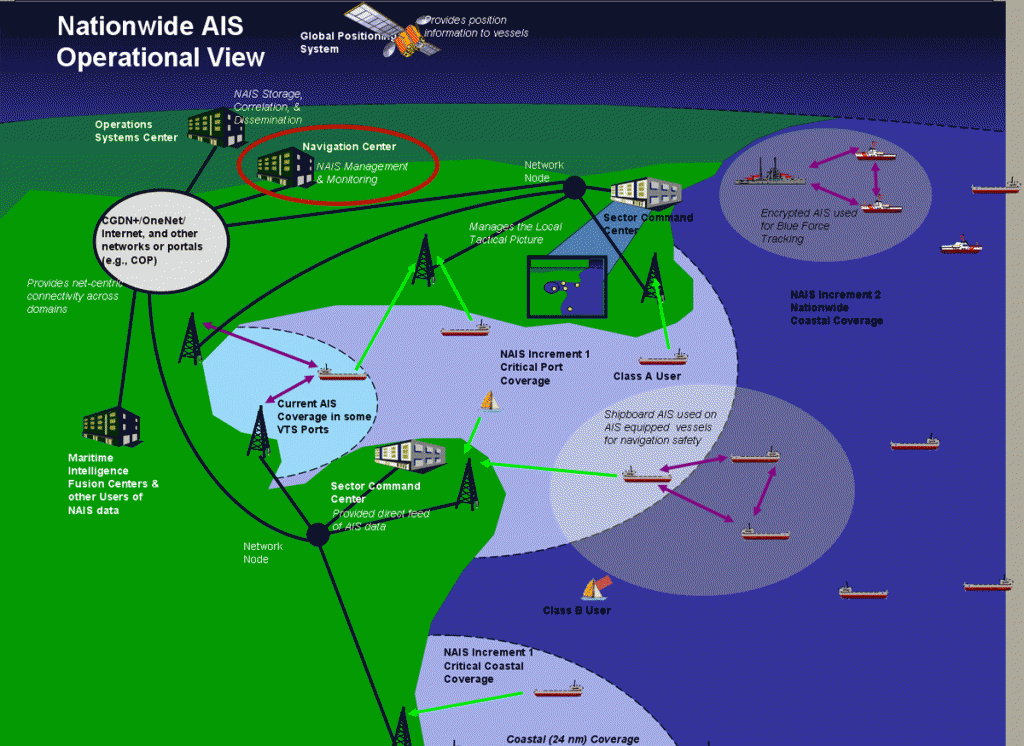
MDA through AIS
                                                            Maritime Domain Awareness through AIS

LTJG Matt Hipple, USN:
Impediments:  The answer is simple.  The real impediment is people, time, and flexibility.  We have fewer people, which leaves us fewer man-hours and perspectives to get work done.  Having fewer people means we have less time… less time for schools, fewer people to run the schools, and less time for training.  The training regimen itself has been increased, by more required schools for alcohol awareness, marine species safety, and the like, having little-to-no bearing on the actual work of the sailor.  This non-essential training, considered more important and tracked more diligently than regular warfighting training, further drains the pool of man-hours for an already diminished grouping of sailors that, having less time to train or go to school, or spots open in school for them to go, are also less ready than they could be.

Added to that death-spiral between people and time, the Navy is increasingly removing the room for flexibility.  While an entire article could be written on the cost-effects of our inflexibility, the fact I can’t, for example, install fire-proof hoses that exceed the necessary requirements without special fleet approval, requiring regular renewing, is itself evidence enough.
NKO
 NKO: Aid or hindrance?

LCDR Joe Baggett, USN:
ImpedimentsLack of interoperability (Common data networks).  Maritime forces are now and will continue to be employed in confidence-building among nations through collective security efforts in a common global system that links threats and mutual interests in an open, multi-polar world.  This requires an unprecedented level of integration among our maritime forces, enhanced cooperation with the other instruments of national power, and the capabilities of our international partners.  No single nation has the resources required to provide safety and security throughout the entire maritime domain.

LT Drew Hamblen, USN:
Impediments:  The amount of required training extraneous to job proficiency (for example, General Military Training (GMT) requirements on Navy Knowledge Online) is cumbersome and only getting lengthier.

The number of passwords required for our systems is unmanageable and results in personnel writing them down, potentially compromising information assurance, or spending inordinate amounts of time on the phone with NMCI.

NMCI storage (and data storage capacity in general) is severely limited and outages are too frequent.

LT Scott Cheney-Peters, USNR:
Impediments:  Others here already address most of what I view as the major impediments to mission accomplishment in the sea services on a day-to-day basis.  At a general level these include a dearth of manning (whether afloat, in aviation squadrons, or ashore) and burdensome administrative requirements.

Expedients:  Short of increasing manning (not likely), or reducing requirements (possible, and some real efforts have been undertaken, but truly it’s never-ending struggle), there are two areas of focus that could help alleviate the effects.  The first is better collaborative tools and sharing of lessons learned. There’s a lot of ‘reinventing the wheel’ that goes on in the fleet, for instance completely different versions of mandatory instructions that only need to be 5% different.  This sort of thing can be reduced through better collaborative tools – especially at the squadron or fleet level.

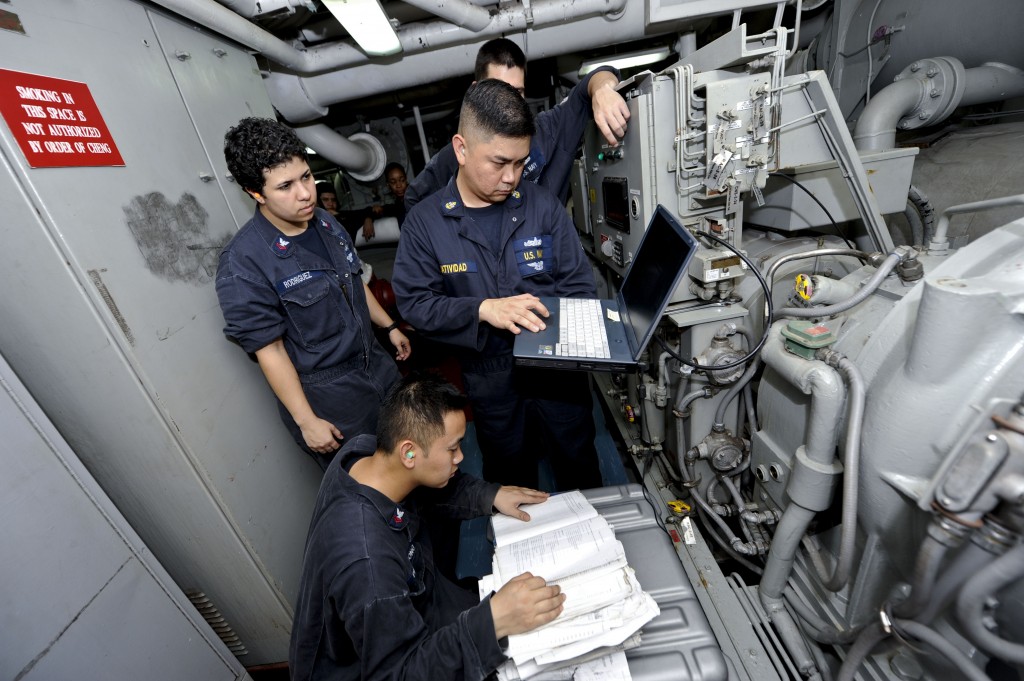
The second is better integration of data streams.  Akin to the low levels of communications interoperability, sailors must deal with a multitude of data streams that often require manual integration in the form of data entry.  This wastes time and effort.  For example, having to manually search online databases for further information about a ship transmitting AIS data to determine its point of origin or destination.

Luckily disaggregated data steams have not escaped notice, especially those from a ship’s organic sensors, resulting in general trends to develop all-encompassing combat system suites rather than stand-
Look it up, or hook it up?
                            Look it up, or hook it up?

alone weapon and sensor systems.  AIS, for example, is today better integrated into navigation displays, and it seems logical it will be integrated into future combat systems suite upgrades.  The trend for aggregated data is also progressing in remote-site monitoring, enabled by better sensors throughout things such as a ship’s engineering plant, helping displace some manually integrated data streams generated by the old Mark I Eyeball.  But data streams for administrative tasks – true data entry between different IT and web-based programs, or just plain old excel spreadsheets – still have a long way to go.  IT certificates and tokens can reduce some of the most redundant data-entry requirements (e.g. “type in your name, rank, and date of birth”), but there’s still a long way to go.  And, with increasing reliance on inter-accessible and integrated data comes the need for better cyber defenses, whether ashore or afloat.

Rex Buddenberg, U.S. Naval Postgraduate School:
Impediments: From a programmatic point of view we keep fixating on platforms (i.e. new
cutters, Deepwater, Navy FYDP shipbuilding, and LCS) rather than making
the platforms work together.  We need to focus on integration.

YN2(SW) Michael George, USN:
Impediments: As a Yeoman dealing with primarily administrative functions, I am usually able to perform my job duties and responsibilities with simply a computer, printer, and some pens, so there’s not much need for improvement on the hardware side.  However, the current setup of processing personnel administrative information uses collateral-duty Command Pass Coordinators (CPCs) and an online system (TOPS) that correspond with ashore Personnel Support Detachments (PSDs) for all matters of pay and personnel support.  This is a good idea in theory to help reduce shipboard manning, but it’s handled poorly, as it grants junior Sailors at PSDs across the fleet the power to supersede orders simply because the person giving the order is not a CPC.  It also causes people like myself in the Yeoman rate (and worse, many ENs, LSs, CMs, and more) to spend an inordinate amount of time on collateral duties, handling personnel paperwork that members used to be able to go directly to their PSD or a true shipboard expert to handle.

LT Jake Bebber, USN:
Impediments: The biggest impediment to maritime cryptology is not a piece of equipment … it is the lack of leadership in the cryptologic spaces.  We need to refocus our cryptologic space-leaders – the LPOs, the Division Chiefs, and the JOs – and reorient them to emphasize the quality and quantity of cryptologic reporting.  This can be done by simply “getting back to the basics” of maritime cryptology and practicing sound fundamentals.  Too often, we are complacent because the advanced equipment we use can appear to do the work for us.  But the most important piece of equipment in a cryptologic space is what’s between the ears, not the new computers or gear.  Our cryptologic leaders – especially Chiefs – need to be present in the spaces, ensuring quality and teaching fundamentals.  The JOs need to be there as well, learning from their Chiefs, LPOs and subject matter experts instead of standing watches on the bridge or combat.  Too much time is being spent by JOs and Chiefs doing things not related to the cryptologic mission, outside the cryptologic space.
An Alternate Naval Typology


Frigate...
                                                                             Frigate…

This was inspired by a question raised by Dr. Robert Farley here and here.

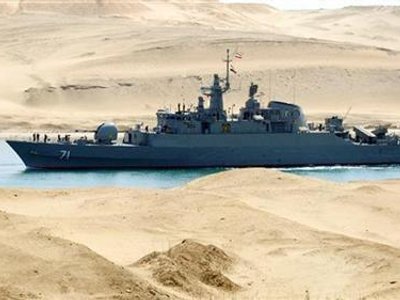
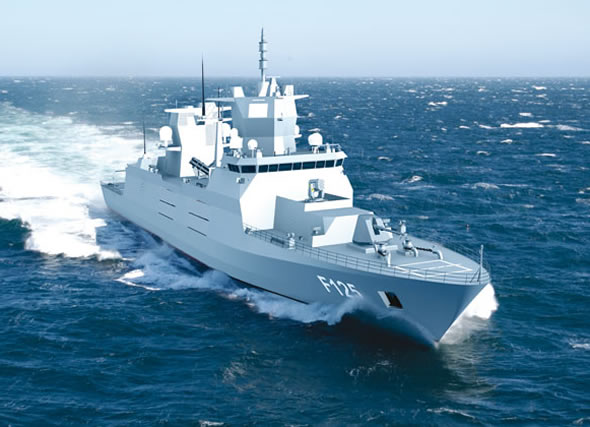
Within a navy the terms ‘frigate’ and ‘destroyer’ may have specific meanings, but there is no international standard.  Governments often choose to call a ship a cruiser, destroyer, frigate, or corvette for political reasons, so the terms have lost much of their meaning.  With the Germans building 7,200-ton F125-class ‘frigates’ and the Iranians calling their 1,500-ton Jamaran-class ‘destroyers,’ the naval typology system has lost its ability to inform. 

Cruisers have all but disappeared.  The term has certainly lost its relevance as a step between destroyer and battleship.  In the few cases they do exist, with the sole exception of the Russian “Peter the Great,” they are  functionally virtually indistinguishable from ships called destroyers, and even from some ships called frigates.

All these classes actually form a continuum of capabilities, influenced most strongly by their displacement.  All fight primarily with gun, torpedo, or missile.  All these ships are cruisers in the classic sense of a ship capable of sustained independent operations.  They are all cruisers in the way Julian Corbett used the term, in that they are the ships that exercise sea control by enforcing blockades and protecting friendly commerce while denying it to the enemy.  Additionally these are the ships that most commonly do boardings and fight piracy. 

When the term cruiser first appeared it was a generic term that referred to a range of ship types with their own names.  Frigates, sloops, and brigs might all have been referred to as cruisers.  I’d like to propose a  a return to something closer to the original meaning, to use cruiser as a generic term for surface warships that are not amphibs or aircraft carriers.  I will suggest a further breakdown based on displacement with this example to show how this might be more informative:

Micro-Cruisers   1,000-<2,000 tons
Mini-Cruisers      2,000-<4,000 tons
Light Cruisers     4,000-<8,000 tons
Heavy Cruisers   8,000-<16,000 tons
Battle Cruisers    16,000 tons or more


...vs Destroyer.
                                              …vs Destroyer.

For illustrative purposes, below is a comparison of five fleets.  I have included ships of the U.S. and Russian Coast Guard, because they are also capable of doing some cruiser-type work, but added a notation.  The numbers may be suspect.  My sources may not be up to date, but I believe the comparison is generally valid. 

                                           US                        Russia                China     UK     France
Battle Cruisers             —                          1                             —             —          —
Heavy Cruisers            84                       4                            —              —          —
Light Cruisers               3  (CG)              13                          42           17        13
Mini-Cruisers               38  (10 CG)      19  (12 CG)       14             —         11
Micro-Cruiser              27 (CG)             34 (12 CG)        17             4           9
                                            —-                       —-                         —-            —-       —-
TOTAL                           152  (40 CG)   71 (24 CG)         73           21       33

There is no reason this typology could not be used in parallel with existing national or alliance systems that retain the destroyer, frigate, and corvette terms.  The numbers above are based on the following:

US
Battle Cruisers            —
Heavy Cruisers          84
– 22 CG
–  62 Burke
Light Cruisers               3
– 3 Bertholf (CG)
Mini-Cruisers               38
– 28 FFG/LCS              
– 9 Hamilton (CG)
– 1 Alex Haley (CG)
Micro-Cruisers             27
– 13 Bear (CG)
– 14 Reliance (CG)
TOTAL                            152

Russia
Battle Cruisers                 1
– 1 Kirov
Heavy Cruisers                4
– 1 Kara
– 3 Slava
Light Cruisers                 13
– 1 Kashin
– 8 Udaloy
– 4 Sovremennyy
Mini-Cruisers                  19
– 3 Krivak (Navy)
– 6 Krivak (CG)
– 2 Neustrashimyy
– 2 Steregushchy
– 6 Ivan Susanin (CG)
Micro-Cruisers               34
– 2 Gepard
– 20 Grisha (Navy)
– 12 Grisha (CG)
TOTAL                               71

China
Battle Cruisers                 —
Heavy Cruisers                —
Light Cruisers                  42
– 2 Type 052 Luhu
– 4 Soveremenny
– 3 Type 51 B/C
– 9 Type 052 B/C/D
– 17 Type 054
– 9 type 051 Luda
Mini-Cruisers                   14
– 14 Jianghu
Micro-Cruisers                17
– 17 Jianghu
TOTAL                               73

UK
Battle Cruisers                __
Heavy Cruisers               __
Light Cruisers                 17
– 17 Type 45 and Type 23
Mini-Cruisers                   __
Micro-Cruisers                 4
– 4 River-class                __
TOTAL                               21

France
Battle Cruisers                 —
Heavy Cruisers                —
Light Cruisers                  13
– 2 Horizon
– 2 Cassard
– 1 Tourville
– 1 Aquitaine
– 7 Georges Leygues
Mini-Cruisers                    11
– 5 La Fayette
– 6 Floreal
Micro-Cruisers                   9
– 9 D’Estienne d’Orves
TOTAL                                 33

Chuck Hill is a retired Commander in the U.S. Coast Guard. He writes at Chuck Hill’s CG Blog, with the objective of looking, over the longer term, at the budgets, policies, tactics, roles, missions, and their physical expression – the platforms – that allow the Coast Guard to do its job.

What is International Maritime Security?

Navies are expensive.  In the case of the U.S. Navy, they’re really expensive.  A quick review of the SIPRI world defense spending database shows over 40 coastal nations whose entire defense budget would not buy a single Arleigh Burke-class destroyer at 2011-2012 prices.

“Perhaps we could try car-sharing?”

Many of us who read and contribute to this forum are professionals in Maritime Security.  As such, we tend to take for granted the importance of Navies and the positive role that Navies play in the international system.  We have been conditioned to believe that Navies are worth the cost.  But looking at the disparity in naval spending among maritime nations, it seems that not all nations share the same view of the relative dollar value of maritime security[i].  In an era of sharply declining defense budgets, and a maritime strategy that, while it places warfighting first, places heavy emphasis on the cooperative and international nature of maritime power, it’s worth asking whether navies are, in fact, cooperating in pursuit of a common goal.  If so, what is that goal?  The question, as suggested by the title of this forum, is: What exactly is “international maritime security?”

Security itself is a dependent concept.  It’s not enough to say that a country is secure.  It must be secure from something or someone.  A reasonable working definition of maritime security might be “freedom from the risk of serious incursions against a nation’s sovereignty launched from the maritime domain, and from the risk of successful attack against a nation’s maritime interests.”  In the absence of a specified threat, how much “security” a nation needs to defend against those incursions or attacks is speculative, at best.  That makes the problem of defining international security more challenging—in order to be international, both the interests and the threat must be held in common by two or more nations.  And, while an interest and threat held in common by just two nations might be international in the strictest sense of the word, the connotation of “international security” is of interests held widely throughout the international community.

Some naval missions seem to be inherently international and cooperative.  Securing sea lines of communication is a great example.  In the introduction to the U.S. maritime strategy, the authors gravely proclaim that, “Our Nation’s interests are best served by fostering a peaceful global system comprised of interdependent networks of trade, finance, information, law, people, and governance.  We prosper because of this system of exchange among nations, yet recognize it is vulnerable to a range of disruptions that can produce cascading and harmful effects far from their sources.”  Sure, maintaining the security of this global system serves our own interests, but we are quick to point out that in doing so, we are helping the interests of others, too.

Although we in the U.S. Navy are proud of our role keeping the oceans safe for commerce, many other nations might reasonably ask, “safe from what?”  Piracy is certainly one example, but does it justify the cost of a Navy?  The global economic cost of maritime piracy has been estimated at $7 billion – $12 billion annually.  Somali piracy in particular was more recently estimated at $7 billion annually.  In contrast, the U.S. Navy budget alone is about $160 billion per year.  With numbers like that, it’s difficult to make the economic case that Navies are a good answer to piracy, even when the human cost of piracy is factored in.  About 3,800 seafarers were attacked and 35 killed by pirates in 2011.  Sticking to water-related hazards, this pales in comparison to the 9,000 bathroom fatalities in the U.S. alone in 1999.

One answer to this critique has been to assert that other nations are free to define their maritime security narrowly because the U.S. defines maritime security broadly.  According to this argument, the U.S. as a global maritime power must maintain open sea lanes all around the world; other nations, especially those whose trade ties are mostly regional, can hitch a free ride on our security at a fraction of the cost.  Such a critique has an intuitive appeal, but it can’t be proved, since to do so would require a definitive measurement of the economic and human costs of the absence of U.S. efforts.  Nevertheless, some version of the free rider argument is at the heart of many calls for increased defense burden sharing, and the desire to have other nations pick up at least a portion of the tab for “low-end” missions that are perceived to benefit all nations, rather than serving strictly U.S. interests.

The Prisoner Fisherman’s Dilemma

The parable of the tragedy of the commons offers an interesting perspective on free-riding, burden sharing, and international maritime security.  Writing in 1968 in the journal Science, biologist Garrett Hardin suggested that when there is a public resource—a commons—which is limited and diminished by use, but can be used by individuals without marginal usage cost, each individual will tend to increase their use (grazing herds in his example) until the resource itself is exhausted.  According to this view, which has great traction in economic circles, each person expects to derive greater benefit from increasing their own use rather than showing restraint, since they expect their neighbors to likewise show no such restraint.  If the commons are going to be depleted anyway, why not get mine?  It is in such a situation that free riding becomes both possible and problematic.  When a wealthy neighbor takes the time and money to fence off parts of the pasture and let it recover, everyone benefits; however the wealthy neighbor alone bears the cost, not only of the restoration efforts, but also of the outrage from their fellow cattlemen that they violated the concept of the commons by fencing it off.    The wealthy neighbor does have some recourse: to begin with, because he is caring for the resource itself, rather than just his own herd, he has a legitimate moral claim against his fellow cattlemen; depending on his own pain threshold, he may try to make good on that claim by withholding his public service (whether in the fenced off area or more widely) until his neighbors begin to pay their share.  Pursuing that course, however, comes with a risk—if he’s not willing to bear the pain of seeing the commons fall into disrepair, his neighbors may effectively call his bluff and he will go back to caring for the public good out of his own pocket.  To many, this seems an apt metaphor for the predicament of the U.S. in security affairs.

The oceans are often described as a “maritime commons;” is there a corresponding “tragedy of the maritime commons?”  Yes and no.  One of the key aspects of Hardin’s metaphor is that the resource itself is limited and diminished by use.  Global commerce has no limiting feature, and while the sea lanes may become more crowded, they are no less available if more trade takes to the seas.  Since the resource itself is not diminished or threatened by use, U.S. efforts to secure the sea lanes are not really efforts to secure the commons, but to protect U.S. interests in the form of trade.  While other nations may benefit from this, we would do it whether they benefited or not.  In such a case, the international aspect of our maritime security interest is purely coincidental.  We may be happy or unhappy with the level of help from other nations, but we have no leverage to encourage them to give more or less.

Fisheries protection, on the other hand, is an example of an international maritime security interest where the tragedy of the commons has been very real and very costly.  According to a study funded jointly by the UK government and the Pew Charitable trusts, illegal fishing costs between $10 and $23 billion annually.  These figures, comparable to piracy in scope, often have an immediate impact on the lives of local populations, and at least one study has suggested that fishery depletion from illegal fishing is a contributing cause of maritime piracy.

Missions like fisheries protection aren’t terribly sexy.  In the U.S., we have normally assigned these missions to NOAA or Coast Guard personnel.  For many other nations, however, this is a central Navy mission.

Seeking common ground in international maritime security is good practice, not only from an economic perspective, but also because it increases our understanding of regional partners and problems, potentially affording the opportunity to stop an emerging crisis before it ever develops.  But our definition of international maritime security must go further than, “other navies do the same things we do, and help foot the bill.”  If the USN is to meaningfully pursue international maritime security we must seek out areas where we truly share common interests, common threats, and common resources.

CDR Doyle Hodges is a Surface Warfare Officer in the U.S. Navy. He has commanded a rescue and salvage ship in the Pacific and a destroyer in the Atlantic, Mediterranean, and Middle East.  He is the Chairman of the U.S. Naval Academy’s Seamanship and Navigation Department. The opinions and views expressed in this post are his alone and are presented in his personal capacity. They do not necessarily represent the views of U.S. Department of Defense, the U.S. Navy, or the U.S. Naval Academy.


[i] For more accurate comparison of the relative value each country places on security, it is more useful to compare defense expenditure as a percentage of GDP, as found here than total outlay.  While the CIA does not break out naval expenditures separately, total defense spending serves as a useful, though not perfect, proxy.

La Frigata USS Nicholas


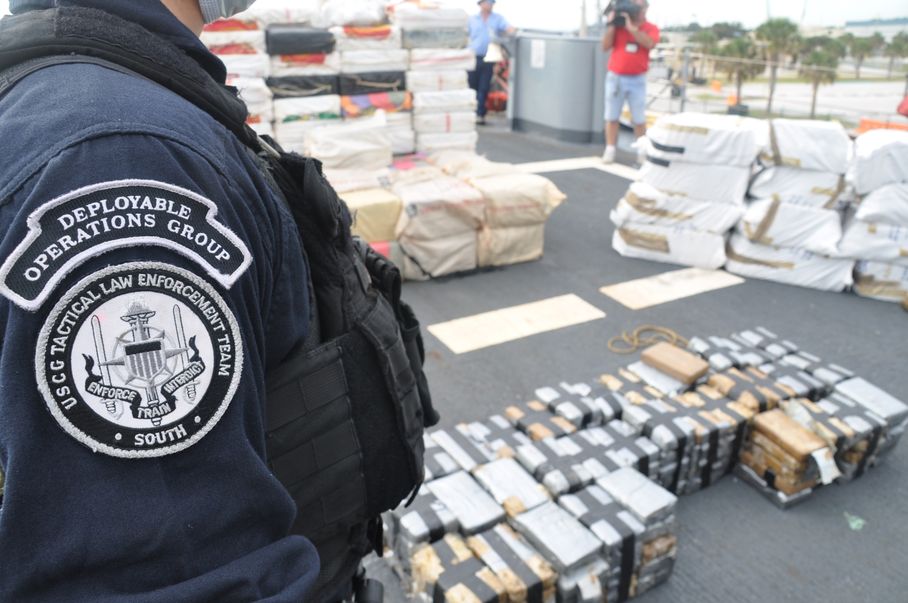
U.S. officials offload drugs from USS Nicholas in July.

With the constant stream of news about maritime disputes in the Asia-Pacific, the threats of piracy, and bluster of the Iranians, it can be easy to forget about the regular naval drama in the Western hemisphere. The U.S. Navy’s contributions to drug interdiction efforts don’t get a as much press, but they are a major focus of naval operations up and down the Atlantic and Pacific coasts, and in the waters of the Caribbean. Yesterday Spanish-language station Univision helped shed light on the mission and its impact thanks access it was given to USS Nicholas (FFG 47).


This is the report from Univision and the English-version clip:

It’s estimated that over 80 percent of the cocaine entering the United States is transported during part of its journey by sea. For that reason, the U.S. Coast Guard has moved the battlefield in the fight against drug trafficking to the oceans.


Univision’s Ricardo Arambarri got exclusive access on board the USS Nicholas during Operation Martillo, a 175-day-long mission patrolling the Caribbean Sea and the Atlantic and Pacific coastal waters of South and Central America.


Arambarri and cameraman Herman Ulloa were on board for 10 days and witnessed the interception of a speed boat loaded with drugs. Operation Martillo returned to land on July 17th with four tons of cocaine and marihuana seized during the mission, with an estimated wholesale value of $93 million.”

This is some great footage, especially if you haven’t spent much time on a surface ship. It again highlights the benefits that mostly untrammeled access can achieve – namely helping generate an understanding of what it is the Navy does in the minds of the American (and international) public. Kudos to the PAOs and whoever else made the decision to give them the access.

According to WAVY 10, “Nicholas‘ crew seized a total of 16,000 pounds of cocaine and 500 pounds of marijuana during the deployment, worth more than $515 million…the crew also captured 14 suspected drug smugglers.”

Univision also provided some entertaining behind-the-scenes footage of the filming process:


This is also a reminder of how well the sea services can work together with practice. In addition to the Nicholas, a maritime patrol aircraft (MPA), an embarked SH-60B Seahawk helicopter, and a Law Enforcement Detachment (LEDET) of the U.S. Coast Guard along for the ride all make an appearance. It is sad, however, to see during the gun shoot and SCAT-team fire (yes, the military does love its acronyms, as the reporter kindly points out) that we still can no better than boxes for targets. They must have run through all their killer red tomatoes. But at least they have some non-combat expenditure allocation (NCEA) ammunition to shoot off, and at least the boxes look like they’re floating. While I’m all for going the inexpensive route, it was hard to tell how well a gunner was at hitting a target when the plywood from pallets we were using slipped below the waves after only a few rounds.


Another thing the videos reinforce is that speed is a big factor in ultimately catching the drug runners. But it’s the speed of the airborne assets that matter, not the surface vessel.


If you’re proficient with your Spanish, you can also check out the original Spanish-language production. As Univision notes, “Check out Navy officers speaking Spanish!


LT Scott Cheney-Peters is a surface warfare officer in the U.S. Navy Reserve and the former editor of Surface Warfare magazine. He is the founding director of the Center for International Maritime Security and holds a master’s degree in National Security and Strategic Studies from the U.S. Naval War College.

The opinions and views expressed in this post are his alone and are presented in his personal capacity. They do not necessarily represent the views of U.S. Department of Defense or the U.S. Navy.