Tag Archives: United States

Reconfiguring the US-ROK Naval Strategy for the Wartime OPCON Transfer (Part I)

On June 1st, Secretary of Defense Chuck Hagel and Republic of Korea (ROK) Defense Minister Kim Kwan-jin met to discuss the creation of an “alternative joint operation body…similar to that of the current South Korea-U.S. Combined Forces Command.” According to the Yŏnhap News Agency, should this change occur, the ROK Chairman of the Joint Chiefs of Staff will lead the new combatant command with the “top U.S. commander in South Korea serving as his deputy.”

Although I have written previously that the United States should retain the wartime OPCON (Operational Control) for the sake of flexible strategic responses against the DPRK, it appears unlikely that the joint decision between the United States and the ROK to transfer the OPCON to the ROK military will be reversed. So how can the U.S.-ROK naval forces successfully adapt to the change?

Answering this question necessitates that we first examine the existing ROK naval capabilities. To the extent that the ROK Navy’s (ROKN) capabilities warrant our attention, it can be argued that this is due to the ROK’s recent military build-up. It should also be noted that the ROK’s naval might can be seen as a reflection of its commercial interests abroad. Indeed, Terrence Roehrig avers that the ROKN’s blue-water capabilities, as seen in its commitment to the ongoing counter-piracy campaigns in the Gulf of Aden, might suggest a link between and its naval might and the ROK’s need to protect its commercial interests and its international standing as a middle power. While there may be some truth to his argument, a more plausible explanation might be that naval power still remains “the best possible means of ensuring the region’s safety without triggering any further escalation.” After all, the ROKN has more than proved its mettle during limited naval skirmishes in the late 1990s and early 2000s over the contested Northern Limit Line (NLL). It is not surprising, therefore, that the ROKN remains the most battle-hardened of the four ROK armed service branches.

Nonetheless, the ROKN still has a long way to go before it establishes itself as a truly independent armed service. As the sinking of the corvette Ch’ŏnan and the shelling of Yŏnp’yŏng in 2010 suggest, the ROKN still lacks the ability to conduct anti-submarine warfare (ASW) and to successfully counter DPRK’s asymmetric threats. The ROKN’s operational shortcomings are particularly troubling in that they were highlighted by the Korean People’s Army Navy, suffering its own limited operability due to its aging fleet and lack of unity within its command structure.

However, as my January piece for the Georgetown Journal of International Affairs and Michael Raska’s East Asia Forum article argue, the greatest barriers to service excellence for the ROKN may be South Korea’s uneven defense spending, and operational and institutional handicaps within the conservative ROK officer corps. Because the ROK Armed Forces remains Army-centric, whereby its command structure and logistics fall under the control of the Chairman of the Joint Chiefs of Staff (ROK CJCS), who has always been an Army general,[1] the ROKN has yet to achieve autonomy as a truly independent service within the existing arrangement. Such barriers do not bode well for the ROK’s most battle-hardened service branch because it ultimately stymies much-needed flexibility and creativity.

In light of both Kim Jŏng-ŭn’s constant threats and the newly proposed Combined Forces Command structure, readjustments at both operational and strategic levels may be required for the U.S.-ROK naval forces to successfully deter further acts of aggression by Kim Jŏng-ŭn. One such readjustment, given ROKN’s weaknesses in its ASW capabilities and counter-asymmetric warfare, would be to redirect ROKN’s focus away from its blue-water ambitions to bolster its coastal defense capabilities. But doing so would jeopardize ROK’s maritime interests abroad and would foster the uneven growth of ROKN by encouraging uneven emphasis on one naval element at the expense of another.
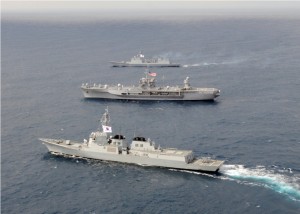
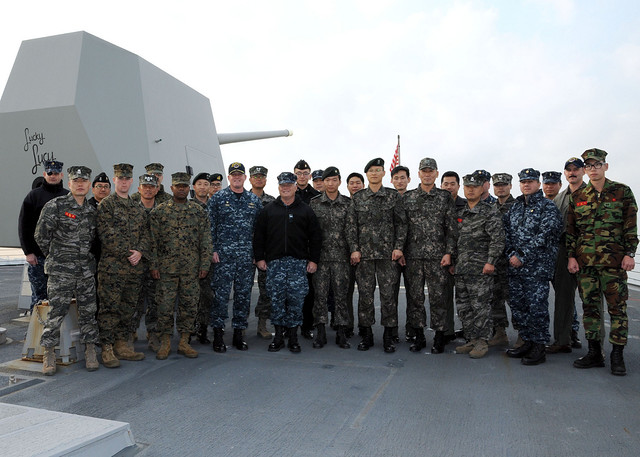
Phase 1: A PHOTEX; Phase 2: The World!
           Phase 1: A PHOTOEX; Phase 2: The World!

Instead, a more pragmatic alternative would be for South Korea and the United States, together with Japan, to establish a combined fleet. While it is true that South Korea and Japan remain at odds over historical grievances and the territorial row over Dokdo/Takeshima, given that the three navies frequently interact through joint exercises, such as RIMPAC, and other exchange programs, so the creation of such fleet in the face of a common threat should not be ruled out. Under this arrangement, each navy would buttress inter-operability by sharing its unique resources and culture with each other. Indeed, the proposed combined fleet would enable ROKN admirals to effectively exercise wartime command over their own fleets, while at the same time help them learn from their sister navies [see note below]. Even more important for the United States, given that “the U.S. operation within the Korean Peninsula is likely to remain a peacekeeping one,” such arrangement would “ensure that [the United States Navy’s] presence is seen and not necessarily felt.” Last but not least, the proposed combined fleet could serve as a quick reaction force in the event of unforeseen crises.

Ultimately, in order for the U.S.-ROK naval forces to effectively counter the threats posed by the DPRK, the ROK Armed Forces itself must undergo a radical transformation. Doing so necessitates that it gradually move away from its Army-centric culture to accommodate jointness among the four services. It must also come up with a coherent budget to sustain its capabilities.

In short, the 2015 wartime OPCON transfer may pose challenges for the U.S.-ROK naval forces to successfully counter and deter future provocations by Kim Jŏng-ŭn. Nevertheless, it also presents an opportunity for those who would seize it. Perhaps this evolution in the extant U.S.-ROK alliance may allow the ROKN to truly come of age as an independent fighting service.

Jeong Lee is a freelance international security blogger living in Pusan, South Korea and is also a Contributing Analyst for Wikistrat’s Asia-Pacific Desk. Lee’s writings have appeared on American Livewire, East Asia Forum, the Georgetown Journal of International Affairs, and the World Outline.


Note:  In a subsequent blog entry, I will explore ways in which the US-ROK Navies, together with the Japanese Maritime Self-Defense Force (JMSDF), can best optimize their capabilities within the aforementioned combined fleet structure.

[1] There has been one exception to this rule. In 1993, Kim Young-sam appointed an Air Force general to serve as CJCS. However, after much resistance from the Army officer corps, no general or admiral from any other service has served as ROK CJCS since 1994.
NATO in the Arctic?

By Andrew Chisholm

An appropriate presence?
                          An appropriate presence?

Canada’s recent assumption of the Chairmanship of the Arctic Council prompted much discussion of Arctic issues, including security, an important element of which is the ongoing tug-and-pull over whether NATO should play a role in the region. Russia is, unsurprisingly, opposed. But there is division within NATO itself: Canada against, Norway and other Nordic states for, and the United States seemingly unsure. These divisions are rooted in the varied nature of the Arctic security challenges that each state or group faces. Therefore Arctic security solutions must be equally tailored.

According to Rob Huebert of the University of Calgary, both Russia and the U.S. are viewing the Arctic in military-strategic terms. Russia aims to maintain its nuclear deterrent, including in the Arctic, through submarine-based missiles to be deployed in its Northern Fleet. Meanwhile the U.S. has bolstered its ballistic missile defence forces in Alaska, and maintains fighter and airlift squadrons as well as a naval submarine presence. Both see their own moves as crucial to national security, but likely view the other with concern, a mindset also prevalent among the Nordic states.

Norway has prioritized Northern defence, moving its operational headquarters to the High North in 2009 and working closely with other circumpolar states, including Russia. But Norway has also been pushing for a NATO presence there because of the importance of the Arctic and increasing interest around the world. It has likewise made clear that as Russia continues its military modernization, Norway sees an Arctic presence of NATO as crucial to continued Norway-Russia cooperation.

Norway’s concerns are similarly felt by Sweden and Finland, which have hosted U.S. and NATO training exercises and deepened ties with the Alliance, as well as by the Baltic states (Latvia, Lithuania, Estonia). This has lead to talk of a Nordic-Baltic alliance or perhaps even of British involvement. Regardless, it is clear that real deterrence of the interested countries’ more powerful neighbour depends on the wider NATO organization.

Top 'O the World to You
                            Top ‘O the World to You

These actions have caused concern in Russia where NATO, not to mention its expansion, has historically been viewed with suspicion. It is important that after a recent visit to Norway, NATO Secretary-General Anders Fogh Rasmussen said that NATO would not increase its presence in the region. He also noted, though, the legitimacy of Norway’s expectation that NATO principles apply to all NATO territory, including its northern reaches. So it seems that while no increase in activity is imminent, neither is a reduction, and the Nordic states will almost certainly continue to seek greater NATO involvement. But while Norway and others have good reason to look to NATO, Canada has good reason to not want an Alliance presence.

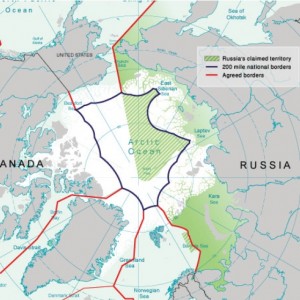
With boundary disputes set to be resolved through the U.N. Convention on the Law of the Sea and all Arctic states saying that military activities are mainly to support of commercial and other civilian priorities, Canada’s desire, especially under the current government, is to see Arctic states focus primarily on economic development. Furthermore, despite sometimes harsh public rhetoric, Canada has a good economic working relationship with Russia it wishes to maintain, as the two countries have much to offer one another. Burgeoning NATO-Russia competition in the Arctic would undermine both those goals. But Canada cannot block U.S., Russian, or Nordic strategic aims, and so it must simply do what it can to defuse Arctic tensions: work to influence the means by which security is organized in the Arctic.

Whether or not the Nordic states achieve their goal of a greater northern NATO presence will depend on the keystone of the Alliance, the United States. In some ways NATO is an attractive option for the Americans, as five of the eight circumpolar states (Canada, Norway, Denmark, Iceland, the U.S.) are member states and the Nordic-Baltic states seem fully willing to contribute to the extent of their (relatively limited) capabilities. But, as its National Strategy for the Arctic Region indicates, the United States is no more interested in de-stabilizing the region than is Canada. Therefore a tension-creating NATO presence is neither ideal nor a foregone conclusion.

This presents Canada with an opportunity to promote an alternative to NATO: NORAD, the North American Aerospace Defence Command. The NORAD option is attractive for several reasons. In concrete terms, NORAD boasts a North America-specific defence architecture (NATO does not), a connection to ballistic missile defence, and an emerging focus on the maritime domain. Through these capacities, it can support both military-strategic and economic activities. In terms of perceptions, NORAD, while closely linked to NATO, is a separate organization. Whereas a NATO presence would stretch solidly from Alaska to the Nordic region, a degree of separation between northern North American and northern European security may present a less anti-Russian and less threatening posture. In the same vein, although it was established during the Cold War NORAD lacks some of the legacy of NATO, which for decades stood at the symbolic heart of East-West competition.

It is important to remember that warfare among the Arctic states is highly unlikely. And, while there will always be disagreements and competition among all states, much of the current Arctic tension is the result of uncertainty about the shape of the Arctic security structure going forward. The task for now is to ensure that the final shape settled on is the best one to calm existing tensions and manage future disputes.

Andrew Chisholm is a Junior Research Fellow at the Atlantic Council of Canada. He recently graduated from the University of King’s College with a B.A., Combined Honours, in Political Science and History, and studied Conflict Resolution at the Rothberg International School at Hebrew University in Jerusalem. Andrew focuses his writing on contemporary Canadian foreign, defence, and security policy. His wider interests include sovereignty and governance, international diplomacy, and emerging security threats. Contact: andrewmchisholm@gmail.com

This article was cross-posted by permission from and appeared in its original form at the Atlantic Council of Canada. Any views or opinions expressed in this article are solely those of the authors and the news agencies and do not necessarily represent those of the Atlantic Council of Canada.

Maritime Security and National Identity

A recent sign posted on the window of a Beijing restaurant refuses to serve certain nationalities due to current international maritime disputes between state actors. Sarah Danruo Wang analyzes how historic disputes on sea (and on land) shape national identity

Restaurant SignAs I near graduation at the University of Toronto, I keep thinking about vignettes of my incredibly awkward, enlightening, and unforgettable first year that really shaped some of my research interests today.  In one such episode, as I was researching a paper on the Franco-Prussian War I encountered an odd little anecdote about how, decades back, a group of people watched an opera so cathartic that when it concluded, Belgium was born. Since then I have researched what it means to be “German” through the ambitions of Bismarck; “Soviet Russian” during Lenin’s implementation of national language policies; “Greek” during the fall of Constantinople; “Czechoslovakian” amidst such an unstable geography; and “Azerbaijani” in a seemingly ethnically homogenous, enigmatic Iran. Personally, I was born in Beijing and I have lived for four to five years each in Ottawa, the San Francisco Bay Area, Vancouver, and now Toronto – a mobile life that renders me identity-less. If our characters are formed through our reactions to our struggles, is a national identity similarly (re)created through the interpretation of conflict?

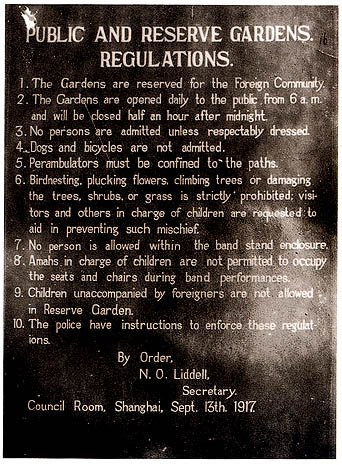
A restaurant in Beijing has a faded sign on its window: This shop does not receive the Japanese, the Philippines (sic), the Vietnamese, and dog.” I admit that I am not shocked by this almost boastful racism from my hometown. Chinese signs were once the tangible symbols of losing something in translation, yet this one is succinctly clear. Why specifically these three countries? It turns out that each has a maritime dispute with China. China is obviously at odds with Japan over the Senkaku/Diaoyu Islands; and with Vietnam and the Philippines over islands in the South China Sea. Although the sign is an isolated incident, provoking nasty reactions from the nationalities in question, the state has not asked the owner to remove the sign as the owner indicates that “this is my own conduct.” What many news outlets did not mention is that this sign is eerily reminiscent of a well-told Chinese story of a sign reading, “Chinese and Dogs Not Admitted”, in Shanghai’s Huangpu Park in the 1920s. Although Chinese people were barred from entering local parks, the exact wording of any signs is disputed. Nevertheless, the restaurateur’s homage, grafted from previous experiences to today’s prejudices, exhibits the tension between perceived relative statuses.

When I was living in the United States, I recited the pledge of allegiance every day. When I returned to Canada, I did not remember the words to the national anthem, let alone the Royal Anthem that we had to sing on the way out of every assembly. I watched my social studies teacher be the only one in the auditorium refusing to stand for “God Save the Queen” because of an alternate stanza belittling the Scots. The nationalism in my Chinese peers and their parents was diluted at best – cultural detachment and youthful apathy. I want to blame the decreased interest in politics on the events and aftermath of 1989, but I now know better, that it was the decision to prioritize economic opportunity, and the spread of a material culture in my generation.

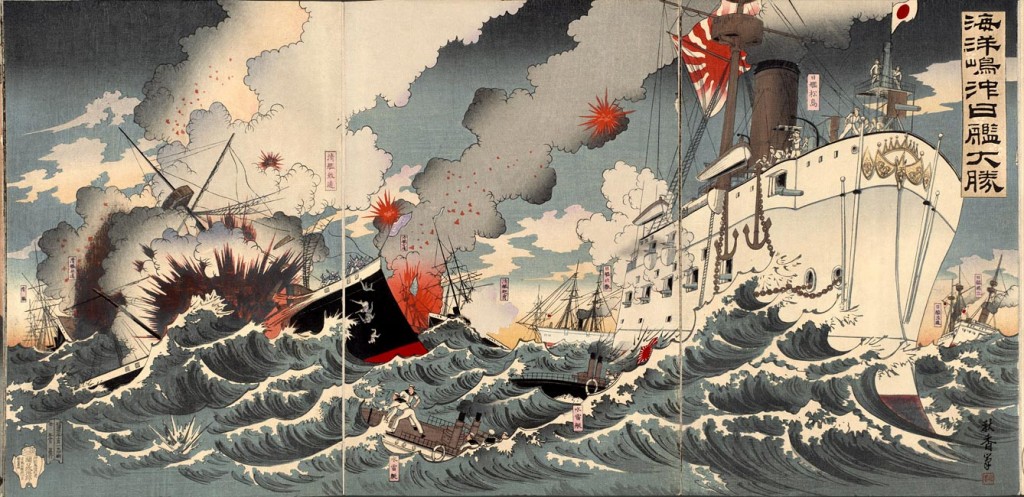
But with a foreign conflict, specifically one that makes the average Chinese feel cheated over our poignant, invaded past, the Chinese public do not disappoint. A traditional Chinese hero is Zheng He, whom we proudly claimed to have travelled the seas centuries before the Europeans. Yet we rarely note that Zheng is not ethnically Han but of Muslim Hui descent. More recent victories and defeats at sea during the Sino-Japanese conflicts of the late 19th century were captured primarily in the Japanese visual style (see image below).

Japanese Style

Since the 1990s, when the nation was once again challenged by non-governmental oversight and the retreat of ideology, China has faced and reacted mostly to land-based or conceptual conflicts. China Can Say No, published in 1996, rejected Americanization of culture. The bombing of the Chinese Embassy in Belgrade in 1999 by NATO produced protests that were verbally supported by Vice-president Hu Jintao. The 2008 Summer Olympics was a triumphant display of cohesion and unity. And now, the historical antagonism with Japan is suddenly reignited over rocks. Is this solidarity perhaps just a defense mechanism to perceived (cultural or national) insecurity, rooted in a historical perspective of either relative inferiority or regional supremacy? Or perhaps, it is just a bit more comforting to confront the other in the company of one’s peers?

As for Canada, the Rush-Bagot Treaty of 1818 demilitarized the Great Lakes region by permitting only one naval vessel each for Britain and the United States on Lake Ontario. This demilitarization was seen as a first step testing the precarious trust after the War of 1812. Furthermore, the Naval Service Act of 1910 created the Canadian Navy with second-hand British vessels, the HMCS Niobe and HMCS Rainbow, and established the Naval College in Halifax. Opponents derided the effort, calling the formation the “tin-pot Navy”.  Yet this was a clear assertion of Canada’s self-protection autonomy – separate from, but loyal to the Commonwealth.

Canada’s maritime security hasn’t always been life-or-death serious. In 2002, Denmark erected a flag and left some Danish vodka on Hans Island in a bizarre attempt to provoke a reaction over a rock that burdens Canadian-Danish relations. Five years later, Russia similarly planted a flag in the seabed of the Arctic to prove “the Arctic is Russian,” illustrating that Russian cooperation and aggression will perpetually be a mercurial cycle. Current maritime concerns in the Arctic revolve around Canada’s ability to react to potential oil spills and pollution through drilling and shipping, and Ottawa’s assistance to indigenous maritime development.

I do not want to poeticize maritime divides, but any fifth grade geography class reveals that the continents were once fitted together like a finished puzzle known as Pangaea. It is appropriate that with continental drift, distance produced distinct people. Only with the advances of maritime technology, ambition, and the lust for adventure led to the discovery of the New World. Shipping and maritime security determined wealth and relative power, which enabled the early flourishing of The Netherlands and divorced England from the European continent.

Before man conquered the skies, maritime passages were the medium for the arrival of the other. It is ironic that for all the efforts China used to build a wall to keep barbarians on horses out, it was defeated by other barbarians on ships at its ports.

The dividing seas also facilitated asymmetric development, ideological escape, and the spread of commerce. The Austro-Hungarian Empire’s lack of a navy exacerbated its economic stagnation as it steadily lost its maritime-efficient proxies through successions or independence. A century later, a Russian ambassador asked why the Czechs needed a navy when the country was obviously landlocked (the Czech representative replied that he did not understand why Russians needed a ministry of cultural affairs). Lastly, incidents like the Komagata Maru and Pearl Harbor shape our collective sense of how national and human security is simultaneously enhanced and endangered by the oceans, as trouble can be carried on the tides.

The racist sign in the Chinese restaurant, among the vast stimuli of a city like Beijing, indicates how disputes trickle down to even the obscurest of places. Conflict on the seas – both today’s and from times past – shapes who we are, what we fear, and how we react.

Sarah Danruo Wang is currently a third year undergraduate student at the University of Toronto studying international relations, philosophy, and fine art history. Her research interests from first year has steadily moved east from Germany to the former Czechoslovakia to Russia and include broader issues in identity politics, EU and NATO eastward enlargement, and education policy. She has previously researched for the Advocacy Project, the Department of History at the University of Toronto, and the G8 Research Group.

This article was re-published by permission and appeared in original form at The Atlantic Council of Canada.  

A Post-Chavez Maritime Order

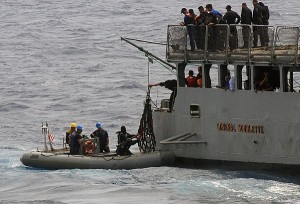
U.S. and Venezuelan Sailors work together during counter-drug operations in 2009.

In the next few days there will undoubtedly be a glut of post-mortems on the Chávez era and predictions for the future (not least because much of Washington’s “blogging class” is home for a snowstorm)1. Much of it will be by experts on the region or those armed with interesting facts. I’m not aiming to compete or replicate their work; what I want to look at is the implications for defense cooperation, specifically naval and maritime matters.

Danse Macabre Venezuelan
America’s tumultuous relationship with Venezuela under Chávez is well documented – from coups to theatrical UN speeches to declaiming Halloween’s frights as acts of “imperialist terror” – but it wasn’t always this way. Prior to Chávez’s inauguration in 1999, the U.S. enjoyed many fruitful defense ties with Venezuela including intelligence-sharing, counter-narcotics, military training, and defense exports.

Most of these ties continued during Chávez’s first term in office, although an initial indication of Chávez’s wariness of the American military may have arisen during floods and mudslides in December 1999-January 2000. After allowing in roughly 100 U.S. troops, he cancelled plans for additional U.S. military construction corps members to assist in the recovery efforts.

On the other hand, as late as 2002 Chávez still enjoyed interacting with the crews of visiting naval vessels, as this post by Chris Cavas, detailing a port call by the USS Yorktown (CG 48), and a declassified U.S. State Dept. Memo highlight. However, a mere 5 weeks later, the April 2002 coup would irreparably alter relations.

The U.S. military came under particular criticism from Chávez, both for allegedly – and without proof – directly aiding the coup attempt and subsequent espionage and coup-plotting efforts. Venezuela expelled a string of military attachés on these grounds, a tradition continuing to this day (see below). Chávez also followed up his words by severing most of the existing military ties between 2003-2005, including ending training-support missions and participation in the annual UNITAS naval exercise. It may have been his calculation that there was greater value in showcasing an external “imperialist” threat to shore up support, in the tradition of Vladimir Putin, than to maintain ties with the U.S. But whatever the reason, military relations after the coup were quickly curtailed.

In 2006, due to a lack of cooperation in anti-terrorism efforts, the U.S. followed suit by sanctioning arms exports to Venezuela. Despite these impediments, informal ties between the two militaries continued as the Venezuelan military backers of Chávez have reputedly been of a more pragmatic strain than their leftist civilian government counterparts.

One area of considerable focus has been counter-drug (CD) efforts. Despite the appearance of Chávez’s personal enmity, the U.S. Navy and Coast Guard have still managed in recent years to work with their counterparts, although this has reportedly been on a case-by-case rather than formalized basis. According to the GAO:

DOD allotted about $3 million for counternarcotics and related security assistance in Venezuela in fiscal years 2006 through 2011. Through 2009, this assistance was used in part to provide tactically actionable intelligence to both US and select Venezuelan law enforcement agencies.

CD efforts will continue to loom large as avenues for cooperation and potential sticking points if the next election returns a “Bolivarian” government. The Wall Street Journal reported this January that attempts to improve ties between the U.S. and Venezuela are hampered by

…allegations of high-level involvement by the Chávez government in drug trafficking. The U.S. has put seven top current and former Venezuelan officials on a Treasury blacklist for their alleged drug and arms dealing links to Colombian guerrillas based in Venezuela. Those links were exposed in 2008 after the Colombian military captured computers used by a guerrilla leader killed on a cross border raid in Ecuador.


Among the officials put on the Treasury list are Gen. Henry Rangel Silva, the former minister of defense who was recently elected governor of the state of Trujillo. Mr. Rangel Silva and the others say they are innocent.

Venezuela’s immediate future looks to be tumultuous and relations could in fact worsen. Vice President Nicholás Maduro moved to expel two American diplomats and claimed that Chávez had been poisoned with cancer by Venezuela’s “historical enemies.” This may have been mere posturing to aid power-consolidation for the immediate transition and new the elections that are constitutionally required to be held in 30 days – but it is a sign that things are far from certain to improve.

Despite today’s focus on Chávez’s death, however, the more meaningful impact on U.S.-Venezuelan naval and maritime efforts may have come from last week’s enactment of Sequestration. As Sam Lagrone describes, the forced budget cuts have dealt a blow to Operation Martillo’s CD efforts, suspending deployments to SOUTHCOM of U.S. Navy frigates USS Rentz (FFG-46) and USS Thach (FFG-43). Just as an opening may occur for increased cooperation in the next few months or years, the U.S. may not be able to take full advantage of it.

LT Scott Cheney-Peters is a surface warfare officer in the U.S. Navy Reserve and the former editor of Surface Warfare magazine. He is the founding director of the Center for International Maritime Security and holds a master’s degree in National Security and Strategic Studies from the U.S. Naval War College.

The opinions and views expressed in this post are his alone and are presented in his personal capacity. They do not necessarily represent the views of U.S. Department of Defense or the U.S. Navy.