This week CIMSEC will be featuring brief responses submitted to our call for recommendations for the incoming administration. Below is a list of responses that will be updated as the topic week features and as prospective authors finalize additional contributions.
Dmitry Filipoff is CIMSEC’s Director of Online Content. Contact him at Nextwar@cimsec.org.
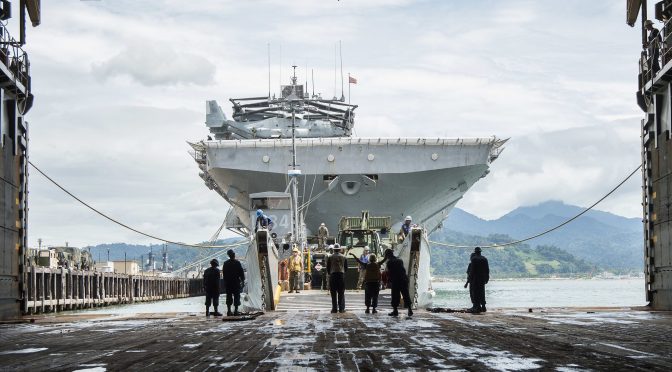
Featured Image: SUBIC BAY, Philippines (Oct. 5, 2016) With amphibious assault ship USS Bonhomme Richard (LHD 6) as a backdrop, Sailors aboard the dock landing ship USS Germantown (LSD 42) conduct landing craft utility operations in the ship’s well deck during Philippine Amphibious Landing Exercise (PHIBLEX) 33. (U.S. Navy photo by Petty Officer 2nd Class Raymond D. Diaz III/Released)
Week Dates: Jan. 16 – Jan. 20. Responses Due: Jan. 15 Response Length: 400 Words or Less
As various bureaucracies orient themselves around the incoming administration, they must transmit a clear message describing their purpose in serving the nation, the challenges they face, and how new leadership offers opportunity for change. Please respond below to share your thoughts on how the U.S. Navy may answer these key questions in 400 words or less. Respondents can opt to reply anonymously if so desired. We ask that submissions be objective and nonpartisan. CIMSEC will publish top responses as a topic week beginning Jan. 16 in the days leading up to the presidential inauguration. If the online form does not work for you please direct your responses to Nextwar@cimsec.org.
Dmitry Filipoff is CIMSEC’s Director of Online Content. Contact him at Nextwar@cimsec.org.
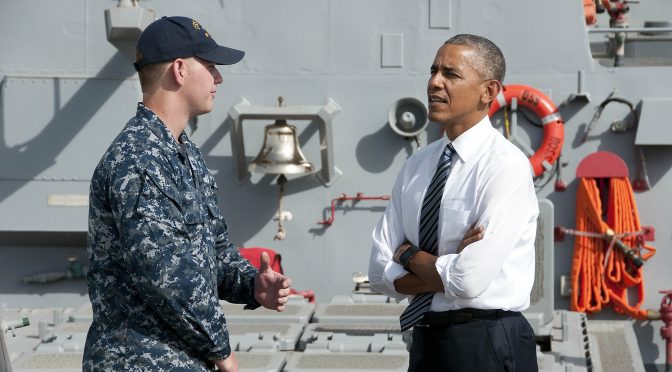
Featured Image: NAVAL STATION ROTA, Spain (July 10, 2016) – Gunner’s Mate 2nd Class Garrett Nelson speaks with President Barack Obama during his visit to USS Ross (DDG 71) July 10. (U.S. Navy photo by Mass Communication Specialist 1st Class Brian Dietrick/Released)
The ushering in of a new administration on January 20th has many wondering what campaign promises will materialize and meaningfully affect the U.S. Navy. Is it reasonable to expect movement toward a “350-ship Navy” and, if so, what might such a Navy look like? Where can increased military spending be focused to have the most immediate impact on the United States’ readiness to address near peer competitors?
To answer these questions, we invited one of the United States’ foremost experts on American Seapower, the Hudson Institute’s Bryan McGrath, on this episode of Sea Control. Hosts Sally DeBoer and Mike also talk with Mr. McGrath about measures to increase force lethality, the newly established N50Z office and efforts to let strategy inform the budget, and burgeoning threats in the 21st Century.
Listeners interested in attending Mr. McGrath’s American Seapower Speaking Tour can find more information here.
Read on, or listen to the audio below. This interview has been edited for clarity and length.
SD: The first topic we’d like to discuss with you is fleet design. The forthcoming Trump Administration has, as part of its campaign promise, vowed to increase military spending and indeed establish a 350-ship Navy (as discussed by Steve Wills in his fantastic recent CIMSEC Article: A New Administration, A New Maritime Strategy). Due to sequestration and decreased funding for platforms in general over the past decade or so, as well as the Reagan-era platforms reaching the end of their service life, we are coming from behind. Where should money be spent to have the most immediate impact?
BM: With respect to the 350-ship Navy, I think the thing to keep in mind is that they have wisely not established a timeline for when they want to reach 350 ships. I’ve done a lot of work over the last few years looking at how the industrial base could flex to meet a larger navy and it seems to me that getting to 350 would be beyond anything but an emergency shipbuilding plan during two terms. What they ought to do is concentrate on getting us on a path to 350, articulate what 350 ships looks like, and create a sense of trust in the congress that the Navy can build ships cheaply and efficiently.
One way to get started on this, and obviously Steve Wills is one of the most articulate defenders of the LCS, is to build more LCSs relatively quickly. I have written an article on this for the Hudson Institute Center for American Seapower where I recommend building two ships per yard in ‘17 and ‘18, and then moving to the frigate design and conducting a competition where the winning yard would build the frigate starting in ‘19 and the losing yard would continue to build LCS through 25. These would be the LCS-plus that the Navy is going to bid on in ‘17 that will have surface-to-surface missiles and air search radar, from what I can tell. This would be one way to produce 12-15 small surface combatants between now and ‘25. That keeps those two shipyards in business.
I think industrial base concerns are important and I recently listened to a hearing on LCS where people were making fun of or dismissing industrial base concerns. I think that’s strategically inept. If we are going to build and maintain the world’s finest navy we have to have a strong maritime industrial base. Plus, the fact is that Wisconsin, where one of the ships is built, was part of breaking down that blue wall and helped elect Mr. Trump. Alabama, where the other ships are built, is the home state of his attorney general. There are political realities here.
The other political reality is Sen. McCain and his desire to move away from the LCS ASAP. I think the Navy could go a long way toward meeting Sen. McCain’s concerns if they articulate within the next year or so what the follow-on frigate is going to be and that it will acquire it at the latest by FY26. There’s a hole in the small surface combatant biplane right now during 4 years in the late 20s that we need to fill and keep building ships.
You asked how to get started – hot production lines can build LCS, and build more oilers. We need oilers and need to rebuild the logistics fleet which is far smaller than it should be. We should also consider ship-to-shore connectors, ocean-going tugs, and understand there are a bunch of ships that can be built quickly, on budget, and show that we’re going forward.
Importantly, in ’17 and ’18, and even more important than building ships, is plugging the holes in the maintenance and modernization of the entire fleet, and not just ships but depot level maintenance on aircraft as well. We are at the ragged edge of hollowness right now and if we decide to start building ships willy-nilly on a base of shifting sands when we haven’t addressed modernization issues then we are making a mistake. I think we can build ships and accomplish this, and plus-up personnel accounts so that we can move and train people. If we’re going to build the Navy 30% bigger then costs are going to be incurred that aren’t bound up in shipbuilding.
SD: To expand on this, what are the major obstacles you see to the 350-ship Navy and to building toward a bigger navy or putting a nation on that road?
BM: I think the biggest issue is that the president-elect made a 350-ship Navy an article of his campaign, he won the election, and navies never grow unless the president is behind them. The first thing is the president has to stay behind that goal. If indeed he does, it is likely to happen. It’s not guaranteed because his bankers on Capitol Hill have to write the checks. The one thing that I haven’t heard yet, but I imagine they’re hard at work on a story to articulate why we need 350 ships, where, why, how will they operate, to what extent, against whom and what threats? The thing that many people don’t realize about the 600-ship Navy in the Reagan era is that that number was rattling around for a while in the late 70s and it was an article of the election in 1980, but it wasn’t until Reagan came into office and John Lehman was able to tie the emerging thinking of some really visionary admirals in the pacific fleet to that number. You need to have a story. Congress won’t appropriate money until they know what the plan is and why. That’s the biggest problem.
SD: Speaking of a narrative, it seems to me as a non-expert, that the Republican party has moved toward the idea of non-intervention and Mr. Trump said yesterday (and I know there’s a difference between things said in promotion and things that actually happen) that there would be focus on non-intervention and just defeating ISIS as far as U.S. military policy goes. Does that indicate to you anything about his commitment to the Navy?
BM: I’m not sure I would say the Republican party has gone in that direction, but the president-elect of the U.S. and his support base have moved in that direction. I think there is a serious tension within the GOP. I am one of the other guys, I think about American exceptionalism and think the world is better with more America in it. The road to perdition is paved by trade wars and moving away from a global trade posture. So, the problem or the difficulty that I see in making the case for a 350-ship Navy is in the “to do what?” question. If you are going to lean on allies to pick up more slack and if Russia is not seen as a major threat, then a 308-ship Navy is probably sufficient, the one that is there now. In order to justify 350 ships you have to have a more global internationalist outlook, so there is some tension there. I think they can thread the needle, but it is going to be hard.
MK: I would like to bring up the decline in attack submarine numbers throughout the early 2020s. There are ways to figure that out, like building 2 Virginia-class SSNs and one Columbia-class SSBN-X a year, but that is going to have to get done and paid for or we won’t have that capability. The attack submarine force will sharply decline right about the time the Chinese undersea threat becomes more pronounced. Right now, having dry-dock space to maintain the fleet that exists is at a sheer premium if we’re going to talk about plussing up the fleet and there will need to be an increase in shipyard capacity for maintaining that fleet.
BM: This is a national strategic issue. The Navy and the U.S. military should defend free markets but we don’t have to practice them. There are sound military reasons for excess capacity – excess capacity that you would never maintain if you were running a business – you don’t want excess stock on the shelves. That’s not the way the military works, we need excess capacity so that we can ramp up and have a workforce that can do what you need it to do.
MK: The other thing I would add to that is we sort of, based on some dubious lessons from WWII, think that we can build ourselves out of any deficit at the beginning of a major war. That isn’t the history of WW2, most of the naval conflict was fought with platforms that existed at or programs that were underway in December of 1941. Second, the shipbuilding excess capacity that existed in the country at the time does not exist today. I am not saying that we’re headed for world war, but it’s a worthy intellectual exercise to think about how you would plus that up and recognize the time that it would take to make a massive change in fleet size inside of a strategic challenge would be prohibitive at this point with the complexity of ships that are being built.
BM: It isn’t going to happen. In those days American shipyards were building merchant ships, you could take that commercial capacity and turn it into cannibalized excess shipbuilding, tank, plane capacity, etc. It just doesn’t exist now.
MK: But it certainly does exist in China though!
SD:That’s a great point, and we talked about in an interview with Dr. Andrew Erickson of the Naval War College, who is the editor of the new book Chinese Naval Shipbuilding. Could you speak to the CNO’s recent OPNAV staff reform co-locating the assessment division with the strategy folks in the new N50 office. Reactions have been positive – people like the idea of strategy informing budget. What kinds of substantive changes do you think we can expect from this arrangement and are you generally in favor of it?
BM: Who could not be in favor of it? It’s like ice cream or air. It’s what we have all always wanted in theory, right? Every strategist or would-be strategist wants resources to follow strategy. I think the CNO is making all the right moves and saying all the right things but resources following strategy is hard, really hard. It’s challenging enough to have resources follow strategy when you are utterly in charge of all of the variables – like if you’re running a company and can put internal investments where you want them to go and enter new markets as you want to. The CNO and SECNAV don’t have those luxuries. They have to respond to national tasking and to national strategy, so I think there is great value in the exercise and in the attempt. I look forward to its success – I might not bet on it. I’m going to meet with the N50 people to talk about some of these things and maybe my opinion will change. I am looking forward to it. I do like that some of the folks from N81 are being dragged over there and that there will be a way to assign them or have some folks who are in charge of thinking about how the fight will happen and what will be the desired strategic outcomes pushing them rather than N81 making it up itself, which kind of appears the way it has been done for a long time.
MK: I am also in the wait and see category. I think no matter how good your intentions may be there’s a tendency in large organizations to sort of know the answer going in. I think there’s the potential there that we assign the answer before the answer is given. If we’re told to program to 350 ships we will find something to do with them, rather than try to take a top down approach, which may take longer, given our needs.
BM: I think the CNO is doing something even more intelligent and even more potentially beneficial to the navy than this N81/N50 alignment thing. And that is taking a more architectural look at fleet design and dividing up or thinking about that architecture through domains rather than platforms, and assigning a honcho to each domain who then works with the resource sponsors within that domain to create a program that serves the domain’s ends – threats, networking, weapons, sensors, platforms – in a more holistic and integral way so that you’re able to allocate functionality more efficiently in a domain without thinking about air, surface, and subsurface and other things separately. Think about fighting in that domain in the most efficient way and allocate functionality that makes the most sense. That could be truly revolutionary if it works.
SD: Let’s switch gears. Characterize the fleet’s current effort to increase lethality in terms of conflict with proto-peer competitors. Specifically, we talk about distributed lethality – which we know you’re an expert on – and would like you to speak to the command and control construct that would accompany DL and the kinds of training and experimentation the fleet will undergo to implement it.
BM: So I just gave a talk at the OPNAV staff/CNA Future Strategy Forum at the Navy Memorial. I was on a panel that was called “beyond distributed lethality” and one of the things I said was that it was gratifying to think that DL had become so integrated into thinking that we could now move beyond it. Some of that was tongue in cheek but not all of it.
The subject of my talk was split into two halves. The first was command and control and the second was combat systems. With respect to distributing lethality in the fleet, this includes things like maritime-strike tomahawk missiles, SM-6’s surface mode, OTH missile for LCS and SSC, and also SEWIP bloc 2 and 3. The Virginia Payload Module (VPM) in the submarine force is the granddaddy of DL in my view. Those guys were on that a long time ago and it really affected my thinking. The Navy’s doing a good job of spreading its weapons and that is important because it makes you harder to find, harder to attack, you get to attack the other guy from multiple angles, and you get to hold more of what he values at risk and through more ways.
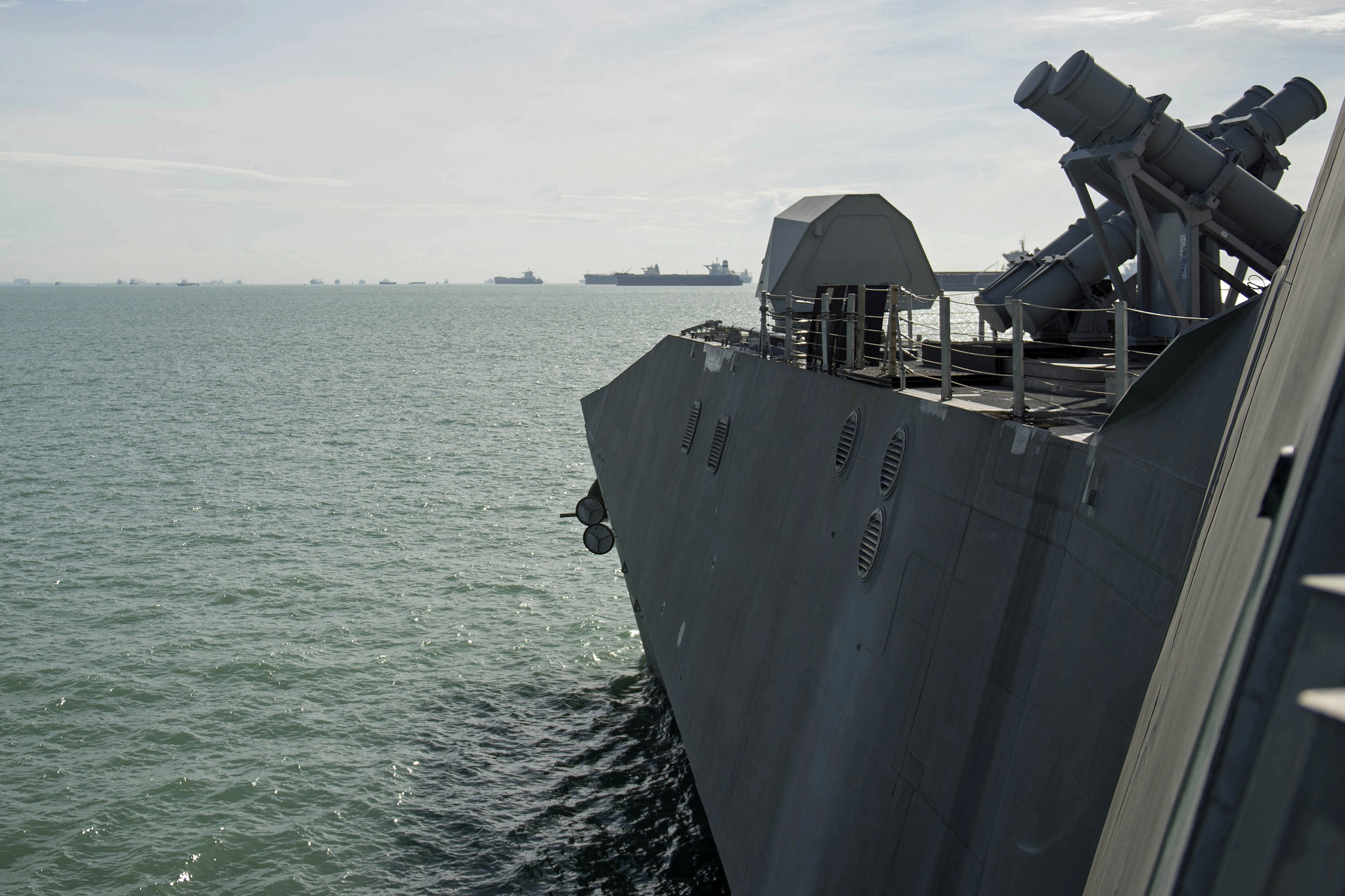
SINGAPORE (November 30, 2016) USS Coronado (LCS 4) departs Changi Naval Base to conduct sea trials after a maintenance period. Currently on a rotational deployment in support of the Asia-Pacific Rebalance. (U.S. Navy photo by Petty Officer 2nd Class Michaela Garrison/Released)
The command and control of a distributed force is something that bears a lot of thought. The way I look at this is that there is a slider, a continuum, that describes an exquisite peacetime network and comms environment that I refer to as the pre-first shot state of the war environment. This involves very centralized control, very strict ROE – the kind of thing we exist in so we don’t get some guy popping off a shot at the ragged edge of the network starting a war. That requires a very sophisticated network with high confidence in communications. For peacetime operations that’s probably the appropriate manner of Command and Control whether concentrated or distributed. You’re still going to want to have centralized control over weapons employment in that environment.
You move that slider to wartime, “the knife fight in a dark closet,” where you’ve lost a good bit of your SATCOM, probably on HL, LPI/LPD kinds of comms, radio silence. Commanding and controlling those forces is a real challenge but it is something we have to think about in the bright light of peace while we aren’t fighting someone in that kind of environment. We have to be able to maintain as much war fighting capability as we possibly can as you move down the sliding scale toward dark and quiet from light and loud. We have to back up aerial layer networks, tactical receiving of satellites, and aerostats potentially. There’s all kinds of ways to set up networks and temporary networks. But we have to be investing money and thinking about it and imbue our commanders with a very honed sense of mission command and that is – go execute your last orders and oh, by the way, if we lose comms, use your initiative. Go kill people and wreck things.
MK: There’s sort of two ways to solve that. The first is by increasing your sensor payload on whatever you think your smallest unit of action is going to be. There’s a lot of inventive ways to look a little further over the horizon, and in the “knife fight in the dark closet,” the potential of mistakes is going to go up. In my view, I don’t think enough effort is being applied to trying to figure out how we’re going to integrate air assets into DL. I have a couple concerns with that, particularly because in a similar place the reason that Vincennes shot down that Iranian airliner in 1988, a part of it was because she was in the dark and couldn’t get her aviation support fast enough. The alert package launched off of the Forrestal and they burned to get there but they couldn’t get there in time. I think there could be a similar mistake, and in a modern 24-hour news cycle, this would look even more poorly. Look at what the Russians are going through having shot down an airliner. There is a lot of blowback from mistakes like that and so I am a little concerned. I would like to see an increase in sensor payload of those sorts of ships to give them a better look without national-level assets.
BM: There’s an interesting DARPA/Office of Naval Research joint program called TERN. It’s a medium-altitude long endurance UAV that would take off and land on LCS, future FF, DDG, and cruisers. I think that it’s a couple hundred pound payload, 14 hours in the air. It’s just a truck and then you decide what package goes on (comms, IR/ER, radar), so that’s one way to get around that problem. The other thing to think about though is – if we’re in the real knife fight, I should hope that mistakes will be tolerated. If we are in an environment where we’ve lost SATCOM and we’re fighting a first world power –mistakes are going to happen and you have to minimize them but I would hope that there would be some understanding.
MK: The Lusitania sinking by a German U-boat in a war zone, potentially carrying war material, had huge strategic impact. So no I don’t think so and the idea that the entire rest of the world while we and China go at it is probably not reality. So you know, to say nothing of some potential attempt to egg us on to do something. I don’t think that’s the case at all.
BM: Don’t get me wrong, you bring up good points, and your point about the rest of the world is well taken. If the U.S. and the PRC get into a scrap the pressure to end it quickly is going to be immense which has in my view, huge fleet architecture implications. You damn sure better have what’s out there in the fleet be a force that can deny or deter their aggression. If you can’t, their aggression becomes more likely because the probability of success becomes higher. I’m not trying to say we would willy-nilly shoot down airliners, what I am trying to say is that there will be mistakes, incredible mistakes when command and control is taken away, but I don’t know that we necessarily want to use the fear of such a thing to help design our force.
MK: I would generally agree. I am just arguing that the likelihood of mistakes will be lessened and the lethality of your basic unit of combat will be higher with some set of fast moving fixed wing aircraft that can look at OTH targets.
BM: Keep in mind one of the reasons DL is attractive is because you don’t need CAW, or you would need one less, because they’re finite and there’s a finite supply. They can’t be everywhere at once. This is the thing that I tell my aviator friends: in a first-world scrape, that air wing is going to be very busy not just doing strike but doing ASUW, hopefully someday ASW again, certainly doing ISR. I think the CAW is going to be incredibly busy, maybe too busy to provide air cover for a SAG out there alone and unafraid.
MK: I think that’s probably true and possible.
SD: With respect to increasing lethality, are there any initiatives you feel that don’t get enough attention from fleet leadership that could lead to increased lethality?
BM: Everyone gets all excited about lasers. Lasers have been just around the corner for 30 years and I think there are applications, they are coming, they are out there, but it’s not like I think, ‘If we just paid attention we could move it along.’ The technology is moving along at the rate that it can. Railgun? I like the railgun as a concept; I like it quite a bit. I think I like it more than anything in its ASMD role, if you could throw a high energy projectile that blows up and creates a lot of FOD in front of a missile that is a wonderful way to take it out and it’s cheaper than trying to do so with a missile. Again, railgun is moving along, someday we will solve the energy storage problem. Storing the power is the issue, not generating it. I would like to see a supersonic long-range ASM that could be fired from a surface ship or sub, I would like to see that in the inventory, and I am talking 500 miles or so. I’m relatively satisfied with the weapons, weapons programs, and sensors. What I am not satisfied with is the networking, the ISR, and the connective tissue among all the elements. What we don’t have is all the interstitial stuff that helps tie it all together.
MK: I think we’ve made some really good progress toward EW but I am not quite sure we’re there yet or have thought about what it’s going to take to fight in a heavy EW environment, both in EA or some sort of electronic defense and providing the frequency agility that we might need in a very complex EW environment. I agree and I think that the increase in lethality of surface ship ASW systems has really changed a lot of things with the way that you can do ASW. AN/SQQ-89(V)15 is really a change in model for the surface navy and it is a very impressive system.
BM: Great point, the surface fleet needs a weapon that can exploit the detection range of the V15. We need to get something headed out quickly toward that submarine in the 4th or 5th CZ to put it on the defense. Killing subs is hard, scaring them is easy. Bryan Clark has done great work at CSBA that showed we were much more effective in WWII at scaring subs away than killing them.
Speaking of EW, the second half of my discussion at the Future Strategy Forum was about combat systems and I made the case – I didn’t command a ship that long ago (2006), that ship is still in the fleet (USS Bulkley) – the combat system is essentially the same, but the kinetic combat system and the EW combat system were not the same system. They were integrated to some degree, but not fully.
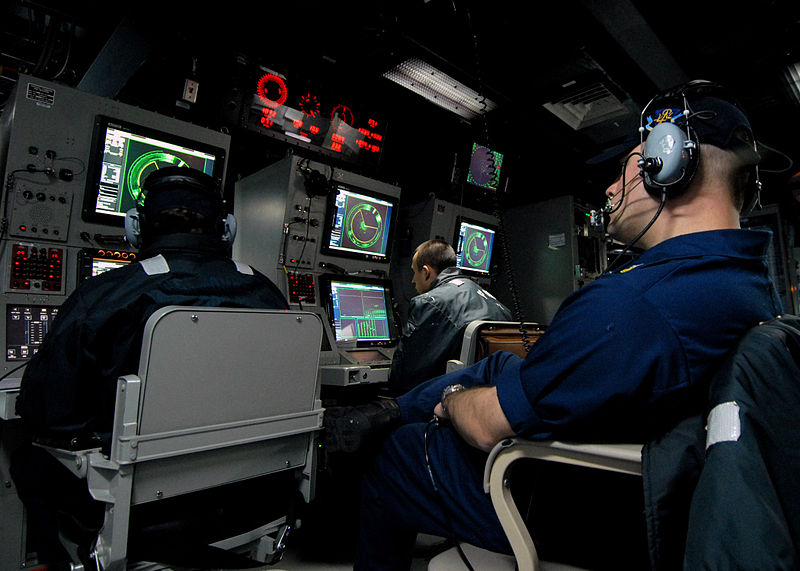
PACIFIC OCEAN (Jan. 26, 2008) Sonar Technician (Surface) 1st Class Mark Osborne supervises Sonar Technician (Surface) 2nd Class Randy Loewen, left, and Sonar Technician (Surface) 3rd Class Roland Stout, right, as they monitor contacts on an AN/SQQ-89V15 Surface Anti Submarine Combat System, aboard the guided missile destroyer USS Momsen (DDG 92). (U.S. Navy photo by Mass Communication Specialist 2nd Class James R. Evans)
We need, at the unit level, to have a single combat system that provides decision makers with automated battle management aids, provide strategies that help you conserve weapons, that tell you the better thing to do here is to jam this missile with this technique rather than shoot it with this missile or this gun – that kind of full integration of hard and soft kill EW with kinetics at the unit level is required. But then we have to take it to the next level and have networked combat systems in a SAG so the SAG can husband its efforts in the most efficient way, which leads you up to the strike group. You can get to a point where you have almost a web-based combat system that degrades gracefully down to the combat system that is in the ship providing end-to-end functionality within the ship – hard kill and soft kill – that can be networked among other units in order to conserve assets. We have to find a way where we are not going Winchester on the first salvo.
BM: First, I have always considered A2/AD to be redundant. A2 and AD are the same thing. It is sea denial – its keeping someone from doing something they wish to do in a chunk of the ocean. So the term itself is redundant. I don’t have any problem with what the CNO did. I think it is reasonable from the standpoint of trying to get people off their fainting couches. People overestimate the “kill zone” that is the Pacific Ocean. It is just not the case, it is looney to think that, but what I think he’s trying to do by eliminating that term is to make sure people understand that we have some tricks up our sleeves and can absorb some of this risk and fight our way in, fight our way out.
MK: I totally agree. He is saying that A2/AD presents it as a fait accompli rather than an aspirational goal is very well taken.
BM: Let’s face it; dealing with OTH radar – OTH radar has different characteristics at night and day. Sun spots, weather comes into play. What’s really needed is the ability in real time to heat map adversary ISR. We have to be able to see where the weaknesses and seams are and that’s where you go project power and do strike, then get the hell out and go do the next one. We can do that, we just have to think our way though it.
SD: I wanted to mention your American Seapower speaking tour. Can you tell our audience what that means, what you’re doing, and how they can attend?
BM: I think we haven’t been doing a good job of telling the American people the value of investing in their Navy and what the payoff is. My speaking tour is targeted to 23 different Rotary Clubs around Maryland. I have done 12 so far and I talk for 20 minutes and answer questions with a bunch of people who don’t ‘get’ the Navy. I am going to the far western edge of Maryland next week, a town called Oakland, and I’m going to talk to people about seapower. It’s a result of my frustration and my effort to try to do some good.
SD: I want to thank you for your time today, it was a true honor to have you on the show. Any last comments before we sign off?
BM: I love what you guys do, keep it up!
SD: Thank you very much, sir. Thank you also to our listeners and have a great holiday season.
Sally DeBoer is the President of CIMSEC for 2016-2017. The views of the guests are theirs alone and do not represent the stance of any U.S. government department or agency.
The incoming Trump administration has called for a 350-ship navy as one of its core defense goals. This number is a good start for adding capability to the U.S. Navy after nearly two decades of force structure reductions. The call for 350 ships, however, is not enough. Such a call must be supported by a new global maritime strategy that draws inspiration from the 1980s Maritime Strategy created to oppose the Soviet Union on a global maritime battlespace. Any ship count by itself is prone to criticism on the grounds of cost or capability. The 1980s Maritime Strategy offers an example on how to intertwine strategy and necessary fleet strength in order to achieve a desired capability that supports national military strategy. The incoming Trump administration should follow the 1980s blueprint in its quest for a U.S. Navy capable of meeting present and future threats.
Arguing for Ships and Strategy
U.S. Naval strategy since 1991 has in effect been the management of desired and financially supportable force structure over time. In June 1990, incoming Chief of Naval Operations Admiral Frank Kelso famously put the 1980s Maritime Strategy “on the shelf” and in response to a question on naval strategy from Senator John McCain replied, “I think we need an enemy in order to have a strategy.” The collapse of the Soviet Union in 1991 left the U.S. without a significant naval opponent around which to build a global strategy. The case in 2016 is very different. The Secretary of Defense and the Chairman of the Joint Chiefs of Staff now say the U.S. faces “4+1” potential opponents (China, Russia, Iran, North Korea, and violent extremism) a threat lineup unequaled since the early days of the Cold War. Admiral Kelso’s requirement for an enemy in order to require a strategy seems to have been met.
Calling for more ships alone in the absence of a defined strategy guiding their employment is not enough. There were several fleet strength analyses done in the 1970s to determine the best fleet size that could be sustained within a given budget. CNOs Admiral James Holloway and Admiral Thomas Hayward, and Navy Secretary Graham Claytor and his deputy R. James Woolsey, analyzed fleets ranging in size from 400-1000 ships. The results of their work all tended to center around 580 ships. At the same time, Admiral Hayward was experimenting with new naval strategy concepts as the Pacific Fleet commander to take a global fight to the Soviet Union rather than just shepherd parts and supplies across the Atlantic in support of NATO; a mission the Navy described as hauling “ash and trash.” Neither concept — whether larger fleet size or new strategy –was likely to go far by itself. Any ship number was open to financial or capability criticism from analysts or members of Congress asking, “won’t 550 ships or 540 ships work just as well and at less cost than 580 vessels?” Likewise, new naval strategy concepts have been previously dismissed by Congressional budget analysts as not reflective of financial reality. The label of “not cost constrained” was enough to limit the influence of new strategic concepts to wargames and think tank discussions rather than actual application.
Navy Secretary John Lehman famously combined these ideas: a global naval strategy and a specific number of ships at a reasonable cost required to achieve their purpose. Lehman’s June 1985 presentation to the House Seapower Subcommittee stated that the 600-ship navy had to be affordable as well as meet strategic requirements. Affordability was to be achieved through more competition among industry providers, more efficiency within the Navy Department, and decentralization of Defense bureaucracy as a means of achieving these goals. High technology should be exploited, but not at the expense of what Lehman called, “Research and Development Rainbows” that created a situation where, “perfect became the enemy of good enough.” There was also an expectation that fleet operational tempo would be decreased.
The 1980s Maritime Strategy, combined with an effective 600-ship navy that could be purchased at reasonable cost, proved to be a stable foundation of effort for the naval services in the 1980s. Fleet strength neared 600 ships by the end of the decade and the Maritime Strategy saw multiple updates that made it in the words of one of its authors, “more joint, more allied and with more forces and explanation in support of its purpose.” How sustainable the 600-ship goal would have been past the 1980s is open to interpretation, but the basic premise of Lehman’s argument was enough to convince Congress of its efficacy while the legislative body was still in a hawkish Cold War military expansion mindset. In 1985, Congressman Charles Bennett (D-FL) of the House Seapower and Strategic and Critical Materials subcommittee wrote to House Armed Services Committee Chairman Les Aspin (D-WI) and stated, “The subcommittee finds that the maritime strategy is, in fact, a proper naval component to national-level military strategy, and that the 600-ship navy as currently described is a reasonable and balanced approach to meeting the force structure requirements of that strategy.”
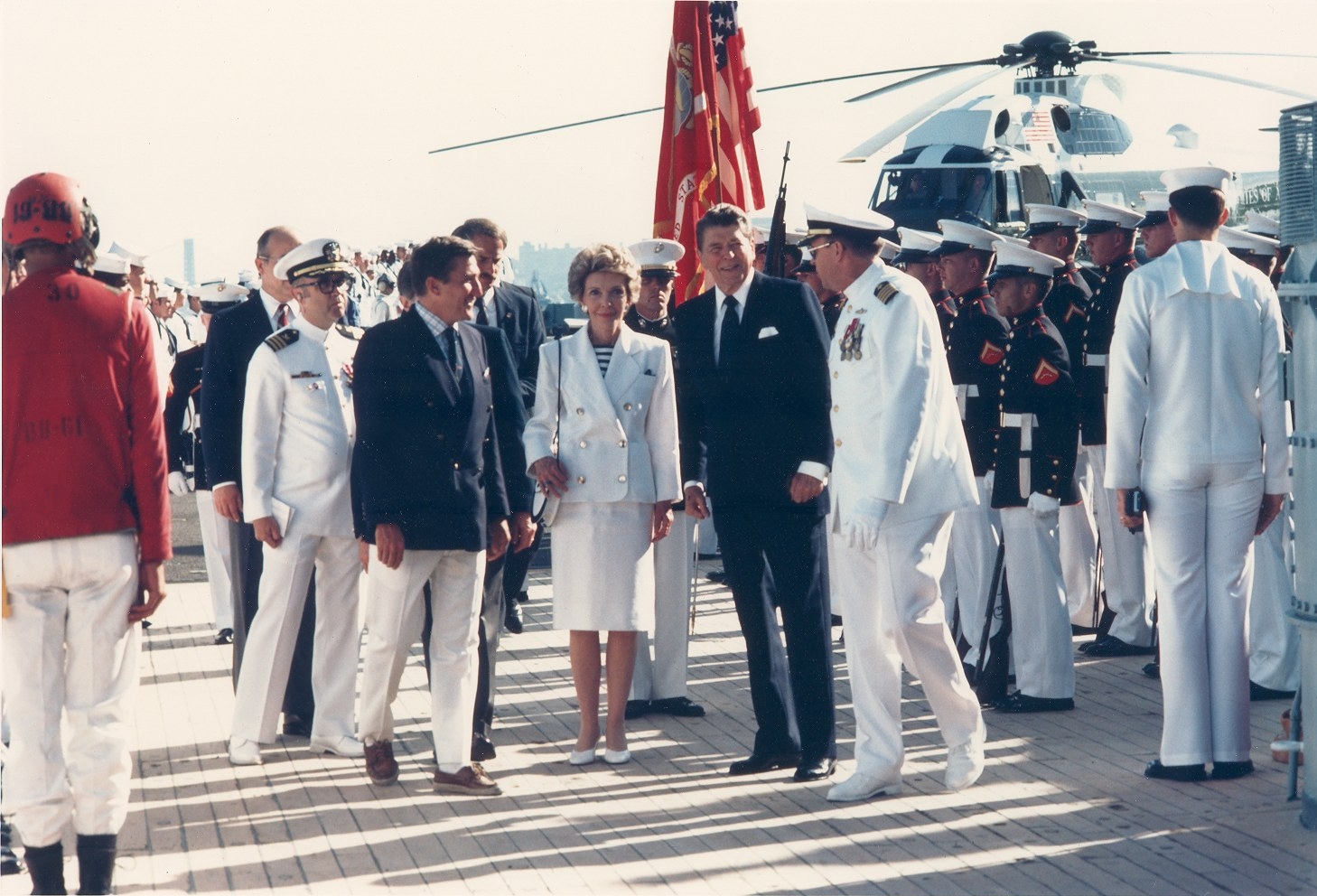
Navy Secretary John Lehman greeting President and Mrs. Reagan aboard the battleship Iowa for the 100th anniversary celebration of the Statue of Liberty on July 4, 1986 in New York Harbor. (U.S. Navy)
It is debatable whether the Maritime Strategy or the 600-ship goal would have done so well as separate entities. There were plenty of influential opponents to both including former CIA director and naval analyst Admiral Stansfield Turner, former Carter administration Undersecretary of Defense for Policy“Blowtorch” Bob Komer, and renowned University of Chicago political scientist John Mearsheimer. Despite the efforts of these individuals and others, the Maritime Strategy and the 600-ship navy endured until the collapse of the Soviet Union consigned both to the past in a post-Cold War era without a peer competitor.
The Current Strategic Foundation
The holiday from history of the last 25 years is over and it is time to get back to the business of properly preparing for global great power competition. A Trump administration 350-ship navy could be part of the process by which the U.S. operates in the new, post-Cold War world. Numbers alone, however, are vulnerable to cuts by analysts seeking the lowest common denominator navy. Likewise, naval strategies without specific ship counts and powerful civilian and uniformed leaders to explain them to Congress also tend to run aground on the shoals of Congressional analyses offices. As naval historian CAPT Peter Haynes, USN (ret) has suggested, “A strategy without a resource plan isn’t one.” Congress does not always understand or support naval strategy, and instead talks in terms of platform numbers and line items. The legislature will, however, support a given number if good strategic arguments are leveled in its support. Any new ship count proposed by the incoming Trump administration must be accompanied by a strong, well-articulated global maritime strategy.
Solid foundations already exist on which to construct a new maritime strategy. Chief of Naval Operations (CNO) Admiral John Richardson’s “Design for Maintaining Maritime Superiority” is the first step in that process. More than a mission statement, but less than a full strategy, it commands the Navy to:
“Make our best initial assessment of the environment, formulate a way ahead, and move out. But as we move, we will continually assess the environment, to ensure that it responds in a way that is consistent with achieving our goals. Where necessary, we will make adjustments, challenging ourselves to approach the limits of performance.”
CNOs have written such documents in the past. Admiral Kelso’s first foray into the post-Cold War era was entitled, “The Way Ahead,” a document co-authored with Marine Corps Commandant General Alfred Gray and endorsed by Navy Secretary H. Lawrence Garrett. It had a similar goal to Admiral Richardson’s guidance in that it exhorted its readers to, “maintain maritime superiority well into the 21st century,” and to accomplish this through, “our full range of skill and knowledge as practitioners of the art of naval warfare.” Finally, it suggested that, “The old excuse—‘Because that’s the way we’ve always done it’— no longer will do. We must work to shape and guide the forces of change in the direction that best serves the needs of our nation.” Clearly the “Design for Maintaining Maritime Superiority” and “The Way Ahead” both serve to inform the Navy that while the mission remains much the same, new challenges await and old methods of doing business may not work. The Navy must be able to adjust and do so boldly.
The current Navy “Cooperative Strategy for 21st Century Seapower”(CS21R) is a strong step toward a maritime strategy with operational warfighting components, a key element of the success of the 1980s Maritime Strategy. This document and its 2007 predecessor (CS21) both sought to describe the global commitment required by the U.S. to secure the global commons for safe and free trade. The 2015 version gave more detailed descriptions of force structure, specific forward locations required to achieve U.S. and Allied goals, and explicitly identified key competitors such as Russia and China.
Upgunning Strategy
What is required now is “the next step.” This new document should be a global maritime strategy that in the words of former U.S. Naval War College Dean of Naval Warfare CAPT Robert C “Barney” Rubel, USN (ret) would serve as “A contingent warfighting doctrine,” that proposes how the U.S. Navy will combat the “4+1” cohort of current and potential opponents across a global battle space.” The 1980s Maritime Strategy performed this role and laid out specific strategic and operational goals for U.S. Navy, Joint, and Allied forces in a global war against the Soviet Union, and all the phases of conflict leading to that eventuality. The Maritime Strategy cited national military strategy, regional command war plans, and specific Presidential national security directives as its core principles. It cited specific geographic objectives, Allied strategy, and specific war aims across the full spectrum of potential conflict with the Soviet Union. Later versions of the Maritime Strategy included contingency plans for operations against regional opponents that might not be mere Soviet surrogates. The level of detail within the 1980s Maritime Strategy crystalized the role of naval forces within the joint force, justified naval power within higher-level national security guidance, provided clear and consistent operational goals to guide war planning, and was unabashedly offensive in taking the fight to the enemy. These specific traits should animate the next maritime strategy.
Integrating the Joint Force
Such a strategic undertaking will likely be more challenging in the present era. The 1980s Maritime Strategy was largely produced before the passage of the Goldwater Nichols Act of 1986 that decreed all U.S. military operations were to be “joint” in character. While the Maritime Strategy was joint in design and execution and its drafting team included members from the other services in the latter 1980s, it was the frequent target of interservice criticism that accused the Navy of “going it alone” in its plan to wage global war against the Soviets. A new maritime strategy must be a joint one, but the other services must also recognize the differences between the 1980s and the present. There are no longer any large U.S. ground force formations deployed on hostile borders needing resupply as in the 1980s. While the seat of purpose may be on land and Eisenhower may have once proclaimed the end of separate ground, sea and air warfare in the future, those paradigms may be shifting. The existence of predominantely maritime hotspots such as the South China Sea, the Strait of Hormuz, and the waters of Yemen warrants innovative thinking in employing the joint force with specific attention on incorporating ground forces in maritime conflict.
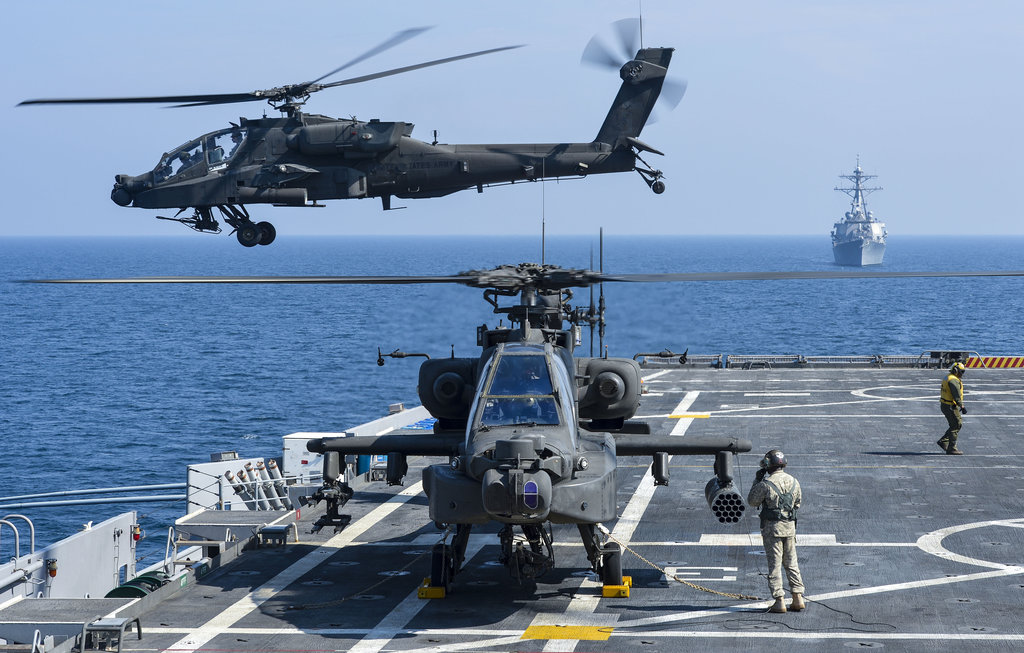
A U.S. Army AH-64D Apache helicopter takes off from Afloat Forward Staging Base (Interim) USS Ponce (AFSB(I) 15), during an exercise. (U.S. Navy photo by Mass Communication Specialist 1st Class Jon Rasmussen/Released)
Employment of U.S. ground forces is more likely to be part of a larger maritime operation as suggested by British strategist Sir Julian Corbett and more bluntly stated by British Foreign Secretary Sir Edward Grey who famously suggested that the British Army, “should be projectile to be fired by the Royal Navy.” PACOM commander Admiral Harry Harris has suggested the U.S. Army can support operations in the Pacific region by fielding land-based anti-ship missiles, a powerful capability that Russia and China already field in abundance and in forward locations. This image of U.S. Army coastal artillery “on steroids” would need to be balanced with larger national strategic needs that require an effective expeditionary ground warfare capability that includes both Army and Marine Corps units when needed. This changed vision of ground operations as auxiliary to war at sea must be considered in a new joint maritime strategy.
Strengthening Operational Alliances
Today’s opponents are a more diverse and capable group requiring an allied vice just a U.S. response. A 21st century maritime strategy would no doubt be a more complex document than its 1980s-era predecessor. The 1980s strategy dealt essentially with one opponent (the Soviet Union), while its 21st century cousin would have to assess multiple combinations of the 4+1 group across several different continuum of conflict. Different sets of active opponents would require differing desired outcomes and end states, as well as preparing for widely varying contingencies. The urgency of the threats posed by the U.S. 4+1 list of opponents might not also have the same urgency across allies and partners.
Still, there is great potential for global maritime strategic action. The recent US/UK/Japanese Trilaterial Maritime Talks resulted in an agreement where these three maritime powers, “Recognized this opportunity to strengthen maritime contributions for achieving mutually desired strategic effects,” (emphasis added). The United States and the United Kingdom already share one of the closest military relationships of any two independent sovereign states, where only British officers may fly F-18 Super Hornet strike missions and the Royal Navy’s “Perisher” submarine training course is the only non-U.S. curriculum eligible for qualifying U.S. Navy submarine commanders. This relationship might further develop in terms of global strategic cooperation with Britain and perhaps France providing a rotational aircraft carrier presence in support of a global Allied maritime strategy. The UK’s Royal Navy has already made a step in this direction with the opening of HMS Juffair, a naval installation in the Kingdom of Bahrain that marks the return of British naval installations in the Middle East after an absence of four decades.
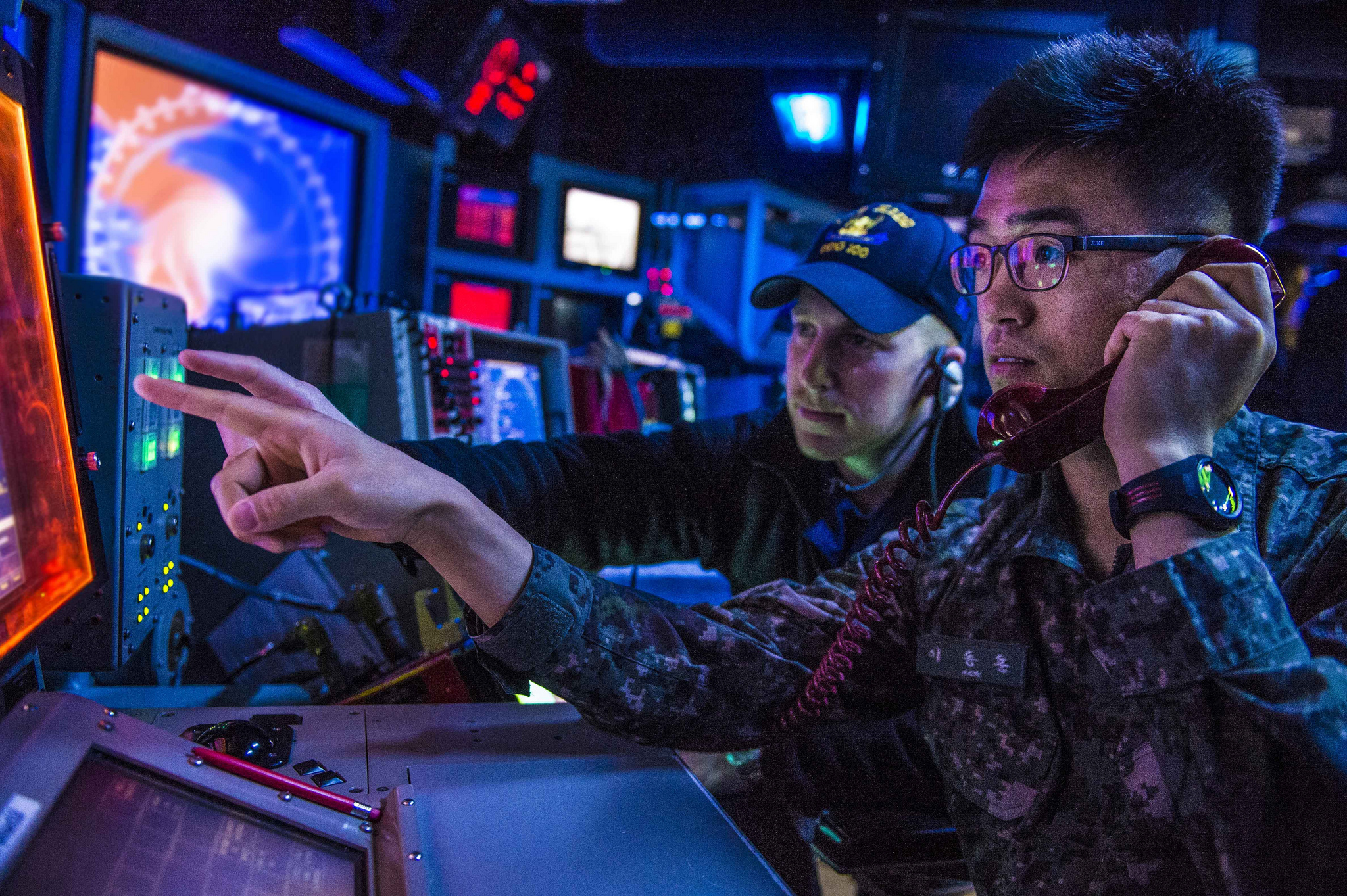
WATERS TO THE WEST OF THE KOREAN PENINSULA (July 17, 2014) Lt. Donghoon Lee, Republic of Korea Navy, right, and Lt. Vincent Simmon stand watch in the combat information center of the Arleigh Burke-class guided-missile destroyer USS Kidd (DDG 100) during bilateral operations. (U.S. Navy photo by Mass Communication Specialist 2nd Class Declan Barnes/Released)
No one state can effectively maintain the command of the commons necessary for free trade over maritime highways, and nothing will increase force structure faster than building meaningful operational relationships with allies. Maritime security was recognized as a global concern a decade ago in the U.S. 2007 Cooperative Maritime Strategy and general concepts like the “1000 ship navy” must evolve into operational and tactically competent formations.
The Global Maritime Partnerships initiative focused on performing constabulary missions such as maritime security, counterpiracy, and drug interdiction with a broad set of partners irrespective of capability. While undoubtedly valuable, this line of effort was devised in a time when great power competition was not so marked and partnership with less capable navies would not come at the expense of conventional deterrence. The emphasis should now shift towards honing high-end warfighting capabilities by strengthening interoperability with treaty allies. This could be accomplished through more frequent and complex joint exercises, technology transfers, wargaming, and increasing the proportion of officers from allied nations in international resident programs. This push for greater interoperability will support the incoming administration’s intent to increase allied burden sharing while still demonstrating tangible American commitment to alliances. These cooperative steps cited here are hopefully the first of many leading to the return of unified Allied maritime commands such as the Cold War-era Supreme Allied Commander, Atlantic (SACLANT).
Communicating Strategy
Navy Secretary John Lehman described strategy as, “The logical set of allocations and priorities that guide how the Navy Department spends its money and trains its people.” Lehman and the maritime strategy authors campaigned vigorously and effectively to further its goals and meet its requirements. Lehman published widely on the Maritime Strategy in print and defended it in media outlets. Uniformed officers took on critics and published extensive works on its genesis and evolution. These efforts continue into the present day long after Admiral Kelso retired the Maritime Strategy. A new document will likewise require an aggressive and comprehensive communications campaign across multiple formats including print, video, and digital outlets. It must educate a global audience and key decision makers on 21st century strategic geography, how naval power contributes to the national interest, and the need to protect the world-wide maritime trade routes that sustain not only U.S. but global economic prosperity and security.
Keeping it Affordable
The leadership of the 1980s navy was fortunate in that much of the technological advancement needed for the 600-ship navy such as the AEGIS system had been completed in the previous decade. Most of the 600-ship navy building programs had commenced before the passage of the Goldwater Nichols Act of 1986, enabling the service to have greater control and less bureaucratic interference in its overall maritime design. Recent defense reform efforts have identified excessive bureaucracy as an impediment to cost effective military platforms.
An expansion of the fleet today will be more challenging in that many fields of technological advance are still struggling toward maturity. The naval service has been somewhat neglected over the last 25 years in terms of maintenance and operational costs. Assessments such as the Balisle report of 2010 andmore recent examinations suggest the situation may not immediately improve. In addition, many new technologies and concepts such as electric drives, modular systems, greater automation and smaller crews remain operationally immature to a degree. Other emerging systems such as directed energy weapons and railguns are on the cusp of operational capability, but will require more funding and testing in order to join the fleet’s future arsenal. A new Maritime Strategy and associated force will need to navigate a series of choices from among these capabilities and decide which are “R&D rainbows” not worth producing, and which can become operational parts of the strategy-supporting force structure.
One of the most persistent claims leveled against the 1980s Maritime Strategy was that it was not “cost constrained” and assumed that a large and complex naval force could be sustained with limited funding. The Strategy and Assessments divisions of the OPNAV staff have been arguing this point for nearly half a century. Strategists argue for the importance of geography, history, and international relations as primary determinents for the development of successful naval policy. Their preferred force structures such as the 600-ship Navy of the 1980s respond directly to threat assessments and the geographic conditions that shape them. The analysis community often responds by suggesting that national resources do not support what the strategists wish to accomplish. They have advocated a policy of force structure and capability management over time as the best means of achieving a force that spends only what is absolutely required to achieve those goals. The 30-year shipbuilding plan is a product of this effort. The combined strategist/analyst composition of the newly formed N50 Strategy Division will serve as an excellent vehicle for wedding a new strategy to a new ship count and subsequently updated shipbuilding plan.
Conclusion
The election of Donald J. Trump to the Presidency of the United States represents a break with past policies as did that of Ronald W. Reagan in 1980 and offers the Navy an opportunity to make a fresh argument for a global warfighting strategy. Past U.S. joint force constructs that emphasized ground forces over naval forces are not as relevant as they were during the Iraq and Afghanistan wars at their heights. The present strategic situation suggests that the time is right for the U.S. Navy to come forward with a modern successor to the 1980s Maritime Strategy. The price tag for this endeavor will also have to be acceptable to the legislature and the public. The Navy must decide which of its emerging technologies and capabilities will be part of the strategy-supporting force and which will be cancelled or relegated to limited experimentation. The OPNAV staff is better organized now than in past decades to articulate and advance such a strategy. A 350-ship navy might be the right size to accomplish this goal, but it must have a strategy in close cooperation in order to convince Congress that 350 ships or even greater numbers are required. The incoming Trump administration should demand a global naval strategy to accompany its proposed increase in fleet strength in order to achieve its goal of a superior U.S. Navy.
Steve Wills is a retired surface warfare officer and a PhD candidate in military history at Ohio University. His focus areas are modern U.S. naval and military reorganization efforts and British naval strategy and policy from 1889-1941.
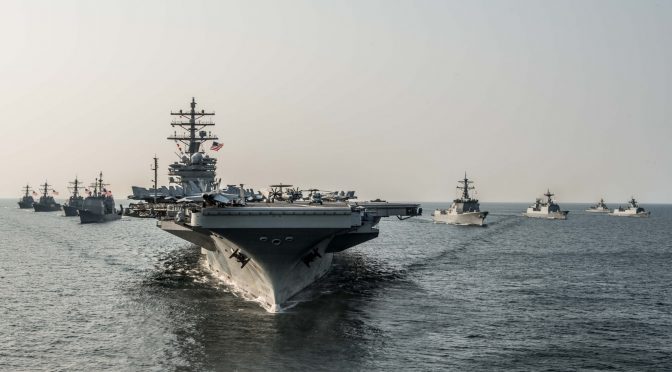
Featured Image: 161014-N-OI810-449 WATERS SURROUNDING THE KOREAN PENINSULA (Oct. 14, 2016) The Navy’s only forward-deployed aircraft carrier, USS Ronald Reagan (CVN 76), steams in formation with ships from Carrier Strike Group Five (CSG 5) and the Republic of Korea Navy (ROKN) during Exercise Invincible Spirit. Invincible Spirit is a bilateral exercise conducted with the ROKN in the waters near the Korean Peninsula, consisting of routine operations in support of maritime counter-special operating forces and integrated maritime operations. (U.S. Navy photo by Petty Officer 3rd Class Nathan Burke/Released)