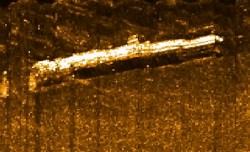
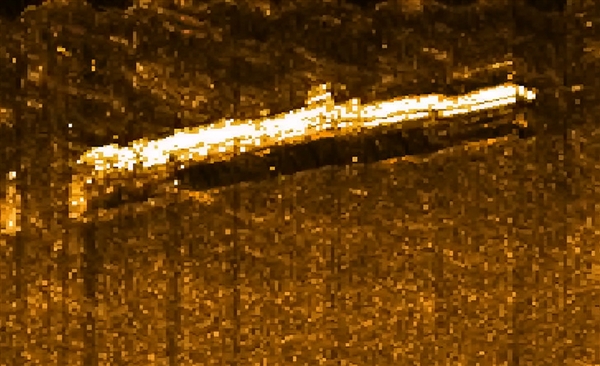
Side-scan sonar image of U-550 from GK Consulting & AWS Expeditions.
Divers using side-scan sonar on Monday found the wreck of U-550. This discovery is a reminder that the oceans that flank America, and have often shielded the nation from the direct wrath of enemies, are not impregnable.
NBC news provides an account of the naval action that sent the U-boat to the bottom:
On April 16, 1944, the U-550 torpedoed the gasoline tanker SS Pan Pennsylvania, which had lagged behind its protective convoy as it set out with 140,000 barrels of gasoline for Great Britain, according to the U.S. Coast Guard website and research by Mazraani.
The U-boat slipped under the doomed tanker to hide. But one of the tanker’s three escorts, the USS Joyce, saw it on sonar and severely damaged it by dropping depth charges.
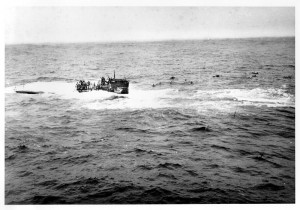
The Germans, forced to surface, manned their deck guns while another escort vessel, the USS Gandy, returned fire and rammed the U-boat. The third escort, the USS Peterson, then hit the U-boat with two more depth charges. The crew abandoned the submarine, but not before setting off explosions to scuttle it. The submarine hadn’t been seen again until Monday.
Crew of the U-550 abandon ship.
The American ships were destroyer escorts (DEs) of Escort Division 22 and manned by Coast Guard crews plus the Gandy, a Navy DE. The surviving German crew were taken to Great Britain.
This week the British Defence Secretary, Philip Hammond, announced a £1.1billion contract to build nuclear reactors for the next generation of British submarines that will replace the current Vanguard-class SSBNs. Though he stopped short of saying that this guaranteed Britain would renew Trident, with a formal decision due to be made in 2016, it is a clear step further in that direction, despite the divisiveness of the issue within both the government and national politics. The Conservatives’ coalition partners, the Liberal Democrats, are openly against renewal on cost grounds and are investigating alternative deterrent options. The Scottish National Party are ideologically opposed to the idea of weapons of mass destruction being present within Scotland, with the current Trident fleet based in Faslane, and with no alternative locations in England at present without huge financial and environmental expense. The issue is even more politically charged with a referendum on Scottish independence scheduled for 2014, where a yes vote would potentially torpedo Britain’s ‘independent’ nuclear deterrent. That is an issue in itself, with the missiles in essence leased from the United States.
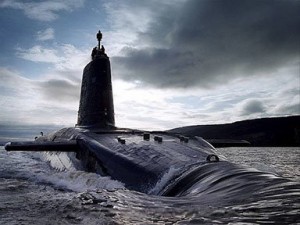
How will HMS Vanguard’s successor deter Somali piracy?
Britain’s ability to construct nuclear submarines is at least being safeguarded with this investment, which as my last post suggested was one of the tough choices the government had to make, and what industries it prioritsed in the national strategic interest. On the flip-side, who loses out? The Royal Navy is overwhelmingly in favour of Trident’s renewal, as the service would be indespensable to the missile’s deployment. But with tensions rising over the Falklands, the recent fishing dispute with Spain in Gibraltar, Somali piracy, and humanitarian atrocities being committed in Syria, surely what the RN needs right now is more surface ships. The Vanguards and their successors can’t help Britain with these current flashpoints, while the vessels that could make a difference, destroyers and frigates, have been cut down to just nineteen. There are forms of deterrence other than the nuclear kind, and a more visible naval presence in the world’s trouble spots could provide that, preventing problems from escalating to a point where intervention becomes a whole lot more costly, both financially and to human lives.
Dr Daniel Owen Spence is Lecturer in Imperial and International History at Sheffield Hallam University, United Kingdom, and publishes on nineteen and twentieth century maritime history.