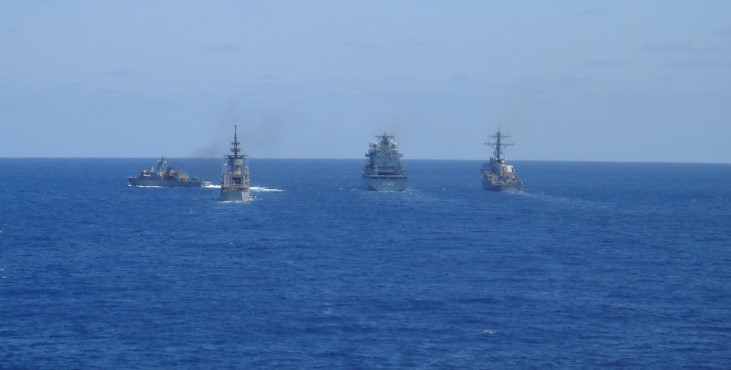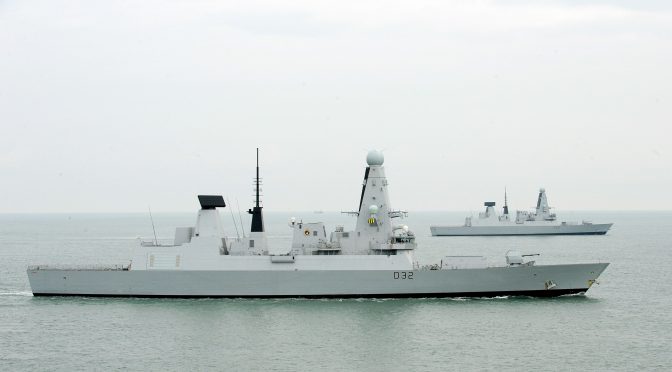
“I’ve engaged with heads of navies from around the world, upwards of 72 different countries, in the concept that I call a 1,000-ship navy. It’s a thousand ships of like-minded nations working together to get at the emerging challenges of weapons of mass destruction, terrorists, drugs, weapons, pirates, human trafficking and immigration. These are challenges we all have, and we need to work together to ensure that the sea-lanes are secure.” -Admiral Mike Mullen1
In 2006, U.S. Chief of Naval Operations, Admiral Mullen, put forward the idea of the navies of the world uniting to fight shared challenges to promote freedom of the seas. While today’s attention focuses more on great power competition and less on trans-national terrorism and piracy, the idea of like-minded nations fighting together for freedom of the seas remains.
The U.S. often fights wars as part of a coalition of like-minded states, and has frequently done so for over a century. The U.S. Navy has not fought a naval war alone since the Spanish-American-Cuban War of 1898. From the Boxer Rebellion to the War on Terror, the U.S. fights in conjunction with its allies and partners. The third theme of A Design for Maintaining Maritime Superiority 2.0 is, “The Navy fighting with the Joint Force and with our allies and partners will control the high end of maritime conflict.” High capability allies increase the lethality of U.S. forces. Allied forces can complement a carrier strike group (CSG) by providing additional air defense units, contribute ships and Marines to amphibious operations, and support Theater ASW with submarines, maritime patrol aircraft, and surface ships. Many allies also specialize in areas the US Navy is weak in, such as mine warfare.
Despite a lengthy pedigree of combined naval operations, the U.S. Navy must continue focusing on interoperability with allies. The U.S. Navy’s attention must remain firmly set on interoperability. It is a mindset that must be consistently reinforced by leaders and sailors operating in a combined environment. The operational staffs at CSGs and Destroyer Squadrons are vital to the successful execution of combined operations because they write the operational tasking messages (OPTASKs) and control the communications paths that enable our allies to fight with us. Without being able to communicate and operate together and understand the capabilities of allies, the U.S. Navy will not be able to take advantage of allied navy skills in a distributed environment.
Interoperability
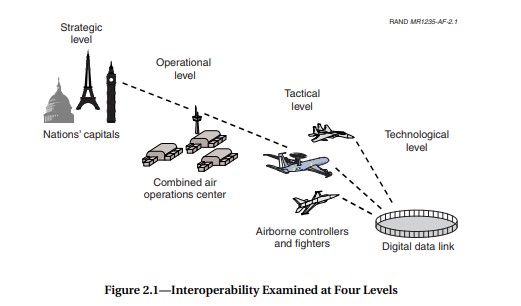
There are four types of interoperability: Strategic, Operational, Tactical, and Technological. Strategic Interoperability is durable relationships with partner nations, organizations like NATO, or Mutual Defense Treaty relationships in Asia. These high level agreements indicate shared mutual interests and a long-term desire to cooperate and determine that an operation is required. Operational Interoperability can be achieved through a myriad of ways: a combined fleet or dividing tasks and territory between nations to accomplish individually. Tactical Interoperability is operating ships or aircraft from different countries together, and the technological level is the data links, radars, or weapons that they utilize to accomplish their missions.
Understanding the capabilities and limitations of allied platforms is vital for effective use of those assets.2 Without an understanding of what partner units can do, both sides will be incredibly frustrated during the operation. The Allied Interoperability and Coordination Guide published by the NATO Combined Joint Operations from the Sea Center of Excellence gives specific examples of areas that have given combined forces problems during U.S. naval exercises. Unsurprisingly, many of those examples are communications related.
Four levels of interoperability (Interoperability A Continuing Challenge in Coalition Air Operations/RAND)
High-Capability Allies and Technological Interoperability
“Link-11 is for NATO because they’re cheap.” -SWO Lore
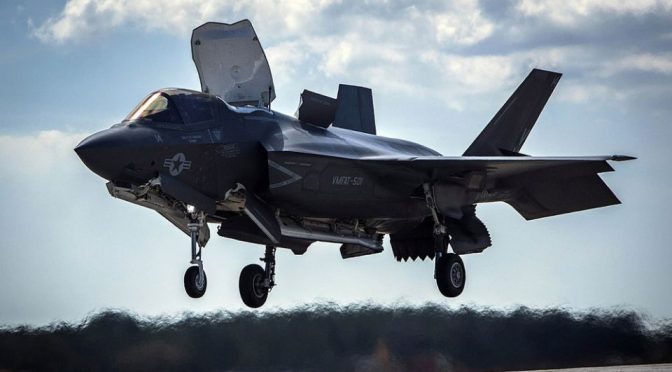
Today’s Allies have modern, capable warships. If one was reading Janes and saw “AEGIS Weapons System, SPY-1 Radar, SM-2 Missile, and Mk-41 Vertical Launching System (VLS),” one might assume that it was a U.S. Navy ship. But today, Japan, the Republic of Korea, Australia, Spain, Denmark, and Norway have warships with the AEGIS Weapons System, SPY-1 radars, and vertical launch cells. Italy, France, the United Kingdom, the Netherlands, and Germany all have ships that have similar combat system capabilities. These ships have Link-11, Link-16, and satellite communications. Over 18 nations operate the P-3 Orion, Australia and India operate P-8 Poseidons, and the U.K. is expected to deploy them by 2020. Nine nations’ navies and air forces are buying variants of the F-35 Lightning II aircraft. Between the new ships and the new planes, the U.S. and its allies are technologically interoperable. The main interoperability friction points are communications and doctrine.
Mexican, German, and US warships conduct Underway Replenishment during UNITAS 2009 (Author photo)
Because of defense budgets and population size, many U.S. allies expect to fight in a combined task force. For example, Denmark has deployed Iver Huitfeldt-class frigates in support of U.S. and French CSGs, and plans to do the same with the British. These ships have regularly made cooperative deployments with the United States Navy. These frigates have AEGIS and SPY and are capable air defense platforms. In 2013, another capable air defense platform, the FGS Hamburg made a cooperative deployment with the USS Dwight D. Eisenhower CSG in 2013, the first cooperative deployment for the Bundesmarine.3 The Spanish frigate Mendez Nunez is scheduled to deploy with the Abraham Lincoln CSG.4 Cooperative deployers go through their own domestic training cycle, followed with certification by the British Royal Navy’s Flag Officer Sea Training (FOST), before sailing to the United States to participate in a Composite Unit Training Exercise (COMPTUEX) and follow-on deployment.
Large scale exercises such as BALTOPS in Europe, KEEN SWORD and COBRA GOLD in the Pacific, and UNITAS in the Americas are a chance to flex all four levels of interoperability. The strategic aspect includes messaging that partner nations are resolved to work together and are ready and willing to fight tonight together. At the operational and tactical level, these exercises give navies a chance to train together, build relationships, and work through interoperability challenges. These relationships, established through frequent exercises, enable confidence in both forces’ ability to fight together. This trust is vital to teamwork and success in a future conflict.
Problems in Tactical Interoperability Communications
Tactical interoperability is the ability to communicate and operate together. The ability to communicate effectively is a complex, never-ending battle. HF, UHF, EHF, SHF, and VHF paths are favored by different nations for different missions and different nets. The U.S. military’s large satellite constellation enables the U.S. Navy to operate at sea with a focus on UHF, SHF, and EHF communications. This enables internet bandwidth which further enables the dominance of SIPR chat as a means of C2. The destroyer’s Tactical Action Officer (TAO) is inundated with chats in multiple chat rooms from higher headquarters expecting reports on everything from enemy actions to hourly potable water percentages or other minutiae. SIPR is a U.S.-only domain which precludes allies from participating. U.S. comfort in SIPR utilization means that oftentimes allies are left outside of the communications chain.
The U.S. also operates BICES and CENTRIX computer networks for use with allies, however there are fewer computers available aboard ship for use, which restricts the ability to operate those systems. This issue can be mitigated by focusing on voice communications. Some commanders utilize chat and then use voice when they remember to include their allies in the operation. This wastes time and sidelines allies, leading to frustration. It is better to utilize the radio nets instead of chat for C2. U.S. ships are used to operating a myriad of circuits simultaneously, but not all partner nation ships have the same capability to use a broad spectrum of circuits. Understanding the limitations of partner nation radio shacks to limit the number of circuits U.S. vessels use is important for designing stable and effective comms architecture.
Cryptographic keying material (crypto) is another major issue for successful communications. One cannot communicate effectively if the crypto is wrong. Different types of crypto rotate at different times and sailors have to understand the nuances of those rotations. As an example, during an operation, two U.S. ships and one allied ship were conducting an exercise. The two U.S. ships did not shift crypto when they were supposed to, but the allied ship did. That allied ship mysteriously fell out of the net and no one knew why. The two U.S. ships did not switch, and said it was the allied ship’s fault they dropped out because the two U.S. ships could still communicate. Eventually, it was realized that the two U.S. ships had not shifted crypto within periodicity, and once crypto had been shifted, comms were restored. This problem is more pronounced when operating with aircraft that cannot reload crypto until they return home which eliminates an asset from the operation.
The N6 community should focus on ensuring that OPTASK Comms are written with interoperability in mind. Ship’s radio shacks must be trained to seamlessly utilize allied crypto. When a ship drops communications, all ships in the squadron should verify that their settings are correct and not assume the other person is wrong. Most importantly, the staff should prioritize voice communications over chat. Emphasis on these things will enable the commander to turn an allied warship from a liability into a useful asset.
Operations
Once allies can communicate, it is time to operate together. Interoperability is a mindset. Commander’s intent can drive a CSG or DESRON to be interoperable. During exercises, the CSG and DESRON can demand that the training and doctrine commands, like Surface and Mine Warfare Development Center (SMWDC), ensure that their support during exercises is releasable to allies. The CSG and Destroyer Squadron must understand the capabilities and limitations of partner nation ships and aircraft and task them appropriately. Many naval vessels are multi-mission, however like most things, some ships are more appropriate for certain missions. A NATO air defense frigate with AEGIS that lacks a towed array sonar might be better suited as plane guard than part of an ASW search and attack unit.
U.S. forces are trained on U.S. publications such as Naval Tactical Techniques and Procedures (NTTP) and Naval Warfare Publications (NWPs). They typically receive less training on Allied Tactical Publications (ATPs). Yet NATO nations expect to fight as a unit and train from the ATPs. U.S. forces operate globally and tend to focus on their own doctrine which is similar to, but often slightly different from NATO doctrine. Part of this is a releasability issue. Since the U.S. partners with nations like Australia, Japan, and the Republic of Korea that are non-NATO countries, the U.S. needs doctrine it can release to them, but also doctrine that is the same in the Atlantic and Pacific Fleets. If OPTASKs are written using only U.S. doctrine it makes it more difficult to share with allied cooperative deployers. If a CSG has a cooperative deployer, it makes sense to utilize ATPs instead of NTTPs and ensure the OPTASKs are releasable to NATO, reducing the time required by short-staffed Foreign Disclosure Officers. The process of releasing critical information to cooperative deployers must be improved so that CSG staffs on deployment can rapidly transfer information required for day-to-day operations to allies.
OPTASKs can be written from ATPs or U.S. publications. The CSG’s OPTASKs should be written early enough for U.S. and allied ships to train to them. ATP-based OPTASKs will require adjustment for the U.S. ships, but will seamlessly incorporate any allied ships for operations on deployment. U.S. ships are supposed to utilize allied publications and procedures when operating with NATO allies; the commander should ensure that his OPTASKs are written to follow that.
U.S. Arleigh Burke Flight IIA warships lack Harpoon missiles and a significant surface strike capability. Most NATO frigates that are equipped with Harpoon or Exocet can provide additional missiles for the surface fight. The Danish Iver Huitfeldt-class frigate carries 16 Harpoon missiles, the equivalent of two U.S. cruisers or FLT I DDGs combined. This large quantity of Harpoons greatly eases the salvo sizes required for successful engagements. The U.S. Navy needs to ensure that once new Distributed Maritime Operations concepts, C4I processes, and techniques are developed, they are released to regular NATO cooperative deployers like Denmark, the Netherlands, Germany, France, Spain, Italy, and the United Kingdom so that coalition assets strengths can be utilized.
The Korean Theater of Operations provides an interesting confluence of interoperability. The U.S. Navy regularly works with the ROK Navy and is interoperable with them, but in the event of a war, United Nations Command expects 11 United Nations Sending States – nations including European nations, Australia, Thailand, and the Philippines – to contribute forces to the campaign. Currently there are few opportunities for European and ROK navies to train together. There are occasional passing exercises (PASSEXes) in CTF 151 and the occasional Tri-lateral Exercise when a European ship passes through the KTO or a Korean ship visits Europe, but those opportunities rarely stress complex interoperability issues like communications and tactical data links.
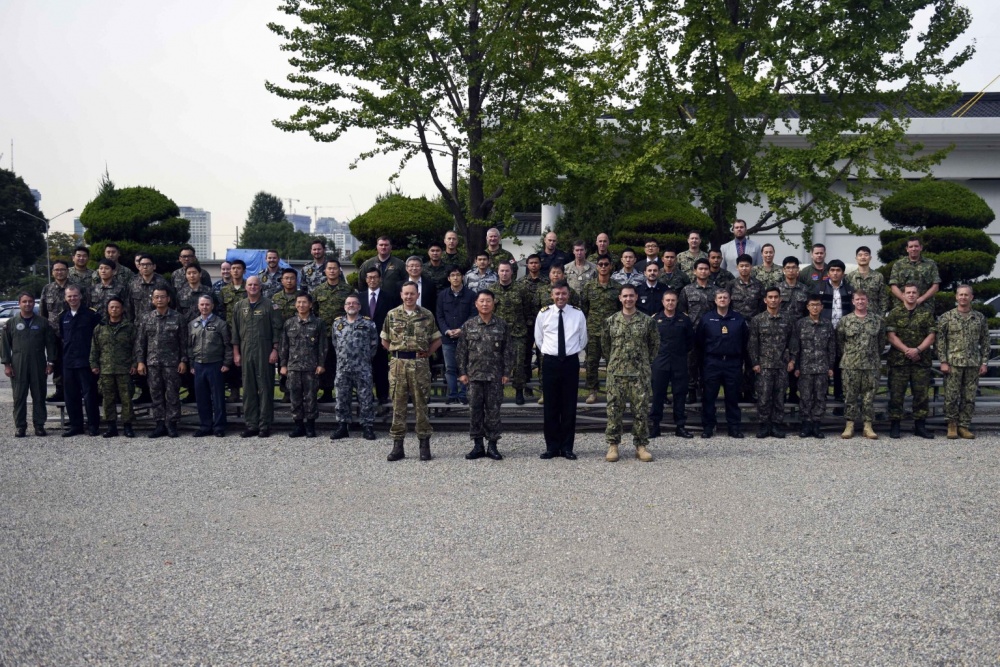
SEOUL, Republic of Korea (Oct. 11, 2016) More than 80 mine-warfare specialists from 12 nations including the U.S. and Republic of Korea (ROK) pose during a break at the annual Mine Countermeasure Warfare Symposium in Seoul. (U.S. Navy photo by Petty Officer 2nd Class Jermaine M. Ralliford)
There has not been much discussion over what doctrine will be used, including NATO Allied Tactical Publications or U.S. doctrine, and how to incorporate nations like the Republic of Korea, Thailand, and the Philippines. One area where the United Nations Command has been successful in incorporating U.N. Sending States is mine warfare. Since 2014, the U.S. and ROK Navies, and United Nations Sending States have come together to conduct mine countermeasure exercises familiarizing themselves with the local conditions and operating as a coalition. As United Nations Command ramps up that exercise, the doctrine and releasability aspects will hopefully solve themselves, however one must identify issues to solve it.
Conclusion
As fleet sizes around the world decline, Admiral Mullen’s thousand ship-navy vision becomes more important and CSGs composed of coalition partners will become more common. Since many U.S. allies operate the same or similar aircraft and ships, these coalitions are technologically interoperable, but tactical and operational interoperability starts with the commander and his intent. As the U.S. Navy creates new C4I systems and tactics, they need to be rapidly released to close partners to ensure the continued interoperability of naval forces. With good communications and releasable tactics, these nations can make excellent contributions to the fight. Without emphasis on partner nations’ interoperability, the U.S. Navy will waste valuable assets, and eventually receive fewer coalition assets on deployment.
LT Jason Lancaster is an alumnus of Mary Washington College and has an M.A. from the University of Tulsa. He is currently serving as the N8 Tactical Development Officer at Commander, Destroyer Squadron 26. The above views are his own and do not reflect the position of the Navy or Department of Defense.
Bibliography
1. U.S. Navy. Office of the Chief of the Naval Operations, “Speeches” http://www.navy.mil/navydata/cno/mullen/speeches/mullen060519-kqv.txt (accessed 31JAN19)
2. Hura, Myron, Gary W. McLeod, Eric V. Larson, James Schneider, Dan Gonzales, Daniel M. Norton, Jody Jacobs, Kevin M. O’Connell, William Little, Richard Mesic, and Lewis Jamison, Interoperability: A Continuing Challenge in Coalition Air Operations. Santa Monica, CA: RAND Corporation, 2000. https://www.rand.org/pubs/monograph_reports/MR1235.html (Accessed 31JAN19).
3. Gorman, Tim, Hamburg First German Ship to Deploy in U.S. CSG, 3Apr2013. https://www.navy.mil/submit/display.asp?story_id=73121 (Acessed 31JAN19).
4. NATO, Allied Interoperability & Coordination Guide Version 1.0, November 2018.
5. Richardson,John M, A Design for Maintaining Maritime Superiority Version 2.0, December 2018.
6. Gause, Kennth, U.S. Navy Interoperability with Its High End Allies, Alexandria VA, Center for Naval Analyses, October 2018, https://apps.dtic.mil/dtic/tr/fulltext/u2/a468332.pdf (Accessed 31JAN19).
7. Jean-Gilles, Jacques,Carrier Strike Group Twelve Welcomes Spanish Frigate Mendez Nunez to Naval Station Norfolk, 14Jan2019, https://www.dvidshub.net/news/307019/carrier-strike-group-12-welcomes-spanish-frigate-mendez-nunez-naval-station-norfolk, (accessed 16FEB19).
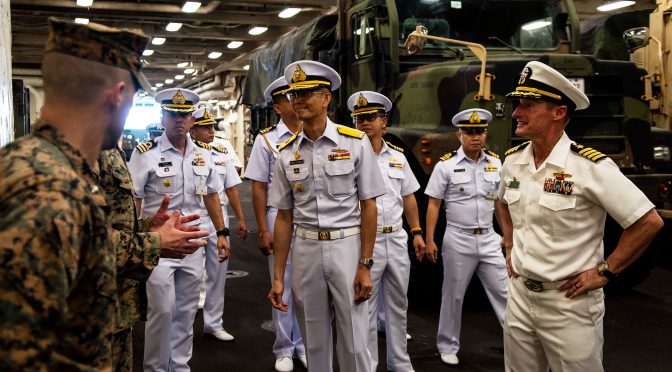
Featured Image: SATTAHIP, Thailand (Feb. 10, 2019) – Marines assigned to the 31st Marine Expeditionary Unit (MEU) discuss vehicle capabilities with Royal Thai Navy Rear Adm. Chatchai Thongsaard, Commander Amphibious and Combat Support Service Squadron, during a ship tour. (U.S. Navy photo by Mass Communication Specialist 2nd Class Anaid Banuelos Rodriguez) 190210-N-DX072-1037
Join us for the latest episode of Sea Control for a conversation with Vice Admiral Lutz Feldt (ret.), former Commander-in-Chief of the German Fleet and Commander-in-Chief of Naval Staff, about the challenges of defining and conceptualizing maritime security.
A transcript of the interview between Admiral Lutz Feldt (LF) and Roger Hilton (RH) is below. The transcript has been edited for clarity.
RH: Admiral Feldt, in addition to the previous discussion, you have said to enhance maritime awareness it is essential to return to the basics of geography. According to renowned geopolitical author Robert Kaplan, a map is a spatial representation of humanity’s division, by which he means not just physical territory but topography. Let me ask: with so much advanced technology providing satellite imagery and real time data, why should we consider the influence of geography?
LF: To answer with a question, are we overestimating all of our technical development? Are we really reliant only on technical information, the internet, etc.? Are we able to take into consideration other important criteria as well? Geography is a big criteria, even today. If you look into geography, you are looking at the people living in that geography, to the culture which is their culture, the weather conditions, the climate, and how people live. This has great importance and great influence on everything which we have to decide in the maritime domain. Therefore I think if you are working together with people from the Southern parts of Europe region, or German authorities to ones in Spain, Italy, South France, Greece, or Turkey, or whatever country you may name, of course the way they are solving problems is different. And this has something to do with the areas in which they live, and the living conditions.
The living conditions are formed and created by geography, and directly and indirectly by the climate conditions in which they live. So I think it is important to look into the geography as well. As a seafarer, even if you believe in civilized navigation, even if you think a satellite is covering the whole globe, you must still learn that that is not the case. It will not happen in the next decade as well. So there will always be areas which are not covered. There will always be areas which are up to today, which have not a reliable a sea map, a sea shot. If you go into the big regions, the only thing you can rely on is the GPS. This makes it very clear that geography and the conditions created by geography are very important. Weather affects all operations. You can have a wonderful operation plan think you have thought through, if you have forgotten the geography of the weather, it is a risk you should not accept.
RH: Admiral Feldt, now that we have looked at a catalogue of issues that have impacted sea awareness, it is critical for our listeners to place these subjects in the role of global stakeholders. Obviously the headlines on this ticket are the NATO and the EU. You distinguish in your piece the remarkably different approaches to issues. Consequently, can you provide a quick snapshot of activities of global stakeholders in the maritime space?
LF: I think we have to talk about the international maritime organizations as well. I always think and call them the guardians of the sea, and they have developed a lot of very helpful legislation for the sea. They are responsible for all the agreements and they have developed a code of conduct for a limited number of countries. So I think yes it is a lot of administrations, a lot of paperwork. On the other hand you need these basic documentation, you need this framework in which you are doing your business as a commercial in which you have to follow the sovereign estate as well.
I think the International Maritime Organization is an important player. The weakness of the IMO that they cannot enforce their own laws. They have no enforcement capabilities and the only nation who is able to enforce the IMO’s laws and other laws is the United States and it will remain to be the United States. Maybe in competition with some other nations, China is trying very hard to become a very important global player in the maritime domain as well as the Russian Federation. I understand very well why they are doing that. I wouldn’t blame them about that, but we have to take into consideration they will in any case be in some sort of competition with the U.S. The U.S. needs a global strategy, maritime strategy, and a naval strategy, this is a comprehensive approach that works very fine.
And then of course we have the European Union. NATO is the North Atlantic Treaty Organization, it was focused on the North Atlantic. During the last years, NATO was much more involved in army and air force business than in the naval business. This is something that I do not appreciate because now we have a lack of maritime expertise which we have to overcome quite soon. The EU is becoming a much more important player, not just in civilian issues, but also in the economic side, from a common defense and security policy side as well. I think the EU will increase its military experience, and NATO will be much more open, civilian-military operations as well. The African Union has developed an all-maritime strategy for the African continent. They are a regional initiative. They have the potential to become a very important player as well. I think they should be interested in taking responsibility for their own territorial waters and increase their independence from others.
And then we have what we did call the BRICS, Brazil, Russia, India, China, South Africa. China will be a big player, and already is a big player, and will become an even bigger player in the maritime domain. Brazil has for the first time taken on international responsibility in supporting the European navies in the Mediterranean several times for example. Russia is looking for naval bases outsides its territories. Now they are in Syria, it has the occupation of Crimea, not only because they love the people there, but because of a very strategic impact in now having an important naval base in the black sea. So they are all playing to their national interests. The only ones who are trying to improve not only its own capabilities but of its neighbors as well is South Africa. They have a good navy as well. They can support the navies in developing their own coast guards and to a certain degree their naval functions as well.
RH: Anyone listening will get a perspective on how crowded the maritime domain is and how competitive it potentially is both from a bloc perspective or from an individual country perspective. Returning to the EU, its early security ambitions were defined by 2003 European Security Strategy: A Secure Europe in a Better World by the EU’s common representative for the common foreign and security policy, Mr. Javier Solana. It was more recently amended in 2008 and paid scant attention to the maritime situational awareness. This is particularly frustrating since this piece establishes how crisis can develop far from Europe and still affect continuity on the continent. Moving forward, has the EU addressed this phenomenon?
LF: Yes, it has. I think in 2003, the world, not just the maritime domain, looked very different from nowadays. Strategy: A Secure Europe in a Better World, updated in 2008, has been overtaken by events. The EU has developed a newer strategy in a very good way. Everyone was involved in that. It took us only three-quarters of a year. We have a new strategy which is a very good build up, taking an important part of security and defense issues in the strategy, which was not the case in the first.
Now I think it is a comprehensive approach. To deliver something of a comprehensive approach, where all the actors know their responsibilities, and knowing that they don’t have to do this on their own in one pillar, in isolation from the other, they are doing this together. Strategy is encouraging them to do that. Perhaps encouraging is not strong enough; it is forcing them to do that. And therefore I really appreciate this approach. You know, in the maritime world, 2014, the European Maritime Security Strategy has been published as well. We have now, not only a global strategy from the European Union side, but maritime strategy as well. We are now working on the implementation of the different subjects. I think that in a good way, a lot of things have been moved in the right direction and I am optimistic that they will carry on. And if I may say so, the commission, the parliament, and the council, they are doing very well. They are doing this in one line.
RH: Any conversation about EU maritime policy or maritime policy will be incomplete without mentioning Turkey and its role in facilitating EU’s maritime sphere. Recently president Erdogan called for a border review of the 1923 treaty of Rozanne in Athens in early December. What do you make of this comment, and how do you think Turkey and the EU can continue to work together on maritime domain issues?
LF: It’s a critical situation. Turkey is a member of NATO, and wants or once at least wanted to become a member of the European Union as well. Greece is a member of NATO and the EU. All these years, all these decades, there has been tension between both countries about sea borders and how the treaty is working. Even in the treaty there are disputes over islands and sea borders. This is a fact. I do not think that in the actual situation the border review will take place. I do not think so. The last signals were bit different. There is another convention we have to consider. This is the Montreux convention which is giving Turkey the responsibility to supervise or monitor the Montreux Strait. You have to look into this as well. Both are very close together.
The EU and Turkey are well-advised if they are accepting of the status quo, or improve the situation. To talk about improving, there is an ongoing operation between NATO and Turkey, as a NATO member, and Greece on the other hand, in the East part of the Mediterranean and the Aegean Sea. The part of the maritime civil operations where everyone is looking for migrants, not only to rescue them, but to prevent them from going illegally from one country to another. And the cooperation of the partners in these technical operations level is very good. I have heard from colleagues in this operation, the cooperation with the Turkish coast guard is good. They are doing their jobs professionally and well, and the same with Greece. It is good practical example of good practical cooperation. As often you can find on the practical, pragmatic level, you can find solutions for almost all problems.
RH: Hopefully based on all the encouraging news you’ve provided with us cooler heads will continue to prevail as there are a plethora of issues that the EU and Turkey need to work together on to solve in the future. Finally Admiral Feldt, for the foreseeable future, you reiterate, the complex picture of today’s maritime security issues, is a consequence of three factors: the transition from industrial to the information age, globalization, and climate change. And that the urgent need for maritime domain and situational awareness is a precondition to achieve good governance at sea. Having spoken about sea blindness already, would you count on those leading to take these issues into effect in policy?
LF: I think the first point, the transition from industrial to information age, I think this is a big challenge. This is nothing you can just do automatically. Switching from the industrial to the information age takes time. This issue is not just for the younger generation, it is an issue for my generation and even for those who are little bit younger than I am. A lot of people are still making the assessments and adjustments based on the procedures and experiences that were right and good in the industrial age but which is now overtaken in the information age. And the information age is more than the internet. The social networks are a very important part. The fact that in the information age a hack can be done by a hacker where nobody knows where he’s from, whether it’s his boss telling him now you have to hack the German parliament, or now you have to hack a big company in France or whatever, no one really knows that in the very beginning.
It’s not just the use of the internet and all the advantages which you can take out from networking. This is the second point. Networking is becoming more important. Networking happens all the time. But it’s not only the internet. It’s also the information age as a whole new environment. Think about new technologies and the impact of the industry, all that development and our naval units where you are reliant on the computer system. These all need new thinking. A new mindset. This is very difficult to achieve. It takes time to be aware that not everybody is able or willing to follow you, but this is the real thing. So it’s a big challenge. The challenge is not the technology, the challenge is to understand and to use the new technology to your advantage.
Globalization is an effect, it’s now under pressure again. I always think that there are no ideas without bad sides, and there are bad sides to globalization as well. Maybe the government has to look into that more carefully, but if we go back to nationalist thinking, then we of course are doing the wrong thing, a very dangerous thing. The clear historical experience that nationalism is in the direction of something we do not want. Certain kinds of own interests is always not only acceptable but necessary, and the real impact is that you have to look for your national interest on one hand, but on the other hand balance them with the international interests as well. If you are not able or willing to do that then you are a danger.
Climate change is something very much related to globalization and the change of information age as well. We do not know the final impact of climate change. We only can think about they will change the maritime domain. This will have an impact on everything. The issues and the outcome of climate change, there is only one solution, and this is to prioritize the protection of our maritime domains. Protection of the oceans and the protection of the maritime domain in relation to climate and everything belonging to that, from biodiversity to clean oceans and whatever you may name it, this has a high priority. And it is not a task done by the civilian authorities, the navy must be included as well. They have a responsibility to report and monitor climate protection as well. This is very new to the navy, other things as well, but there is an urgent need to do that. Climate change and the negative sides of climate change are a real challenge. They are a threat.
RH: Admiral Feldt, I want to thank you on behalf of the listeners for such a comprehensive analysis and sobering judgment of the current state of affairs. As we dawn on another sea control podcast, Admiral, do you have any quick operational takeaways for the listeners, or issues related to maritime domain we should keep tabs on?
LF: If you are interested, take some keywords and go into the internet, or even look into the publications. It’s not just Robert Kaplan who publishes a lot of things. There are a lot of authors and scientists who are publishing a lot about the maritime domain and the complexity and they are not only good for students, but for normal people as well. There are sometimes scientists who are able to write in a way everyone can understand it. The awareness is the first method for my side. The second side is that the cooperation and trust and confidence between the different maritime services must be supported as a citizen of my country. I cannot understand that for example how customs is not able to communicate with the navy without taking some risks due to data protection. Data protection is very important, but if data protection is hindering us in providing safety and security, than it has to be questioned.
A lot of people are talking about legal obstacles, who are talking about what we want to do but the law is against us, this is eight out of ten times not the case. They often use the law as shelter not to do something. This is something where citizens must be able to carefully be able to increase security internal and external security in a much more professional way; we are open to information exchange. The internal and external security issue is something which is very crucial thing as well, we have not touched upon that, but it is a very important. You cannot separate internal and external security any longer. And if you do so, you must accept the risk, and you must explain to your citizens why you are doing this, with all the consequences.
My third point is if you love the sea, if you are in favor of the sea, if you are really knowing about the sea, not only from the coast but from the ocean as well, it is much more easier to understand the complexity as well as overcome the challenges. It was a great pleasure for me, thank you very much.
RH: Admiral Feldt, I would say in conclusion, if our listeners want to follow up on the European or international maritime domain, the Routledge Handbook of Naval strategy and Security, edited by Sebastian Bruns and Joachim Krause and published in 2016 is an indispensable resource to have. In addition, please visit www.kielseapowerseries.com for more info on the book and other podcasts derived from the book.
With no shortage of maritime issues in the greater geopolitical landscape, I will be back to keep CIMSEC listeners informed and up to date. From the Institute of Security Policy and its adjunct center for strategy and security, I am Roger Hilton saying farewell and auf wiedersehen.
Vice Admiral Lutz Feldt (ret.) served in the German Navy for 38 years and served as Commander-in-Chief of the German Fleet and Commander-in-Chief of Naval Staff. Since retiring in 2006, Vice Admiral Feldt has taken over several different posts of honor: he was the President of the German Maritime Institute, Bonn, from 2007 to 2012 and is now a member of the Board of the German Maritime Institute, a member of the “Bonner Forum”of the German Atlantic Association; from 2005 until March 2010 he was a member of the advisary board of the “Evangelische ilitärseelsorge”(evangelical miltary religious welfare) and he is still a member of the advisary board of the publication “Schiff und Hafen”, an International Publication for Shipping and Marine Technology. He is director of WEISS Penns International.
Roger Hilton is from Canada and a graduate of the Diplomatic Academy of Vienna where he holds a Master’s Degree in Advanced International Studies. He has previous experience at the Office of the State Minister of Georgia for European and Euro-Atlantic Integration as well as with the delegation of the Kingdom of Belgium at the Organization for Security and Co-operation in Europe. Since 2017 he is a Non-Resident Academic Fellow at the Center for Maritime Strategy & Security at the Institute for Security Policy at Kiel University in Germany. His research publications concentrate on transatlantic affairs and the post-Soviet sphere.
Cris Lee is Senior Producer of the Sea Control podcast.
Over the last few years, the Russian Federation pursued an increasingly assertive foreign policy in Eastern Europe. Geopolitical infringements on Crimea and Eastern Ukraine are coupled with hybrid warfare and aggressive rhetoric. The buildup and modernization of the Russian armed forces underpins this repositioning and Russia has taken major steps in increasing its conventional and nuclear capabilities.
The significant rearmament of its Western exclave Kaliningrad requires special attention.1 The recent buildup of Russian A2/AD forces in Kaliningrad, coupled with increasingly assertive behavior in the Baltic Sea, poses a serious challenge for European naval policy. Should Russia make active use of its sea denial forces, it could potentially shut down access to the Baltic Sea and cut maritime supply lines to the Baltic states. The full range of Russia’s A2/AD capabilities in Kaliningrad comprises a wide array of different weapon systems, ranging from SA-21 Growler surface-to-air missiles2 to a squadron of Su-27 Flanker fighters and another squadron of Su-24 Fencer attack aircrafts3 that can be scrambled at a moment’s notice to contest Baltic Sea access.4 German naval capabilities to counter the SS-C-5 Stooge anti-ship missile system,5 Russia’s mining of sea lanes, and its attack submarines are of particular interest in retaining Baltic sea control.
Russian A2/AD Systems
The K300 Bastion-P system includes in its optional equipment a Monolit-B self-propelled coastal radar targeting system.6 This radar system is capable of, according to its manufacturer, “searching, detection, tracking and classification of sea-surface targets by active radar; over-the-horizon detection, classification, and determination of the coordinates of radiating radars, using the means of passive radar detection and ranging.”7The manufacturer further states that sea-surface detection with active radar ranges up to 250 kilometers under perfect conditions, while the range of sea surface detection with passive detection reaches 450 kilometers.8
With regard to its undersea warfare capabilities, the Russian Baltic Fleet currently only operates two Kilo-class submarines. Of these diesel-powered submarines, only one is currently operational with the other unavailable due to repairs for the foreseeable future.9 However, the entire Russian Navy’s submarine fleet is currently undergoing rapid modernization and the Baltic Fleet will receive reinforcements consisting of additional improved Kilo-class submarines.10 Despite the fact that the Baltic fleet remains relatively small in size, these upgrades amount to “a level of Russian capability that we haven’t seen before” in recent years.11
With its formidable ability to float through waters largely undetected and versatile missile equipment options capable of attacking targets on water and land, the Kilo-class presents a serious threat to naval security in the region.12 In fact, its low noise level has earned it the nickname “The Black Hole.”13
The Baltic Sea is relatively small in size and has only a few navigable passageways that create chokepoints. Therefore, it resembles perfect terrain for the possible use of sea mines.14 While often underestimated, sea mines can have a devastating impact on naval vessels. Affordable in price and hard to detect, they can be an effective area-denial tool if spread out in high quantities.15 Russia still possesses the largest arsenal of naval mines, and according to one observer, Russia has “a good capability to put weapons in the water both overtly and covertly.”16 The versatility of possible launch platforms, ranging from full-sized frigates to fishing boats, makes an assessment of current capabilities in Kaliningrad a difficult endeavor.
A Possible Scenario for Russian A2/AD Operations in the Baltic Sea
Given Russia’s long-term strategic inferiority to western conventional capabilities, a realistic scenario will bear in mind that Russia is not interested in vertical conflict escalation. Instead, it is primarily interested in exploiting its temporary regional power superiority.17 Thus, its endgame will not be to destroy as many enemy vessels as possible, but rather to send a signal to opponents and deter them from navigating their ships east of German territorial waters as long as needed.18 Ultimately, A2/AD capabilities only have to inflict so much damage to make defending the Baltic States appear unattractive or too costly to decision makers, especially if those measures can create the perception of Russian escalation dominance.19
Russia is very inclined to use means that offer plausible deniability, to possibly include sea mines.20 The Baltic Sea is still riddled with sea mines from both World Wars21 and if Russia manages to lay sea mines undetected, it can make the argument that any incidents in the Baltic Sea involving sea mines were simply due to old, leftover mines instead of newly deployed Russian systems.
Should measures to deploy sea mines in the Baltic Sea fail, Russia may consider use of a more overt, multi-layered approach to sea denial. We can expect that a realistic scenario will feature a mixture of above-mentioned approaches that include submarine warfare as well as the use of anti-ship missiles. Russia could also make use of its naval aviation assets and other missile capabilities stationed in Kaliningrad.
Strategic Implications and NATO’s Interests
It is difficult to interpret the deployment of these weapon systems and missiles as anything different than an addition to Russia’s A2/AD capabilities. Russia is actively trying to improve it strategic position to deter possible troops movements on land as well as on the water.22 They mirror Russia’s claims to its sphere of influence in Eastern Europe and serve as an example of Russia’s attempts to exert authority over its periphery, effectively giving Russia the potential to deny access to the Baltic Sea east of Germany.
If Russia increases its A2/AD capabilities in the Baltic Sea, it complicates NATO’s access to the Baltic states during a potential crisis. This is especially startling due to the fact that NATO troops are currently stationed in the Baltics and cutting off maritime supply routes would leave those troops extremely vulnerable. If Russia can effectively cut off NATO’s access to the Baltic states, it increases the “attractiveness to Russia of a fait-accompli.”23 Ben Hodges, then-commanding general of the United States Army in Europe, shared these concerns: “They could make it very difficult for any of us to get up into the Baltic Sea if we needed to in a contingency.”24 In case regional states will be called to fulfill its alliance commitments in the Baltic Sea, Russian submarine blockades, along with mining and missile deployments, will be a major roadblock and possibly threaten safe passage for European vessels.
NATO has an immense national interest in maintaining freedom of navigation in the Baltic Sea and ensuring free access. On average, 2,500 ships are navigating the Baltic Sea at any time and its shipping routes are vital to European economic activity.25 In the 2016 German Defence White Paper, this is clearly identified: “Securing maritime supply routes and ensuring freedom of the high seas is of significant importance for an exporting nation like Germany which is highly dependent on unimpeded maritime trade. Disruptions to our supply routes caused by piracy, terrorism and regional conflicts can have negative repercussions on our country’s prosperity.”26 Thus, if Russia impedes freedom of navigation in this area with its A2/AD capabilities, it will significantly damage Germany’s and other European nations’ export potential. However, vulnerabilities are not limited to shipping routes but also include the Nord Stream gas pipeline and undersea cables upon which a large part of European economies depend.27
A map of the Nord Stream infrastructure project (Gazprom)
In sum, Russia’s A2/AD systems, along with updated submarine capabilities and the potentially disastrous effects of disrupted undersea pipelines and communication cables, enhance Russia’s strategic position and makes hybrid warfare a more realistic scenario. This kind of instability would have serious security and economic implications for NATO.
Recommendations
Should the Baltic Sea fall under de facto authority of the Russian Federation or witness conventional or hybrid conflict, then NATO would face dire economic consequences and live with a conflict zone at its doorstep. This is especially concerning given the poor state of Germany’s naval power in particular. The German Navy lacks most capabilities that would qualify it as a medium-sized navy, and its strategy is mostly agnostic of a threat with significant A2/AD capabilities just East of its own territorial waters.28 Since it is in Germany’s vital interest to maintain freedom of navigation in the Baltic Sea and plan for a potential use of Russian A2/AD capabilities, the German Navy should shift its operational focus to the Baltic Sea. Having outlined the means through which Russia can deny access to the Baltic Sea, specific recommended actions can follow.
Effectively countering the effects of anti-ship missiles stationed in Kaliningrad requires two measures. First, it requires the German Navy to equip its ships and submarines with standoff strike capabilities that enable them to engage Russian radars and anti-ship missiles from outside their A2/AD zone.29 In practice, this requires the procurement of conventional long-range land-strike capabilities for the German Navy. To this day, the entire German fleet lacks any form of long-range land-attack weapon for both surface vessels and submarines.30 Second, if the German Navy has to operate within Russia’s A2/AD environment, it should equip its surface ships with more advanced electronic warfare countermeasures that disrupt sensing and enable unit-level deception.
Russia’s submarines are traditionally hard to detect, but they can be countered by Germany’s own class of 212A submarines. Those feature better sonars and are even quieter, giving them an advantage over Russia’s submarines.31 However, in order to fully exploit this advantage, Germany has to do a better job of committing resources to the maintenance of its submarines as all six of its active submarines are currently not operational due to maintenance.32
German Type 212A submarine U-32. (Bundeswehr/Schönbrodt)
A large part of the effectiveness of anti-mine operations hinges on preemptive detecting. If Germany and other NATO allies can catch Russia in the act of laying mines, it will actively decrease the possible damage those mines can do to vessels in the future and thus their effect on sea denial.33 It can do so by increasing its sea patrols in the region. These patrols can include minimally armed vessels such as the Ensdorf and Frankenthal classes in order to avoid incidental confrontations and to assume a non-threatening stance toward Russia. If preventive action fails, Germany should be ready to employ a NATO Mine Countermeasure Group in order to clear as many mines as possible and to ensure safe passage of ships.
Conclusion
The buildup of forces on Russia’s Western border is paired with a more aggressive stance by the Russian military. Over the last months, the Baltic Sea became “congested” with Russian military activity, leading to increasingly closer encounters.34 In April 2014, an unarmed Russian Su-24 jet made several low-passes near a U.S. missile destroyer, the USS Donald Cook in the Baltic Sea.35 Later in 2014, a small Russian submarine navigating in Swedish territorial waters spurred a Swedish military buildup along its coast due to “foreign underwater activity.”36 And during July 2017, Russia conducted joint naval exercises with China in the Baltic Sea. By conducting a joint naval drill with China in these waters, the Russian military demonstrated strength and flexed its military muscle in a message specifically directed at NATO.37 These actions by the Russian military all point toward conveying the message that Russia does not want the presence of foreign militaries in Baltic Sea waters and is capable of taking countermeasures to exert its sovereignty in the region.
Tobias Oder is a graduate student in International Affairs at the Bush School of Government and Public Service at Texas A&M University. He focuses on international security, grand strategy, and transatlantic relations
References
[1] “The Baltic Sea and Current German Naval Strategy,” Center for International Maritime Security, last modified July 20, 2016, accessed September 22, 2017, https://cimsec.org/baltic-sea-current-german-navy-strategy/26194.
[2] Also known as S-400 Triumf.
[3] “Chapter Five: Russia and Eurasia,” The Military Balance 117, no. 1 (2017), 183-236.
[4] “Entering the Bear’s Lair: Russia’s A2/AD Bubble in the Baltic Sea,” The National Interest, last modified September 20, 2016, accessed September 24, 2017, http://nationalinterest.org/blog/the-buzz/entering-the-bears-lair-russias-a2-ad-bubble-the-baltic-sea-17766?page=show.
[5] Also known as K-300P Bastion-P.
[6] “K-300P Bastion-P System Deliveries Begin,” Jane’s, last modified March 5, 2009, accessed November 20, 2017, https://my.ihs.com/Janes?th=janes&callingurl=http%3A%2F%2Fjanes.ihs.com%2FMissilesRockets%2FDisplay%2F1200191.
[7] “Monolit-B,” Rosoboronexport,, accessed November 20, 2017, http://roe.ru/eng/catalog/naval-systems/stationary-electronic-systems/monolit-b/.
[8] Ibid.
[9] Kathleen H. Hicks et al., Undersea Warfare in Northern Europe (Washington, D.C.: Center for Strategic and International Studies, 2016).
[10] Karl Soper, “All Four Russian Fleets to Receive Improved Kilos,” Jane’s Navy International 119, no. 3 (2014).
[11] “Russia Readies Two of its most Advanced Submarines for Launch in 2017,” The Washington Post, last modified December 29, 2016, accessed September 23, 2017, https://www.washingtonpost.com/news/checkpoint/wp/2016/12/29/russia-readies-two-of-its-most-advanced-submarines-for-launch-in-2017/?utm_term=.2976db8c1710.
[12] “The Kilo-Class Submarine: Why Russia’s Enemies Fear “the Black Hole”, The National Interest, last modified October 23, 2016, accessed November 21, 2017, http://nationalinterest.org/blog/the-kilo-class-submarine-why-russias-enemies-fear-the-black-18140.
[13] “Silent Killer: Russian Varshavyanka Project 636.3 Submarine,” Strategic Culture Foundation, last modified July 14, 2016, accessed November 21, 2017, https://www.strategic-culture.org/news/2016/07/14/silent-killer-russian-varshavyanka-project-636-3-submarine.html.
[14] Stephan Frühling and Guillaume Lasconjarias, “NATO, A2/AD and the Kaliningrad Challenge,” Survival 58, no. 2 (April-May, 2016), 95-116.; Alexander Lanoszka and Michael A. Hunzeker, “Confronting the Anti-Access/Area Denial and Precision Strike Challenge in the Baltic Region,” The RUSI Journal 161, no. 5 (October/November, 2016), 12-18.; Hicks et al., Undersea Warfare in Northern Europe.
[15] “Sea Mines: The most Lethal Naval Weapon on the Planet,” The National Interest, last modified September 1, 2016, accessed November 21, 2017, http://nationalinterest.org/blog/the-buzz/sea-mines-the-most-lethal-naval-weapon-the-planet-17559. In fact, even a small number of sea mines have the capability to disrupt marine traffic due to the perceived risk of a possible lethal encounter (Caitlin Talmadge, “Closing Time: Assessing the Iranian Threat to the Strait of Hormuz,” International Security 33, no. 1 (Summer, 2008), 82-117.).
[16] “Minefields at Sea: From the Tsars to Putin,” Breaking Defense, last modified March 23, 2015, accessed November 21, 2017, https://breakingdefense.com/2015/03/shutting-down-the-sea-russia-china-iran-and-the-hidden-danger-of-sea-mines/.
[17] Frühling and Lasconjarias, NATO, A2/AD and the Kaliningrad Challenge, 95-116, 100.
[18] Lanoszka and Hunzeker, Confronting the Anti-Access/Area Denial and Precision Strike Challenge in the Baltic Region, 12-18 Specifically, commentators outline various scenarios that all share the basic notion that the ultimate goal is to deny NATO forces access to its eastern flank (“Anti-Access/Area Denial Isn’t just for Asia Anymore,” Defense One, last modified April 2, 2015, accessed November 20, 2017, http://www.defenseone.com/ideas/2015/04/anti-accessarea-denial-isnt-just-asia-anymore/109108/).
[19] Andrew F. Krepinevich, Why AirSea Battle? (Washington, D.C.: CSBA, 2010). For a more detailed discussion of potential Russian escalation dominance, see David A. Shlapak and Michael W. Johnson, Reinforcing Deterrence on NATO’s Eastern Flank (Santa Monica, CA: RAND Corporation, 2016); “Demystifying the A2/AD Buzz,” War on the Rocks, last modified January 4, 2017, accessed September 24, 2017, https://warontherocks.com/2017/01/demystifying-the-a2ad-buzz/.
[20] Rod Thornton and Manos Karagiannis, “The Russian Threat to the Baltic states: The Problems of Shaping Local Defense Mechanisms,” The Journal of Slavic Military Studies 29, no. 3 (2016), 331-351. The idea behind plausible deniability states that Russia will only make use of means to disrupt Western forces if they cannot explicitly trace their origins back to Russia and that they cannot hold Russia accountable for these actions. This, in turn, leads to insecurity among NATO allies and prevents the alliance from taking collective action.
[21] “German Waters Teeming with WWII Munitions,” Der Spiegel, last modified April 11, 2013, accessed November 25, 2017, http://www.spiegel.de/international/germany/dangers-of-unexploded-wwii-munitions-in-north-and-baltic-seas-a-893113.html.
[22] Martin Murphy, Frank G. Hoffman and Gary Jr Schaub, Hybrid Maritime Warfare and the Baltic Sea Region (Copenhagen: Centre for Military Studies (University of Copenhagen), 2016), 10.
[23] “The Russia – NATO A2AD Environment,” Center for Strategic & International Studies, last modified January 3, 2017, accessed September 23, 2017, https://missilethreat.csis.org/russia-nato-a2ad-environment/.
[24] “Russia could Block Access to Baltic Sea, US General Says,” Defense One, last modified December 9, 2015, accessed September 23, 2017, http://www.defenseone.com/threats/2015/12/russia-could-block-access-baltic-sea-us-general-says/124361/.
[25] Frank G. Hoffman, Assessing Baltic Sea Regional Maritime Security (Philadelphia: Foreign Policy Research Institute, 2017), 6.
[26] Federal Ministry of Defence, White Paper on German Security Policy and the Future of the Bundeswehr (Berlin: Federal Ministry of Defence, 2016), 50.
[27] Murphy, Hoffman and Schaub, Hybrid Maritime Warfare and the Baltic Sea Region.
[28] Bruns, The Baltic Sea and Current German Naval Strategy.
[29] Andreas Schmidt, “Countering Anti-Access/Area Denial: Future Capability Requirements in NATO,” JAPCC Journal 23 (Autumn/Winter, 2016), 69-77.
[30] Hicks et al., Undersea Warfare in Northern Europe.
[31] Hicks et al., Undersea Warfare in Northern Europe.
[32] “All of Germany’s Submarines are Currently Down,” DefenseNews, last modified October 20, 2017, accessed November 21, 2017, https://www.defensenews.com/naval/2017/10/20/all-of-germanys-submarines-are-currently-down/.
[33] Talmadge, Closing Time: Assessing the Iranian Threat to the Strait of Hormuz, 82-117, 98.
[34] “Russian Warships in Latvian Exclusive Economic Zone: Confrontational, Not Unlawful,” Center for International Maritime Security, last modified May 15, 2017, accessed September 23, 2017, https://cimsec.org/russian-warships-latvias-exclusive-economic-zone-confrontational-not-unlawful/32588.
[35] “Russian Jet’s Passes Near U.S. Ship in Black Sea ‘Provocative’ -Pentagon,” Reuters, last modified April 14, 2014, accessed September 23, 2017, https://www.reuters.com/article/usa-russia-blacksea/update-1-russian-jets-passes-near-u-s-ship-in-black-sea-provocative-pentagon-idUSL2N0N60V520140414.
[36] “Sweden Steps Up Hunt for “Foreign Underwater Activity”,” Reuters, last modified October 18, 2014, accessed September 23, 2017, https://www.reuters.com/article/us-sweden-deployment/sweden-steps-up-hunt-for-foreign-underwater-activity-idUSKCN0I70L420141018.
[37] “Russia Says its Baltic Sea War Games with Chinese Navy Not a Threat,” Reuters, last modified July 26, 2017, accessed September 23, 2017, https://www.reuters.com/article/us-russia-china-wargame/russia-says-its-baltic-sea-war-games-with-chinese-navy-not-a-threat-idUSKBN1AB1D6.
Featured Image: Russian troops load an Iskander missile. (Sputnik/ Sergey Orlov)
This analysis was produced as part of the Naval Academy Foreign Affairs Conference, held in April of 2017. Since that time, Montenegro has officially joined NATO.
By Kirk Wolff
Introduction
There is no sugarcoating it: Russia’s continued aggression in Eastern Europe is not only reckless and a violation of international norms, but is illegal. In the invasion of Georgia and the annexation of Crimea, Russia showed complete disregard for the sovereignty of its neighbors and violated multiple treaties to which Russia is a party, including the 1994 Budapest Memorandum. Under the Budapest Memorandum, Russia agreed to never use force against or in any way threaten the territorial integrity of Ukraine.1 It is clear Russia is no longer following international laws, even those it helped establish. Vladimir Putin’s desire to reclaim the perceived glory of the Soviet Union has manifested itself in illegal invasions of weaker neighbors. These actions have been met with responses from much of Europe and the United States that were, at best, toothless. The Russian Federation’s aspiration to expand its borders and sphere of influence into former Soviet states and satellites poses a great threat to the stability of Europe and has already caused instability and military buildup in Eastern Europe. Putin has never hidden his desire to restore the USSR, the dissolution of which he referred to as “the greatest geopolitical catastrophe of the 20th Century.”2
NATO and Russian Pressures
Consequently, the international system is now witnessing the single most important moment in NATO’s history since the collective response to the 9/11 attacks. It is clear that continued sanctions in the vein of visa bans and asset freezes are no longer adequate responses to Putin’s actions. In order to stave off further illegal expansion by an emboldened Russia, NATO must swiftly expand to include Finland and Sweden. Deciding not to expand NATO to include these Nordic States would represent a complete failure to learn the lessons of the last decade, which occurred as a result of the rejection of Ukraine and Georgia’s attempts to join NATO. This proposed 7th expansion of NATO would include Montenegró, which has recently earned acceptance from Alliance member states.3 There is no better way to contain Russia than through expanding the alliance, the most effective collective defense organization in history and the historical counterbalance to Russo-Soviet expansionism.
Russian troops ride atop armoured vehicles and trucks near the village of Khurcha in Georgia’s breakaway province of Abkhazia. (Associated Press)
Prior to and throughout the invasions of Georgia (2008) and Ukraine (2014), Russia telegraphed its intention to regain its former status as a great power. After the dissolution of the Soviet Union, the Russian military fell from around 5 million troops to roughly 1 million in 19944 and the capacity of those 1 million troops to exert Russian influence was questionable. Since that time, Russia’s military strength has experienced a revitalization, bringing the current number to over 3 million troops.5 The Russian military budget has increased by a factor of 5 since 1994, with a 91 percent boost in spending from 2006 to 2016.6 This boost in military spending and size transformed the Russian Armed Forces from a fledgling that could only muster around 60,000 troops to put down a Chechen rebellion in 19947 to its current status as a resurgent world superpower that successfully used covert military forces to annex an entire region of its sovereign neighbor Ukraine in 2014. Through his reforms following the 2008 invasion of Georgia, Vladimir Putin has orchestrated a spectacular comeback for Russia in a region where the nation lost almost all of its influence a quarter century ago.
The question of why Georgia and Ukraine were targeted specifically is answered by the failure of NATO to offer either nation a Membership Action Plan following the April 2008 Bucharest Summit despite the pursuit of admission to the Alliance by both states.8 It is likely that Putin was greatly relieved by this shortsighted decision by NATO, as his plans for Russian expansion were no longer threatened by NATO’s collective defense pledge. It only took four months for Russia to invade the former NATO-hopeful Georgia, in what is referred to as the first European war of the 21st Century.9 There is a reason the invocation of NATO’s collective defense measure, otherwise known as Article 5, has only occurred once in history, and that it was prompted by the actions of rogue non-state actors on 9/11. The full backing of NATO’s member states maintains peace at a level unseen in history by guaranteeing a costly counterattack to actions like the invasions of Georgia and Ukraine. It is critical for NATO to learn from the mistakes of the Bucharest Summit and prevent further destabilization of Europe by accepting both Finland and Sweden into the Alliance posthaste.
The Grand Strategy of Russian Resurgence
The United States and NATO have been operating without a grand strategy since the fall of the Soviet Union, and consequently, Russia has implemented its own grand strategy that takes advantage of this stunning lack of action by the West. Russia is clearly, though not officially, following the grand strategy laid out in the Foundations of Geopolitics by Alexandre Dugin. The book has had a considerable impact on Russian foreign policy and was adopted as an official textbook at the Russian equivalent of the U.S. Naval War College, where senior officers and government officials receive graduate degrees related to policy.10 Major points of the work include (among other goals) separating England from Europe, dismantling Georgia, and annexing Crimea,11 all of which have been at least partially accomplished through Russian pressure, overt or otherwise. Not only have the arguments laid out in Dugin’s work been mirrored by Russian policy, but Dugin has even been made a major foreign policy advisor to the Putin regime12 and enjoys considerable influence and contact with the parliament and military.13 One major goal listed in the plan that has yet to be accomplished is the annexation of Finland. This, along with continued aggressive actions against Finland, shows that there is an imminent threat to Finland from Russia. If Finland fails to act quickly to join NATO, it is likely to be next in line for Russian expansion, in partial fulfillment of Dugin’s grand strategy for resurgent Russia.
Russian T-26 light tanks and T-20 Komsomolets armored tractors advancing into Finland during the Winter War, 2 Dec 1939.
In both Finland and Sweden, support for accession to NATO has been growing due to the aftermath of the annexation of Crimea. Russia has significantly ramped up operations and drills in the vicinity of Finland to such a degree that both Finland and Sweden are actively seeking new defensive agreements with western nations including the U.K. and U.S.14 Multiple Russian jets have violated Finnish airspace, further showing Russia’s disregard for the sovereignty of any of its neighbors.15 Additionally, Russia has been working to increase Finland’s dependency in order to further pull it into Russia’s economic and political sphere of influence. One such attempt involves energy, where Russia is attempting to undermine the Finnish energy sector and even create an artificial energy crisis which would drive Finland to rely heavily on Russian government and energy firms.16 Like Georgia and Ukraine, Finland was once part of Russia, and such historical ties were used as justification for both of Putin’s illegal invasions.1718 In fact, the Winter War of 1939 was started by Russia in an attempt to reabsorb Finland; it resulted in Russian territorial gains from Eastern Finland.19 Based on the recent Russian actions in Georgia and Ukraine, it is not outside of the realm of possibility for Russia to make another attempt to regain Finland. Sweden has felt the increased pressure from Russia as well, as evidenced by the extreme step the Civil Contingency Agency of Sweden took in December 2016 of telling towns to reinitiate Cold War era counter-invasion measures, including bunker systems and military drills.20 All of this represents a return to the great power conflict of the Cold War. Additionally, this demonstrates the clear and present threat to both Finland and Sweden from Russia that NATO would best solve.
The Current State of Partnership
Convincing the people of Finland of the necessity of NATO membership appears to be reliant on Sweden agreeing to join simultaneously. Support for a military alliance with Sweden is high, with 54 percent of Finns supporting such an alliance in 2014 while only 36 percent oppose21, so the people of Finland could be persuaded to support NATO if their friend Sweden agrees to join as well. That same year, Gallup found that 53 percent of Finnish citizens would support joining NATO if the government of Finland recommended the move.22 Since Finland already recognizes the importance of a military alliance with Sweden, it clearly can be convinced of the necessity of NATO as well. In Sweden, support of NATO membership has been on the rise. For instance, in 2015 the Centre Right Party joined two other major Swedish political parties to support NATO membership after having previously opposed the measure,23 which further indicates the political tides of the nation are turning in support of NATO. Not only is the move towards membership a necessity for these two nations, but it is also entirely within the realm of possibility in the near future.
Both Finland and Sweden have been longtime members of the Partnership for Peace (PfP)24, a NATO program which aims to build stronger relationships with non-Alliance members.25 Participation in the PfP is often seen as a pathway to membership since so many current NATO members were originally part of the PfP. This is crucial, because under Article 10 of the treaty all members must be unanimously confirmed; the fact that Finland and Sweden are already contributing to the collective defense of NATO shows that they would be valuable assets to the Alliance. Both Finland and Sweden sent troops to support NATO actions in Afghanistan, and Sweden was part of NATO’s 2011 mission in Libya.26 Due to their willingness to participate in operations, Finland and Sweden are clearly military assets to NATO, thus clearing the collective defense hurdle of NATO.
Despite this, neither nation could take on Russia alone. Swedish military experts found that if attacked by Russia, the nation could only hold out for one week27, further highlighting the need for NATO to step in and prevent another Crimean crisis. Opponents of NATO enlargement may argue that Sweden and Finland fail to meet the requisite military spending requirement of the Alliance, which is 2 percent of GDP. This is irrelevant for two reasons. First, it is far more important to keep Russia in check and have nations remain in America/NATO’s sphere of influence than to worry about the arbitrary 2 percent requirement. Demanding Sweden and Finland to increase their spending before joining will not create any measurable increase in NATO’s military effectiveness, as the U.S. spends around $650 billion dollars on defense.28 The next closest Alliance member spends a mere 60 billion dollars.29 It could be reasonable to require that both nations set a goal of reaching the 2 percent threshold within a decade, but the situation in Europe is too precarious to hesitate on such a minor issue. The true goal of NATO is maintaining the post-Soviet world order through the maintenance of the current spheres of influence.
The second reason the 2 percent requirement is irrelevant is the fact that only 5 of the 28 members currently meet the requirement. Based on publicly available military budget information, of the 28 NATO members, Finland outspends 14 before even joining and Sweden outspends Finland as well. Allowing Russia to continue to destabilize all of Europe because Finland and Sweden fail to meet a standard that over 80 percent of current NATO members also fail to meet is shortsighted.
Conclusion
For Finland, Russia’s western neighbor, the stakes are quite high. Putin has made multiple threatening statements in opposition to NATO enlarging to include Finland. These statements should be disregarded, as an identical scenario played out almost a decade ago in Georgia and recently in Ukraine. As mentioned earlier, Putin publicly opposed Georgia and Ukraine joining NATO, and shortly after NATO decided not to include the two nations, both were invaded by Russia’s military. The only way to secure the stability of Northern Europe is through the accession of Finland and Sweden into NATO, since this provides the closest thing to a guarantee against Russian intrusion, as admitted by Russia’s foreign minister Sergei Lavrov who said in 2016 that Russia “will never attack a member state of NATO.”30
There is a choice for NATO currently: either allow Russia to expand its sphere of influence even beyond the bounds of the former USSR into the Nordic States, or learn from the examples of Georgia and Ukraine by blocking expansionism through a 7th enlargement of the Alliance. We are clearly in a new era of great power conflict, and for their own safety Sweden and Finland must join their Nordic neighbors under the collective defense shield of NATO. NATO must recognize the dawn of this new era and learn the lessons of Crimea. The move to add Finland and Sweden to NATO is not only plausible, but entirely necessary to safeguard the stability and peace that Europe has enjoyed since the fall of the USSR.
Midshipman Kirk Wolff is from Morristown, Tennessee and is studying political science as a member of the U.S. Naval Academy Class of 2018. He can be contacted at wkirkwolff@gmail.com.
The author would like to thank Dr. Gale Mattox at USNA for her help.
References
[1] Organization for Security and Co-operation in Europe (OSCE). Budapest Memorandums on Security Assurances. 1994.
[2] Ellen Barry and Steven Myers. “Putin Reclaims Crimea for Russia and Bitterly Denounces the West.” New York Times, March 18, 2014.
[3] Edward Joseph and Siniša Vuković. “Montenegro’s NATO Bid.” Foreign Affairs, December 22, 2016.
[4] Dmtri Trenin,. “The Revival of the Russian Bear.” Foreign Affairs, May & June 2016.
[5] “Russian Military Strength.” Global Firepower. 2016.
[6] Sam Perlo-Freeman, Aude Fleurant, Pieter Wezeman, and Siemon Wezeman. “Trends in World Military Expenditure, 2015.” SIPRI Fact Sheet- Stockholm International Peace Research Institute, 2016, 4.
[7] Trenin, The Revival of the Russian Bear
[8] Adam Taylor. “That time Ukraine tried to join NATO — and NATO said no.” Washington Post, September 4, 2014.
[9] “Post-Mortem on Europe’s First War of the 21st Century.” Centre for European Policy Studies Policy Brief, no. 167
[10] John Dunlop. “Aleksandr Dugin’s Foundations of Geopolitics.” Demokratizatsiya: The Journal of Post-Soviet Democratization, no. 41 (January 31, 2004): 1.
[11] Ibid., 2-8.
[12] Henry Meyer and Onur Ant. “The One Russian Linking Putin, Erdogan and Trump.” Bloomberg, February 2, 2017.
[13] Dunlop. Aleksandr Dugin’s Foundations of Geopolitics. 12.
[14] Julian Borger. “Finland says it is nearing security deal with US amid concerns over Russia.” The Guardian, August 22, 2016.
[15] Tuomas Forsell and Jussi Rosendahl. “Estonia, Finland say Russia entered airspace before U.S. defense pact.” Reuters. October 7, 2016.
[16] Rebecca Flood. “Finland warns Russia is becoming ‘more aggressive’ with nuclear power threat.” The Express UK, September 1, 2016.
[17] “Russia moves toward open annexation of Abkhazi, South Ossetia.” Eurasia Daily Monitor 5, no. 74. April 18, 2008.
[18] Barry. “Putin Reclaims Crimea for Russia and Bitterly Denounces the West.”
[19]“The Soviet-Finnish War, 1939-1940.” Military Review, July 1941, 1-16.
[20] “Swedish towns told to ‘make preparations regarding the threat of war and conflict’ with Russia.” The Telegraph, December 15, 2016.
[21] “Majority of Finns back Swedish military union.” The Local. March 24, 2014.
[22] Verkkouutiset explained: The people willing to join NATO, if the state leadership so wishes.” Verkkouutiset. March 25, 2014.
[23] “Swedish centre right in favour of NATO membership.” Reuters. October 9, 2015.
[24] “Signatures of Partnership for Peace Framework Document.” NATO. January 10, 2012.
[25] “Partnership for Peace programme.” NATO. April 7, 2016.
[26] Gabriela Baczynska. “Wary of Russia, Sweden and Finland sit at NATO top table.” Reuters. July 8, 2016.
[27] Suvi Turtiainen. “Sweden and Finland Face Their Russian Fears.” Die Welt (The World, German). April 9, 2014.
[28] Ivanna Kottasova. “These NATO countries are not spending their fair share on defense.” CNN.com. July 8, 2016.
[29] Ibid.
[30] “Just Visiting: Russian aggression is pushing Finland and Sweden towards NATO.” The Economist, July 7, 2016.
Featured Image: Soldiers from Estonia, Latvia, Lithuania, the U.K. and the U.S. conduct a convoy June 10 into the field-training portion of Exercise Saber Strike. (Latvian MoD/Gatis Diezins)