Tag Archives: featured

Flotilla Sitrep: USMC Transformation, Offensive Mining, Winged Luddites

By Dmitry Filipoff

This month the CIMSEC Warfighting Flotilla will continue the conversation on especially controversial naval force development topics as well as certain offensive concepts for Pacific conflict.

Down below is a look at the invites for our upcoming June discussions. The Flotilla will be holding discussions on Force Design 2030 and Marine stand-in forces, the challenges and opportunities of introducing unmanned systems to naval aviation, and the utility of offensive mine warfare against China. If you haven’t already, sign up through the form below to become a Flotilla member and receive the invites to our upcoming off-the-record June sessions.

Last month the Flotilla held discussions on naval combat in the Russia-Ukraine War, the viability of lightning carrier platforms and concepts of operation, and the usefulness of wargaming as a unit-level combat training method. These conversations helped shed light on ongoing combat operations abroad and force development initiatives under consideration. 

Feel free to visit the Flotilla homepage to learn more about this community, its activities, and what drives it.

Upcoming June Sessions

USMC Transformation and Stand-In Forces vs. A2/AD

Debates continue apace about the merits of Force Design 2030 and whether it can effectively meet modern high-end threats. Can Marine stand-in forces effectively hold their own against A2/AD systems and enable the joint force? What may it take to effectively transition Marine units into combat credible stand-in forces? Join us to discuss these questions and more as we continue the conversation on Force Design 2030.

Read Ahead: “Stand-In Forces: Disrupting Anti-Access Systems,” by Joseph Mozzi
____________________________________________

Naval Aviation and Fielding Unmanned Systems

Highly capable unmanned aviation is on the horizon and threatens to disrupt traditional concepts of naval aviation. What are the merits of carrier-based unmanned aviation and what will it take to field these systems? What sorts of obstacles exist to their introduction, including tactical, political, and cultural? Join us to discuss the disruptive potential of unmanned naval aviation and more.

Read Ahead: “Winged Luddites: Aviators are the Biggest Threat to Carrier Aviation,” by Noah Spataro, Trevor Phillips-Levine, and Andrew Tenbusch
____________________________________________

Offensive Mine Warfare Against China

Mine warfare is a traditionally underappreciated element of naval capability for the U.S. Navy, but could reap significant dividends in a contingency against China. How could offensive mine warfare be employed in western Pacific contingencies, and what capability gaps deserve closer scrutiny? Join us to discuss mine warfare in the Pacific and what opportunities or shortfalls may exist.

Read Ahead: “Disputing Chinese Sea Control Through Offensive Sea Mining,” by Victor Duenow
____________________________________________

Completed May Sessions

Russia-Ukraine War at Sea

The Russia-Ukraine war has featured significant naval combat, even as the conflict has predominantly taken place over land. From the sinking of the Moskva and the Orsk, to amphibious landings and submarine-launched missile strikes, the maritime domain remains active and contested. How do we make sense of the maritime domain and its role thus far in the Russia-Ukraine conflict, and what are the lessons learned for force development and force employment? Join us to discuss these questions and more as we consider the maritime dimensions of this ongoing conflict.

Read ahead: “The Russo-Ukraine War at Sea: Retrospect and Prospect,” by B.J. Armstrong

____________________________________________

The Viability and Roles of Lightning Carriers

Flattops ranging from LHDs to allied platform such as the Izumo are offering carrier air wing capabilities, although at smaller proportions. How could these “Lightning” carriers help in conflict and steady-state competition? Are they a viable compliment to modern naval force structure, or do they divert resources from larger-scale carrier capabilities that are much more effective? Join us to debate the effectiveness of lightning carriers and their potential roles.

Read aheads: “Marines Load Record 16 F-35Bs Aboard USS Tripoli Test of ‘Lightning Carrier’ Concept,” by Gidget Fuentes

“Whither the Lightning Carrier in an Asia-Pacific War?” by Ben Ho

____________________________________________

Bringing Wargaming to Wardrooms

Wargaming is a versatile teaching tool, but what value can it have as a training device at the unit-level? Can wargaming be broadly adopted in wardrooms and ready rooms across the fleet to enhance readiness and warfighter understanding? Join us to discuss these questions and more as we consider the merits of wargaming as a training method at the unit level.

Read ahead: “Introduce Wargaming to Wardrooms,” by Commander Thomas T. Dixon

____________________________________________

Dmitry Filipoff is CIMSEC’s Director of Online Content and Community Manager of the Warfighting Flotilla. Contact him at Content@cimsec.org.

Missing: Expeditionary Air Defense

Transforming the Marine Corps Topic Week

By Ben DiDonato

In the many discussions on the Marine Corps’ new Expeditionary Advanced Base Operations (EABO) concept, the subject of air defense seems to have largely fallen through the cracks and threatened a critical capability gap. More analysis must be focused on how these forces can be defended against various aerial threats and identify key capability gaps. By analyzing air defense across three broad categories, including advanced missiles, small drones, and traditional aircraft, EABO can be further strengthened as an operating concept.

Advanced Missiles

The most discussed aspect of air defense as it relates to EABO is China’s advanced long-range missiles. This discussion is often couched in vague terms and usually centered on phrases like “targeting problems,” but boils down to three key points in practice.

The first is distribution to minimize damage. Barring a nuclear warhead, the damage inflicted by these missiles is both limited and localized. Distributing Marines ashore instead of trying to control the same seas with multi-billion-dollar warships limits the damage these missiles can individually cause to a handful of casualties and/or a single piece of major equipment. This may still outweigh the cost of the missile, but the margin is much closer and makes it possible to invert the exchange ratio.

The second point is that distributing forces into smaller formations makes them more difficult to detect, track, and target. China has invested extensively in sensor systems optimized to engage large warships, and that very optimization means these systems will not be as effective at identifying Marines distributed in small units ashore.

Finally, the corollary to small, distributed formations being difficult for Chinese sensors to locate is that decoys will be highly effective. If the Marines deploy numerous effective decoys alongside distributed forces, China will be forced into an unwinnable dilemma. They can either not use their weapons out of lack of confidence, or they can expend them against numerous decoys and cause minimal damage to U.S. forces. While the U.S. obviously has various decoys available and troops of all kinds have repeatedly shown their ingenuity in improvising decoys in the field, there has not been much public discussion of new decoys and the critical importance of decoys to EABO’s success.

The conclusion is that while EABO can be an effective strategy for mitigating the high-end missile threat through effective softkill countermeasures, more could be done to emphasize the use of decoys to defeat these weapons. This is particularly important to deterrence because China cannot effectively factor in the U.S. ability to decoy their weapons into their decision-making if these capabilities are not publicly advertised to a certain extent.

Small Drones

While small, swarming drones and loitering munitions are a very serious threat in many environments and have received significant attention and investment as a result, the actual threat in the Indo-Pacific region is greatly limited by the distances involved. These small platforms simply do not have the range to cross the hundreds or thousands of miles of ocean that will be between U.S. forces and hostile territory in most cases.

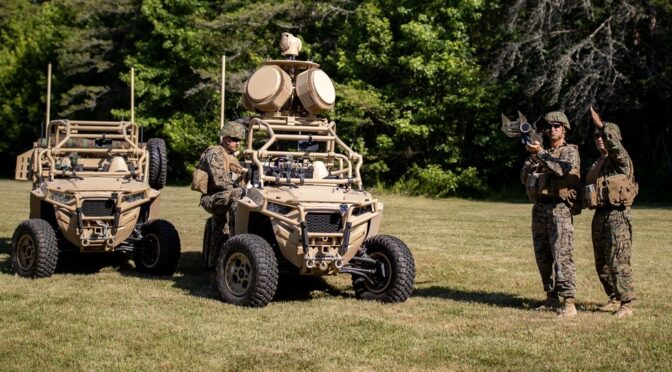
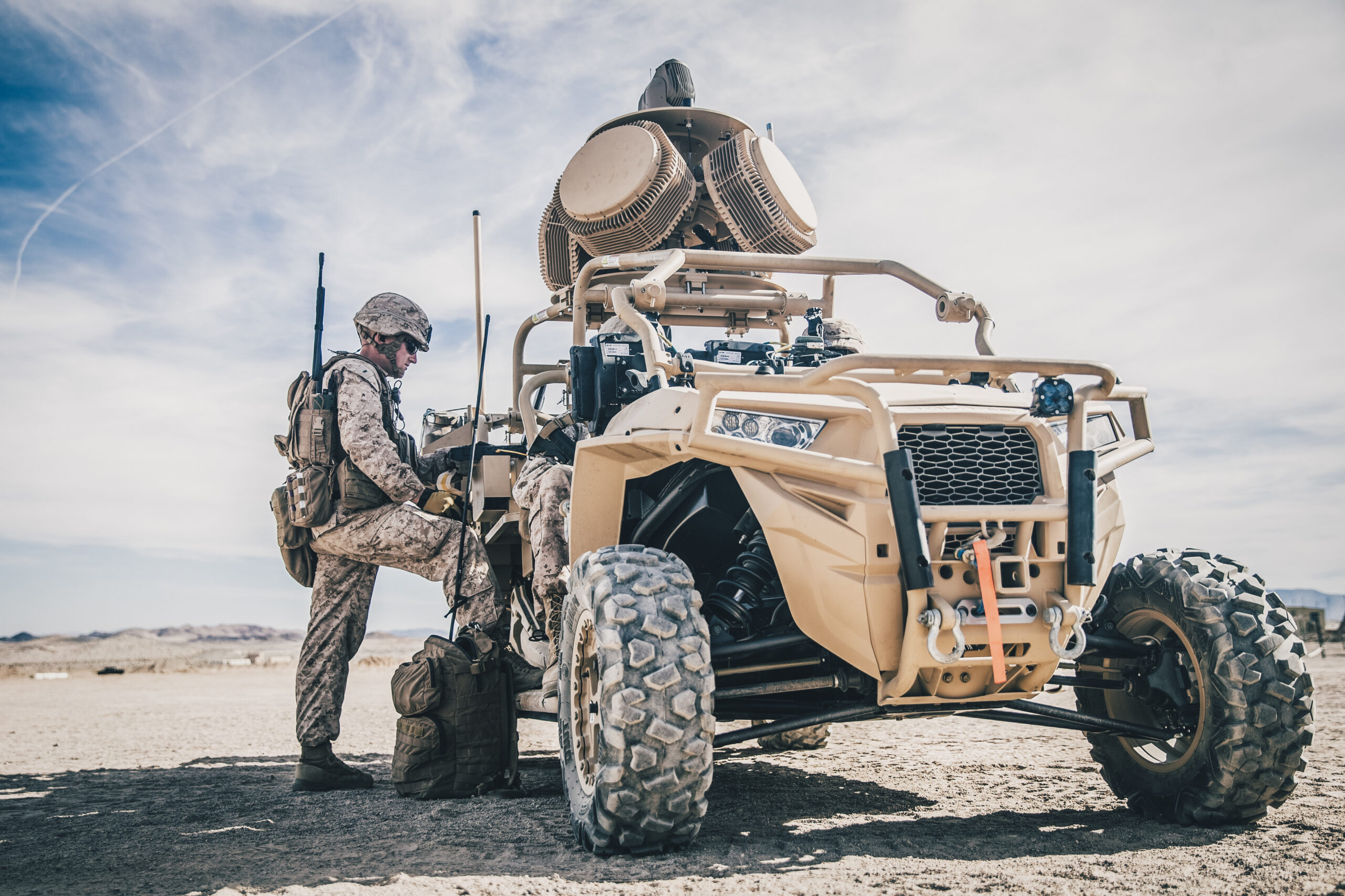
That said, there may be some areas where Marines are close enough to hostile territory for drone swarms to be used, and it is also possible drone swarms could be launched from maritime platforms, particularly those of the People’s Armed Forces Maritime Militia. There is still a need for distributable defenses against these platforms, and that need is being filled by the Marine Air Defense Integrated System (MADIS). This system should prove sufficient to contest this threat and protect Marines against small drones in a local area defense context, and its softkill mechanisms could prove invaluable for logistically intensive distributed operations. But it remains subject to debate whether the use of these jamming systems creates another telltale signature that could enable other forms of strike.

Twentynine Palms, Ca – 1st Lt. Taylor Barefoot, a low altitude air defense officer with Marine Medium Tiltrotor Squadron 163 (Reinforced), 11th Marine Expeditionary Unit, programs a counter-unmanned aircraft system on a Light Marine Air Defense Integrated System (LMADIS) during a predeployment training exercise at Marine Corps Air Ground Combat Center Twentynine Palms, Calif., Nov. 13, 2018. (U.S. Marine Corps photo by Lance Cpl. Dalton S. Swanbeck)

Traditional Aircraft

This threat category has been badly neglected in most discussions of EABO and risks completely collapsing the concept if ignored. The Marines currently do not have an organic anti-aircraft weapon capable of engaging high-altitude targets, making Marines poorly defended against a multitude of airpower tactics. Whether it be bomber attacks or drone strikes, Marines are currently defenseless against any aircraft at even medium altitude, and there do not seem to be plans to remedy this problem aside from hoping the joint force can provide the needed capabilities.

This oversight transforms many of China’s older and/or less capable aircraft like the H-6 bomber and Wing Loong drone into significant threats. They could loiter for long durations over islands suspected to have Marines at more than 20,000 feet, allowing them to perform detailed surveillance to help distinguish decoys from Marines and striking forces at their discretion. While it is true U.S. fighters could inflict casualties against these aerial assets, contesting advanced bases within an adversary’s weapons engagement zone makes it more likely that the adversary has greater counter-air capabilities and local air superiority. Attempting to interdict Chinese strikes against advance bases with airpower could draw U.S. fighters into exchanges featuring lopsided force ratios and exacerbate dependencies on limited tanking assets. Surface-to-air missiles on the other hand can sit persistently on islands to deter or contest hostile strikes, and can be rapidly repositioned after an engagement if sufficiently mobile.

Since the retirement of the MIM-23 Hawk, the only surface-to-air missile in Marine Corps service is the aging FIM-92 Stinger. Since the Stinger is first and foremost a man-portable system, it simply does not have the kinematic performance to engage aircraft unless they choose to come down to low altitude. But if there is no threat of high-altitude surface-to-air capabilities, aircraft will not be forced to lower altitudes where they can then be made susceptible to shorter-range systems like Stinger. Air defense therefore requires both high and low-altitude systems to effectively contest and deny airspace across its various dimensions and manipulate adversary air assets into maneuvering through engagement zones. The MIM-104 Patriot missile in active service can engage higher altitude targets, but Patriot is perhaps too large or logistically intensive to distribute as envisioned by EABO. It is also worth mentioning the National Advanced Surface to Air Missile System (NASAMS), which is in limited service protecting Washington DC, since this is a medium-range system which is smaller and lighter than Patriot. However, it is still a multi-vehicle networked system which would likely still be too difficult to deploy in the distributed, low-footprint manner envisioned by EABO.

Looking abroad, the closest to a suitable system is the Russian Buk which, while intended to operate as a networked, multi-platform system like Patriot and NASAMS, is also capable of operating as a self-contained, standalone single-vehicle system. Its unusual Transporter Erector Launcher And Radar (TELAR) combines medium-range missiles capable of engaging aircraft at any altitude with a radar, generator, and fire control center to allow it to be used with no external support systems. This makes it far more suitable to the distributed operations envisioned by the Marine Corps since a useful capability could be achieved with just one vehicle, and without the need for waiting for other enabling vehicles to be set up and connected. Such a capability should be able to facilitate the shoot-and-scoot tactics of distributed forces as well.

Of course, the Russian Buk is obviously not an option for the United States, but the U.S. should develop a similar single-vehicle, medium-range surface-to-air missile system, most likely using the RIM-162 Evolved Sea Sparrow Missile (ESSM). This missile is both smaller and more capable than the Russian missile, so an American system designed primarily to act as a standalone, land-based ESSM platform would be significantly more capable than Buk’s TELAR.

Conclusion

The current EABO concept, in conjunction with current developments, is broadly suitable for defending against advanced missiles and small swarming drones, but features a critical capability gap against traditional aircraft and large drones. Moving forward, the Marines should place more emphasis on decoys, both in messaging and procurement, and should also continue with the current MADIS program. However, by far the most critical step the Marines must take to make EABO workable is the urgent development of a medium-range air defense system.

Ben DiDonato is a volunteer member of the NRP-funded LMACC team lead by Dr. Shelley Gallup. He originally created what would become the armament for LMACC’s baseline Shrike variant in collaboration with the Naval Postgraduate School in a prior role as a contract engineer for Lockheed Martin Missiles and Fire Control. He has provided systems and mechanical engineering support to organizations across the defense industry from the U.S. Army Communications-Electronics Research, Development and Engineering Center (CERDEC) to Spirit Aerosystems, working on projects for all branches of the armed forces. Feel free to contact him at Benjamin.didonato@nps.edu.

Featured Image: U.S. Marines with the Ground Based Air Defense Program, conduct a demonstration of the Light-Marine Air Defense Integrated System (L-MADIS) and FIM-92 Stinger Missile, on Marine Corps Base Quantico, Virginia, June 30, 2021. (U.S. Marine Corps photo by Tia Dufour)

When Only a Chisel Will Do: Marine Corps Force Design for the Modern Era

Transforming the Marine Corps Topic Week

Capt. Jesse Schmitt, U.S. Marine Corps

One of the U.S. Marine Corps’ greatest strengths has been a weakness of late. Its storied history and rich service culture make it an organization notoriously resistant to critical self-examination and change. If “man cannot remake himself without suffering, for he is both the marble and the sculptor,” then the Marine Corps is particularly fond of its own marble and sensitive to the chisel.1 Such a fondness explains the spate of articles from retired Marine Corps leaders criticizing the “hasty” execution of 2019 Commandant’s Planning Guidance (CPG) and lamenting they sacrifice critical aspects of the Marine Corps combined arms heritage.

Taken sincerely, it represents well-intentioned men and women expressing concern for a service they care about. However, they should not be heeded if the Marine Corps is to realize its status as a modern and relevant force provider. Change is at the heart of maneuver warfare philosophy. This framework should guide the Marine Corps’ plans strategically as it does tactically, given the trajectory of global affairs. Applied, this process will see the Marine Corps carve its own marble to provide relevant and novel capabilities to combatant commanders, while shedding legacy capabilities that are ill-suited for the realities of the modern battlefield.

Well Meaning, But Wrong

It is useful to understand the critiques leveled at the Commandant’s Planning Guidance. Some of the critiques can be specifically refuted, such as General Zinni’s (USMC (ret.)), assertion that the proposed changes “do not meet … requirements and do not meet the needs of the combatant commander.”2 Meanwhile, General Todd Wolters, current Commander of U.S. European Command, told the House Armed Services Committee that the changes “dramatically enhance(s) our options … a brown-water force that can shoot, move and communicate and is very expeditionary is priceless for 21st century security.”3 Lieutenant General Van Riper’s chief complaint concerns the speed of change and overall lack of due diligence. This commentary fails to account for years of wargaming and study dating back to Commandant Neller’s tenure and for several years’ worth of oversight from the Office of the Secretary of Defense (OSD), the Joint Staff, and Congress.4

Notably, nearly all of the capabilities slated for divestment (with the exception of tanks—shed for the incompatibility of tank units with expeditionary operations) have only been reduced in capacity to make way for novel and relevant capabilities. Despite changes to the III Marine Expeditionary Force, the domestic-based Marine Corp expeditionary forces remain largely unchanged, outside of reduced capacity in cannon artillery (to be replaced by precision long-range fires, such as rockets and missiles) and aircraft.

Change is the Answer

It must be accepted as fact that change is required. The last four Commandants all agree, dating back to 2011, that the Marine Corps must evolve beyond the force that deployed to Operation Enduring Freedom, Operation Iraqi Freedom, and Operation Inherent Resolve. Even those who oppose the CPG’s restructuring concede the point: Lt Gen. Van Riper (ret.) told Politico, “We recognize that the Marine Corps has to make changes,… what we want to see is these changes based on thorough study and analysis…”5 No serious commenter claims that the Marine Corps should not grow to take advantage of new capabilities and learn to operate in a more complex operating environment impacted by ubiquitous and emerging technologies. The disagreement, then, exists over the speed and extent of said changes.

Incremental change fails to achieve the objective of the change. The purpose of the Marine Corps’ evolution is to frustrate the adversary’s plans to mitigate Marine capabilities. Strategic competitors have observed the Department of Defense’s actions over the last two decades of operations and structured themselves accordingly.6 What they have not planned to directly counter and destroy, they have done their best to copy. A current Marine infantry battalion, equipped and enabled with legacy systems, represents a dangerous and noteworthy quantity, but a known one.

For example, the classical model of Marine Expeditionary Units (MEU)—consisting of three ships, with a composite squadron on the big deck, and a Battalion Landing Team organized as company raid forces — have routinely deployed for decades, establishing patterns of employment and capability. These are not incapable systems and their roles as flexible deterrents below the threshold of conflict are useful, but they have existed long enough in their current forms that adversaries have developed counters to reduce their deterrent value.

Taken further, Anti-Ship Cruise Missile (ASCM) proliferation limits the MEU’s Amphibious Ready Group (ARG) littoral access (and relevance) in conflict.7 However, adding piecemeal capabilities, such as unmanned systems to an infantry battalion or Information-Related Capabilities (IRCs) to a MEU does not move the needle. An organization committed to maneuver warfare should recognize these adaptations by competitors and modify itself to maintain an advantage.

The Marine Corps’ Greatest Strength

Fortunately, the Marine Corps’ greatest asset has always been its people, particularly those that lead Marines in chaotic and unknowable environments. From the outset, Marine leaders are trained to act in the “intrinsically unpredictable” nature of war, because that is what enables success in combat.8 Do not take the Marine Corps’ word for it, either. In 2015, the People’s Republic of China (PRC) Central Military Commission, chaired by President Xi Jinping released a document that came to be known as the Five Incapables.” The document detailed shortcomings of the People’s Liberation Army (PLA) force, particularly the inability of enlisted and junior officers to judge situations, understand higher authorities’ intentions, make operational decisions, deploy troops, and deal with unexpected situations. This document has been referenced hundreds of times in the PLA Daily—the official newspaper of the PLAbetween 2015 and 2019.9

The contrast is clear: where strategic competitors struggle to cope with ambiguous situations the Marine Corps thrives in them. The reasons for this trait in autocratic systems are manifold, from a reliance on higher-ranking decision makers to political oversight of commanding officers.10,11 The best way for the Marine Corps to be a relevant, capable resource to Combatant Commanders is to be a force that can create those ambiguous, chaotic situations and then use its advantage in them to win. That principle holds true regardless of the adversary from the Indo-Pacific to the polar regions and points in between.

A smaller, less expensive, but uncertain and survivable entity can be more disruptive to the enemy’s understanding of the situation than any current systems, making it a more effective use of resources. Developing new capabilities to modernize the Marine Corps’ ability to defeat an enemy’s plan is precisely what maneuver warfare doctrine calls for to “circumvent a problem and attack it from a position of advantage.”12 With ubiquitous advances in long range fire — not just in the Indo-Pacific — highly nimble, survivable, and independent forces capable of operating inside a given weapons engagement zone will critical to a future fight.

Finally, what all critiques have failed to appreciate is that the most important change is not equipment or manpower, it is the creation and invigoration of a culture that seeks novel solutions to novel problems. By publishing the CPG, making important divestments, and following through, the Commandant of the Marine Corps has empowered an entire generation of Marines to think boldly about what comes next. The opportunity cost of maintaining antiquated structures and systems is not just fiscal, but one of growth. Necessity, embodied by a new environment, drives innovation and creates novel problems for competitors. The CPG has explicitly called out the new environment and situation; it is now the institution’s responsibility to adapt.

The Commandant’s Planning Guidance appropriately and meaningfully empowers institutional change in recognition of a shifting environment and the capabilities of strategic competitors. The inherent challenges of the modern battlefield cannot be met by legacy structures and systems. The process—akin to maneuver warfare at the strategic level—will not be painless, as the Marine Corps carves from its own marble to provide relevant and novel capabilities to combatant commanders in any clime or place.

Captain Jesse Schmitt is the S-2a for the 31st Marine Expeditionary Unit in Okinawa, Japan. He has a Master’s degree in International Relations and has written for CIMSEC, War on the Rocks, U.S. Naval Institute Proceedings, and the Marine Corps Gazette

References

  1. Alexis Carrel, “Man, the Unknown”, 1935
  2. https://taskandpurpose.com/opinion/zinni-marine-corps-role/
  3. https://www.politico.com/news/2022/04/01/corps-detat-how-two-dozen-retired-generals-are-trying-to-stop-an-overhaul-of-the-marines-00022446
  4. https://warontherocks.com/2020/02/to-deter-china-the-naval-services-must-integrate/
  5. https://www.politico.com/news/2022/04/01/corps-detat-how-two-dozen-retired-generals-are-trying-to-stop-an-overhaul-of-the-marines-00022446
  6. http://www.nids.mod.go.jp/publication/chinareport/pdf/china_report_EN_web_2022_A01.pdf
  7. https://www.andrewerickson.com/2014/05/a-low-visibility-force-multiplier-assessing-chinas-cruise-missile-ambitions/
  8. MCDP-1, Warfighting
  9. https://warontherocks.com/2019/02/the-chinese-military-speaks-to-itself-revealing-doubts/ 
  10. https://www.japantimes.co.jp/news/2021/11/27/national/japan-china-military-report-integration/
  11. https://news.usni.org/2020/07/03/political-commissars-on-chinese-warships-play-crucial-role-in-interactions-with-foreign-vessels
  12. MCDP-1, Warfighting

Featured Image: Marines with 5th Battalion, 11th Marine Regiment, 1st Marine Division, arrive at one of their launch positions with the High-Mobility Artillery Rocket System at the Air Combat Element landing strip as a part of Integrated Training Exercise 3-18 aboard the Marine Corps Air Ground Combat Center, Twentynine Palms, Calif., May 21, 2018. (U.S. Marine Corps photo by Lance Corporal William Chockey)

Sea Control 350 – Top Gun 2 Reactions *Spoiler Warning*

By Jared Samuelson

To celebrate 200 episodes since our relaunch, we watched Top Gun: Maverick!! I’m joined by TOPGUN grad Graham Scarbro and retired Naval Aviatrix and Public Affairs Officer Sarah Higgins to capture all of our reactions to seeing Maverick on the Big Screen again 35 years later. Spoilers ahead!

Download Sea Control 350 – Top Gun 2 Reactions *Spoiler Warning*

Jared Samuelson is Co-Host and Executive Producer of the Sea Control podcast. Contact him at Seacontrol@cimsec.org.