Maritime Piracy – A Global Issue

First Prize Winner, 2015 CIMSEC High School Essay Contest

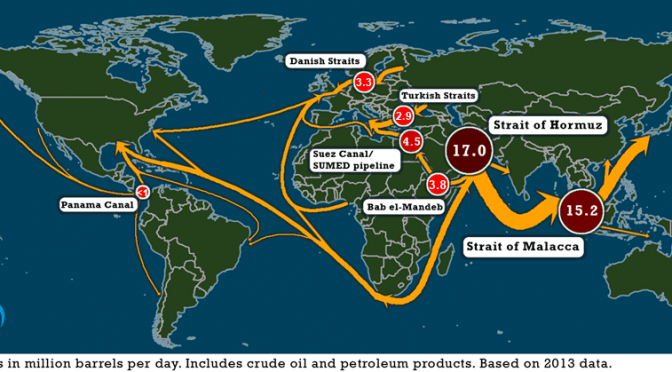
The nations of Somalia, Eritrea, Djibouti, Indonesia, Malaysia, Thailand and Singapore all share a unique strength. Despite being third world countries and overall economically weak, they have strength in their geographic position; each are located on crucial waterways. These waterways consist of some of the most heavily traveled commercial shipping routes in the world. In terms of crude oil alone, the strait of  Malacca in Southeast Asia has an estimated 15 million barrels a day, while the strait of Hormuz that links the Arabian Gulf to the Indian Ocean has an even larger amount of oil cargo, estimated at 17 million barrels per day.

These numbers are increasing exponentially every year as the global economy grows and becomes even more interconnected. Yet, despite their critical importance, these sea lanes are among the greatest hotspots for modern­day piracy; a “movement” that costs the commercial shipping industry more than 16 billion dollars each year.

Maritime piracy is a global issue, and in these two regions, there is a trio of factors which have catalyzed the problem; weak economic opportunities for the local populations, a lack of security/enforcement by officials, and the geographic locations all provide ample opportunity for piracy. All of these factors are pretty apparent, and if you eliminate any of these three, you will see piracy decrease tremendously; the result is improved safety, perception, and ultimately, the profitability of the shipping industry.

The solution for the first decade of the 21st century has been to increase security. Indonesia, Malaysia, Singapore, and Thailand have joined together to eliminate piracy in Southeast Asia and create safer shipping lanes. In the Red Sea, along the coast of Africa, and off the Arabian peninsula, western countries have taken

the initiative in eliminating piracy through the creation of the combined Maritime Forces; a collaboration of 26 countries and three task forces; CTF­150 with Maritime Security & Counter­terrorism, CTF­151 with Counter-piracy, and CTF-152 with Persian Gulf Security Cooperation. Due to these efforts, attacks from piracy are at a record low and the seas are safer.

Piracy is a cyclical event that features both periods of outbreaks and minimal incidents. Currently, maritime piracy is under control, however it’s only a matter of time until the next wave of attacks. Following uneventful years, governments and shipping companies will become complacent due to this lack of incidents; they will assess the security threat and adjust their budgets. As companies and governments downsize their security investments, they allow the reinstatement of the one factor that they had eliminated; lack of law enforcement. As a result, pirate attacks will once again revamp.
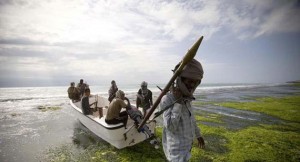
Heading home after another long day at work.In order to prevent another wave of attacks, a solution must be selected from a multitude of options. The first such solution would be the proven and traditional method of continued security forces/measures in high-risk locations. However, aside from being expensive, it is not permanent and places the burden of responsibility on Western governments. A spinoff of this idea, and an emerging method, is to place this burden on the shipping companies themselves and have them invest in their own security measures. This capitalistic approach expands the market for private security firms. However, in pursuit of profits, shipping companies might try to cut corners. This would allow for increased attacks, which almost always escalate into hostage situations that have to be dealt with through military intervention.

Taking a more permanent approach to fixing the problem is to address a different factor: poor economic conditions. This could be done through direct investment into a region’s economic development or into developing local security forces. To take the direct investment approach would be a long-term approach that would benefit the country overall. Developing local security forces, for example matching dollar for dollar, would be an intermediate solution that would both create economic opportunity while placing the burden of security on local governments. This second approach would be arguably the best in countries such as Indonesia and Singapore because they are already investing in securing their waterways. However, neither of these approaches are applicable in countries with corrupt or unstable governments, particularly Somalia where there’s no central government and various Warlords are in control.

The most unique approach to piracy would be unmanned or drone ships. As the name implies, they would operate similar to U.S. military drones where a controller sits in a building thousands of miles away, while a satellite link provides the controller with the ability to control the craft while receiving input from visual and other sensors. This is a newly emerging concept; in February of 2014, Rolls Royce announced they are developing drone cargo ships, and in November of 2014, Space X unveiled a drone barge for their reusable rocket program. In terms of freighting, the benefits range from better energy efficiency to lower cost due to the lack of a crew.

Drone ships are not pirate proof; they could still be hypothetically hijacked depending on the design of the ships. An example would be that if the engine systems were not secured/contained enough, the vessels propulsion could be halted. The reason drone ships would be so effective against piracy is they eliminate the worst situation for security forces to combat; hostage situations.

The creation of drone ships are host to numerous other difficulties; as with any form of creative destruction that causes structural unemployment, the idea will be, and already is opposed by many who make their livelihood aboard ships. Additionally, unmanned ships are currently illegal under international conventions that set minimum crew requirements. Even if that hurdle was to be overcome, then regulations would still have to be created for the new ships.

So which of the options would be the most effective? A combination of all the different methods would probably be the best solution in both the short and long run. No matter what solution is best, governments and companies need to choose a method and instate it in the coming years to ensure we don’t see another wave of attacks. Growth of the world’s economy depends on the safety of the major waterways, and inaction could cost lives.

Citations

Kermeliotis, Teo. “Somali Pirates Cost Global Economy ‘$18 Billion a Year’.” Piracy on the High Seas. Ed. Debra A. Miller. Farmington Hills, MI: Greenhaven Press, 2014. At Issue. Rpt. from “Somali Pirates Cost Global Economy ‘$18 Billion a Year.’.” CNN.com. 2013. Opposing Viewpoints in Context. Web. 13 Jan. 2015.

Debusmann, Bernd. “Military Action and Foreign Aid Must Be Used to Eliminate Pirate Sanctuaries.” ModernDay Piracy. Ed. Debra A. Miller. Detroit: Greenhaven Press, 2012.

Current Controversies. Rpt. from “Why High Seas Piracy Is Here to Stay.” Reuters 4 Mar.  Opposing Viewpoints in Context. Web. 13 Jan. 2015.

Arnsdorf, By. “RollsRoyce Drone Ships Challenge $375 Billion Industry: Freight.” Bloomberg.com. Bloomberg, 25 Feb. 2014. Web. 13 Jan. 2015. .

“Combined Maritime Forces.” Combined Maritime Forces. Web. 13 Jan. 2015.

Smith, Mat. “SpaceX Is Going to Land a Rocket on a ‘spaceport’ Barge.” Engadget. 17 Dec.  Web.13Jan.2015. <http://www.engadget.com/2014/12/17/spacexrocketlandingxwingsupersonicautonomous spaceportdroneship>

“U.S. Energy Information Administration  EIA  Independent Statistics and Analysis.” World  Oil Transit Chokepoints Critical to Global Energy Security. EIA, 1 Dec. 2014. Web. 13 Jan.  2015  <http://www.eia.gov/todayinenergy/detail.cfm?id=18991>

About the Author

Steel Templin is a senior from South Lake High School in Groveland, Florida. He is active in Key Club, Student Government, and National Honor Society, and holds leadership positions in each. In addition to school clubs, he is a varsity football player and varsity crew member. Steel hopes to attend and row at either the Naval Academy, Cornell, or Georgia Tech and study nuclear or aerospace engineering. Additionally, after college Steel plans to serve in the military or one of our country’s security agencies. 
Publication Release: A Special Report on PMSCs

CIMSEC is proud to present the first publication in its series of collected analysis – our Compendium to last year’s Private Military Contractor (PMC), focusing on the role of PMCs, also known as Private Military Security Companies, in the maritime domain.

PMSCAuthors:
Scott Cheney-Peters
Claude Berube
Tim Steigelman

Editors:
Matt Hipple
Chris Papas
Scott Cheney-Peters

     Download Here


Military contractors are assisting militaries and civilian government agencies throughout the world and across the mission spectrum, including planning, training, logistics, and security. Their use in support of a range of security-related activities is growing. Employing private military contractors (PMCs) for any security purpose, has both distinct advantages and disadvantages. PMCs are seen as having inherent advantages over militaries with regard to cost, flexibility, and responsiveness.

Relying on PMCs, though, does have its share of risks—including safety and liability issues, performance, force management, compliance with international and domestic laws, and lost resources because a capability is outsourced rather than retained. With this increase in contractor use in general, and the rise of privatized firms that are specifically organized to provide security services, the question is now how to determine the right force mix to most effectively and efficiently complete a task or mission. In some cases, contractors may be the best choice; however, they are not the perfect fit for every mission or the right solution for all skill or manpower shortages.

Despite their recent pillorying, PMC’s have existed since before the condotierri and will continue to exist after America’s campaigns. In this publication and the original week of special analysis from April 2014 we discussed their utility and future, especially in the maritime domain.

Whither the Private Maritime Security Companies of South and Southeast Asia? (Parts 1 and 2)
Author: Scott Cheney-Peters

PMCS: The End or the Beginning?
Author: Claude Berube

America Should End Mercenary Contracts
Author: Tim Steigelman

A Response to “America Should End Merceneary Contracts”
Author: Claude Berube

About this Series:

As a multinational community of strategists, researchers, and practitioners, the Center for International Maritime Security strives for a clear, relevant, and quick response to the issues facing international security.

To that end, CIMSEC is publishing collections of its focused articles in PDF format. This allows for quick distribution of diverse opinions on the topics that of relevance to maritime security today. For those who prefer browsing, the articles remain on the website under their respective categories. By organizing and distributing our authors’ analysis in multiple ways, CIMSEC is steaming ahead with the maritime policy-maker in mind.

Credit is due to all CIMSEC members – both contributors and those who share their insights through our informal collaborative channels and make such projects possible. In particular, this series is the work of Chris Papas, Director of Publications, under the guidance of head editor for the project, Matt Hipple, Director of Online Content and the head editor for this project.

Maritime Security Student Writers Week

By Chris Rawley

One of the goals of CIMSEC is to bring new perspectives into the discussion on maritime security and to break down traditionalcomposition-notebook barriers in the conversation between younger and older voices, military and civilians, and across international partners.  Along these lines, we recently hosted our first annual Maritime Security Scholarship Essay Contest.  We are pleased to announce the three contest winners and publish their essays here this week.  They are:
1st Place, and the winner of a $500 cash scholarship is Steel Templin, from Groveland, Florida.

2nd Place, receiving a $250 scholarship is Griffin Cannon, from South Burlington, Vermont.

Honorable mention goes to Nolan McEleney, of Gaithersburg, Maryland, who will receive $150.

The challenges piracy poses to freedom on the seas is a timeless topic, so it’s no wonder that two of our winning essayists decided to cover this topic.  Perhaps as a sign of trends to come, they both suggest a role for unmanned systems in fighting piracy.  Our honorable mention winner outlines the importance the space domain to maritime security.  Well done to our participants and winners!  We look forward to seeing many more fine essays next year.

Members’ Roundup Part 13: Herd, defend, distract, attack

Welcome back to another edition of the weekly roundup, where we disseminate the recent blog posts, journal articles, web articles, books, and podcasts that CIMSEC members have published elsewhere. This week we have topics that range from narco-submarines to swarming tactics in future naval warfare. I am certain the articles presented here will make great weekend reading in case you missed any of them in the past week.

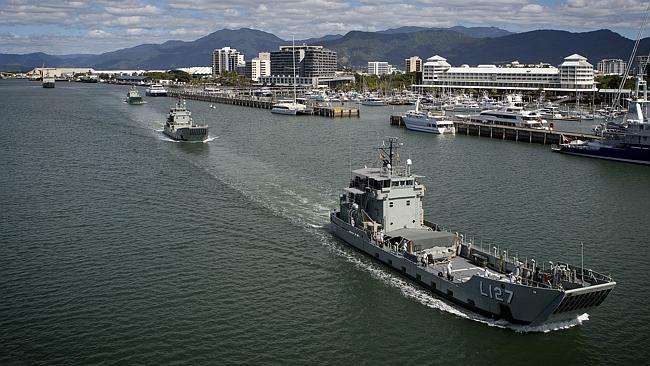
The first article mentioned here is by Armando Heredia, on the US Naval Institute’s website, who analyses the Philippines’ naval buildup.   The buildup under the leadership of President Aquino include, but is not limited to, the acquisition of new helicopters as well as the boost to Philippines’ sealift capability with the donation of two ex-Royal Australian Navy Landing Craft Heavies. It is still unclear, however, when a decision will be made regarding the acquisition of two new multi-role frigates. Even with these ‘new’ platforms, however, the realities of historical challenges to their naval service will need to be considered in order to establishing a credible defence. Armando’s article can be accessed here.

Ex-HMA Ships Brunei and Tarakan are to be gifted to the Philippines Navy with refurbished equipment and upgraded navigation systems.
Ex-HMA Ships Brunei and Tarakan are to be gifted to the Philippines Navy with refurbished equipment and upgraded navigation systems. In this photo the RAN’s final LCHs depart Cairns Naval Base in formation for the final time.

Sri Lanka’s political landscape has significantly shifted with President Maithripala Sirisena’s surprise electoral victory. Sri Lankan politics was dominated by President Mahinda Rajapaksa, who strengthened the executive presidency system, placed members of his family in key positions of power, and maintained a loyal political party. In this Q&A, CIMSECian Nilanthi Samaranayake tells us why Sirisena’s victory represents an opportunity for changes in Sri Lanka’s domestic policies, as well as its foreign relationships with China, India, and the United States, which could significantly alter regional political and security dynamics in South Asia.

Narco-submarine moments before interception by the U.S. Coast Guard in August 2007.

CIMSECian Byron Ramirez recently co-edited a new Foreign Military Studies Office paper titled ‘Narco-Submarines: Specially Fabricated Vessels Used For Drug Smuggling Purposes.’ Maritime drug smuggling accounts for a significant portion of illicit substance transportation and special fabricated vessels are becoming increasingly prevalent in this field. Additionally, the foreword is written by another CIMSECian, James Stavridis, of the Fletcher School. You can access this publication here.

At The National Interest, defence reporter Dave Majumdar continues his series of ‘Top Fives’ with an analysis of the Most Overrated Weapons of War. From the mighty battleship to the next generation of stealth fighters, Dave provides his arguments on why these costly platforms do not provide value-for-money in war. Fanatics and history buffs may not necessarily agree with Dave’s conclusions, but he does make a strong case why it is easy to fall into the trap of purchasing the sexier, but less-useful, option. You can also access Dave’s other National Interest articles here.

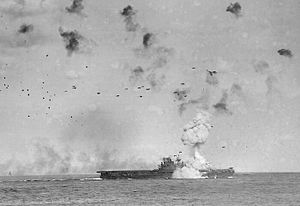
A kamikaze attack on USS Enterprise. Swarm attacks were used by the Japanese Imperial forces in the closing stages of World War II to inflict heavy casualties in the Pacific theatre.

Over at Information Dissemination Chris Rawley continues the carrier debate with his view on the future of naval warfare: swarming. Chris has written about this concept previously, and other elements of the US Navy is researching how to employ autonomous and unmanned platforms, in conjunction with manned platforms, to fight and win the battle at sea. History provides examples of how the swarming tactic has been employed at sea. The Japanese kamikaze attacks, for example, had devastating consequences for the sailors who faced them in battle. The tactic can also be adapted to other elements of the Navy and will need to be multi-domain to achieve its goal. Find out more by reading Chris’ article here.

Zachary Keck returns in this edition of the roundup with the following articles. Firstly,  that Russia will be holding Joint Military Drills with North Korea and Cuba. Secondly, the US Navy’s 6th Generation Fighter jets will be slow and unstealthy.  Third,  Ghosts of Imperialism Past: How Colonialism Still Haunts the World Today.  Finally,  how North Korea is practicing to sink US Carriers.

As a side note, I recently published an article for an Australian-based organisation called Young Australians in International Affairs for their new ‘Insights’ blog. In it, I analyse the top five defence and national security items to watch closely in 2015. From new submarines to what can be considered an ‘Australianised Department of Homeland Security’, these projects will need to be carefully implemented to ensure that the next few years are not spent correcting avoidable mistakes. Thus, positive outcomes this year will prevent exposing a capability gap or security risk for Australia. My post can be accessed here.

At CIMSEC we encourage members to continue writing, either here on the NextWar blog or through other means. You can assist us by emailing your works to dmp@cimsec.org.

Fostering the Discussion on Securing the Seas.