Russia Resurgent Topic Week
By Patrick Truffer
The end of the Cold War and the collapse of the Soviet Union led to a weakening of the former Soviet Armed Forces. It was not until after the turn of the millennium that Russia directed its efforts towards qualitative rearmament and simultaneously shifted its focus to strategic systems with the associated lowering of the threshold regarding the use of nuclear weapons.1 This new focus concentrated on land and air forces, and was necessarily not applied in full to the Russian Federation Navy (RFN), even if an article by Ben Hernandez warned that the RFN would be similarly developed.2 This essay poses questions based on these findings: to what extent have the capabilities of the RFN changed since the end of the Cold War? Can a trend towards a weakening of conventional and a strengthening of the strategic components be identified?
[otw_shortcode_button href=”https://cimsec.org/buying-cimsec-war-bonds/18115″ size=”medium” icon_position=”right” shape=”round” color_class=”otw-blue”]Donate to CIMSEC![/otw_shortcode_button]
When the Russian armed forces were officially established on 7 May 1992, the RFN was in quantitative terms a navy of rank II (see “Notes: Classification of the capabilities of marine power” further below). The economic problems of Russia, which lasted until the early years of the 21st century, resulted in the maintenance and modernization of the ex-Soviet military systems playing only a subordinate role. Financial spending for the Red Army had previously accounted for at least 15% of GDP, but between 1992 and 1997 expenditure fell to no more than 5%, despite the 50% drop in GDP during the same period. Spending was further reduced to 2.9% in 1998 during the Ruble crisis, increasing only from 1999. The financial resources available to the Russian armed forces until 1999 barely sufficed for operating costs. Important new acquisitions were not possible, as can be seen in the development of the armed forces during the consolidation period which lasted until after 1999, when out-dated, surplus Soviet systems were scrapped.3 The consolidation phase was particularly punishing for the RFN which lost four of its original five aircraft carriers within the four year period – only the conventionally powered Admiral Kuznetsov is still operational today.4 By the turn of the millennium, the strategic and tactical submarines, minelayers and minesweepers as well as amphibious capabilities had been drastically reduced in number.5 In addition, Russia withdrew from almost all its foreign bases – Tartus in Syria remained as the last Russian naval base outside of Russian territory.6
The potential of the RFN and its suppliers of defence technology deteriorated not only in terms of quantity but also of quality. At present, only about a quarter of the fleet has ocean-going capacity, and the abandonment of armaments projects as well as a shortage of new vessels since the turn of the millennium have reduced the RFN to a navy of rank III.7 The RFN is capable, although with considerable effort, of projecting power at a global level. However, a major operation would only be possible within a limited arena and for a limited period.8 The problems the RFN has in maintaining its Mediterranean task force, which consist of between 10 and 12 vessels, indicate that a sustained operation would have less success.9
Financial constraints in the defence industry have led to the unravelling of the production chain and to a loss of know-how, complicated by the fact that former Soviet production sites were often located outside of Russia. Russian aircraft carriers, for example, were built in Mykolaiv in Ukraine.10 Due to these factors and combined with a lack of investment in new industrial capabilities and technologies, Russia must in part rebuild its industrial military technology from the ground up.11 The modernisation of the Russian armaments industry made only slow progress till 2010, due for the most part to inefficient and corrupt state-funded structures. In spite of this, three new strategic nuclear-powered submarines of the Borei-class have successfully been put into service since 2008. Together with a further five, they will replace Russia’s remaining strategic Delta- and Typhoon-class submarines by 2020 and compose the future maritime component of the nuclear triad. The strategic submarines serve as a carrier system for up to 16 of the currently not yet fully operational Bulava intercontinental ballistic missile (ICBM).12 The Borei-class is in part Soviet technology because the relevant planning phase began during the Cold War.13 After successful implementation, this will reduce the strategic submarine fleet from the Cold War levels of 55 units (covering six classes) and 832 nuclear-capable ICBMs (five types) to 8-10 Borei-class submarines with altogether 128-160 nuclear-capable ICBMs of a single type armed with one nuclear warhead each. The strategic maritime component of Russia will thereby be quantitatively modest compared to that of the USA which, from 2018 and taking into account the New START agreement, will have 12 Ohio-class submarines, each with 20 Trident D-5 ICBMs, each of which theoretically capable of carrying up to 14 nuclear warheads.14 Regarding the quantity of the carrier systems, Russia is still superior to those of the UK (four Vanguard-class submarines, each with 16 Trident D-5 ICBMs, capable of carrying three nuclear warheads each) and France (four Le Triomphant-class submarines, each with 16 ICBMs equipped with six nuclear warheads per missile).15 Despite significant quantitative disarmament, which in turn has reduced pressure on the military budget, Russia has been able to ensure the capabilities of the maritime component of its nuclear triad.
Military Statistics – Russian Armed Forces – Nov 2015
Optimistic estimates of the development periods for new, possibly nuclear-powered aircraft carriers arrive at 15-20 years.16 This is the most fundamental of several preconditions required for a return to the rank of a Major Global Force Projection navy (if only “partial”). In addition, every deployed aircraft carrier requires further vessels. When the Admiral Kuznetsov passed through the English Channel in January 2014, the Russian carrier battle group consisted of a further five cruisers, destroyers and frigates as escort vessels.17 Thus to an aircraft carrier, enough suitable escorts and the necessary logistics required for sustained operations must be available for deployment. The Russian shipbuilding industry currently seems almost incapable of successfully implementing this mammoth project within the prescribed time, because the problems, massive cost overruns and time delays in the conversion commissioned by the Indian Navy of the Kiev-class aircraft carrier Admiral Gorshkov into the INS Vikramaditya generate little confidence in the capabilities of Russian shipyards.18
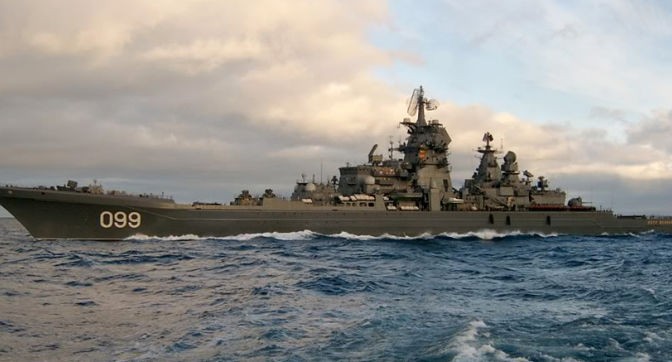
Despite these changes required, the conventional sector appears to have made progress. For example, modernisation work began in 2007 on the Oscar-class submarines (each with 24 P-700 Granit anti-ship cruise missiles) which are still in operation and for the most part date back to the 1980s. In addition, at the end of 2013 a new tactical, nuclear-powered Yasen-class submarine entered service.19 However, this was not a new development; as with the Borei-class, the planning phase dates back to the Soviet era. Construction was delayed by years, partly due to financial restrictions and partly due to the priority given to the Borei-class. Four more Yasen-class submarines are to follow in the medium- to long-term. With Russias diesel-electric powered attack submarines, the Kilo-class fleet has been partly modernised and increased to 20 units. The first submarine in the subsequent Lada-class, whose drive system possibly will be air-independent and significantly quieter, has been operational since 2010 and two more are to follow by 2020.20 Two heavy nuclear-powered guided missile cruiser (Kirov-class) from the Soviet era are also being modernised.21 There seems otherwise to be no new development in the field of cruisers. The outlook is more positive with frigates: The multi-role Admiral Gorshkov-class (1 being tested, 3 under construction and a total of 5-6 operational by 2020) and the guided-missile Admiral Grigorovich-class (5 in construction, 6 planned) are new Russian developments.22 The Buyan-class (5 operational, 1 undergoing testing, 5 in construction and 1 planned) and the Steregushchy-class corvette23 (4 operational, 4 under construction and 18 planned by 2020) are also new Russian developments. Both corvette classes are primarily for the protection of coastal waters and, in the case of the Steregushchy-class with its operational flexibility, the 200-mile economic zone. Two of the successor model, Project 22160, which will have a greater level of self-sufficiency24, are already in production.25
The 20 obsolete landing craft which still exist on paper mean that the amphibious capabilities of the RFN are virtually non-existent. In the long term, Russia is planning to bridge this gap with the Ivan Gren-class, but although begun in 2004, the project is not yet fully functional. It was announced in July 2015 that only two of the six ships planned would be completed. In addition, the purchase of two French Mistral-class amphibious assault ships was cancelled by France because of tensions resulting from the annexation of the Crimea and the war in eastern Ukraine. Russia is now planning to create a modern replacement with a project of its own (Avalanche), but as with all major maritime projects in Russia, doubts about its successful implementation pervade.26
Conclusion
After the Cold War, the quantitative and qualitative potential of the RFN declined considerably. It is presently in the same league as the UK and the France Navy and could at the most carry out one major operation for a closely defined period in a specific location. This capability gap in global power projection will continue to exist in the long-term. In addition, the amphibious capabilities of the RFN are virtually non-existent, and here no long-term closing of the gap can be detected. The RFN is currently capable of policing the 200-mile economic zone and the coastal waters of the Russian regional space. At the strategic level, maritime component of the Russian nuclear triad with its Burei-class submarines and the Bulava ICBMs is capable of ensuring a presence, even after 2020. The number of simultaneously usable nuclear warheads, low in comparison to that of the USA, UK and France, is not the most significant factor. Despite the existing capability gaps and the efforts to continue to maintain the nuclear triad, the present analysis of the RFN capabilities does not reveal the kind of unilateral shift in focus towards the strategic component which can be detected in Russia’s land and air forces.
Patrick Truffer publishes the Swiss security policy blog offiziere.ch. He graduated from the Swiss Federal Institute of Technology in Zürich with a Bachelor of Arts in Public Affairs and is completing a Master of Arts program in International Relations at the Freien Universität Berlin.
Read other contributions to Russia Resurgent Topic Week.
[otw_shortcode_button href=”https://cimsec.org/buying-cimsec-war-bonds/18115″ size=”medium” icon_position=”right” shape=”round” color_class=”otw-blue”]Donate to CIMSEC![/otw_shortcode_button]
1 Patrick Truffer, “Strategic rearmament of the Russian armed forces after end of the Cold War”, offiziere.ch, February 01, 2015, part 1: https://www.offiziere.ch/?p=22571, part 2: https://www.offiziere.ch/?p=22958.
2 Ben Hernandez, “Is Russia’s Maritime Strategy Adrift?”, Medium, August 14, 2015, https://goo.gl/io5W08.
3 Mike Bowker and Cameron Ross, Russia After the Cold War, 1st edition (New York: Routledge, 2000), 230ff; Patrick Truffer, “Statistics – Russian Armed Forces”, November 2015, https://goo.gl/UwnQqM.
4 This craft class is not defined in Russia as a full-fledged aircraft carrier, but as a heavy-aircraft carrying cruiser. “New Russian ‘Storm’ Supercarrier Design Wows Chinese Media”, Sputnik, July, 11, 2015, http://goo.gl/2ShnAU.
5 Truffer, “Statistics – Russian Armed Forces”.
6 Felix F. Seidler, Maritime Herausforderungen der NATO, Analysen zur Sicherheitspolitik, Bd. 8 (Frankfurt am Main: Peter Lang GmbH, Internationaler Verlag der Wissenschaften, 2015), 62.
7 Sean MacCormac, “The New Russian Naval Doctrine”, CIMSEC, September 3, 2015, http://goo.gl/ZalkqF.
8 Seidler, Maritime Herausforderungen der NATO, 61.
9 Paul Pryce, “Russia’s Rusting Task Force”, CIMSEC, September 16, 2013, http://goo.gl/bSwPkZ.
10 Peter Dunai and Guy Anderson, “Russia commits to building Black Sea naval shipyards”, Jane’s Navy International 118:2 (March 2013): 49.
11 Seidler, Maritime Herausforderungen der NATO, 63.
12 “Chapter Five: Russia and Eurasia”, The Military Balance 113 (2013): 204.
13 Construction began in 1996. The test phase planned for 2002 and the planned completion in 2006 were delayed by several years. “Russia”, The Military Balance 108 (2008): 223, “Russia”, The Military Balance 106 (2006): 164.
14 Under the New START, the number of nuclear warheads for all delivery systems altogether is restricted to 1,550. U.S. Departement of Defense, “Fact Sheet on US Nuclear Force Structure under the New START Treaty”, April 08, 2014.
15 UK Government, “Fact Sheet 10: Trident Value for Money Review”, October 19, 2010; “Chapter Four: Europe”, The Military Balance 115, (2015): 91.
16 “New Russian ‘Storm’ Supercarrier Design Wows Chinese Media”.
17 “Russian Carrier Battle Group on its Way to the Mediterranean”, RIA Novosti, January 10, 2014, http://goo.gl/w6cmvN.
18 “INS Vikramaditya: Indias New Carrier”, Defense Industry Daily, July 16, 2015, http://goo.gl/wAV4Jw; Dmitry Gorenburg, “Russian naval capabilities and procurement plans”, Russian Military Reform, January 14, 2015, https://goo.gl/Sq4P62.
19 “Russia Commissions New Attack Submarine”, Sputnik, Dezember 13, 2013, http://goo.gl/WRHK1t.
20 “Chapter Five: Russia and Eurasia”, The Military Balance 115 (2015): 187, 205.
21 “Russian Shipyard Sevmash Ordered New Equipment for Overhaul of Kirov Class Cruiser Nakhimov”, Navy Recognition, January 06, 2015, http://goo.gl/qlwoSd.
22 Gorenburg, “Russian naval capabilities and procurement plans”; “Baltic Shipyard Starts Work on New Fregatten for Russian Navy”, Sputnik, November 15, 2013, http://goo.gl/lbCGyU.
23 The Corvette appears in the “Military Balance” statistics only from 2009, and from 2011 it is classed among the frigates
(accordingly considered in Truffer, “Statistics – Russian Armed Forces”).
24 An operational range of 6,000 miles and a continuous operating time of 60 days instead of 3,500 miles and 15 days for the Steregushchy class. John Pike, “Project 22160 Vasily Bykov Patrol Ship”, GlobalSecurity.org, May 02, 2014, http://goo.gl/wo3NH1.
25 Gorenburg, “Russian naval capabilities and procurement plans”.
26 “Russia Reduces Procurement of Ivan Gren Class Landing Ship to Focus on Mistral Analog Lavina”, Navy Recognition, July 10, 2015, http://goo.gl/soGy1k.
Notes: Classification of the capabilities of marine power1
| Rank |
Designation |
Description |
These include: |
| I |
Major Global Force Projection Navy – Complete |
Can carry out all naval tasks globally, implementing several operations at the same time and establishing military supremacy worldwide. Includes aircraft carrier battle groups, nuclear-powered attack and strategic missile submarines, amphibious assault ships and a corresponding three-digit number of surface warships. |
USA |
| II |
Major Global Force Projection Navy – Partial |
Can participate globally in several locations simultaneously with sea denial forces of oceanic range, but only with limitations when it comes to creating military superiority distant from the national territory and for an extended period of time. Has limited access to aircraft carriers and/or amphibious assault ships, but remains dependent on on-shore bases for air support. Includes nuclear-powered attack and strategic missile submarines. The main burden is carried by a significant number of surface warships, in three-digit or high double-digit numbers. |
Currently no State |
| III |
Medium Global Force Projection Navy |
Can project power globally in multiple simultaneous operations, but can only successfully implement one major operation in one location at any specific time. Has few/individual aircraft carriers and/or amphibious assault vessels, nuclear-powered attack and strategic missile submarines and a two-digit number of surface warships capable of geographically limited naval patrols. |
Russia
China
France
Great Britain (almost)
|
| IV |
Medium Regional Force Projection Navy |
Can project power on its own shores, but without being able to establish military superiority on a large scale. Compared to Ranks I to III has a smaller number of surface warships, and may have individual small aircraft carriers or amphibious assault vessels; rarely nuclear, usually conventionally powered attack submarines and land-based aircraft to support operations at sea. |
Germany
Italy
Spain
Netherlands
India
Japan
Brazil
Australia |
| V |
Adjunct Force Projection Navies |
Can exert military power along their own coastline with surface vessels and possibly conventionally powered submarines. |
Sweden
Egypt |
| VI |
Offshore Territorial Defence Navies |
With surface vessels and possibly conventionally powered submarines they have a credible capability to defend their territorial waters and exclusive economic zones. |
Chile |
| VII |
Inshore Territorial Defence Navies |
Can defend their coasts with surface vessels. |
Tunisia
Venezuela |
| VIII |
Constabulary Navies |
Can patrol their coastal waters with weakly armed surface vessels. |
Bangladesh |
| IX |
Token Navies |
These are navies operated by small states with minimal operational capacity, for example in the form of small patrol boats. |
Pacific island states |
1 Classification according to Eric Grove, The Future of Sea Power (Annapolis, MD: Naval Institute Press US, 1990), 236-240. From: Seidler, Maritime Herausforderungen der NATO, 49f, 349-355. I also wish to thank Felix for his additional explanations, suggestions and tips as well as for country examples.
References
“Baltic Shipyard Starts Work on New Frigate for Russian Navy”. Sputnik, November 15, 2013, http://goo.gl/lbCGyU.
Bowker, Mike, und Cameron Ross. Russia After the Cold War. 1st edition. New York: Routledge, 2000.
“Chapter Five: Russia and Eurasia”. The Military Balance 113, (2013): 199–244.
“Chapter Five: Russia and Eurasia”. The Military Balance 115, (2015): 159–206.
“Chapter Four: Europe”. The Military Balance 115, (2015): 57–158.
Dunai, Peter, and Guy Anderson. “Russia commits to building Black Sea naval shipyards”. Jane’s Navy International 118:2 (March 2013): 49.
Gorenburg, Dmitry. “Russian naval capabilities and procurement plans”. Russian Military Reform, January 14, 2015, https://goo.gl/Sq4P62.
Grove, Eric. The Future of Sea Power. Annapolis, Md: US Naval Institute Press, 1990.
Hernandez, Ben. “Is Russia’s Maritime Strategy Adrift?” Medium, August 14, 2015, https://goo.gl/io5W08.
“INS Vikramaditya: Indias New Carrier”. Defense Industry Daily, July 16, 2015, http://goo.gl/wAV4Jw.
MacCormac, Sean. “The New Russian Naval Doctrine”. CIMSEC, September 03, 2015, http://goo.gl/ZalkqF.
“New Russian ‘Storm’ Supercarrier Design Wows Chinese Media”. Sputnik, July 11, 2015, http://goo.gl/2ShnAU.
Pike, John. “Project 22160 Vasily Bykov Patrol Ship”. GlobalSecurity.org, May 02, 2014, http://goo.gl/wo3NH1.
Pryce, Paul. “Russia’s Rusting Task Force”. CIMSEC, September 16, 2013, http://goo.gl/bSwPkZ.
“Russia”. The Military Balance 106, (2006): 147–64.
“Russia”. The Military Balance 108, (2008): 205–24.
“Russia Commissions New Attack Submarine”. Sputnik, Dezember 30, 2013, http://goo.gl/WRHK1t.
“Russia Reduces Procurement of Ivan Gren Class Landing Ship to Focus on Mistral Analog Lavina”. Navy Recognition, July 10, 2015. http://goo.gl/soGy1k.
“Russian Carrier Battle Group on its Way to the Mediterranean”. RIA Novosti, January 10, 2014, http://goo.gl/w6cmvN.
“Russian Shipyard Sevmash Ordered New Equipment for Overhaul of Kirov Class Cruiser Nakhimov”. Navy Recognition, January 06, 2015, http://goo.gl/qlwoSd.
Seidler, Felix F.. Maritime Herausforderungen der NATO. Analysen zur Sicherheitspolitik. Bd. 8. Frankfurt am Main: Peter Lang GmbH, Internationaler Verlag der Wissenschaften, 2015.
Truffer, Patrick. “Statistics – Russian Armed Forces”, November 2015, https://goo.gl/UwnQqM.
Truffer, Patrick. “Strategic rearmament of the Russian armed forces after end of the Cold War”, February 01, 2015, part 1: https://www.offiziere.ch/?p=22571, part 2: https://www.offiziere.ch/?p=22958
UK Government. “Fact Sheet 10: Trident Value for Money Review”, October 19, 2010.
U.S. Department of Defense. “Fact Sheet on US Nuclear Force Structure under the New START Treaty”, April 08, 2014.