Let Me Get this Strait: The Turkish Straits Question Revisited

Chokepoints and Littorals Topic Week

By Paul Pryce

The Bosporus and Dardanelles Straits, together with the adjoining Marmara Sea, are known collectively as the Turkish Straits and provide the only access between the Black Sea and the Aegean Sea. More than 40,000 vessels passed through these waters in 2019, transporting almost 650 million tons of cargo, and reaffirming the Turkish Straits as one of the most important maritime trade corridors in the world. Additionally, the shores of the Straits – which narrow at some points to as little as 700 meters apart – are home to more than 22 million people, including the historic city of Istanbul.

Since 1936, the Montreux Convention Regarding the Regime of the Straits, hereinafter referred to as the Montreux Convention, has allowed for the peaceful flow of commerce through the Turkish Straits. However, recent calls from Turkish and Russian policy circles for revisions to the Montreux Convention should be cause for concern, as these proposals threaten to either spur a naval arms race in the Black Sea region or look to exploit the Straits as a geostrategic chokepoint.

The Montreux Convention

The Montreux Convention sought to address questions regarding the status of the Turkish Straits that, by the time of the Convention’s writing, had persisted for well over a century, occasionally culminating in violence or near-violence, as in Britain’s effort to wrest control of the Dardanelles in 1922. Among its terms, the Convention stipulates that only littoral states to the Black Sea may transit capital ships (which, if we follow the 1923 Washington Naval Treaty’s definition, refers to “…a vessel of war… whose displacement exceeds 10,000 tons… or which carries a gun with a caliber exceeding 8 inches…”) through the Straits, escorted by no more than two destroyers.

The Bosporus Straits, straddled by Istanbul, are the gateway to and from the Black Sea. (Image: Marine Vessel Traffic)

It also prohibits any country from deploying to the Black Sea more than nine naval vessels displacing a total aggregate of 45,000 tons; it requires that no group of non-littoral states deploy to the Black Sea any naval vessel weighing more than 10,000 tons; and it limits the stay of any vessels from non-littoral states to just 21 days. Littoral states are further obliged under the Convention to inform the relevant Turkish authorities of an intended transit of the Straits by a military vessel at least eight days prior and non-littoral states are obliged to provide 15 days’ notice. Turkey is further empowered to close the Straits to all military traffic in wartime or when under threat of aggression while also denying passage to merchant vessels belonging to countries at war with Turkey.

It is worth noting that Annex II of the Convention specifically excludes aircraft carriers from the definition of a capital ship. This does not extend to any other ship transporting aircraft since, at the time of the Convention’s writing, it was not uncommon for battleships and other military vessels to carry observation aircraft. This may explain the Soviet Union’s unusual designation of its aircraft carriers as ‘aircraft-carrying cruisers’ – for example, the Kiev and Kuznetsov classes. These vessels could fulfill the same strategic function as carriers while still being free to transit the Turkish Straits, even as the Convention denied access to the Black Sea for NATO aircraft carriers due to their explicit designation as aircraft carriers in both name and function.

Though the Montreux Convention has constrained the capacity of NATO support to Ukraine in its struggle against Russian aggression, such as by limiting the number of vessels permitted in the Black Sea as part of Standing NATO Maritime Group 2 (SNMG2), the continued implementation of the agreement is in the national interest of the United States and other non-littoral nations. The United States has long supported the “principle of freedom of transit and navigation” referred to in Article 1 of the Convention and, although it has never ratified the United Nations Convention on the Law of the Sea (UNCLOS), the United States already abides by UNCLOS as a matter of customary international law.

On the one hand, this seems to suggest that challenging the legitimacy of the Montreux Convention would advance American interests – after all, the International Court of Justice (ICJ) ruled in 1949 that, for vessels transiting the Straits or Corfu, which runs along the coasts of Albania and Greece and which serves as a passage between the Adriatic and Ionian Seas, the concept of innocent passage should prevail over any claims of state control over such strategic waterways. With the Corfu precedent and the customary nature of UNCLOS, one might assume that a legal challenge of the Montreux Convention by a non-littoral state would easily succeed.

But the unique geography of the Turkish Straits makes this legal question far from simple. The Marmara Sea is an internal sea, all the coasts of which belong to Turkey. In the event of a dissolution of the Convention, the ICJ would need to consider whether the Turkish Straits constitute a single strait connecting two open seas, in which case innocent passage prevails, or if they are two separate straits connecting an open sea and an internal sea, in which case Turkey would be able to exert even greater control over the flow of maritime traffic through the Straits. Referring to the Turkish Straits in common parlance – rather than referring separately to the Dardanelles, the Bosporus, and the Marmara Sea – implies a single unit, and the bulk of the maritime traffic has flowed over the past decade between the Aegean Sea and the Black Sea. It would seem likely then that the ICJ would favor the conception of the Turkish Straits as a single strait connecting two open seas, but this outcome is not guaranteed.

The Turkish Straits are comprised of: (A) The Dardanelles, (B) The Marmara Sea, and (C) The Bosporus. (Image: Maritime Studies South Africa)

It is also difficult to discern to what extent the United States would be able to practically alter the administration of the Turkish Straits. Turkey is a significant maritime power in its own right and much of its naval forces are stationed at Gölcük Naval Base, located on the east coast of the Marmara Sea. Any freedom of navigation operation (FONOP) would encounter immediate resistance and would add to the existing tensions between the Turkish and U.S. governments, especially as Turkey refuses to recognize UNCLOS.

The economic and social importance of the Straits to Turkey cannot be overstated. Beyond the millions of Turkish citizens who live on its banks and the commerce the Straits facilitate, it also offers a physical representation of Turkey’s duality as a European and Asian state, while the administration of the Straits has afforded Turkey a self-image as the guardian of the Black Sea.

Given all of this, it would possibly require the wholesale destruction of Turkish naval forces to impose a major change in the administration of the Turkish Straits and, even then, barriers could be erected intentionally or accidentally that would interfere with the future use of the waterway. In short, the legal and practical status quo offers the best guarantee for the continued flow of trade through the Straits.

Calls for Reform

However, there has been much discussion in Russian and Turkish policy circles around possible revisions to the Montreux Convention. These revisions would be detrimental to U.S. national interests, which include the maximum possible freedom of transit and navigation through the Turkish Straits. In particular, since the annexation of Crimea, some Russian defense planners have called for the Convention to be revised so that the length of stay in the Black Sea for vessels from non-littoral states would be shorter than the current allowance of 21 days. Furthermore, Russian policymakers have creatively interpreted the Convention since annexing Crimea in 2014.

In May 2016, Turkish President Recep Erdogan decried the Black Sea as a “Russian Lake.” In response, the Chair of the State Duma Committee on Defense, Admiral Vladimir Komoyedov, claimed that the Russian Federation need only inform Turkey of the transit of its military vessels through the Turkish Straits and that restrictions on the number and kind of vessels transiting applied only to non-littoral states. Meanwhile, in response to Russia’s unilateral restrictions on the flow of maritime traffic through the Kerch Strait between the Black Sea and the Sea of Azov, Ukraine called in November 2018 for tighter restrictions on the number and kind of vessels from all states transiting the Turkish Straits, in hopes that this might interfere with the strategic maneuvers of the Russian Navy.
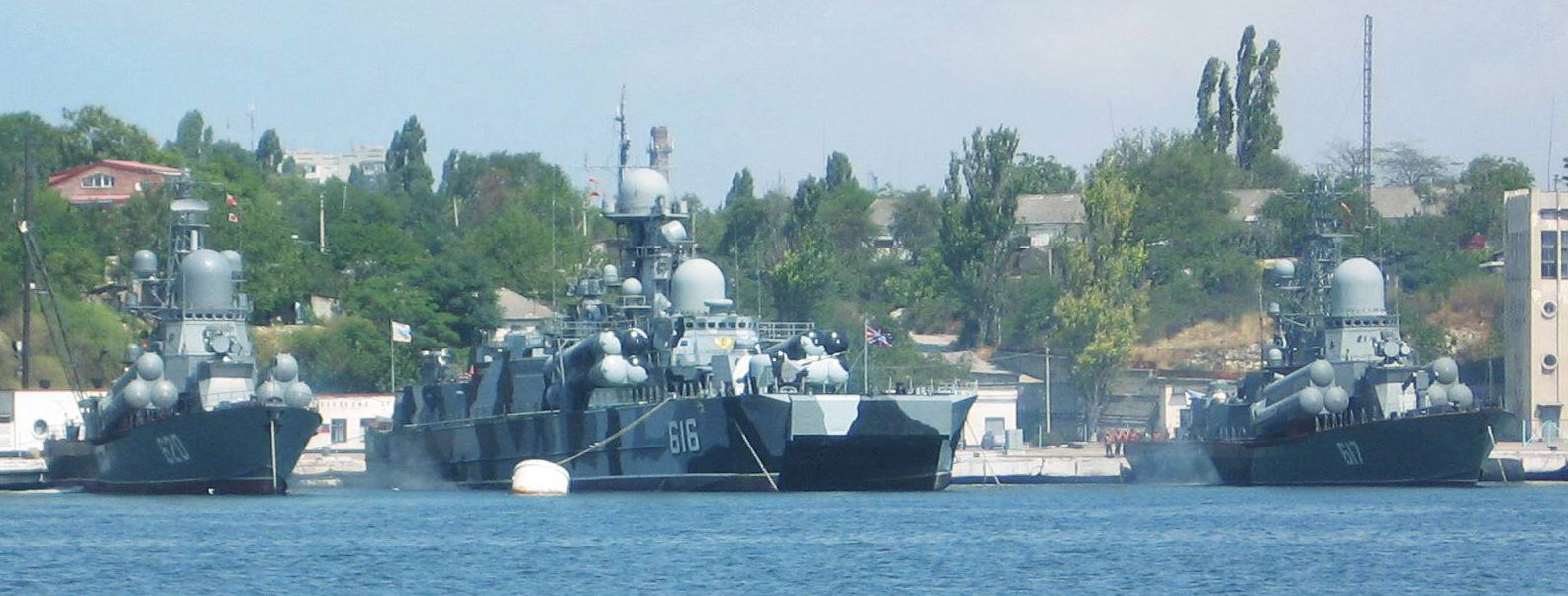
Russian Navy warships based in the Black Sea (Wikimedia Commons)

There have been rumblings from the Turkish government as to how Istanbul is “…threatened by the ever growing number of oil tankers and other dangerous cargo vessels” that transit the Straits. While Turkey has been mostly satisfied by regulations adopted through the International Maritime Organization (IMO) and other multilateral bodies, some Turkish commentators have proposed further action. In particular, some suggest promoting a regional ownership model for the Straits under the auspices of the Black Sea Economic Cooperation (BSEC), a multilateral forum comprised of Turkey and the Russian Federation but also Albania, Armenia, Azerbaijan, Bulgaria, Georgia, Greece, Moldova, Romania, Serbia, and Ukraine.

Such a model could facilitate the re-interpretation of the Montreux Convention, loosening the restrictions on vessels from Black Sea littoral states, but maintaining or even tightening the restrictions on vessels from non-littoral states. This could, in turn, be circumvented by the United States and other non-littoral states by re-flagging vessels. In the wake of the Crimean annexation, some American commentators suggested an enhanced NATO presence in the Black Sea by having U.S. Navy ships fly Bulgarian or Romanian flags. But this, too, would likely only add to tensions between the United States and Turkey as well as further undermine the rules-based order.

The Istanbul Canal

A $25-billion infrastructure project announced in 2011 by Turkey’s then-Prime Minister Recep Erdogan, known as the Istanbul Canal, presents the greatest challenge to the legal and practical status quo in the Turkish Straits. The canal would consist of a 45-kilometer waterway bisecting the European side of Istanbul, allowing 160 vessels daily to bypass the Bosporus as they transit between the Marmara and Black Seas. Officially, the Istanbul Canal was proposed to alleviate congestion on the Bosporus and divert tanker traffic toward less sensitive areas of Istanbul. However, Turkish freighter captains have cast doubt on this, noting that the canal as currently envisioned would be too shallow to accommodate many of the tankers Erdogan claims would be diverted from the Bosporus. Indeed, the canal plan calls for a maximum draft of 17 meters.

In reality, the Istanbul Canal may have been introduced to circumvent the Montreux Convention. In January 2018, Turkey’s then-Prime Minister Binali Yıldırım asserted that, as an artificial waterway, the Convention would not apply to the Istanbul Canal and so the Turkish authorities would be able to unilaterally restrict or regulate traffic through it. This again depends on whether the Turkish Straits are understood to be a single unit or as three distinct waterways – the Dardanelles, Marmara, and Bosporus. In the former interpretation, the Convention could still apply to the canal, given that it connects part of the Straits to the open waters of the Black Sea. In the latter interpretation, however, the canal would be an entirely new and distinct feature to which the Convention would indeed not apply.
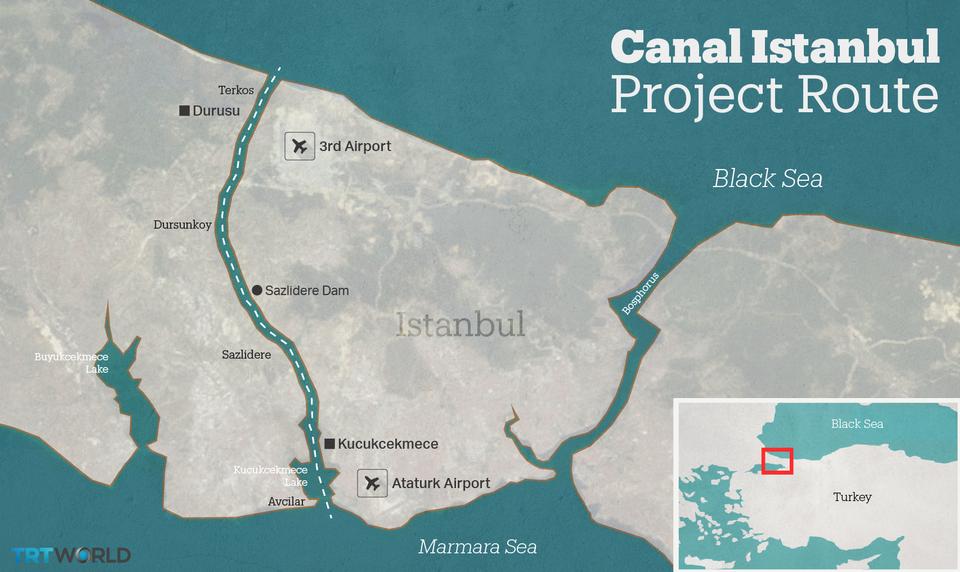
Project route of the Istanbul Canal. (Image: TRTWorld)

In any case, the canal presents a serious threat to the spirit of the Convention. On the one hand, Turkey has consistently advanced the narrative that continued use of the Bosporus is unsafe to the natural environment, the millions who live on its banks, and the hundreds of vessels that transit each day, and so unilateral restrictions on maritime traffic through the Bosporus could be justified on the basis that vessels ought to transit the safer canal route. On the other hand, Turkey could upset the balance of power in the Black Sea region by allowing vessels to transit the canal that would have otherwise been denied passage through the Turkish Straits under the Convention. Either scenario would clash with the U.S. policy of seeking the maximum possible freedom of transit and navigation, while also making NATO’s capacity to support members and partners in the Black Sea region contingent on Turkish whims.

Similar concerns regarding Erdogan’s strategic intentions have been expressed in Russia, with some commentators warning that completion of the canal could soon be followed by a Turkish denouncement of the Montreux Convention. Under the Convention’s provisions, a denunciation by any of the signatories would prompt a conference to be held for the purposes of drafting amendments to the existing Convention or an entirely new agreement on the use of the Turkish Straits. For such a conference to be valid, the Convention calls for participation from three-quarters of the “High Contracting Parties” that are littoral states – in other words, five out of six of what is now Ukraine, Romania, Bulgaria, Georgia, Russia, and Turkey.

It is conceivable, then, that a denunciation by Turkey of the Montreux Convention could be followed by a conference to draft a new agreement, held validly without Turkish participation. But it is unlikely Turkey would readily abide by any new agreement that was drafted without its participation, especially when, from the perspective of the Turkish authorities, the Istanbul Canal and the denunciation of the Montreux Convention would afford Turkey full control over access between the Aegean and the Black Seas.

Open Channels

Fortunately, there are diplomatic options available that could preserve the status quo in the Turkish Straits. For example, through the auspices of the Organization for Security and Cooperation in Europe (OSCE) – of which the United States and all the Black Sea littoral states are members – a series of confidence- and security-building mechanisms (CSBMs) could be developed regarding access between the Aegean and the Black Sea. As exemplified by the Vienna Document, an integral document to the work of the OSCE, CSBMs can include annual exchanges of information on the disposition of military forces, base inspections, and the mutual invitation of observers to military exercises, all of which are intended to demonstrate to neighbors that there is no hostile intent behind various military activities in border areas.

The development of a similar document or agreement pertaining to the Turkish Straits could include a commitment from all parties not to interfere in any way with access between the Aegean and the Black Sea, aside from those powers already afforded Turkey under the Montreux Convention, effectively backstopping the Convention but also de facto extending its remit to any artificial waterways that might be established connecting the Aegean and Black Seas.

There is nothing here that would stop Turkey from refusing to abide by these terms at some later date – after all, Russia suspended its participation in the Conventional Forces in Europe (CFE) Treaty, another OSCE-related CSBM, a little over one year before it mounted its 2008 attack on Georgia. But a suspension of Turkish participation in CSBMs related to the Straits would afford an early warning to the U.S., Russia, and other interested parties that a denunciation of the Montreux Convention may be forthcoming.

Even with a Turkish denunciation of the Convention, CSBMs would help to avoid a regional arms race. The continued exchange of information between the other Black Sea littoral states would provide assurance that no one state intends to take advantage of the change in the practical and legal status of the Turkish Straits, such as by securing a side agreement with Turkey that would allow for an increased buildup of naval forces in the Black Sea. The inclusion of some clear punitive measures for state non-compliance in the CSBM could also deter Turkey from unilaterally altering the practical or legal status of the Straits – for example, the imposition of sanctions by all other parties – but this could also make the conclusion of any agreement on the CSBM unlikely. In any case, it would serve Turkey’s national interests to participate in such an arrangement as CSBMs would provide a safety net for all of the concerned parties, helping to avoid any change in the legal or practical status of the Turkish Straits from escalating into armed conflict.

Beyond multilateral agreements and fora, Erdogan must also contend with public opinion at home. The newly elected Mayor of Istanbul, Ekrem İmamoğlu, has expressed strong opposition to the Istanbul Canal project and handily defeated former Prime Minister Binali Yıldırım, a canal proponent and Erdogan ally, despite alleged efforts by the Turkish authorities to skew the election results in Yıldırım’s favor. Calls for a referendum on the canal also bode ill for Erdogan, with polling in December 2019 showing that more than 72 percent of Istanbul residents are opposed to the project. The canal could be sacrificed in hopes of avoiding a showdown with İmamoğlu for the presidency in Turkey’s anticipated 2023 general election.

Conclusion

Given the strategic importance of the Turkish Straits – and the rumblings for reform from Ankara, Moscow, and even Kyiv – the most prudent course for U.S. policymakers would be to ensure open diplomatic channels, both by pursuing commitments from littoral states in multilateral fora like the OSCE, and by maintaining an open dialogue with all Turkish stakeholders on this issue. Neglecting these diplomatic tools would mean surrendering the initiative to the Turkish authorities, who have thus far demonstrated a willingness to erode the legal order that has governed the Turkish Straits for nearly a century whenever it is deemed to serve narrowly defined national interests.

Paul Pryce is the Principal Advisor to the Consul General of Japan in Calgary, and a long-time contributor to the Center for International Maritime Security (CIMSEC). He has previously written as the Senior Research Fellow for the Atlantic Council of Canada’s Maritime Nation Program and earlier served as a Research Fellow with the Organization for Security and Cooperation in Europe (OSCE) Parliamentary Assembly.

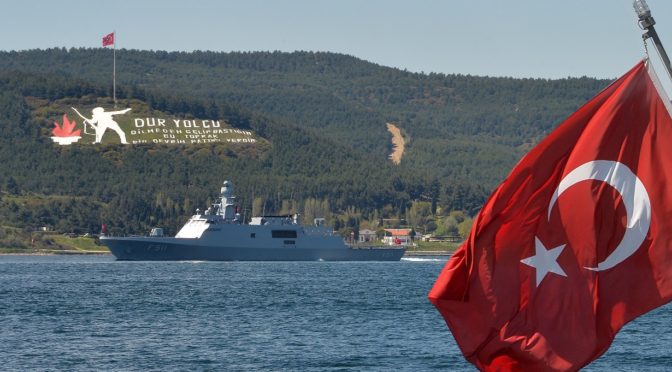
Featured Image: Turkish Navy MILGEM corvette transits by the Dur Yolcu Memorial on its way to the Dardanelles (Turkish Ministry of Defense photo)
Strategic Chokepoints and Littorals Week Kicks Off on CIMSEC

By Dmitry Filipoff

CIMSEC received a tremendous response to our call for articles on strategic chokepoints and littorals, issued in partnership with U.S. Marine Corps University’s Brute Krulak Center for Innovation and Creativity, and as a part of Project Trident. Because of the high volume of excellent submissions received, this topic week will be extended through June 12. 

The authors took insightful and creative approaches toward exploring the significance of strategic chokepoints and littorals. One major theme is that chokepoints, usually thought of as fixed areas, are becoming more flexible in definition and function. Whether it be new chokepoints emerging in the Arctic as the ice thaws, or more abstract chokepoints flowing from gaps in operational concepts, it is clear that the nature of the chokepoint itself is evolving. What remains consistent is that the final value of influencing chokepoints and littorals is not defined by simply controlling adjacent geography, but whether economic and military access is ultimately preserved and sustained.

Another critical theme the authors point to is how great power competition is affecting the role of chokepoints and littorals. Chokepoints and littorals have often been considered as an arena for mainly competing against non-state actors or third-rate states in the developing world. But with great power competition on the rise, chokepoints and littorals are emerging as the front line in potential battlegrounds. Authors looked at the role of new technology and warfighting concepts in contesting chokepoints and littorals in great power conflict, especially through the lens of emerging constructs such as U.S. Marine Corps’ stand-in forces and expeditionary advanced bases.

Below is the lineup of articles featuring during the topic week, which will be updated as more publications are finalized.

Sea Control 180 – Narrow Seas: The Black Sea with Lt. Gen. Ben Hodges (ret.) by Jared Samuelson
Let Me Get this Strait: The Turkish Straits Question Revisited” by Paul Pryce
The Assumption of Access in the Western Pacific” by Elee Wakim and Blake Herzinger
Mine the Littorals and Chokepoints: Mine Warfare in Support of Sea Control” by Major Brian Kerg, USMC
There are no Strategic Chokepoints” by Captain Jamie McGrath, USN (ret.)
An Emerging Strategic Geometry – Thawing Chokepoints and Littorals in the Arctic” by Robert C. Rasmussen
The Strategic Littoral Geography of Southeast Asia” by Pete McPhail, Arthur Speyer, Bret Rodgers, Steve Ostrosky, Jesse Burns, and Dan Marquis
Chiseled in Space: Temporary, Non-Geographic Chokepoints in the Battle of the Atlantic” by Heather Venable
Thinking Like a Pirate: Contesting Southeast Asia’s Chokepoints” by Drake Long
Sea Control 181 – The ‘Amphibious’ 8th in the Pacific War” with Jared Samuelson, Major General Pat Donahoe, and Don Chisholm
Sink ‘Em All: Envisioning Marine Corps Maritime Interdiction” by Dustin League and Dan Justice
Seeing the World Through Points” by Captain H. Clifton Hamilton, USMC
Guarding the Gates: Is International Naval Control of the Bab Al Mandeb Feasible?” by Elizabeth White
Developing Security in a White Water World: Preparing for the Arctic” by Ian Birdwell
Does Tomorrow Ever Truly Die?” by Capt. John Holmes, USMC
Expeditionary Advanced Base Operations and Mine Warfare in Littoral Control” by Mark Howard

Dmitry Filipoff is CIMSEC’s Director of Online Content. Contact him at content@cimsec.org.

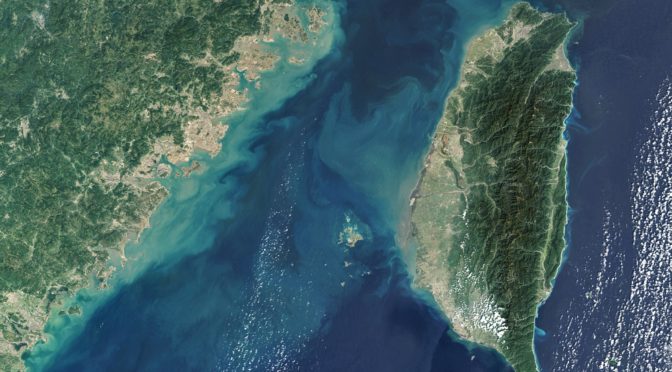
Featured Image: The Strait of Taiwan, located between the coast of southeast China and Taiwan. (Gallo Images/Getty Images)

Sea Control 180 – Narrow Seas: The Black Sea with Lt. Gen. Ben Hodges (ret.)

By Jared Samuelson

We’re kicking off our collaboration with The Krulak Center on Chokepoints and Littorals Week with a big one! Lt. Gen. Ben Hodges (ret.), former commander, U.S. Army Europe, stops by the podcast to discuss lessons learned from the exercise Defender 2020, Russia’s Black Sea strategy, and the importance of the Black Sea to NATO. 

Download Sea Control 180 – Narrow Seas: The Black Sea with Lt. Gen. Ben Hodges (ret.)

Links

  1. “One Flank, One Threat, One Presence,” by LTG (Ret.) Ben Hodges, Janusz Bugajski, COL (Ret.) Ray Wojcik, and Carsten Schmiedl, The Center for European Policy Analysis, May 2020
  2. “The Naval Power Shift in the Black Sea,” by Michael Peterson, War on the Rocks, January 9, 2019
  3. “Russia’s Strategy in the Black Sea Basin,” by Nikolas Gvosdev, War on the Rocks, August 2, 2018
  4. “Geopolitical Gerrymandering and the Importance of Key Maritime Terrain,” by Olivia Garard, War on the Rocks, October 3, 2018
  5. “Wargaming of the Black Sea Security,” by Natalia Wojtowicz, Ukraine Analytica, April 2, 2020
  6. “Naval Warfare Scenarios for 2020,” by Andrii Klymenko, Ukraine Analytica, Issue 1 (19), 2020 

Jared Samuelson is the Senior Producer of the Sea Control Podcast. Contact him at seacontrol@cimsec.org.

Vice Admiral Brian Brown On the U.S. Naval Information Warfare Community

By Dmitry Filipoff

CIMSEC had the opportunity to discuss the formation and future of the U.S. Navy’s Information Warfare (IW) community with Vice Admiral Brian B. Brown, commander of U.S. Naval Information forces (NAVIFOR). In this discussion, Vice Admiral Brown discusses how the IW community came together, how it is delivering capability to the fleet, and how information warfare is featuring in an era of great power competition.

The IW community was founded 10 years ago and saw the establishment of its own warfighting development center (NIWDC), numbered fleet command (10th Fleet), type command (NAVIFOR), and other critical components. What has the journey of establishing this community been like? 

First, I have to give due credit to the founding fathers of what we call Information Warfare today, strategic thinkers like then-Chief of Naval Operations (CNO) Adm. Gary Roughead and Vice Adm. Jack Dorsett (the first N2/N6). Over ten years ago, those two leaders had the vision and foresight to see that we needed to reorganize to meet the needs of warfighting in the Information Age. And then they took the decisive action that made that vision real.

We started as a collection of high-performing individual specialties, including Information Professionals (IP), Intelligence, Cryptologic Warfare (CW), Meteorology/Oceanography (METOC), and the Space Cadre, which were originally established together as the information dominance corps (IDC). This was later rebranded under CNO Adm. John Richardson as the Information Warfare (IW) community. The change of IDC to IW community was more than just a name change. It was a recognition of our community’s value in delivering battle-minded warfighters and capabilities to the full spectrum of warfighting. Our current CNO, Adm. Mike Gilday, was a commander of U.S. Fleet Cyber Command/U.S. 10th Fleet, so the IW community continues to be a focus area at all levels.

It would be an understatement to say that we face more complex challenges in this information-based era of great power competition. It is now a much more cognitive operating space and requires a different kind of fighting force. We find ourselves in a time where information, no longer just firepower, brings true advantage. How effectively we operate in this information space determines our ability to decisively act faster than our competition.

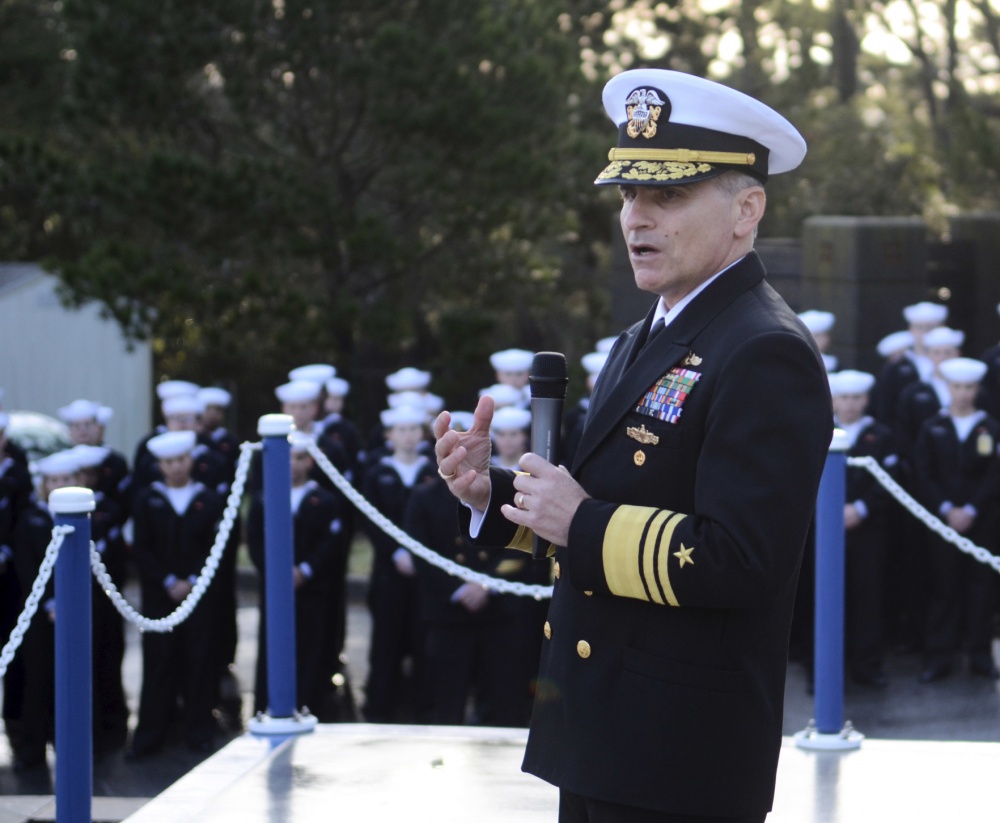
Monterey, Calif. (January 17, 2020) Vice Adm. Brian B. Brown, commander, Naval Information Forces, discusses chief of naval operations’ strategic intent and Sailor readiness during an all-hands call and visit to Information Warfare Training Command (IWTC) Monterey. (U.S. Navy photo by Cryptologic Technician (Interpretive) 3rd Class Shelby Sims)

We have come a long way in the past 10 years. While each information-based skillset brings significant and needed capabilities (the Navy still needs great intelligence, IP, CW, METOC professionals, and space expertise), this is a true case of the sum being greater than its parts. The combination of these capabilities brings winning advantage to the Navy’s needs in today’s complex fight. 

In the IW domain, you are constantly dealing with competitors every day, with DCNO for IW Vice Adm. Kohler stating “We consider ourselves in contact with the adversary now.” The Navy traditionally has its Phase 0 to Phase 5 spectrum of operations, but how does this apply to IW operations? How does the IW community balance winning the daily fight with being ready for what may be needed in a major conflict?

In today’s complex warfighting environment, we talk less about phases and more about the spectrum of conflict. That spectrum spans from so-called day-to-day/peaceful presence, through escalation and all the way up to lethal combat. We absolutely have to be ready for that high-end fight – lethal combat, but we also need to be successful across the entire spectrum.

Having said that, though, even in the peaceful presence side of the spectrum, there is daily conflict in the cyber domain. Both state and non-state actors leverage cyber to gain advantage in the strategic space below the threshold of armed conflict. Activity in this left-of-conflict spectrum run the gamut from intellectual property theft, to election interference, to ransomware and DDoS attacks, just to name a few. From a Navy IW perspective, this conflict at the left end of the spectrum is more than cyber, it is also contested engagement in intelligence, space, and the electromagnetic spectrum, and in understanding the physical domain.

Information Warfare is in that fight today in all those areas. The keys to this success are two-fold. First, we must defend forward. A great power’s weaponized information and influence operations are possible because of cyberspace. Defending forward means defending U.S. critical infrastructure from malicious cyber activity, individually or as part of a campaign, to prevent a significant cyber incident. Second, we must maintain persistent engagement. In cyberspace, this means the continuous execution of the full spectrum of cyberspace operations to achieve and maintain cyberspace superiority, including defending vulnerable networks through maintaining advantage in the electromagnetic spectrum.

Navy IW professionals use sensors, systems, and information to generate operational outcomes—passively and actively in all domains. While all those systems provide the tools to fight and win across the spectrum, people remain our greatest asymmetric advantage. We are fully using existing personnel policies and are constantly looking for new methods to attract and retain the best and brightest personnel. We need to maintain technical talent and personnel overmatch that includes our active and reserve uniformed personnel, as well as our civilian workforce. The Navy’s IW skillsets are needed more than ever in the daily fight of today as well as to be prepared for any potential high-end conflict.

How does information warfare fit into the Navy’s Distributed Maritime Operations (DMO) concept and other future warfighting concepts?

DoD’s and, in particular, the Navy’s primary mission is to protect the nation by defending forward. In the IW domain, that means disrupting and halting threats before they reach our networks or our forces. In the current era of great power competition, the concept of Distributed Maritime Operations (DMO) provides the ability for the fleet to maneuver effectively for advantage in a distributed manner, to create dilemmas for an adversary, while simultaneously maintaining the benefits of force integration. To accomplish that kind of maneuver across potentially multiple maritime combat formations requires all that IW delivers. The glue that pulls that all together is the collective set of IW capabilities.

Information warfare is a deeply cross-cutting discipline. How has the rise and establishment of the IW community elevated the understanding of IW more generally across the Navy’s communities? 

IW is a warfighting discipline, a set of warfighting capabilities, and a key enabler for all Navy mission areas. It underpins every warfighting domain from sea to land, to air, to undersea, to cyber, to space. It is a complex capability comprised of humans, machines, electromagnetic spectrum, and data that, when effectively combined, provides our force with non-kinetic options, increases the lethality of kinetic options, enables Distributed Maritime Operations, and delivers critical advantages in great power competition.

Over the past 10 years, the IW community has continued to further integrate fleet operations to provide vital decision space for our commanders. It is through collective IW capabilities that data from multiple sources are optimally transferred into actionable information to use for operational superiority.

One way the IW community has been elevated within the Navy is with the establishment of the Information Warfare Commander afloat. For several years now, the Navy has been operating with a senior, board-screened, post O-6 command tour IW captain as the warfare commander for information warfare on carrier strike groups, equal to other traditional warfare commanders. Based on value, the demand is expanding to amphibious ready groups and expeditionary strike groups.

We also have the Naval Information Warfare Development Center (NIWDC), established in 2017, that works with the other community Warfare Development Centers (WDCs) and the Naval Warfare Development Center (NWDC) to ensure our concepts, tactics, techniques, and procedures are fully integrated. This integration is critical, because the collective IW capabilities that assure command and control, provide predictive battlespace awareness, and deliver integrated IW fires are integral to all plans and operations.

What has been done to make IW capability and capacity more easily leveraged by sailors and commanders on the deckplate and afloat?

I’ve already mentioned the IW Commander Afloat role and the NIWDC, which bring the capabilities directly to the fleet, but I would also add that we have created an IW Training Group. This organization is analogous to and works closely with the long-standing Afloat Training Group structure to train individual ships and crews in IW capabilities at the deckplate level. This, along with NIWDC, is overseen by the IW Type Commander (TYCOM) – Naval Information Forces (NAVIFOR), which was established six years ago.

From the cybersecurity of the naval industrial base to hiring top-notch civilian talent, IW arguably demands an especially close relationship with the private sector. How do you view the nature of the IW community’s relationships that go beyond government?

Put simply, we could not succeed without our partners in industry. We work very closely with industry reps, at all levels, to ensure that the capabilities the Navy and Joint Force need to fight and win in the IW domain are available when needed. We feature significantly in a wide range of industry-focused forums, such as the annual USNI/AFCEA WEST Conference in San Diego, AFCEA EAST in Norfolk, and the Navy League’s Sea Air Space Symposium here in Washington, D.C., to build and maintain those relationships.

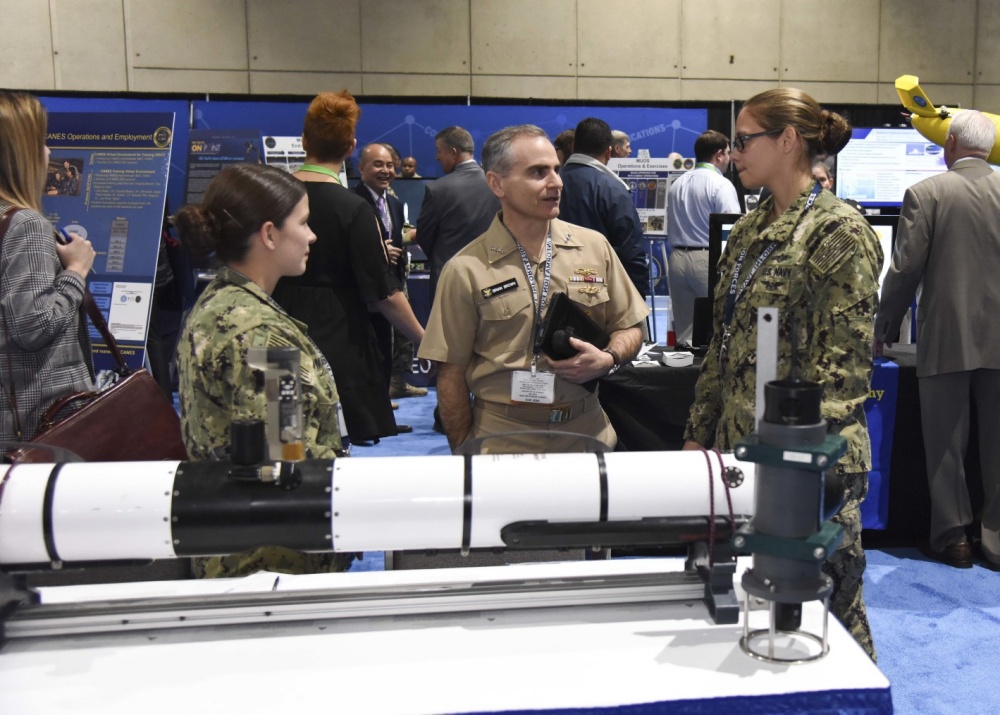
San Diego, Calif. (Feb. 13, 2019) Vice Adm. Brian B. Brown (center), commander, Naval Information Forces, speaks with Aerographer’s Mate 2nd Class Annalina DiMaggio (left) and Aerographer’s Mate 1st Class Deserae Laczniak (right) from Naval Oceanographic Special Warfare Center (NOSWC), at the Information Warfare Pavilion while attending WEST 2019.

From year one of our existence, we have co-sponsored, with AFCEA and the Naval Intelligence Professionals organization, an annual IW Industry Day. This IW Industry Day provides a day-long series of briefs and discussions, in a classified venue, to allow us to discuss where the Navy and Information Warfare in particular, are focusing our efforts and what we need to fight and win. We have had up to 500 industry representatives attend our most recent event. And, of course, I and my fellow IW military and civilian leaders participate in various other industry breakfast, luncheons, meetings, and conferences throughout any given year.

With the advent of technologies like artificial intelligence and big data, some suggest we may be in the midst of an IW-driven revolution in warfighting. How do you view the potential of IW to transform the nature of the warfighter and warfighting going into the future?

These technologies bring significant capability, with increasingly more expected. We spend a good deal of effort focused on what those new technologies mean to us, and how they can improve our capabilities. These new technologies will continue to advance how we train and fight, not just in IW, but in every domain. We work hand-in-glove with the Office of Naval Research, and across the Navy staff and the fleet, to continually harness this revolution in technology to give the Navy and Marines Corps team the edge we need to succeed, across the spectrum of conflict and operations. We will be directly involved in developing and employing the advantages to be gained through the use of revolutionary technologies such as artificial intelligence and machine learning.

Any final thoughts to share?

The recognition of the need for IW capabilities is now universal across the Department of Defense. We (the Navy) may have gotten to the table earlier, but all our sister services now have in place their own organizations aligned to the spirit of information warfare and are employing and building capabilities in the information domain. Each service may do it a little bit differently based on their own unique service cultures, but all understand the importance of harnessing these capabilities to fight and win today and in the future.

The Air Force, for example, combined their A2 (Intelligence) and A6 (Communications) directorates at the headquarters level here in the Pentagon as we did, while also creating the 16th Air Force at the next level down. Within the Department of the Navy (DON), the U.S. Marine Corps created a counterpart to OPNAV N2/N6, the Deputy Commandant for Information (DCI), with Lt. Gen. Lori Reynolds in the role. They call their effort “Operations in the Information Environment (OIE)” and include psychological operations and strategic communications in their OIE approach.

We work very closely together to provide the DON an integrated Naval IE/OIE capability – bringing the power of both the Navy and Marine Corps to bear.

Vice Adm. Brian Brown is currently serving as Commander, Naval Information Forces (NAVIFOR), and is a 1986 graduate of the U.S. Naval Academy. 

Dmitry Filipoff is the Director of Online Content for CIMSEC. Contact him at content@cimsec.org

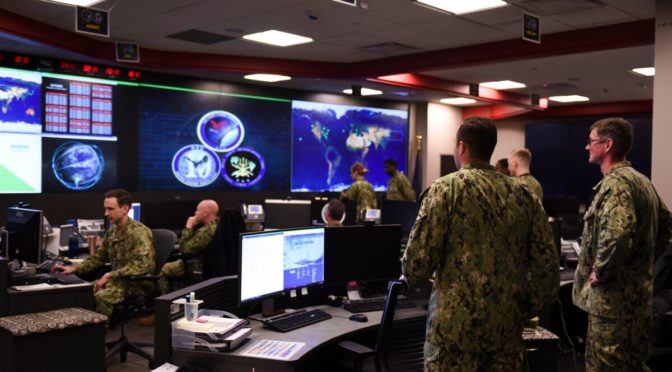
Featured Image: Fort George G. Meade Md. (Sept. 27, 2018) – Sailors stand watch in the Fleet Operations Center at the headquarters of U.S. Fleet Cyber Command/U.S. 10th Fleet (FCC/C10F). (U.S. Navy Photo by MC1 Samuel Souvannason/Released)

Fostering the Discussion on Securing the Seas.