By Robert C. Rubel
Soon the nuclear aircraft carrier USS Dwight D. Eisenhower will depart from Norfolk, Va., on a “double pump” deployment; going back out for another six or seven month cruise just six months after returning from a deployment that set records for the amount of time at sea. This departure will occur shortly after Ike’s sister ship USS Theodore Roosevelt did the same thing from the West Coast. This will take a toll on both the ships of the two battle groups and the sailors that man them, not to mention their families. The reasons behind the decision to double pump Ike boil down to too much demand from the regional combatant commanders and too few ships available to fill those demands at an operating tempo that allows for adequate ship maintenance and stateside time for sailors.
Although former Secretary of Defense Mark Esper issued a plan for expanding the fleet, its prospects for implementation are unclear at best due to massive government expenditures for COVID-19 relief and vaccines. For its part, the Navy is looking for ways to meet demands within expected budgets, such as fielding unmanned vessels and building smaller ships. But these measures miss seeing the strategic forest for the operational trees. The current U.S. military command and control system of regional combatant commands is tacitly based on having a much larger military force than is available today. In lieu of building the U.S. military, especially the Navy, back up to Cold War levels, a new approach to managing the use of naval forces on a global level is needed.
U.S. maritime strategy, which consists of the way the nation uses the seas to support its overall grand strategy, has been consistent since shortly after the end of World War II. The national grand strategy, adopted by President Roosevelt and his Secretary of State Cordell Hull, was to broker a system of international institutions and rules that would level the international economic playing field and at least work toward a rules-based international order. That grand strategy has been consistent to the current day despite changes in administrations, their differing policies, and massive geopolitical shifts; the U.S. seeks to comprehensively defend the global system of commerce and security.
The maritime component, as described by the political scientist Samuel Huntington in 1954, is to ring Eurasia with naval power to deter, suppress or defeat instability and aggression that might threaten the system. This maritime strategy is mechanized by the Navy, which is tasked with raising, training and maintaining forces for use by the regional unified combatant commanders. The combatant commanders, for their part, develop both war plans for use in case of military aggression and theater strategies for day-to-day security operations. Both include estimates of forces needed, which can be broken down into surge forces that might be needed for contingencies and steady state forces for day-to-day use, including deterrence, engagement and general constabulary functions. Thus, in the Navy’s case, it not only needs forces to meet the demands of day-to-day operations, but to have in reserve forces to surge in case war breaks out. During the Cold War, especially in the 1980s, the Navy had sufficient forces to support both aspects of force demand. Now it does not.
The strategic paradigm taught in the nation’s war colleges is ends-ways-means. These three elements must be harmonized if strategy is to be successful. Ends and the ways to achieve them must not be based on inadequate means. This implies, in the current instance, that either U.S. ends – a liberal global trading order – must be modified to be less expansive, or the ways, a grand strategy of comprehensive defense and support of that system, must be adjusted. Despite the Trump Administration’s adoption of an “America First” policy, it does not appear that it made any significant move to alter the supporting maritime strategy aspect of the traditional grand strategy, and the Biden Administration is likely to reaffirm U.S. adherence to it.
Given that the means the Navy has at its disposal to support the national maritime strategy are more or less fixed, something has to give. At various points suggestions have been made to shift the Navy to a surge posture, significantly reducing its forward deployments, but this would be out of step with the character of the national grand strategy. Altering fleet design to an architecture of a larger number of smaller and cheaper ships is a possibility, but this will take a decade or more to achieve, even if sufficient institutional and political support for it can be mustered. A way must be found to stretch the available means to accommodate the national maritime strategy in the short term.
One way of viewing the U.S. joint command and control structure is that it is based on strategic sufficiency of means. Whether the overall U.S. military strategy was based on two simultaneous major contingencies or down to one in one theater and a holding strategy in another, the demands for day-to-day forces emanated from all six geographic commands all the time, and a grand strategy of comprehensive system defense required that all of them be honored, even in light of the Navy’s severe difficulty in satisfying those demands. Former Deputy Defense Secretary Robert Work attempted to shift the formula from a demand-based model to one based on supply; the combatant commanders would be placed on a diet of forces that could be sustained by the Navy. He was not able to institute such an approach because starving the combatant commanders of forces across the board was neither consistent with the U.S. grand strategy nor was it politically acceptable to the combatant commanders. Another way of dealing with scarcity must be found.
An answer can be found in U.S. Air Force air power theory. That theory asserts that air power is a scarce but mobile resource. These two characteristics imply that it must be subject to centralized management such that can be applied strategically across the theater. This logic can be scaled up and applied to sea power on a global basis. In other words, the nation’s sea power, at least the allocation of it, should be managed by a staff in Washington that has a global perspective. Sea power, given the reduced size of the fleet, is a scarce asset whose application must be managed strategically.
Former Secretary of Defense James Mattis devised the idea of randomizing naval deployments or at least keeping intended movements of forces under wraps such that potential adversaries would not know when a U.S. task force would show up. In theory this would maintain deterrence with a force too small to conduct a station keeping strategy. While it made for good deterrence theory, it did nothing to address day-to-day combatant commander requirements and, from a global perspective, reduced the availability of U.S. Navy forces for response purposes. In any case, the strategy was never fully implemented; the combatant commander demands for forces just overrode it.
The failure of both the Work and Mattis schemes, even though emanating from the top two Defense Department officials, indicates that a more institutionalized fix is needed. That fix would consist of a new staff within the Pentagon with global command authority, at least for maritime operations. Its authority to allocate maritime resources would echo that of Admiral Ernest King in World War II in his role as Commander-in-Chief U.S. Fleet. He was the only officer that had the “latitude to change the longitude” of Navy ships. However, simply establishing the authority to manage the global distribution of naval forces is not enough, that distribution must be based on a new approach to the nation’s maritime strategy.
The U.S. Navy simply does not have enough ships to provide “full service” of robust deterrence, contingency response capability and engagement capacity in all areas, at least at an acceptable cost in terms of maintenance and personnel tempo. Prioritization on a global basis will be needed, and that is where a global maritime staff with global allocation authority is needed. Such prioritization must be strategic; that is, on the basis of some idea for how forces can be allocated to achieve desired effects or to manage the risk associated with executing the current maritime strategy with fewer forces. The current organizational structure is only able to allocate on the basis of satisficing. Such a staff might also be able to conceive of and implement a new version of the national maritime strategy.
Heretofore the U.S. Navy has, from time to time, issued what have been called maritime strategies, but as a military service constrained by statute to raising, training and equipping forces, it has no formal authority to do so. On the other hand, the Navy does have a global and maritime perspective, which at times has impelled it, notably in the cases of the 1980s Maritime Strategy and the 2007 Cooperative Strategy, to deal with an operational/strategic problem in the maritime domain that needed to be solved but which the joint chain of command either could not or would not address. A maritime staff within the joint chain of command would have such authority. This would require close coordination with most other cabinet departments and the National Security Council, which suggests that it be located in Washington.
A kind of template for such a staff already exists; each combatant command has a Joint Force Maritime Component Commander (JFMCC) embedded within its C2 structure. The JFMCC possesses the requisite authorities for moving, tasking and supporting naval forces, including not only the needed administrative mechanisms but a maritime operations center (MOC) that provides real-time situational awareness and communications.
A national level version of a JFMCC would be feasible from a mechanical point of view; the challenges to its instantiation would be political. First, it would essentially constitute a new unified command that combined the characteristics of current geographic and functional ones. However, unlike the geographic commands, the new global JFMCC would not directly command naval forces within a theater, it would simply allocate forces. Nonetheless, new legislation would be needed to create it and imbue it with the requisite authorities. Opposition from the Air Force and Army could be expected, as it might be viewed as giving the Navy too much power. However, the command would not have any Title X authority over budgets, although as a joint command, it would have a draw on forces from those Services if it thought necessary; the maritime domain involves the functioning of all types of forces. Moreover, as a joint command, it would be staffed by personnel from all the Services and its commander could wear any uniform. It is the perspective of the command – global – and its function – strategic allocation of forces – that governs the approach of whoever commands it, not the color of their uniform.
The current structure of the Unified Command Plan bakes in an inefficient approach to the execution of the national grand strategy and its maritime component. When the United States enjoyed a robust force structure this inefficiency could be tolerated; in the current environment of resource scarcity it creates more strategic risk than is necessary by limiting the global mobility of naval forces, and to some extent other forces. Strategic allocation vice satisficing must be achieved, and current structures such as the Joint Staff and Office of the Secretary of Defense are not able to accommodate the function. The creation of a new unified command with a global, maritime perspective is a viable and frankly necessary solution.
Robert C. Rubel is a retired Navy captain and professor emeritus of the Naval War College. He served on active duty in the Navy as a light attack/strike fighter aviator. At the Naval War College he served in various positions, including planning and decision-making instructor, joint education adviser, chairman of the Wargaming Department, and dean of the Center for Naval Warfare Studies. He retired in 2014, but on occasion continues to serve as a special adviser to the Chief of Naval Operations. He has published over thirty journal articles and several book chapters.
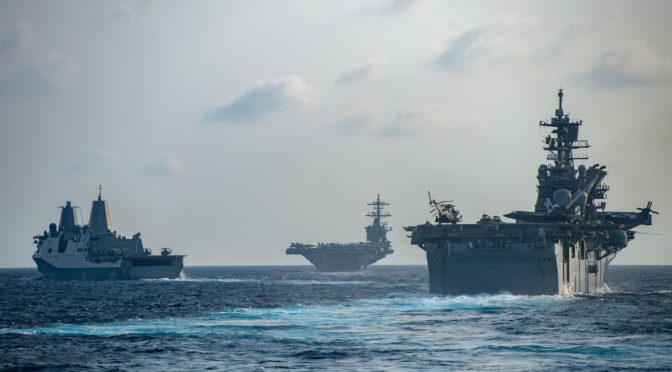
Featured Image: U.S. Navy ships from the Theodore Roosevelt Carrier Strike Group and the America Expeditionary Strike Group transit the South China Sea March 15, 2020. (U.S. Navy photo by Mass Communication Specialist 3rd Class Nicholas V. Huynh)