Preparing for the Future Fight: A Blended Career Path for Surface Warfare Officers

SWO Specialization Week

By Scott Mobley

Specialization debates are hardly new to the U.S. Navy or the Surface Warfare Officer (SWO) community. Rapid technological change over the past two centuries repeatedly propelled demands for specialization, drawing naval officers toward narrow fields of technical mastery and mechanistic views of warfare. At the same time, the growing complexity and scope of warfare required naval leaders to master the Art of War—harnessing technology, doctrine, and decision-making with an emphasis on the human elements of warfare. Two threads of professional culture arose, one centered narrowly on technology and specialized expertise, and the other focused upon understanding warfare broadly as a fundamentally human endeavor. Often these cultures—techno-centric and human-centric—competed against one another, producing uneven outcomes.1 However, the Navy also achieved notable success by blending and balancing the two cultures in the form of “generalist” commanders at the unit, force, and fleet level.

As they weigh future career paths, today’s surface warfare officers should inform their preferences and policy decisions with a critical understanding of past specialization debates, guided by several key questions:

  • What is a “generalist” commander? How has this concept evolved over time and what do these changes reveal about shifts in professional culture?
  • What is the art of war and why should today’s SWO leaders embrace it?
  • Why did the Navy adopt technical specialization in the past? How did specialization shape the service, and what are its implications for the SWO community today?
  • How have cultural tensions between technical specialization and the demands for generalist commanders affected the naval profession?

It is useful to explore these questions from a historical perspective, connect the Navy’s past experience to the present-day SWO debate, and ultimately propose a blended career path, incorporating the best aspects of technical specialization and generalist command.

What is a “Generalist”?

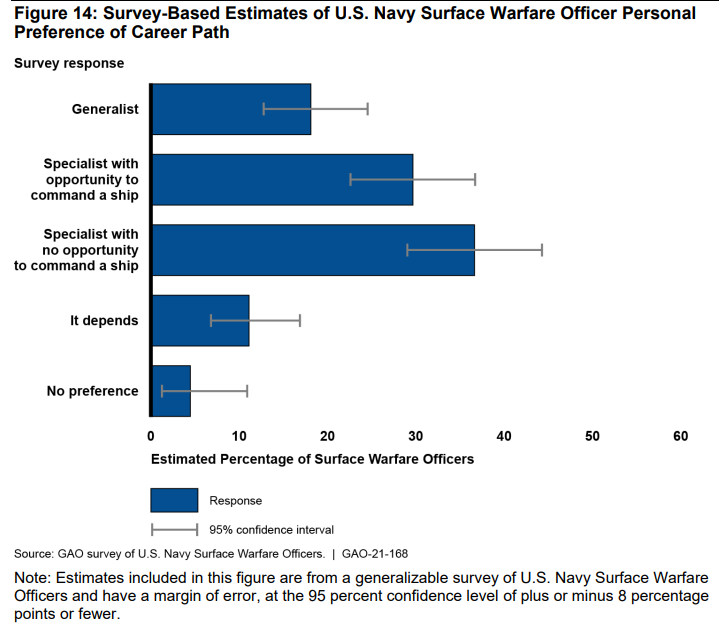
In 2021, the Government Accountability Office (GAO) surveyed members of the SWO community as part of a study on ways to improve the surface warfare officer career path. The survey results suggest that SWOs favor specialized career tracks over a generalist model by a margin of four to one—a strong demand signal, to be sure.2 However, the survey offers a narrow definition of “generalist” that does not align with a historical understanding of the U.S. Navy’s use of the term.

Choosing the SWO career path is itself a form of specialization. Accordingly, the GAO report defines the concepts of Specialist and Generalist within this narrow context. A “specialized” SWO typically serves within a single department throughout their career (Operations, Combat Systems, or Engineering) or in a single ship type. By contrast, a SWO generalist rotates across multiple departments and ship types.3

Traditionally, however, the term Generalist carried a broader meaning. During much of the 20th century, the concept of “generalist” described an officer with wide experience serving in a variety of roles ashore and afloat, often transcending a single platform type to include tours in surface ships, submarines, and/or aviation. Yet identifying as a generalist involved more than diverse assignments, it required an ability to weave technological and human elements together into coherent action.

In short, the naval generalist was—and should remain—not merely a technical expert with some experience beyond their specialization, but a leader who understands and practices the art of war at its highest level. As naval historian Mark Hagerott observes, “there was in the past, and will be in the future, an urgent need for those officers who can synthesize the many facets of sea power into a coherent whole.”4 Hagerott labels such officers “generalists and integrators,” capable of seeing beyond individual systems and specializations to grasp the larger strategic and operational picture.5

What is the Art of War?

At its core, the art of war frames how human agency shapes conflict. Wars unfold amid uncertainty, chance, fear, and material constraints. To navigate these conditions and prevail, combat commanders must exercise situational awareness, adaptive thinking, and judgment, while forging trust, teamwork, and esprit among those they lead. Commanders must also anticipate the dynamic and often obscure nature of enemy thought and action, while seeking to gain and retain the initiative.

Carl von Clausewitz placed human elements at the center of his theory of war, emphasizing the essential role of “moral factors” in war. For Clausewitz, war was not a technical problem, but a clash of opposing wills, shaped by passion, chance, and intellect. Recent scholarship amplifies this interpretation, arguing that the human elements constitute the timeless nature of war, even as advancing technology, new methods, and shifting cultures may evolve its character.6

Yet modern militaries—and the U.S. Navy in particular—today struggle to sustain focus on the human dimension. As technological complexity increases, institutional focus and professional culture gravitate toward material solutions, quantitative metrics, and technical mastery. In the process, the moral and psychological components of warfare often become marginalized. “Will and morale now represent critical aspects of warfare,” military scholar Byran Terrazas argues, “that the U.S. military has neglected in favor of material factors.”7 This tendency reflects not a rejection of the art of war, but a gradual obscuring of its human elements by the promise of seeming technical certainty.

Writing more than century ago, naval strategist Alfred Thayer Mahan warned against such trends. For Mahan, the art of war was grounded in “the mental and moral processes which determine action.”8 War, Mahan insisted, could not be reduced to mechanical processes or “made a rule of thumb”—attempting to do so would invite disaster by failing to account for the friction and unpredictability of human conflict.9 Mahan argued that the effective employment of navies required not merely wielding ships and weapons, but officers capable of understanding, synthesizing, and harnessing the diverse elements of sea power in pursuit of national goals.

This emphasis on synthesis lies at the heart of the naval art of war. Sea power does not reflect a single capability, but a complex amalgam of platforms, personnel, leadership, logistics, information, political and economic context, and culture. 19th-century naval reformers recognized a need for officers to cultivate their ability to integrate the elements of sea power through deliberate study, reflection, and practice. They believed that the art of war was best understood through engagement with the history and theory of conflict, reinforced whenever possible by practical experience through wargames, fleet exercises, and actual combat. As Captain Henry Clay Taylor observed in 1896, such activities are “calculated to bring into play the military qualities of the mind” that cannot be developed through technical training alone.10

It was precisely for this reason that Stephen Luce founded the Naval War College in 1884. Luce sought to institutionalize the study of the art of war, providing naval officers with the intellectual tools necessary to think and act critically in matters of strategy, operations, and command. After a rocky start, the College found its footing during the 1890s. However, interest plateaued during the first decade of the twentieth century as officers increasingly pursued technical education and specialized expertise. This shift did not eliminate the need for understanding the art of war—but it did complicate the Navy’s efforts to foster such understanding, setting the stage for enduring tensions between the need for human-centric integrators and technology-centric specialists within the U.S. naval profession.

“A house divided against itself”: U.S. Navy Specialization, 1842-1917

As the Naval War College sought to inculcate naval officers with the art of war, debates over specialization fragmented the U.S. naval profession. During the latter decades of the nineteenth century, two distinct lines of specialization drove this trend: deck officers and steam engineers.

Since the Navy’s inception, deck officers had formed the Navy’s “line” corps, dominating service leadership and embodying what it meant to be a naval professional. During the age of sail, officers of the line commanded all warship functions: operations, seamanship, navigation, gunnery, and propulsion (in the form of sail-handling). As David Kohnen has noted, these “salt horse” line officers valued action and practical experience over formal schooling.11

However, shortly after 1800, steam engines began to supplement and eventually supplant sails as the motive force for ships. Recognizing a growing need for specialists to operate the new propulsion systems, the U.S. Navy established a Corps of Steam Engineers in 1842, with its own rank structure and specialized educational requirements. This action served to realign shipboard authority and fracture officer identity in ways that many deck officers viewed as detrimental. With engineers playing an increasingly critical role in ship operations and forming a distinct core of specialists separate from the line, discord arose between the two corps.

During the 1870s, rivalry between line and engineer officers erupted into a bitter fight that went far beyond their technical roles—it became a struggle over identity and influence within a Navy in transition. As steam power displaced sail, engineers demanded rank and authority equal to the line corps, while line officers fought to preserve their primacy even as they themselves pressed to master emerging technologies like electricity and metallurgy. One official dubbed the quarrel a clash of “warring creeds,” underscoring its cultural depth.12

This line-engineer feud endured for three decades, fracturing the service and undermining both administration and operational effectiveness. One engineer officer described an atmosphere of “rivalry, jealousy, and strife for preferment.”13 War College founder Stephen Luce repined, “It is like the house divided against itself, or an organism carrying within itself the seeds of its own destruction.”14 At its core, the conflict reflected the Navy’s challenge to reconcile a culture of technical specialization to the wider needs of naval command. The “line-staff conflicts,” recounts historian Donald Chisholm, “were really battles over how professional ‘naval officer’ would be defined. The definition that prevailed would determine the place of specialization in a naval environment of increasing institutional and technological complexity.”15

By the late 1890s, the line-engineer fissure became so acute that civilian leadership intervened. Acting on recommendations from a personnel board chaired by Assistant Secretary of the Navy Theodore Roosevelt, Congress mandated in 1899 that the two corps unify into a single body. Accordingly, the Navy’s steam engineers became line officers, and all junior officers within the amalgamated corps were now required to perform both deck and engineering duties. Although amalgamation ultimately succeeded, it took nearly two decades of continuing debate and adjustment to strike an effective balance between deck and engineering expertise within the unified corps.16

One important consequence of the line-engineer merger was a surge of younger officers seeking to develop their technological knowledge and skills. When the Navy opened a new School of Marine Engineering at Annapolis in 1909, some 20 percent of the amalgamated line corps applied for its inaugural graduate program.17 Consequently, Luce expressed concerns that the push to recreate line officers as “fighting engineers” was in fact creating a new body of stove-piped engineering specialists, untutored in the art of war. Faced with declining enrollment trends at the Naval War College, he lamented “the majority of our young officers prefer the mechanical arts to the military arts.”18 While acknowledging that the Navy was making “ample provision for specialization,” Luce cautioned that they needed to be balanced with measures for developing the capacity of naval leaders to practice the art of war.19 Despite Luce’s warnings, line corps enrollment at the Naval War College continued to lag, even as interest in advanced engineering education remained strong.20

Great Power War and its Aftermath

The Navy’s uneven performance in the First World War validated many of Luce’s concerns. As it entered the conflict, the service possessed a growing cadre of technical experts, yet it lacked sufficient depth in understanding and practicing the art of war. Navy leaders and planners struggled with a host of issues: deployment planning; complex logistics and sealift; training bottlenecks, adapting to new technologies; command, control, and coordination (at the intra-service, joint, and combined levels), alliance management, industrial mobilization; and civil-military relations, among others.

In sum, the Navy failed to balance its drive for technical specialization with a coherent grasp of warfighting. This neglect left too many of its officers unprepared to address the complex elements of great power conflict, expansive multi-theater operations, and coalition warfare. As B.J. Armstrong observed, “some senior leaders didn’t discover the study of strategy until they had to do it.”21

Recognizing these deficiencies, in 1919 Navy leadership convened a board to examine officer education and career development. The three members—Captains Dudley Knox and Ernest J. King, and Commander William S. Pye—brought to bear their extensive wartime experience on fleet and theater staffs.22 In its final report, the board affirmed the need for technical specialization to accommodate rapidly advancing technologies that were already transforming naval warfare—most notably aircraft and submarines. However, the report also argued that such specialization must not come at the expense of developing capacities for integrating the technical and human aspects of conflict. Too often, officers attained senior rank without a full grasp of the complexities of modern naval warfare, leaving them poorly equipped to command in combat.

In response, the board recommended a blended, generalist career path, combining specialization “in at least one branch of the profession” with an advanced, progressive education in fleet operations, strategy, logistics, and international relations.23 It further proposed that officers complete advanced courses at the Naval War College before promotion to senior grades, ensuring their development as sea power integrators alongside technical expertise and practical experience. Working with the Navy’s technical experts and “salt horse” officers, these integrators would craft holistic solutions under wartime conditions of uncertainty, friction, and chance.

The Rise and Decline of the Generalist Naval Officer

The Knox–King–Pye Board’s recommendations reshaped the Navy’s approach to officer development. By adopting much of the board’s prescription, the service produced a generation of innovators and integrators—leaders who combined technical specialization with a deep understanding of strategy, policy, operations, logistics, and the human elements of warfare. Figures such as Chester Nimitz, Raymond Spruance, and William Halsey exemplified this fusion, practicing the art of war with remarkable success during World War II. Their ability to orchestrate complex campaigns across multiple theaters reflected the efficacy of the ‘blended’ career model, an outcome affirmed by Trent Hone’s analysis in Learning War, which shows how collaborative learning, experimentation, and diverse experience across systems and platforms were essential for operational success.24 And countering the historically divisive tendencies wrought by unmitigated specialization, the blended model fostered a more unified professional identity, bridging the technological and human elements of sea power to strengthen the Navy’s leadership culture.

Although the Knox–King–Pye system endured into the 1950s, it gradually declined after World War II. Several factors drove this erosion: an enlarged postwar officer corps overwhelmed the Navy’s educational institutions; a growing faith in technological solutions; the growing influence of specialized platform-specific communities in the form of aviation, submarine, and surface; Congressional mandates prioritizing “jointness” over unified service identity, and persistent cultural biases against formal education in the art of war.25 Cold War pressures amplified these trends, as rapid technological innovation and budget priorities favored hardware over human capital, reinforcing preferences that privileged advanced technology over strategic and operational insight. These developments diluted the integrative vision championed by Knox, King, and Pye, leaving the Navy increasingly fragmented along lines framed by platforms, technology, budgetary imperatives, and joint priorities. “As specialized platform and technical communities carved up the Navy’s officer corps,” Hagerott recounts, “the larger organizational value attached to integration was gradually discounted.”26

Blending Specialization with the Art of War

As with the Navy’s past reckonings with specialization, the current SWO debate ultimately turns on balance. Specialization delivers indispensable depth for warfighting—technical mastery, effective systems problem-solving, and deep expertise in rapidly-evolving technologies and domains of warfare. Yet specialization also introduces detriments: fragmented professional identity, siloed and sub-optimized thinking, and potentially a diminished focus on developing commanders with mastery in the art of war.

The traditional generalist model—rooted in integrative command—offers a counterweight. It cultivates breadth: the capacity to forge technology and human agency into decisive action. This approach fosters adaptability and unity of effort—qualities central to success in great‑power contests marked by multi-domain complexity. However, a generalist without sufficient grounding in the Navy’s technology and systems, and platforms would be unprepared to effectively command modern ships, forces, and fleets in combat. In sum, professional breadth unbalanced by technical depth is a brittle quality.

The Navy’s historical experience suggests that officer specialization is critically important but in itself insufficient. SWOs must also understand and harness the art of war—adaptive judgment, strategic sensibility, and the human elements of leadership. Overvaluing specialization risks dividing the SWO community—and indeed the wider Navy—into “warring creeds.” Underinvesting in the art of war risks leaving the fleet technologically sharp yet operationally blunt.

The challenge, then, is to produce SWO officers with technical expertise and warfighting command competencies aligned with Mark Hagerott’s call for “generalists and integrators.” Accordingly, the SWO community might consider these specific measures as it forges new career paths for the 21st century:

  • Pair technical mastery with integrative skills: Couple specialization with measures to broaden understanding and practice of the art of war. This would include mandatory Naval War College education, reinforced by iterative fleet-based training, problem-solving case studies, and intensive wargaming, similar to the interwar system that prepared the U.S. naval leaders of WWII.
  • Align incentives: Shape the performance evaluation system, promotion, and detailing to recognize and reward officers who demonstrate both technical ability and competence in the art of war.
  • Cross‑pollinate tours: Require at least one tour outside a specialist track to build breadth and strengthen ship team cohesion (e.g., Engineering or Combat Systems specialization plus an Operations tour). The “non-specialty” tour(s) could take place at the division officer or department head level.

Technological prowess hones the Navy’s combat edge. Combat leaders well-anchored in the art of war can make it victorious. The SWO community needs both.

Captain Scott Mobley, USN (Ret.) commanded the USS Boone (FFG-28) and USS Camden (AOE-2). He also served as reactor officer in the USS Harry S. Truman (CVN-75). After retiring from the Navy, he authored Progressives in Navy Blue: Maritime Strategy, American Empire, and the Transformation of U.S. Naval Identity, 1873–1898 (Naval Institute Press, 2018). He earned an M.A. in national security affairs from the Naval Postgraduate School and a Ph.D. in history from the University of Wisconsin–Madison, where he currently teaches in the Political Science Department.

References

[1] Scott Mobley, Progressives in Navy Blue: Maritime Strategy, American Empire, and the Transformation of U.S. Naval Identity, 1873-1898 (Annapolis, Maryland: Naval Institute Press, 2018), 10, 266-267.

[2] Cary Russell, Navy Readiness: Actions Needed to Evaluate and Improve Surface Warfare Officer Career Path (Washington, D.C.: Government Accountability Office, 2021), 126.

[3] Ibid., Highlights.

[4] Mark Hagerott, “Commanding Minds: Naval Leadership in the Age of AI,” U.S. Naval Institute Proceedings 151, no. 12/1,474 (December 2025), https://www.usni.org/magazines/proceedings/2025/december/commanding-minds-naval-leadership-age-ai.

[5] Ibid.

[6] For a vibrant ongoing discussion comparing the nature of war to its character, see: Gerard Roncolato, “The Character of War Is Constantly Changing,” U.S. Naval Institute Proceedings 148, no. 4/1431 (May 2022), https://www.usni.org/magazines/proceedings/2022/may/character-war-constantly-changing; F Hoffman, “Will War’s Nature Change in the Seventh Military Revolution?,” Parameters 47, no. 4 (November 2017): 19–31; and Christopher Mewett, “Understanding War’s Enduring Nature Alongside Its Changing Character,” War on the Rocks, January 21, 2014, https://warontherocks.com/2014/01/understanding-wars-enduring-nature-alongside-its-changing-character/.

[7] Bryan Terrazas, “The Human Element: The Other Half of Warfare,” The Strategy Bridge, June 2, 2022, https://thestrategybridge.org/the-bridge/2022/6/2/the-human-element-the-other-half-of-warfare.

[8] Alfred T. Mahan, “The Naval War College,” The North American Review, July 1912, 72.

[9] Alfred Thayer Mahan, “The Practical Character of the Naval War College,” U.S. Naval Institute Proceedings 19, no. 2/66 (April 1893), https://www.usni.org/magazines/proceedings/1893/april/practical-character-naval-war-college.

[10] Henry C. Taylor, “The Study of War,” The North American Review, February 1896, 181.

[11] David Kohnen, “Charting a New Course: The Knox-Pye-King Board and Naval Professional Education, 1919–23,” Naval War College Review 71, no. 3 (May 2018), 2.

[12] William G. McAdoo, “Reorganization of the Personnel of the Navy,” The North American Review, October 1894, 457.

[13] Frank M. Bennett, The Steam Navy of the United States: A History of the Growth of the Steam Vessel of War in the U.S. Navy, and of the Naval Engineer Corps (Pittsburgh: W.T. Nicholson, 1896), 604.

[14] Stephen B. Luce, “Annual Address,” U.S. Naval Institute Proceedings 14, no. 1/44 (January 1888), https://www.usni.org/magazines/proceedings/1888/january/annual-address.

[15]. Donald Chisholm, Waiting for Dead Men’s Shoes: Origins and Development of the U.S. Navy’s Officer Personnel System, 1793-1941 (Stanford, CA: Stanford University Press, 2001), 419.

[16]. The 1899 merger quelled the worst friction between the two specialist groups, but it did not end debate. Some officers in both corps initially resisted the change, and critics questioned whether former deck officers could safely manage increasingly complex propulsion plants compared to professionally trained engineers. For years, discussions continued over the proper mix and depth of engineering and deck expertise required for effective command. See Dana L. Mathes, “The Fight for the Soul of the U.S. Navy: Engineering the Officer Corps of the New Steel Navy, 1886-1916” (University of Texas at San Antonio, 2018), 143-161, 164-166.

[17] Stephen B. Luce, “On the Relations Between the U.S. Naval War College and the Line Officers of the U.S. Navy,” U.S. Naval Institute Proceedings 37, no. 3/139 (September 1911), https://www.usni.org/magazines/proceedings/1911/september/relations-between-us-naval-war-college-and-line-officers-us; U.S. Department of the Navy, Register of the Commissioned, Warrant, and Volunteer Officers of the Navy of the United States Including Officers of the Marine Corps and Others (Washington D.C.: Government Printing Office, 1910), 6-50.

[18] Luce, “Relations Between the U.S. Naval War College and the Line Officers.”

[19] Ibid.

[20]. The U.S. Navy line corps more than doubled between 1900 and 1917, growing from 882 officers to 2113. Naval War College enrollment, however, did not keep pace. From 1894 to 1897, more than 3% of active line officers enrolled annually. During the decade following the line-engineer merger, average enrollment dropped to 2% per year. Between 1911 (the year of Luce’s warning) through 1917, the rate declined further to about 1.5% annually. Register of the Commissioned, Warrant, and Volunteer Officers of the Navy, volumes 1894-1917; Naval War College, Register of Officers, 1884-1979 (Newport, RI: U.S. Naval War College, 1979).

[21] B.J. Armstrong, “A 96-Year Old Report Can Teach Us About Velocity in Naval Learning,” War on the Rocks, September 9, 2016, https://warontherocks.com/2016/09/a-96-year-old-report-can-teach-us-about-velocity-in-naval-learning/.

[22] Kohnen, “Charting a New Course,” 128-129.

[23] “Report And Recommendations Of A Board Appointed By The Bureau Of Navigation Regarding The Instruction And Training Of Line Officers,” U.S. Naval Institute Proceedings 46, no. 8/210 (August 1920), https://www.usni.org/magazines/proceedings/1920/august/report-and-recommendations-board-appointed-bureau-navigation.

[24] Trent Hone, Learning War: The Evolution of Fighting Doctrine in the U.S. Navy, 1898–1945, Illustrated edition (Annapolis, MD: Naval Institute Press, 2018), 323-330.

[25] In 1937 (before world war expansion kicked in) the U.S. Navy officer corps numbered 9,897 persons. In 1947, as postwar mobilization proceeded and before Cold War rearmament began, the officer corps numbered 58,689, down from a wartime peak approaching 324,000. See “US Navy Personnel Strength, 1775 to Present,” Naval History and Heritage Command, July 27, 2020, http://public1.nhhcaws.local/research/library/online-reading-room/title-list-alphabetically/u/usn-personnel-strength.html. Multiple developments underpinned the Navy dropping the Knox-King-Pye prescription, as synthesized from Robert B. Kelly, “The Education Of The Line,” U.S. Naval Institute Proceedings 85, no. 12/682 (December 1959), https://www.usni.org/magazines/proceedings/1959/december/education-line; John T. Kuehn, “US Navy Cultural Transformations, 1945–2017,” in The Culture of Military Organizations, ed. Peter R. Mansoor and Williamson Murray (Cambridge: Cambridge University Press, 2019), 356-357; Steve Wills, Strategy Shelved: The Collapse of Cold War Naval Strategic Planning (Annapolis, MD: Naval Institute Press, 2021); 4-8; Scott Mobley, “How to Rebalance the Navy’s Strategic Culture,” U.S. Naval Institute Proceedings 148, no. 11/1437 (November 2022), https://www.usni.org/magazines/proceedings/2022/november/how-rebalance-navys-strategic-culture.

[26] Hagerott, “Commanding Minds.”

Featured Image: U.S. CENTRAL COMMAND AREA OF RESPONSIBILITY (Nov. 26, 2024) A U.S. Navy surface warfare officer takes bearing while standing watch on the bridge aboard the Arleigh Burke-class guided-missile destroyer USS Cole (DDG 67) in the U.S. Central Command area of responsibility. (Official U.S. Navy photo)
The Merchant Marine Specialized 100 years ago. The Navy should have then, and needs to now.

SWO Specialization Week

By MIDN 1/C Jeffrey W. Jaeger, USNR

Since 1899, the U.S. Navy has used a generalist career track for its surface warfare officers. This coincides with the Arthur administration’s imperative that the Navy rehabilitate itself from traditionalist mores that restricted steam engines, available in common maritime usage from the early 1800s as auxiliary systems for primary sail power. Congress responded to President Arthur and authorized the Navy’s first all-steel, all-steam warships in 1883.1 The Spanish- American War finally convinced most of the Navy’s recalcitrant officers that machinery-powered warships were the future. The Great White Fleet followed, and tall ships were relegated to history.

Although sailing had long been viewed throughout the world as a specialized profession, those within the profession qualified “able-bodied” seaman as generalists. This meant that just about every sailor aboard ship had the capability of working with sails and rigging, and the officers were possessed of knowledge not just of navigation but of how the propulsion system had to be operated and maintained. Even so, a major criticism of this transition from the officer corps was that the more crew-efficient, technically-specialized nature of machine-driven plants would degrade the teamwork required amongst the seamen, petty officers, and junior officers to work en masse with the labyrinthine sail rigs.2 This was in addition to the perceived unreliability of machine plants, which was justified in part due to the specialized skills required to maintain, operate, and repair such plants. The navigator was relieved from the burden of having to constantly optimize the set of his sails in dynamic conditions over distance and fixing position by celestial sights at frequent intervals as the dead reckoning course became more reliable. With regular propulsion not dependent on environmental factors and operated from a remote position away from the quarterdeck, much of the watch officer’s duties could be refocused toward other deck-related tasks.

The Navy believed that redundancy and the operational needs of gunnery and damage control meant that military crews would remain more generalist, while merchant crews grew leaner and more profitable. Crews did indeed become more fragmented into the divisions and departments that exist today instead of gun crews and messes. They were broken up by technical function into smaller and more disparate teams across larger vessels. Watch officers became disengaged from the operation of the propulsion, since their navigational duties became increasingly disconnected from the means of propulsion itself and was more reactive, or corrective, than proactive in nature.

The deck and engine departments formed themselves, which panicked the Navy. Redundancy, they decided, required every officer aboard to return to the Age of Sail and know every other officer’s job aboard so that a loss of men would not result in combat ineffectiveness of the unit. Steeped in tradition, and mourning a time that would never return, the Navy clung to the adage that an officer could only be effective if he had a passable knowledge of every system aboard ship, rather than in-depth expertise of certain systems.

The Merchant Marine, on the other hand, leapt into steam power with gusto. Scottish engineers in Glasgow created the Charlotte Dundas, a canal tug, as the world’s first practical steam-powered vessel in 1802, less than a century after the original Newcomen steam engine was built on land but decades before the Navy adopted steam power.3 Robert Fulton built the first commercially viable steamship in America five years later, using a Watt engine of mid-eighteenth century design. By 1819, the auxiliary steamer SS Savannah had completed the first trans-Atlantic voyage under partial steam power. Although maritime steam languished for several decades, better understanding of the relationships between cubic capacities versus the square water resistance of ships along the waterplane led to the creation of larger, more economical vessels, while naval vessels unconcerned with cargo profits focused on armament, armor, survivability, and maneuverability. Professionalization of marine steam engineers relieved many of the concerns about steam boiler explosions, since they were operated by experts rather than captains pushing unfamiliar systems to the limit. In 1838, the SS Sirius won the first unofficial Blue Riband by crossing the Atlantic entirely by powered machinery in record time.4 She made the crossing with a crew of 36. A U.S. Navy first-rate tall ship of the line launched in the same year, the USS Pennsylvania, carried 1,100. An early Navy steamship of the 1830’s, the USS Fulton, mounted only four 32-pounders but carried a complement of 130. Setting aside gun crews, Sirius was far more efficient ton-for-ton by deadweight and displacement. Amongst commercial ships of the time, Sirius had half the crew of full-rigged tall ships. The Age of Steam was well upon the Merchant Marine.

Driven by the business necessities of minimizing crew costs, lowering transit times, and maximizing carriage capacity, the Merchant Marine’s adoption of steam power was an economic imperative. It did not have the luxury of clinging to tradition for tradition’s sake, and could not afford to overbuild ships for minimal risks that were underwritten by insurers anyway. This capitalist mandate for innovation spurred the Merchant Marine to adopt engineers as a separate and distinct department of maritime labor. More efficient engines in terms of machinery and fuel, along with additional developments such as multiple-expansion boilers, condensers, and economizers, came with increased demands for specialists that could keep these plants running with minimal laytime and personnel.

Authority is more horizontal in the Merchant Marine than in the Navy, and duties are less formally assigned. This necessitates broader swaths of knowledge despite the separation of departments. On the deck side, officers fill roles that are flexible, often interchangeable, and usually according to informal tradition. This flexibility amongst the captain’s mates allows the master (as the captain is legally known) to exercise broad authority for the entire crew and vessel, despite being licensed solely as a deck officer. Engineering officers have even more flexibility in their roles and are usually assigned a broad group of systems to supervise. Both sets of officers stand watches within their departments, although automation has resulted in “unmanned” engine rooms for many newer ships that permit the engine crew to operate as dayworkers. These officers are usually the only licensed personnel on duty at any time, so they must have a complete knowledge of every task and duty which might befall them during the watch. Unlicensed watch personnel are also typically limited to just one or two on either side. Most unlicensed sailors do daywork, fulfilling their working hours on a normal schedule with overtime for after-hours cargo, locking, or docking operations.

In the Navy, however, officers are considerably more siloed and yet pulled in more directions throughout the day than their Merchant Marine counterparts. A junior officer is assigned control of a division, which comprises a chief petty officer, one or more petty officers, and several enlisted sailors that are grouped together by their technical rating or the specific systems they operate on a daily basis. They will fill different roles in different situations, according to multitudes of station bills written up for every conceivable circumstance the ship could find itself in. The officer in charge of that division has no specialized or technical training for that division’s equipment. He is made to manage a small group of sailors, who are the experts that train new enlisted sailors rotating in from A-school already in possession of foundational training.

Contrast that with a Merchant Marine officer, who is not only licensed by proving that he has expertise in every facet of his department on a grueling series of exams, but has also sailed for no less than a full calendar year as a trainee in his department (half that for engineers, since their roles are more easily trained on land). His unlicensed personnel are either highly experienced, requiring little supervision, or new with minimal union schooling, thereby requiring considerable supervision and training with a capitalistic impetus to learn rapidly. This is a more efficient crew structure that maximizes usage of each individual and of automated equipment.

Throughout their careers, surface warfare officers acquire training and warfare-specific knowledge through on-the-job training and sporadic schooling ashore. Merchant Marine officers arrive to the fleet fully-trained and expected to stand a watch on day one, which they are qualified to do. The Navy previously shipped officers directly from their commissioning source (college, OCS, or USNA) to their ships. Practically zero of them had any shipboard experience whatsoever and had to get a crash course on the basics such as COLREGs or maneuvering. Some watchstanding training is now provided ahead of time, first through a distance-learning course derisively known as “SWOS in a box” and now through the Basic Division Officer Course in Newport.5 However, these officers must learn the basics while managing a division of sailors, with all the needs and wants of sailors wholly dependent on their leadership for their careers and well-being, standing watches on the bridge, and then at some point in the engine control room. As a result, surface warfare officers are constantly burned out, overtaxed, and less knowledgeable about the thing that makes them a SWO – their ship – than their Merchant Marine counterparts. Even the SWO pin qualification is less an exercise in actual proof of understanding, as the curricula for Merchant Mariners’ “sea years” are, and more just a matter of rote memorization.

The fact remains that a Navy SWO is less trained and less experienced than a more junior Merchant Marine officer at that thing that unites them professionally – being a mariner. The lack of seamanship has gotten so critical that the Navy, who commissions a small cadre of under 2,200 licensed Merchant Mariners as reserve Strategic Sealift officers (SSOs), has to send these mariners out to sea to teach SWOs basic shipboard concepts such as bridge resource management.

While there can be a need for officers to be well-rounded leaders and know their entire ship, the fact of the matter is that combat redundancy is no excuse for simultaneously pigeonholing officers into a division with no relevant training and then forcing them to understand every department’s equipment and operations through slapdash “training” performed almost entirely as a competition to their already-strained workday. If so many engineering officers are killed in combat that a deck officer must fill their role, then the ship is already combat ineffective. Generalist officers often cannot offer enough instruction, expertise, and advice to the more specialized enlisted sailors they are meant to supervise. Passing that buck to their chief petty officers robs the officer of their responsibility to become a mariner and a leader of mariners.

By contrast, Merchant Marine officers are either deck or engineering officers from their first day as cadets. They spend up to four years training in academies and at sea, or even longer if they “hawsepipe” (that is, learn from observation and classes taken during vacations on land while working as an unlicensed sailor), just to master the basics of their department. Front- loading training and then specializing them in one of just two major functions common to every ship afloat means they are effective on day one of work. Specialization permits more in-depth knowledge of tasks and equipment, which still takes many years of intense training to master. Forcing them to learn both halves of the ship would cause the training sufficient for them to be ready “day one” to take seven or more years, or else result in officers who are somewhat familiar with both halves but incapable of properly manning any role in either half. Specialization, to the extent that the Merchant Marine does so, strikes the right balance between the technical expertise of individual ratings that rightfully belongs to the enlisted Navy sailor while allowing them to be effective supervisors, managers, and – most importantly – mariners.

Navy generalists argue that SWOs operate vessels that are orders of magnitude more complex than merchant vessels and have weaponry and sensors to operate that merchantmen do not. They argue that a SWO must have a total understanding of the entire vessel so they can employ their division or department within the context of the whole. How, we ask, is that any different than what a merchantman does? While a modern merchant vessel no longer employs weapons systems, the ship’s “weapons” are the interlinked cargo-handling gear systems that give the vessel its purpose just as a destroyer’s missiles give it its mission. For the same reason that merchantmen took on steam power in its infancy, commercial trade dispensed with longshoremen as soon as better technology was available. While more efficient, this increased the technical and engineering demands on both departments of the ship crews. Yet no one would argue that merchant officers should have become less expert in their fields as a result.

There is also a major difference in that merchant mariners are constantly employing their vessel’s central capabilities and functions to full effect. The same cannot be said of SWOs who have not had to fight their ships in a great power war in decades. This lack of experience in performing their ultimate function may be masking a need for specialization because the generalist model has not been subjected to the stress of modern great power conflict. Recent sustained missile conflict in the Red Sea has offered the closest glimpse, and perhaps shown some cracks in the system. Yet the generalist model is arguably already struggling to meet peacetime demands beyond the bare minimum. With the advent of warfare tactics instructors, it is possible for a third department to emerge within the surface warfare community – operations – which focus on the weapons and sensors used to fight the ship.

With retention being one of the most critical issues apart from maritime expertise facing the SWO community, specialization will only enhance a sense of professionalism that lends itself to more fulfilling careers served in full. Despite bonuses into the six figures, SWO department head retention rates are stubbornly stuck around 35 percent, well below other warfare communities.6 SWOs have complained of overwork and being pulled in too many directions. Specialization into a single department just as Merchant Mariners enjoy, combined with more frequent shore time in the model of the submarine service’s blue-gold crewing structure, will relieve these issues. The SWO will become more mission-focused in a field in which he is not only allowed but encouraged to develop deep professional expertise, and permitted to stay in the area of his expertise in the same way that naval aviators fly the same aircraft type for their entire career. Professional satisfaction and welfare will increase retention, building up into manpower levels that permit more flexible crewing structures.

On the topic of aviators and submariners, the generalist argument that broad knowledge is required to assume higher levels of responsibility rings hollow. While it is true that Merchant Marine captains are exclusively licensed as deck officers, chief engineers are accorded similar levels of respect within the community. The Navy relegates this position to mid-level management as a department head with no particular engineering expertise.

Thanks to bridge manning with watch officers and officers of the deck, it is entirely feasible that a captain can be drawn from any department. Even if the Navy chooses to emulate the Merchant Marine and draws captains from the most “seaman-ly” department, the deck, this is little different than distinguishing between the unrestricted and restricted lines. Officers motivated to stay in their fields from which they draw professional satisfaction instead of being forced into management positions they are less engaged in are more likely to stay in service and hone their craft.

MIDN 1/C Nicholas Punla Smith, USNR, previously served as a bosun’s mate aboard the USCGC Barque Eagle (WIX 327) and has argued that generalized training for new officer candidates is valuable precisely because it demands the teamwork and foundational seamanship that Navy generalists cling to with their traditional mindsets left over from the Age of Sail. Generalized operations, however, are counterproductive. We cannot ignore the fact that our vessels today are far more complex than even the largest ships of the line. While electronics and automation have reduced the requisite number of crew for equivalent tasks, many shipboard tasks today were unimaginable to tall ship sailors who were simply not technologically advanced and would not recognize the style of warfare we now practice. The Merchant Marine embraced change and adapted to new technologies with their commensurate labor roles as soon as it was feasible and demanded by economics. The Navy, thanks to their ability to stand outside the flow of constant market forces, clung to tradition for tradition’s sake even to the point of ordering all-sail ships half a century after the introduction of marine steam plants.7

The time was a century ago for the SWO officer corps to accept that the future had arrived, and it is past high time for them to do so now. The U.S. Navy surface warfare community must adapt accordingly, as their Merchant Marine brethren have to great effect, for their benefit as professional mariners.

MIDN 1/C Jeffrey W. Jaeger, USNR, is in his final year at the Great Lakes Maritime Academy and will be licensed as a third mate and first-class pilot in the U.S. Merchant Marine as well as commissioned as an ensign in the Navy’s Strategic Sealift Officer Force. He has sailed in unlicensed and cadet capacities aboard the M/V Edwin H Gott, USNS Washington Chambers (T-AKE 11), USS Mason (DDG 87), and M/V Herbert C Jackson. MIDN Jaeger has been previously published in the US Naval Institute’s Proceedings and is a former indirect fire infantryman and infantry officer of the U.S. Army.

References

1. US Navy. (2024, February 20). Sail to Steam Propulsion. Naval History and Heritage Command. https://www.history.navy.mil/browse-by-topic/communities/surface/steam.html

2. US Navy. (2024a, January 17). The Steel Navy. Naval History and Heritage Command. https://www.history.navy.mil/browse-by-topic/exploration-and-innovation/steel-navy.html

3. Fry, Henry (1896): The History of North Atlantic Steam Navigation: With Some Account of Early Ships and Shipowners, Sampson Low, Marston & Co., London.

4. Britannica Editors (2019, September 13). Sirius. Encyclopedia Britannica. https://www.britannica.com/topic/Sirius-steamship

5. Faram, M. (2017, August 27). Maybe today’s Navy is just not very good at driving ships. Navy Times. https://www.navytimes.com/news/your-navy/2017/08/27/navy-swos-a-culture-in-crisis/

6. Stancy, D. (2024, January 9). Here’s what the Navy is doing to boost SWO retention. Navy Times. https://www.navytimes.com/news/your-navy/2024/01/09/heres-what-the-navy-is-doing-to-boost-swo-retention/

7. National Park Service. (2011, June 5). USS Constellation (frigate). National Historic Landmarks Program. https://web.archive.org/web/20110605234813/http://tps.cr.nps.gov/nhl/detail.cfm?ResourceId=697&ResourceType= Structure

Featured Image: The Cape Edmont Ready Reserve Force vessel docks in Agadir, Morocco, Feb. 29, 2020. The cargo vessel, operated by Merchant Marines from the U.S. Department of Transportation, carried nearly 7,000 tons of military equipment for use in African Lion 20, the largest exercise in Africa. (Photo by Maj. Cain Claxton U.S. Army Southern European Task Force, Africa)

SWO Specialization: Specialize by Platform Groups to Win the High-End Fight, Pt. 1

SWO Specialization Week

By LCDR JR Dinglasan, USN

Introduction

 To win the fight against a peer adversary, the navy’s surface warfare officer (SWO) community must display a level of warfighting proficiency – one of excellence – not yet seen in many years. The collisions of 2017 and continued near misses and actual mishaps since, such as the grounding of USS Howard (DDG 83) in 2023 and the Harry S. Truman (HST) Carrier Strike Group (CSG) friendly fire incident in 2024, reveal that the surface force lacks a high level of operating proficiency, in terms of both shiphandling and tactical skill. However, while sweeping reforms were swiftly implemented to increase shiphandling proficiency, the SWO community has not shown the same kind of fervor to implement the sweeping changes needed to dramatically increase tactical proficiency.

But this fervor and urgency is needed. Despite the groundbreaking success of the SWO warfare tactics instructor (WTI) program, it alone has not been enough to increase the overall floor of the surface force’s tactical proficiency. The HST CSG friendly fire incident is a symptom of a larger problem, not an exception to the rule. And it is not the only symptom. Despite the relatively successful performance of the surface force recently in the Red Sea (no ships have yet been struck by a Houthi anti-ship missile), there have been several unnecessary close calls. Additionally, ships enter SWATT (Surface Warfare Advanced Tactical Training) with varying levels of proficiency, with some ships entering at such a low level that precious underway days are spent on basic tactics.1 Today’s ships carry immense combat power and in very different forms, but SWOs are not effectively prepared to command them. A destroyer commander with little knowledge of the Aegis Weapon System, which is possible with today’s construct, will struggle to effectively lead their ship in great power combat. These symptoms indicate a flawed system of training and tactical development for SWOs, resulting in the community’s warfighting proficiency being far from a level needed to defeat the primary competitor of the era – the People’s Liberation Army (PLA).

Perhaps the most hotly debated reform to improve warfighting skill is the specialization of the SWO community – proposed in the wake of the 2017 collisions but not implemented. Of myriad proposals, SWO specialization is the single most effective structural change the community can undertake to substantially increase the surface force’s tactical proficiency in the long term.

SWOs as Generalists, the Pitfalls of Generalization, and the Subsequent Need to Specialize

Currently, SWOs are considered generalists, and this generalization is often debated in the SWO community. A 2021 Government Accountability Office (GAO) study on the SWO career path concludes that a large majority of SWOs believe that specialization is necessary, with 67% of those surveyed believing that specialization in some form is needed, as seen in the figure below:2

Figure 1. GAO Report Survey Summarizing SWO Personal Preference of Career Path

What is meant by SWOs being generalists? Or as SWOs like to call themselves, “jacks-of-all-trades”? Throughout a SWO’s career, a SWO can both 1) serve as any administrative billet on a ship (e.g., damage control assistant (DCA), weapons officer, chief engineer, training officer, etc.) and 2) serve their tours on any ship class, including cruisers, destroyers, amphibious assault ships, littoral combat ships (LCS), and mine countermeasures (MCM) ships.

Consider the following hypothetical example. A SWO starts their career as the gunnery officer on an LPD (landing platform dock) for their first division officer (DIVO) (1DV) tour, then serves their second DIVO (2DV) tour as the 1st Lieutenant on an MCM, then serves their first department head (DH) (1DH) tour as the chief engineer on an MCM, then their second department head (2DH) tour on a CG (guided-missile cruiser), which also serves as the air and missile defense commander (AMDC) for a carrier strike group (CSG). That 2DH would be expected to employ the highly complex Aegis Weapon System (AWS) and coordinate the air defense of an entire CSG during their watch, with very little previous experience in employing these highly advanced tactics. Then at the rank of Commander, that SWO could then potentially take command of an Aegis DDG (guided-missile destroyer), with only one previous tour employing Aegis, long-range surface fires, and advanced anti-submarine warfare capabilities such as the SQQ-89 ASW weapon system. Officers such as this SWO are stretched thin across a wide variety of highly complex systems and platforms. This stretching can increase as their career advances, all while being charged with progressively greater warfighting responsibility.

Another example further illustrates the issues with generalization. Imagine two newly-reporting department heads reporting to a DDG. Given equal talent and tactical training (let us assume that both attended the DH tactical action officer (TAO) course and neither one is a WTI), one might believe that two DHs who report at the same time would be equals at fighting the ship as TAOs. However, one did their first two DIVO tours on an LPD then an MCM, with no tactical qualifications achieved (since none are mandated at the DIVO level), while the other did both of their DIVO tours on a destroyer and then a cruiser, qualifying as AAWC and SUWC. The latter, armed with experience on the same platform, would be far more proficient than the former at employing that destroyer’s exquisite weapons systems, despite both being equally talented and trained.

This switching would be roughly akin to a naval aviator beginning their career as a DIVO in a rotary wing squadron, then conducting their DH tour in a fighter squadron, then their executive officer (XO) and commanding officer (CO) tours in an MPRA (maritime patrol reconnaissance aircraft) squadron. The aviation community prohibits this for many reasons, the most notable being the sheer lack of credibility and operational proficiency for that officer in command. This concept of serving on only one platform during a career is called the “type-model-series” concept. While it is possible to change platforms, it is quite rare, with the most common example being a transition to a more advanced platform that performs the same mission set, such as transitioning from the F/A-18 to F-35C.

What makes the generalist path so detrimental? The previous two examples illustrate DH TAOs and COs being disadvantaged by their lack of expertise. This lack of expertise – caused by a lack of specialized experience – seriously damages the credibility of many TAOs across the fleet, despite them being considered the most senior tactician in the combat information center (CIC). As controversial as it may sound, this is no mere hypothetical. The HST CSG friendly fire investigation report reveals that the AMDC liaison officer (LNO), who was a TAO-qualified DH from the AMDC ship, was only viewed as a communications conduit and not as a critical member of the air defense planning team on the carrier.3 Though not an official conclusion from the report, it appears that SWO TAOs are often perceived as not tactically proficient enough to be equals at the table. In short, the generalist path produces leaders that possess neither the skills nor the credibility to tactically employ their ships to their full combat potential.

This lack of proficiency also saps morale at the junior officer ranks because it creates a cadre of officers lacking confidence in their tactical proficiency and are unable to leverage a guaranteed amount of experience operating similar weapons systems. The GAO study reveals that low job satisfaction is caused in large part by a lack of operational proficiency and expertise. Another study shows that many junior SWOs do not feel ready for combat.4 If many of these JOs do not have confidence in themselves, then it stands to reason that they may not have confidence in each other. And they may not have confidence in their seniors. When SWOs look to their commanders whose formative career experience was the War on Terror and on many different platforms, are they confident their commanders could mentor them on how to fight China? Do they think their COs could hold their own?

Generalization results in generalized tactical training that lacks specificity and depth. Perhaps the most prominent example, the DH TAO course must cater to the lowest common denominator of students. It therefore serves as a generalized cursory introduction to tactical employment instead of the advanced tactics curriculum that it should be. It also heavily leverages a simulator called the Multi-Mission Team Trainer (MMTT), a low-fidelity combat system simulator intended to be a combat system agnostic method (not based on Aegis or the Ship Self-Defense System (SSDS)) to train new DHs as TAOs. Low-fidelity lessons and a low-fidelity simulator result in low-fidelity tactics learned at the DH level.

Generalization also results in a low return on investment for all the training that a SWO receives during their 1DV tour. Consider the final oral board to earn the SWO pin. On many ships, it naturally skews toward questions that focus on the class of ship they are on. A SWO training for a CRUDES-heavy set of questions, along with earning qualifications revolving around proficiency in that particular ship class, will develop a skillset that will be for naught if assigned to an amphibious ship, LCS, or MCM for their 2DV tour.

It also prevents the incentivization of intermediate tactical qualification. A common rebuttal to an article proposing extra slating points for warfare coordinator qualifications was the difficulty in achieving equity across all ship types. Skeptics argued that SWOs on certain types of platforms could be disadvantaged by being on a platform that was not as capable as another type. But equity occurs at the expense of lethality due to generalization.

We often claim that SWOs do a multitude of things – driving ships, fighting ships, leading Sailors (as part of a ship’s administrative chain of command), and steaming the ship (operating the engineering plant). While true on the surface, to claim that we do these things at similar levels of proficiency across all ship classes is extremely misguided. Modern ships have individually become far too sophisticated and complex in their weapons capabilities and tactics. This complexity is further complicated by the vast variability across ship classes in terms of mission sets, weapon systems, and engineering systems. Attempting to master this complexity and variability results in not only lower tactical proficiency, but across the board – in driving, fighting, leading, and steaming ships – and calls for a focused approach. In the classic work Fleet Tactics, CAPT Wayne Hughes effectively articulated this need via one of his six cornerstones to naval tactics: “to know tactics is to know technology.”5 With the technology vastly different across surface platforms, SWOs must specialize to achieve tactical proficiency.

But what are the different ways to specialize and what do those different approaches bring to the table? To begin answering that question, we must first explore the history of generalization versus specialization, how other navies and communities approach specialization, and lastly ask ourselves, “What is a SWO?” Or rather, “What should a SWO be?”

History of the U.S. SWO Generalist Model and a Primer on Different Specialization Approaches

CAPT James P. McGrath, USN (ret.) provides an excellent background on the history of generalization in the surface navy in his article “Engineer-Warriors or Engineers and Warriors?” and also compares how sister communities tackle specialization. Historically, engineer officers began as a separate community in the 1840s from line officers, with the rivalry between the two communities raging until Congress mandated the two communities merge in 1899.6 Engineering study dramatically increased for SWOs, with some arguing that it increased too much. CAPT McGrath also notes how other communities (aviation and submarine) and navies (e.g., the Royal Navy) approached the generalization dilemma differently than the U.S. surface community. McGrath’s article and the 2021 GAO study are critical primers on the topic of SWO specialization.

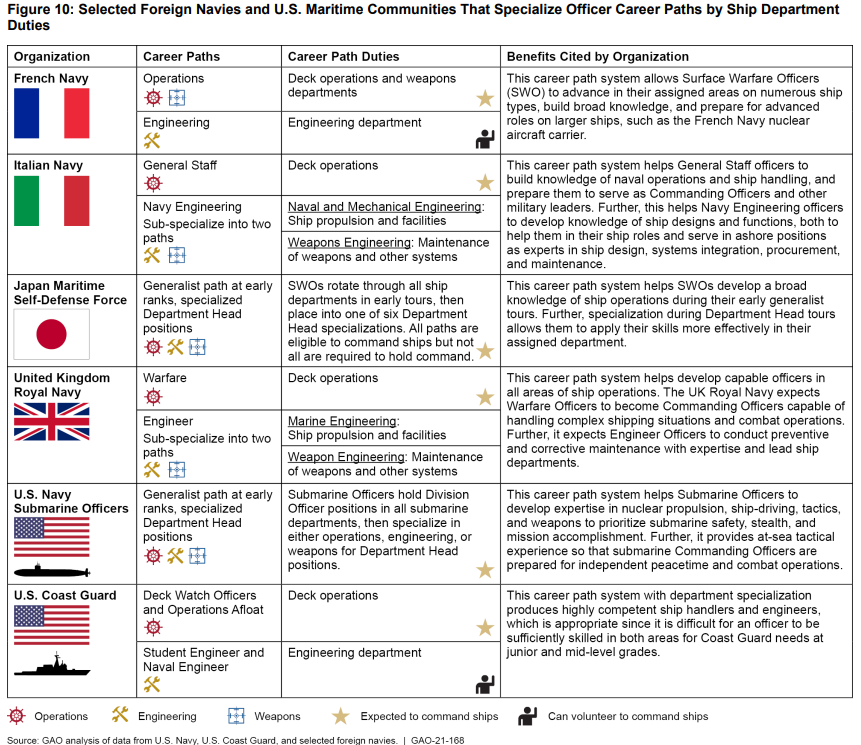
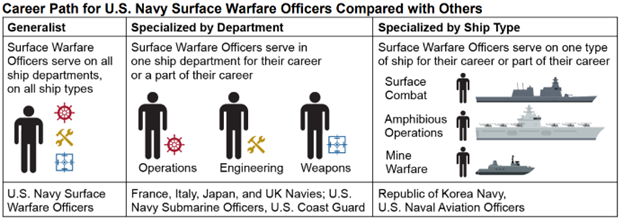
When it comes to specialization, there are multiple approaches implemented by different navies, naval officer communities, and services. Figure 2 below (a compilation of multiple figures from the 2021 GAO study) illustrates and succinctly summarizes these approaches.

Figure 2. Comparison of Career Specialization Approaches Between Different Navies and Communities. Click to expand.

The GAO study examines where proficiency is held for the following three disciplines:

1. Operations (e.g., employment of weapons, ship driving).
2. Engineering (material readiness of the engineering plant, along with its operation).
3. Weapons (material readiness of weapons and combat systems onboard).

The GAO study then summarizes the three main approaches for proficiency in those three disciplines, as seen at the bottom of Figure 2:

1. Generalist, where SWOs practice the three disciplines above across any class of ship.
2. Specialization by department (often known as the “Royal Navy model”) where the three disciplines are split into three distinct officer communities.
3. Specialization by ship type, which is like approach #1 in which the three disciplines are practiced, but only within a particular class or type of ship.

The U.S. Navy SWO community, of course, falls under the first approach. The Republic of Korea (ROK) Navy (ROKN) employs the third – the ship type approach. Perhaps the most famous approach, the Royal Navy, directs that the operations discipline is held by the Principal Warfare Officer (PWO) community, the engineering discipline by marine engineer officers, and the weapons discipline by weapon engineers. Another notable approach is a twist on the Royal Navy approach – the French Navy approaches this by having the operations and weapons disciplines still part of their SWO community, while separating off marine engineer officers like in the Royal Navy model.

Those who argue for SWO specialization typically argue for the “Royal Navy model” – it is perhaps the most common proposal to implementing SWO specialization. But implementing only this approach to specialization for U.S. SWOs is flawed for two main reasons.

First, once a SWO/PWO becomes a CO, that officer possesses little experience in the force generation aspects of leading a ship. A ship cannot employ its weapons if it is not ready to fight and if its systems are in disrepair due to ineffective leadership. A CO could be a brilliant tactician but poor at material readiness – a skill still critical to being an effective CO. Personal discussions with officers in allied navies that employ the Royal Navy approach have revealed that this is a commonly identified drawback to this approach.

Second, the U.S. Navy possesses an extremely diverse surface fleet, more so than many other navies, with ship classes that vary widely in tonnage, armament, and capability. To say that an Avenger-class MCM is very different from an Arleigh Burke-class DDG with Aegis Baseline (BL) 9C is an immense understatement. It does not have any air search radar or any meaningful way to defend itself from air attack. In contrast, the DDG can intercept a ballistic missile in the exoatmosphere and possesses none of the minesweeping capability of the MCM. If a SWO followed the specialization proposal that the House’s version of the 2019 National Defense Authorization Act (NDAA) proposed, that SWO would still be a generalist, with no real depth in proficiency in a ship’s specific tactical capability, whether MIW, AMD, SUW, etc. A weapons/operations-specialized SWO in this proposal would still have a generalist career path as the examples mentioned earlier, because they would still be bouncing between many different platforms, like DDGs, LCSes, amphibious ships, MCMs, and so on. The only difference is that they would not have served as an engineer.

Moving strictly to the Royal Navy model will still result in a lack of tactical proficiency. Therefore, SWOs should specialize via a platform-based (ship type) approach first and foremost. To begin to understand why, we must first ask ourselves: “What is a SWO? Or what should a SWO be?”

What is a SWO? Or What Should a SWO Be?

Because there are many ways to specialize, we cannot answer the question of how exactly SWOs should specialize until we answer what a SWO currently is and what a SWO should be.

The military functions via two distinct chains of command – the administrative and operational chains of command. The administrative chain of command, which possesses administrative control (ADCON) of their subordinate forces, “mans, trains, and equips” those forces, a responsibility known as force generation. The operational chain of command then takes operational control (OPCON) and employs the forces generated by the administrative chain of command. A ship (as well as an aviation squadron or a submarine) also possesses these two chains of command, and Sailors on a ship have roles in both. For example, a SWO at the DIVO level can serve as the fire control officer (FCO) on an Aegis ship, and that SWO is responsible for the “force generation” of Aegis. However, that officer has no authority to employ the ship’s weapons, at least not in the capacity of the FCO. It is not until that SWO stands the watch, for example, as the anti-air warfare coordinator (AAWC) in the CIC, do they have the authority to employ the ship’s weapons. DIVOs and DHs serve as the heads of the ship’s administrative chain of command to ensure the ship’s combat and engineering systems are materially ready for employment by the operators: the TAO, AAWC, ASUWC, ADWC, MIW Evaluator, OOD, etc.

When asking an aviator how they professionally identify themselves or describe their job, they would likely answer first and foremost that they are an operator of a certain aircraft, not that they are, for example, the maintenance officer of a squadron. Aviators tend to emphasize the operational aspect of their designator, not the administrative aspect. SEALs, Marines, and other military communities do the same without becoming deficient in their man, train, and equip responsibilities.

When asked about what we do as SWOs, we tend to say, “I am the CSO, DCA, etc.” This common answer betrays how we think of ourselves as SWOs – we tend to identify ourselves as force generators, not force employers. In any reform of the SWO community, we must confront this fundamental dilemma. In the two chains of command on a ship, operational or administrative, which should we emphasize or identify by?

Specialization via ship type gets at specializing at the former and identifying ourselves foremost as warfighters, rather than as material managers. Specialization by department (the Royal Navy model) gets at the latter. The latter without the former is highly problematic. Implementing only the Royal Navy model in the U.S. Navy, with its vast variability in ship classes, means that an engineer officer from an LPD can serve a future tour on a CRUDES platform, which has vastly different engineering systems. It also means a PWO on an LPD could also serve as a PWO on a CRUDES platform, platforms that employ very different mission sets and combat systems (SSDS vs. Aegis). In these two examples, very little specialization, and therefore the advancement of tactical expertise, has arguably occurred.

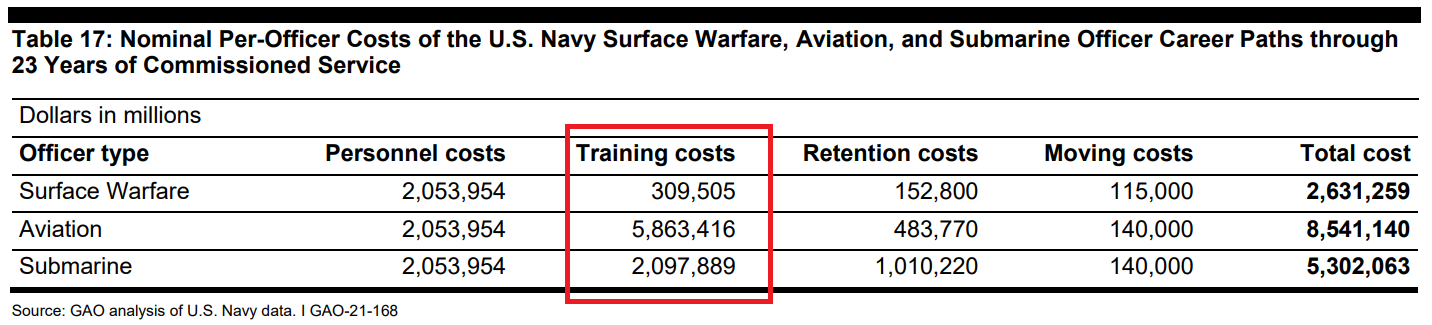
SWO culture has historically maintained that DHs are the tacticians, while JOs/DIVOs simply drive the ship and manage their Sailors. Fleet Tactics disagreed with this sentiment: “The young officer deals in tactics. That is what he cares about most. While he chafes against other duties, his first focus is meant to be the development of skills to bring combat power to bear on an enemy in circumstances of mortal danger.”7 This sentiment is keenly felt by SWO JOs, but results in frustration when their professional development does not emphasize warfighting as much as they believe necessary: “The approach to developing the warfighter mentality in the community was described as overly passive, with little to no direct or active efforts outside of entry-level indoctrination and training.”8 Indeed, the community provides little standardized tactical training to SWO JOs, with the only tactics course common to all SWOs at the DIVO level being the Advanced Division Officer Course (ADOC), which touches on tactics at a basic level. Table 17 of the 2021 GAO study shows that the SWO community already spends far less on training per officer than the submarine and aviation communities:

Figure 3. Comparison of Training Costs Between Naval Officer Communities

SWOs should not primarily be middle managers or “force generators” because it comes at the cost of the SWO’s warfighting proficiency and a subsequent decrease in the surface fleet’s combat power. The overemphasis on being material managers comes at an immense opportunity cost of proficiency at combat. While the force generation aspect is important, its overemphasis has heavily deprioritized other critical aspects, like tactical proficiency.9 We emphasize material readiness so much that we bemoan the amount of effort it takes to administratively prepare for inspections and wonder if we are more ready for inspection than for war.10 This is a symptom of being a peacetime Navy for many decades. SWOs should be the primary tacticians on a ship and embrace this identity. Put another way, SWOs must embrace the “warfare” aspect of “surface warfare officer.” The tactical proficiency of the entire surface force is dependent on the tactical proficiency of SWOs because SWOs are the primary tacticians aboard ships.

Therefore, to increase the lethality of the surface force for high-end combat operations, SWOs must embrace an identity as operators and create a career systematic approach to specialize by platform (the ROKN approach) since that is the approach that will optimize that identity. Specializing in this way would also yield many benefits, such as more efficient tactical training and increased retention among junior officers. 

The Three Pillars of the Platform-Group Specialization Model

The platform-group specialization model based on groupings of ships, not individual ship classes, is a practical way to induce specialization while retaining enough flexibility in manpower management (which is one of the few benefits of the generalized model, at least from a manpower perspective). For example, having SWOs that only serve on the Arleigh Burke-class DDG would make officer inventory management far more difficult without a tangible benefit. The differences between a DDG and a CG are minimal, and transitioning between the two would still yield a substantial increase in tactical proficiency over generalization. CAPT McGrath’s proposal that SWOs specialize by singular ship class is therefore a bit too narrow.11

Instead, SWOs could specialize by platform via three categories: 1) cruiser/destroyer (CRUDES), 2) amphibious ships and capital ships, and 3) unmanned and small combatants (USC), sometimes known as small surface combatants (SSC). This would emulate the ROKN approach in which there are four groups to specialize in: surface combat, amphibious operations, mine warfare, and logistics ships. (The U.S. Navy already employs a separate community to operate its logistic ships.) These ship groupings generally possess similar propulsion systems, combat systems, and mission areas. Additionally, these groups typically deploy with certain types of naval task forces, such as CRUDES with a carrier strike group (CSG) and amphibious ships with an amphibious ready group (ARG), with SSCs tending to deploy independently. Specialization within a platform group will extend to specialization with force packages and their combined arms logic. Additionally, many navies already categorize their ships into these three categories, so it is a very logical way to specialize for tactical proficiency without being too restrictive by specializing in single classes.

The CRUDES platform group, primarily consisting of the Arleigh Burke-class DDG and a Ticonderoga-class guided-missile cruiser (CG) possess the following commonalities: the Aegis Weapon System (AWS), long-range fires in the form of Standard Missile-6 and the Tomahawk missile, an advanced ASW capability, gas turbine propulsion, and MH-60R aircraft. DDGs and CGs operate within a CSG.

The amphibious platform group, or “amphibs,” carries the following commonalities: the Ship Self-Defense System (SSDS) armed with short-range, terminal defense weapons such as the Evolved Sea Sparrow Missile (ESSM), integration with United States Marine Corps (USMC) aircraft and other assets, and proficiency in amphibious warfare. As large, slower ships with significant sail areas, they also possess ship maneuvering characteristics very different from the CRUDES or SSC platform groups. These ships also possess significant aviation capability, which is why an aviator can take major command of an LHD/LHA or an LPD. These platforms typically operate in amphibious ready groups, which have their own unique Optimized Fleet Response Plan (OFRP) cycle that differs significantly from a CSG’s OFRP cycle. Specialization here would allow for senior amphibious SWOs to have multiple ARG workup cycles under their belt, similar to senior CRUDES SWOs possessing multiple CSG cycles under theirs.

The last group, SSCs, possesses the greatest variability in systems, and include LCSs, mine countermeasures (MCM) ships, and unmanned surface vehicles (USV). Despite the higher degree of variance compared to the first two groupings of ship platforms, they possess the following common attributes: a focus on littoral warfare (MIW, short-range SUW), a higher degree of maneuverability commensurate with their size, and a tendency to deploy independently (not part of a CSG or ARG).

Semblances of platform-based specialization already exist, which is a tacit acknowledgement regarding the downsides of a generalized career path. One example is the general rule-of-thumb that a SWO will generally not slate for command of an Aegis DDG without Aegis experience. A SWO(N) serving on an amphib for their DIVO tour would only serve on an amphib for their 1DH tour. Furthermore, the navy’s Program Executive Offices (PEO) are subdivided by platform. Within PEO Ships, individual offices manage specific platforms or platform groups, such as the office for amphibs. There is also a separate PEO Unmanned and Small Combatants (USC) due to the unique nature of USVs, LCSs, and the like. If the unique nature of these platform groups necessitates separate offices, which are likely staffed by SWOs with extensive experience in these platforms, then we can logically deduce that the SWO community should probably codify this type of specialization in SWO career paths. Additionally, the well-known World War II-era law mandating that only naval aviators command aircraft carriers is founded on the notion that expertise in how a platform accomplishes its specific mission is key to command. This law is an embrace of specialization by platform.

Conclusion

Junior officers often feel that the surface force is not ready for combat.12 Junior officers do not want to only be administrators – they want to be operators that “deal with tactics.”13 They take far more pride in being tacticians than simply being administrators that spot check maintenance, conduct zone inspections, and write casualty reports (CASREP). Specializing by platform will drive toward an identity where SWOs are no longer considered as only middle managers or force generators, but as proficient tactical operators. Job satisfaction will increase dramatically when greater tactical expertise is being attained at the JO levels and beyond, and this satisfaction will yield better results for retention than bonus money will. Being able to fight the ship at a proficient, even expert level, will raise the sense of pride for the profession. It will yield the lethal DHs and COs we have sought for so long.

The surface force is far from the level of excellence in tactical proficiency needed to meet great power threats. It must increase dramatically to win the next high-end conflict. The best way to accomplish this is with a platform group-based approach, centered on three categories – CRUDES, amphibious ships, and SSCs. Specializing this way will certainly be challenging and take some time, but we must decisively reform the community for higher levels of warfighting skill. Specialization is necessary to make the fundamental structural changes that enable major increases in tactical skill, rather than settling for minor improvements on the margins of the current model. Attempts to achieve major warfighting improvement will fall short without specialization.

LCDR JR Dinglasan, USN, is a surface warfare officer (SWO) and an Integrated Air and Missile Defense (IAMD) Warfare Tactics Instructor (WTI). He is currently conducting his third WTI production tour/second post-department head tour (PD2) as the IAMD Tactics Development Lead at the Surface Advanced Warfighting School (SAWS) detachment of the Naval Surface and Mine Warfighting Development Center (SMWDC). He previously served as the IAMD WTI Course of Instruction (COI) Lead at SAWS. Afloat, he last served in 2023 as the Combat Systems Officer (CSO) aboard USS BENFOLD (DDG 65) as part of Forward Deployed Naval Forces (FDNF) Japan. He has authored a number of tactical publications, including a tactical bulletin on 5-inch gunnery air defense tactics and a tactical memorandum on SM-6 anti-surface warfare tactics.

References

1. Megan Eckstein, “US Navy Collecting Tactical Training Data It Once Shunned,” Defense News, July 6, 2022, https://www.defensenews.com/naval/2022/07/06/us-navy-collecting-tactical-training-data-it-once-shunned/

2. Cary Russell. Navy Readiness: Actions Needed to Evaluate and Improve Surface Warfare Officer Career Path, GAO-21-168 (Washington, DC: Government Accountability Office, 2021), https://www.gao.gov/assets/gao-21-168.pdf

3. RDML Kavon Hakimzadeh, Command Investigation into HSTCSG Friendly Fire Incident (FPO, AE: U.S. Naval Forces Central Command, 2025), 37, Findings #183-184, https://www.secnav.navy.mil/foia/readingroom/HotTopics/HST%20Investigation/Redacted_Full%20CI%20Friendly%20Fire%20HSTCSG%20(2)_Redacted.pdf

4. LT Judith Hee Rooney, USN, “The State of the Warfighter Mentality in the SWO Community,” CIMSEC, August 22, 2022, https://cimsec.org/the-state-of-the-warfighter-mentality-in-the-swo-community/

5. CAPT Wayne P. Hughes Jr. and RADM Robert P. Girrier, USN (Ret.), Fleet Tactics and Naval Operations, 3rd ed. (Annapolis, MD: Naval Institute Press: 2018), 23–24.

6. CAPT James P. McGrath, USN (ret.), “Engineer-Warriors or Engineers and Warriors?” Proceedings, January 2019, https://www.usni.org/magazines/proceedings/2019/january/engineer-warriors-or-engineers-and-warriors

7. Hughes and Girrier, Fleet Tactics and Naval Operations, xxi.

8. Rooney, “The State of the Warfighter Mentality in the SWO Community.”

9. LT Chris Rielage, USN, “Bring Out the Knives: A Programmatic Night Court for the Surface Navy,” CIMSEC, November 21, 2025, https://cimsec.org/bring-out-the-knives-a-programmatic-night-court-for-the-surface-navy/

10. GMCS Norman Mingo, USN, “The Navy Is Prepared for Inspections, Not War,” Proceedings, March 2021, https://www.usni.org/magazines/proceedings/2021/march/navy-prepared-inspections-not-war

11. McGrath, “Engineer-Warriors or Engineers and Warriors?”

12. Rooney, “The State of the Warfighter Mentality in the SWO Community.”

13. Hughes and Girrier, Fleet Tactics and Naval Operations, xxi.

Featured Image: PHILIPPINE SEA (June 26, 2025) Sailors stand watch in the combat information center aboard the Arleigh Burke-class guided-missile destroyer USS Higgins (DDG 76) during a training drill in the Philippine Sea, June 26. (U.S. Navy photo by Mass Communication Specialist 3rd Class Trevor Hale)

The Commanding Officer Must Be a Fighting Engineer — Surface Warfare and Generalism

SWO Specialization Week

By Rob Watts

The debate over whether Surface Warfare Officers (SWOs) should be “generalists” or “specialists” is an old and vigorous one.1 For more than 125 years, SWOs have followed a generalist career path.2 This means that division officers typically serve in two different departments during their first two tours, often one tour in engineering and another in a topside (non-engineering) department. During their two department head tours they might serve in different departments or two of the same type. Officers also must qualify in three watchstations to be eligible for command: Officer of the Deck (OOD), Tactical Action Officer (TAO), and Engineering Officer of the Watch (EOOW). These qualifications build an officer’s experience in seamanship, warfighting, and engineering respectively. The alternative would be “specialist” career paths enabling officers to focus their tours and qualifications in one field.

Some argue that generalism readies officers for the broad responsibilities of command.3 Others contend that specialization would enable officers to master the complexities of modern naval warfare and become more effective leaders and warfighters earlier in their careers.4 This debate is ultimately about the culture and values of the surface warfare officer community. It forces us to decide whether it is more important to prepare leaders over many years for command or to more quickly build tactical and technical experts with greater depth of skill.

Authors advocating each approach have employed personal experience and beliefs, historical analysis, and comparisons with other navies to make their cases. Data has had little role in this debate. To add data to this discussion, this author collected and analyzed information about the careers of current (as of December 1, 2025) destroyer commanding officers (COs) and executive officers (XOs) encompassing 148 people across 74 ships. Using their biographies posted on each ship’s public website, this author built a dataset that records what department each of them served in during their division officer and department head tours. This data focused on destroyers because they provide the largest group of officers across a single ship class. This dataset can be downloaded here.5

A dataset of 74 destroyer CO and XO career assignments as of December 1, 2025. Click to download.

Three things stand out in this data about the value of generalism and the costs of specialization. First, the current generalist approach still enables most officers to build specialized experience in one type of department. Second, specialist career paths would impose career costs on engineers and shrink the pool of officers eligible for command. Third, the generalist approach also builds leadership teams with complimentary expertise and experience. This analysis helps quantify why the generalist career path remains the right choice for the surface Navy. 

Are SWOs Generalists? 

We must better understand the outcomes of generalism. It aims to provide future commanding officers with a broad foundation, but the data shows that it does more than just that.6 Although some assert that the generalist approach develops officers who are “jacks-of-all-trades” and “masters of none,” we can see that within the generalist system most of today’s COs and XOs actually gain an important degree of specialized experience across their sea tours.7

According to Commander, Naval Surface Forces (CNSF), “the vast majority of SWOs remain within the same department (or at least will remain topside or non-engineers) during department head tours.”8 The data validates this description. At least 82% of today’s XOs and COs served in different departments across their division officers tours. After this generalist start, most of them then specialized at the department head level. 80% of this group were either a topsider or an engineer for both department head tours (see Chart 1).

Chart 1. A breakdown of DH specialization with both tours in the same department.

If we divide departments into three categories for a more granular analysis (Engineering, Operations/Plans and Tactics, Weapons/Combat Systems), nearly two-thirds of current XOs and COs led only one type of department across both tours. Half of those who did not specialize had a tour that precluded specializing. They either fleeted up on the same ship, took early command, or served in a nuclear billet (see Chart 2).

Chart 2. A breakdown of DH specialization.

We see more signs of specialization when we look at division officer and department head tours together. Most (81%) of today’s COs and XOs had at least one tour in the same type of department across their division officer and department head tours. Notably, over half (53%) of today’s COs and XOs had at least three of their division officer and department head tours within the same type of department.

Should Engineers Command at Sea?

EOOW is the focus of several critiques of the generalist approach, including most recently an article in CIMSEC by Seth Breen. He contends that EOOW does not contribute to the “tactical competencies” of surface warfare. Applying a zero-sum logic, he argues that time spent qualifying to run an engineering plant comes at the expense of building warfighting skills.9

Instead of requiring EOOW for all officers, proponents of specialization recommend a “two-track system” that would split the surface community into engineering and warfare specialists.10 Some say this approach would enable officers to build more tactical expertise, to focus on leadership, and to improve their watchstanding.11 This view ignores the likely impact on engineering officers’ career prospects and on the vitality of the surface community.

In navies with specialized career paths, engineers are usually not eligible to command at sea. In Britan’s Royal Navy, for example, engineers cannot command. Some navies, like France’s, allow engineers to choose to pursue command, but they have limited opportunities.12 From the advent of steam engines to 1899, the U.S. Navy also had a two-track system. Engineers were not eligible for command.13

Specialization today would likely be no different. This change would shrink the pool of command-eligible officers, making it even harder for the community to select ship captains from among its very best. At the individual level, engineers would no longer have the opportunity or incentive to build seamanship and warfighting skills. The “battle cheng” would become extinct. Specialization could also reduce retention among engineers. Some navies with specialized career paths have challenges retaining engineers both because of limited advancement opportunities in the fleet and competing demand for their skills in the civilian sector.14

The data helps quantify the potential cost of specialization. 14% of current destroyer XOs and COs — 20 officers — served both of their department head tours as chief engineers or squadron N4s. If we consider these officers as a surrogate for those who might be specialist engineers, we can see how many talented officers could be excluded from command.

Teamwork

The generalist approach tends to create command leadership teams (CO and XO) with different experiences and expertise. This means they can better support and backstop each other. Recognizing this benefit, the nuclear submarine community creates leadership teams with one leader who served as an engineer and one who was either a weapons officer or navigator.15

Although the surface navy does not formally balance leadership teams, destroyers often have COs and XOs with different department head backgrounds. 79% of today’s destroyer COs and XOs led different types of departments from each other when they were department heads. Scoping down to engineering, 46% of destroyers — 34 ships — have a CO or XO who served as a chief engineer. This valuable synergy within leadership teams would fade away if only certain types of officers could command.

Culture and Command

The generalist career path reflects the culture of the surface navy. This culture emphasizes both the importance of command and the breadth of experience across seamanship, warfighting, and engineering required to wield it. This is not new. An 1898 congressional report recommending the Navy adopt the generalist approach said, “The personnel must fit the materiel.…In other words, the commanding officer must be a fighting engineer. To fight his ship he must know her, and to know his ship he must know engineering. [Not only that, but] he must know other things as well, such as ordnance and navigation, and have the ‘habit of command.’”16

This century-old conception of command holds true today. Seamanship, warfighting, and engineering are inseparable from each other. Each domain is complex. Each domain depends on the other two. So, the commanding officer, unlike anyone else on their ship, must master all three — blending the technical with the tactical — while leading their team.

The generalist system underpins how the Navy develops potential future commanding officers over the first dozen (or more) years of their career. In other words, generalism is a marathon towards command. Recent arguments for specialization often advocate shifting to a sprint towards TAO, a very different goal with a much shorter time horizon. While the sense of urgency is commendable, this argument neglects that ample time exists in an officer’s career to hone all of these skills before reaching the goal of command.

Some may say that placing primacy on command incorrectly frames this issue. Not every SWO aspires to command.17 For many, though, the drive to command takes time to set in. A generalist approach preserves the opportunity to command and provides time for junior officers to decide if they want to captain a warship.

Conclusion

While keeping the generalist approach, the surface navy should still continue to create more opportunities to specialize — to build more tactical and technical proficiency — across an officer’s career.18 The Warfare Tactics Instructor program and the new Advanced Engineering Instructor program — paired with follow-on production tours — are particularly impactful ways for officers to develop expertise and return it to the fleet.19 As the surface force continues to invest in improving seamanship proficiency through initiatives like the Maritime Skills Training Program, it should establish an Advanced Seamanship Instructor program to also build a cadre of experts in this essential field.20 At the unit level, COs should continue to encourage junior officers to make the most of their limited time at sea to keep building their proficiency in seamanship, warfighting, and engineering with an eye towards one day commanding at sea themselves.

Changing from a generalist to a specialist approach would be a significant culture shift in the surface navy. Perhaps change is needed, but the data presented here helps to understand the likely impacts of specialization. A two-track system would not afford officers many more opportunities to gain expertise than they already have. For that marginal gain, it would narrow opportunity for command by excluding engineers and reduce the breadth of experience across leadership teams, especially in engineering.

On the other hand, the generalist approach provides each officer equal opportunity to strive for command. It helps them build leadership experience and establish a technical foundation across different types of departments. It requires them to learn core seamanship, warfighting, and engineering skills. It enables them to develop specialized expertise over time. It readies them for command. The surface community should hold fast to generalism.

Captain Rob Watts is the military speechwriter to the Secretary of War and commanded USS John Paul Jones (DDG 53). He holds a B.A. in Foreign Affairs and History from the University of Virginia and a Master’s in Public Policy from Princeton University. The views expressed here are those of the author and do not necessarily represent the official views of any U.S. government department.

References

[1] For an early argument in favor of a generalist approach see reports by Secretary of the Navy Gideon Wells written in 1864 and 1865 which are quoted in U.S. House of Representatives, “Personnel of the Navy,” House Report No. 1375, 55th Congress, 2nd Session, 19 May 1898, p. 4, https://www.govinfo.gov/content/pkg/SERIALSET-03721_00_00-182-1375-0000/pdf/SERIALSET-03721_00_00-182-1375-0000.pdf.

[2] Donald Chisholm, Waiting for Dead Men’s Shoes: Origins and Development of the U.S. Navy’s Officer Personnel System, 1793-1941 (Stanford University Press: Stanford CA, 2001) p. 175,193-4, 456-7, 463-4.

[3] Bryan McGrath, “Back Off Congress: Don’t Meddle with the US Navy’s Command Philosophy,” Defense One, May 23, 2018, https://www.defenseone.com/ideas/2018/05/back-congress-dont-meddle-us-navys-command-philosophy/148430/.

[4] Michael L. Crockett, “SWOs Should be Specialists, Not Generalists,” Proceedings, August 2002, https://www.usni.org/magazines/proceedings/2002/august/swos-should-be-specialists-not-generalists, Nathan Sicheri, “Redesign the SWO Junior Officer Pipeline: Centralized Training, and Extended Pipeline, and Specialized Tours Could Increase Surface Warfare Officer Retention and Expertise,” Proceedings, September 2023, https://www.usni.org/magazines/proceedings/2023/september/redesign-swo-junior-officer-pipeline, and Seth Breen, “Reprioritize SWO Tactical Qualifications for the High End Fight,” Center for International Maritime Security, 03 September 2025, https://cimsec.org/reprioritize-swo-tactical-qualifications-for-the-high-end-fight/.

[5] The complete data set can be downloaded at https://cimsec.org/wp-content/uploads/2026/01/XO-CO-DH-Billet-Analysis-Watts-Dataset.xlsx. 

[6] Bryan McGrath.

[7] Jon Paris, “The Virtue of Being a Generalist, Part 3: Viper and the Pitfalls of Being ‘Good Enough’,” CIMSEC, August 19, 2014, https://cimsec.org/virtue-generalist-part-3-viper-pitfalls-good-enough/, and Thibault Delloue, “Create an Engineering Officer Corps for Surface Ships,” Proceedings, June 2022, https://www.usni.org/magazines/proceedings/2022/june/create-engineering-officer-corps-surface-ships.

[8] Government Accountability Office (GAO), Navy Readiness: Actions Needed to Evaluate and Improve Surface Warfare Officer Career Path, June 17, 2021, p. 165, https://www.gao.gov/products/gao-21-168.

[9] Breen.

[10] Crockett and Delloue. For a proposal for a nuclear-trained SWO career path see Matthew Phillips, “Master of None: the Nuclear Surface Warfare Officer Career Path Must Change,” Proceedings, November 2018, https://www.usni.org/magazines/proceedings/2018/november/master-none-nuclear-surface-warfare-officer-career-path-must.

[11] Breen, Crockett, Delloue, and Paris.

[12] GAO, p. 45, 79-82.

[13] Chisholm, p. 193-4.

[14] GAO, p. 45, 88, 99.

[15] James P. McGrath, “Engineer-Warriors or Engineers and Warriors,” Proceedings, January 2019, https://www.usni.org/magazines/proceedings/2019/january/engineer-warriors-or-engineers-and-warriors.

[16] U.S. House of Representatives, “Personnel of the Navy,” p. 4, quoted in Chisholm, p. 457.

[17] GAO, p. 40-3, 131-3.

[18] For a recent example of surface warfare training initiatives see Jeffrey Bolstad and Matthew Bain, “Building Tactical Excellence: How SWCTC Supports LT Breen’s Call for Higher SWO Proficiency,” Center for International Maritime Security, 08 October 2025, https://cimsec.org/building-tactical-excellence-how-swctc-supports-lt-breens-call-for-higher-swo-proficiency/.

[19] U.S. Navy, “Warfare Tactics Instructor Program Qualification,” Surface Advanced Warfighting School Instruction 1402.2B, 07 May 2024, https://www.surfpac.navy.mil/Portals/54/Documents/Command/NSMWDC/WTI/SAWSINST%201402.2B%20-%20WARFARE%20TACTICS%20INSTRUCTOR%20PROGRAM%20QUALIFICATION.pdf, and John Goulette, “SWSC – Advanced Engineering Instructor Program,” 04 April 2025, https://www.dvidshub.net/news/494604/swsc-advanced-engineering-instructor-program.

[20] Joseph A. Baggett, “Not Your Father’s Surface Warfare Training,” Proceedings, January 2026, https://www.usni.org/magazines/proceedings/2026/january/not-your-fathers-surface-warfare-training, and U.S. Navy, “Surface Warfare Officer Career Manual,” Commander, Naval Surface Forces Instruction 1412.7B, 06 May 2025, Ch. 4.

Featured Image: ATLANTIC OCEAN (Oct. 16, 2025) The Arleigh Burke-class guided-missile destroyer USS Paul Ignatius (DDG 117) renders honors to the USS Roosevelt (DDG 80). (U.S. Navy photo by Mass Communication Specialist 2nd Class Joseph Macklin)

Fostering the Discussion on Securing the Seas.