
By David Scott
Operation Highmast, running from April to November 2025, took a UK Carrier Strike Group (CSG), led by HMS Prince of Wales, over 40,000 nautical miles to the Sea of Japan and back. The CSG consisted of five UK vessels, with eight others joining the CSG at various stages from other navies. Three strategic considerations underpinned this deployment as per Prime Minister Keir Starmer: successfully operating a two-carrier navy (HMS Queen Elizabeth and HMS Prince of Wales), sending a “clear message of strength to our adversaries,” and “a message of unity and purpose to…allies.”
Operating a Two-Carrier Navy
Operation Highmast was announced in May 2023 by Conservative Party Prime Minister Rishi Sunak at the signing of the Hiroshima Accord, which was a landmark agreement focusing on “an enhanced UK-Japan global strategic partnership” and included “the future deployment of the UK Carrier Strike Group to the Indo-Pacific.” The deployment was carried out by the Labour Party administration after it came to power in July 2024, and it proceeded despite some calls to “mothball” of one of the carriers after the exchange of power between parties.
Another strategic decision illuminated by Operation Highmast was that despite growing concerns over Russian aggression in Europe, the Royal Navy maintained an Indo-Pacific commitment, albeit modified. The March 2021 Integrated Review of Security, Defence, Development and Foreign Policy announcement of an “Indo-Pacific tilt” underpinned the Queen Elizabeth CSG deployment in that year’s Operation Fortis. Four years later, the June 2025 Strategic Defence Review mantra of “NATO first does not mean NATO only” guided the Prince of Wales CSG deployment in Operation Highmast.
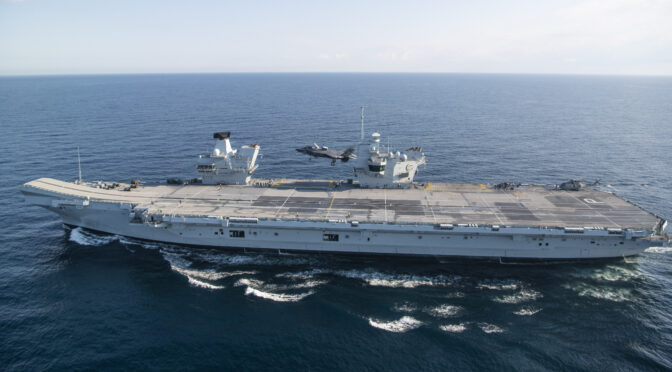
Strategically, the UK’s punch increased as both its Elizabeth-class aircraft carriers, the HMS Queen Elizabeth and HMS Prince of Wales, are the largest vessels ever constructed for the Royal Navy (80,000 ton displacement). This is almost four times the displacement of the three Invincible-class aircraft carriers (22,000 ton displacement) they replaced. Additionally, the Initial Operating Capacity (IOC) for the Wildcat helicopter Sea Venom anti-ship missile, carried on the Prince of Wales, was announced at the start of October. The Royal Navy considered this “a step-change in [its] combat power.”
After deciding to build the aircraft carriers, the UK government chose to embark F-35B fighters, considerably more advanced than the retired Harriers used on the previous Invincible-class. Strategically, the F-35B decision would enhance interoperability with the US, Italian, and Japanese navies. Eighteen UK F-35Bs embarked at the start of the Prince of Wales deployment and were joined by six more in October for a total of 24. Unfortunately, these jets had embarrassing engine malfunctions including one that was temporarily grounded in India as well as another in Japan. Nevertheless, Full Operational Capacity (FOC) was declared in November, signifying that the two carriers, the Queen Elizabeth and the Prince of Wales, could operate with purely UK F-35B complements.
Working with Allies and Partners
The Royal Navy’s ability to work with others was illustrated in cooperation with various European navies as well as in operations with India, Australia, Japan, and the United States—denoting a tacit balancing against China.
Operation Highmast represented a European rotation of CSGs, under the European Carrier Group Interoperability Initiative (ECGII), which has been guiding defense movements since 2008. The 2023 UK-France Summit had agreed on “the sequencing of more persistent European carrier strike group presence in the Indo-Pacific.” In this vein, the Italian CSG deployment in the second half of 2024, led by ITS Cavour, was followed by the French CSG deployment in the first third of 2025, led by FNS Charles de Gaulle, and then by the UK CSG deployment, led by HMS Prince of Wales, in the following months of 2025.
Operation Highmast had other European nations embedding their ships within the UK CSG. The Norwegian frigate HNoMS Roald Amundsen was in support throughout the CSG deployment. This reflects the Joint Statement on Enhanced Defence Cooperation between Norway and the United Kingdom signed in February 2025. Portugal’s frigate NRP Bartolomeu Dias joined the CSG from the Atlantic to the Mediterranean. Spain’s frigate ESPS Mendez Nunez joined from the Atlantic to the Philippines, and Italy’s ITS Luigi Rizzo joined the CSG in the Mediterranean.
Close UK-Italy ties were on show as Foreign Secretary Yvette Cooper and Defense Secretary John Healey hosted their Italian counterparts on board the Prince of Wales in November at the conclusion of the Falcon Strike exercise, which was the NATO exercise at the end of Operation Highmast of the coast of Naples, Italy. Their Joint Statement noted:
The presence of the F-35-equipped UK Carrier Strike Group in Naples underlines deep British-Italian defense ties. Complex joint exercises during the deployment have further enhanced the interoperability of our Armed Forces.
The dual carrier exercises with Italy’s ITS Cavour in the Med Strike exercise in May as well as the Neptune Strike exercise in November represented a European willingness to carry the burden in the Mediterranean, enabling US carrier strength to be deployed elsewhere.
The UK CSG interaction with India reflected the February 2025 Defense Partnership-India (DP-1) as well as the UK decision in 2022 to co-lead India’s Indo-Pacific Ocean Initiative (IPOI). The CSG exercised in the Arabian Sea with India twice on its way to and from Japan. In June 2025, the CSG exercised with INS Tabar, a P-8I Neptune plane, and an Indian submarine. The October Konkan exercise was particularly powerful. It involved dual carrier operations with the INS Vikrant CSG for the first time, which included seven ships in the Indian CSG and six ships in the UK CSG. Port calls to Mumbai and Goa coincided with Keir Starmer’s visit to Mumbai. Not surprisingly, the India-UK Joint Statement on October 9 declared: “Prime Minister Modi welcomed the port call of UK’s Carrier Strike Group and the Royal Navy’s exercise Konkan with the Indian Navy.” An implementing agreement on electric-powered engines, currently in development by Rolls Royce for India’s next generation navy, was on show with the Prince of Wales’s and HMS Richmond’s Full Electric Propulsion System.
Australian involvement with the CSG was noticeable. Having just carried out freedom of navigation activity around the Spratley Islands with HMS Spey in June, Australia’s HMAS Sydney joined the UK CSG in July on their way to Australia for Exercise Talisman Sabre. The Sydney participated in the CSG exercises in the Timor Sea with the USS George Washington CSG, representing a trilateral Australia-UK-US (AUKUS) format. On July 27, the third day of the Australia-UK Ministerial (AUKMIN) talks were held in Darwin, Australia on the Prince of Wales under Reciprocal Access Agreement (RAA). These talks involved Foreign Secretary David Lammy, Defense Secretary John Healey, and their Australian counterparts. The AUKMIN Joint Statement welcomed that “the [CSG] deployment demonstrates the UK’s ongoing commitment to increase interoperability with Australia in the Indo-Pacific.” HMAS Brisbane joined the CSG in August in the Philippine Sea as part of the trilateral Japan-UK-US CSG and again in the bilateral UK-Japan carrier drills southwest of Japan in September.
UK convening power was on display as—for the first time—the Prince of Wales led the Bersama Lima exercise in September, off the Malaysian coast, under the Five Power Defense Arrangements (FPDA). This involved other naval units from Malaysia, Singapore, Australia (HMAS Ballarat) and New Zealand (HMNZS Aotearoa). New Zealand’s HMNZS Te Kaha had earlier joined the CSG from April to July across the Indian Ocean from the Arabian Sea to the Timor Sea, while Canada’s HMCS Ville de Québec joined the CSG from April (Devonport) to August (North Philippine Sea).
UK cooperation with Japan was further strengthened by Operation Highmast. When the Prince of Wales moored in Tokyo Bay on August 28, UK Defense Secretary John Healey, First Sea Lord General Sir Gwyn Jenkins, and Japan Minister of Defense Gen Nakatani were present to welcome the carrier and participate in the Pacific Future Forum onboard. At the Forum, Healey stressed UK-Japan defense cooperation: “[T]his carrier strike route deployment is the operational demonstration of this truth,” and “that is why the presence of the Prince of Wales here in Tokyo is not just symbolic — it’s strategic.”
Naval cooperation with Japan was on show with the trilateral carrier exercises involving JS Kaga in the North Philippine Sea in August, the F-35B bilateral exercises in the Sea of Japan on September 6, and the bilateral carrier exercise off south-west Japan, which again involved JS Kaga as well as JS Akebono, on September 9. It was particularly helpful to provide proof of concept when UK jets landed on JS Kaga as it was converted from a helicopter carrier to a fixed-wing F-35B-capable aircraft carrier. It was also noticeable that JS Akebono stayed with the UK CSG on its way back across the Indian Ocean.
The trilateral carrier exercise in the North Philippine Sea was a particularly striking visual moment, involving as it did four flat-top F-35B carrying battle groups, involving the USS George Washington, the USS America, Japan’s JS Kaga, and the UK’s Prince of Wales. This trilateral naval format reflects the Japan-UK-US agreement signed by naval chiefs in October 2016, that “as Chiefs of three highly capable and like-minded Services, [the nations] share a common vision of enhancing the operational effectiveness of… maritime forces through increased cooperation.” This was furthered in their Joint Statement in November 2019 about maintaining a “routine forward presence“ for cooperating over “the security of the Indo-Pacific region.” In the case of operational effectiveness, the common F-35B choices made by all three navies aids inter-operability, which was very much on show with the crossdeck activities carried out in Operation Highmast between these various carriers.
Last but not least, cooperation with the US was present throughout. The UK CSG was led through the Bab-el-Mandeb by USS Truxtun. Twice the USS George Washington CSG exercised with the UK CSG: once bilaterally in the East Timor Sea and another time trilaterally with Japan in the Philippine Sea. In another first, the USNS Wally Schirra, alongside RFA Tidespring, carried out a simultaneous Replenishment at Sea (RAS) with the Prince of Wales. The USS Higgins accompanied HMS Richmond on its transit of the Taiwan Strait in September before briefly joining the main UK CSG group as it sailed across the South China Sea. When the CSG transited into Red Sea in October, anti-drone and missile cover was provided by USS Forrest Sherman.
Deterring Adversaries?
On the eve of departure, the UK Defense Secretary John Healey had been upbeat in April, commenting, “[The] Royal Navy is once again demonstrating its formidable capability while protecting British values and sending a powerful message of deterrence to any adversary.”
In terms of operations, the CSG was able to twice deploy through the troubled Red Sea. When transiting in late May/early June, the CSG had been put on “defense station” in the light of continuing Houthi activities in the Red Sea. The context was that the UK had carried out strikes on Houthi drone facilities on April 29, joining the US in Operation Rough Rider. However, despite Houthi outrage, all was calm a month later for the CSG. Upon the CSG’s return in September, a diversionary tactic was employed. A fake Bahr Guardian sea exercise was announced for the Arabian Sea, with an accompanying press blackout, leaving the CSG free to instead slip though the Bab-el-Mandeb and up the Red Sea. It is unclear as to whether this move was an indication of the UK’s cunning or a fear that a publicly announced transit was still too dangerous.
China remained the elephant in the room as the UK refused to acknowledge the deployment was China-motivated. Though China did not use official public channels to announce its displeasure, its state media, namely the Global Times, was ready to express China’s negative opinions. Back in 2023, when the deployment was first announced, a Global Times editorial on December 17, titled “The UK’s sunset fleet should just stay surfacing the internet,” warned that the UK was “closer to becoming a laughing stock.” The article derided UK collaboration with Japan as a vain attempt to restrain China. These protestations more likely revealed a sensitive subject for Beijing over UK-Japan security collaboration.
During the 2025 CSG deployment, the Chinese state media was ready to comment again. Starmer’s announcement about meeting threats was immediately denounced in the Global Times on April 24 with a piece titled “Can the UK aircraft carrier’s ‘return to the Indo-Pacific’ deter anyone?” Global Times journalists, Liu Xuanzun and Liang Rui, scoffed over UK problems with the F-35B jets in their August 10 article titled: “UK carrier-based F-35B reportedly makes emergency landing in Japan; Chinese expert says incidents highlight Britain’s struggling with aircraft complexity.”
There had been advance speculation whether the UK would be deterred from freedom of navigation activities in the Taiwan Strait and the South China Sea. It was significant that both were carried out. The CSG detached HMS Richmond for a transit of the Taiwan Strait alongside USS Higgins on September 12, which was immediately denounced as “provocative” by the PLA Eastern Theater Command. Some Chinese harassment had taken place. “Constructive kills,” or in layman’s terms tactical drills run with no missiles fired, were carried out around HMS Richmond with Chinese jets following the path they would take if they were launching an attack. Immediately after, the CSG transited the South China Sea, during which RFA Tidespring and HNoMS Roald Amundsen carried out specific freedom of navigation activities around the Spratleys in mid-September. The CSG was followed by several Chinese ships broadcasting messages for the CSG to stay away. However, the details on this only came to light in a Times report on September 29 followed by the Royal Navy briefing on 30 September, by which time the UK ships had long left these waters.
Unsurprisingly, the UK exercising with other China-concerned actors attracted further criticisms from China. On July 14, Zhang Changyue and Guo Yuandan denounced the Talisman Sabre exercise in their piece titled: “US-Australia largest ever war drill underway, hyping it may draw ‘Chinese observation’ to boost attention.” The subsequent trilateral exercising drew more Chinese fire with Liu Xuanzun and Liang Rui’s piece on August 6 titled: “US, UK, Japan, others hold drill in Pacific; move undermining regional peace.” One can surmise that such Chinese criticisms would not appear unless the UK deployment was having an impact regarding freedom of navigation issues and a tacit balancing of China.
Looking forward
Five strategic questions remain to be answered for the future concerning the operation of a two-carrier Navy:
- With two carriers scheduled for active service until 2029, should the UK maintain a two-carrier navy and resist any further calls for ”mothballing?”
- What is the right balance between Euro-Atlantic and Indo-Pacific CSG deployments? If Indo-Pacific deployments continue regularly should the four-year gap between Queen Elizabeth and Prince of Wales missions become the norm, or should it be shortened or lengthened?
- How far should carriers operate as “crewed aircraft” carriers. The Strategic Defence Review recommends that:
Much more rapid progress is needed in its evolution into ‘hybrid’ carrier airwings, whereby crewed combat aircraft (F-35B) are complemented by autonomous collaborative platforms in the air, and expendable, single-use drones. Plans for the hybrid carrier airwings should also include long-range precision missiles capable of being fired from the carrier deck.
It can be noted that in a “historic first,” the Prince of Wales used drones to transfer supplies between ships as opposed to traditional helicopters.
- How will the Royal Navy manage its fleet’s numbers to support its strategic goals? The structural problems of being hollowed out, in terms of other naval assets, remain acute. The continuing challenge of numbers expected to decline before eventual increase in numbers as eight Type-26 and five Type-31 replacements for the nine current Type-23 frigates are completed.
- How will the Royal Navy manage its new F-35Bs moving forward? Questions and choices still remain surrounding the numbers and capabilities of the F-35B planes. At present, the UK currently has 34 F-35Bs with initial plans to acquire 48 and potentially 138 in the more distant future. F-35B capabilities await the replacement of their Paveway-series guided bombs by more advanced Spear-3 cruise missiles. These were originally slated for delivery and use on F-35Bs by 2025 but face delays due to software configuration problems at Lockheed Martin and US export control regulations.
“Quo Vadis?” indeed, for a two-carrier UK navy.
Dr. David Scott is an associate member of the Corbett Centre for Maritime Policy Studies. A prolific writer on Indo-Pacific maritime geopolitics, he can be contacted at davidscott366@outlook.com.
Featured Image The U.K. Queen Elizabeth-class (QEC) aircraft carrier HMS Prince of Wales (R09)’s participation in WESTLANT 23. (US Navy photo by Dane Wiedmann)
Discover more from Center for International Maritime Security
Subscribe to get the latest posts sent to your email.
Seems we are seeing the price of that 2025 deployment as we speak. The UK can cough up one late destroyer. In not deciding between STOVL and CATOBAR they landed on a high expense low return solution that makes the fleet top heavy. They could have a great STOVL carrier for half the displacement while keeping enough of the rest of the fleet to support it. Just look at Japan.