By Bruce Stubbs
I. Introduction
The United States should designate the U.S. Coast Guard as its lead agency for maritime security in the Western Hemisphere. In military command and control terminology, this would make the Coast Guard the “supported” service with all other armed services and federal agencies as “supporting” services. Such a designation would reverse the customary approach for the Navy to lead at sea, but this reversal is long overdue.
Restoring America’s maritime dominance in the Western Hemisphere aligns with the 2025 National Security Strategy and the 2026 National Defense Strategy.1 The former directs a reconsideration of the U.S. military presence in the Western Hemisphere. It specifically calls for “a more suitable Coast Guard and Navy presence to control sea lanes, to thwart illegal and other unwanted migration, to reduce human and drug trafficking, and to control key transit routes in a crisis.”2 The latter declares that “the U.S. military’s foremost priority is to defend the U.S. Homeland” through securing the U.S. border, countering narco-terrorists, and securing key terrain.3
These two strategic documents frame their guidance for the entire Western Hemisphere to reflect what the strategies describe as a renewed emphasis on limiting external influence in regional affairs. Their specific objectives and tasks, however, are primarily oriented toward operations in U.S. Homeland Seas. This term is used here to refer to the four maritime approaches to the United States, the Arctic, Caribbean, Eastern Pacific, and Western Atlantic. This commentary examines the structural and operational impediments that impair fully achieving these national policies. It also explains why a more suitable maritime presence in the U.S. Homeland Seas must begin with the U.S. Coast Guard.
Of note, presence itself is not a mission. Presence is no more than the geographic location on the globe where the Navy conducts its five core functions. The term, “maritime dominance,” is used to refer to the sustained ability to monitor, control, and enforce law and sovereignty across the U.S. Homeland Seas, vice naval superiority over a peer competitor. The article advances two arguments. First, maritime security in the Western Hemisphere is fundamentally a persistence problem, not a warfighting problem. Second, and more consequentially, the Coast Guard should be the supported service for the mission and lead its command architecture.
II. The Security Challenges of the Western Hemisphere and the U.S. Homeland Seas
Although the two national strategies employ different terminology, both state similar objectives: secure the U.S. maritime approaches, suppress illicit activity, protect U.S. borders, and ensure control of critical sea lanes during a crisis. Notably, these objectives predominantly emphasize maritime security vice military force, except for the control of key transit routes. Threats to these strategies’ objectives fall into two distinct categories that require different operational responses.
The first category consists of external military threats principally posed by China, Russia, and their state-linked actors. In practice, however, these threats manifest only intermittently in the Western Hemisphere. Consider the June 2024 deployment of the Russian Yasen-M-class nuclear-powered attack submarine Kazan (K-561) to the Caribbean. Armed with Zircon hypersonic and Kalibr cruise missiles, it illustrates the operational character of this threat category.4 To address this category of threats, the Navy’s principal mission in the Hemisphere is Homeland Defense including deterrence against external military aggression and strategic coercion.5 Because such adversary activities are episodic rather than persistent, the Navy does not maintain a continuous at-sea operational presence across the U.S. Homeland Seas. Indeed, U.S. Fourth Fleet has no permanently assigned forces and primarily functions as a coordinating headquarters. Its area of responsibility encompasses the Caribbean Sea and the waters surrounding South America.
The second category consists of persistent maritime security threats within the Homeland Seas themselves. These include illegal migration, narcotics trafficking, illegal fishing, transnational criminal activity, and other illicit uses of the maritime domain. These activities undermine U.S. sovereignty, border security, and regional stability. To address this category of threats, the Coast Guard conducts continuous homeland security centered on maritime security activities to deter and defeat non-military threats.6 The Coast Guard is a unique service, both an armed force and a federal law enforcement agency. As the Acting Secretary of the Navy Hung Cao stated before the House Armed Services Committee in May 2026, “Border security is national security.”7 This formulation explicitly links maritime security operations in the Caribbean and Eastern Pacific to the defense of the U.S. border and the protection of the American homeland.
Broadly speaking, the Navy employs high-end warfighting assets to deter infrequent military threats, whereas the Coast Guard employs maritime security-oriented forces and legal authorities to counter persistent maritime security threats. This distinction does not mean the Navy never conducts maritime security operations or that the Coast Guard does not contribute to military missions. Rather, it reflects the focus and operational specialization of each service. The Coast Guard’s comparatively affordable platforms, law enforcement authorities, and persistent presence make it the most operationally suitable maritime force for day-to-day security operations throughout the Hemisphere. Consistent with these differing missions, the Navy and Coast Guard maintain separate command-and-control structures for operations at sea.
III. Background: Operation Southern Spear
In August 2025, the Joint Force began Operation Southern Spear to detect, disrupt, and degrade transnational criminal and illicit maritime networks in the Western Hemisphere.8 The operation served purposes beyond counter-narcotics. It provided the coercive maritime presence that shaped conditions for the subsequent capture of Venezuelan President Nicolas Maduro in January 2026. Southern Spear was complemented by Operation Absolute Resolve, which extended homeland defense and maritime interdiction operations across the Western Hemisphere. That effort reflected the broader operationalization of the Navy’s homeland defense, counter-narcotics, and regional maritime security missions in the approaches to the United States.9
The administration designated major Latin American drug cartels as Foreign Terrorist Organizations, declared a Non-International Armed Conflict, and authorized military force, including kinetic strikes against narco-terrorist vessels at sea.10 In their September 2025 report, “Going to War with the Cartels: The Military Implications,” Mark Cancian and Chris Park, analysts at the Center for Strategic and International Studies, assessed Southern Spear. They noted that at its peak, the operation concentrated 38 percent of all Navy ships underway in the Caribbean. That force included the USS Gerald R. Ford Carrier Strike Group, the USS Iwo Jima Amphibious Ready Group, multiple guided-missile destroyers and cruisers, and a Littoral Combat Ship.11 MQ-9 Reapers operating from Puerto Rico and AC-130J gunships operating from El Salvador conducted lethal strikes against cartel maritime targets.12 By March 2026, the Defense Department reported a 30 percent reduction in drug vessel movements in the Caribbean and 25 percent reduction in the Eastern Pacific.13
Southern Spear demonstrated both the effectiveness and the limits of the existing architecture. It produced measurable results against cartel maritime networks. It also exposed the strategic costs of relying upon high-end naval combatants and improvised command structures for a mission that never ends.
IV. The Structural and Operational Impediments
Several significant structural and operational impediments exist that inhibit a more suitable U.S. maritime presence in the Western Hemisphere and U.S. Homeland Seas.
Impediment 1: Force Structure, A Navy Mismatch and a Coast Guard Insufficiency
The Navy’s existing force structure is optimized primarily for high-end deterrence and warfighting missions against peer and near-peer adversaries rather than for sustained maritime security operations in the Western Hemisphere. Carrier strike groups, amphibious ready groups, and guided missile destroyers can perform maritime security missions, but they were designed principally for power projection, sea control, and expeditionary warfare. In December 2025, defense analyst Peter Singer estimated that the U.S. forces committed to Southern Spear cost at least seven times the annual revenue of the cartels they were targeting. They cost thousands of times more than the value of the individual speedboats being destroyed.14 Cancian and Park reached a similar conclusion, describing the operation as “swatting flies with golden hammers” but the “long-term military solution is to beef up the Coast Guard” rather than relying upon scarce fleet combatants.15 The Chief of Naval Operations (CNO), Admiral Daryl Caudle, agreed and stated in March 2026, “I don’t need the carrier to do maritime interdiction. I want to reserve the carrier for power projection and deterrence in the theaters that really need that capability.”16
The Coast Guard’s insufficiency crisis is not a separate problem from the persistence argument. It is what a persistent requirement looks like when it is chronically underfunded. Persistence cannot be surged. It must be built, crewed, and sustained years ahead of need, which is precisely what decades of episodic funding failed to do. The Coast Guard has a force structure optimized for maritime security operations. But it has historically lacked sufficient capacity to achieve a decisive operational tipping point against non-military threats. The Coast Guard’s own fleet mix analysis concluded that its planned fleet would provide only 61 percent of the cutters required to fully execute statutory missions.17 Acting Commandant of the U.S. Coast Guard Kevin Lunday stated in April 2025, “When a National Security Cutter pulls into port, we do a controlled parts exchange, which is a fancy term for cannibalizing our readiness. No ship gets underway without stripping another for parts. You can only cannibalize your readiness for so long in that downward death spiral and that’s where we’re at.”18 Three major cutters had been laid up because the service lacked sufficient enlisted personnel to crew them. In the following month, Secretary of Homeland Security Kristi Noem bluntly stated in Force Design 2028 that the service, “can no longer reliably protect the American people and our Homeland,” is “less ready than at any time since the end of World War II,” and is “fragile, in crisis, and on a path to failure without sustained investment.”19
Congress and the President heard the Coast Guard’s distress call. In July 2025 the reconciliation act provided the Coast Guard a one-time appropriation of $24.6 billion.20 This was its largest single investment in the service’s history. This act funded 17 new icebreakers, 21 new cutters, over 40 helicopters, and six C-130J aircraft through fiscal year 2029. Next came the Coast Guard Authorization Act of 2025 which authorized end strength growth to 60,000 personnel by fiscal year 2028.21 These investments were precedent-setting and halted the Coast Guard’s immediate decline. But ships take years to build, and trained, experienced personnel cannot be generated overnight. The Offshore Patrol Cutter program remains years late and billions over budget.22 The capability gap documented in 2025 will not close before the end of this decade, and the command architecture deficiencies that money alone cannot fix will remain unresolved.23
The Coast Guard’s major cutter recapitalization programs illustrate the scale of the problem. The Offshore Patrol Cutter program, the service’s highest acquisition priority, replaces aging 210-foot and 270-foot medium-endurance cutters. It remains years behind schedule and billions over budget following shipyard failures, production delays, and contract restructuring. The Polar Security Cutter program has experienced similar delays. Those delays are slowing the recapitalization of the nation’s aging icebreaker fleet at the very moment Arctic competition within the Homeland Seas is intensifying.24 These acquisition difficulties are not merely procurement problems. They directly constrain the Coast Guard’s ability to generate the persistent maritime presence the National Security Strategy now demands across the U.S. Homeland Seas.
Impediment 2: Command and Control Gap
No single commander owns the Western Hemisphere maritime security mission continuously across the spectrum spanning routine operations, crisis response, deterrence operations, and kinetic escalation. The United States does not possess a unified operational maritime security command architecture for the Western Hemisphere. Instead, maritime security, deterrence, interdiction, homeland defense, detection and monitoring, and kinetic strike operations are divided among multiple commands. Authorities overlap, geographic boundaries are inconsistent, and operational relationships shift as missions escalate. Coast Guard Atlantic Area, Pacific Area, and subordinate regional commands, formerly the district commands, maintain the only continuous maritime security operational presence across the U.S. Homeland Seas. But they are not joint maritime commanders, and their operational boundaries do not align with Navy fleet geography. Navy Second Fleet, Third Fleet, Fourth Fleet, Fleet Forces Command, and Naval Forces Northern Command have homeland defense and deterrence responsibilities, but none maintains continuous responsibility for the full maritime security mission.
As operations escalate, command relationships shift again. Southern Spear exposed the consequences of that fragmentation. The Department of Defense established Joint Task Force Southern Spear as a parallel headquarters to direct kinetic strike operations against cartel maritime targets rather than assigning the mission to an existing command. That decision was an implicit admission. No existing organization possessed the authority, operational scope, or unity of command required to execute the full Western Hemisphere maritime security mission from routine maritime security operations through theater-level deterrence and kinetic action.
Joint Interagency Task Force South (JIATF-S) illustrates both the effectiveness and limits of the current architecture.25 Built principally for detection and monitoring under 10 U.S.C. §124, it integrates intelligence, coordinates surveillance, tracks targets, and cues interdiction opportunities across multiple agencies and partner nations. What it was never designed to do is command permanently assigned maritime forces, conduct sustained maritime operations, or maintain continuous operational responsibility for the broader maritime security mission. Coast Guard cutters conducting counter-drug patrols generally remain under Atlantic Area, Pacific Area, and subordinate district command relationships rather than being assigned under JIATF-S operational control. The problem, therefore, is not JIATF-S itself. The problem is a larger maritime security architecture that relies upon coordination among multiple headquarters rather than continuous operational command accountability.
The Navy’s increasing emphasis on “coordinated deterrence” within the Homeland Seas reflects the operational reality. Maritime security, deterrence, intelligence integration, and interdiction activities are now deeply interconnected across multiple commands and agencies.26 That framing, however, implicitly acknowledges the fragmentation the current architecture produces. Southern Spear demonstrated that coordination mechanisms, however well-intentioned, remain insufficient substitutes for continuous operational command accountability when missions escalate from routine interdiction into theater-level deterrence and kinetic action.
Impediment 3: Coast Guard Kinetic Limitations
The Coast Guard remains highly effective in interdiction, boarding, and law-enforcement operations at sea and the use of disabling fires. But it does not possess the organic capability to conduct independent lethal kinetic strikes against maritime surface targets.27 Its aviation assets are designed for surveillance, pursuit, and disabling fire, not deliberate target destruction. Likewise, major cutters are not configured to integrate within joint kill chains involving MQ-9 Reapers, AC-130J gunships, or other theater strike assets employed for destructive kinetic effects. Southern Spear demonstrated that once operations escalated from maritime interdiction into deliberate lethal strikes against narco-terrorist vessels, the Coast Guard could not independently execute lethal strike operations.
More fundamentally, Coast Guard force structure, training pipelines, legal authorities, and operational culture are oriented toward maritime security, law enforcement, and maritime governance rather than sustained offensive strike operations. This approach allows the Coast Guard to “capture and interrogate cartel members, collect evidence, and prepare case packages for criminal prosecution.”28 When operations require destructive kinetic effects, escalation dominance, or politically sensitive lethal force employment, those capabilities reside within the Department of Defense. The establishment of Joint Task Force Southern Spear under a three-star joint commander to oversee kinetic strike operations against cartel maritime targets reflected the operational and institutional sensitivity surrounding those missions. This is a limitation of the Coast Guard’s design, not a shortfall to be corrected. It is the reason the command architecture must be able to draw Navy strike authority on demand, the requirement taken up in Recommendation 3.
V. Implications
Implication 1: Why a More Suitable Maritime Presence in the Western Hemisphere Starts with the U.S. Coast Guard
Since the end of the Cold War, Russian nuclear-powered submarines have deployed into the Caribbean and off the U.S. East Coast. Combined Chinese-Russian surface action groups have operated near Alaska and within the U.S. Exclusive Economic Zone.29 Chinese naval vessels have repeatedly transited near the Aleutian Islands, while Russian intelligence collection ships have operated near Hawaii and critical U.S. undersea infrastructure.30 These operations are strategically significant and require credible Navy deterrence and response capability. Yet they remain episodic rather than continuous. They appear periodically as demonstrations of military power, strategic signaling, intelligence collection, or geopolitical coercion rather than as a permanent daily maritime presence challenge.
The operational response to many of these incidents also revealed a broader institutional reality. In numerous cases, the first American surface asset to detect, monitor, shadow, or respond to Russian and Chinese naval activity near U.S. waters was not a Navy ship but a Coast Guard cutter. Coast Guard cutters such as Kimball (WMSL-756), Stratton (WMSL-752), and Healy (WAGB-20) routinely encountered and monitored foreign naval vessels. They did so because the Coast Guard already maintains the persistent day-to-day maritime presence across the U.S. Homeland Seas.31 The Navy retains the indispensable role for deterrence, escalation dominance, and high-end warfighting against military threats. But the persistence requirement in the Western Hemisphere is fundamentally different. Beyond episodic Russian and Chinese naval deployments, the United States still confronts constant maritime security threats on a daily basis. These threats involve narcotics trafficking, illegal migration, sanctions evasion, illegal fishing, criminal organizations, and sovereignty enforcement. The Navy responds episodically to military threats. The Coast Guard operates continuously against persistent maritime security threats. That enduring operational reality is why the National Security Strategy’s call for a more suitable maritime presence in the Western Hemisphere must start with the U.S. Coast Guard.
Implication 2: Persistent Maritime Security Is the Wrong Mission for High-End Naval Combatants
As discussed above, the Navy portion for a more suitable presence is episodic rather than persistent. It does not generate a continuous daily warfighting presence requirement across the Homeland Seas. The persistent operational requirement in the Western Hemisphere is maritime security against narcotics trafficking, illegal migration, sanctions evasion, illegal fishing, criminal organizations, and sovereignty violations. That requirement exists every day regardless of whether Russian or Chinese naval forces are operating nearby.
Caudle’s May 2026 posture testimony before the House Armed Services Committee reinforced this distinction. He emphasized the Navy’s contribution through domain awareness, coordinated deterrence, advanced surveillance, and maritime interdiction support.32 The operational activities he described — detection, monitoring, and interdiction augmentation — are enabling and supporting functions appropriate to the Navy’s episodic role. They are not an argument for continuous fleet-centric naval presence across the Homeland Seas. Caudle’s own framing of Homeland Defense operations implicitly recognizes that the Western Hemisphere mission is fundamentally a persistent maritime security campaign requiring selective naval augmentation rather than permanent high-end naval concentration.
The Navy’s force structure is not the economical or sustainable instrument for that persistent maritime security mission. Carrier strike groups, amphibious ready groups, cruisers, and destroyers can conduct maritime security operations effectively, but they were designed principally for deterrence and high-end warfighting against state adversaries. Using them for routine maritime security patrols imposes substantial operational and opportunity cost while degrading readiness for the high-end missions only the Navy can perform. The Ford Carrier Strike Group departed for operations against Iran before the counter-narcotics mission was complete. The maritime security requirement outlasted the availability of the Navy forces assigned to execute it.33 Persistent maritime security is not a surge requirement. It is a standing operational requirement, one that high-end naval combatants are too scarce and too expensive to sustain indefinitely.
The Navy also lacks the legal authorities the mission requires. In a recent year 59 percent of Coast Guard drug interdictions relied on bilateral agreements that Navy crews cannot invoke and Navy ships cannot execute.34 That limitation is one of legal authority, not capability. The power to board, search, seize, and arrest on the high seas belongs to the Coast Guard by statute (14 U.S.C. § 89). The Posse Comitatus Act bars Department of Defense personnel from exercising it. When a Navy warship conducts a counter-narcotics boarding, it does so only because a Coast Guard Law Enforcement Detachment is embarked for that purpose (10 U.S.C. § 279). The boarding proceeds under Coast Guard authority and command. Navy personnel may take part only in support, and only under that command. The arrangement proves rather than refutes the point. The Navy can surveil, track, intercept, and escort, but it cannot independently execute the law-enforcement core of the maritime security mission. To board, search, seize, and arrest, it must embark Coast Guard personnel and operate under Coast Guard authority.
The Navy’s institutional culture and force-structure history reinforce the same conclusion. As Admiral Michael Mullen, the CNO, stated in 2006, “Your Navy remains first and foremost a warfighting, seagoing service.”35 That orientation is correct and necessary, but it is precisely why the persistent maritime security mission should not compete for the Navy’s scarce high-end capacity. Furthermore, that institutional orientation has repeatedly transformed lower-end maritime security platforms into increasingly expensive fleet combatants optimized for warfighting missions. The Littoral Combat Ship proved operationally constrained and insufficiently survivable. The Constellation-class frigate evolved toward a smaller version of a Burke-class destroyer. It steadily lost the affordability and operational simplicity that originally justified the program. Secretary of the Navy John Phelan canceled the Constellation-class frigate and decided to base the Navy’s replacement frigate on the Coast Guard’s Legend-class hull. That choice reflected a broader institutional reality. The Navy will prioritize warfighting capability over persistent maritime security optimization, because warfighting is its core institutional purpose.36 The Western Hemisphere’s enduring maritime security requirement therefore starts with the Coast Guard, while the Navy remains the indispensable but episodic instrument for deterrence and combat operations against military threats.
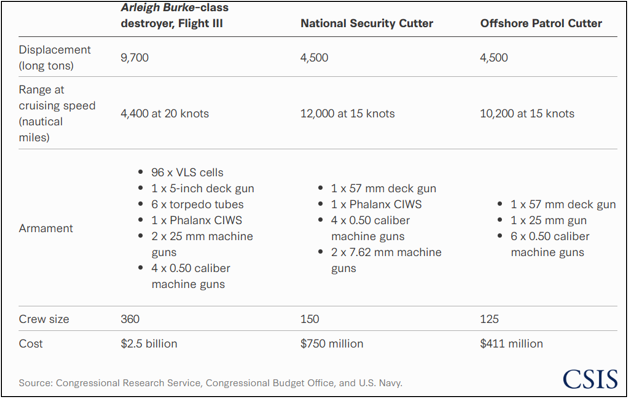
Cancian and Park in their report concluded that Coast Guard cutters are better suited, much cheaper while “Navy destroyers have systems and capabilities for a great power conflict … are useless for counter-drug operations.”37 They produced Table 1 to compare the Navy’s Arleigh Burke-class destroyer with the Coast Guard’s National Security Cutter and proposed Offshore Patrol Cutter. The table graphically shows this mismatch.
Table 1: Comparison of a Destroyer and Coast Guard Cutters
Used with permission: Mark F. Cancian and Chris H. Park, “Going to War with the Cartels: The Military Implications,” 8 September 2025, Center for Strategic and International Studies.
The comparison shows that the Coast Guard’s cutters deliver greater persistence and lower operating cost while giving up only capabilities unnecessary for most maritime security missions.
Implication 3: Coordination Is Not Command
The Western Hemisphere maritime security mission distributes responsibility across multiple commands, but accountability is not centralized anywhere. No single commander owns the mission continuously across routine maritime security operations, crisis response, deterrence operations, and kinetic escalation. Instead, the United States relies upon a system of overlapping service authorities, interagency coordination mechanisms, shifting operational relationships, and temporary task forces that function adequately during routine interdiction operations but become increasingly fragmented as missions expand in scale, complexity, or violence.
Southern Spear exposed the operational consequences of that architecture. Once operations expanded beyond detection, monitoring, and law enforcement interdiction into theater-level deterrence and kinetic strike operations, existing command relationships proved insufficient. The Department of Defense established Joint Task Force Southern Spear as a parallel headquarters rather than assigning the mission to an existing standing command. That decision revealed three related deficiencies in the current architecture.
The first is assignment. Western Hemisphere maritime security is a continuous responsibility, but no document assigns it continuously to any commander. The Unified Command Plan distributes elements of the mission across geographic and functional commands without making any one commander accountable for the whole. A mission treated as a finite operation will require a new headquarters each time it escalates, and that headquarters will begin its work without the relationships, the authorities, and the practiced habits of a command that has owned the mission all along.
The second is authority. A task force established for a defined operation receives the authorities required for, but limited to, the operation, based on the way the mission is stated. Western Hemisphere maritime security requires statutory law enforcement authority on any given day, and that authority resides in the Coast Guard rather than in a joint task force assembled for a campaign of finite duration.
The third is command relationships. The task organization relied on support relationships among headquarters that retained their own priorities and their own chains of command, an arrangement adequate for coordinating routine interdiction but insufficient for operations that combine law enforcement, deterrence, and kinetic strike. Those operations require tactical control or operational control over assigned forces, exercised by a commander accountable for the outcome.
Together these three deficiencies reveal the requirement for a continuously accountable operational maritime command structure capable of integrating maritime security, deterrence, and kinetic operations across the full spectrum of competition, crisis, and conflict.
Maritime security in the Western Hemisphere is not an episodic contingency mission but a continuous operational requirement spanning all four U.S. Homeland Seas. Those threats evolve from routine law enforcement problems into strategic security challenges with little warning. A command architecture built primarily around coordination rather than continuous operational accountability risks fragmentation precisely when unity of command becomes most important.
VI. Recommendations
Recommendation 1: Sustain the Investment in Coast Guard Maritime Security Capacity
This first recommendation is not a call to spend more. It is a call to fund persistence the way persistence must be funded, as a permanent and predictable commitment rather than a one-time rescue. A persistent mission financed by episodic appropriations will always decay between crises. The $24.6 billion reconciliation appropriation signed in July 2025 and the Coast Guard Authorization Act of 2025 represent the most significant investment in the service’s history. They are a long overdue recognition that decades of chronic underfunding had driven the Coast Guard to the lowest point of readiness since World War II. The investment is substantial and has altered the Coast Guard’s trajectory. But one-time mandatory spending is not a sustained shipbuilding program. Shipyards cannot expand production capacity, train skilled workforces, or invest in facilities on the basis of a single appropriation. The Coast Guard’s Offshore Patrol Cutter program is already years late and billions over budget. That delay reflects the stop-and-start funding history that reconciliation money alone does not correct.
In 2026 the Coast Guard (and the Navy) need a modern version of the famous Vinson-Trammell Act of 1934. That act built the Navy that won the Second World War and accomplished a lot more. The Act was built on three profound shipbuilding policies that would prevent today’s Coast Guard and Navy from lurching from one shipbuilding crisis to another.38 First, the United States must build and maintain a fleet of modern cutters and combatants sustained through a continuous replacement schedule that prevents block obsolescence. Second, sufficient replacement programs must be financed from year to year to maintain continuous force generation and lower costs through repetitive construction. Third, the sequencing establishes maritime security and warfighting requirements first, and affordability is considered only afterward. If the budget does not support the requirements, then the selected means for the mission must change. This does not mean these three policies alone define the Coast Guard and Navy’s force structures. Naval War College professor Anand Toprani has noted that “political and budgetary realities played an equal role as strategic imperatives in shaping the size of the U.S. Navy.”39 In his research, Toprani concluded that “resource constraints are never absent from decisions about the size and composition of the military even in wartime.”40 The intent of these three policies is to ensure in the final analysis that if the budget does not support the strategy, then either the means or the ends must change. The abandonment of these three shipbuilding policies after the Cold War produced the slow-motion crisis whose full consequences Southern Spear made visible. Restoring them requires Congress to treat the Coast Guard and the Navy recapitalization not as a supplemental emergency measure but as a permanent annual commitment embedded in their base budget.
Congress should therefore sustain and expand the Fiscal Year 2027 budget request’s $2.1 billion increase for the Coast Guard as a floor, not a ceiling.41 The Offshore Patrol Cutter program, Polar Security Cutter program, and Arctic Security Cutter program, along with the cutter workforce and aviation fleet, should be funded at levels sufficient to sustain persistent maritime security operations across the U.S. Homeland Seas on a continuous basis. The objective is not merely to address the current crisis through a single appropriation, but to prevent the recurrence of similar readiness and recapitalization failures in the future.
Recommendation 2: Reserve High-End Naval Combatants for Warfighting and Deterrence
Persistent maritime security in the Western Hemisphere should not be sustained primarily with high-end naval combatants optimized for major warfighting against state adversaries. Carrier strike groups, amphibious ready groups, cruisers, and destroyers can execute maritime security missions. But Southern Spear demonstrated the substantial strategic and operational costs of using scarce fleet combatants for a mission that is continuous rather than episodic. Every high-end naval combatant assigned to routine maritime security patrols in the Caribbean or Eastern Pacific is one less asset available for deterrence and warfighting missions elsewhere.
The Navy should therefore remain the force employed episodically for deterrence and combat operations against military threats in the Western Hemisphere, while the Coast Guard provides the persistent maritime security presence against non-military threats. Navy forces should support Coast Guard-led maritime security operations when military capability, escalation management, or destructive kinetic force is required, not substitute routinely for the continuous maritime presence mission itself.
The Navy’s force structure experience over the past two decades reinforces the same lesson. As Implication 2 described, the Navy’s own force-structure history with the Littoral Combat Ship, the Constellation-class frigate, and ultimately a future frigate based on the Coast Guard’s Legend-class hull shows how persistently the service converts affordable presence platforms into expensive combatants.
But Southern Spear demonstrated that no Navy force structure solution should be expected to absorb a mission better matched to the Coast Guard. None of this diminishes the Navy’s role in the Western Hemisphere, but, instead clarifies it. The Navy remains the indispensable instrument for deterrence, escalation dominance, and combat against military threats that no other service can perform. This is an argument about the mission assigned to each service, and the persistent mission is not the Navy’s.
Recommendation 3: Establish Continuous Maritime Command Accountability
The United States requires a standing maritime security command structure with continuous accountability across the U.S. Homeland Seas rather than fragmented coordination among multiple headquarters. The current architecture distributes maritime security, deterrence, interdiction, homeland defense, detection and monitoring, and kinetic strike operations across overlapping commands with shifting authorities and inconsistent geographic boundaries. That structure can coordinate routine operations adequately, but Southern Spear demonstrated that it becomes increasingly fragmented as missions escalate from law enforcement interdiction into theater-level deterrence and kinetic operations.
The future maritime security command and control architecture for the Western Hemisphere should draw upon the relevant lessons demonstrated by the Cold War Maritime Defense Zones and Joint Interagency Task Force South.42 Those lessons show that continuous maritime security operations require enduring joint command relationships operating under unified operational accountability. Joint Interagency Task Force South already integrates intelligence, surveillance, detection and monitoring, interdiction coordination, interagency participation, and multinational cooperation under Coast Guard leadership. Southern Spear demonstrated that the next requirement is to extend those principles beyond detection and monitoring into a standing maritime security command structure. That structure would integrate maritime security operations, deterrence support, and escalation management across the Homeland Seas. The objective is not to create another temporary task force or additional coordinating headquarters. It is to establish continuous operational accountability for a mission that now spans a spectrum of routine maritime security operations, crisis response, deterrence activities, and kinetic escalation.
Several designs could deliver that accountability: a strengthened JIATF-S elevated to a standing operational command; a Western Hemisphere maritime component commander; reestablished Maritime Defense Zones adapted to current geography; or a dual-hatted Navy–Coast Guard commander. This commentary does not prescribe a final structure, but the controlling principle should narrow the field. Because the mission is persistent and law-enforcement-centric for all but episodic intervals, the standing command should be Coast Guard-led, with Navy forces placed under its tactical control or operational control when military capability or escalation management is required. How that command aligns with existing combatant commands, numbered fleets, and Coast Guard Areas is a joint force-management question. But the alignment should follow the persistence of the mission rather than the convenience of existing fleet geography.
This recommendation deliberately reverses a long-standing assumption that U.S. maritime commands in the Western Hemisphere should be Navy-led. The Coast Guard must lead this command for reasons that already exist in fact rather than aspiration. It alone holds the statutory law enforcement authority that the Western Hemisphere mission requires every day. It already maintains the only continuous operational presence across the Homeland Seas through its Atlantic Area, Pacific Area, and regional commands. It operates the nation’s only icebreakers, which means polar maritime dominance runs through the Coast Guard and no other service. And through the National Fleet Policy, signed in 1998, the Coast Guard and Navy have spent decades deliberately building common command, control, and communications systems. They built those systems precisely so that their forces can integrate when the mission demands it. The supported-supporting relationship recommended here does not invent a new partnership. It merely proposes to formalize one the Coast Guard and Navy have practiced for a generation, and it assigns the lead to the service that already owns the persistent mission, the authorities, and the continuous presence the mission requires.
VII. Conclusion
The 2025 National Security Strategy calls for a more suitable Coast Guard and Navy presence in the Western Hemisphere. The 2026 National Defense Strategy states plainly that the U.S. military’s foremost priority is to defend the homeland. That priority includes defending America’s interests throughout the Western Hemisphere. Together they establish a clear strategic direction to build the maritime forces and command structure capable of executing this mission permanently rather than improvising it episodically.
The Southern Spear campaign tested the existing architecture and found it wanting. The operation disrupted cartel maritime networks and demonstrated the value of integrated maritime, intelligence, and kinetic operations. It also exposed the costs of relying upon high-end naval combatants for missions requiring persistent maritime security presence, law enforcement authorities, regional partnerships, and long-duration operational endurance.
The campaign reinforced a broader institutional reality visible throughout American maritime history. The Navy is optimized for deterrence, warfighting, and preparation for major conflict against state adversaries. The Coast Guard is optimized for persistent maritime presence across the U.S. Homeland Seas. It achieves that presence through a combination of military authority, law enforcement authority, partner engagement, and sustained offshore operations. Southern Spear demonstrated that the mission requires each service to perform the role it was institutionally designed to execute.
When Coast Guard boarding teams enforce sanctions against Russian and Venezuelan oil tankers in the Eastern Atlantic, they are not merely conducting inspections but executing American strategic policy. When Coast Guard icebreakers operate in the Arctic, they are not merely breaking ice but asserting U.S. sovereignty against Russian and Chinese expansion. When Coast Guard cutters enforce fishing laws across the 4.38 million square miles of the U.S. exclusive economic zone, they are not merely protecting fish stocks but defending sovereign American resources against foreign poaching fleets operating inside the Homeland Seas. When Coast Guard cutters conduct naval diplomacy throughout the Caribbean, they are not merely training counterparts but strengthening U.S. influence and regional partnerships in ways no high-end Navy destroyer can replicate. This is what a more suitable maritime presence looks like. This is why it starts with the Coast Guard.
Restoring America’s maritime dominance requires resourcing the Coast Guard as America’s persistent maritime security instrument, preserving the Navy’s high-end warfighting capacity for global deterrence, and organizing both services within a permanent maritime security architecture suited to the operational realities of the Western Hemisphere. Achieving that objective requires removing the structural and operational impediments Southern Spear exposed.
Bruce Stubbs had assignments on the staffs of the secretary of the Navy and the chief of naval operations from 2009 to 2022 as a member of the U.S. Senior Executive Service. He was a former director of Strategy and Strategic Concepts in the N3N5 and N7 directorates. As a career U.S. Coast Guard officer, he had a posting as the assistant commandant for capability in Headquarters, served on the staff of the National Security Council, taught at the Naval War College, commanded a major cutter, and served a combat tour with the U.S. Navy in Vietnam during the 1972 Easter Offensive.
Notes
1. President Donald J. Trump, Executive Order 14269, “Restoring America’s Maritime Dominance,” 9 April 2025.
2. U.S. Department of State, National Security Strategy of the United States of America, White House, 4 December 2025.
3. U.S. Department of Defense, 2026 National Defense Strategy, Washington, D.C., 23 January 2026.
4. Sam LaGrone, “Russian Nuclear Sub, Frigate with Long Range Land Attack Missiles Operating Off East Coast,” USNI News, 11 June 2024.
5. The definition of homeland defense is: “The military protection of United States sovereignty and territory against external threats and aggression or, as directed by the President, other threats.” Office of the Chairman of the Joint Chiefs of Staff, DoD Dictionary of Military and Associated Terms, The Joint Staff, June 2025, page 78. The definition of deterrence provided by: GEN David H. Berger, USMC; ADM Michael M. Gilday, USN; and ADM Karl L. Schultz, USCG, Naval Doctrine Publication 1: Naval Warfare (NDP-1), April 2020.
6. The definition of homeland security is: “A concerted national effort to prevent terrorist attacks within the United States and to reduce our vulnerability to terrorism, major disasters, and other emergencies.” Office of the Chairman of the Joint Chiefs of Staff, DoD Dictionary of Military and Associated Terms, The Joint Staff, June 2025, page 78. The definition of maritime security provided by: GEN David H. Berger, USMC; ADM Michael M. Gilday, USN; and ADM Karl L. Schultz, USCG, Naval Doctrine Publication 1: Naval Warfare (NDP-1), April 2020.
7. Hung Cao, Acting Secretary of the Navy, Statement on the Department of the Navy Posture Before the House Armed Services Committee, 14 May 2026.
8. Diana Roy, “The U.S. Military Campaign Targeting Venezuela and Nicolás Maduro: What to Know,” Council on Foreign Relations, 3 January 2026.
9. Admiral Daryl L. Caudle, U.S. Navy, Chief of Naval Operations, Statement on the Posture of the United States Navy Before the House Armed Services Committee, 14 May 2026.
10. Diana Roy, “The U.S. Military Campaign Targeting Venezuela and Nicolás Maduro: What to Know,” Council on Foreign Relations, 3 January 2026.
11. Mark F. Cancian and Chris H. Park, “Going to War with the Cartels: The Military Implications,” Critical Questions, Center for Strategic and International Studies, 8 September 2025.
12. Howard Altman, “CV-22B Osprey, MC-130J Commando II Special Ops Aircraft Deploy To Puerto Rico,” The War Zone, 23 December 2025.
13. Heather Mongilio, “U.S. Forces Strike Suspected Narco Boat in the Eastern Pacific,” USNI News, 20 March 2026.
14. Peter W. Singer, “Sinking Speedboats With a Supercarrier: The Lopsided Cost of Operation Southern Spear,” Defense One, 7 December 2025.
15. Cancian and Park, “Going to War with the Cartels: The Military Implications,”8 September 2025.
16. Lee Willett, “CNO: New Surface Ship Classes Reflect US Navy’s New Force Structure and Global Output Needs,” Naval News, 12 March 2026.
17. Heather MacLeod, Director, Homeland Security and Justice, Government Accountability Office, Statement on the Coast Guard: Actions Needed to Address Challenges that Hinder Maritime Security Operations Before the Subcommittee on Transportation and Maritime Security, Committee on Homeland Security, House of Representatives, GAO-26-108901, 3 February 2026.
18. Sam LaGrone, “Reconciliation Bill Calls for $14.6B in Coast Guard Cutters, New Arctic Icebreakers,” USNI News, 29 April 2025. “The supplemental is more than the Fiscal Year 2025 Coast Guard budget request of $13.8 billion and more than 10 times the cutter budget of $1 billion in current budget proposal. The new cutters are part of an overall $22.5 billion supplemental to the Coast Guard’s bottom line that also includes $3 billon for new aircraft and billions more for shoreside infrastructure, according to the bill. If ratified, the Coast Guard has 90 days to submit a proposal with timelines for deliveries.”
19. Kristi Noem, Secretary of Homeland Security, Force Design 2028, Introduction, Executive Report, Department of Homeland Security, Released 28 May 2025.
20. U.S. Coast Guard Headquarters, Press Release, “U.S. Coast Guard Receives Historic Investment to Rebuild Under President Trump’s One Big Beautiful Bill,” 4 July 2025. [Budget Reconciliation Act of 2025 (H.R. 1)].
21. H.R. 4275: 119th Congress: Coast Guard Authorization Act of 2025.
22. Caitlyn Burchett, “Eastern Shipbuilding Halts Work on Coast Guard Cutter Program, Cites Financial Strain and Program Conditions,” USNI News, 18 November 2025. United States Government Accountability Office Report to the Committee on Transportation and Infrastructure, House of Representatives November 2025 Offshore Patrol Cutter Coast Guard Should Gain Key Knowledge Before Buying More Ships GAO-26-107583.
23. United States Government Accountability Office, Report to the Committee on Transportation and Infrastructure, House of Representatives, June 2023, “Coast Guard Acquisitions: Offshore Patrol Cutter Program Needs to Mature Technology and Design,” Revised on August 1, 2023 to reflect shipbuilder’s correct percentage construction completion as of October 2022. Correction is on report page 37. GAO-23-105805
24. Nick Blenkey, “GAO Looks at What’s Gone Wrong With the Coast Guard’s OPC and PSC Programs, MarineLog, 31 July 2023.
25. Joint Interagency Task Force (JIATF) was started on February 22, 1989, under President Ronald Reagan’s administration as part of its anti-drug enforcement policy. Specifically, the U.S. Department of Defense was tasked to establish a joint task force (JTF) to conduct detection and monitoring operations to support law enforcement disruptions of cocaine and marijuana trafficking in the Caribbean, thereby preventing these drugs from reaching the United States. The joint interagency task force model was established in 1994 to strengthen collaborations among federal and international partners. As a result, the task force in Key West – then known as JTF-4 – was renamed JIATF East. JIATF South, which was originally located in Panamá, was merged into JIATF East in Key West in 1999. The name was changed to Joint Interagency Task Force South (JIATF-South) in 2003. Its mission, in conjunction with Partner Nations, leverages all-domain capabilities to target, detect and monitor illicit drug trafficking in the air and maritime domains, within the Joint Operating Area, facilitating interdiction and apprehension to reduce the flow of drugs and degrade & dismantle Transnational Criminal Organizations.
26. Caudle, Statement on the Posture of the United States Navy Before the House Armed Services Committee, 14 May 2026.
27. Stephen Smith, “U.S. Coast Guard Offloads $63 Million of Cocaine After Shootout at Sea Sinks Suspected Drug Smuggling Boat and Crew,” CBS News, 7 June 2024.
28. Cancian and Park, “Going to War with the Cartels: The Military Implications,”8 September 2025.
29. Dzirhan Mahadzir, “Russian, Chinese Warships Operated Near Alaska, Say Senators,” USNI News, 6 August 2023.
30. Nathaniel Herz, “Inside the U.S. Coast Guard’s Aleutian Encounter With China’s military — and What It Means,” Northern Journal, 12 July 2024, and Barbara Starr and Oren Liebermann, “US Coast Guard Monitoring Russian Military Vessel Near Hawaii, CNN, 15 January 2022.
31. “Chinese Warships Spotted off Alaska Coast, US Coast Guard Says,” The Guardian, 11 July 2024. “U.S. Coast Guard Watching Uptick in Russian, Chinese Navy Activity Near Alaska, Reuters, 27 September 2024. Rana Foroohar, “10 Days with the US Coast Guard on the New Arctic Front Lines,” Financial Times Magazine, 8 February 2025.
32. Caudle, Statement on the Posture of the United States Navy Before the House Armed Services Committee, 14 May 2026.
33. Sam LaGrone, “Carrier Ford’s Extension to the Middle East Could Break Recent Deployment Records, USNI News, 13 February 2026.
34. United States Government Accountability Office, Report to Congressional Requesters, “Coast Guard Actions Needed to Improve Maritime Interdictions,” GAO-26-107440, January 2026.
35. Michael G. Mullen, Admiral, U.S. Navy, Chief of Naval Operations, Opening Statement, Before Subcommittee of the Committee on Appropriations, U.S. Senate, Department of Defense Appropriations for Fiscal Year 2007, 15 March 2006.
36. Sam LaGrone, “Navy Cancels Constellation-class Frigate Program, Considering New Small Surface Combatants, USNI News, 25 November 2025.
37. Cancian and Park, “Going to War with the Cartels: The Military Implications,”8 September 2025.
38. Charles F. Elliott, “The Genesis of the Modern Navy,” USNI Proceedings, Vol. 92/3/757, March 1966.
39. Anand Toprani, “Was the 600-Ship Navy a Chimera? Budgets, Force Structure, and the Political Realities Behind Reagan-Era Naval Strategy,” Journal of Strategic Studies, June 24, 2024, p. 3.
40. Anand Toprani, “Was the 600-Ship Navy a Chimera? Budgets, Force Structure, and the Political Realities Behind Reagan-Era Naval Strategy,” p. 8.
41. Stew Magnuson, “SEA-AIR-SPACE NEWS: Best of Times, Worst of Times for Coast Guard Budget,” National Defense, 22 April 2026.
42. James R. Boma, “Troubled Waters Off the Land of the Morning Calm: A Job for the Fleet,” Naval War College Review, Vol. 42 No. 2, 1989.
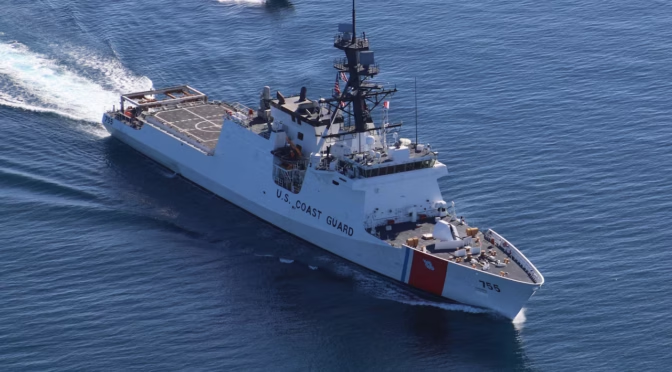
Featured image: Crew members aboard the U.S. Coast Guard Cutter Munro, a 418-foot national security cutter, and its small boat transit the Gulf of Mexico, Feb. 12, 2017. (U.S. Coast Guard photo by Seaman Courtney Fussell)